

New Hampshire rewards a well-built tiny house and punishes a flimsy one. Snow stacked on the roof, frost heaving under the footings and a winter that tests every pipe mean the company you hire matters more than the floor plan you fall for. This guide compares the types of tiny house builders new hampshire buyers can choose from, what each route really costs in money and effort, and the checks to run before you sign anything.
1. New Hampshire Tiny House Builders at a Glance
Every builder you will talk to works in one of four ways. A custom builder designs and builds a one-off home around your land, your winters and your life. A semi-custom builder starts from proven plans and lets you pick options. A shell builder hands over a weather-tight structure for you to finish. A kit or plan seller supplies the materials list or the drawings, and you do the building. The table below sums up the four routes before we look at each one in the New Hampshire context.
| Builder Type | What You Get | At a Glance |
|---|---|---|
| Custom builders | Full design-build | Most control |
| Semi-custom builders | Plans + options | Mid-range |
| Shell builders | Weather-tight shell | DIY finish |
| Kit & plan sellers | You build | Lowest cost |
Key factors in New Hampshire: snow load, insulation, delivery and warranty. As the comparison below puts it, White Mountain winters are serious — roof load and insulation decide the build.
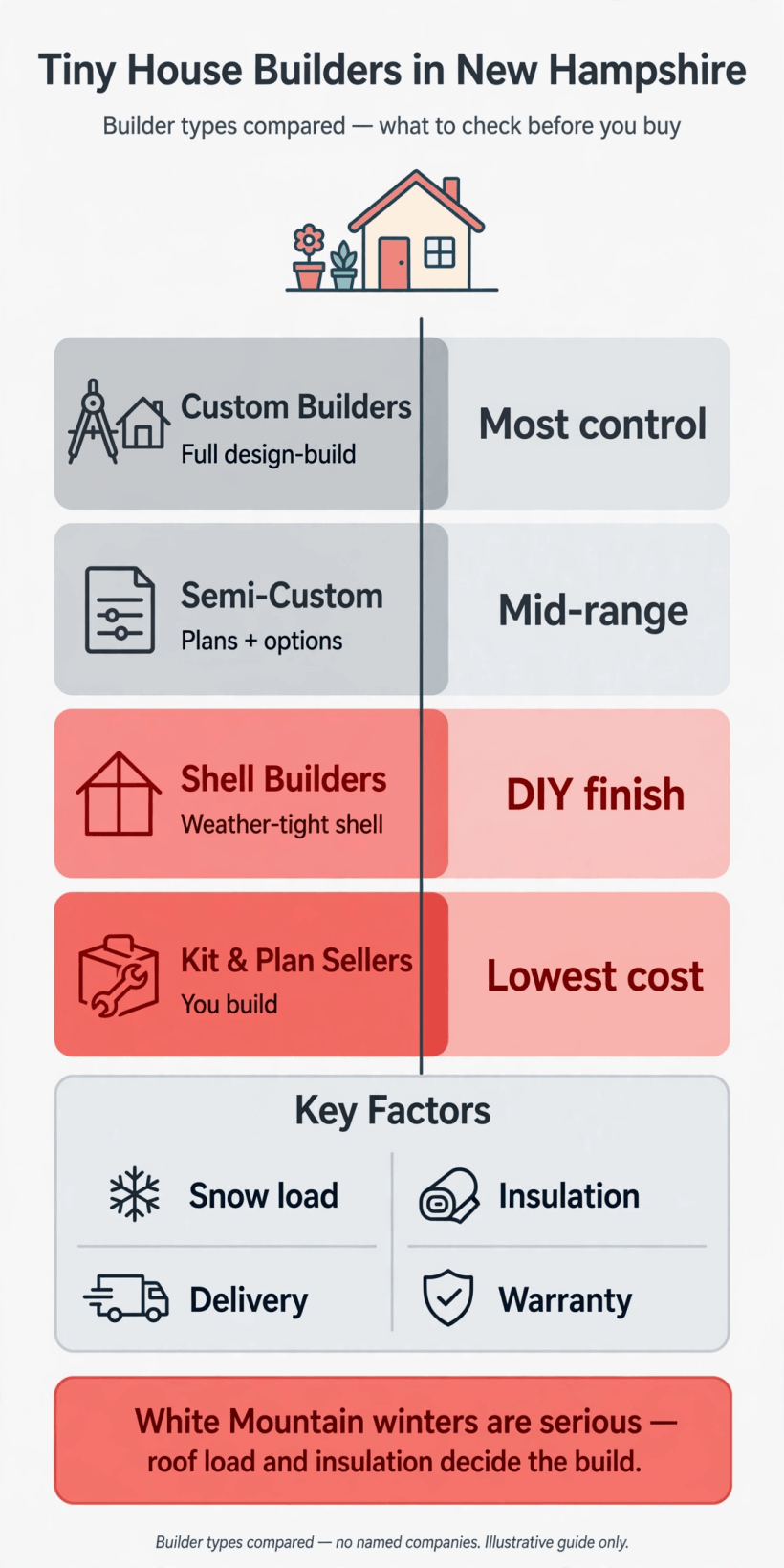
The four builder types compared, with the New Hampshire checks that come first: snow load, insulation, delivery and warranty.
Use the table as your shortlist filter. If you want a home designed for a steep, snow-heavy site, you are probably looking at the first two rows. If you have tools, time and patience, the last two rows trade money for your own labour. The rest of this guide walks through what each route involves, what drives the price, and the New Hampshire-specific checks that protect you whichever row you choose.
2. How New Hampshire Conditions Shape the Build
Start with the weather, because every good New Hampshire build starts there. Roofs here carry real snow. A builder used to milder states may design a roof that looks fine on paper and sags under a White Mountains winter, so ask how the roof is framed and what snow load it is designed to carry — and expect the answer to change between the Seacoast, the Lakes Region and the North Country. Insulation is the second half of the same conversation. Cold snaps bite hard, heating runs for months, and thin walls mean high bills and cold floors. Ask about wall, floor and roof insulation as a system, not a single number.
Then think about what sits under the house and how it gets there. Frost moves the ground, so foundations, piers and skirting need a plan that suits your soil and slope. Water lines and drains need protection from freezing, and the route from the road to your site has to work for a delivery vehicle — narrow lanes, low branches, soft spring ground and posted winter roads can all change the delivery date or price. Work through these site questions alongside the design ones; our building a tiny house checklist walks the full sequence from land to move-in. A builder who asks about your site before quoting is a builder who has delivered in this state before.
3. Custom Builders: When Full Design-Build Fits
A custom builder takes you from sketches to a finished home. You get a layout drawn around how you actually live — a real entry with room for boots and coats, a sleeping loft with honest headroom, a kitchen that suits someone who cooks — and a structure engineered for your exact site. That control matters in New Hampshire more than in gentle climates, because the same builder who draws the plan also specs the roof framing, the insulation package and the heating system, and can balance them against each other instead of leaving you to merge three separate opinions.
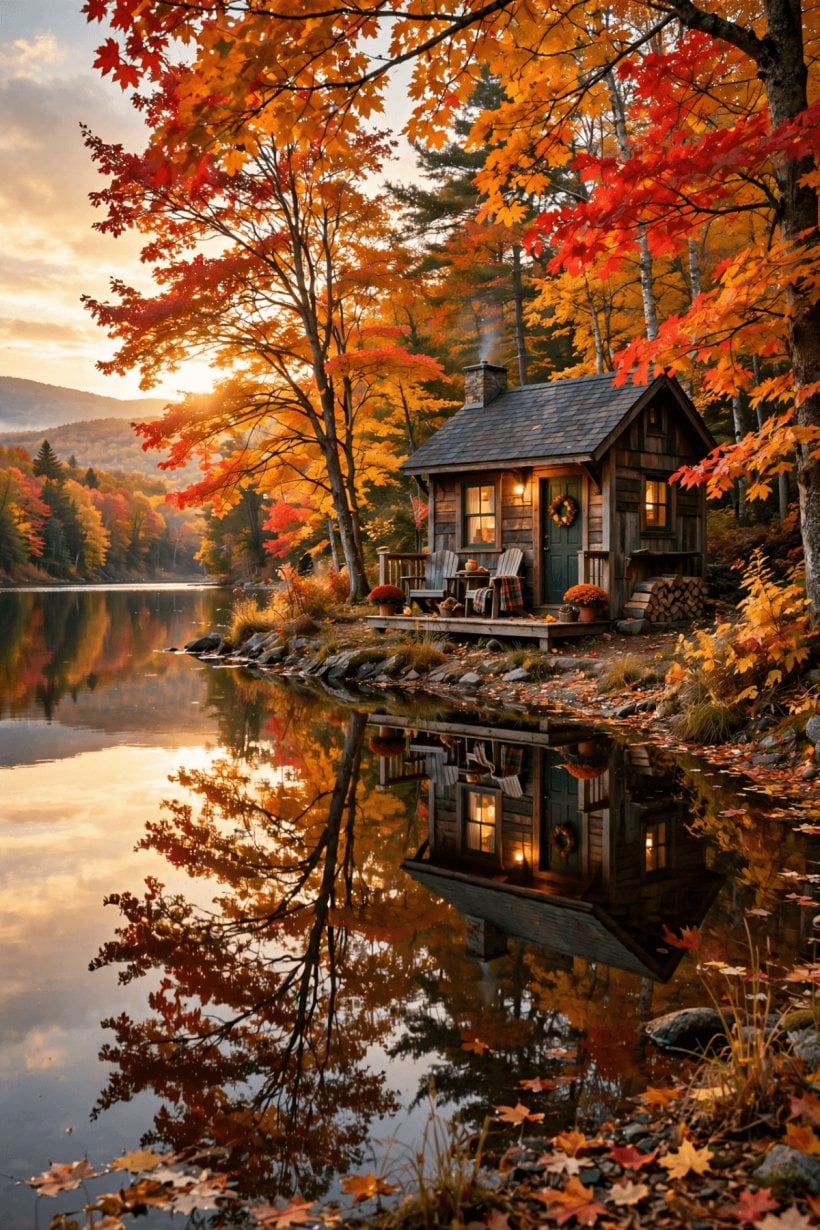
A custom build is shaped around your site and your winters — roof pitch, entry storage and heating are designed in, not added on.
Full design-build is the most expensive route per square foot and usually the slowest, because design time, engineering and one-off construction all add up. It fits buyers with an unusual site, a year-round living plan, accessibility needs, or a strong wish list that stock plans keep missing. Ask a custom builder how many of their homes are lived in through northern winters, who handles permits and site coordination, and whether winter deliveries are part of their normal calendar. Buyers comparing the wider New England market often look at tiny house builders in Maine as well, since the climate checks — snow, insulation, delivery — are near-identical across the state line.
4. Semi-Custom Builders: Proven Plans, Your Options
Semi-custom builders work from a catalogue of plans they have already built, then let you adjust the finish and some of the layout. Because the bones are proven, the price is easier to predict than a one-off custom build, and the build itself is usually quicker. The options list is where you spend wisely in this state: upgraded insulation, a cold-climate heating package, better windows, a steeper or stronger roof specification and a proper cold-weather entry are worth far more here than decorative upgrades.
Read the options list carefully and ask what the base price actually includes. Some builders price the shell of the plan and treat items you would assume are standard — appliances, skirting, delivery, set-up on your foundation or trailer — as extras. Ask which options other New Hampshire customers choose, and why. Also ask how far they deliver and set, because a builder based in the southern tier may add real cost, or decline, for a North Country site. If you are cross-shopping the region, the same proven-plan model shows up among tiny house builders in Massachusetts, and our sibling guide to tiny house builders in New York covers the same builder types in a neighbouring market. Semi-custom is the middle path: less freedom than custom, far less risk than doing it yourself.
5. Shell Builders: A Weather-Tight Start You Finish
A shell builder delivers the structure — framing, roof, exterior cladding, windows and doors fitted — weather-tight and ready for you to insulate, wire, plumb and finish inside. The appeal is straightforward: the skilled, time-critical work of getting a building dry is done by professionals, the total cost drops, and you finish the interior at your own pace and budget. In New Hampshire there is a second appeal: a weather-tight shell delivered before the snow flies lets you spend the winter finishing the inside instead of framing in the cold.
Be honest about the finish work before choosing this route. Insulating well enough for a Granite State winter is not a weekend job, and the plumbing and electrical work you install still has to satisfy whoever inspects or insures the home. Price the full finish — materials, tools, your time, and any trades you hire — before deciding the shell is the cheap option; it often lands closer to semi-custom money than buyers expect, just spread over more months. Ask the shell builder exactly where their work stops: is the shell insulated, are window and door flashings complete, is the roof vented for snow country, and what do they need from your site on delivery day? Buyers who like this balance of pro and DIY work will find the same model explained in our guide to tiny house builders in Michigan, another state where getting dry before winter drives the whole plan.
6. Kit and Plan Sellers: The Lowest-Cost Route
At the far end of the scale, kit sellers ship a package of materials — sometimes pre-cut, sometimes panelised — and plan sellers provide drawings for you to build from scratch. This is the lowest-cost route in money and the highest-cost route in your time, and it puts every decision on you: trailer or foundation, framing, roof specification for snow, insulation strategy, and all the systems inside. For a confident builder with a workshop, a helper and a realistic calendar, it can produce a genuinely good home for the least money of any route in this guide.
The risks are just as clear. A plan drawn for a mild climate may under-spec the roof and walls for New Hampshire snow and cold, and adapting it is your problem, not the seller’s. Kits vary hugely in what is included — fasteners, membranes, flashing and trim are common gaps — so compare inclusion lists line by line, not headline prices. Check what delivery to a New Hampshire address adds, and whether the seller will talk to your town office or inspector when questions come up; the good ones will. However you build, the discipline is the same as buyers follow in the far north — our guide to tiny house builders in North Dakota makes the same point for an even harsher winter: in cold states, the envelope decides whether the home works.
7. What a Tiny House Costs in New Hampshire: The Real Drivers
We do not print prices here, because no honest guide can: the same floor plan can cost very different amounts depending on the choices below, and any builder who quotes a firm number before asking about your site and specification is guessing with your money. What we can do is show you the drivers, in the order they usually move the total. Builder type is the first: as the table in section 1 shows, control costs money — full design-build sits at the top, kits at the bottom, with semi-custom and shell routes in between.
After that comes specification. In New Hampshire, the cold-climate package is not optional decoration: heavier roof framing, more insulation, better windows, a heating system sized for deep cold and freeze-protected plumbing all add cost, and all of it is money you get back in comfort and low running costs every winter you own the home. Site work is the third driver — clearing, access, foundation or piers, utility connections and delivery distance can quietly rival the cost of finishing work. Finish level, size and timeline follow: bespoke joinery costs more than flat-pack, bigger costs more than smaller, and a build squeezed into a short pre-winter window may cost more than one scheduled with slack. When you compare quotes, compare them driver by driver against the same written specification, and see how the same discipline applies down the coast in our guide to tiny house builders in New Jersey.
8. Questions to Ask Before You Sign Anything
Contracts protect buyers who read them. Before you sign with any builder, work through these questions and get the answers in writing. What snow load and insulation specification is this home built to, and where is that stated? What exactly is included in the price — delivery, set-up, skirting, appliances, utility hook-ups — and what is not? What warranty covers the structure, the roof and the systems, who honours it, and how are claims handled if the builder is hours away? What does the payment schedule look like, and what stage of the build triggers each payment?
Finish with warranty, delivery and specification answers in writing — the questions you ask before signing are the cheapest protection you will ever buy.
Keep asking. How many of your homes are lived in year-round in northern New England, and can I talk to one of those owners? Who arranges permits and inspections, and what happens if the town asks for changes? What is the realistic timeline from contract to delivery, and what happens if weather delays it? A good builder answers these questions calmly and completely — several of them cover exactly this ground in our guide to tiny house builders in New Mexico, where the climate checks are different but the contract checks are the same. Vague answers, pressure to sign quickly, or a warranty that shrinks as you read it are all reasons to walk away, however much you love the plan.
9. Placement, Permits and Legal Checks in New Hampshire
Where you can put a tiny house in New Hampshire depends far more on the town than the state. Rules on minimum dwelling size, foundations, accessory dwelling units and homes on wheels are set and enforced locally, and they vary from one town line to the next — a town that welcomes a tiny house as an accessory unit may sit beside one whose zoning has no clear place for it. Treat every general statement you read online, including this one, as a starting point only, and check with your city or town planning and zoning office before you buy land or sign a build contract.
Ask the town direct questions. Is a tiny house treated as a dwelling, an accessory unit, a recreational vehicle or a temporary structure here? Must it sit on a permanent foundation, or are wheels acceptable? What applies to water, septic or sewer, and electrical connections, and who inspects them? Are there winter access or driveway requirements a delivery vehicle must meet? If you plan to live in the home year-round, say so plainly, because some permissions are written for seasonal use. Getting these answers early is dull and decisive: the best builder in the state cannot fix a placement your town will not allow, and the cheapest time to discover a problem is before any money moves.
10. From First Call to Move-In: Process and Timeline Checks
A smooth New Hampshire build follows a predictable rhythm. You start with the site and the town checks from section 9, then shortlist builders using the table in section 1 and the questions in section 8. Design or plan selection comes next, with the specification — snow load, insulation, heating, delivery — agreed in writing before the contract. Through the build, stay close to progress: photo updates, stage payments tied to completed work, and early warning of anything that changes the price or the date.
Timing deserves its own check in this state. Builders’ calendars fill ahead of winter, delivery is easier before the ground softens in spring or the snow arrives in autumn, and a home delivered late can mean finishing work in the hardest months of the year. Build slack into every promise a builder makes, confirm who is responsible for the site being ready on delivery day, and walk the finished home slowly before the final payment — testing heating, water, drainage and every door and window against the written specification. The sequence mirrors the national picture in our guide to tiny house builders in Nevada: details differ by state, but a written spec, stage checks and a careful handover protect buyers everywhere.
Final Considerations
Choosing among New Hampshire’s builder types is really a decision about control, time and winter. Buy control if your site or your plans are unusual, buy a proven plan if you want predictability, and buy a shell or a kit only with your eyes open about the work you are taking on. Whatever route you pick, let the state set the specification — snow load, insulation, protected plumbing and a delivery plan that respects the seasons — and let the contract set the protection. Do the town checks early, get everything in writing, and the home you move into will be the home you thought you were buying.


0 Comments