

North Dakota does not do mild. The wind comes off the prairie with nothing to stop it, winter cold settles in for months, and the distance between towns means help is rarely next door. A tiny house here can be superb — small spaces are cheap to keep warm — but only if it is built for the place: heavily insulated, honestly heated, anchored against the gusts. This guide compares the types of tiny house builders north dakota buyers can hire, what each route really involves, and the specification checks that matter more than any floor plan.
1. North Dakota Tiny House Builders at a Glance
The market sorts into four types, and in this state the first type names the whole game. Cold-climate custom builders design to an arctic-grade specification, with the most control over insulation, heating and wind resistance. Semi-custom builders adapt proven plans with options — the route most buyers take, provided the cold package is real. Shell builders deliver a weather-tight structure to finish yourself. Kit and plan sellers supply the package or drawings at the lowest cost and the highest risk if the design was drawn for gentler country.
| Builder Type | What You Get | At a Glance |
|---|---|---|
| Cold-climate custom builders | Arctic spec | Most control |
| Semi-custom builders | Plans + options | Mid-range |
| Shell builders | Weather-tight shell | DIY finish |
| Kit & plan sellers | You build | Lowest cost |
Key factors in North Dakota: insulation (cold-proof buildup), heating (a reliable heat source), wind rating (gust-resistant design) and warranty (coverage and service). The comparison below is blunt about it: few places test a house like this — insulation, heating backup and wind rating are the spec.
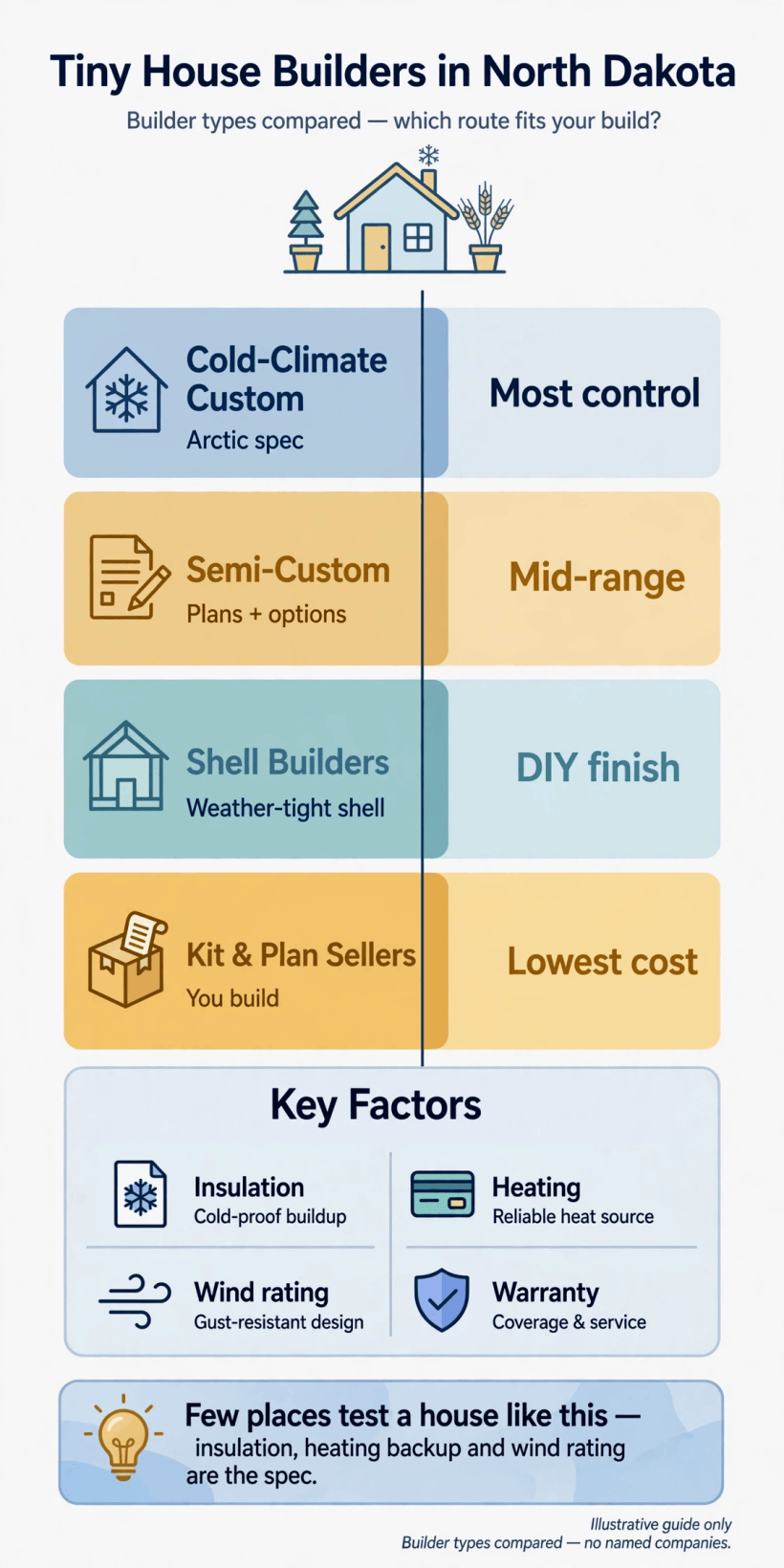
The four builder types compared, with the North Dakota checks that come first: insulation, heating, wind rating and warranty.
Read the table as a specification filter before it is a price filter. Any of the four types can produce a good North Dakota home, and any of them can produce a bad one — the difference lives in the buildup of the walls and floor, the heating plant and its backup, and how the structure handles wind on an exposed site. The rest of this guide takes each type in turn, then turns to costs, contract questions, placement checks and the build calendar.
2. How North Dakota Conditions Shape the Build
Three forces shape every serious build here: cold, wind and distance. The cold is prolonged rather than dramatic — weeks where the heating system is the only thing between you and frozen pipes — so the insulation buildup and air sealing decide both comfort and whether plumbing survives. Smart layouts keep water in a warm core of the plan, and every builder should be able to explain how their floor is insulated, because a tiny house on a trailer or piers has its underside in the weather. The wind is the second force: on open prairie there is no shelter, so roof fixing, cladding, skirting and anchoring are structural questions, and drifting snow finds every weak detail around doors and vents.
Distance is the third. Builders, materials, trades and warranty service may all be hours away, and the building season compresses into the warmer months, so schedules slip differently here than in a metro market. None of this argues against building — land is available, communities are used to self-reliance, and a well-specified small home is one of the cheapest houses in America to keep warm. It argues for planning in the right order: site, specification, then builder. Our building a tiny house checklist lays that sequence out from land to move-in, and every conversation below assumes you have winter, not the brochure, in mind.
3. Cold-Climate Custom Builders: Arctic Spec, Most Control
A cold-climate custom builder designs the house as a thermal system first and a floor plan second. The wall, floor and roof buildup is chosen for sustained deep cold; plumbing is routed through the warm core; the heating plant is sized for the worst week of the year, with a backup source planned for outages; and the structure is detailed for wind exposure on open ground. This is design-build in its most literal sense — the person drawing the plan is solving your site’s exact problems, and the result is the most control any route offers.
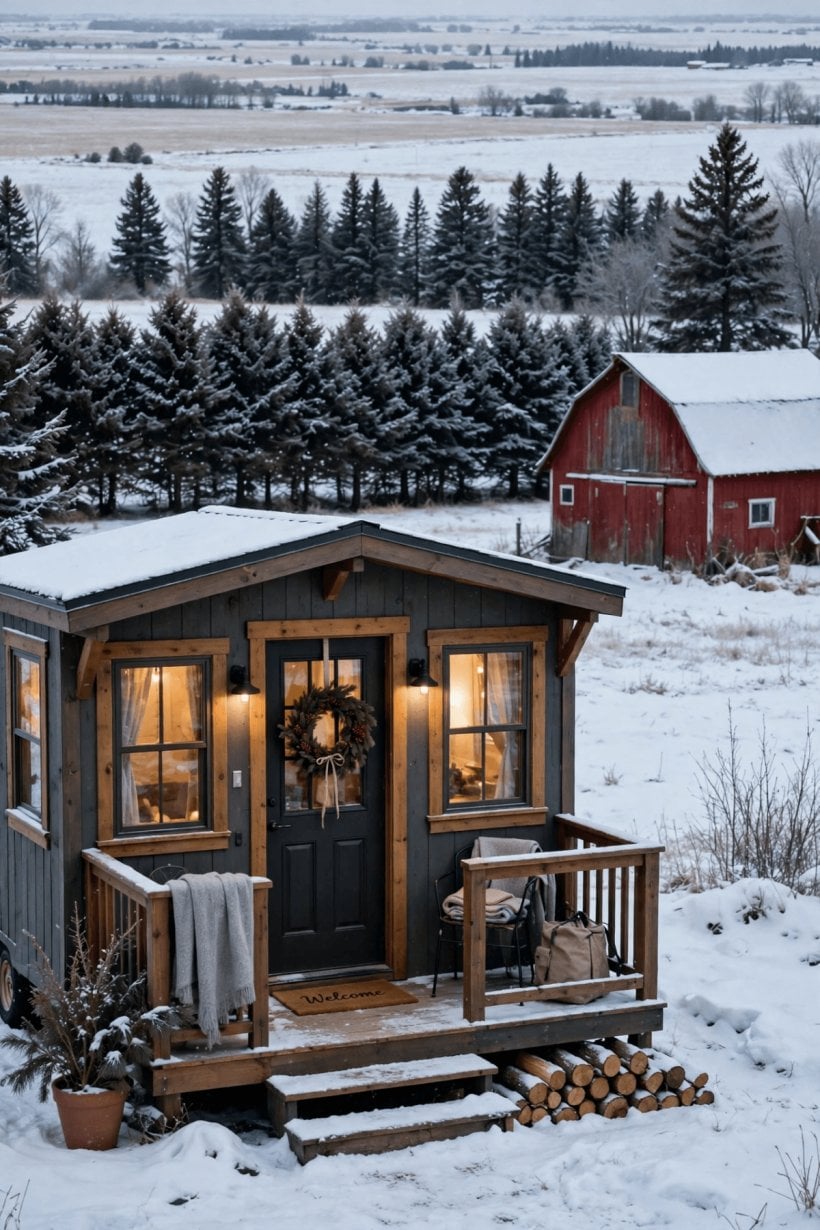
An arctic-spec custom build treats insulation, heating backup and wind resistance as one design problem — because in January they are.
The cost of that control is the highest price of the four routes and a build calendar at the mercy of a short season. It fits year-round residents, exposed rural sites, off-grid or partly off-grid plans, and anyone whose heating failure would be a genuine emergency rather than an inconvenience. Ask how many of the builder’s homes have wintered in the northern plains, what their owners heat with, and what happens in those homes when the power goes out at the coldest moment. Many North Dakota buyers end up shopping across the line as well — our guide to tiny house builders in Minnesota covers the same cold-climate custom model in the neighbouring market most of these builders actually serve.
4. Semi-Custom Builders: Proven Plans, Your Options
Semi-custom builders work from plans they have built repeatedly, and for most North Dakota buyers this is the pragmatic centre of the market: a proven structure, a firmer price and a shorter wait than a one-off design. The entire game is the options list, because a plan that winters in a mild state needs deliberate upgrading for this one. The cold-climate package is the option that matters: enhanced insulation buildup in floor, walls and roof, high-performance windows, a heating system sized for deep cold with a credible backup, freeze-protected plumbing, and wind detailing for an exposed site. If a builder’s catalogue treats those as exotic extras, their plans were not drawn for your winters.
Verify with evidence, not adjectives. Ask which of their homes are actually standing in the northern plains, and whether you can talk to an owner who has lived through a full winter in one. Confirm the written specification behind words like ‘winter package’ — buildups, not slogans. And pin down delivery and setting: distances here are long, and a price that assumes an easy drop near the builder’s yard may grow on a rural route. The same proven-plan market, tuned to different extremes, is compared in our guides to tiny house builders in Montana and tiny house builders in New Hampshire, where buyers ask the same question: is the cold package engineering, or marketing?
5. Shell Builders: A Weather-Tight Start You Finish
A shell builder hands over the envelope — framing, roof, cladding, windows and doors — sealed against the weather and ready for insulation, services and interior finish. In North Dakota the timing logic is powerful: get a shell raised and dried-in during the warm months, and the interior becomes winter work you can do under cover, at your pace, as funds allow. For buyers with building skills, or family and neighbours who trade in them, this splits the project where it should split — the structural shell done professionally and fast, the finish done personally and patiently.
The trap is the word ‘finish’. Here the interior work includes the most consequential system in the house: the insulation buildup and air sealing that decide whether the home is cheap to heat and freeze-proof. Do that work thinly and you own a cold box; do it properly and it is skilled, slow labour that must be budgeted like it matters. Get the shell scope precise in writing — bare frame or insulated panels, window installation and flashing complete, roof and door detailing for drifting snow — and agree who documents the shell for inspection and insurance purposes. The staged-finish approach, with winter as the deadline, is familiar across the plains; our guide to tiny house builders in Nebraska walks through the same shell maths for a neighbouring market.
6. Kit and Plan Sellers: The Lowest-Cost Route
Kits and plans cost the least and assume the most. A kit arrives as materials, sometimes pre-cut; plans are drawings alone. In most states the risk is workmanship. In North Dakota the risk is specification: a kit engineered for ordinary winters may carry insulation values, window grades and wind detailing that are simply not enough here, and upgrading inside a fixed package can erase the saving. Before pricing anything, compare the kit’s written specification against the cold-climate list from section 4 — buildup, glazing, heating plan, wind rating — and treat every gap as a cost you will pay in money or in January regret.
Then run the logistics honestly. Delivery to a rural North Dakota address is a long haul with a price to match; materials need weatherproof storage; and a self-build that starts late can meet winter half-finished, so your calendar is a safety issue, not a preference. Ask the seller what support exists after the sale — replacement parts at distance, answers for an inspector, engineering documentation for the wind and snow questions your county may ask. The principle is universal, whether the hostile element is cold, heat or code: our guide to tiny house builders in New York makes the same point for plan buyers there. On the cheapest route, you are the cold-climate expert — become one before the crate arrives.
7. What a Tiny House Costs in North Dakota: The Real Drivers
This guide prints no prices, because the range between a mild-spec catalogue home dropped near a builder’s yard and an arctic-spec custom build hauled to a remote section line is too wide for a single number to mean anything. The drivers are clear, though. Builder type sets the first range, from kit money to custom money, exactly as the table shows. Specification is the second driver and the one buyers most often under-budget: the insulation buildup, window package, heating plant plus backup, and wind detailing that make a home genuinely North Dakota-proof are a substantial, deliberate slice of the total — and they repay it every winter in fuel and in pipes that do not freeze.
Site and distance drive the rest. Foundation or pier work that respects deep frost, skirting and anchoring for wind, water and septic arrangements, and electrical service all vary by parcel. Delivery across a big, sparse state, and trades or warranty service travelling the same miles, add costs that compact states never see. Season is a cost too: a project timed to finish before winter is simply a different financial animal from one caught by it. Compare quotes only against one written scope — house specification, delivery, setting, site connections — and be suspicious of any total that leaves the cold package as a footnote.
8. Questions to Ask Before You Sign Anything
Ask for the winter specification in writing, item by item. What exactly is the insulation buildup in the floor, walls and roof, and the window specification? What heats the home on the coldest night of the year, what backs it up in an outage, and where does the plumbing run relative to the warm core? What wind detailing and anchoring does the price include for an exposed site? How many of your homes have lived through full North Dakota winters, and may I talk to one of those owners?

Insulation, heating backup and wind rating are the spec — get all three answered in writing before a deposit changes hands.
Then cover coverage and calendar. What does the warranty include — structure, envelope, systems — who performs the work, from how far away, and how quickly in mid-winter? What does the payment schedule look like, tied to which completed stages, and what is the honest timeline given the building season? Who is responsible for the site being ready — frost-ready foundation work, access, utilities — on delivery day? Builders who winter homes here answer these questions the way our guide to tiny house builders in New Mexico advises buyers to demand: completely, specifically, and in writing.
9. Placement, Permits and Legal Checks in North Dakota
North Dakota’s placement picture is local. Cities and counties set and enforce the zoning, minimum-size, foundation and classification rules that decide whether a tiny house can be a residence on a given parcel, and the answer in one county is not evidence about the next. Rural areas are often more receptive to small and unconventional homes, but receptive is not the same as unregulated — so check with your county or city planning and building officials before you buy land or sign a contract, and treat any general claim, including ours, as background rather than permission.
Work through the practical list. Under what classification can a home this size sit on this land — dwelling, accessory structure, manufactured or recreational category — and does it need a permanent foundation? What applies to wells, septic approval and electrical service, and who inspects them? How do frost-depth expectations shape foundation work here, and are there siting considerations for wind exposure, drifting and access in winter — can a delivery vehicle, a fuel truck and you actually reach the house in February? If the land is cheap and remote, verify legal access and any covenants with the same care. An hour of questions at the county office is the best-value hour in the entire project.
10. From First Call to Move-In: Process and Timeline Checks
Sequence is survival here. Run the county checks from section 9 first, shortlist builders with the table in section 1, and agree a written specification — insulation buildup, heating and backup, wind detailing, delivery and setting — before money moves. Stage payments against completed work, and build the calendar backwards from winter: approvals, build slot, delivery and utility connections all need to land with margin before the season turns, or be deliberately planned as a dried-in shell to finish under cover.
Close like a northerner. On delivery, confirm the set, skirting and anchoring are complete, then walk the home against the specification: heating running, backup heat demonstrated, water live and drained correctly, every door and window sealed against the wind they will actually face. Collect warranties, manuals and inspection records in one file, and learn your own systems — shut-offs, filters, freeze alarms — before the builder’s truck is out of sight, because in this state the nearest help may be far away. It is the same closing discipline we recommend in our guide to tiny house builders in New Jersey, with the stakes raised by latitude: here, a careful handover is a winter safety measure.
Final Considerations
North Dakota is the honest test of tiny-house building: insulation, heating backup and wind rating are not upgrades here, they are the house. Choose cold-climate custom work when the site is exposed or the plan is demanding, semi-custom when the cold package is genuinely engineered, a shell when your own finish skills are real, and a kit only when you can supply the arctic specification yourself. Verify placement with your county early, get the winter specification and warranty in writing, and time the build to the season. Do that, and the smallest house on the prairie will also be one of the warmest.


0 Comments