

The tiny house movement is the story of an old idea, living deliberately in a small home, returning at exactly the moment houses grew bigger, dearer and harder to heat, insure and own.
This guide traces that story from cabin philosophy to television fame to city rulebooks, and asks honestly where a movement built on less might go next.
1. The Movement at a Glance
Every movement has eras, and this one has three that matter. First came the roots, writers and cabin builders who argued that a small shelter, honestly built, could hold a large life. Then came a boom, when economic pain and television cameras turned a fringe preference into a household phrase. Now comes the paperwork era, in which cities and counties decide where these homes may legally stand.
| Era | What Defined It |
| Roots | Thoreau, cabins and simple-living ideals of self-reliance |
| Boom | Post-2008 housing costs and television fame |
| Today | Accessory-dwelling rules and legal tiny-home villages |
| Key factors | Housing costs, zoning change, climate and community |
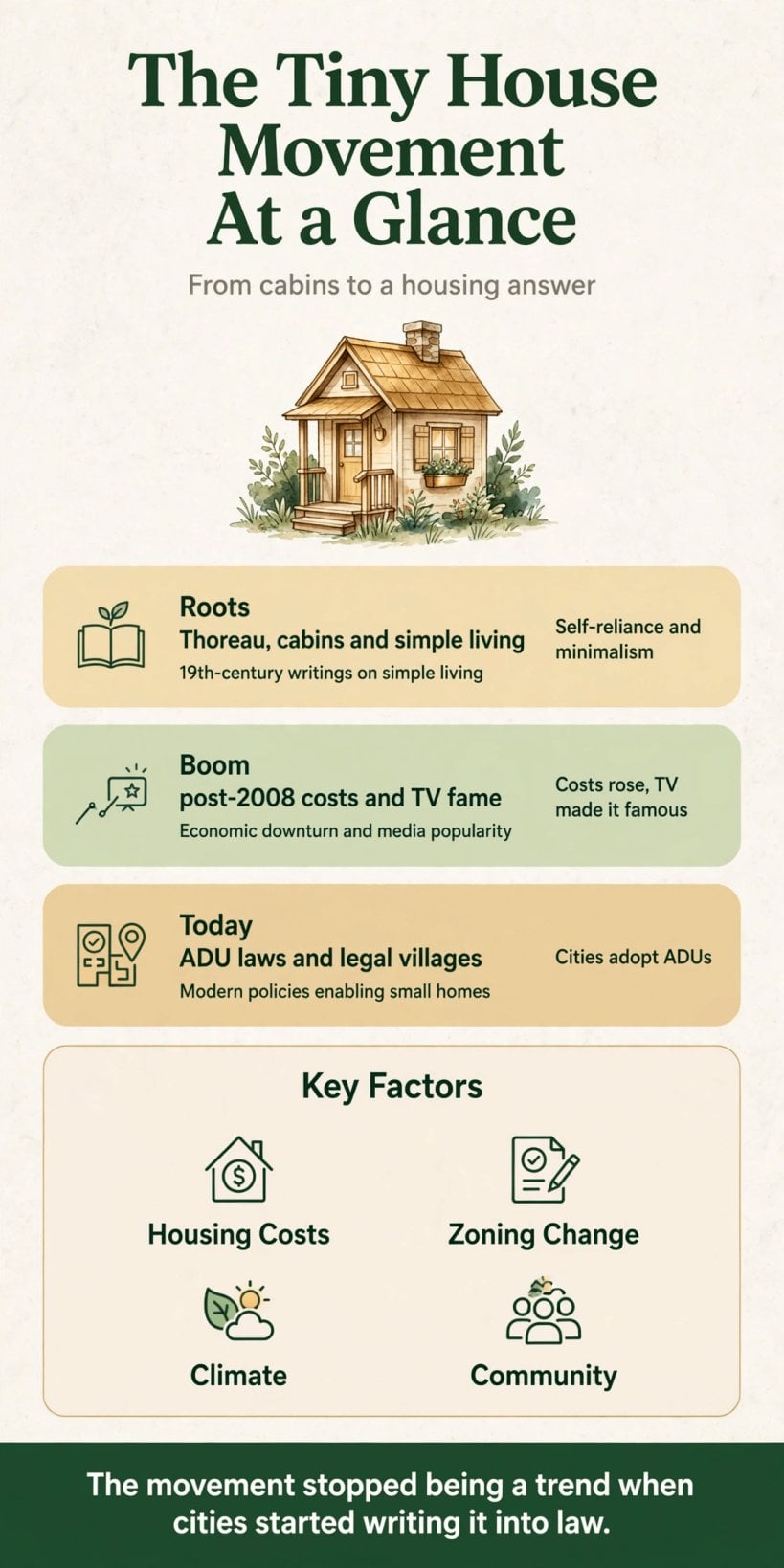
A quick visual summary of the roots, the boom and the rulebook era that followed.
2. Roots: Cabins, Thoreau and Simple Living
The philosophy is older than the phrase. In the nineteenth century, Henry David Thoreau built a small cabin on wooded land by a pond and wrote about living deliberately, fronting the essential facts of life. He was not reviewing floor plans; he was asking how much house a human actually needs, and his answer, one room, a desk, a bed and a wood stove, still reads like the first tiny-home manifesto.
He was not alone. Pioneer cabins, shepherd huts, fishermen’s shacks and monks’ cells all carried the same quiet argument across centuries: shelter is a tool for living, not a scoreboard. The twentieth century added its own voices, from back-to-the-land homesteaders to the designers of the small, efficient houses built during wartime shortages. What these ancestors share is intent. A small home was not a failed big home; it was a chosen one.
Understanding those roots matters because the modern conversation keeps rediscovering them. Minimalism, simple living and self-reliance are not marketing garnish on this movement; they are its load-bearing walls. When today’s owners talk about freedom from clutter and debt, they are quoting, knowingly or not, arguments that cabin writers made beside their ponds a very long time ago.
3. The Quiet Decades: Small Houses Before the Name
For most of the twentieth century, small houses simply existed without a movement to name them. Kit houses arrived by rail and were built by families on modest plots. Tourist cabins and early trailer camps housed travellers and workers. After the Second World War, though, the mainstream current ran the other way: new suburbs, growing floor areas, and a cultural equation that read square footage as success.
Even then, countercurrents flowed. The 1970s brought geodesic domes, hand-built homesteads and a generation experimenting with living lightly on the land. Architects published small-house pattern books, and a few brave souls built cabins that magazines photographed with affectionate amusement. Looking back, these decades were the movement’s compost: ideas layered quietly, waiting for economics and media to give them heat and light.
There were practical ancestors too. The park-model trailer, the site-built cottage courts of older resorts, and the granny flat over a garage all normalised the idea that a complete, dignified home could be far smaller than the street’s average. When the modern wave arrived, it did not invent small living; it named, photographed and organised it.
4. The Spark: Designers, Workshops and the First Builders
The modern chapter opens in the late 1990s and early 2000s, when a handful of designers and carpenters began treating the small house as a serious design problem rather than a compromise. They drew compact homes with real stairs’ worth of storage in every wall, published plans and manifestos, and built demonstration houses that proved a small footprint could feel crafted rather than cramped.
Workshops followed, and workshops are how movements reproduce. Weekend courses taught framing, trailer selection and composting-toilet plumbing to accountants and nurses who had never swung a hammer for a living. Early blogs documented every triumph and leak. A reader in one country would finish a build, post photographs, and unknowingly recruit ten readers in others. If you want to feel that workshop spirit in practical form, our how to get a tiny house built guide and the tiny house floor plans hub carry it today.
The trailer was the era’s enabling technology. Building a small house on a trailer chassis placed it, in many places, in a different legal conversation from a fixed house, and it promised something intoxicating: a home that could move when its owner’s life did. That promise, half practical and half romantic, powered the next decade.
5. The Boom: Hard Times, Rising Costs and Television
Then economics lit the fuse. The financial crash of 2008 left a generation staring at repossessed suburbs and impossible rents, and the question changed from ‘why would anyone live small?’ to ‘why would anyone sign that mortgage?’ A finished tiny home, owned outright, stopped sounding eccentric and started sounding like an exit door. Searches, books and build courses surged as housing costs did.
Television poured fuel on it. Through the 2010s, tiny homes became a staple of lifestyle programming: the reveal, the loft ladder, the owner insisting the house felt huge. Millions who would never build one could suddenly describe one in detail. Social media did the rest, with photograph-friendly interiors carrying the idea into feeds worldwide, a pattern our box truck conversion ideas and gooseneck tiny house ideas guides still ride today, as wheeled formats multiplied far beyond the original cottages on trailers.
Fame had side effects. Builders professionalised, waiting lists formed, and a market was born, complete with showrooms and finance desks. That commercial chapter matters to the story because it is where a protest against expensive housing met expensive products, and the tension has never entirely left. Honest histories admit it; the movement’s own magazines debated it at the time.
6. Communities, Villages and Belonging
Humans rarely move alone for long, and tiny living soon collectivised. Villages and communities formed, some as simple rented clusters of pads with shared gardens, others as carefully designed neighbourhoods with common houses, workshops and guest parking. For many residents the discovery was social as much as financial: a street where neighbours know your name because the porches are close and the fences are low.
Communities also solved practical puzzles collectively. Shared laundry, shared tools, a shared agreement about noise and guests, and a landlord or co-operative that understood the homes: these mundane arrangements removed much of the friction that solitary parking creates. Our earlier fieldwork on choosing land in the where to buy land for eco-living scoring system scores exactly these social and legal factors, because a beautiful plot with hostile rules is a trap wearing a view.
Not every experiment bloomed. Some villages folded over money, management or local opposition, and their lessons are part of the inheritance too: get the land agreement in writing, plan the boring infrastructure first, and remember that community is a practice, not a purchase. The survivors tend to be the groups that treated governance as seriously as architecture.
7. The Law Catches Up: Rules, Parking and Recognition
Popularity forced a question that enthusiasm alone could not answer: where may these homes legally stand? The honest summary is that recognition is arriving patchily, place by place, and the detail is always local. Some cities welcome small backyard homes as a gentle way to add housing, some counties create pathways for tiny-home communities, and some places still treat a wheeled tiny home as a vehicle that may not be lived in at all.
This guide deliberately invents no rules, because the only version that matters is yours. If you are placing a home, check with your county or city offices what is permitted on your plot, what connections are required, and how the home should be described for official purposes. The pattern of that research is laid out in our building codes for unconventional eco-structures guidance, and the water side of the same homework appears in our tiny house greywater systems guide.
What can be said generally is that the direction of travel is toward frameworks rather than bans: definitions are being written, standards discussed, and pilot communities studied. The movement stopped being a trend, as the saying goes, when officials started writing it into their plans, and every year’s new permissions make the next year’s conversation easier.
8. Critics, Limits and Honest Doubts
No honest history skips the criticisms. Detractors note, correctly, that a picturesque tiny home on a rural plot does little for a family priced out of a city, that some commercial builds grew costly enough to mock their own founding argument, and that living small by choice is a privilege unavailable to those who live small by necessity. These arguments have improved the movement by forcing it to talk about land, legality and equity, not just joinery.
There are practical limits too. Small homes suit some seasons of life gloriously and others awkwardly; growing families, home workshops and live-in care all push against the walls. The healthiest voices inside the movement say so plainly, and point readers toward the full spectrum of small living, from garden annexes to modest conventional houses, a spectrum our living in a tent long term guide explores at its most minimal end.
9. The Movement Today: Builders, Buyers and the Mainstream
Today the tiny house movement looks less like a campfire and more like an industry with a conscience it argues about. Established builders offer certified models, insurers have products for them, as our how to insure a tiny house guide explains, and lenders have begun, cautiously, to finance them. Buyers have diversified too: downsizing retirees, first-time owners locked out of conventional prices, remote workers, and hosts building garden accommodation for family or guests.
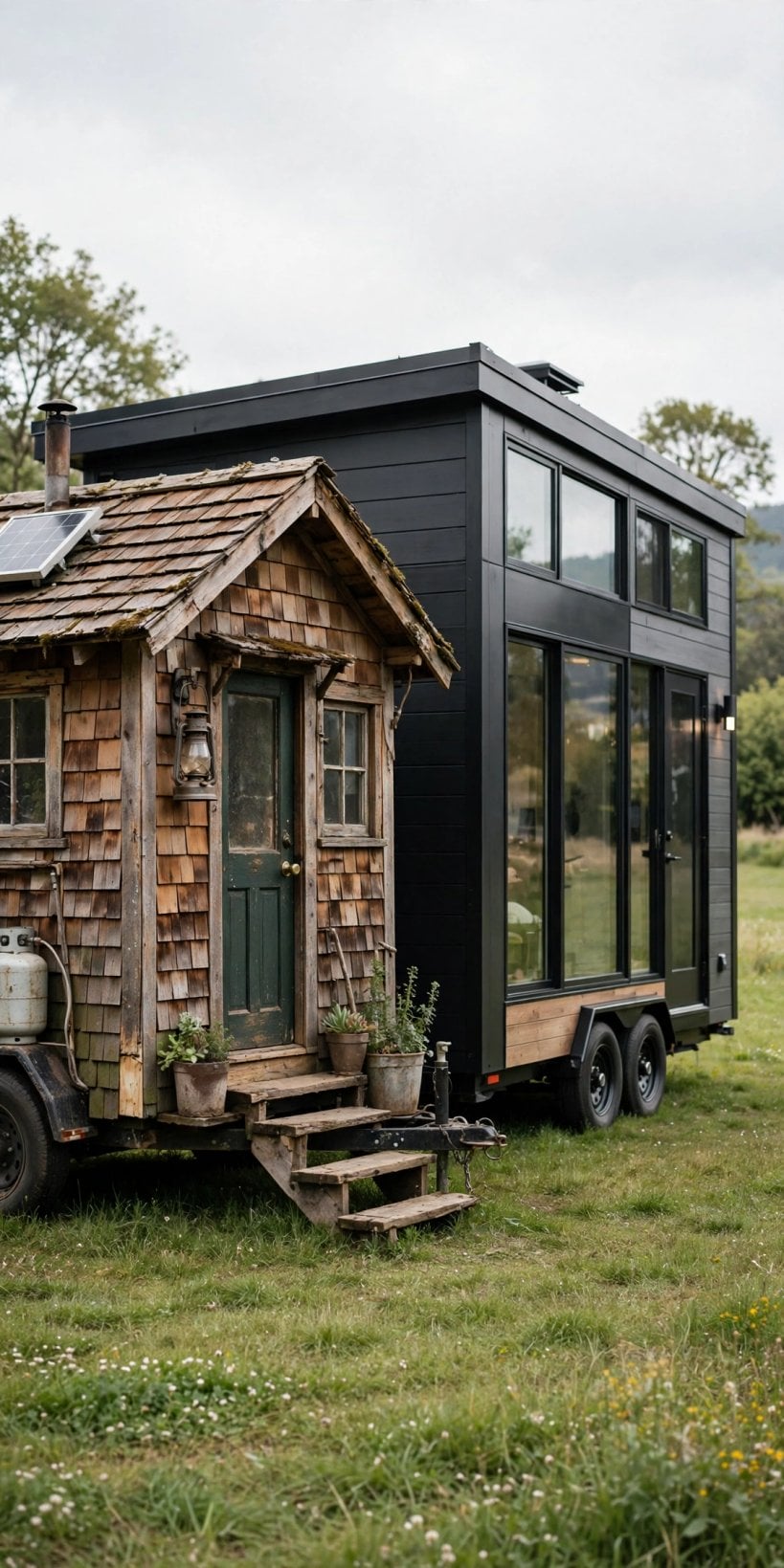
The design language matured with the market. The early aesthetic of reclaimed barnwood everything has company now: crisp modern boxes, traditional cottages, accessible single-level plans with proper bathrooms, and off-grid builds whose systems would satisfy a homesteader. Under the variety sits the same central entity it began with, a small, complete, deliberately chosen home, and the same test: does it free its owner’s life, or merely photograph well?
10. Where It Is Heading Next
The next chapter is likely to be written less by television and more by policy and demography. Ageing populations need small, accessible homes near family; adult children need a legal way to house parents in the garden; cities need gentle density that neighbours will accept. On each front, small homes are a ready answer looking for permission, which is why the rulebook work of the last section matters more than any new floor plan.
One more force deserves a place in any forecast: the do-it-yourself knowledge loop. Every build documented online lowers the fear barrier for the next household, and every honest account of a leak, a blown budget or a planning refusal quietly improves the next design. Movements built on shared mistakes mature faster than movements built on brochures, and this one’s library of mistakes is now very large, very public and genuinely useful to anyone starting out.
If you are reading this history as a possible future resident rather than a spectator, take the long view the founders took. Visit a finished home, rent one for a week if you can, talk to owners about winters rather than reveal days, and read the local rules before the listings. The romance opened the door for millions; the research is what keeps the people who walk through it happy, housed and still smiling a year after the cameras have gone.
Expect formats to keep specialising: park models for communities, certified builds for finance, rugged off-grid homes for the land-rich and cash-careful, and factory production quietly improving quality and price. Expect also a greener emphasis, as the climate argument, small homes sip energy and materials, moves from footnote to headline. If you are building rather than watching, our building a tiny house checklist turns the movement’s hard-won lessons into an order of work.
Final Considerations
From a cabin by a pond to villages with waiting lists, the through-line is a question, not a product: how much home does a good life actually need? The answers will keep changing with prices, rules and families, and the movement will keep arguing happily about all three. What seems settled is the contribution: it proved that small can be chosen, designed and loved, and it left the housing conversation permanently larger than the houses it builds.


0 Comments