

Well-managed tiny house greywater turns the water from your shower, basin and laundry from a disposal problem into a garden resource. The trick is doing it cleanly, safely and within your local rules.
This guide explains what counts as greywater, how filters and simple reuse systems work, and how to stay on the right side of regulations that are always local and specific.
1. Greywater at a Glance
Greywater is the lightly used water that leaves a home through showers, bathroom basins and washing machines. It is not sewage, but it is not clean either, and treating it with that in-between respect is the whole art. The summary below is the map for everything that follows in this guide.
| Topic | The Short Version |
| What counts | Shower, bathroom basin and laundry water |
| What never counts | Toilet waste and greasy kitchen sink water |
| Reuse systems | Mulch basins, reed beds and branched drains |
| Key factors | Local rules, soap choice, filtration and setbacks |
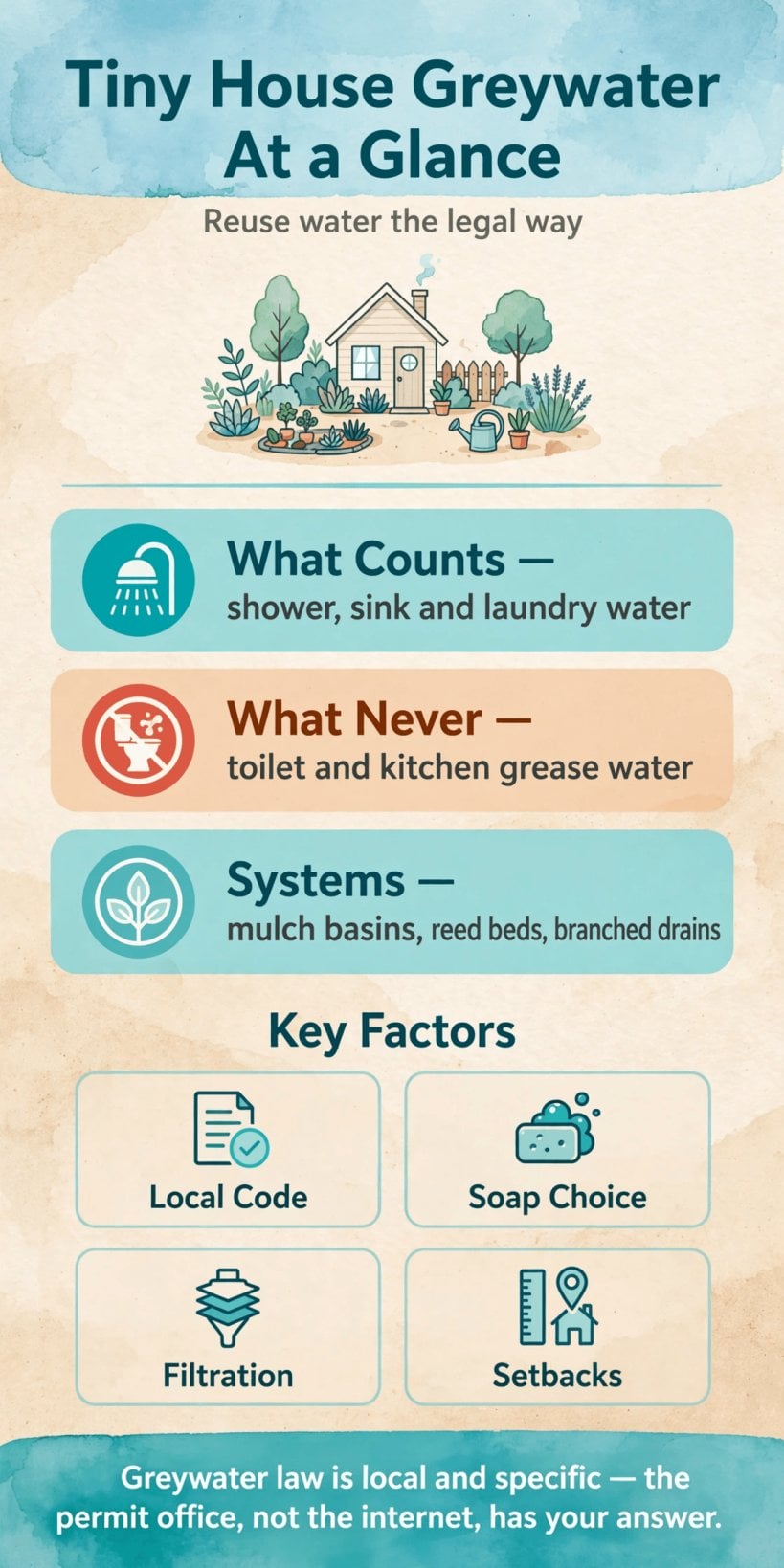
A quick visual summary of what counts, what never does, and the systems that put used water to work.
2. What Counts as Greywater, and What Never Does
The sources are ordinary. Shower and bath water is the largest stream in most small homes, bathroom basin water is the cleanest, and laundry water sits in between, carrying lint, detergent and whatever the week did to your clothes. Together these streams make up most of the water a household uses, which is why reusing them matters far more than saving drips from a single tap.
Two streams stay out, always. Toilet waste is blackwater, a different category entirely with its own systems and rules. Kitchen sink and dishwasher water is excluded in most guidance too, because it carries grease, food solids and a heavier load of microbes than a simple soil system should be asked to handle. When in doubt, leave a stream out: a greywater system fed only by gentle sources stays sweet for years.
It helps to count your own flows before designing anything. Time a shower, note the washing machine’s appetite, and watch a normal week honestly rather than aspirationally. A system sized for the household you actually are will cope on laundry day in winter, which is precisely when undersized filters clog, tanks sulk and owners give up on reuse altogether.
3. The Rules: Local, Specific and Non-Negotiable
Here is the honest headline: the legality of reusing greywater depends on where your home sits, and the detail differs between states, counties and cities. Some places encourage simple laundry-to-landscape systems, others regulate any reuse through permits, and a few restrict it closely. There is no single national answer, and anyone who gives you one has not checked yours.
So the working rule in this guide is simple: check with your county or city offices, and with the local health or environmental department, before you install anything permanent. Ask what sources may be reused, what treatment is expected, and where reused water may be applied. Our legality of collecting rainwater guidance shows how sharply water rules can vary by state, and greywater is at least as local. The building codes for unconventional eco-structures guidance is also worth reading before you talk to officials, so you arrive with sensible questions.
Treat that conversation as a design tool, not a hurdle. Officials can tell you the setback distances expected from wells and waterways in your area, the soils that give trouble, and the simple systems they see working locally. A short, friendly enquiry at the start is worth more than any amount of internet certainty, and it protects you if a neighbour ever asks questions later.
4. Filters: Keeping Hair, Lint and Grease Out
Every successful system starts with screening. A simple lint and hair filter at the outlet catches the solids that would otherwise clog pipes and smother soil, and a coarse mesh or sock filter that you can rinse in a minute will be maintained, while a clever sealed unit that needs tools will quietly be abandoned. Design for the cleaner you will be on a wet Sunday, not the enthusiast you are on installation day.
Grease deserves its own sentence. Even with the kitchen excluded, bath oils, conditioners and laundry loads bring fats that coat filter media and soil pores. A small settling step, where water pauses and grease can be skimmed, extends the life of everything downstream. Keep filter points accessible, label what you install, and note the cleaning rhythm in a calendar rather than trusting memory.
For the supply side of the same water story, our rainwater harvesting and tank sizing guide pairs naturally with this one: rain in the tank for clean uses, greywater out to the garden for irrigation, and the two systems together can change a small home’s whole relationship with water.
5. Branched Drains and Mulch Basins
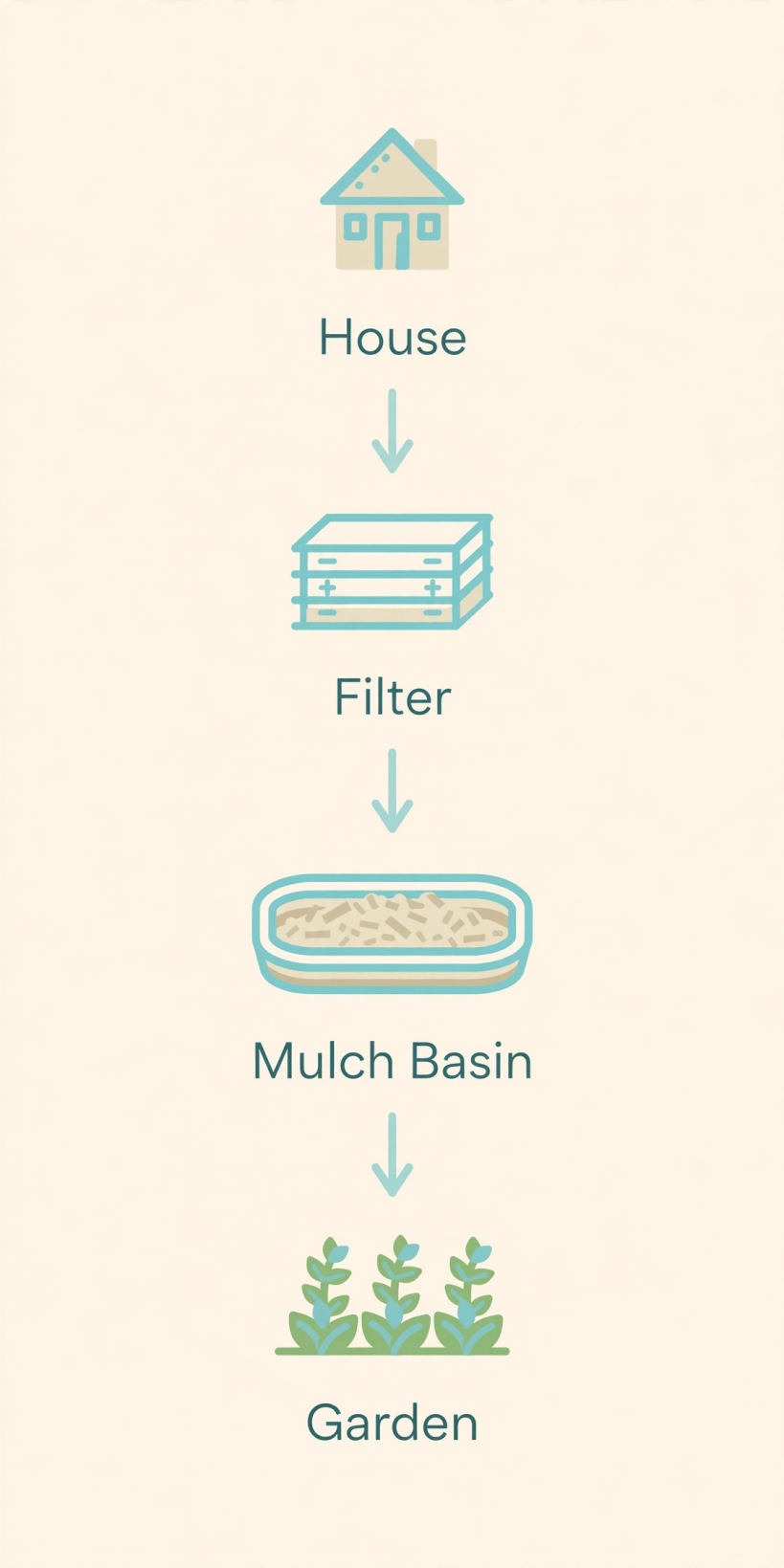
The simplest reuse pattern needs no pump and no tank. Water leaves the house, passes the filter, and is split by a branched drain into several gently sloped lines, each ending in a mulch basin: a shallow, mulch-filled hollow around a tree or shrub. Soil and mulch do the treatment, roots drink the water, and the surface stays dry, which keeps people, pets and smells out of the story entirely.
Mulch is the unsung hero. A deep layer of coarse wood mulch hosts the microbes that digest soap residues and nutrients, and it needs topping up as it breaks down, which is the system’s main chore. Plant choice matters too: fruit trees, shrubs and thirsty perennials thrive on this regime, while root vegetables and anything eaten raw should never be watered this way, a common-sense line that most local guidance repeats.
Gravity is free but unforgiving, so slopes must be planned with a level in hand. Lines that sag will pool, lines that dive will erode their basins, and every junction must be reachable when a clog eventually arrives. Sketch the runs on paper, walk them on the ground, and remember that a system you can inspect in five minutes is a system that gets inspected.
6. Reed Beds and Planted Filters
Where a household wants a step more treatment, a planted gravel bed, often called a reed bed, is the classic answer. Water flows slowly through a lined bed of gravel planted with vigorous water-loving plants; roots feed oxygen to microbial communities, and the water that leaves is markedly cleaner than the water that arrived. In a tiny-home garden, a modest bed can be both treatment plant and a green feature in its own right.
Reed beds ask for patience and honesty. They take time to establish, they slow down in cold winters, and they must be sized for the real daily flow rather than the hoped-for one. They also dislike shock loads of bleach and harsh chemicals, which connects directly to the next section: what you pour into the system decides what the system can do for you.
Owners who have parked their home long term often combine approaches, and the land-first thinking in our how to prepare your land for a tiny house guide will help you place beds, basins and lines before the home arrives, when moving soil is still easy. Vehicle-based builds handle drainage differently, as our box truck conversion ideas and gooseneck tiny house ideas guides both show in their plumbing sections.
7. Soap, Shampoo and What Goes Down the Drain
A reuse system is only as kind as its inputs. Choose soaps, shampoos and laundry products that are low in salt, boron and harsh disinfectants, and that describe themselves honestly as suitable for gardens, because everything in them ends up in your soil. Powdered laundry products are often saltier than liquids, and the occasional bleach load should be diverted to the ordinary drain if your setup allows a simple diverter valve.
Build the habit at the shelf, not at the pipe. Keep one set of gentle products in the tiny bathroom and laundry nook, and the system never has to forgive a thoughtless purchase. Guests can be handed the right bottle with a smile. It is a small social chore that protects months of soil biology, and regular visitors learn it as quickly as they learn where the mugs live.
8. Storage, Pumps and Moving Water Uphill
The golden practical rule is to move greywater along promptly rather than storing it. Untreated greywater left sitting in a tank turns stale and unpleasant surprisingly fast, growing exactly the microbial party you were trying to avoid. Most simple systems therefore flow by gravity straight to the garden, with any surge tank kept small, vented and emptied by design rather than by memory.
Where the garden sits above the house, a small pump lifts filtered water to the distribution lines, and this is the one place electricity enters the story. Keep the pump accessible, protect it from grit with the filter upstream, and fit a simple way to divert flow to the normal drain for winter, maintenance or a load of washing you would rather keep out of the soil.
9. Tanks, Setbacks and Siting
Siting is where the local conversation from Section 3 becomes tape measures. Setbacks, the distances between reused water and wells, boundaries, buildings and waterways, are set by your local rules, which is why this guide gives principles rather than numbers: keep distribution below the surface in mulch, keep it away from drinking-water sources and play areas, and keep it where you can see and reach it. When you discuss tiny house greywater with your county or city office, these are exactly the details to confirm for your plot.
Soil decides the rest. Free-draining soil accepts water gratefully, while heavy clay demands larger basins, slower application and realistic expectations in a wet winter. A simple percolation test, a hole, a bucket of water and a watch, will tell you more about your design than a week of reading, and it costs nothing but an afternoon.
10. Maintenance and Troubleshooting
Maintenance is small, regular and unglamorous: rinse the lint filter, top up the mulch, walk the lines after heavy use, and check that every basin is draining as it should. Most problems announce themselves politely first, as a slow drain, a damp patch or an unfamiliar smell, and nearly all of them trace back to a filter that waited too long or a product that should never have gone down the plughole.
Keep a one-page record with the system: a sketch of the pipe runs, the filter-cleaning dates, and the products you have approved for the house. If you sell or move the home, that page is gold for the next owner. For the staged view of a whole build, our building a tiny house checklist places plumbing decisions in their proper order, and the tiny house movement story shows how reuse thinking like this moved from fringe habit to mainstream expectation.
Seasons change the routine in ways worth planning for. In freezing weather, exposed lines should be drained or buried below the frost line as your local guidance suggests, and a diverter to the ordinary drain earns its keep until spring. In a dry summer the system becomes the garden’s lifeline, and you may find yourself wishing for more laundry, which is a pleasant problem. Autumn leaf-fall can blanket basins and slow them, so a quick rake joins the seasonal chores. A system understood across the whole calendar, rather than just on installation day, is one that will still be working, quietly and without drama, many years from now.
Final Considerations
Greywater done well is almost boring: gentle products in, a humble filter, water disappearing quietly into mulch, and plants doing visibly better for it. The rules are local, so check with your county or city before you build, keep toilet and kitchen water out of the system, and maintain the little things on schedule. Do that, and the water your household uses twice becomes one of the quiet satisfactions of small, self-reliant living.
Start small if the whole picture feels daunting. A single laundry line to one mulch basin teaches you your soil, your products and your own habits within a month, and every later branch of the system gets easier to design with that experience behind you. Water is too precious in a small home, and gardens too grateful, for any of it to be wasted on hesitation.


0 Comments