

Canvas walls, a wood stove ticking in the corner and the weather as your nearest neighbour: the idea of living in a tent long term is equal parts freedom and discipline.
This guide separates the romance from the reality, covering tent choice, platforms, heat, moisture, daily systems and legality, so a full-time canvas home can be planned with open eyes.
1. Full-Time Tent Living at a Glance
Start with the whole arrangement in one view. A canvas wall tent on a platform, heated by a small flued stove and supported by daily-run systems, is the proven formula for year-round tent life, and it succeeds or fails on four factors. The summary below, drawn from this post’s own infographic, shows what actually makes it work.
| Part of the Design | What It Means |
|---|---|
| Shelter (Tent) | Canvas wall tent on a platform: durable fabric, real headroom, off the ground |
| Heat (Comfort) | Small wood stove, safely flued, sized for the tent’s modest volume |
| Systems (Daily) | Water, power and sanitation solved daily as running routines, not installations |
| Key Factors | Legality, moisture, heat and security checked and planned from day one |
Tent living is ten percent romance and ninety percent moisture management: plan the ninety first.
Read the shelter row as the foundation decision. A canvas wall tent, tall enough to stand in, pitched on a solid platform, is a different proposition from a backpacking tent: it is closer to a soft-walled cabin, and that is the point. Heat is the second leg: a small wood stove, properly flued through a heat-shielded jack, turns the tent from seasonal shelter into a home that faces winter honestly. Systems are the daily truth, because water, power and sanitation in a tent are routines you run, not utilities you forget.
The key factors row gathers the disciplines that decide whether the experiment thrives. Legality determines where and how long you may stay. Moisture, the caption’s ninety percent, decides the health of the tent, the bedding and the lungs. Heat decides the calendar: which months are comfortable and which demand real winter craft. And security, of person and possessions, shapes the site choice as much as the view. Hold these four together and the romance survives contact with January.
2. Choosing a Tent for the Long Term
Not every tent can be a home, and the choice matters more than any later accessory. Canvas wall tents dominate serious long-term setups for good reasons: breathable cotton canvas handles condensation far better than nylon, steep walls give usable interior volume, and the fabric tolerates a stove jack and years of sun when it is properly treated and maintained. Bell tents offer similar virtues in a rounder, more portable form; tipis and yurts sit nearby in the family, each with its own structural logic.
Size for the life, not the trip. A tent that sleeps four on a weekend can feel cavernous for a solo dweller and cramped for a couple living in it through winter, once stove, bed, storage, kitchen gear and drying space all claim their corners. Stand-up height throughout the main area changes daily life more than any other single dimension, and a sewn-in or separate groundsheet decision shapes both comfort and moisture behaviour.
Buy from makers who understand permanent pitching. The questions to ask, canvas weight, treatment, stove jack placement, pole and frame strength, guy-line geometry, are the tent equivalent of the material scrutiny in cordwood house building with walls, mortar and cost guidance: in both cases the envelope is the home, and its quality decides everything downstream. A cheap tent is the most expensive way to learn this.
3. The Platform: Your Floor, Foundation and Dry Line
The platform is what turns camping into dwelling. A raised wooden deck under the tent lifts living off cold, wet ground, gives a level, cleanable floor, and creates the dry line that the whole moisture strategy depends on. Build it properly: sturdy framing, a floor that sheds water, and detailing that keeps the tent’s edges and guys working with the deck rather than fighting it.
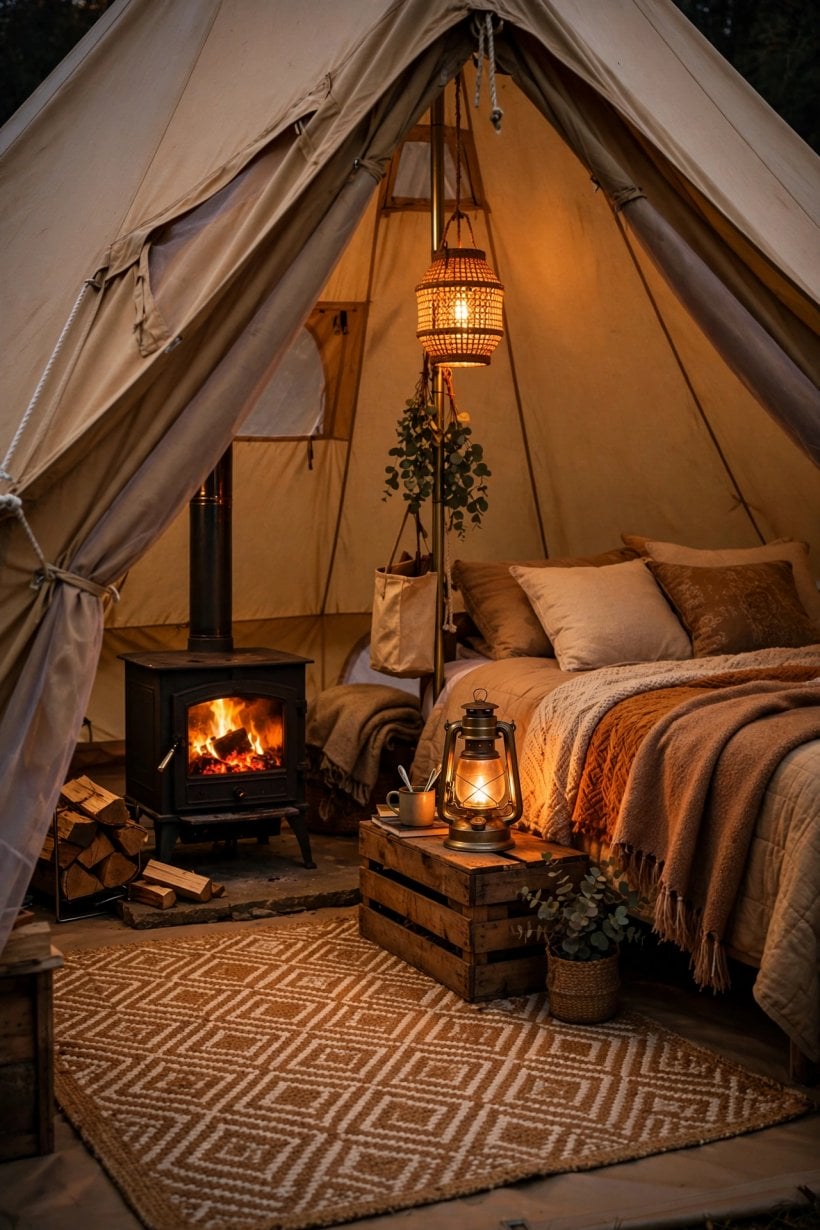
Size and siting repay thought. The platform should extend beyond the tent walls enough for boots, firewood and a covered entry, because the threshold is where weather and daily life collide. Site it for drainage, sun and wind sense: high enough that water runs away, open enough for solar gain and drying breezes, sheltered enough that winter winds do not test every guy-line nightly.
Compare the siting discipline in living in a shed with legality, comfort and conversion basics, where a humble structure becomes a dwelling only when access, moisture and services are planned properly. A tent platform asks the same questions at lower cost and higher exposure: how will water arrive and leave, how will supplies reach you in bad weather, and can the site be lived on happily in February, not just photographed in June?
4. Heat: The Small Wood Stove, Safely Flued
Heat is what makes the calendar negotiable. A small wood stove designed for tents, properly flued through a heat-shielded stove jack with correct clearances, transforms the canvas home from a three-season shelter into a place that faces frost with confidence. Size the stove to the tent’s modest volume: too small and it cannot hold the night, too large and it cycles between roaring and smouldering, which is inefficient and hard on the flue.
Safety is the entire subject, not a subsection of it. The flue must exit through a proper jack with heat shielding, clearances to canvas must meet the stove and tent makers’ requirements, a carbon monoxide alarm is non-negotiable, and the stove needs a stable, non-combustible hearth that cannot tip or shift. Fuel storage stays outside the tent’s living space, dry and accessible, because a winter’s warmth depends on a summer’s woodpile planned in advance.
Learn the stove’s rhythm before you need it. Banking for the night, managing draught, reading the flue’s behaviour in wind, these are skills acquired in autumn, not discovered at midnight in a storm. The heating honesty in earthship homes and off-grid design, costs and realities applies at canvas scale: thermal comfort is a system of fuel, appliance, shelter and skill, and the skill is the part most newcomers under-budget.
5. Moisture: The Ninety Percent
The infographic’s warning deserves its own section, because moisture is where long-term tent living is won or lost. Canvas breathes, which helps, but cooking, washing, drying clothes and simply breathing release litres of water into a small volume daily. Without a strategy, that moisture condenses on the coolest surfaces, wets bedding and clothing, and feeds the mildew that destroys both fabric and morale.
Ventilation is the primary tool. A tent lived in full-time needs deliberate airflow even in cold weather: ridge vents, adjustable openings and the discipline to use them, because sealing the tent against the cold also seals the moisture in. Heat helps by raising the air’s capacity to carry vapour out, which is another reason the stove is comfort infrastructure, not a luxury. Wet gear lives in a porch or covered entry, never in the sleeping area.
Maintenance completes the system. Canvas needs periodic re-treatment, guy-lines need tension as fabric moves with weather, and the tent should be aired and inspected on a routine, not when something smells wrong. The moisture patience in underground house ideas and earth-sheltered living pros and cons is the same discipline underground: in buildings that live close to water, whether soil or sky, moisture management is not a chore. It is the home.
6. Water, Power and Sanitation: Solved Daily
Systems in a tent are routines, and the honest way to plan them is as daily practices with proper equipment. Water means a reliable source, transport, storage and filtration sized for drinking, cooking and washing, with a margin for the week the source is awkward. Power usually means solar panels, a battery and efficient loads, the same off-grid ledger as any small dwelling, sized from honest calculations rather than hope.
Sanitation needs a real plan, not an embarrassed improvisation. Options range from composting toilets to arranged facilities, depending on the site and what local rules allow, and greywater from washing needs a lawful, sensible disposal route that harms neither the site nor the neighbours. Whatever the arrangement, it should be dignified, reliable in winter, and maintainable without drama, because this is the system that most directly decides whether tent life feels like freedom or squalor.
Cooking deserves its own systems thought. A safe cooking setup, whether on the wood stove, a proper camp kitchen or a combination, needs ventilation, stable surfaces and fuel storage that respect the canvas. The off-grid water and power logic in hobbit house ideas with earth-sheltered charm, plans and costs makes the same point in a buried context: unusual homes get their comfort from complete systems, and half a system is a failed utility wearing a romantic hat.
7. Comfort: Furniture, Kitchen and Daily Rhythms
Comfort in a tent is built from the floor up. A real bed, raised off the floor on a proper frame with a good mattress, changes everything: sleep quality, warmth, dryness and the feeling of dwelling rather than camping. Seating with back support, a table at a usable height, and storage that keeps belongings off the floor and sorted turn the canvas volume into rooms with purposes.
The kitchen is the heart of the tent home. Plan it like a small, serious workspace: stable surfaces, organised stores, washing-up arrangements that handle greywater properly, and everything secured against wind-rock and curious weather. A covered outdoor cooking area extends the kitchen in fair weather and keeps heat, steam and smells out of the sleeping space, which the moisture strategy will thank you for.
Rhythms matter as much as objects. The most contented long-term tent dwellers run their days with the deliberate routines of small households everywhere: morning ventilation and stove tending, water and power checks, weekly canvas and guy-line inspection, seasonal re-treatment and deep cleaning. The interior calm in tiny house interior paint colors that make small rooms glow has a canvas equivalent: order, light colours and uncluttered surfaces make a small soft-walled space feel serene rather than makeshift.
8. Weather, Wind and the Four Seasons
Weather is the nearest neighbour, and the relationship needs managing in every season. Wind is the structural test: the tent must be pitched, guyed and maintained to maker’s specification, with lines checked and re-tensioned as fabric moves, because a tent that survives a calm summer can still fail its first real gale. Know your site’s exposure honestly and choose the tent’s strength accordingly.
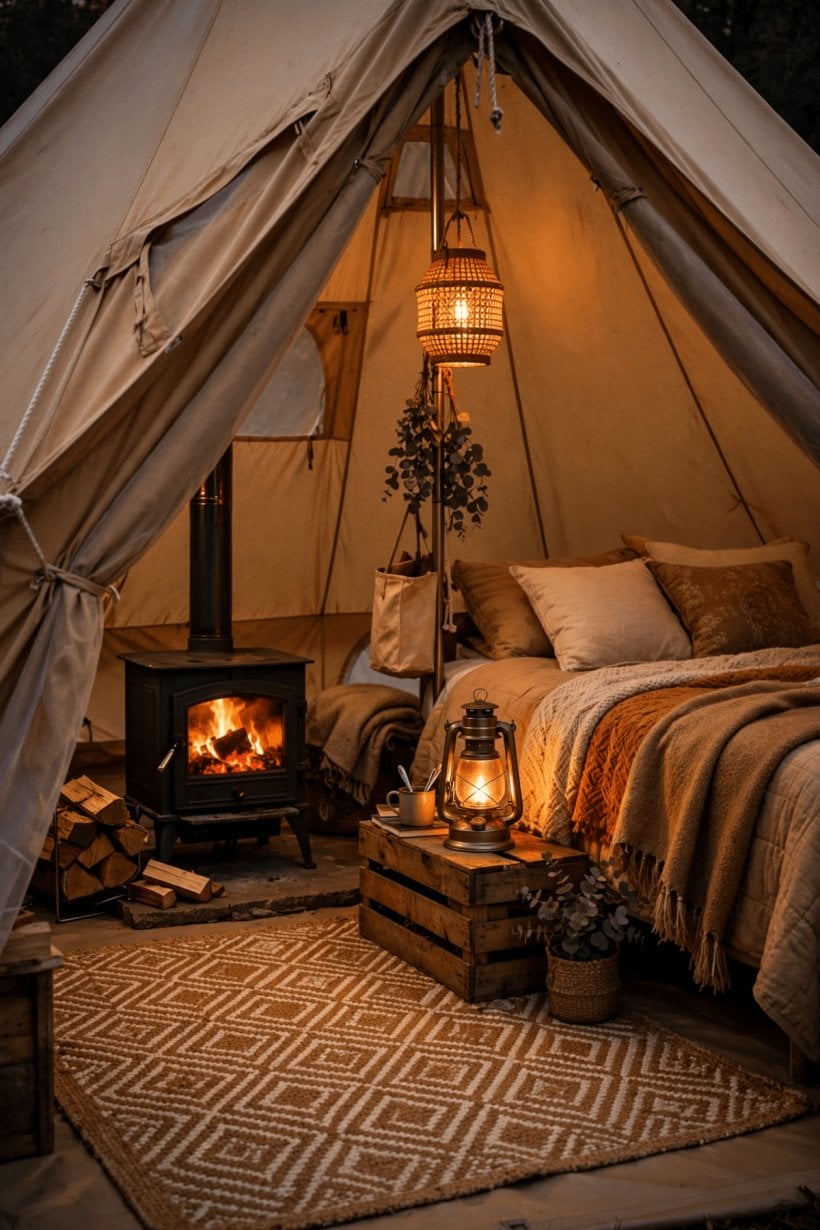
Snow and heavy rain are the load tests. Canvas sheds weather well when it is taut and properly angled, but snow must be cleared before it loads the structure, and prolonged rain tests every seam, guy and groundsheet junction. Seasonal routines, re-tensioning, seam checks, drainage around the platform, are the price of a tent that stands through the year’s worst week, and they should be scheduled like any building’s maintenance.
Summer brings its own disciplines: shade management, insect screening, ventilation against heat, and fire awareness in dry landscapes. The seasonal honesty in silo house ideas for converting a grain silo into a home applies in canvas: every unusual dwelling has a season that tests it hardest, and the design should admit that season gracefully rather than pretending all months are June.
9. Legality: Where You May Stay and For How Long
Legality is the key factor most romantics meet last and should meet first. Long-term tent dwelling sits at the intersection of planning, land use, tenancy and sometimes environmental health rules, and what is tolerated for a season may not be lawful for a year. This guide gives the principle, not a promise: check with your county or city what rules apply to dwelling in a tent on your intended land, how long you may stay, and what permissions, if any, make it proper.
Land tenure shapes everything. Your own land, a friendly landowner’s arrangement, a rented pitch and informal occupation are profoundly different legal situations, with different risks, different time horizons and different investments worth making. Match the setup’s permanence and cost to the security of the tenure: a fine platform and stove on a handshake week’s notice is a different decision from the same setup on owned land with proper approvals.
Engage officials early and honestly where the rules require it. A well-kept, safe, sanitary setup presented openly fares better than a hidden one discovered, and the questions officials ask, about sanitation, fire safety, water and waste, are usually the same questions a responsible dweller should already have answered. The permission-first discipline in how to get a tiny house built the proper way is the model: design to what is required, document what you build, and let compliance be part of the craft rather than its enemy.
10. What Drives the Cost of Tent Living
Costs are best discussed by what drives them, because the headline of cheap canvas misleads as surely as any other. The first driver is the setup done properly: a quality canvas tent, a real platform, a safe stove and flue, water and power equipment, and sanitation arrangements. Bought once and well, these are modest against any conventional home; bought cheaply twice, they are the most expensive option.
The second driver is the running cost in time and consumables: fuel, canvas treatment, replacement of lines and wear items, and the daily labour of water, wood, power management and maintenance. The third is the site itself: any rent or pitch fees, access costs and the transport of a life lived at a distance from services. Set against these the genuine economy: minimal housing overhead, tiny energy needs, and a way of life whose costs are visible, honest and largely within your control.
Budget like the tent-dweller’s honesty deserves: price the full proper setup, add a contingency for the first year’s learning, and value your time at something real. The land-planning sense in a half acre homestead layout that pairs pasture with garden beds closes the loop: a tent home on a well-chosen, well-organised piece of land is a smallholding in soft walls, and it deserves the same whole-design thinking as any homestead.
Final Considerations
Canvas, a platform, a small stove and the discipline to run the daily systems: long-term tent living asks less money than almost any home and more attention than most. Choose a tent built for permanent pitching, raise it on a proper platform, heat it safely, manage moisture like a profession and settle the legality before the first night. Do that, and the tent stops being an extended camping trip and becomes what its most committed dwellers always intended: a light, honest, deliberate home under the sky.


0 Comments