

The tiny house gets the headlines, but it is one species in a diverse ecosystem of small, sustainable shelter. Earthships bury their walls in rammed-earth tires, container homes stack retired steel boxes, and domes enclose the most volume with the least material — and each one attracts people the tiny house never would. This guide compares all three against the tiny house baseline, honestly: costs, build times, legality, and daily life.
Alternative Housing Options: At a Glance
Judging alternative housing options well means holding all three cousins to the same measures as the tiny house itself: real all-in cost, build time, DIY feasibility, energy performance, mobility, legal ease and resale. On those measures the three could hardly differ more. The Earthship is a multi-year act of devotion that ends in total autonomy. The container home is a fast steel shell whose hard problems — insulation, width, contamination — all arrive after the box does. The dome is the engineer’s favourite: the strongest, most efficient shape on the list, wrapped around the most puzzling interior. The ten sections below take each dwelling on its own terms first, then run the head-to-head comparison, the legal landscape for each, the daily reality of living in them, the honest cheapest ranking, the hybrid combinations experienced builders settle on, and a decision framework that matches the dwelling to what you actually value.
| Topic | What It Covers | Key Fact or Figure |
|---|---|---|
| 1. Beyond the Tiny House | One species in a wider ecosystem of small shelter | Three cousins compared against the tiny baseline |
| 2. Earthships: The Autonomous Vessel | Total autonomy from tire walls, sun and rain | $150,000–400,000+ completed |
| 3. Shipping Container Homes: The Industrial Kit | The retired steel box as structure | Boxes $2,000–5,000 each; homes $30,000–150,000+ |
| 4. Domed Houses: The Efficient Shell | Maximum volume from minimum material | Kits $20,000–80,000; concrete $80,000–200,000+ |
| 5. Head-to-Head: The Comparison | Cost, time, DIY, energy, mobility, legality, resale | Tiny house wins mobility and resale outright |
| 6. The Legal Landscape for Each | Permits for non-standard construction | Engineered documents + friendly jurisdiction = permit |
| 7. Living in Them: The Daily Reality | Greenhouse corridors, steel acoustics, dome volume | Earthship interiors hold 65–75°F year-round |
| 8. Which One Is Actually Cheapest? | The honest all-in ranking | Simple cabin or dome kit $40,000–80,000 |
| 9. Hybrids: The Best of Multiple Worlds | Each system’s strength, none of its weakness | Greenhouse + tiny structure is the classic pairing |
| 10. Making the Choice | Matching the dwelling to what you value | Mobility, autonomy, speed or resilience |
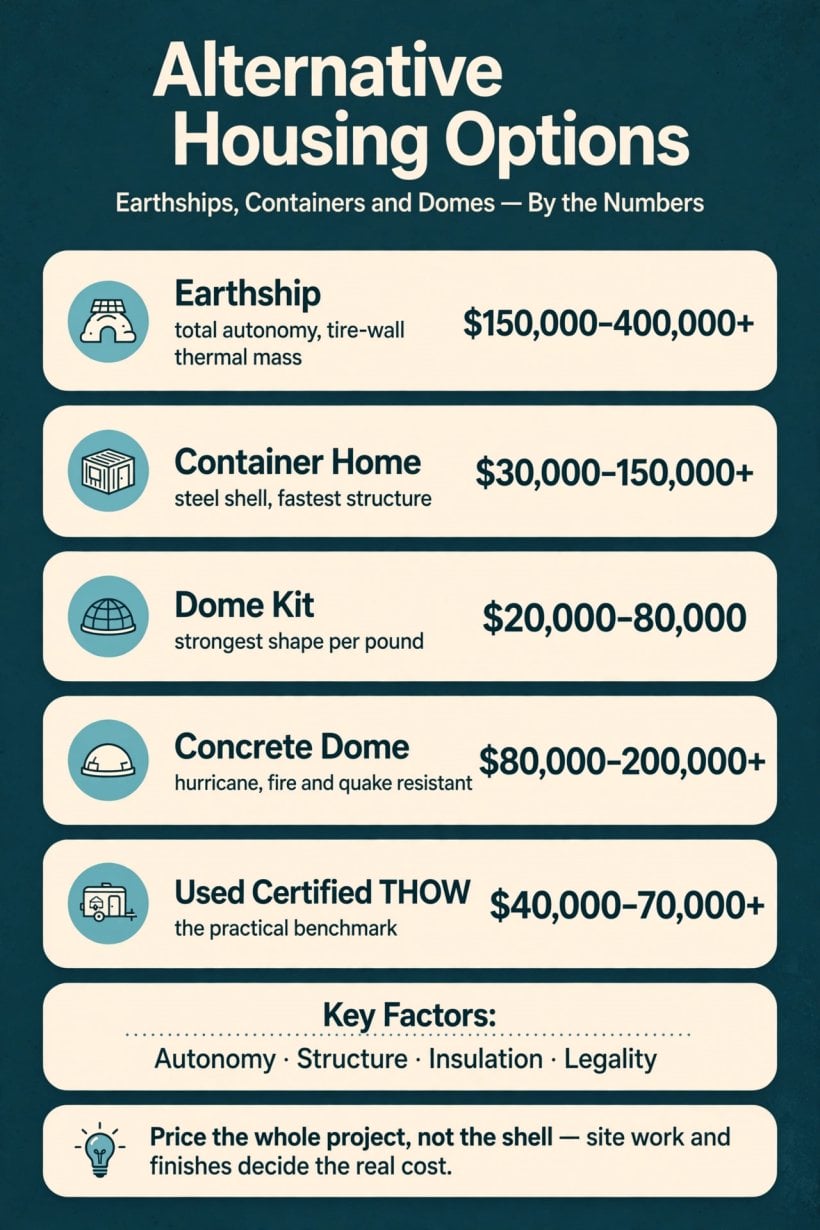
The cousins by the numbers: a completed Earthship at $150,000–400,000+, container homes at $30,000–150,000+, dome kits from $20,000–80,000 — and the used certified tiny house that still sets the practical benchmark.
1. Beyond the Tiny House
The tiny house is one species in a diverse ecosystem of alternative dwellings. Earthships, shipping container homes, and domed houses each solve the small-sustainable-shelter problem differently — with different costs, legal paths, and daily realities. Whether you are committed to a tiny house or still choosing, understanding the cousins sharpens the decision, because every strength the tiny house claims looks different once you see how another dwelling claims the opposite one. The tiny house’s great compromise is that it stays small and conventional enough to remain legal, mobile and sellable; each cousin refuses some part of that compromise and gains something real in exchange.
That refusal is the first lesson of alternative housing options: there is no best dwelling here, only the best trade. The Earthship trades years of labour for freedom from utility bills. The container trades interior width for a structure that arrives on a truck. The dome trades furniture-friendly walls for strength and efficiency no box can match. Even the wider family beyond these three teaches the same lesson — the fabric cousin covered in our roundup of yurt floor plans trades insulation and permanence for a home that packs onto a trailer. Read the next three sections as three different answers to one question — what are you willing to give up? — and the comparison that follows them will make sense as arithmetic rather than taste.
2. Earthships: The Autonomous Vessel
The concept: buildings made from rammed-earth tires, cans, and bottles, designed for total autonomy — passive solar heating and cooling, rainwater catchment, on-site sewage treatment via interior botanical cells, and solar or wind power. The thermal mass walls, three feet thick and more, moderate temperature passively, holding the interior in a narrow comfort band while the desert outside swings between frost and heat. Of the three cousins, the Earthship is the only one designed from the first tire to need nothing from the grid at all.
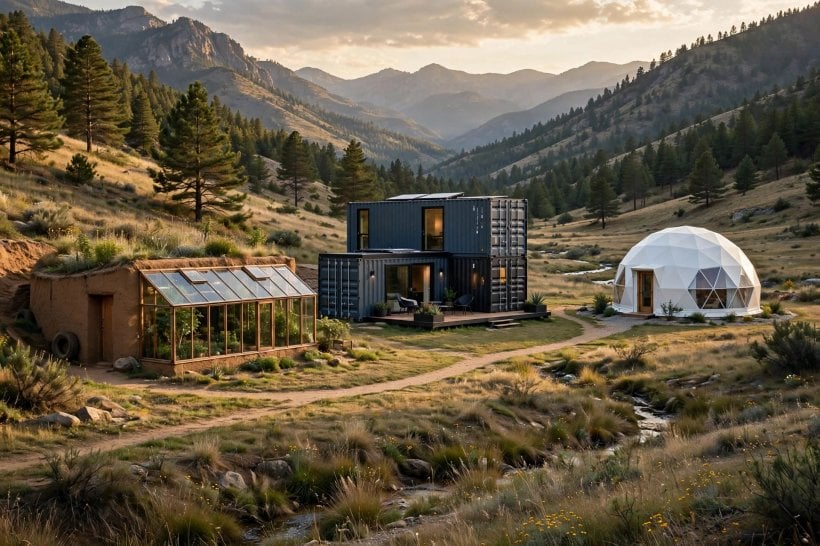
The costs are the shock: $150,000–400,000+ for a completed Earthship — the most expensive dwelling in this guide by a wide margin. The money is really labour in disguise. Tire-pounding is measured in thousands of hours, and most Earthships are owner-built over years with volunteer crews, which is why the build is best described as a multi-year epic rather than a project. Permitting is difficult, because the construction is non-standard everywhere; the aesthetic is polarizing; and resale is niche, because the buyer pool for a tire-walled autonomous vessel is small and specific. Set against that: near-zero utility bills, unparalleled thermal stability, and a fair claim to being the most self-sufficient dwelling on earth. The Earthship is a lifestyle commitment, not a housing product — choose it for the philosophy, not the convenience. Households drawn to the autonomy but not the tire walls will find the framed version of the same discipline in our guide to how to live off grid in a tiny house.
3. Shipping Container Homes: The Industrial Kit
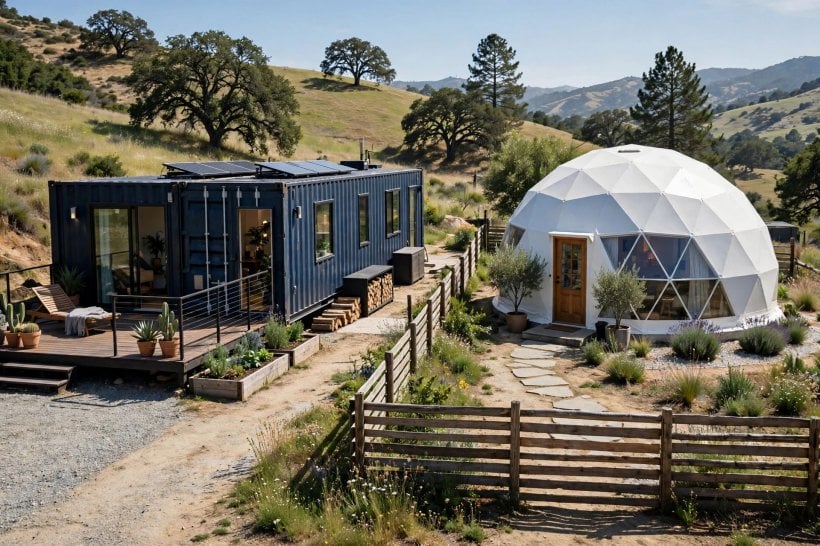
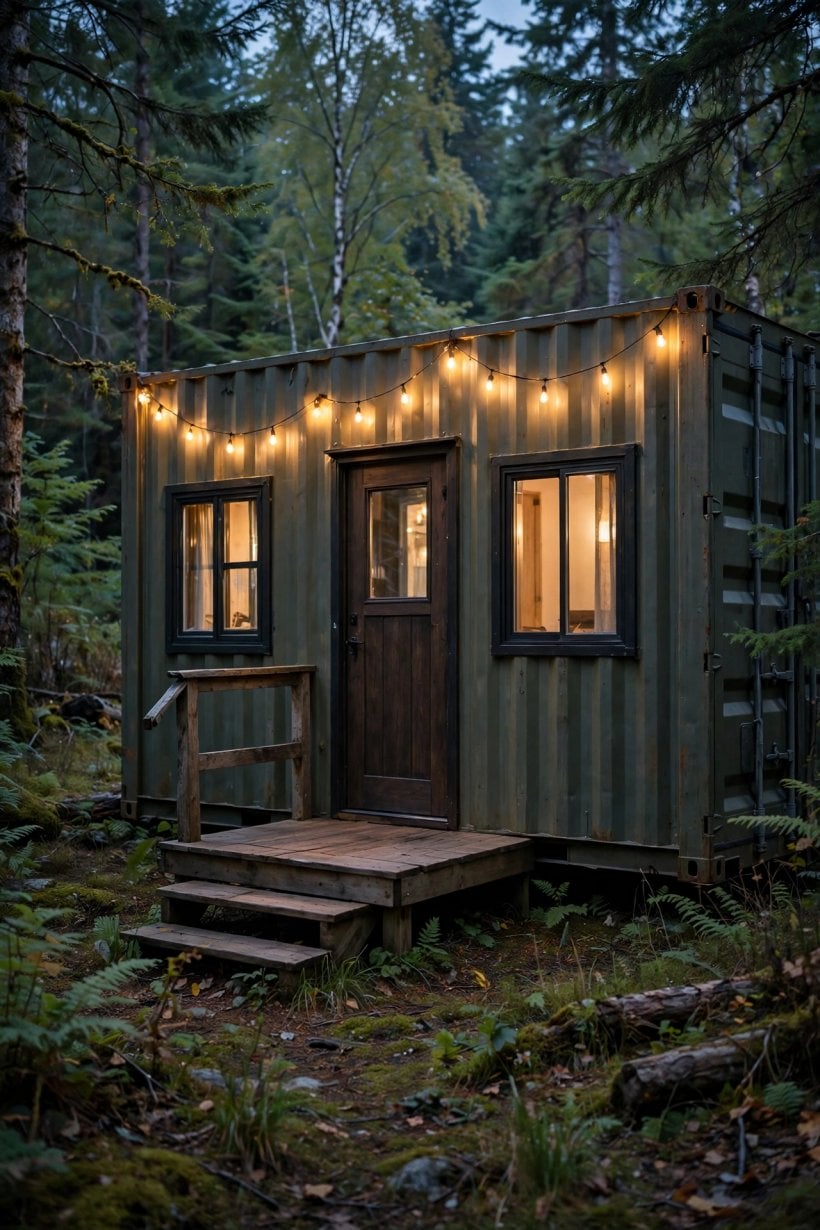
The concept: retired shipping containers — 8×20 or 8×40 feet, roughly $2,000–5,000 each used — converted into dwellings, singly, stacked, or combined. The structure is the box itself: corten steel, engineered for stacking, delivered by truck and set in place in a day. All-in costs run $30,000–150,000+ depending on ambition, from a single-container cabin to a multi-container architectural home. The build rhythm is seductive: the shell stands almost immediately, and then the real work begins — cutting openings, where every door and window cut needs structural reinforcement; insulating, because the steel is a thermal bridge nightmare without it; and finishing the interior like any small house.
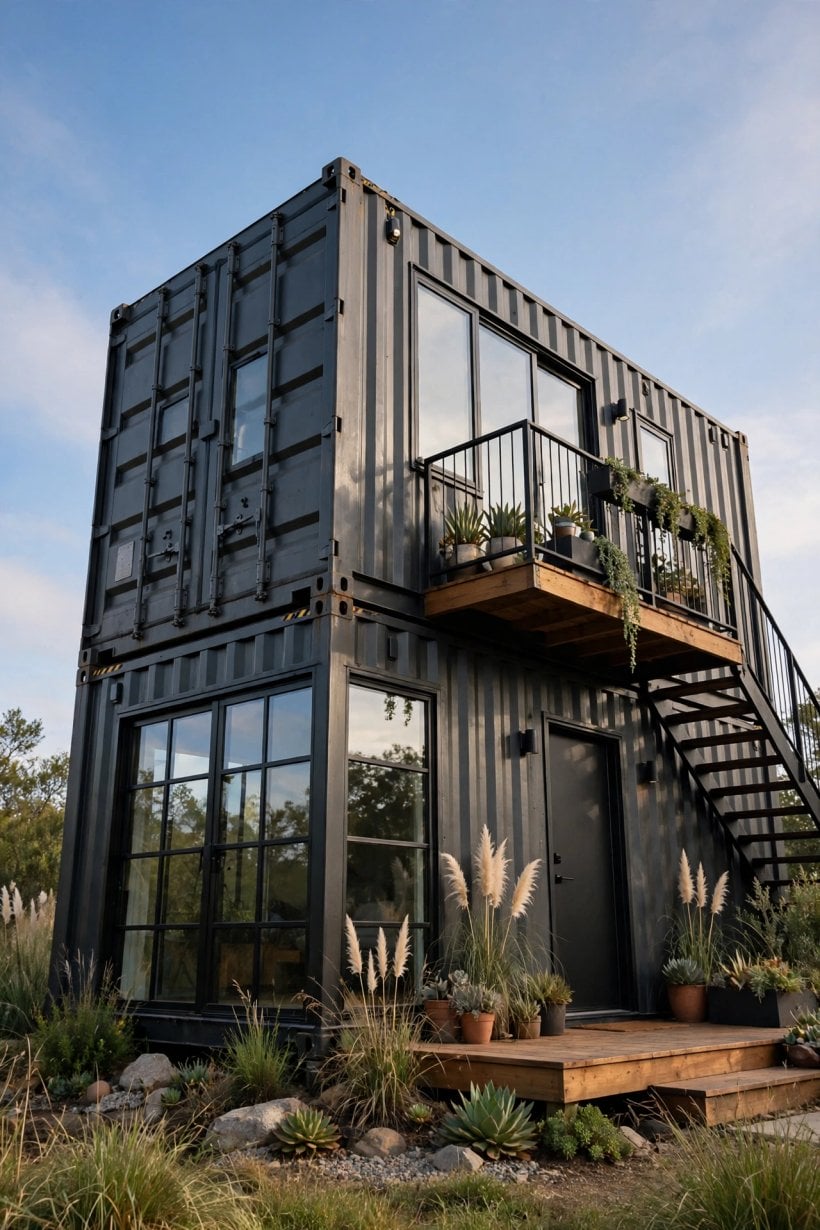
The weaknesses are specific and worth memorizing. Insulation is the hard problem: steel conducts heat brutally, and interior insulation eats into the already-narrow 7’8″ interior width, while exterior insulation preserves the width at higher cost. Used containers may carry chemical contamination — pesticide-treated floors are the known hazard — so verify and remediate before building. The width constraint is permanent: under eight feet of interior is tight for conventional furniture and two people passing. And permitting skepticism is real, with many jurisdictions eyeing container homes warily. Here is the container reality check the original comparison insists on: the “$5,000 house” myth dies at insulation, finishes, and site work. A comfortable container home costs 60–80% of a comparable tiny house — the savings are real but not revolutionary. The floor plans that make the narrow box livable are collected in our roundup of shipping container house floor plans. The container home rewards good design and punishes shortcuts.
4. Domed Houses: The Efficient Shell
The concept: geodesic domes — and their monolithic concrete cousins — enclosing maximum volume with minimum material, the structurally strongest shape per pound of anything in this guide. Kits run $20,000–80,000 and assemble in days to weeks; concrete domes run $80,000–200,000+ and are near-indestructible, resistant to hurricane, fire, and earthquake alike. The strengths stack up impressively: unmatched strength-to-weight, genuine energy efficiency — the aerodynamic shape sheds wind, and the volume-to-surface ratio minimizes heat loss — and the wow factor, because nothing photographs like a dome.
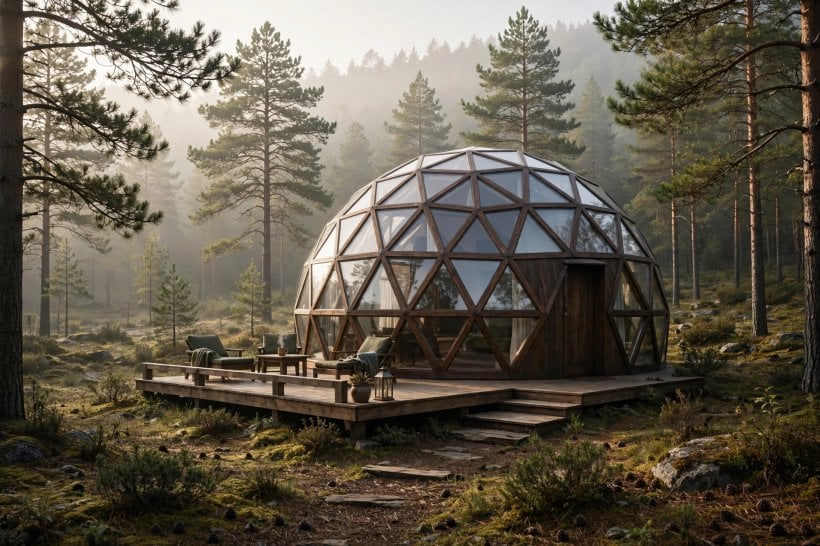
The weaknesses live inside. Curved walls fight furniture, room division, and conventional fixtures — the number-one lived-experience complaint among dome owners, and the reason dome interiors drift toward custom-built everything. Permitting is non-standard, though dome-friendly engineers exist and kit engineering packages do much of the arguing. Resale is niche, and there is the “living in a planetarium” adjustment: a soaring central volume that delights guests and disorients residents for the first month. None of this diminishes the engineering case; it defines who should make it. Domes are the engineer’s dream and the interior designer’s puzzle, and the households happiest in them are the ones who walked in loving both halves of that sentence.
5. Head-to-Head: The Comparison
Run all four dwellings across the seven measures and the pattern of trade-offs sharpens into a table you can decide from. On all-in cost for a comfortable, finished home: container $30K–150K; dome kit $50K–150K; tiny house $60K–150K; Earthship $150K–400K+. On build time: container weeks to months; dome kit days to weeks; tiny house months; Earthship years. On DIY feasibility: the Earthship scores highest, because labour literally is its budget; dome kits are high, being assembly; container and tiny house are moderate, the container demanding cutting and welding skills.
On energy performance: the Earthship is best, being passive by design; the dome is excellent on shape; the tiny house is good on smallness; the container is hardest, fighting its own thermal bridging. On mobility, the tiny house on wheels wins outright — the rest are permanent, full stop. On legality ease, the tiny house’s RV path is easiest; container moderate; dome moderate-hard; Earthship hardest. And on resale, the tiny house is the most liquid market of the four, containers are growing, domes are niche, and the Earthship’s market is the thinnest. No column sweeps the table. That is the comparison’s real finding: each dwelling wins the measures its design refused to compromise, and loses the ones it traded away.
6. The Legal Landscape for Each
Earthships are permitted as experimental or sustainable construction in friendly jurisdictions — Taos County, New Mexico is the exemplar — while elsewhere you can expect engineering reviews, variances, and patience. The tire walls are the permitting crux: structural engineers who will stamp them exist, but they are few. Containers are increasingly accepted under the IRC and IBC as alternative construction, with engineered connection details and insulation meeting energy code; some jurisdictions have container-specific provisions. Domes split by type: geodesic kits often arrive engineered and stamped — the kit’s engineering package is the permit argument — and monolithic domes have established engineering behind them.

In all three, the pattern holds exactly: engineered documentation plus a friendly jurisdiction equals a permit; improvisation plus a strict jurisdiction equals a denial. That pattern is the same one tiny house builders meet at the zoning counter, which is why the approach in our guide to zoning laws for tiny houses and how to talk to officials — arrive with documents, speak the department’s language, get answers in writing — transfers to the cousins unchanged. The practical sequence is also unchanged: choose the jurisdiction as carefully as the dwelling, because a dome kit with a stamped engineering package in a receptive county is an easier build than a conventional tiny house argued into a hostile one.
7. Living in Them: The Daily Reality
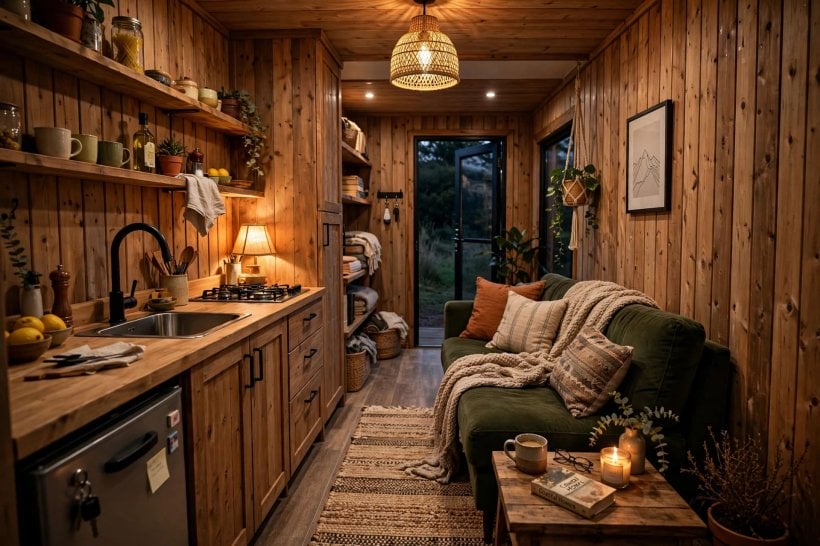
Earthship life centres on the greenhouse corridor — food growing inside the thermal envelope, the signature joy of the design — and on temperature stability, the mass doing the work at 65–75°F year-round in many climates. The offset is systems maintenance: the botanical sewage cells, cisterns, and batteries are a part-time job, pleasant for the philosophically committed and a chore for everyone else. Container life is the opposite surprise: conventional once finished. It feels like a narrow apartment — familiar, practical — with one acoustic signature, because rain on steel is loud and only insulation mitigates it.
Dome life is the volume: a cathedral-like central space that feels glorious every single day, balanced against the furniture puzzle — custom solutions for curved walls, ongoing — and the acoustics, because sound focuses oddly in domes, the famous whispering-gallery effect installed permanently in your living room. Step back and the daily-reality pattern is as consistent as the cost pattern: each dwelling’s signature joy and signature chore are the same feature viewed from two sides. The greenhouse is both the garden and the job. The steel is both the fast shell and the loud roof. The curve is both the cathedral and the puzzle. Choosing well means choosing which feature you want to live with in both its moods — a question the communal versions of these experiments answer at larger scale in our tour of off-grid alternative communities, cohousing and ecovillages.
8. Which One Is Actually Cheapest?
The honest ranking by total cost of comfortable, legal, finished shelter: a simple container cabin or dome kit, at $40,000–80,000, can undercut a builder-built tiny house — if the site work and finishes are disciplined, which is a larger “if” than most budgets admit. But the comparison most people actually need cuts the other way: a used certified tiny house on wheels, at $40,000–70,000 — movable, financeable, insurable — beats all three cousins on practical economics for most buyers. The alternatives win on philosophy, permanence, and self-sufficiency, not on price.
Anyone choosing on price alone should price the whole project, honestly, before romanticizing the box, the dome, or the tires — the shell is the cheap part of every dwelling in this guide, and the site work, insulation, finishes and permits are where budgets go to be corrected. The line-by-line version of that honesty for the tiny house itself is worked through in our guide to the true cost of tiny houses, prefab vs DIY, and its lesson generalizes: a dwelling’s sticker is its first chapter, not its story. The Earthship’s sticker hides thousands of hours; the container’s hides insulation; the dome kit’s hides the interior. Price the whole project, and the cheapest answer is usually the dwelling whose hidden chapters you are genuinely equipped to write.
9. Hybrids: The Best of Multiple Worlds
The experienced alternative-housing pattern is to combine systems. The classic: an Earthship-style greenhouse attached to a conventional tiny structure — food growing and a thermal buffer without the full tire commitment. Then the utility-core pattern: containers as the bathroom, kitchen and mechanical core in steel boxes, with conventional or timber framing for the living space around them. And the community pattern: a dome as the gathering and event space, with tiny houses as private quarters around it. Each hybrid takes a system’s strength and skips its weakness, which is the mark of builders who have lived with the pure versions and kept notes.
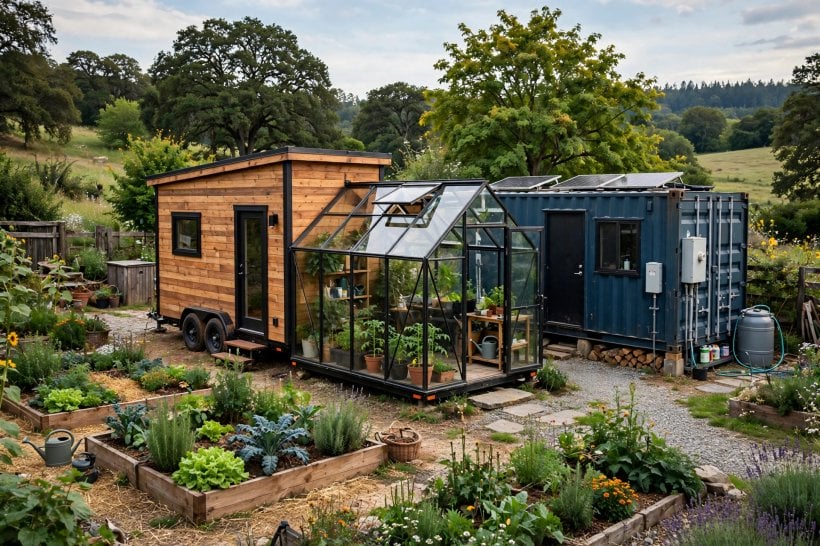
The community pattern deserves the extra sentence, because it scales the hybrid idea from one household to a settlement: the dome’s volume is wasted on one couple’s sleeping quarters and perfect for shared meals and workshops, while privacy — the thing domes do worst — is handed to the tiny houses that do it best. That division of labour is exactly how the legal communities in our roundup of tiny house villages and successful legal communities organize shared and private space. Hybrids are not indecision; they are the second-generation answer, and the fact that experienced builders converge on them is the strongest evidence in this guide that no single cousin wins outright.
10. Making the Choice: The Decision Framework
Choose the tiny house if you want mobility, the clearest legal path, resale value, and conventional rooms. Choose the Earthship if autonomy is the goal, you have years and a crew, and the philosophy is the point. Choose the container if you love the industrial aesthetic, want fast structure, and will invest in proper insulation. Choose the dome if structural resilience and energy efficiency top the list and you embrace the interior puzzle. Choose the hybrid if you have lived in one pure type and know exactly what you would change.
One step sits underneath every branch of that framework, whichever dwelling wins: the land. Every cousin except the tiny house on wheels is permanent, which makes the parcel a one-way decision — and the diligence sequence in our guide to how to prepare land for a tiny house, perc test and zoning verification before purchase, applies to a dome or an Earthship with even higher stakes than to a house that can be towed away from a mistake. Pick the dwelling by what you value; pick the land like the dwelling can never leave it — for three of the four, it can’t.
Final Considerations
Earthships, container homes, domes, and tiny houses are not rivals but relatives — four answers to the same question of how to dwell lightly on the earth. The tiny house offers the most practical path; the Earthship the deepest autonomy; the container the fastest structure; the dome the strongest shell. Know what you value — mobility, self-sufficiency, speed, resilience — and the right cousin steps forward. The alternative housing world is wide; the tiny house is the doorway, not the destination.



4 Comments