
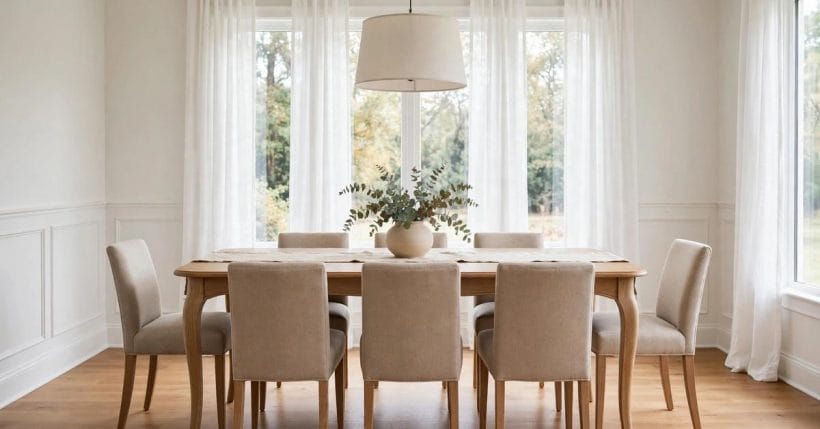
A dining room in the transitional manner sits comfortably between two older ways of decorating, borrowing the warmth and manners of a traditional room and the calm, clean lines of a modern one, and it refuses to let either side take over completely. Nothing shouts, nothing feels stiff, and nothing looks as though it were bought in a single hurried afternoon, because the whole point is a room that feels settled, welcoming and easy to live with across many years of ordinary meals and larger gatherings alike. This guide gathers seventy-five ideas for building that kind of room, from the shape of the table and the comfort of the chairs to the colour on the walls, the light over the table and the storage that keeps serving simple.
The ideas below are written for a dining room only, and for this style only, so every suggestion stays inside that frame rather than wandering into kitchens, living rooms or bedrooms, and every choice is judged by the same simple test, which is whether it helps people sit longer, talk more easily and feel at home at the table. A room built this way does not need to be large, grand or expensively furnished, because the style works through balance, through soft colour, through honest materials and through pieces that are comfortable before they are showy, and a modest room handled with care will often feel more inviting than a grand room filled without thought. If you are still settling the broad shape of your dining space, the wider survey of dining room ideas sets out the general ground that this guide then narrows to one particular manner of decorating.
Costs are treated here only in general terms, because what a room ends up asking of a household depends on drivers that vary from one home to another, such as the size of the table, the material it is made from, whether chairs are upholstered or plain, how much storage is built in, what kind of lighting is chosen and how much making or fitting the work involves. No figure is offered as a guide to what any single piece should cost, and no piece is presented as a bargain or a luxury, because the useful question is not a number but a set of choices, and the sections that follow help you weigh those choices in the order that matters most, starting with layout and the table, and ending with the small dressing details that make a room feel finished.
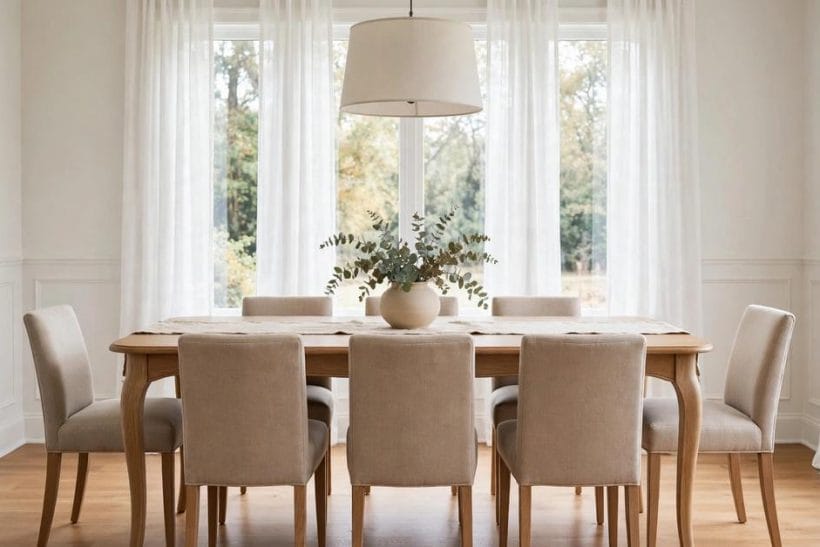
1. Layouts That Gather People Well
Layout comes before decoration, because a room that is hard to move around in will never feel welcoming however pretty its colours may be, and the first job is to give the table a clear centre, give every chair room to pull out and be pushed back, and keep a comfortable path for carrying dishes in and out without squeezing past seated guests. The best transitional layouts feel unforced, with the table centred on its light, the serving pieces within easy reach, and the doorway clear, so that the room works as well for a quiet supper for two as it does when every seat is taken. In a compact room the same thinking applies with even more care, and the survey of small dining rooms shows how a tighter footprint can still hold a proper table when the shape and the seating are chosen honestly.
| Item | What it is |
|---|---|
| Centre the table on its light | Begin by placing the table so that its middle sits directly beneath the main light, because a light that hangs off to one side makes the whole room feel slightly wrong even when guests cannot quite say why, and a centred light gives the table a natural focus that draws people in and makes serving feel orderly. |
| Leave a generous path to the kitchen | Keep the route between the table and the kitchen as direct and as clear as possible, because every meal involves several journeys with hot dishes, and a path that forces the carrier to edge sideways past chairs will make serving feel like a chore rather than a pleasure. |
| Let one wall carry the serving pieces | Choose a single wall for the sideboard, dresser or console, and keep the other walls lighter, because a room with serving furniture on every side feels busy and leaves nowhere for the eye to rest, while one well-dressed wall gives the room a backbone and a place for lamps, candles and serving dishes to live. |
| Angle a table in an awkward corner | When a room has an awkward corner, a bay or a door that will not move, try turning the table slightly rather than forcing it square to walls that do not cooperate, because a gentle angle can open up the walking space on one side and make an odd shape feel deliberate instead of accidental. |
| Use a rug to mark the dining ground | A rug beneath the table does more than warm the floor, because it marks out the dining ground, tells guests where the room for eating begins and ends, and softens sound so that conversation stays easy even when the table is full. |
| Keep the doorway clear of chairs | Never let a chair back block a doorway or a passage, because a blocked doorway makes a room feel smaller than it is and turns every entrance into a small negotiation, while a clear doorway lets guests arrive without apology and lets the host move freely. |
| Float the table when the room allows | In a room with space to spare, pull the table away from the walls and let it float in the middle of the floor, because a floating table can be walked around from every side, which makes serving easier, lets guests sit where they like, and gives the room a generous, unhurried feeling. |
| Plan for the largest gathering first | Think about the largest gathering the room will ever hold before settling the everyday arrangement, because a layout that works beautifully for a quiet household can fail badly when guests arrive, and it is far easier to plan for extra seats from the start than to rearrange a room under pressure. |
| Choose a rectangular table for long rooms | A rectangular table suits a long room better than any other shape, because it follows the line of the walls, leaves even walking space on both sides, and seats guests in a sociable row where conversation can travel easily along the table. |
| Choose a round table for conversation | A round table suits a squarer room and a household that values conversation, because every guest can see every other guest, nobody sits at the head in a formal way, and the room feels softer and less regimented than it does with a long rectangle. |
| Let an extending table earn its keep | An extending table is worth considering when the room must serve both small and large gatherings, because it keeps the everyday footprint modest while still allowing the table to grow when guests arrive, and the extension should feel like part of the table rather than an afterthought. |
| Soften the table edge | Look for a table edge that is rounded, bevelled or gently eased rather than sharp, because a softened edge is kinder to forearms during a long meal, safer for children passing by, and truer to the transitional manner, which favours gentle curves over hard corners. |
| Match the wood tone to the floor, loosely | Let the table wood sit comfortably beside the floor rather than matching it exactly, because an exact match can make the room feel flat, while a tone that is a little lighter or a little darker gives the table its own presence and lets the floor and the furniture each be seen. |
| Consider a painted table for a lighter room | A painted table in a soft white, warm grey or muted green can lighten a room that feels dark or heavy, and it brings a gentle country ease that suits the transitional manner when the paint is kept matte and the shape stays simple. |
| Keep the tabletop clear between meals | Resist the urge to fill the tabletop with permanent decoration, because a clear table invites use, makes the room feel larger, and lets the meal itself become the decoration when guests arrive. |
| Protect the top without hiding it | Protect a wood top with a runner, mats or a soft cloth under hot dishes, because a table that is used daily will show its life, and a little care keeps the surface beautiful for years without covering it in plastic or hiding the grain that made you choose it. |
| Upholster the seat, not just the back | Choose chairs with a padded seat as well as a comfortable back, because a hard seat will hurry guests away from the table no matter how beautiful the room looks, while a generously padded seat invites people to stay for another course and another conversation. |
| Mix chairs and a bench with care | Pair chairs on one side of the table with a bench on the other when the room needs flexibility, because a bench seats a changing number of guests, slides neatly under the table when not in use, and gives the room a relaxed, family feeling. |
| Give the host chairs arms | Place armchairs at the ends of a rectangular table to mark the hosts seats gently, because arms give a sense of occasion and comfort, and they frame the table in a way that makes the whole arrangement look considered. |
| Slipcover for easy living | Consider slipcovered chairs when the household includes children, pets or frequent large meals, because a slipcover can be removed and washed, which keeps pale fabric practical rather than precious, and the soft drape of a slipcover suits the relaxed side of this style beautifully. |
| Test chairs for a full hour | Before settling on chairs, sit in them for a good long while rather than perching for a moment, because a chair that feels fine for a minute can grow uncomfortable over a meal, and the true test of a dining chair is how it feels when conversation is still going strong. |
| Keep chair backs in proportion | Choose chair backs that sit in proportion to the table and the room, neither so tall that they dominate the space nor so low that guests feel unsupported, because a well-proportioned back helps the room feel balanced and lets the table, rather than a forest of tall backs, hold the eye. |
| Let fabric do the softening | Use fabric to soften a room that might otherwise feel hard, because linen, cotton and soft weaves absorb sound, warm the colour and make the whole space feel more welcoming than bare wood or metal alone. |
| Keep a spare chair nearby | Keep one or two spare chairs within easy reach, perhaps against a wall or in a nearby room, because an unexpected guest should never mean a scramble, and a room that can welcome one more person without fuss feels generous. |
| Start with a warm white | Begin the palette with a warm white on the main walls, because a warm white reflects light kindly, flatters wood and linen, and gives every other colour in the room a calm ground to sit against. |
| Layer greige for depth | Layer greige, that soft meeting of grey and beige, through chairs, curtains and the rug, because greige adds depth without adding drama, and it lets wood tones and metal finishes sit comfortably beside each other. |
| Add one muted accent colour | Add a single muted accent, such as sage, dusty blue or soft terracotta, in cushions, art or a vase, because one restrained accent gives the room personality, while several competing accents would make it feel restless. |
| Let wood be a colour too | Treat wood itself as part of the colour scheme, because the tone of the table, the floor and the sideboard does as much colour work as paint, and a room with warm wood needs less wall colour than a room with pale furniture. |
| Keep ceilings pale and light | Keep the ceiling pale, ideally a soft white, because a pale ceiling lifts the room, reflects the light from the table lamp and the windows, and stops a dining room with a large light fitting from feeling top-heavy. |
| Use dark notes sparingly | Use dark notes, such as a dark wood console, black metal frames or deep cushions, in small doses, because a few dark touches anchor the room and stop a pale palette from feeling washed out, while too much darkness would make the room feel heavy. |
| Repeat the accent in threes | Repeat an accent colour in at least a few places, such as a cushion, a vase and a piece of art, because repetition makes a colour feel intentional, while a single isolated splash can look like an accident. |
| Let daylight set the palette test | Judge every colour in daylight before committing, because dining rooms are used at all hours, and a colour that looks perfect under shop lights can turn cold or muddy in the light of your own windows. |
| Add simple wall panelling | Add simple rectangular panelling to the lower wall when the room feels too plain, because panelling gives structure, echoes traditional rooms without their formality, and protects the wall from chair backs. |
| Choose wood floors in warm tones | Choose wood flooring in a warm, mid tone when the choice is open, because warm wood grounds the table, flatters linen and upholstery, and ages gracefully under daily use. |
| Layer a woven rug underfoot | Layer a woven rug, in jute, wool or a soft flatweave, beneath the table, because a woven texture warms the floor, softens footsteps and adds a natural note that balances the smoother surfaces of wood and linen. |
| Hang art at eye level | Hang wall art so its centre sits at the eye level of a seated guest, because art hung too high floats away from the table and art hung too low crowds it, while art at seated eye level becomes part of the conversation. |
| Use a mirror to borrow light | Place a mirror where it can borrow light from a window or reflect the glow of the table light, because a mirror doubles the sense of light and space without adding any furniture, and a simple wood or slim metal frame keeps it in the transitional manner. |
| Soften walls with linen curtains | Dress windows with linen curtains that fall to the floor, because linen softens the hard edges of glass and frames, filters daylight beautifully, and adds a vertical softness that balances the horizontal table. |
| Keep the ceiling simple | Keep the ceiling plain or with only a simple cornice, because a busy ceiling competes with the light fitting and the table below, while a calm ceiling lets the room breathe. |
| Let texture replace pattern | When the room starts to feel flat, add texture rather than pattern, because a woven throw, a ceramic vase, a linen runner and a wood grain together give richness without visual noise. |
| Hang the main light low over the table | Hang the main light so its glow pools over the tabletop rather than washing the whole ceiling, because a low light creates intimacy, makes the meal look inviting, and lets guests see each other across a warm pool of light. |
| Choose a drum shade for softness | Consider a drum shade in linen or a soft fabric when the room needs gentle, even light, because a drum shade diffuses the bulb, hides glare, and gives the classic transitional silhouette that suits both traditional and modern neighbours. |
| Use restrained crystal for occasion | Use crystal in a restrained way when the room calls for a little occasion, because a simple crystal fixture with clean lines can sparkle without turning the room formal, while an overly ornate chandelier would pull the room toward a grander style. |
| Add lamps to the sideboard | Place a pair of lamps on the sideboard or console, because side lamps add a second layer of light at a lower level, soften the corners of the room, and make the serving wall glow in the evening. |
| Put every light on a dimmer | Fit dimmers to the main light and, where possible, to the side lamps, because a dining room is used for bright breakfasts, working lunches and soft evening meals, and no single brightness suits all three. |
| Choose warm bulbs throughout | Choose warm-toned bulbs for every light in the room, because warm light flatters skin, food and wood alike, while cool light can make a dining room feel like a workspace. |
| Let candles finish the table | Finish the table with candles for evening meals, because candlelight is the oldest dining light and still the most flattering, and a few candles in simple holders add life and movement that electric light cannot match. |
| Choose a sideboard with closed doors | Choose a sideboard with doors that close, because closed storage hides the mixed shapes of serving dishes and keeps the room looking calm even when the inside is busy. |
| Display only the prettiest pieces | Display only the serving pieces that are genuinely pleasing, such as a favourite platter, a set of glasses or a simple vase, because a dresser crowded with every dish the household owns looks like a shop, while a few chosen pieces look like a home. |
| Keep linen near the table | Keep table linen in the sideboard drawer nearest the table, because linen that lives far away will not be used, and a room where the tablecloth, napkins and runner are within reach is a room that gets dressed properly for guests. |
| Give glasses their own shelf | Give glasses a shelf of their own, away from heavy platters, because glasses chip easily and a dedicated shelf keeps them safe, visible and easy to reach when setting the table. |
| Use a tray for serving | Keep a sturdy tray in the sideboard for carrying dishes, glasses and condiments, because a tray turns several trips into one, protects the table from hot dishes on the way, and gives the host a graceful way to clear. |
| Store extra leaves safely | Store table leaves flat, dry and protected, because a leaf that warps or scratches will never sit flush again, and the extending table is only useful if its leaves are in good condition. |
| Leave breathing room on shelves | Leave empty space on every shelf and on the sideboard top, because a surface with room to breathe looks calm and gives you somewhere to set a dish down in the middle of serving, while a surface filled edge to edge looks busy and leaves no room for the meal itself. |
| Lay a simple linen runner | Lay a linen runner down the centre of the table, because a runner protects the wood, adds a soft line of colour, and gives the centrepiece a natural home without covering the whole table. |
| Fold napkins without fuss | Fold napkins simply, in a rectangle or a soft roll, because an elaborate fold looks fussy in this style and collapses at the first touch, while a simple fold looks confident and lets the fabric itself be the decoration. |
| Keep the centrepiece low | Keep the centrepiece low enough that guests can see each other over it, because a tall arrangement turns a sociable table into two separate sides, while a low bowl of flowers, a row of candles or a simple ceramic piece lets conversation flow. |
| Change greenery with the seasons | Change the greenery on the table with the seasons, using fresh leaves, simple branches or a small potted herb, because a living centrepiece keeps the room feeling current and costs little in effort. |
| Mix ceramics with confidence | Mix ceramic pieces in soft whites, creams and muted earth tones, because a table set entirely in one matching set can feel stiff, while a gentle mixture of ceramics feels collected and lived with. |
| Use placemats for daily meals | Use placemats for everyday meals, because they protect the table, mark each place clearly, and can be changed quickly when the meal changes. |
| Dress the table before guests arrive | Set the table fully before guests arrive, with glasses, cutlery and napkins in place, because a table set in advance welcomes guests the moment they enter, and it saves the host from fussing while guests are already seated. |
| Lean warmer for a family room | Lean warmer, with deeper wood tones, warmer whites and soft terracotta touches, when the dining room is mainly a family room, because warmth forgives daily wear, flatters wood and linen, and makes a busy household feel cosy rather than exposed. |
| Lean cooler for a bright room | Lean cooler, with pale greys, soft blue-greys and lighter woods, when the room is very bright or faces the sun for much of the day, because cooler tones balance strong daylight and keep a sunny room feeling fresh rather than glaring. |
| Borrow tradition gently | Borrow traditional details gently, such as a turned leg, a panelled wall or a classic shade, because one or two traditional notes give the room roots, while a room full of them becomes a period room rather than a transitional one. |
| Borrow modern calm sparingly | Borrow modern calm sparingly, such as a clean-lined sideboard, a simple mirror or a slim metal light, because a touch of modern clarity keeps the room from feeling dated, while too much of it would harden a room that should feel soft. |
| Dress up for celebrations simply | Dress the room up for celebrations with simple changes, such as candles, fresh flowers, a tablecloth and the best glasses, because a room that needs a major rearrangement for a celebration will rarely be dressed at all. |
| Keep everyday meals beautiful too | Keep everyday meals beautiful with the same care, using cloth napkins, a simple runner and a low centrepiece even on ordinary days, because a room that is only beautiful for guests teaches the household that daily life does not deserve beauty. |
| Let the room age gracefully | Choose pieces and finishes that will age gracefully, because wood mellows, linen softens and a well-made table gains character with use, and a room built from honest materials will look better in a few years than a room built from fashionable surfaces. |
1. Centre the table on its light
Begin by placing the table so that its middle sits directly beneath the main light, because a light that hangs off to one side makes the whole room feel slightly wrong even when guests cannot quite say why, and a centred light gives the table a natural focus that draws people in and makes serving feel orderly. Once the table and the light agree, the rest of the room can be arranged around them with confidence, and chairs, storage and wall pieces will fall into place without crowding the centre of the room.
2. Leave a generous path to the kitchen
Keep the route between the table and the kitchen as direct and as clear as possible, because every meal involves several journeys with hot dishes, and a path that forces the carrier to edge sideways past chairs will make serving feel like a chore rather than a pleasure. A clear route also keeps conversation flowing, since the person serving can return quickly to the table instead of being held up in a narrow gap, and the room feels larger when movement is easy.
3. Let one wall carry the serving pieces
Choose a single wall for the sideboard, dresser or console, and keep the other walls lighter, because a room with serving furniture on every side feels busy and leaves nowhere for the eye to rest, while one well-dressed wall gives the room a backbone and a place for lamps, candles and serving dishes to live. That wall becomes the natural backdrop for the table, and it keeps the daily work of serving close at hand without turning the room into a storeroom.
4. Angle a table in an awkward corner
When a room has an awkward corner, a bay or a door that will not move, try turning the table slightly rather than forcing it square to walls that do not cooperate, because a gentle angle can open up the walking space on one side and make an odd shape feel deliberate instead of accidental. The trick is to keep the angle modest, so the room still reads as calm and orderly, and to let the light and the rug follow the table rather than fighting it.
5. Use a rug to mark the dining ground
A rug beneath the table does more than warm the floor, because it marks out the dining ground, tells guests where the room for eating begins and ends, and softens sound so that conversation stays easy even when the table is full. Choose a rug large enough that chairs stay on it when they are pulled out, and keep its pattern quiet, so that it supports the room rather than competing with the table, the chairs and the light above.
6. Keep the doorway clear of chairs
Never let a chair back block a doorway or a passage, because a blocked doorway makes a room feel smaller than it is and turns every entrance into a small negotiation, while a clear doorway lets guests arrive without apology and lets the host move freely. If the room is tight, choose a slimmer chair or a shorter table rather than squeezing a chair into the path, since comfort at the table matters more than squeezing in one extra seat.
7. Float the table when the room allows
In a room with space to spare, pull the table away from the walls and let it float in the middle of the floor, because a floating table can be walked around from every side, which makes serving easier, lets guests sit where they like, and gives the room a generous, unhurried feeling. A floating table also shows off the floor and the rug, and it stops the room from feeling like a corridor with furniture pushed to the edges.
8. Plan for the largest gathering first
Think about the largest gathering the room will ever hold before settling the everyday arrangement, because a layout that works beautifully for a quiet household can fail badly when guests arrive, and it is far easier to plan for extra seats from the start than to rearrange a room under pressure. An extending table, a bench that slides in, or chairs kept nearby can all help, but only if the floor space for them was considered when the table was first placed.
2. The Table, Chosen First
The table is the anchor of the room, and in this style it should feel substantial without feeling heavy, with softened edges, a warm wood tone or a pale painted finish, and legs that have a gentle curve or a simple turned detail rather than a sharp modern slab or an ornate carving. A transitional table does not try to be the star of the room, because its job is to bring people together and to hold the meal, the candles and the conversation, and the best tables in this manner are the ones guests notice only when they sit down and realise how comfortable the whole arrangement feels. Size matters more than ornament, so measure the room honestly, allow room for chairs to move, and choose a table that leaves the room feeling generous rather than filled.
9. Choose a rectangular table for long rooms
A rectangular table suits a long room better than any other shape, because it follows the line of the walls, leaves even walking space on both sides, and seats guests in a sociable row where conversation can travel easily along the table. It also takes an extending leaf gracefully, so the same table can serve a small household through the week and a larger party at the weekend without changing the character of the room.
10. Choose a round table for conversation
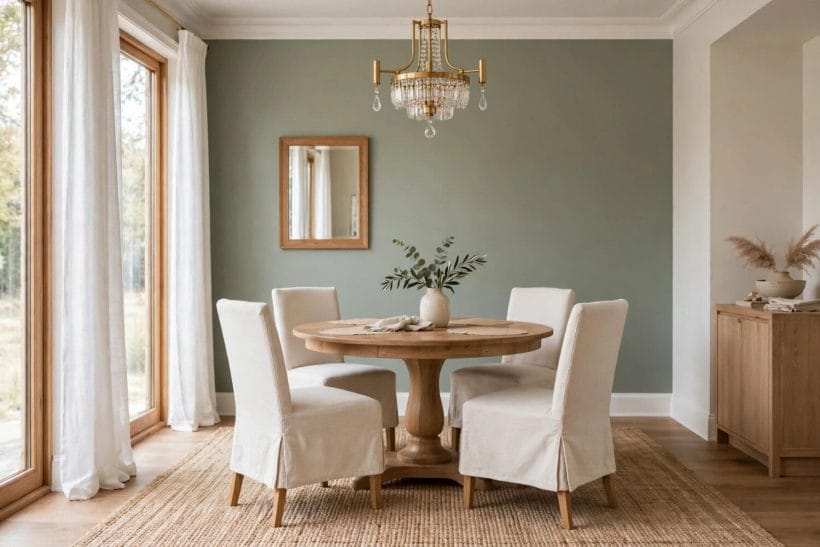
A round table suits a squarer room and a household that values conversation, because every guest can see every other guest, nobody sits at the head in a formal way, and the room feels softer and less regimented than it does with a long rectangle. A pedestal base helps here, since it frees legroom and lets chairs tuck in neatly, and a round table in a bay or a corner nook can turn an awkward space into the most loved seat in the house.
11. Let an extending table earn its keep
An extending table is worth considering when the room must serve both small and large gatherings, because it keeps the everyday footprint modest while still allowing the table to grow when guests arrive, and the extension should feel like part of the table rather than an afterthought. Test the mechanism for ease, check that the extended table still leaves walking room, and store the extra leaves where they can be reached without a struggle.
12. Soften the table edge
Look for a table edge that is rounded, bevelled or gently eased rather than sharp, because a softened edge is kinder to forearms during a long meal, safer for children passing by, and truer to the transitional manner, which favours gentle curves over hard corners. The softened edge also catches light in a pleasing way, giving the table a warm, worn-in look even when it is new.
13. Match the wood tone to the floor, loosely
Let the table wood sit comfortably beside the floor rather than matching it exactly, because an exact match can make the room feel flat, while a tone that is a little lighter or a little darker gives the table its own presence and lets the floor and the furniture each be seen. Warm oak, walnut and pale washed woods all suit this style, and the choice should be guided by the light in the room and the colours already on the walls.
14. Consider a painted table for a lighter room
A painted table in a soft white, warm grey or muted green can lighten a room that feels dark or heavy, and it brings a gentle country ease that suits the transitional manner when the paint is kept matte and the shape stays simple. Painted wood also forgives daily wear more kindly than a dark polished surface, and it pairs beautifully with linen chairs and a simple runner, keeping the room calm rather than formal.
15. Keep the tabletop clear between meals
Resist the urge to fill the tabletop with permanent decoration, because a clear table invites use, makes the room feel larger, and lets the meal itself become the decoration when guests arrive. A single low arrangement, a runner or a pair of candlesticks is enough for everyday, and the rest of the dressing can be added when the table is set, so the room never feels like a display.
16. Protect the top without hiding it
Protect a wood top with a runner, mats or a soft cloth under hot dishes, because a table that is used daily will show its life, and a little care keeps the surface beautiful for years without covering it in plastic or hiding the grain that made you choose it. A runner down the centre protects the most-used strip while still showing the wood at the edges, which is the best of both worlds.
3. Seating That Stays Comfortable
Chairs decide whether guests linger or leave early, and in this style they should be upholstered enough to be kind over a long meal, with a seat that supports without sagging, a back that reaches comfortably, and fabric that can be cleaned or covered without fuss. The transitional chair often has a simple frame, a gently shaped back and a cushion in linen or a washable weave, and it looks neither like a stiff formal dining chair nor like a casual kitchen stool, which is exactly the middle ground the style aims for. Mixing a bench on one side can soften the formality further and seat children or extra guests with ease, while host chairs with arms at the ends of the table give the room a quiet sense of occasion. The sleeker end of the dining world, surveyed among modern dining rooms, shows the contrast clearly, because where that manner favours sculptural hardness, this one favours softness you can feel after an hour at the table.
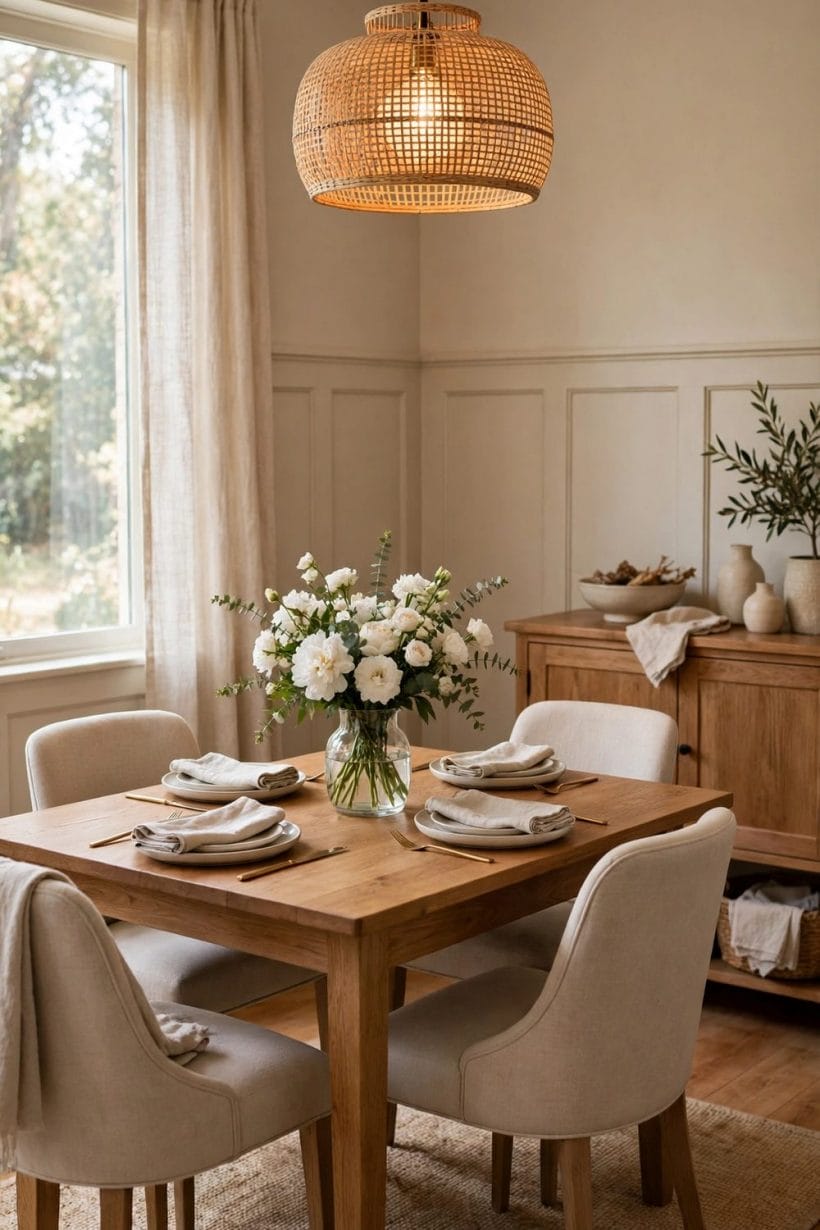
17. Upholster the seat, not just the back
Choose chairs with a padded seat as well as a comfortable back, because a hard seat will hurry guests away from the table no matter how beautiful the room looks, while a generously padded seat invites people to stay for another course and another conversation. The padding need not be deep or plush, but it should feel supportive after a long meal, and a removable cushion makes cleaning far simpler.
18. Mix chairs and a bench with care
Pair chairs on one side of the table with a bench on the other when the room needs flexibility, because a bench seats a changing number of guests, slides neatly under the table when not in use, and gives the room a relaxed, family feeling. Keep the bench cushion in the same fabric family as the chairs, so the mixture reads as deliberate rather than accidental, and check that the bench height matches the table.
19. Give the host chairs arms
Place armchairs at the ends of a rectangular table to mark the hosts seats gently, because arms give a sense of occasion and comfort, and they frame the table in a way that makes the whole arrangement look considered. The armchairs should still be light enough to move and slim enough not to crowd the corners, and their upholstery should echo the side chairs rather than shout against them.
20. Slipcover for easy living
Consider slipcovered chairs when the household includes children, pets or frequent large meals, because a slipcover can be removed and washed, which keeps pale fabric practical rather than precious, and the soft drape of a slipcover suits the relaxed side of this style beautifully. Choose a washable linen-look fabric, keep the fit neat rather than baggy, and keep a spare set if the chairs see daily use.
21. Test chairs for a full hour
Before settling on chairs, sit in them for a good long while rather than perching for a moment, because a chair that feels fine for a minute can grow uncomfortable over a meal, and the true test of a dining chair is how it feels when conversation is still going strong. Check the seat height against the table, the back support, and whether your feet rest comfortably, since all three matter more than the chair’s appearance alone.
22. Keep chair backs in proportion
Choose chair backs that sit in proportion to the table and the room, neither so tall that they dominate the space nor so low that guests feel unsupported, because a well-proportioned back helps the room feel balanced and lets the table, rather than a forest of tall backs, hold the eye. A mid-height back with a gentle curve is the safest transitional choice, and it works in both small and large rooms.
23. Let fabric do the softening
Use fabric to soften a room that might otherwise feel hard, because linen, cotton and soft weaves absorb sound, warm the colour and make the whole space feel more welcoming than bare wood or metal alone. A pale neutral fabric keeps the room calm, while a muted pattern on the seat can add interest without turning the room busy, and washable fabrics keep the softness practical.
24. Keep a spare chair nearby
Keep one or two spare chairs within easy reach, perhaps against a wall or in a nearby room, because an unexpected guest should never mean a scramble, and a room that can welcome one more person without fuss feels generous. The spare chairs should match the set closely enough not to look like an apology, and they should be light enough for one person to carry without help.
4. Colour, Calm and Gentle Contrast
Colour in this style is a quiet background, not a performance, and it is built from warm whites, soft greys, greige tones, muted sage and gentle blue-greys, with deeper notes used sparingly as accents rather than as whole walls of drama. The palette should feel like a single calm wash with a few darker touches, so that the table, the chairs and the light stand out gently against it, and the room feels restful at noon and warm in the evening. A single accent wall in a muted tone can give the room depth, but the accent should stay muted, because a loud colour would pull the room toward a different style altogether, and the transitional manner depends on restraint. The warmer, timber-led end of the dining world, seen among farmhouse dining rooms, uses a similar warmth with a rougher hand, while this style keeps the same warmth but smooths it, pairing it with cleaner lines and softer finishes.
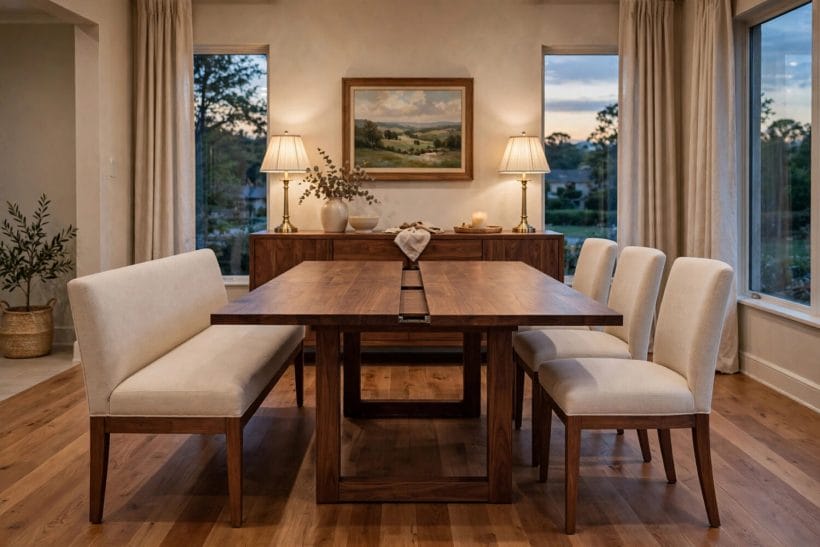
25. Start with a warm white
Begin the palette with a warm white on the main walls, because a warm white reflects light kindly, flatters wood and linen, and gives every other colour in the room a calm ground to sit against. Avoid a stark, cold white, which can make a dining room feel clinical, and choose a white with a hint of warmth that glows in the evening light.
26. Layer greige for depth
Layer greige, that soft meeting of grey and beige, through chairs, curtains and the rug, because greige adds depth without adding drama, and it lets wood tones and metal finishes sit comfortably beside each other. Used as a thread through the room, greige ties together pieces that were not bought as a set, which is one of the quiet strengths of this style.
27. Add one muted accent colour
Add a single muted accent, such as sage, dusty blue or soft terracotta, in cushions, art or a vase, because one restrained accent gives the room personality, while several competing accents would make it feel restless. Keep the accent muted and repeat it in small touches around the room, so it feels like a thread rather than a shout.
28. Let wood be a colour too
Treat wood itself as part of the colour scheme, because the tone of the table, the floor and the sideboard does as much colour work as paint, and a room with warm wood needs less wall colour than a room with pale furniture. Let the wood tones vary slightly rather than matching perfectly, so the room feels collected over time rather than bought at once.
29. Keep ceilings pale and light
Keep the ceiling pale, ideally a soft white, because a pale ceiling lifts the room, reflects the light from the table lamp and the windows, and stops a dining room with a large light fitting from feeling top-heavy. A pale ceiling also gives the eye somewhere calm to rest, which matters in a room where guests spend a long time looking up during conversation.
30. Use dark notes sparingly
Use dark notes, such as a dark wood console, black metal frames or deep cushions, in small doses, because a few dark touches anchor the room and stop a pale palette from feeling washed out, while too much darkness would make the room feel heavy. The dark pieces should be the quiet anchors, not the loudest voices in the room.
31. Repeat the accent in threes
Repeat an accent colour in at least a few places, such as a cushion, a vase and a piece of art, because repetition makes a colour feel intentional, while a single isolated splash can look like an accident. The repeats need not match exactly, and a family of similar tones will feel more natural than one flat colour used everywhere.
32. Let daylight set the palette test
Judge every colour in daylight before committing, because dining rooms are used at all hours, and a colour that looks perfect under shop lights can turn cold or muddy in the light of your own windows. Paint a generous sample on the wall, live with it through a day and an evening, and only then decide, since repainting a whole room is a far larger job than testing a patch.
5. Walls, Floors and Quiet Texture
Walls and floors in this style should be felt more than noticed, with subtle panelling, a soft plaster finish or a gentle paper adding texture without pattern shouting for attention, and wood floors in warm tones grounding the whole room. Wainscoting or a simple chair rail can give a plain wall structure and a traditional echo, but it should be painted the same soft tone as the wall or only slightly deeper, so it reads as texture rather than as a bold feature. The floor should be durable and easy to clean, since dining rooms see spills, and a rug over wood gives warmth and sound softening without hiding the floor entirely. Texture is the secret ingredient here, because a room with only flat surfaces feels thin, while linen, wood grain, woven rugs and matte ceramics together give the room a richness that colour alone cannot provide.
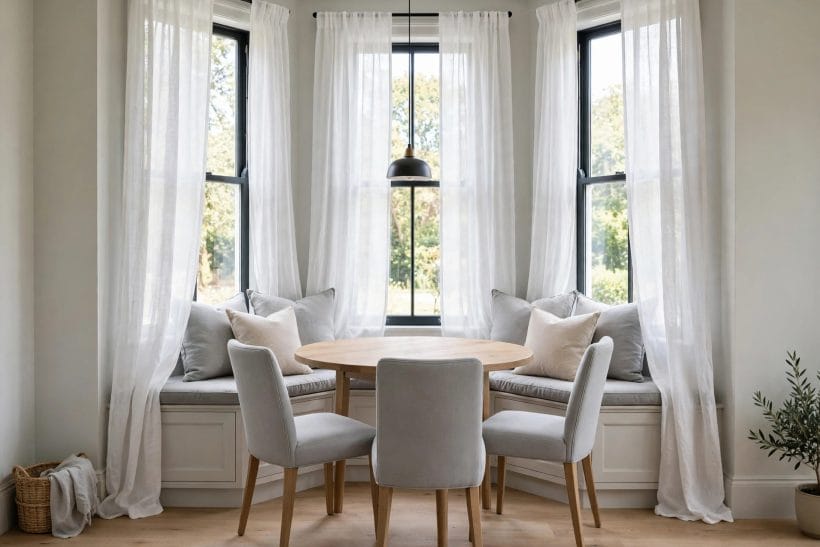
33. Add simple wall panelling
Add simple rectangular panelling to the lower wall when the room feels too plain, because panelling gives structure, echoes traditional rooms without their formality, and protects the wall from chair backs. Keep the panels simple and paint them in the wall colour or a tone close to it, so the effect is one of quiet craftsmanship rather than decoration for its own sake.
34. Choose wood floors in warm tones
Choose wood flooring in a warm, mid tone when the choice is open, because warm wood grounds the table, flatters linen and upholstery, and ages gracefully under daily use. A matte or satin finish suits this style better than a high gloss, which can look too polished, and wider boards give a calm, generous feeling underfoot.
35. Layer a woven rug underfoot
Layer a woven rug, in jute, wool or a soft flatweave, beneath the table, because a woven texture warms the floor, softens footsteps and adds a natural note that balances the smoother surfaces of wood and linen. Keep the rug pattern quiet and the pile low, so chairs move easily and cleaning stays simple.
36. Hang art at eye level
Hang wall art so its centre sits at the eye level of a seated guest, because art hung too high floats away from the table and art hung too low crowds it, while art at seated eye level becomes part of the conversation. A single larger piece often works better than many small ones, and a landscape or still life in muted tones suits the room better than a loud abstract.
37. Use a mirror to borrow light
Place a mirror where it can borrow light from a window or reflect the glow of the table light, because a mirror doubles the sense of light and space without adding any furniture, and a simple wood or slim metal frame keeps it in the transitional manner. Avoid placing a mirror where it reflects clutter, since it will double whatever it faces.
38. Soften walls with linen curtains
Dress windows with linen curtains that fall to the floor, because linen softens the hard edges of glass and frames, filters daylight beautifully, and adds a vertical softness that balances the horizontal table. Keep the curtains in a pale neutral, hang them high and wide so the window feels larger, and let them puddle only slightly, if at all.
39. Keep the ceiling simple
Keep the ceiling plain or with only a simple cornice, because a busy ceiling competes with the light fitting and the table below, while a calm ceiling lets the room breathe. If the room has beams, let them be part of the architecture rather than a feature to decorate, and paint them to sit quietly with the ceiling.
40. Let texture replace pattern
When the room starts to feel flat, add texture rather than pattern, because a woven throw, a ceramic vase, a linen runner and a wood grain together give richness without visual noise. Texture rewards a closer look, which is exactly what a dining room should do, since guests spend a long time sitting still and noticing the surfaces around them.
6. Lighting That Flatters Faces
Lighting makes or breaks a dining room, because the light over the table is the light guests sit in, and it should flatter faces, warm the food and make the whole table glow without glaring into anyone’s eyes. The main light should hang low enough to pool over the table, yet high enough that guests can see each other across it, and it should be dimmable, so the same room can move from bright family supper to soft evening gathering with a single touch. Layer the main light with softer side light, such as lamps on the sideboard or candles on the table, because a single overhead source alone creates harsh shadows, while layered light gives the room depth and warmth. For the fixture itself, the survey of dining room chandeliers covers the range of shapes that suit this style, from simple drum shades to restrained crystal, and the lesson there is the same as here, which is to choose a fixture that serves the table rather than dominating the room.
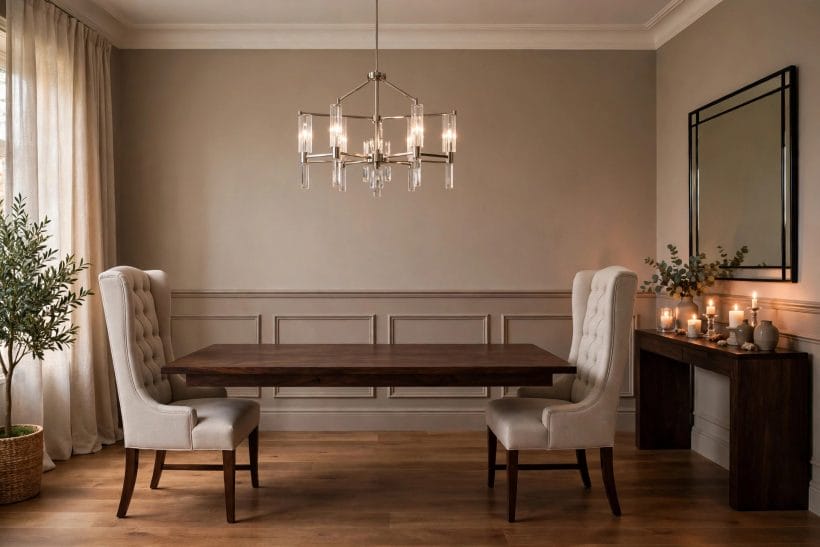
41. Hang the main light low over the table
Hang the main light so its glow pools over the tabletop rather than washing the whole ceiling, because a low light creates intimacy, makes the meal look inviting, and lets guests see each other across a warm pool of light. The exact height should be judged by eye, with the fixture clear of sightlines, and a dimmer lets you fine-tune the mood once the room is in use.
42. Choose a drum shade for softness
Consider a drum shade in linen or a soft fabric when the room needs gentle, even light, because a drum shade diffuses the bulb, hides glare, and gives the classic transitional silhouette that suits both traditional and modern neighbours. A drum shade in a warm neutral keeps the room calm, while a slightly larger drum suits a longer table better than a small, tight shade.
43. Use restrained crystal for occasion
Use crystal in a restrained way when the room calls for a little occasion, because a simple crystal fixture with clean lines can sparkle without turning the room formal, while an overly ornate chandelier would pull the room toward a grander style. Keep the crystal simple, the metal finish warm, and the scale in proportion to the table below.
44. Add lamps to the sideboard
Place a pair of lamps on the sideboard or console, because side lamps add a second layer of light at a lower level, soften the corners of the room, and make the serving wall glow in the evening. Matching lamps give symmetry, while lamps in the same family but slightly different heights can feel more collected, and both approaches suit this style.
45. Put every light on a dimmer
Fit dimmers to the main light and, where possible, to the side lamps, because a dining room is used for bright breakfasts, working lunches and soft evening meals, and no single brightness suits all three. A dimmer is a small change that transforms the room more than almost any other single choice, and it lets the same fixture serve every mood.
46. Choose warm bulbs throughout
Choose warm-toned bulbs for every light in the room, because warm light flatters skin, food and wood alike, while cool light can make a dining room feel like a workspace. Keep the warmth consistent across the main light, the lamps and any candles, so the room glows as one rather than in patches of different colour.
47. Let candles finish the table
Finish the table with candles for evening meals, because candlelight is the oldest dining light and still the most flattering, and a few candles in simple holders add life and movement that electric light cannot match. Keep candles low enough not to block faces, use holders that catch drips, and never leave them unattended.
7. Storage and Serving, Close at Hand
Storage is what keeps a dining room calm, because a room without a home for serving dishes, table linen, candles and extra glasses will slowly fill with clutter, and clutter is the enemy of the relaxed feeling this style aims for. A sideboard with closed doors is the workhorse here, hiding the everyday serving pieces while offering a top for lamps and display, and a dresser or hutch with glass doors can show the prettier pieces while keeping dust away. The seaside version of this thinking, among coastal dining rooms, leans lighter and airier, but the principle is identical, which is that serving should be easy, storage should be close, and the table should never have to hold what a sideboard could hold instead. Keep storage within a few steps of the table, group like with like, and leave some empty space on every shelf, because a sideboard stuffed to bursting is no better than no sideboard at all.
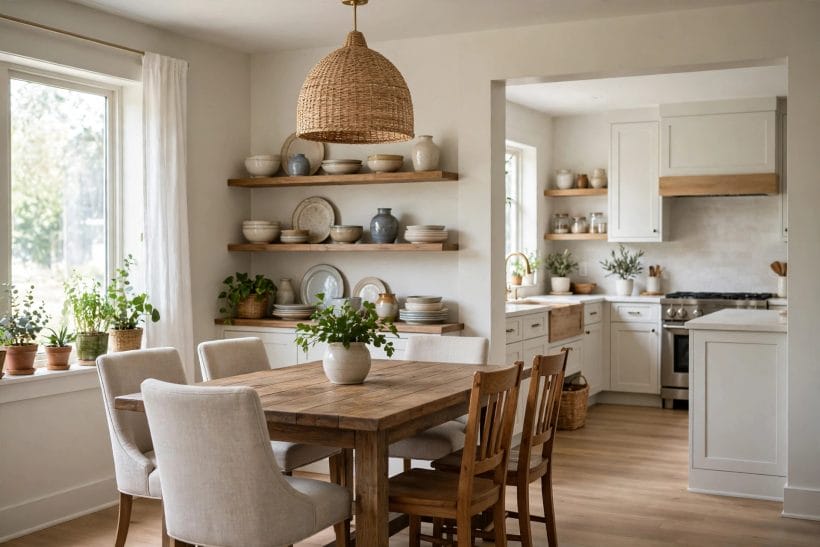
48. Choose a sideboard with closed doors
Choose a sideboard with doors that close, because closed storage hides the mixed shapes of serving dishes and keeps the room looking calm even when the inside is busy. A sideboard in warm wood or a soft painted finish suits this style, and its top becomes a natural home for lamps, a vase and the candles waiting for the evening.
49. Display only the prettiest pieces
Display only the serving pieces that are genuinely pleasing, such as a favourite platter, a set of glasses or a simple vase, because a dresser crowded with every dish the household owns looks like a shop, while a few chosen pieces look like a home. Rotate the display with the seasons if you like, and keep the rest behind closed doors.
50. Keep linen near the table
Keep table linen in the sideboard drawer nearest the table, because linen that lives far away will not be used, and a room where the tablecloth, napkins and runner are within reach is a room that gets dressed properly for guests. Fold linen neatly, keep a spare set for large gatherings, and store candles and holders in the same place.
51. Give glasses their own shelf
Give glasses a shelf of their own, away from heavy platters, because glasses chip easily and a dedicated shelf keeps them safe, visible and easy to reach when setting the table. Group them by use, keep everyday glasses at hand height, and reserve the higher shelves for pieces used only on special occasions.
52. Use a tray for serving
Keep a sturdy tray in the sideboard for carrying dishes, glasses and condiments, because a tray turns several trips into one, protects the table from hot dishes on the way, and gives the host a graceful way to clear. A wood or woven tray suits this style, and it can double as a centrepiece base when not in use.
53. Store extra leaves safely
Store table leaves flat, dry and protected, because a leaf that warps or scratches will never sit flush again, and the extending table is only useful if its leaves are in good condition. A cloth bag or a felt cover, stored in the sideboard or a nearby cupboard, keeps leaves safe and ready.
54. Leave breathing room on shelves
Leave empty space on every shelf and on the sideboard top, because a surface with room to breathe looks calm and gives you somewhere to set a dish down in the middle of serving, while a surface filled edge to edge looks busy and leaves no room for the meal itself. Empty space is not wasted space in a dining room, it is working space.
8. Textiles and Table Dressing
Textiles are where a dining room shows its softer side, and linen napkins, a simple runner, soft curtains and a woven rug together do more for warmth than any single piece of furniture. The transitional table is dressed simply, with a runner or a cloth in a pale neutral, napkins folded without fuss, and a low centrepiece that never blocks faces, because the meal and the guests are the decoration, not an elaborate display. Change the dressing with the seasons in small ways, such as greenery in winter, fresh flowers in spring and simple ceramics in summer, and the room will feel alive all year without ever needing a major change. Keep the palette of the textiles inside the room’s calm colours, and let texture, rather than bright pattern, carry the interest, so that the table looks inviting at a glance and comfortable up close.
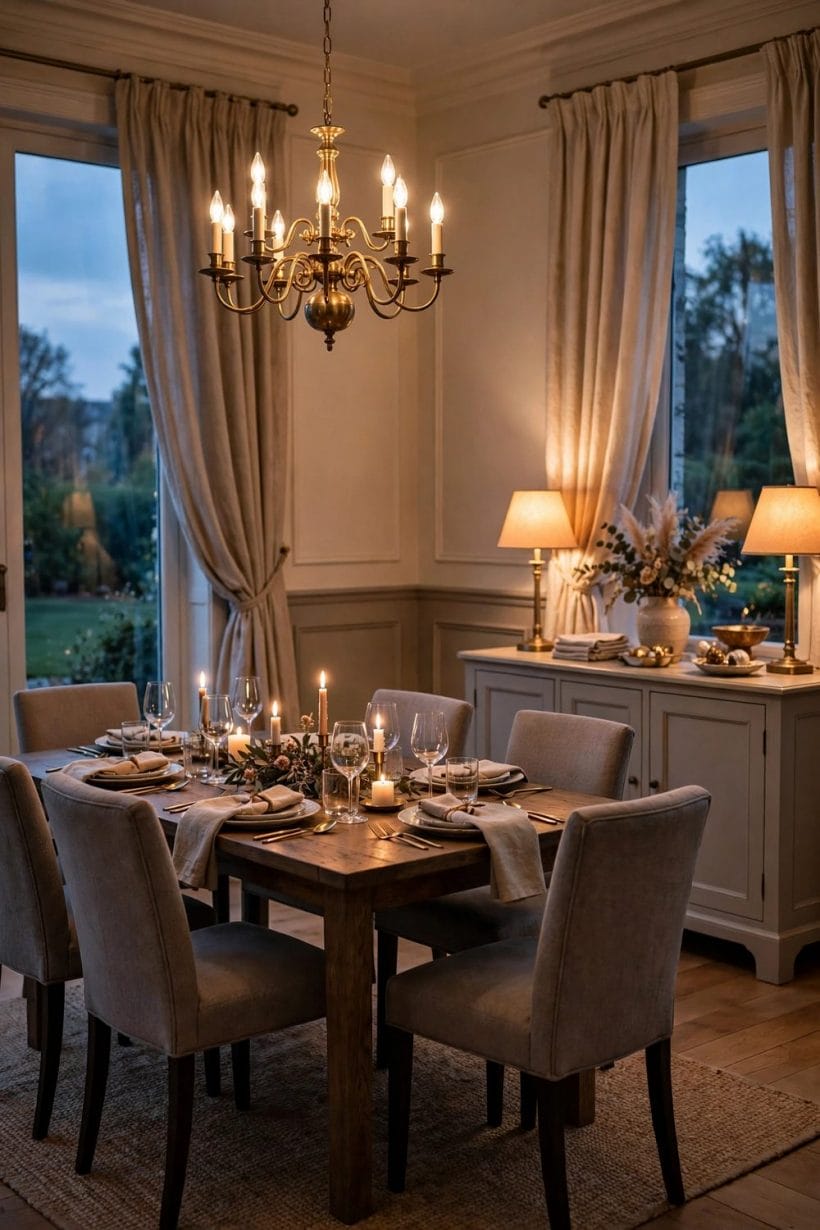
55. Lay a simple linen runner
Lay a linen runner down the centre of the table, because a runner protects the wood, adds a soft line of colour, and gives the centrepiece a natural home without covering the whole table. Choose a runner in a pale neutral or a muted tone from the room’s palette, and keep it long enough to hang slightly over each end without reaching the floor.
56. Fold napkins without fuss
Fold napkins simply, in a rectangle or a soft roll, because an elaborate fold looks fussy in this style and collapses at the first touch, while a simple fold looks confident and lets the fabric itself be the decoration. Cloth napkins in linen or a soft cotton suit the room far better than paper, and they make even a weekday meal feel considered.
57. Keep the centrepiece low
Keep the centrepiece low enough that guests can see each other over it, because a tall arrangement turns a sociable table into two separate sides, while a low bowl of flowers, a row of candles or a simple ceramic piece lets conversation flow. A low centrepiece also lets the light from above reach the whole table evenly.
58. Change greenery with the seasons
Change the greenery on the table with the seasons, using fresh leaves, simple branches or a small potted herb, because a living centrepiece keeps the room feeling current and costs little in effort. Keep the arrangement simple and in proportion to the table, and let the vase or bowl be part of the room’s palette.
59. Mix ceramics with confidence
Mix ceramic pieces in soft whites, creams and muted earth tones, because a table set entirely in one matching set can feel stiff, while a gentle mixture of ceramics feels collected and lived with. Keep the mixture inside one colour family, so it reads as harmony rather than accident, and let the plates themselves be plain enough for food to shine.
60. Use placemats for daily meals
Use placemats for everyday meals, because they protect the table, mark each place clearly, and can be changed quickly when the meal changes. Woven, linen or wood mats all suit this style, and a mat in a natural tone keeps the table calm while still giving each guest a defined place.
61. Dress the table before guests arrive
Set the table fully before guests arrive, with glasses, cutlery and napkins in place, because a table set in advance welcomes guests the moment they enter, and it saves the host from fussing while guests are already seated. A set table also lets you check the light, the centrepiece height and the walking room while there is still time to adjust.
9. Styles Within the Style, and Occasions
Transitional decorating is a broad middle ground, and within it there is room for a slightly warmer, slightly cooler, slightly more traditional or slightly more modern reading, as long as the balance is kept and neither side is allowed to dominate. A room can lean toward soft French country ease, with painted wood and gentle curves, or toward a cleaner, more modern calm, and both remain transitional while the palette stays muted, the lines stay gentle and the comfort stays first. The painted, provincial cousin of this look, among French country dining rooms, shows how far the traditional side can go before the balance tips, and the lesson is to borrow its softness without borrowing its full rusticity. Occasions, too, should shape the room lightly, because a room that works for everyday meals and can dress up for celebrations without a major rearrangement is a room that will be used and loved, rather than kept only for show.
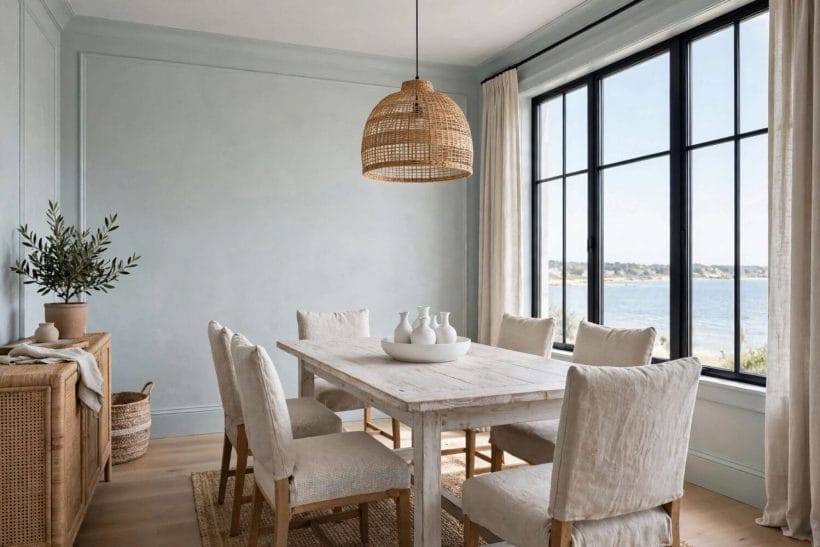
62. Lean warmer for a family room
Lean warmer, with deeper wood tones, warmer whites and soft terracotta touches, when the dining room is mainly a family room, because warmth forgives daily wear, flatters wood and linen, and makes a busy household feel cosy rather than exposed. Warmth should still be muted, with no loud colour, so the room stays calm even when it is full.
63. Lean cooler for a bright room
Lean cooler, with pale greys, soft blue-greys and lighter woods, when the room is very bright or faces the sun for much of the day, because cooler tones balance strong daylight and keep a sunny room feeling fresh rather than glaring. Cooler does not mean cold, and warm wood or warm light should still be present to keep the room welcoming in the evening.
64. Borrow tradition gently
Borrow traditional details gently, such as a turned leg, a panelled wall or a classic shade, because one or two traditional notes give the room roots, while a room full of them becomes a period room rather than a transitional one. The traditional notes should feel like echoes, not reproductions, and they should sit comfortably beside cleaner, simpler pieces.
65. Borrow modern calm sparingly
Borrow modern calm sparingly, such as a clean-lined sideboard, a simple mirror or a slim metal light, because a touch of modern clarity keeps the room from feeling dated, while too much of it would harden a room that should feel soft. The modern pieces should be the quietest in the room, letting the warmer, softer pieces set the tone.
66. Dress up for celebrations simply
Dress the room up for celebrations with simple changes, such as candles, fresh flowers, a tablecloth and the best glasses, because a room that needs a major rearrangement for a celebration will rarely be dressed at all. The everyday arrangement should already be beautiful, so celebration dressing is a matter of adding light and flowers rather than moving furniture.
67. Keep everyday meals beautiful too
Keep everyday meals beautiful with the same care, using cloth napkins, a simple runner and a low centrepiece even on ordinary days, because a room that is only beautiful for guests teaches the household that daily life does not deserve beauty. The transitional room is at its best when it is used daily, and daily use is what gives it its settled, loved feeling.
68. Let the room age gracefully
Choose pieces and finishes that will age gracefully, because wood mellows, linen softens and a well-made table gains character with use, and a room built from honest materials will look better in a few years than a room built from fashionable surfaces. Ageing gracefully is the quiet promise of this style, and it rewards patience over novelty.
10. Costs, Care and Practical Details
Practical details decide whether a beautiful room stays beautiful, and costs in this style are best understood as a set of drivers rather than a list of figures, because the same room can be built in many ways and the choices that move the overall outlay most are the ones worth understanding first. The size of the table and the material it is made from are the largest drivers, followed by whether chairs are upholstered, how much storage is included, what kind of lighting is chosen, and how much making, delivery or fitting the work involves, and each of these can be adjusted up or down without changing the style, as long as the balance of the room is kept. Care is the other practical matter, because a dining room is used daily and must be easy to clean, easy to repair and easy to live with, and the ideas that follow cover both the spending drivers and the daily care that protects them.
69. Let table size drive the budget first
Understand that the size of the table is the first driver of overall outlay, because a larger table needs more material, more making and more floor space, and it will also call for more chairs and a larger rug. Choosing the smallest table that truly serves the household, rather than the largest that fits, is therefore both a practical and a financial kindness, and it leaves the room feeling generous.
70. Weigh upholstery against easy care
Weigh upholstered chairs against their care needs, because upholstery adds comfort and softness, and it also asks for fabric that can be cleaned, covers that can be washed, or a finish that resists stains. A washable fabric or a slipcover keeps pale chairs practical, while a plain wood chair asks less care but gives less comfort, and the right balance depends on how the household actually lives.
71. Treat lighting as a layered investment
Treat lighting as a layered matter rather than a single purchase, because the main light, the side lamps, the dimmers and the bulbs each contribute, and spending thoughtfully across the layers gives a better room than spending heavily on one dramatic fixture alone. A dimmer, in particular, changes the room out of proportion to its modest nature, and it should be considered before any decorative flourish.
72. Count storage as part of the room
Count storage as part of the room’s overall picture, because a sideboard or dresser is not an extra but a necessity, and a room without storage will soon need baskets, boxes or extra furniture that cost attention as well as money. A single well-chosen storage piece, bought once and used daily, serves the room better than several small pieces added over time.
73. Allow for making and fitting
Allow for the work of making, delivering and fitting, because a table that needs assembly, a light that needs wiring or a rug that needs laying all involve work beyond the piece itself, and that work should be part of the early thinking rather than a surprise at the end. Ask what is included, what needs a skilled hand, and what the household can safely do itself, before committing to any piece.
74. Protect surfaces from daily life
Protect wood, fabric and paint from daily life with simple habits, such as mats under hot dishes, coasters for glasses, a runner on the table and a prompt wipe for spills, because small habits preserve a room far better than occasional deep cleaning. Teach the household the same habits, so care is shared rather than falling to one person, and the room stays beautiful without becoming precious.
75. Refresh, do not replace, first
When the room starts to feel tired, refresh it before replacing anything, because new cushions, a fresh runner, a different centrepiece or a coat of paint on a single wall can renew a room that is fundamentally sound. Replacement should be the last step, not the first, and a transitional room, built from honest materials and calm colours, is particularly well suited to refreshing, since its bones rarely go out of favour.
Final Considerations
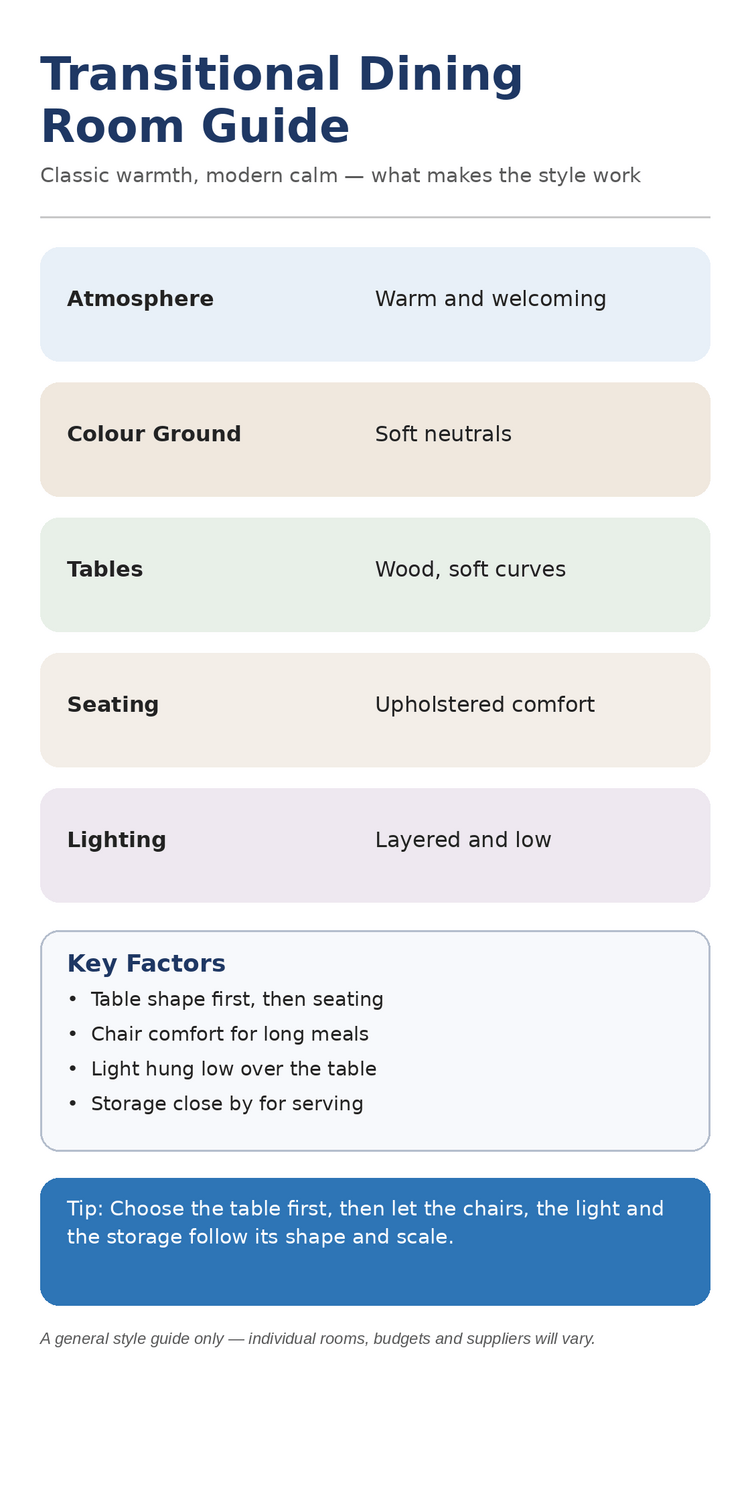
A transitional dining room succeeds when it feels like neither a museum nor a showroom, but like a room where meals are enjoyed, conversations run long, and guests feel welcome the moment they sit down. The ideas in this guide all point the same way, toward a table chosen first, chairs that stay comfortable, colour kept calm, light hung low and warm, storage close at hand, and dressing kept simple, and a room that follows those ideas will feel settled whether it is large or small, grand or modest. Take the ideas that suit your room, leave the ones that do not, and judge every choice by the same test that opened this guide, which is whether it helps people gather, linger and feel at home at the table, because that feeling, more than any single piece, is what this style is for.


0 Comments