

The floor under your feet is the heaviest finish you will choose — and the least useful. It holds nothing up, carries no water and stores no power.
Run your numbers through the flooring weight calculator below, then read on: the right finish can free dozens of pounds for the things that actually earn their weight.
1. At a Glance: Flooring Finishes by Weight
Start with the comparison the tool itself makes, because the spread is larger than most builders expect. The calculator weighs three familiar finishes against the same floor area, and the lightest comes in at a fraction of the heaviest. Multiplied across a main floor and a loft, that gap becomes one of the easiest weight decisions in the whole build.
| Flooring option | Weight per square foot | Character | Best use |
|---|---|---|---|
| Solid hardwood | ~4.0 lbs/sq ft | Warm, traditional and heavy; can warp with humidity swings | Parked builds where payload is generous and the classic look matters most |
| Luxury vinyl plank (LVP) | ~1.5 lbs/sq ft | Durable, lightweight and waterproof in the tool’s analysis | Most tiny houses on wheels, especially kitchens, entries and bathrooms |
| Carpet / cork | ~0.5 lbs/sq ft | Soft, quiet and the lightest of the three | Lofts, bedrooms and low-traffic sleeping areas where comfort leads |

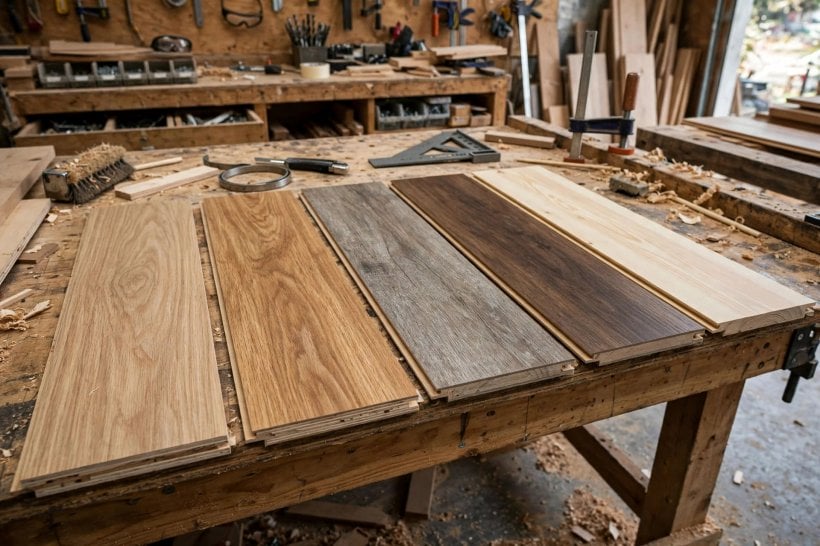
The three finishes at a glance: solid hardwood at about 4.0 pounds per square foot, luxury vinyl plank at about 1.5, and carpet or cork at about 0.5 — choosing vinyl over hardwood saves about 60% of the floor weight.
Engineered wood and laminate belong in this conversation too, as do the layers underneath every finish. The sections that follow take each option in turn — what it weighs, how it behaves in a house that moves, and where saved pounds are better spent.
2. Flooring Is Dead Weight: Pretty, Necessary and Non-Structural
The tool puts it bluntly: flooring is dead weight. It provides no structural integrity to the trailer; it is, in the calculator’s own words, purely aesthetic. The frame, subfloor and walls hold the house up. The finish floor adds comfort, looks and a cleanable surface — all valuable — but it does not earn its pounds the way structure, water or power storage earn theirs.
That distinction changes how you judge every finish. In a conventional house, a heavier floor is mostly taste and budget. In a tiny house on wheels, every pound of finish is taken from a fixed total the trailer and tow vehicle can safely carry. Our guide to calculating GVWR for tiny homes explains how that total is set, and flooring belongs in the same ledger as framing and appliances — not waved through as decoration that weighs nothing.
Think of it as a budget. Spend heavily on the floor and you have less left for fresh water, batteries and belongings. Spend lightly and the same trailer carries more of what you use each day. Neither answer is automatically right — a parked build with payload to spare can carry hardwood happily — but the trade should be conscious. Dead weight is only a problem when it sneaks in uncounted.

3. Measuring Your Main Floor and Loft Area
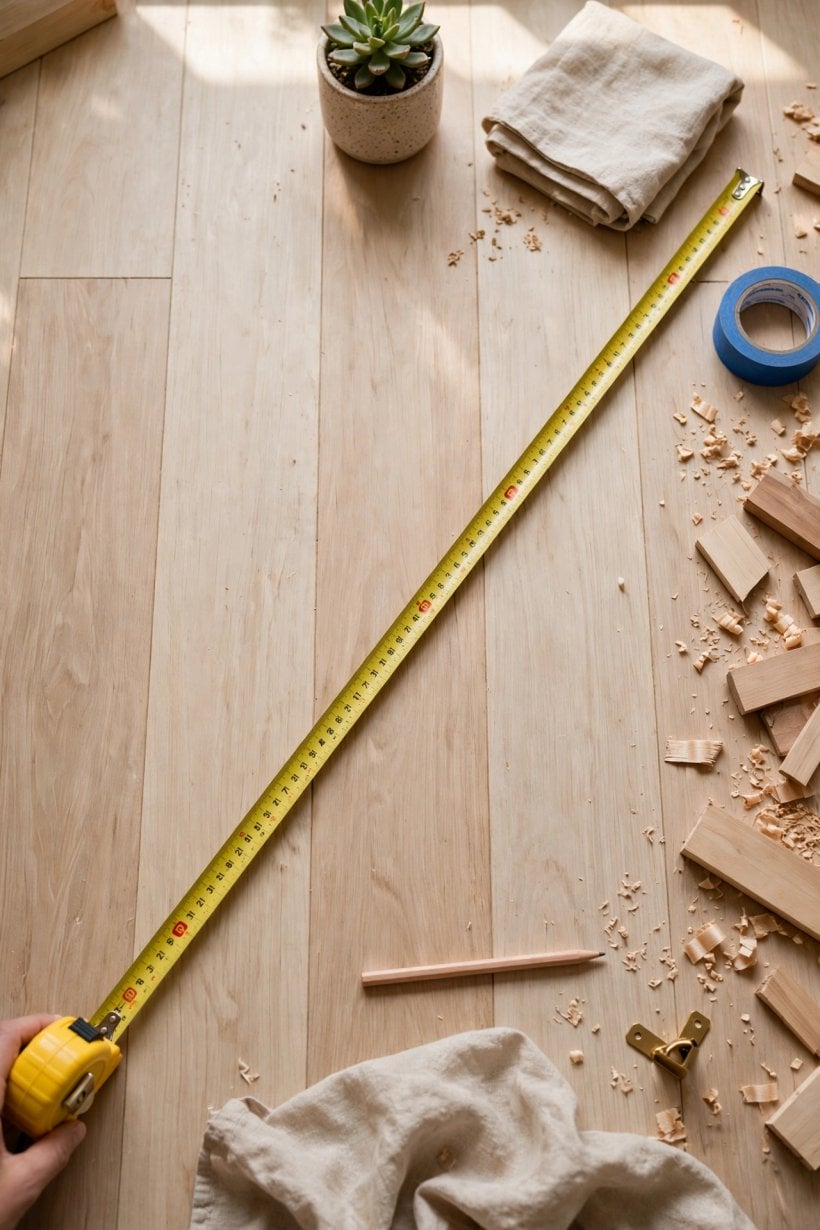
The calculator asks for two numbers, and getting them right is most of the work. The first is the main floor area in square feet: measure the inside length and width of the floor you will actually finish, and multiply them together. Work in inside dimensions, not the trailer’s outside size, because walls and wheel boxes change the area that truly receives flooring. If the plan is irregular, break it into simple rectangles, measure each one and add them together.
The second number is the loft area, entered separately and easy to forget. A sleeping loft still has a floor, and that floor still gets a finish, even if it is only carpet or cork over boards. Measure each loft the same way and add them together if you have two. Keeping the areas separate also helps you mix finishes clearly — hard-wearing below, soft and light above.
Be honest about what to leave out. Floor hidden under a fixed kitchen run, bench or shower tray may receive no finish at all. Sketching the layout alongside a tiny house weight distribution diagram helps here, because the same drawing shows where its weight will sit relative to the axles. Measure twice, enter the figures once, and let the tool do the multiplication.
4. Solid Hardwood, Honestly Weighed
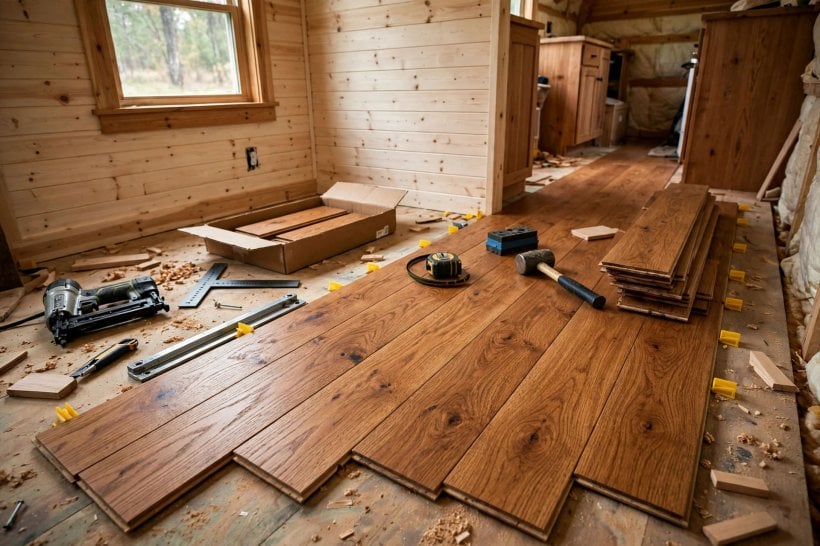
Solid hardwood is the finish many people picture first: real timber boards, warm underfoot, repairable by sanding, and able to last as long as the house itself. Honesty about it starts with the tool’s figure — around 4.0 pounds per square foot, the heaviest of the three options by a wide margin. That is not a reason to rule it out. It is a reason to choose it with your payload checked, rather than discovering its cost on a scale after the build.
Hardwood also brings a behaviour the tool flags directly: real hardwood can warp with the humidity fluctuations common in tiny homes, especially if the house is left unconditioned for periods of time. A small, sealed volume changes humidity faster than a large house does — cooking, showers and breathing all happen in the same few cubic metres — and solid boards respond by expanding, contracting and, in unhappy cases, cupping or gapping.
Where hardwood earns its place is in parked or rarely moved builds, on generous trailers, and in designs where the floor is the centrepiece and other weight has been kept lean to pay for it. If you love timber, our steel vs wood framing weight comparison makes the same point at frame level: natural materials can be the right choice, provided the savings are found elsewhere.
5. Luxury Vinyl Plank: Light, Durable and Waterproof
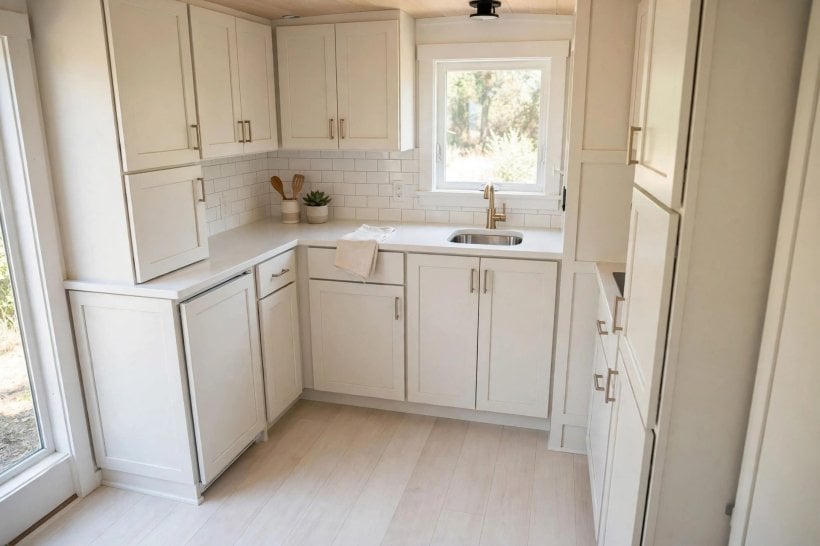
Luxury vinyl plank, usually shortened to LVP, is the tool’s clear recommendation for most tiny houses on wheels. At around 1.5 pounds per square foot it weighs well under half as much as solid hardwood, and the calculator puts the headline plainly: choosing vinyl over hardwood saves about 60% of the floor weight. Across a full main floor that saving is payload handed back to the systems discussed later.
The second advantage is water. Beyond weight, the tool notes, LVP is often waterproof, where real hardwood can warp in humidity swings. In a tiny house the floor meets water constantly: wet boots, splashes from a small sink and shower, spills and condensation. A waterproof plank shrugs off the daily version of all of that, and tolerates the unconditioned spells the tool warns about — the house left closed while you travel — without the movement that troubles solid boards.
LVP also suits the way tiny floors are used. The whole main floor is high-traffic; there is no spare room taking the wear instead. Planks are tough under grit, individual pieces can be replaced if damaged, and wood-look finishes give most of hardwood’s warmth at the vinyl weight. For kitchens, entries and bathrooms, it asks the least of the trailer and the least of you.
6. Carpet and Cork: The Lightest Finishes of All
At around 0.5 pounds per square foot in the tool’s figures, carpet and cork are the lightest finishes the calculator lists — a fraction of vinyl’s weight and a small sliver of hardwood’s. If payload is the binding constraint on your build, these are the finishes that almost remove flooring from the weight conversation altogether. They earn their place first in the loft, where you crawl rather than walk, where hard-wearing matters less, and where softness and warmth matter more than anywhere else in the house.
Carpet’s virtues in a loft are quiet and insulation as much as comfort. It deadens sound where every noise carries, feels kind on knees and bare feet on a cold morning, and tiles or a fitted piece are easy to lift or replace. Its weaknesses are plain: it holds dirt and moisture more readily than a hard floor, dislikes wet boots and splashes, and wants regular cleaning.
Cork offers a different version of light: naturally soft, warm and quiet underfoot, for people who prefer a natural material. It needs sensible care around standing water and dents under point loads more readily than vinyl. Used where each suits — carpet in the dry loft, cork where warmth matters, vinyl where life is wet and busy — the lightest finishes become a deliberate zoning of the house by weight and use.

7. Engineered Wood and Laminate: The Middle Ground, in Qualitative Terms
Two popular finishes do not appear in the tool’s three-way comparison, and this article will not invent figures for them. Engineered wood — a real timber surface layer bonded over a layered base — and laminate — a printed, sealed surface over a manufactured core — belong in your thinking in qualitative terms: generally between the very lightest finishes and heavy solid boards in feel and purpose, with the exact weight depending on the specific product you choose. The honest method is to take the weight per square foot from the manufacturer of the exact board you are considering and compare it against the tool’s three benchmarks.
Engineered wood appeals to builders who want a genuine timber surface with more stability than solid boards, because its layered construction is designed to move less with changing conditions. That suits a tiny house’s humidity swings better in principle, though it does not make the floor waterproof, and standing water still deserves respect. A thicker timber layer also tolerates more refinishing over the house’s life.
Laminate appeals on toughness and ease: a hard, sealed surface that shrugs off scuffs and goes down quickly in click-together boards. Its weak point is water at the joints — a soaked edge can swell — so it suits dry living areas better than bathrooms and entries. For either material, the discipline is the same: get the product’s own stated weight, multiply it by your measured area, and judge it against the vinyl saving rather than by showroom feel alone.
8. Underlayment, Subfloor and the Layers You Forget
The finish floor is only the top layer, and calculators weigh the finish. The layers beneath it still ride on the trailer. A subfloor gives the finish a flat, stiff base and is part of the structure; underlayment, where a finish needs it, adds cushioning, sound softening or a moisture barrier. Each layer has its own weight, and across a full floor those quiet pounds add up just as finish pounds do.
The practical lesson is to count the floor as a build-up, not a single product. A finish needing separate underlayment and one with attached backing are different systems. Our sheathing weight calculator applies the same layer-by-layer thinking to the shell: list every layer, note its stated weight, and add them before you judge the total.
Moisture belongs in this conversation too. A suitable barrier under a bathroom or entry floor protects the subfloor from splashes, and in a house this small a rotted subfloor is a far bigger repair than a damaged plank. Keep the build-up as thin and light as the finish honestly allows, seal the wet zones, and remember that the lightest finish on a heavy stack of layers is only half a saving.
9. Moisture, Movement and Life in a Travelling House
A tiny house on wheels lives a harder life than a house on a foundation, and its floor feels all of it. The tool highlights humidity fluctuations and unconditioned periods; travel adds vibration, flex and temperature swings. Floors respond by moving — boards expanding and contracting, joints opening and closing, fixings working with every mile. Finishes that tolerate movement and moisture forgive the life the house actually leads.
This is where the earlier sections join up. Waterproof vinyl tolerates both the wet entry and the damp, closed-up month. Solid hardwood is happiest in a conditioned, settled house. Carpet in a loft that gets damp while stored will hold that damp and smell of it. Match the finish to the use pattern: a full-time, conditioned, rarely moved house can carry finishes a seasonally stored, frequently towed house should avoid.
Before a move, give the floor the same attention you give tyres and lights: check for soft spots, lifted edges and signs of a leak feeding the subfloor, because road vibration turns small water damage into larger repairs. Our tiny house moving guide and transport cost breakdown covers the wider preparation; the floor’s part is simple — dry, sound and securely finished before the wheels turn.

10. Spending Saved Pounds Well — and Using the Calculator
The tool makes the purpose of saving explicit: every pound saved on flooring is a pound you can use for water capacity, batteries or personal belongings. Saved pounds are not a trophy; they are payload returned to systems that improve daily life — fuller water, longer off-grid running, or simply carrying your books, tools and clothes without edging over the limit. A floor you barely notice can fund comforts you notice every day.
Placement matters as well as total. Weight saved at floor level is carried low, where you want mass to live, and weight added back in tanks or batteries should stay low too. The capacity choices in our axle comparison tool and the balance checks in the tongue weight tuner serve the same end: a total that fits, carried in the right places. Flooring is one line in that budget — an easy one to get right early.
Using the calculator itself takes a minute. Enter your main floor area, add the loft area if you have one, and read the three totals: the same floor in hardwood, in vinyl plank and in carpet or cork, plus the saving for choosing vinyl over hardwood. Run it again with a mixed pairing — vinyl below, carpet in the loft is common — for a realistic figure rather than a single-material guess. Then confirm the finished build on a real scale, as our CAT scale weighing guide and simulator walks through.
Final Considerations
Flooring rewards builders who weigh it early. The finish is dead weight — beautiful, necessary dead weight — and the spread between heaviest and lightest is wide enough to change what the rest of the house can carry. Measure the main floor and loft honestly, compare hardwood at about 4.0 pounds per square foot against vinyl at about 1.5 and carpet or cork at about 0.5, count the layers underneath, and match the finish to the moisture and movement your house will see. Choose vinyl and the roughly 60% saving becomes water, power and belongings instead. Choose hardwood knowingly, on a trailer that can carry it, and it is a luxury rather than a mistake.
Flooring Weight Calculator
Flooring Weight Calculator
Hardwood vs. Vinyl Plank: Calculate your payload savings.
1. Calculate Surface Area
Weight Factors
- Solid Hardwood ~4.0 lbs/sf
- Vinyl Plank (LVP) ~1.5 lbs/sf
- Carpet / Cork ~0.5 lbs/sf
Weight Comparison
Total Area: 0 sq ftHeavy payload penalty
Durable & Lightweight
Why Flooring Weight Matters
Flooring provides no structural integrity to the trailer; it is purely aesthetic “dead weight.” Every pound you save on flooring is a pound you can use for water capacity, batteries, or personal belongings.
Beyond weight, LVP is often waterproof. Real hardwood can warp with the humidity fluctuations common in tiny homes, especially if you leave the house unconditioned for periods of time.


2 Comments