

At cycling speeds, air is the wall you never see. Roughly 80 percent of a rider’s effort goes into pushing it aside — yet a streamlined shell turns those same legs into startling speed on the same watts. This guide explains the drag equation in plain language, compares the numbers machine by machine, and shows exactly where the shell’s advantage comes from — and where it ends.
1. The Physics of Velomobiles at a Glance
The physics of velomobiles is the study of one lopsided contest: a human engine producing a modest stream of watts against an atmosphere that resists with the square of your speed. Everything in this guide hangs off a single equation and a single measurable quantity — CdA, the product of drag coefficient and frontal area — because CdA is the one term in the drag equation the machine’s designer actually controls. The upright cyclist presents 0.35–0.45 m² of it; the teardrop shell presents 0.05–0.10 m². That tenfold gap, not the motor and not the rider’s fitness, is why the enclosed machine cruises at speeds an open bicycle cannot sustain. The table below is the whole argument on one screen; the sections after it take each term, each number and each trade-off apart in turn.
| Attribute | Detail |
|---|---|
| The Enemy | Aerodynamic drag — roughly 80% of a rider’s effort at cycling speeds goes into pushing air aside |
| The Law | F = ½ρv²CdA — drag force equals half × air density × velocity squared × drag coefficient × frontal area |
| The Tyranny | The v² term — double the speed and the drag quadruples; the wall every cyclist meets near 15 mph |
| CdA — Upright Cyclist | 0.35–0.45 m² — the baseline, the rider as a sail |
| CdA — Recumbent | 0.15–0.25 m² — the reclined position roughly halves it |
| CdA — Velomobile | 0.05–0.10 m² — the teardrop’s order-of-magnitude cut |
| CdA — Car | 0.6–0.8 m² — the “aerodynamic” car is the draggiest entry on the list |
| The Payoff | 100W holds 15 mph upright — and 23 mph inside a shell |
| The Other Force | Rolling resistance, Crr 0.004–0.008 — it grows gently and linearly, never squared |
| The Crossover | Above 15 mph, aerodynamics dominate the power budget; below it, the tyres matter more |
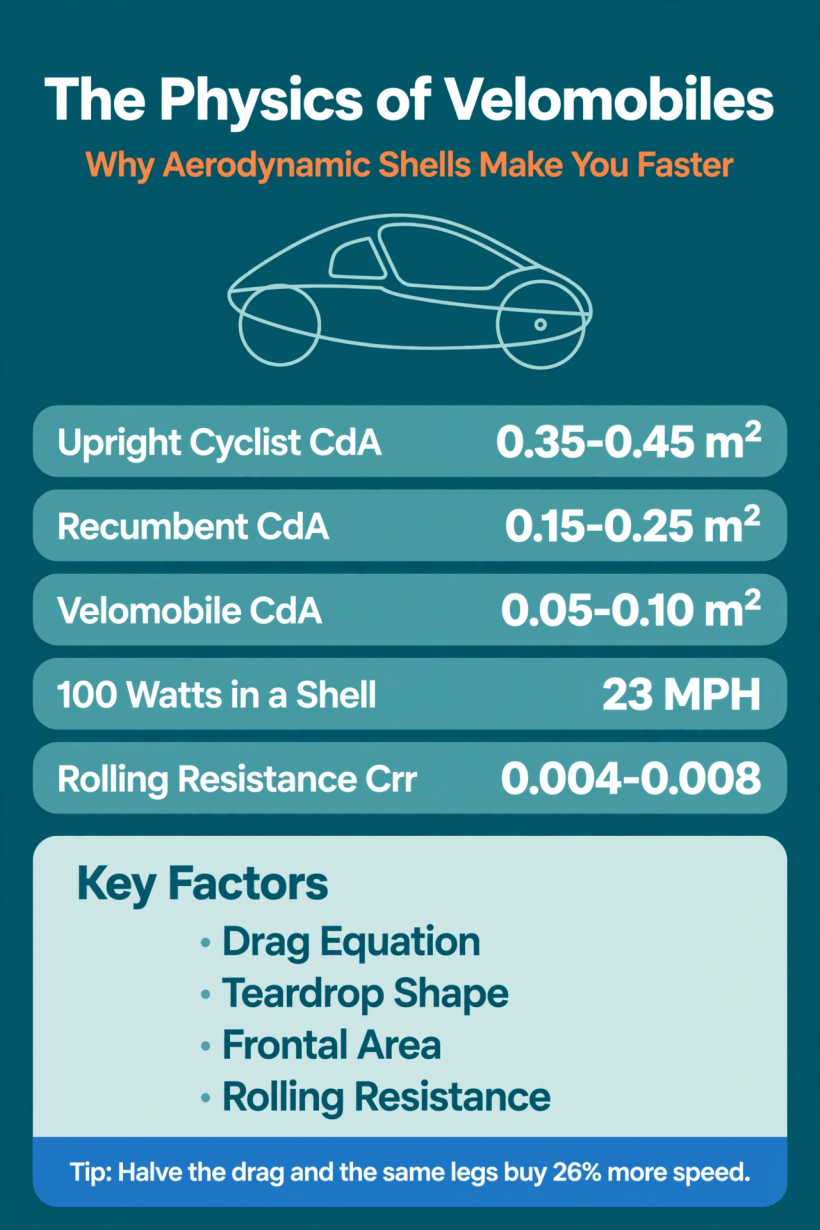
0.35–0.45 m² upright against 0.05–0.10 m² enclosed — the whole speed story is the gap between those two numbers.
Read the table as a chain of causes. The v² term explains why unaided cycling speed plateaus where it does: the faster you go, the steeper the wall. CdA explains why the plateau moves: it is the only term in the equation that design can shrink, and the shell shrinks it tenfold. The watts table in §8 is simply the equation solved at four power levels, and the rolling-resistance section is the reminder that drag is not the only force in the room — merely the one that grows teeth. Keep those three ideas — the square law, the controllable term, the second force — and every number in this article falls into place.
2. Drag Is the Enemy: The Wall of Air
Start with the proportion the original states plainly: at cycling speeds, roughly 80 percent of a rider’s effort goes into pushing air aside. The legs are not mainly fighting gravity, friction or the road — they are fighting the atmosphere itself, a fluid the rider must part, displace and leave behind in a turbulent wake. That is why cycling speed is a war against air, and why the war is won with geometry rather than strength: a stronger rider pushes against the same wall slightly harder, while a slipperier shape moves the wall.

The upright cyclist is the extreme case — the original calls the position “the sail,” and the photograph above shows why: torso vertical, chest and shoulders presented flat to the airflow, loose clothing ballooning behind. Every element of the classic cycling silhouette maximises the area the air sees and the turbulence it sheds. The velomobile begins from the opposite premise. The machine itself — an enclosed, human-electric recumbent tricycle — is introduced in the guide to what a velomobile is and where it came from; its physics begins here, with the recognition that the rider’s body, not the bicycle, is most of the drag problem, and that enclosing the body inside a shaped shell is the direct answer to it.
3. The Drag Equation: F = ½ρv²CdA and the v² Tyranny
The governing law fits in one line: F = ½ρv²CdA. Drag force equals half, times air density (ρ), times velocity squared (v²), times the drag coefficient (Cd), times frontal area (A). Each term has a character. Air density is given — weather, not design. Frontal area is the size of the hole you punch in the air. The drag coefficient is how cleanly your shape lets the air close behind you. And velocity squared is the tyrant: because drag rises with the square of speed, doubling your speed quadruples the drag force — and since power is force times speed, the watts required climb with the cube. This is the cyclist’s wall, felt by every rider as the effort curve that steepens brutally somewhere around 15 mph.
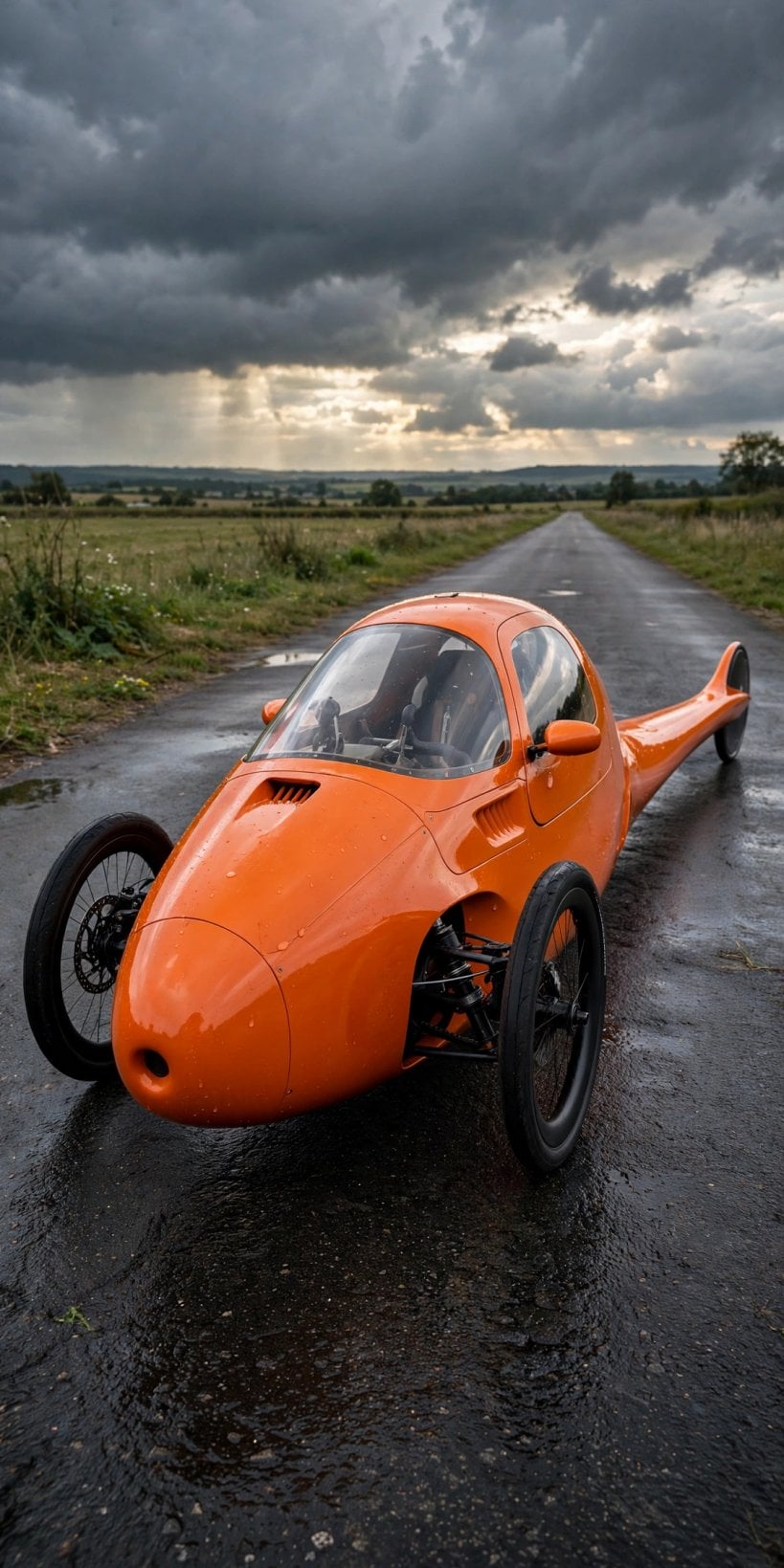
Inside that equation, exactly one term is negotiable. You cannot repeal v², and ρ is the weather’s business. CdA — the coefficient and the area bundled as one measured quantity — is, in the original’s phrase, the beatable term: the only one you control, and therefore the shell’s entire mission. A velomobile does not make its rider stronger; it edits the equation. Cut CdA and the same rider, at the same power, sits higher up the v² curve before the wall stops them. Every design decision in §9 — the long tail, the rounded nose, the sealed seams — is an attack on this single term, which is why the next two sections are devoted to measuring it.
4. CdA: What the Number Actually Measures
CdA rewards unpacking, because its two halves fail differently. The A — frontal area — is brutally literal: how much of you and your machine the air meets head-on. The Cd — drag coefficient — is subtler: a shape factor describing how the airflow behaves over and behind the body, whether it stays attached and closes smoothly or tears away into a churning wake. A blunt shape with a small area can drag more than a sleek shape with a larger one, which is why the product, not either factor alone, is the number that predicts speed. The velomobile attacks both halves at once: reclining the rider shrinks the area, and wrapping the rider in a teardrop shrinks the coefficient.
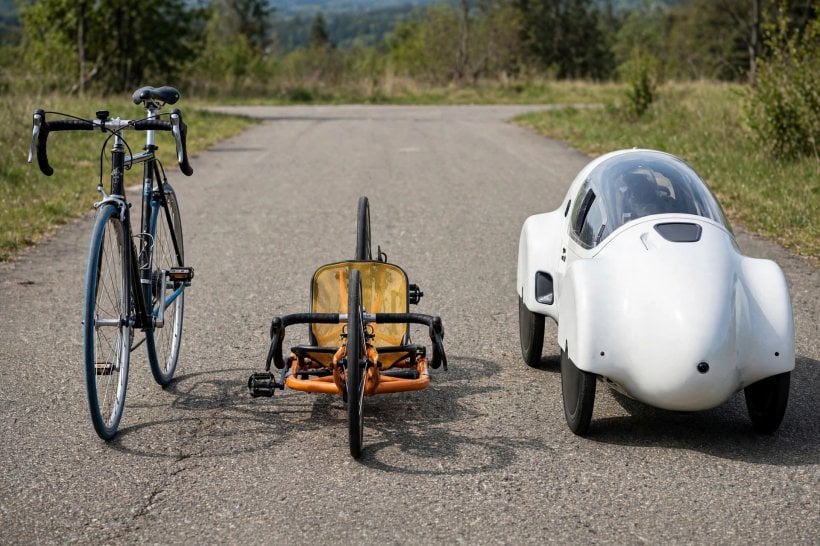
The position alone does half the work before any shell exists. A recumbent rider, reclined with legs forward, presents far less area than an upright torso — which is why the recumbent’s CdA lands roughly halfway between the upright’s and the velomobile’s in the comparison that follows. The shell then does what position cannot: it gives the air a continuous, shaped surface to follow, replacing the lumpy, separating flow over a human body with attached flow over a designed one. The deeper treatment of coefficients, CdA testing and what the numbers mean at speed is in velomobile aerodynamics and drag coefficients; this guide’s business is the comparison itself, next.
5. CdA Compared: Upright, Recumbent, Velomobile, Car
The numbers, as the original lays them out, form a ladder. The upright cyclist: 0.35–0.45 m² — the baseline, the worst case, the sail. The recumbent: 0.15–0.25 m² — the halved figure, bought purely with position. The velomobile: 0.05–0.10 m² — the order-of-magnitude figure, the teardrop’s achievement, roughly ten times slipperier than the upright rider it replaces. And then the irony the original savours: the car, at 0.6–0.8 m², is the draggiest entry on the list. The “aerodynamic” car has a respectable coefficient but an enormous frontal area, and the product is what counts — a car punches a hole in the air bigger than any cyclist’s. It overcomes that hole with horsepower, not slipperiness.
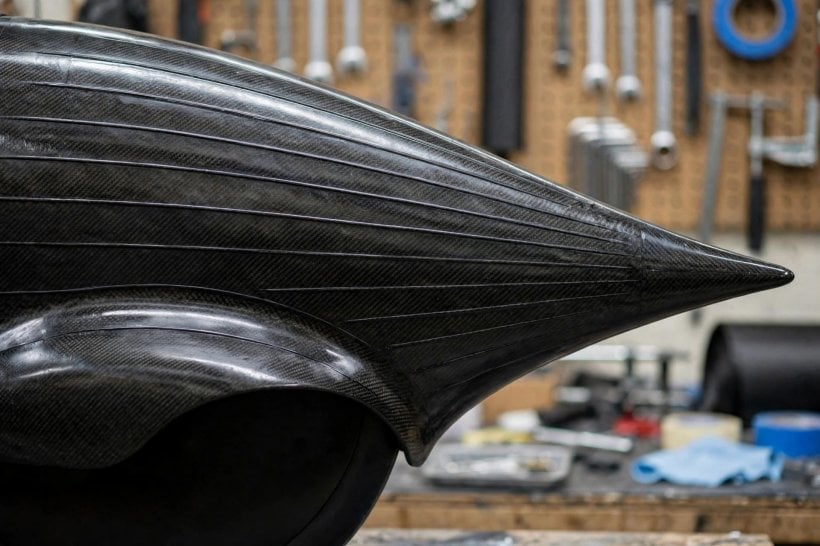
The ladder’s lesson is about where improvement lives. Going from upright to recumbent halves CdA by rearranging the rider. Going from recumbent to velomobile cuts it by half again and more by replacing the rider’s outline with a designed surface. Each step is harder than the last — position is free, a shell is a vehicle — and each step’s gains arrive through the cube-root law of §8: large CdA cuts buy meaningful but not magical speed. What the ladder rules out is the fantasy that small tweaks to an upright bicycle can reach the shell’s territory. The gap is an order of magnitude, and order-of-magnitude gaps are closed by changing the machine’s category, not by optimising within it. Builders who take that step themselves will find the shell shapes and materials in the velomobile DIY kits guide.
6. The Teardrop: Why the Shape Works
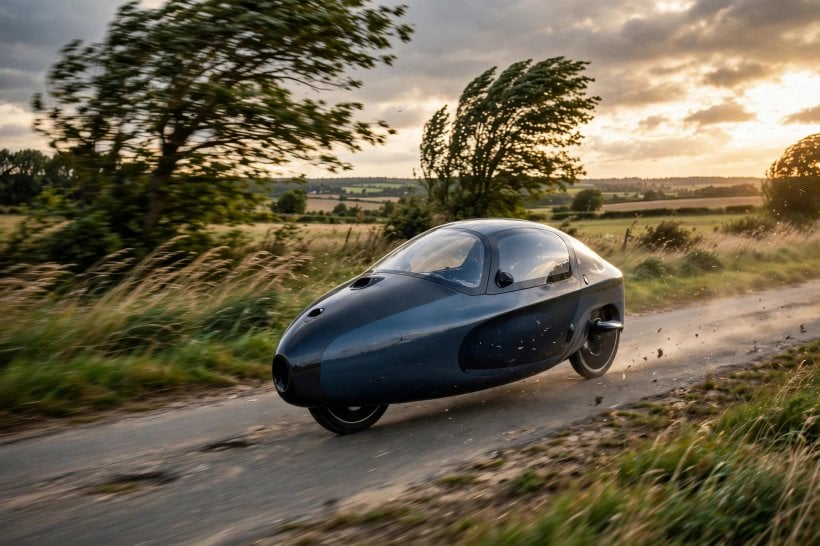
The teardrop is not styling; it is the shape the equation rewards, and it works on two distinct kinds of drag. The first is pressure drag: the resistance created when airflow separates from a body and leaves a low-pressure, turbulent wake behind it — the blunt rear’s penalty. A shape that tapers gently to a tail lets the air stay attached and close progressively, so the wake shrinks and the pressure behind the body recovers. The second is skin friction: the drag of air sliding along the surface itself, minimised by a smooth shell over which the flow stays laminar and polished rather than tripping over seams, edges and clothing. The teardrop is the compromise that serves both: rounded where the air arrives, tapered where it leaves.
The third element is the frontal area the reclined position buys. A velomobile rider lies back, low and narrow, inside the shell — the small silhouette the air meets is a fraction of an upright torso’s. The shell’s width is set by the recumbent trike beneath it and no more; its height by a seated rider’s shoulders and no more. There is one honest trade, and the original names it: crosswind. A body with a long, smooth side presents area to a gust from the flank, and the side area that makes the shell slippery head-on makes it pushable from the side — the design’s compromise, managed by the machine’s low centre of gravity and three-wheel stance rather than eliminated by the shape.
7. Rolling Resistance: The Other Force
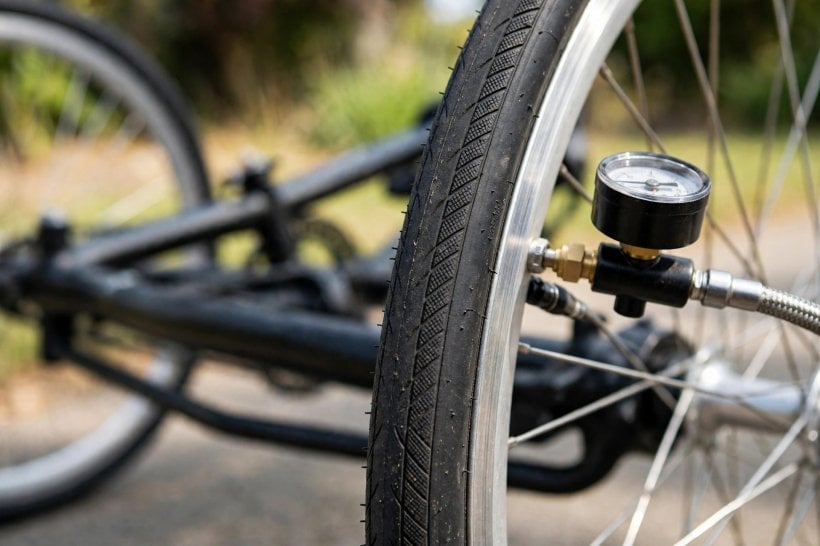
Drag is not the only force eating watts. Rolling resistance — the energy lost as the tyres flex against the road — is governed by its own coefficient, Crr, which for bicycle tyres runs 0.004–0.008, with tyre pressure playing a leading role: harder tyres flex less and roll easier on smooth surfaces. Its character is the opposite of drag’s. Rolling resistance grows gently and linearly with speed — double the speed, double its force — where drag quadruples. At walking pace it is the main resistance a rider feels; at speed it fades into the budget’s background.
The velomobile pays one specific rolling tax, and the original is candid about it: three wheels. The third tyre adds roughly 50% more rolling resistance than a bicycle’s two — more rubber flexing, more contact patches working. The balance nonetheless favours the shell decisively, because of the crossover: above about 15 mph, aerodynamic drag dominates the power budget so completely that the extra tyre’s linear tax is swamped by the tenfold CdA saving. Below 15 mph — on the climb, in the first metres from a stop — the tyres and the weight are the story, which is why §10 returns to them. On the open road, in the shell’s domain, aero wins. The same balance, tested against real weather rather than a formula, is what winter riders exploit in how to commute in winter — a headwind that stops an upright rider merely slows a shell.
8. Speed on Watts: The Payoff
Now solve the equation. The original’s payoff table converts four power levels into two speeds each — upright versus shell — and it is the most persuasive arithmetic in cycling. At 100W, the upright rider holds 15 mph; the velomobile rider holds 23 mph — eight free miles per hour, the shell’s gift, bought with shape alone. At 150W: 17 mph becomes 27, the commuter’s watts at the car’s urban pace. At 200W: 19 becomes 31, the trained rider’s fast cruise. At 250W with the motor’s help: 35 mph and beyond, motorcycle pace on bicycle watts. Behind the table sits the rule that generates it: because power scales with the cube of speed, every halving of CdA buys roughly 26% more speed — the cube-root law, the exact exchange rate between slipperiness and velocity.
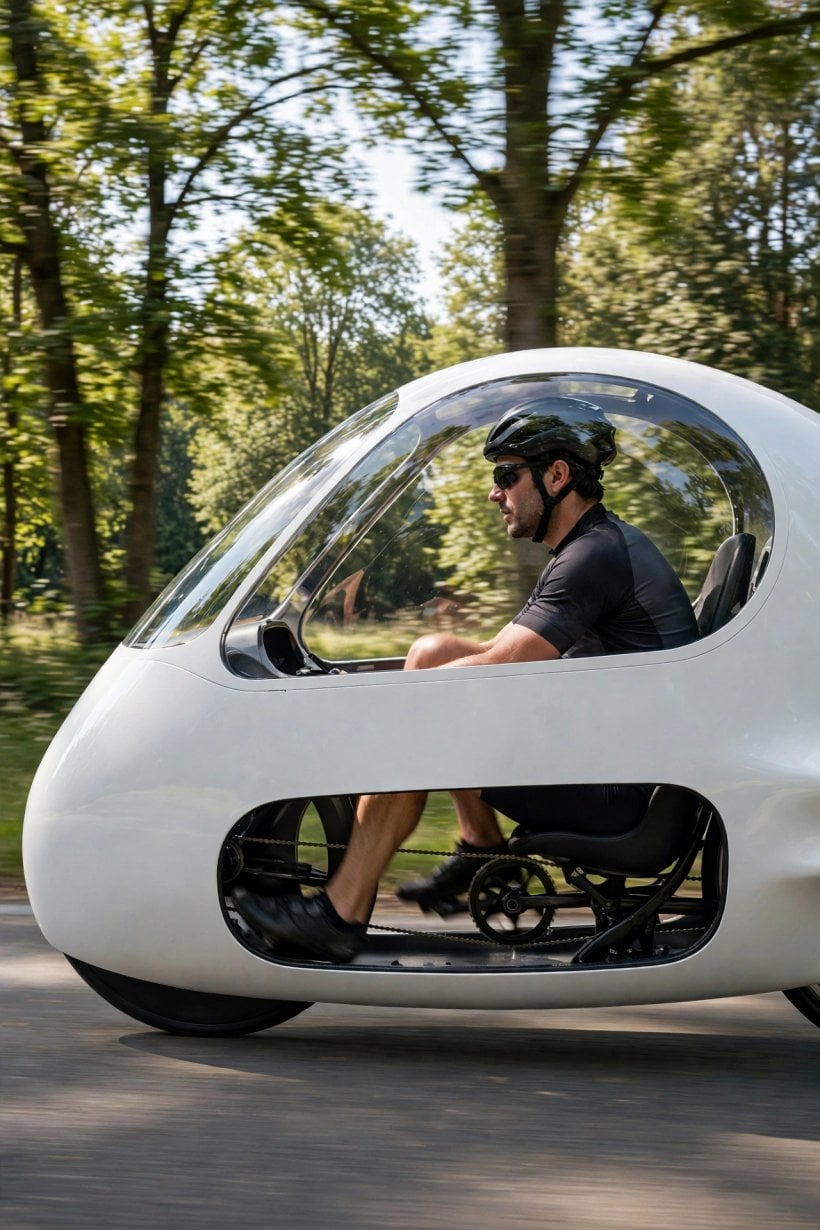
The rider inside those numbers matters as much as the numbers. A human engine is not a fixed power supply: output varies with duration, position and physiology, and the recumbent position itself changes what the legs can sustain — the balance explored in human power versus electric assist. What the shell guarantees is that whatever watts the rider brings are spent against a tenth of the drag. That is also why the assisted figures mislead no one who has read this far: the motor adds watts to the same equation, but the equation’s shape term — the CdA the shell provides — is what makes modest total power, human or human-plus-motor, translate into speeds that look impossible to anyone still thinking like an upright cyclist.
9. Designing Faster: Tail, Nose, Seams, Rider
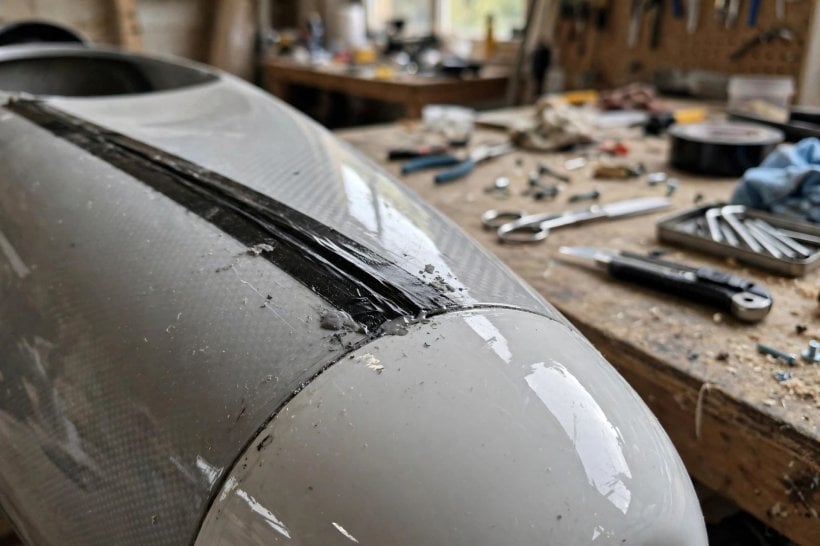
The engineering that squeezes CdA lower follows directly from §6’s two drags. The tail is extended: a longer, more gradual taper keeps the flow attached further and shrinks the wake — up to the practical limit where the machine becomes unwieldy to store, turn and live with. The nose is rounded: the point where the airflow first meets the body, the stagnation region, must present a smooth, blunt curve that divides the air cleanly rather than a sharp edge that trips it into turbulence from the first centimetre. The seams are sealed: every gap, joint and panel step is a small turbulence generator, so builders tape and fair the shell’s joins until the surface the air reads is one continuous shape.
The fourth design element is the rider. A pedalling body moves — knees rise, shoulders shift — and inside a shell tuned to a fixed outline, the rider’s motion is itself a drag variable: the still, smooth pedaller preserves the shape the designers drew, while a rocking, straining style disturbs it. Designing faster therefore ends in technique as much as bodywork. None of these refinements changes the category of the result — they polish the order of magnitude the teardrop already won — but at the margin they are exactly the difference between the top and the bottom of the velomobile’s 0.05–0.10 m² band, and between two shells that look identical to an untrained eye.
10. The Limits: Weight, Hills and the Honest Trade-Offs
The physics that flatters the shell on the flat does not flatter it everywhere, and the original closes by testing the theory in the real world. The headline results first: the century — 100 miles — is the velomobile’s party trick, covered in about 5 hours against the upright rider’s 7; the 20-mile commute takes about 45 minutes, the car’s time at the bicycle’s energy cost. Then the qualifications. The hill: a velomobile weighs around 65 lb, and on a climb, where speed is low, drag is trivial and gravity is the whole bill, that weight is a genuine penalty — the one the electric assist erases, which is why so many shells carry a motor they barely use on the flat. The wind inverts the story again: into a headwind, the shell’s advantage compounds, because the upright rider’s effective airspeed — and with it the squared term — soars while the velomobile cruises.
Assembled honestly, the trade is this: the shell surrenders a little at walking pace, on the steepest climbs and in crosswind gusts, and in exchange it rewrites every speed above 15 mph. The economics follow the physics — the original’s closing verdict is that aerodynamics beat fitness dollar-for-dollar: watts can be trained for, slowly and temporarily, while CdA is bought once and kept. The ownership arithmetic behind that verdict is in the cost of owning a velomobile, and the efficiency it produces is the same figure that anchors the environmental impact of velomobiles and the wider family in sustainable micro-mobility. The shell is not faster because of its motor. It is faster because of its shape.
Final Considerations
Drag grows with velocity squared — the tyranny no rider repeals. The shell cuts CdA tenfold — the one term in the equation design controls. One hundred watts becomes 23 mph instead of 15 — the payoff, paid every ride. Rolling resistance takes its linear tax, the hills take theirs, and above 15 mph neither matters next to the air. Physics doesn’t negotiate; the teardrop just obeys it better.




5 Comments