

A white tree dressed in silver has a particular kind of calm. It does not shout for attention, and it does not depend on a riot of colour to feel festive. Instead, the pale branches, the cool shine of silver, and the soft glow of white light work together, and the room around the tree stays part of the picture rather than disappearing behind it. For readers browsing silver and white christmas tree decorations, this survey gathers the layouts, colours, costs and practical details that shape the look, in general terms, so the choices can be weighed before anything is bought or hung.
The appeal is easy to describe. White branches lighten a corner that might otherwise feel heavy in winter, and silver picks up whatever light is already in the room, whether that light comes from a window by day or from lamps in the evening. The combination suits rooms that are already pale and quiet, and it can also soften a room with darker furniture, because the tree itself reads as a bright, airy shape. What matters most is restraint. When every ornament competes, the calm is lost, and when too little is added, the tree can look bare rather than elegant. The sections that follow look at each decision in turn, from tree form and layout to ornaments, ribbon, lighting, the base, and the way the tree sits with the rest of the room.
This is a seasonal decorating survey, not a record of one home or one project. The rooms described are the kinds of rooms readers commonly have, and the suggestions are general: they are meant to be adapted to the size of the room, the light available, and the pieces already in place. Where lighting or fire safety is concerned, the guidance stays general too, and any electrical work near a tree should be left to a qualified professional, with local safety guidance followed. Nothing here asks a reader to alter wiring, adapt a light set, or work around a fire risk on their own.

1. What Defines the White and Silver Look
The look rests on two colours and the space between them. White supplies the structure, in the branches themselves and in the pale surfaces around the tree, while silver supplies the shine, in baubles, ribbon, beads and finials. A third presence, soft and quiet, often sits behind both: the pale neutrals of walls, curtains and seating, which keep the tree from looking isolated. When those neutrals are warm, with cream or light wood, the tree feels gentle. When they are cool, with pale grey or soft white, the tree feels crisp and wintry. Either direction can work, and the choice usually follows the room rather than the tree.
Texture does as much work as colour. Matte silver reads as soft and muted, shiny silver catches the light and draws the eye, and frosted finishes sit somewhere between the two, with a dusty, wintry surface. Mixing those finishes in one tree gives depth without adding colour, because the eye moves from dull to bright and back again. Smooth baubles, ribbed or patterned ones, and small clusters of beads can all sit together, provided no single finish dominates the whole tree. A tree dressed entirely in high-shine silver can feel hard and glittering, while a tree dressed entirely in matte silver can feel flat, so a balance of finishes usually reads best from across the room.
Shape matters too. Round baubles are the backbone of the look, but stars, drops, icicles and simple geometric forms add variety, and a few larger ornaments placed deeper among the branches give the tree a sense of fullness. Small ornaments belong toward the tips, where they catch light, while larger pieces sit further in, where they anchor the shape. The overall aim is a tree that looks layered rather than pasted on: silver at several depths, white branches showing through in places, and light moving across both. Stepping back regularly while decorating is the simplest way to judge whether that layering is working.
2. Choosing a Tree Form for the Room
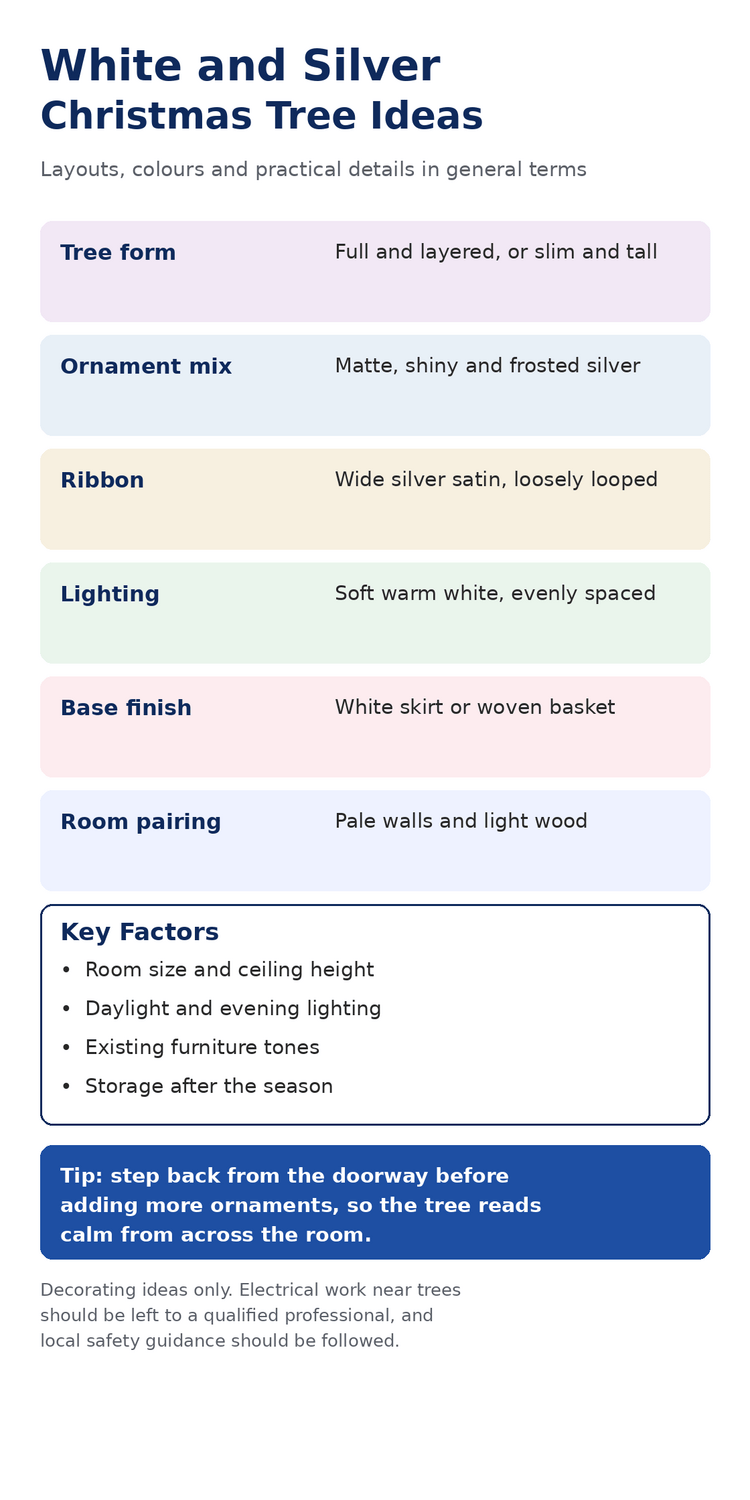
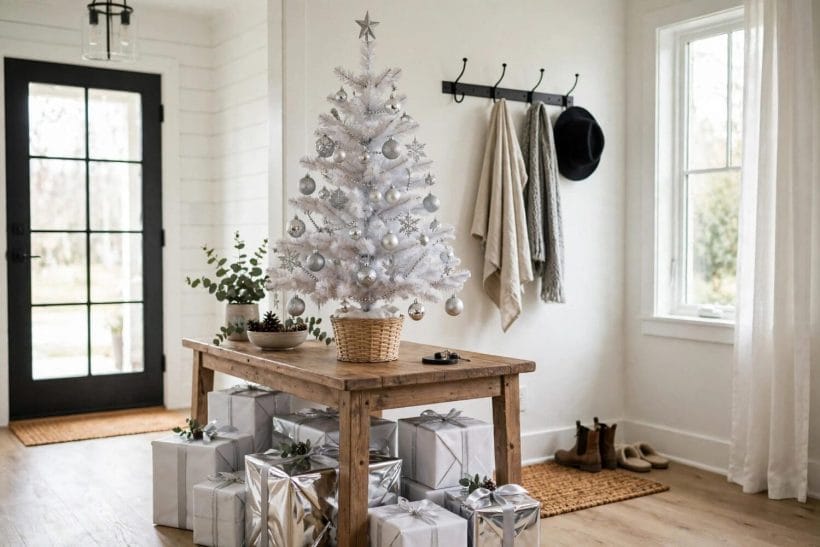
Tree form is the first practical decision, and it follows the room. A full, layered tree suits a generous corner with clear floor space around it, because its width needs room to breathe. A slim, tall tree suits a narrower corner, a hallway-adjacent living space, or a smaller room where a full tree would crowd seating and walkways. A tabletop tree suits an entryway, a side table, or a room where a floor-standing tree would block light or movement. Each form can carry the white and silver palette well, and none is inherently more elegant than the others; the right form is the one that fits without forcing furniture to move or blocking a doorway.
Height follows the ceiling and the furniture nearby. A tree that nearly touches the ceiling can feel grand in a tall room, but the same height can feel overwhelming where the ceiling is low or where the tree stands beside tall shelving. Leaving a comfortable gap above the top ornament keeps the tree in proportion and makes the topper easier to place. Equally, a tree that stands well below the height of nearby bookcases or cabinets can look lost, so the tree is best judged against the tallest nearby piece rather than in isolation. A quick look from the doorway, where visitors will first see the tree, usually settles the question.
Branch fullness is worth considering alongside form. Dense branches hide the centre of the tree and give ornaments a thick backdrop, which suits a heavily dressed look. Sparser branches show more of the tree’s structure and let light pass through, which suits a lighter, airier arrangement with fewer ornaments. White branches make this difference more visible than green ones do, because gaps read as pale space rather than shadow. Readers who prefer a minimal look often favour sparser branches, while readers who enjoy layering ornaments often favour denser ones, and either choice can be dressed well with silver.
3. Layouts That Keep the Tree in Proportion
Placement begins with movement. The tree should stand where people can pass without brushing against it, where doors can open fully, and where seating still faces the room naturally rather than being pushed aside. A corner beside a window is a classic position, because daylight shows the white branches well by day, and the tree becomes a glowing shape in the evening. A corner beside a fireplace is another common position, though it needs care: the tree should stand clear of heat, and anything placed on the mantel should be kept away from open flame, with heat and clearance considered in general terms and local guidance followed.
The space around the base matters as much as the position itself. A tree with a clear skirt of floor around it looks intentional, while a tree squeezed between furniture can look like an afterthought, however well it is dressed. If the room is small, a slim tree or a tabletop tree preserves that clear space, and the rest of the decorating can move to the mantel, the windowsill, or the dining table rather than crowding the tree. In a larger room, the tree can anchor a seating arrangement, with chairs angled toward it rather than lined up against walls, so the tree becomes part of how the room is used rather than a decoration pushed to the edge.
Viewing distance shapes how much decoration the tree needs. A tree seen mainly from across a large room benefits from larger ornaments and broader ribbon, because small details disappear at a distance. A tree seen mainly from close up, in a small room or a reading corner, benefits from finer ornaments and delicate beads, because the detail is visible and can be enjoyed. This is why the same palette can look sparse in one room and busy in another: the room sets the scale. Walking to the far side of the room and looking back is a better test than standing beside the tree and judging it at arm’s length.

4. Colour Balance: White, Silver and Soft Neutrals
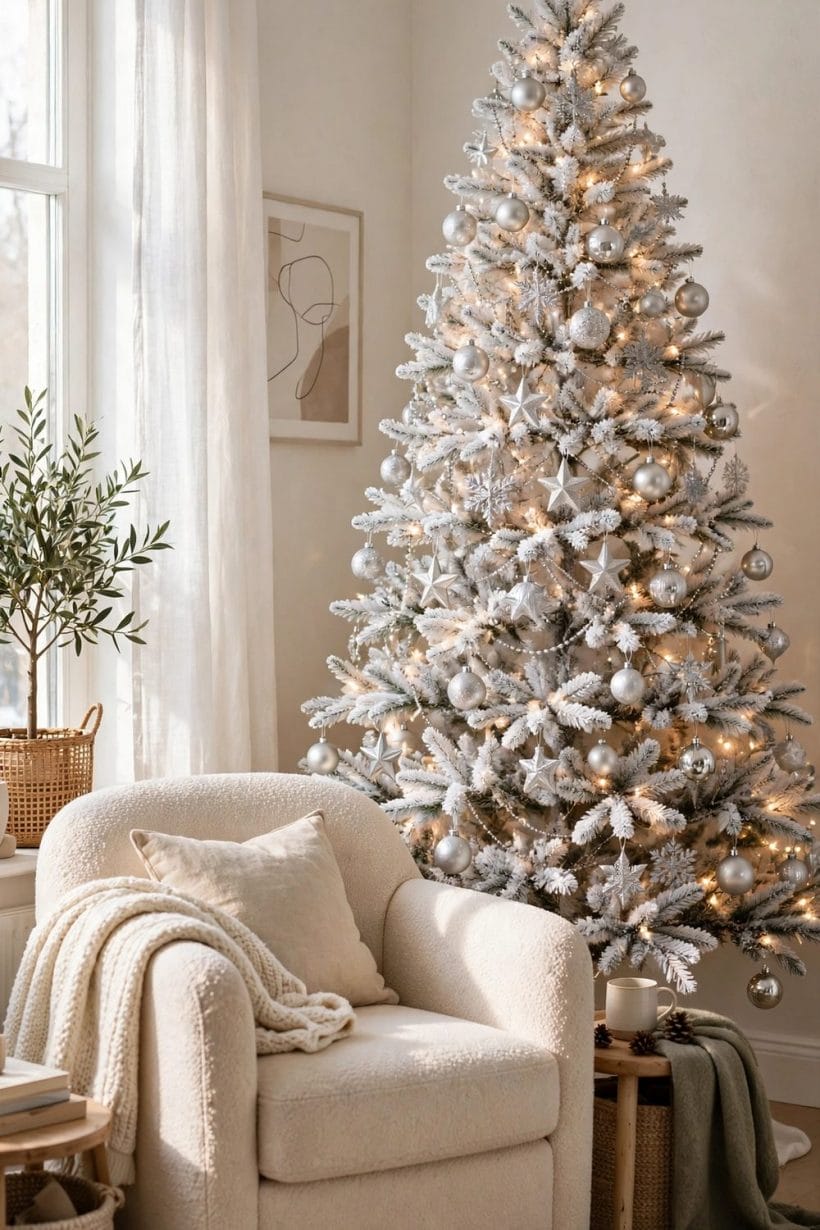
White and silver are both cool, pale colours, so the room needs something to keep them from feeling cold or clinical. Warm neutrals do that job gently: cream cushions, a light wooden floor, a woven basket at the base, or a soft throw over a chair arm. Those touches do not compete with the tree, but they stop the palette from feeling like a display rather than a room. Cool neutrals do a different job: pale grey walls, white curtains, and silver-grey cushions sharpen the wintry feeling and make the tree feel like a natural extension of the room. The choice between warm and cool neutrals is a matter of the room’s existing character, not a rule imposed by the tree.
A small accent can deepen the palette without breaking it. Soft gold, used sparingly in a ribbon edge or a few ornaments, warms silver without turning the tree into a gold tree. Pale blush or soft blue, used in the same sparing way, can echo cushions or artwork already in the room. The key is proportion: an accent that stays a minor presence enriches the look, while an accent that grows to rival silver changes the tree’s character altogether. Readers who want a strictly white and silver tree can skip accents entirely and rely on texture, with matte and shiny silver providing all the variation needed.
Greenery, used sparingly, is another way to soften the palette. A garland on the mantel, a sprig in a vase, or a wreath on a nearby wall introduces a natural green that makes the white tree feel less stark, and it connects the tree to the wider seasonal decorating in the room. Fresh greenery needs care with drying and with heat sources, and it should be kept clear of open flame, with any concerns about drying or fire risk handled by following local safety guidance and seeking professional advice where needed. Artificial greenery avoids the drying question and can be reused, which suits readers who decorate the same way each year.
5. Ornaments: Finishes, Shapes and Layering
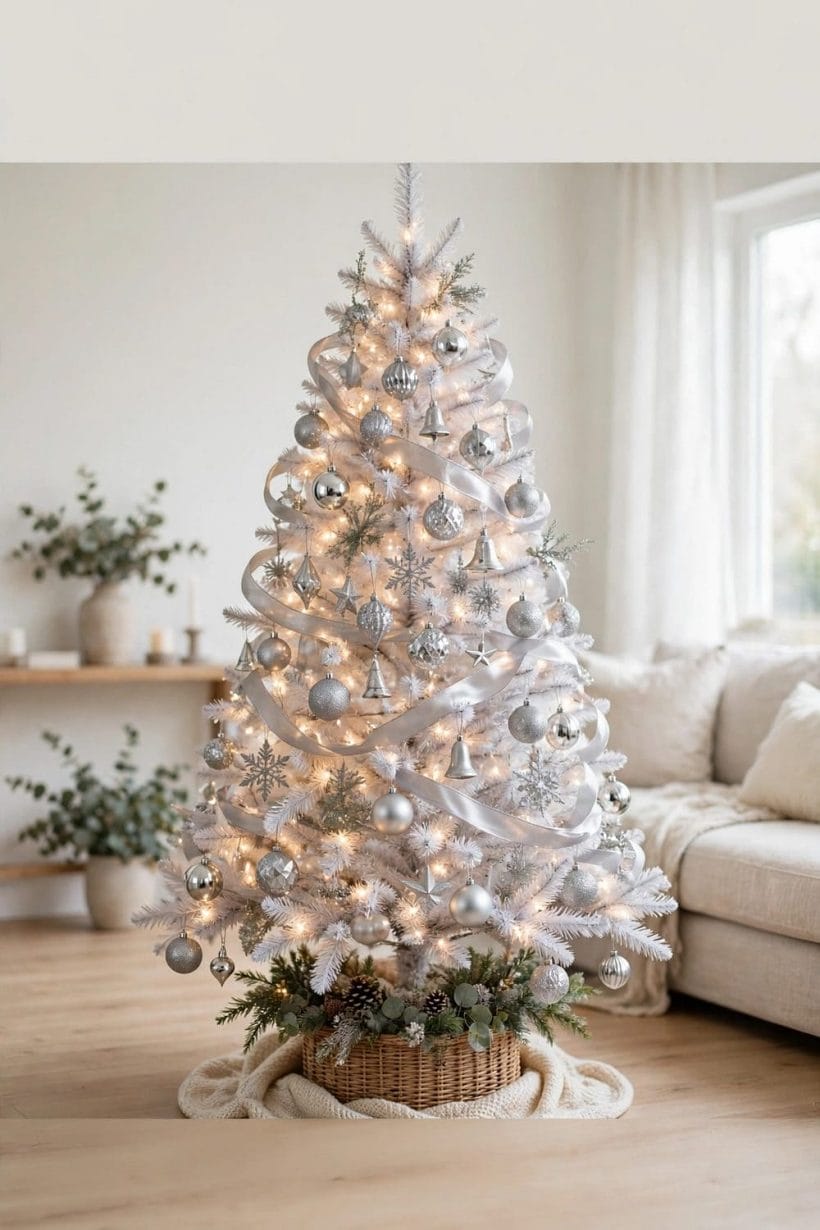
Ornament layering follows a simple order: larger pieces first, placed deeper among the branches, then medium pieces spread evenly, then smaller pieces toward the tips. This order keeps the tree from looking top-heavy or patchy, because the larger pieces give structure and the smaller pieces give sparkle. Spacing matters as much as size. Ornaments clustered in one area leave bare patches elsewhere, and the eye notices the gaps more than the clusters. Spreading ornaments around the whole tree, including the back where it can be seen from another angle, gives a finished look from every seat in the room.
Finish is where silver shows its range. Matte baubles absorb light and read as soft spots of grey-silver, shiny baubles reflect light and become bright points, frosted baubles look dusted with winter, and beaded or sequinned pieces add fine detail at close range. A tree that mixes these finishes looks richer than a tree that uses only one, even when the colour stays strictly silver. Clear glass ornaments, which show the white branches through them, can also work, because they add shine without adding weight. Whatever the mix, keeping the finishes within the silver family preserves the calm that defines the look.
Shape variety keeps the eye moving. Round baubles provide the rhythm, while stars, drops, icicles, snowflakes and simple geometric forms provide points of interest. A finial or star at the top finishes the shape, and its finish should echo the ornaments below rather than introducing a new colour. Heavier ornaments need sturdier branches and secure hanging, and fragile ornaments are best kept higher, away from busy walkways and curious hands. Storing ornaments carefully after the season, grouped by finish and size, makes the next year’s decorating easier and protects the pieces that carry the look.
6. Ribbon, Garlands and the Top of the Tree
Ribbon is the element that ties the tree together visually. A wide silver ribbon, looped loosely from branch to branch, creates flowing lines that guide the eye around the tree, while a narrower ribbon, wound more tightly, creates a neater, more structured pattern. Mesh ribbon holds its shape and adds volume, satin ribbon lies flatter and shines more, and wired ribbon can be shaped into bows and loops that stay in place. The ribbon should echo the ornaments rather than compete with them, so a silver ribbon in a similar tone to the baubles usually works best, with any accent ribbon kept to a minor presence.
Garlands sit inside the tree or across the mantel, and they need the same restraint. A beaded silver garland adds sparkle between ornaments without adding bulk, while a thicker garland can fill gaps in sparser branches. Draping a garland loosely, with gentle swags rather than tight spirals, keeps the tree looking natural, and the same loose draping suits a mantel garland, where it can echo the tree without copying it exactly. The mantel and the tree should feel related, through shared finishes and tones, rather than identical, because a room decorated in exactly the same way everywhere can feel staged rather than lived in.
The top of the tree deserves attention last, once the rest of the tree is dressed. A star, a finial, or a generous bow can all finish the shape, and the choice usually follows the tree’s character: a star suits a classic, symmetrical tree, a finial suits a slimmer, more modern tree, and a bow suits a softer, more romantic arrangement. Whatever tops the tree, it should sit securely and in proportion, neither so small that it disappears nor so large that it overwhelms the upper branches. Checking the topper from the doorway, where the full height of the tree is visible, is the best way to judge its scale.
7. Lighting for a Calm Glow
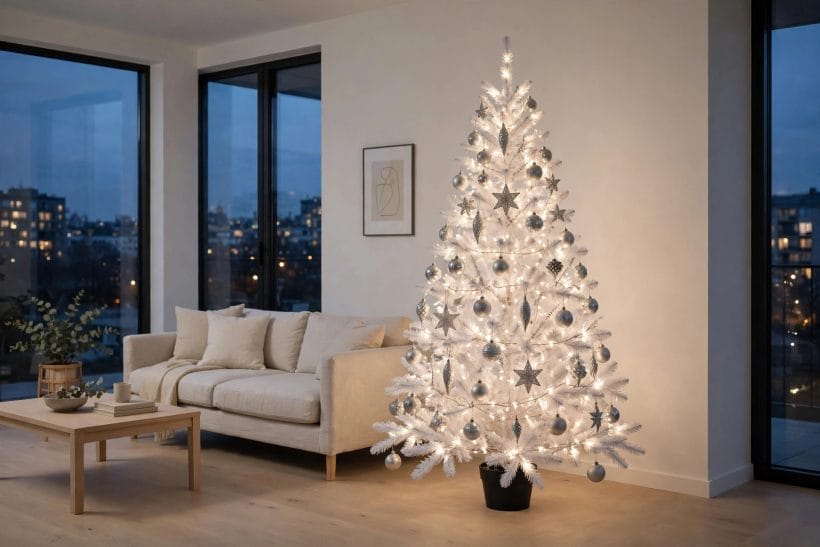
Lighting transforms a white and silver tree more than any other element. White branches reflect light, so even a modest set of lights can make the whole tree glow, and silver ornaments multiply that glow by reflecting it back. Warm white light gives a soft, inviting glow that suits evening rooms and pairs well with cream and light wood, while cool white light gives a crisper, more wintry glow that suits pale grey rooms and modern furniture. The choice follows the room’s existing lighting: a room lit mainly with warm lamps usually suits warm white tree lights, while a room with cooler daylight and pale surfaces may suit cool white better.
Even spacing is the main practical point. Lights wound evenly from the inside of the branches outward give a glow that comes from within the tree, while lights draped only on the outer tips give a surface sparkle that can look patchy. Starting at the top and working down, or starting at the base and working up, matters less than keeping the spacing regular and stepping back to check for dark patches. A tree that glows evenly looks calm, while a tree with bright clusters and dark gaps looks unfinished, however good the ornaments are. This is one of the few decorating jobs where patience pays visibly.
Safety around tree lighting should be treated with care and left to professionals where any electrical question arises. Readers should follow the instructions that come with any light set, keep lights and cables away from heat sources and open flame, and never adapt, repair, or extend electrical parts themselves. If a light set is damaged, if there is any doubt about its condition, or if any wiring work is needed near the tree, a qualified professional should be consulted and local safety guidance followed. Dried greenery, paper decorations, and fabric near heat or flame need the same caution, and the tree itself should stand clear of fireplaces, heaters, and candles. The glow should be enjoyed without any electrical or fire risk being taken lightly.

8. The Base, the Floor Around the Tree, and Everyday Use
The base is the part of the tree most often overlooked, and it is also the part that grounds the whole arrangement. A white tree skirt softens the transition from branches to floor and hides the stand, while a woven basket or a simple collar gives a tidier, more structured finish. The base finish should echo the room: a soft skirt suits a cosy, layered room, while a basket or collar suits a cleaner, more modern room. Whatever the choice, the base should sit flat and stable, with no wobble, and the floor around it should stay clear so the tree can be enjoyed without tripping hazards.
Gifts, when they are placed under the tree, become part of the look. Wrapping in white, silver, and soft neutrals extends the palette to the floor, while a mix of unrelated wrapping colours can break the calm the tree has built. This does not require every gift to match exactly; a shared tone, a silver ribbon, or a simple white tag can tie different papers together. Keeping the gift area tidy, with larger gifts at the back and smaller ones in front, preserves the shape of the base and keeps walkways clear. After the season, the same care with wrapping and storage keeps the palette ready for the next year.
Everyday use shapes how the tree should be dressed. A tree in a busy family room needs sturdier ornaments lower down, where they may be brushed, and more delicate pieces higher up. A tree in a quieter room can carry finer ornaments throughout. A tree near a dining area, where meals are shared, should leave the table and chairs usable rather than crowding them, and a tree in an entryway should leave the door and any hooks or seating usable. Decorating for the room as it is actually lived in, rather than for a photograph, is what keeps the tree enjoyable through the whole season rather than only on the day it is dressed.
9. Matching the Tree to the Rest of the Room
A tree rarely stands alone, and the rooms around it shape how it reads. In a living room, the tree should relate to the seating, the curtains, and the artwork, through shared tones rather than exact matching. A pale sofa and light curtains already give a white and silver tree a natural home, and the tree in turn gives the room a seasonal focus. Readers looking at living rooms in red or living rooms with orange walls will see a different kind of warmth, and the contrast is instructive: where those rooms use strong colour to anchor the space, a white and silver tree uses light and shine, so it suits rooms that are already pale and quiet.
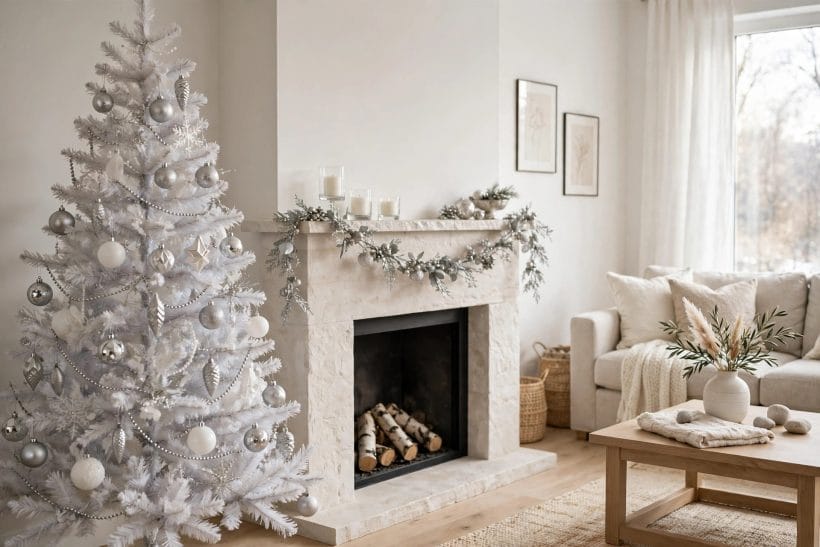
The fireplace, where one exists, is the tree’s natural companion. A mantel dressed with a simple garland, a few silver-toned pieces, and candles kept well clear of anything flammable can echo the tree without repeating it. Guidance on artwork above a fireplace is useful here, because what hangs above the mantel sets the tone for the whole wall, and a painted fireplace in a pale finish can sit especially well beside a white tree. The tree and the mantel should be dressed as a pair, with shared finishes and a similar level of restraint, rather than as two separate displays competing for attention.
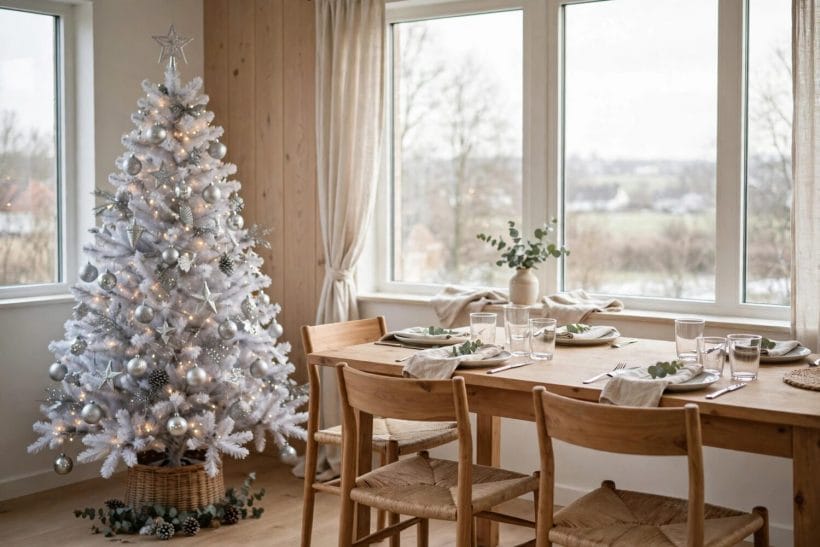
Dining spaces need a lighter touch. A transitional dining room with pale walls and simple furniture can carry a white and silver tree in the corner without the tree overwhelming the table, provided the tree leaves the table usable and the chairs movable. A small tabletop tree, a simple centrepiece in silver and white, or a garland along a sideboard can carry the palette into the dining area without a second full tree. The aim throughout is continuity: the same pale, shining palette appearing in different forms as a reader moves through the home, rather than a single decorated corner in an otherwise undecorated house.
10. Costs in General Terms, and Planning Ahead
Costs for a white and silver tree are best understood as drivers rather than fixed amounts, because the same look can be achieved at very different levels of spending depending on what is already owned and what is bought new. The tree itself is usually the largest single consideration, with form, height, and branch fullness all influencing the general level of cost. Ornaments follow, with finish and material shaping the picture: glass ornaments generally sit at a different level from shatterproof ones, and larger ornaments generally cost more in relative terms than smaller ones, though the difference depends on the shop and the range. Ribbon, garlands, lighting, and the base finish each add their own smaller considerations, and the total is the sum of those parts rather than any single item.
Reusing what is already owned changes the picture considerably. Silver ornaments kept from earlier years, ribbon saved and re-looped, and a base finish that suits the room can all reduce what needs buying, and the white and silver palette lends itself to reuse because it does not depend on a fashionable colour that dates quickly. Buying in stages, across more than one season, is another way readers commonly manage the total: the tree one year, the ornaments the next, and the ribbon and base finish after that. Checking local shops and comparing ranges in general terms, rather than assuming any single source, helps keep the plan realistic, and local prices should always be checked directly rather than taken from any general guide.
Planning ahead also covers storage and care. Ornaments stored grouped by finish and size, ribbon rolled rather than crumpled, and lights stored without tangling all make the next season easier and protect the pieces that carry the look. A tree stored carefully, with branches protected and the stand kept with it, lasts longer and keeps its shape. Thinking about storage before buying also prevents a common problem: a tree or a set of ornaments that looks right in the shop but has nowhere sensible to live for the rest of the year. A decorating plan that includes the months after the season is a plan that is more likely to be enjoyed again.
Final Considerations
A white and silver tree rewards restraint, light, and a room that is allowed to stay itself. The palette works because white branches lighten the corner, silver ornaments catch and return the light, and pale neutrals around the tree keep the whole arrangement feeling like a room rather than a display. For readers gathering silver and white christmas tree decorations, the most useful test remains the simplest: step back, look from the doorway, and ask whether the tree reads calm, balanced, and in proportion. If it does, the details are working, whatever the individual pieces cost or wherever they came from.
Before buying, it helps to measure the corner in general terms, note the ceiling height and the nearest furniture, and consider how the tree will be seen, from across the room or close up. Before dressing the tree, it helps to group ornaments by finish and size, plan the ribbon loosely, and place lights evenly, checking for dark patches as the work goes on. And throughout the season, the safety points in this survey bear repeating in general terms: electrical work near a tree belongs with a qualified professional, lights and cables should stay clear of heat and open flame, and local safety guidance should be followed whenever there is doubt. A tree dressed with care, and enjoyed with care, is the whole point of the exercise.
Readers who want to carry the palette further can browse home design ideas and interior design ideas for the wider rooms these trees sit in, from pale living spaces to transitional dining rooms and mantel walls. The white and silver tree is, in the end, a quiet kind of festive decorating: it does not demand attention, it gathers light, and it lets the room, the season, and the people in it take centre stage.




0 Comments