

A shower curtain liner has one clear job, and its direction decides whether it does that job well. The liner hangs on the wet side, inside the tub or shower tray, while the decorative curtain hangs on the dry side, facing the bathroom. Water that hits the liner runs down its inner face and back into the tub or tray instead of pooling on the floor, soaking a bath mat, or creeping toward the wall. It is a small detail, yet getting it the wrong way round is one of the most common reasons a bathroom floor ends up wet after every shower.
The question often comes paired with a second one about the rings and hooks themselves, and it is worth answering both together, because liner, curtain and hooks work as one hanging system. If you have ever wondered which way should shower hooks face, the short version is that the openings of the hooks point outward, toward the bathroom, so the rings can be lifted off the rod easily and the liner and curtain can be taken down for washing without a struggle. The rest of this guide explains the full picture, from hanging order and drape to billowing, cleaning and replacement, so the setup keeps water where it belongs.

1. The Short Answer: Liner Inside, Curtain Outside
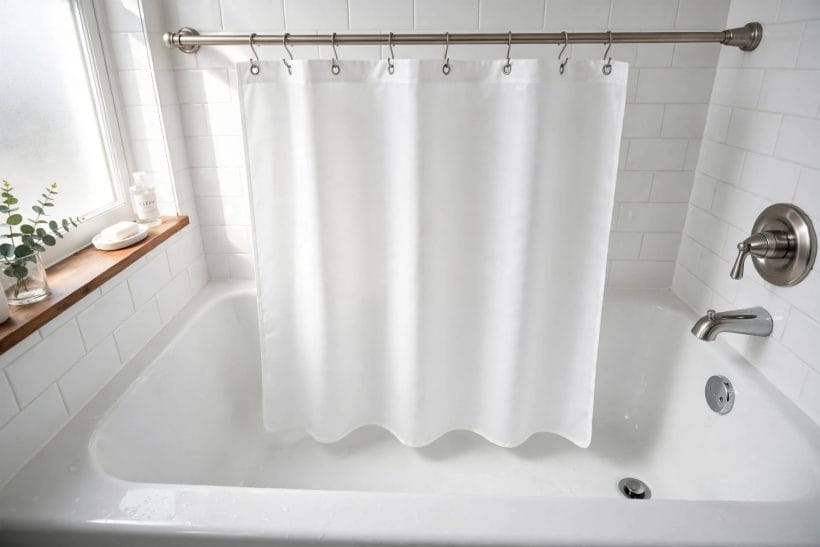
The liner faces inward, toward the shower, and the decorative curtain faces outward, toward the bathroom. Think of the liner as the working layer and the curtain as the dressing layer. The liner is made to get wet, to shed water, and to dry between showers, while the curtain is there for colour, pattern and privacy. When the two layers are hung in that order, spray hits the liner first, runs down it, and lands back inside the tub or tray.
Reversing the layers defeats the purpose of both. A decorative curtain hung on the wet side soaks through, stays damp, and can develop a musty smell, while a liner hung on the dry side leaves the curtain exposed to spray and lets water run down the outside of the liner onto the floor. If a bathroom floor is wet after every shower even though the curtain looks closed, the first thing to check is whether the liner is truly inside the tub or tray along its whole length, not just at the middle.
There is one common exception worth knowing about, and it is about the type of liner rather than the rule itself. Some liners are sold as a single combined curtain, with a waterproof layer already joined to a fabric face. With a combined curtain, the waterproof side still faces the shower, and the fabric face still faces the bathroom, even though there is only one hanging layer. The principle stays the same: waterproof side to the water, decorative side to the room.
2. Why the Liner Faces Inward
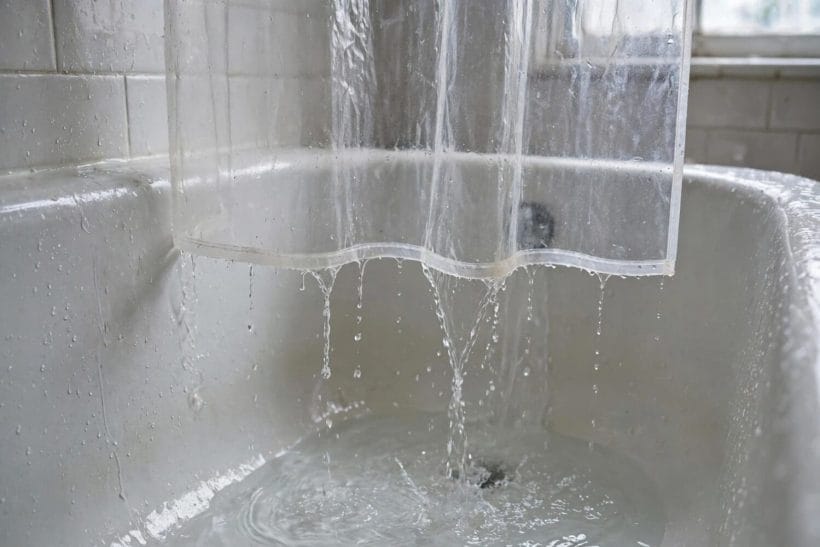
Water in a shower does not fall straight down. It bounces off shoulders, runs along arms, and sprays sideways when it hits the tub or tray. A liner on the inside catches that spray across its full width and guides it downward, because gravity pulls each drop along the liner and into the tub or tray below. The liner acts like a light, flexible wall that happens to hang from a rod, and its position on the wet side is what makes that wall useful.
The bottom edge matters as much as the top. A liner that hangs inside the tub or tray but is too short, or one that is tucked behind a tub rim, can still let water escape at the ends. The ends of the liner, near the wall and near the open side of the tub, deserve a quick check each time the curtain is drawn. If either end hangs outside the tub, water will follow it out, however well the middle of the liner is placed.
Keeping the liner inward also protects the rest of the bathroom. A floor that stays wet encourages damp patches near the tub, swollen skirting, and a mat that never quite dries. None of that needs a complicated fix. It usually needs the liner moved to the inside, the curtain drawn fully closed, and the bottom edge left free to hang straight down inside the tub or tray, rather than folded over the rim.
3. How Hooks and Rings Are Meant to Sit
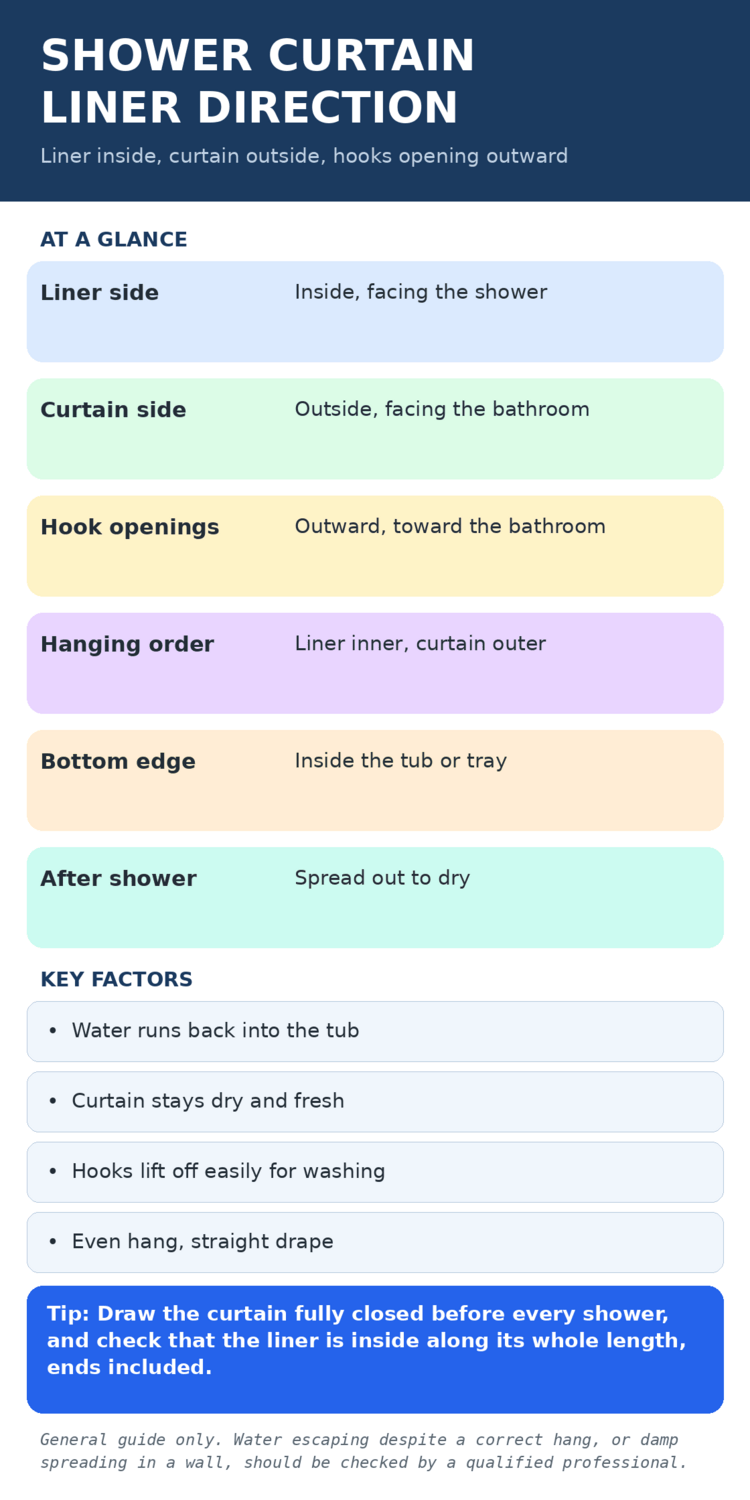
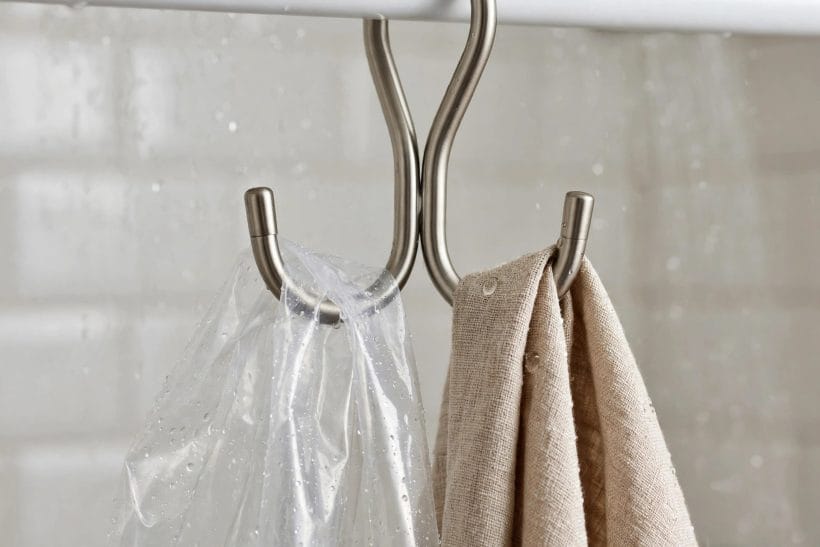
Hooks and rings carry both layers, and their direction affects how easy the whole setup is to live with. The opening of each hook points outward, toward the bathroom, so a ring can be lifted up and off the rod from the dry side. That matters on wash day, when the liner and curtain both need to come down, and it matters when a single hook slips or a ring breaks and needs replacing without dismantling the whole rod.
Hook openings that face inward, toward the shower, are not wrong in the sense that the curtain will still hang, but they make removal awkward and they put the opening where spray and steam reach it most. Over time, hooks that are hard to remove tend to be left in place, and liners that are hard to remove tend to be washed less often. A small choice at hanging time therefore shapes how well the liner is looked after for months afterwards.
Double hooks are worth a mention here, because they are made for exactly this two-layer setup. One side of a double hook carries the liner and the other side carries the curtain, so each layer hangs freely and can move on its own. That separation helps the liner stay inside while the curtain stays outside, and it stops the two layers from bunching together when the curtain is drawn. With single hooks, both layers share one hook, which still works, but the layers need a little more care to keep them in the right order when the curtain is opened and closed.
4. Liner First, Curtain Second: Hanging Order
Hanging order follows the same logic as direction. The liner goes on first, closest to the shower, and the curtain goes on second, closest to the bathroom. On a double-hook set, that means the liner takes the inner hook and the curtain takes the outer hook. On a single-hook set, it means threading the liner onto each hook before the curtain, so the liner ends up behind the curtain when viewed from the bathroom.
It helps to hang the liner and curtain with the rod at a comfortable height and the tub or tray clear, rather than leaning over a full tub. Start at one end, work steadily along the rod, and check after every few hooks that the liner is still the inner layer. It is easy for the layers to swap near the middle of the rod, especially with a patterned curtain that draws the eye, and a swapped section is often the section that lets water through.
Once both layers are up, draw the curtain closed and step back. From the bathroom, only the decorative curtain should be visible. From inside the shower, only the liner should be visible, with its bottom edge inside the tub or tray. If either layer is visible from the wrong side, or if the layers are tangled, it is quicker to fix the order now than to mop a wet floor later. A related shower room layout can change how much spray reaches the curtain, but the liner-first order holds whatever the layout around it.
5. Getting the Length and Drape Right
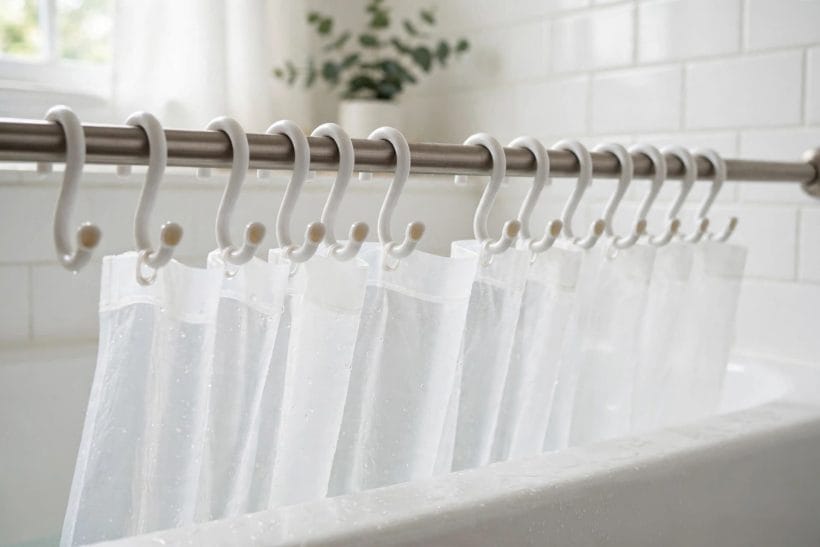
Length is where many liner setups quietly go wrong. A liner that is too long pools at the bottom of the tub or tray, folds over itself, and stays damp in the folds. A liner that is too short leaves a gap at the bottom where spray escapes, and it can swing freely in the draught of a running shower. The right length lets the bottom edge hang inside the tub or tray with a little clearance, so water runs off it cleanly and air can move around it as it dries.
Drape matters too. A liner should hang straight down, without being pulled tight across the rod or bunched at one end. A rod that sags in the middle, or hooks that are spaced unevenly, can pull the liner into folds that trap water and stop the curtain from closing fully. Spacing the hooks evenly along the rod, and checking that the rod itself sits level, gives the liner a smooth fall and the curtain a smooth draw.
Weighted hems and magnetic strips at the bottom of some liners help the liner hang straight and stay inside the tub or tray. They are not essential, and a plain liner hung at the right length works perfectly well, but a weighted hem can be a useful fix for a liner that keeps drifting outward. If a liner is much too long, trimming is not the answer for most household liners, since a cut edge can fray or lose its finish; choosing a liner made for the tub or tray height is the cleaner solution.
6. Keeping Water Inside the Tub or Tray
Water containment is a team effort between liner, curtain, rod and tub, and the liner is only one part of it. The curtain should be drawn fully closed before the shower starts, not left half open, because spray finds the gap quickly. The liner should be inside the tub or tray along its whole length, including the ends near the wall. The rod should hold the curtain far enough out from the wall that the liner can hang straight, rather than pressed against the tiles.
The ends of the curtain deserve particular attention. At the wall end, the liner and curtain should meet the wall closely enough that spray does not slip behind them. At the open end, the curtain should overlap the tub edge rather than stopping short of it. A shower that still splashes despite a correctly hung liner may have a rod set too high, a curtain drawn too short, or a liner that has drifted outside the tub during use, and each of those is a hanging check rather than a plumbing problem.
It is worth saying plainly where the boundary sits with water problems. A liner handles surface spray and drips, and it is not a fix for water coming from behind tiles, from a damaged tray, or from a joint that has failed. If water appears on the floor even when the liner is correctly placed and the curtain is closed, or if damp is spreading in a wall, that is a job for a qualified professional, who can check the waterproofing and plumbing in general terms and advise on the right repair. No liner adjustment should be presented as a substitute for that check.

7. Stopping the Liner from Billowing Inward
Billowing is the familiar moment when a liner blows inward during a shower and clings to whoever is standing under the spray. It happens because warm air rises inside the shower while cooler air sits in the bathroom, and the pressure difference pulls the light liner toward the warm side. It is annoying rather than dangerous, but it is also a sign that the liner is hanging freely, which is exactly what it should do.
A weighted hem is the simplest calming influence, since extra weight at the bottom resists the pull of rising air. Keeping the bathroom door slightly open, or the extractor running, can also even out the air movement, though that depends on the bathroom and its ventilation. Some people find that a liner with a mesh or vented top section billows less, because air can pass through the upper part while the waterproof lower part still blocks spray. That vented section, where present, sits above the spray line and does not change the rule that the waterproof part faces inward.
What does not help is weighing the liner down with objects clipped to its hem, or taping it to the tub. Clips can tear a light liner, and tape leaves residue and can pull the liner out of shape. A liner that billows badly despite a weighted hem may simply be too light for the shower, or the shower may be unusually steamy, and a slightly heavier liner is a better answer than an improvised fix. The goal is a liner that hangs calmly, dries well, and still moves enough to be drawn open and closed easily.
8. Cleaning, Drying and Mildew Habits
A liner that is easy to take down is a liner that gets cleaned, and that brings the hook direction back into the picture. With hook openings facing outward, the liner lifts off the rod in a few moments, goes into a wash or a wipe-down, and goes back up in the same order. A liner left hanging for months without a clean will gather soap film, and soap film holds moisture, which is what gives mildew a foothold.
Between showers, the liner should be left spread out rather than bunched at one end of the rod. A bunched liner stays damp in its folds, while a spread liner dries across its full surface. Drawing the curtain open after a shower, so air reaches the liner, helps just as much. The decorative curtain benefits from the same habit, since it stays dry when the liner does its job, but it still collects bathroom dust and steam and deserves its own occasional wash.
Cleaning itself can stay simple. A wipe with a soft cloth, a rinse, and a full dry before rehanging suits most liners, and any care label on the liner is the best guide for washing. Harsh scrubbing can damage a waterproof coating, and a liner that has lost its coating will let water through even when it hangs in the right direction. When cleaning no longer restores a liner, or when its surface feels rough or patchy, replacement is the honest answer rather than another wash.
9. When to Replace a Liner or Hooks
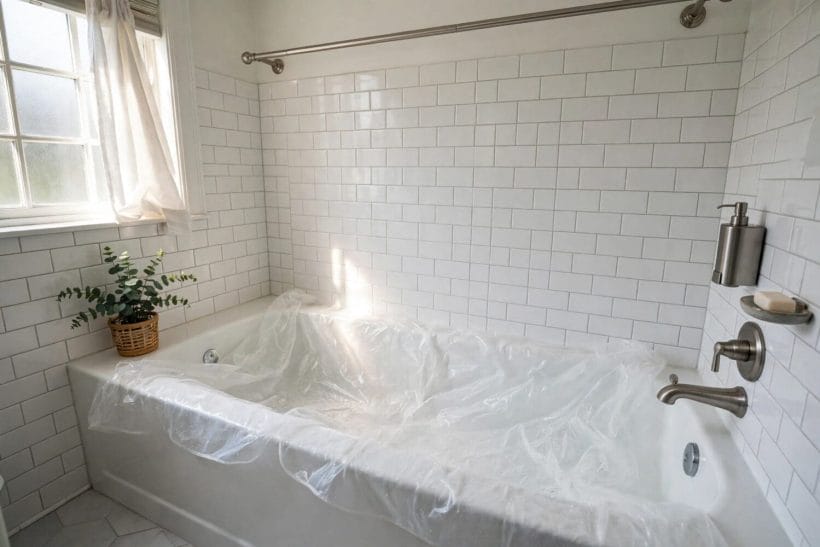
Liners do not last forever, and knowing the signs saves a run of damp floors. A liner that stays stiff, that has torn eyelets, that has a hem coming apart, or that smells musty after a proper clean has reached the end of its useful life. A liner that has yellowed or gone cloudy can still work, but cloudiness often comes with a coating that is wearing thin, so it is worth watching for damp patches on the curtain behind it.
Hooks and rings wear out too. A hook that no longer closes properly, a ring that sticks on the rod, or a set that has rusted will pull the liner unevenly and make drawing the curtain a chore. Replacing hooks is a small job, and it is a good moment to check the rod as well. A rod that has slipped from its brackets, or one that sags, will undo the best liner, so the brackets and the level of the rod deserve a look at the same time.
Replacement is also the right moment to recheck direction from scratch. New liners sometimes arrive folded in a way that makes the waterproof side hard to spot, and new hook sets sometimes include two different hook styles in one pack. Lay the liner out, find the smooth waterproof face, put that face toward the shower, and hang the liner on the inner hooks before the curtain goes on the outer ones. A fresh start with the order right is easier than correcting a mixed-up hang later.
10. Small Bathrooms and Renter-Friendly Fixes
Small bathrooms make liner direction matter even more, because there is less floor to absorb a splash and less room for a wet mat to dry. A liner that hangs correctly inside a compact tub or tray keeps the small floor dry, and a curtain that draws fully closed keeps spray off the nearest storage and laundry. In a tight bathroom, a lighter curtain that draws smoothly is often kinder than a heavy one that bunches and pulls the liner out of place.
Renters have the same liner choices as anyone else, and none of them need changes to the room itself. A tension rod, where one is already in use, a fresh liner, and a set of double hooks can all be fitted and removed without touching tiles or plumbing. That is part of the appeal of getting the liner question right: it is a change of hanging, not a change of room, and it can be reversed in minutes when a tenancy ends.
Small bathrooms also reward a tidy routine. A liner left spread to dry, hooks checked now and then, and a curtain drawn fully closed before each shower will keep a compact bathroom feeling fresh. For ideas on making a compact bathroom work harder overall, a tiny bathroom guide can sit alongside this liner guide, and a window in shower guide covers a different element of shower daylight and privacy. The liner itself, though, stays a one-job item: waterproof side in, decorative side out, hooks opening outward.

Final Considerations
The whole question comes down to a simple picture. The liner hangs inside the tub or tray, facing the shower, so water runs back where it came from. The decorative curtain hangs outside, facing the bathroom, so it stays dry and looks its best. The hooks open outward, toward the bathroom, so both layers lift off the rod easily for washing. Once that picture is clear, the rest is maintenance: an even hang, a straight drape, a full close before each shower, and a spread-out dry afterwards.
If a floor still gets wet, work through the checks in order before assuming a bigger problem. Is the liner inside along its whole length, including the ends? Is the curtain drawn fully closed? Are the layers in the right order, liner inner and curtain outer? Is the liner the right length, hanging straight rather than pooling or swinging short? Most wet floors trace back to one of those checks, and most are fixed by rehanging rather than replacing anything.
That leaves only the boundary already noted. Liners, curtains and hooks are hanging items, and they handle spray and drips. Water that escapes despite a correct hang, damp that spreads through a wall, or any sign of damage to a tray, joint or pipework belongs with a qualified professional, who can assess the waterproofing and plumbing and advise properly. Within that boundary, the liner question has a settled answer, and it is one worth getting right the first time, because a correctly hung liner quietly protects the bathroom every single day.
For the wider bathroom around the shower, a bathroom vanity guide, a bathroom mirror guide, and a bathroom heat lamp guide each cover a separate fitting in general terms, while a shower room guide covers the room as a whole. None of those changes the liner rule, which stays the same in every bathroom: waterproof side to the water, decorative side to the room, and hooks opening outward for an easy lift-off.





0 Comments