

A tiny house fogs its windows faster than any other kind of home, because the same breathing, cooking and washing happens inside a fraction of the air. The dehumidifier that fixes it has to be sized to that density — and built for the temperatures your winters actually reach. This guide unpacks the sizing maths and the compressor-versus-desiccant choice, so the tool’s number makes sense before you run it.
1. Sizing a Dehumidifier at a Glance
Most dehumidifiers are rated for ordinary houses, and ordinary-house maths fails in a tiny one. The tool below is tailored specifically for tiny houses: it starts from the AHAM (Association of Home Appliance Manufacturers) sizing guidelines, adapts them for small spaces, and corrects for the two things that make small spaces different — how damp the home already is, and how many people load its air with moisture. It answers with a recommended technology, a required capacity in pints per day, and a reality check — how many times a day you would empty a small bucket. The table gathers the whole method; the sections after it take each input apart.
| Attribute | What the Tool Uses |
|---|---|
| The Baseline | AHAM sizing guidelines adapted for small spaces, built on a reference space of about 500 sq ft |
| The Condition Scale | Moderately Damp 10 · Very Damp 12 · Wet 14 · Extremely Wet 16 pints per day |
| The People Factor | About 5 pints per person per day — the occupants slider runs from 1 to 6 |
| The Area Rule | Past 500 sq ft, add 1 pint for every extra 100 sq ft; below it, the base barely shrinks, because density rules |
| The Temperature Question | Your lowest indoor temperature in winter, on a slider from 30°F to 75°F |
| The Technology Line | Below 60°F the tool recommends desiccant; at 60°F and above, compressor |
| The Compressor’s Limit | Works like an air conditioner or fridge, best above 65°F — below 60°F its coils freeze up and it stops working |
| The Desiccant’s Floor | A silica wheel absorbs the moisture and a heater dries the wheel; it keeps working down to 34°F and blows out warm, dry air |
| The Bucket | About 4 pints on a compact unit (a large unit holds about 10) — empties per day is the capacity divided by the bucket |
| The Hose Line | More than 2 empties a day, and the tool tells you to install a continuous drain hose |
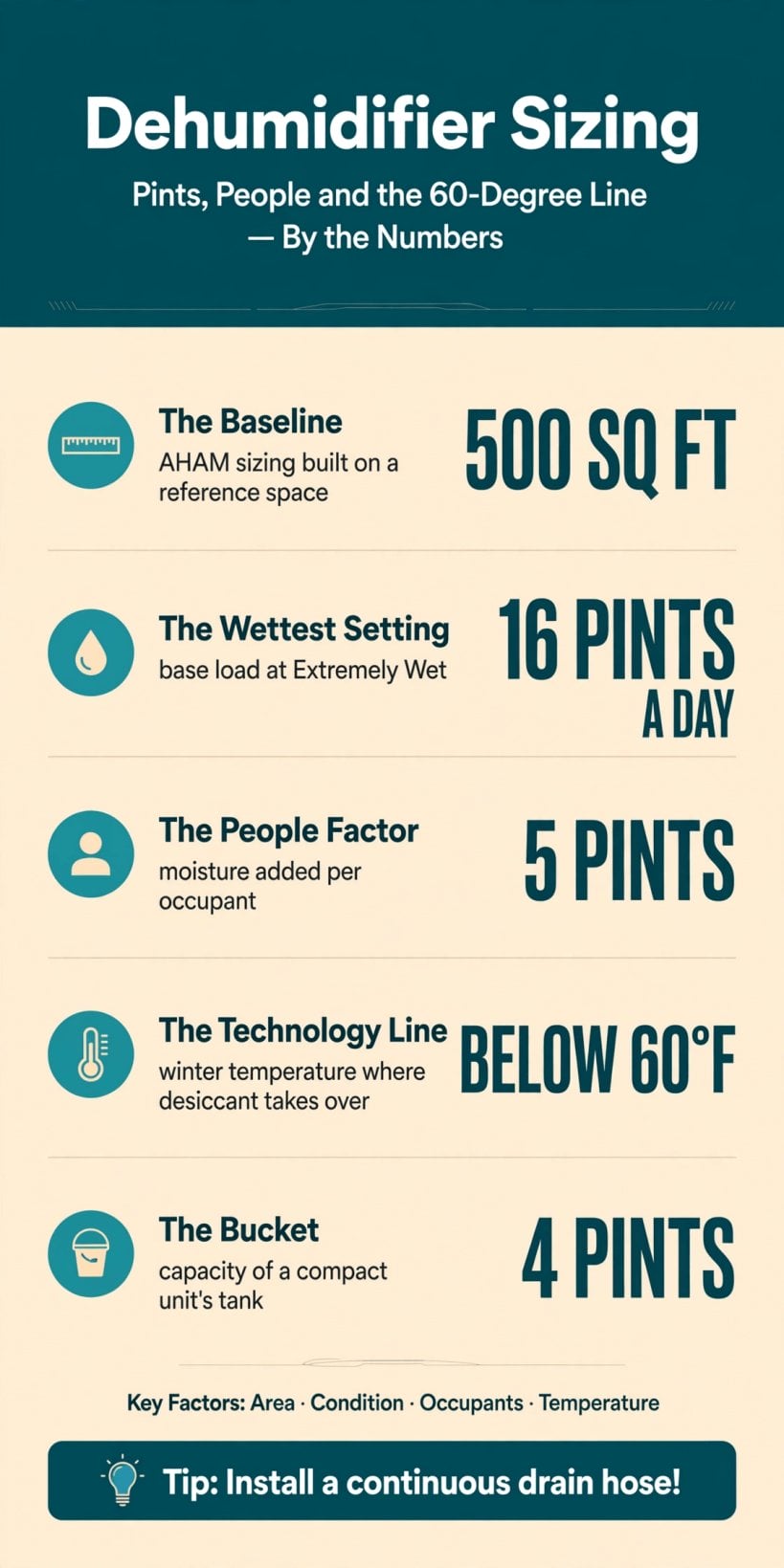
AHAM’s baseline, a four-step condition scale, five pints per person and one temperature line at 60°F — the sizing method on one card.
2. Why Tiny Houses Collect Moisture
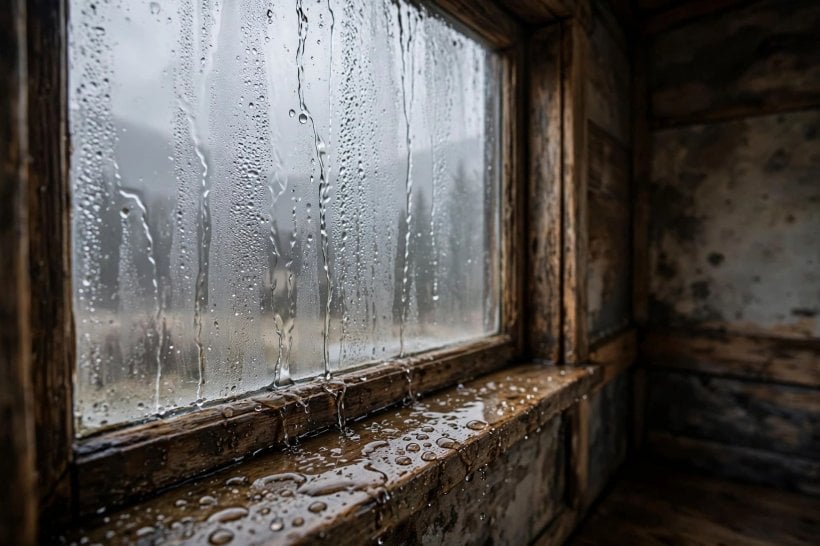
Start with the physics the tool is built on: high occupant density and small air volume. A conventional house dilutes the moisture its occupants produce across thousands of cubic feet of air. A tiny house holds the same human output — every breath, every boiled kettle, every pot of pasta — in a box a fraction of the size, so humidity climbs faster and the air saturates sooner. Saturation is visible: the condensation streaming down the window in the morning, pooling on the sill, quietly soaking the frames and corners nobody looks behind.
Heat can add to the load as well as fight it. Unvented heating dumps its own moisture into the room it warms — the problem the diesel heater ROI and moisture calculator works from the heating side — so a tiny house can gain water from its occupants, its cooking and its heater at once. That is why a sizing method written for ordinary houses under-reads a tiny house so badly. The tool’s whole design is a correction for density: it refuses to let a small floor plan talk it into a small number.
3. Start With Square Footage: The AHAM Baseline
The first input is the simplest: your square footage, with the field opening at 350 sq ft as its worked example. Behind it sits the AHAM baseline — the Association of Home Appliance Manufacturers’ sizing guidelines, which anchor their pints-per-day figures to a reference space of about 500 square feet. The tool adapts that baseline for small spaces rather than applying it raw, because the raw version assumes the one thing a tiny house never has: spare air.
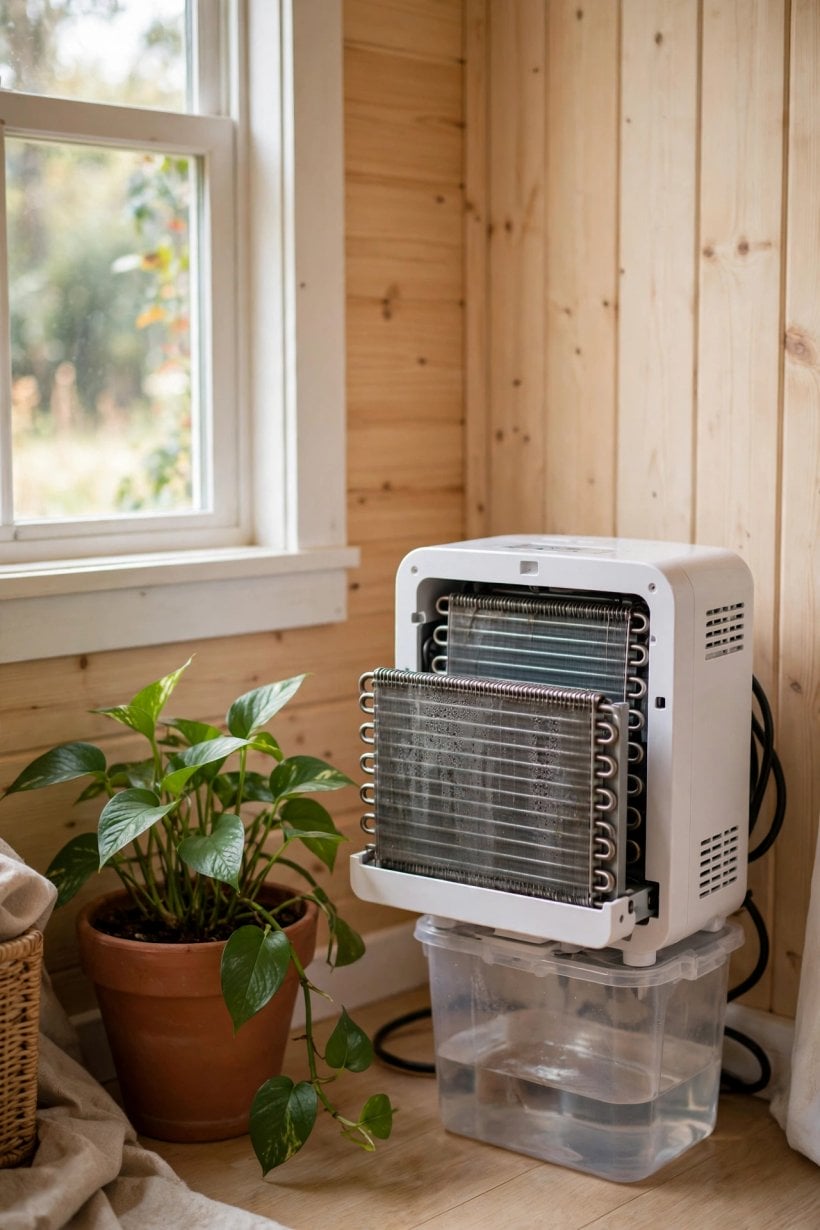
The adaptation shows in how the area rule behaves at the edges. Grow past 500 sq ft and the requirement grows with you — one extra pint for every extra 100 sq ft. Shrink below 500 and the base barely reduces at all. That asymmetry is deliberate: in a small space, moisture density replaces floor area as the thing being sized for. A 300 sq ft home with two occupants, measured by the air each person lives in, can be the bigger problem. Measure your floor honestly — it is the floor of the calculation, not the whole of it.
4. The Condition Scale: Musty, Clammy, Wet, Extreme
The second input asks you to grade your home’s current condition, and the four options are written as things you can sense rather than numbers you would have to measure. Moderately Damp is a musty smell. Very Damp is a clammy feel. Wet is visible condensation on the windows. Extremely Wet is puddles and mold. Each step raises the base load: 10 pints a day for Moderately Damp, 12 for Very Damp, 14 for Wet and 16 for Extremely Wet.

Grade honestly, because this is the input people are most tempted to flatter. The scale is a ladder of evidence: smell is the earliest warning, touch comes next, and by the time water is visible on glass or standing in puddles, the moisture has been winning for a while. The tool underlines the top two steps visually — choose Wet or Extremely Wet and its visualizer fills with animated green mold spores. Mold is not a separate problem arriving later; on this scale it is what the wettest conditions are already called. If two grades both sound like your house on different days, size for the worse one: unused capacity is a setting, but unbought capacity is a renovation.
5. The People Factor: Five Pints Per Person
The third input is the one ordinary sizing charts leave out entirely, and the tool flags it as critical for tiny homes: the occupants slider, running from one to six, opening at two. Every person adds roughly five pints of moisture a day — the tool’s own note puts it plainly, “breathing/cooking adds ~5 pints per person” — through nothing more exotic than living: breathing, cooking, washing, drying clothes in the same small air.

Run the arithmetic and the people factor stops looking like a correction and starts looking like the main event. Two occupants add 10 pints a day — as much as the entire Moderately Damp base load. A full house of four adds 20, more than the wettest base on the scale. This is the density problem as a headcount: the machine is not drying a building, it is keeping pace with the people inside it. A solo winter and a winter with guests are different moisture loads, and summer, with its own humidity battle covered in our guide to tiny home summer prep, does not let the number rest either. Count every regular occupant, and count the cooking you actually do.
6. Compressor vs. Desiccant: Two Ways to Pull Water From Air
Before the temperature question can mean anything, the two technologies need separating, because they dry air by opposite methods. A compressor dehumidifier works like an air conditioner or a fridge: room air passes across cold coils, the moisture condenses on the cold surface, and the water drips into the bucket. It is the standard technology, efficient and proven in warm conditions.
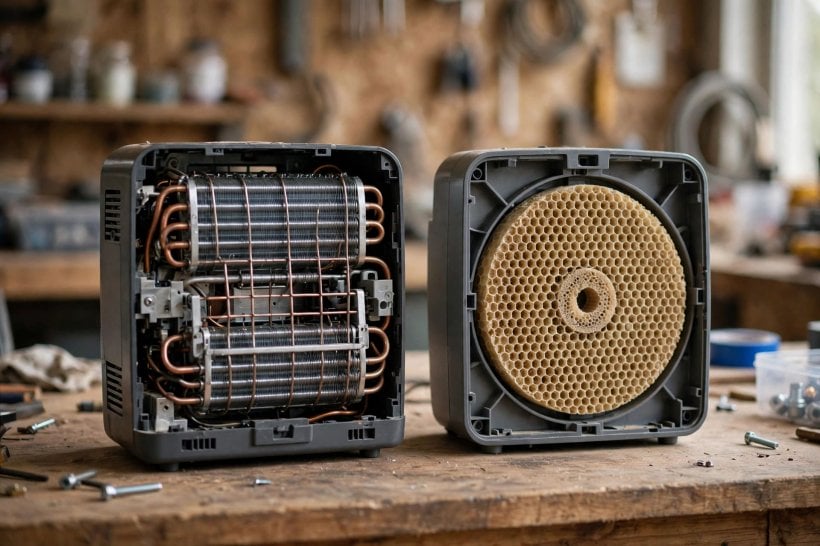
A desiccant dehumidifier dries the air chemically instead. Its heart is a wheel of silica that absorbs moisture from the air passing through it, while a heater continuously dries the wheel back out so it can keep absorbing. No cold coils, no condensation step — which produces two side effects the tool makes much of. The air leaves the unit warm as well as dry, so in winter the machine doubles as a small supplemental heater. And because nothing inside depends on staying above freezing, it keeps working in cold rooms where the compressor design cannot. Two machines, one job — and one variable decides between them.
7. The 60-Degree Line: When Winter Changes the Answer
That variable is the fourth input: the lowest indoor temperature your home reaches in winter, on a slider from 30°F to 75°F that opens at 55°F. The question sounds like a detail; it is actually the technology decision in disguise. The tool draws one hard line at 60°F: below it, the recommendation comes back Desiccant (Winter); at 60°F and above, Compressor (Standard).
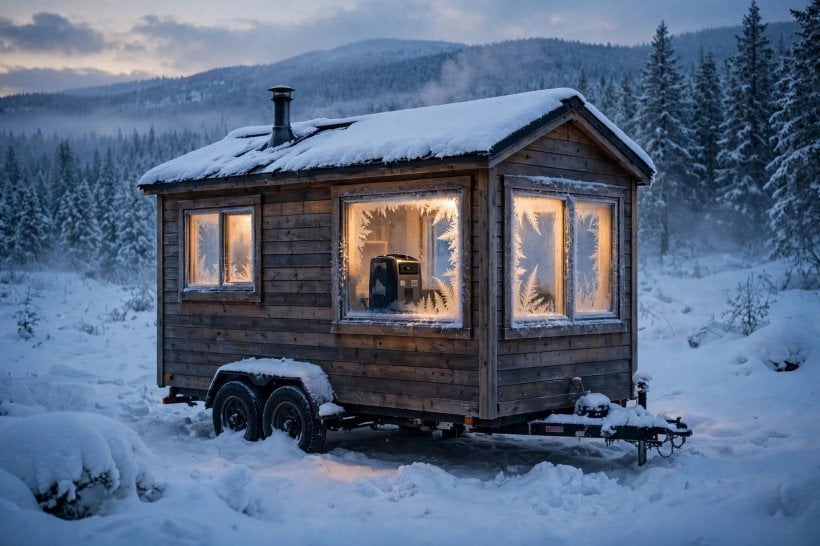
The reason is the compressor’s flaw, stated bluntly in the tool’s own comparison: if your house drops below 60°F — common in winter, and near-certain in a house left empty while you are away — the coils freeze up and the unit stops working, just when you need it most. A frozen dehumidifier fails silently through exactly the weeks when condensation does its damage. The desiccant machine’s floor is far lower: it works down to 34°F, covering the unheated-weekend and cold-snap cases that defeat the coils. Answer with your coldest realistic night, not your thermostat setting — and remember the envelope is the other half of holding temperature, which the insulation strategy analyzer scores on the wall side of the same fight.
8. The Bucket Reality Check: Four Pints at a Time
The headline result — required capacity, in pints per day — is only half the answer. The tool’s second readout translates it into labour: you will empty the bucket this many times per day. The maths rests on one honest assumption, that the compact units which fit tiny houses carry a bucket of about 4 pints (a large unit holds about 10). Divide your daily capacity by 4 and the ownership experience appears: a 12-pint day is three trips to the sink; a 24-pint day is six.
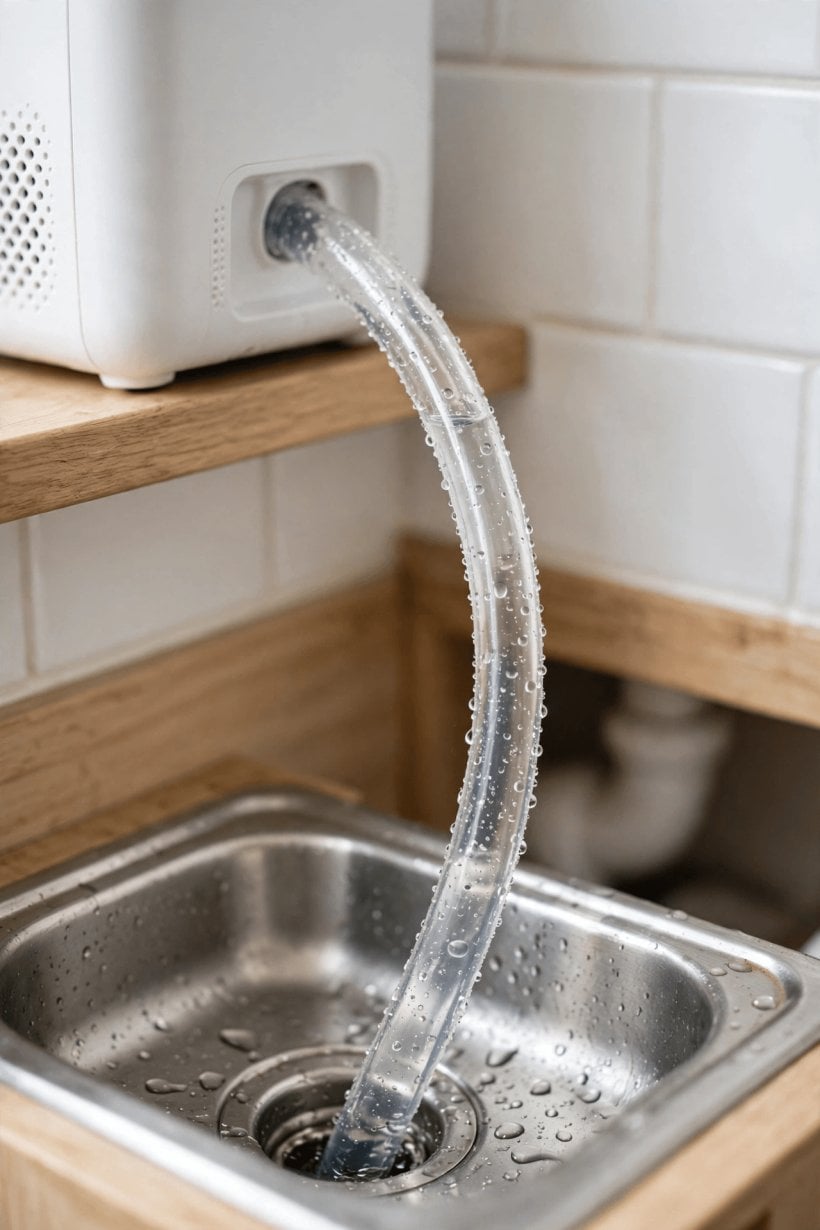
That translation is the tool’s quiet act of honesty, because bucket duty is where inconvenient setups get abandoned — and an abandoned dehumidifier removes zero pints. So the readout carries a verdict: if the bucket needs emptying more than twice a day, a tip appears telling you to install a continuous drain hose. A hose turns the machine from a chore with a schedule into plumbing that simply runs, and the capacity you paid for actually gets used. Compare machines on this line as much as the pints line: the best unit is the one whose water has somewhere to go.
9. Reading Your Result: The Tool’s Own Starting Point, Worked
Put the pieces together with the exact values the tool opens with, and the method shows itself in one worked example. The defaults are a 350 sq ft home, condition set to Wet, two occupants, and a lowest winter temperature of 55°F. The Wet base contributes 14 pints. The two occupants add 5 pints each — 10 more — for a required capacity of 24 pints per day. The area adds nothing, because 350 sq ft sits below the 500 sq ft baseline where the extra-pints rule begins.
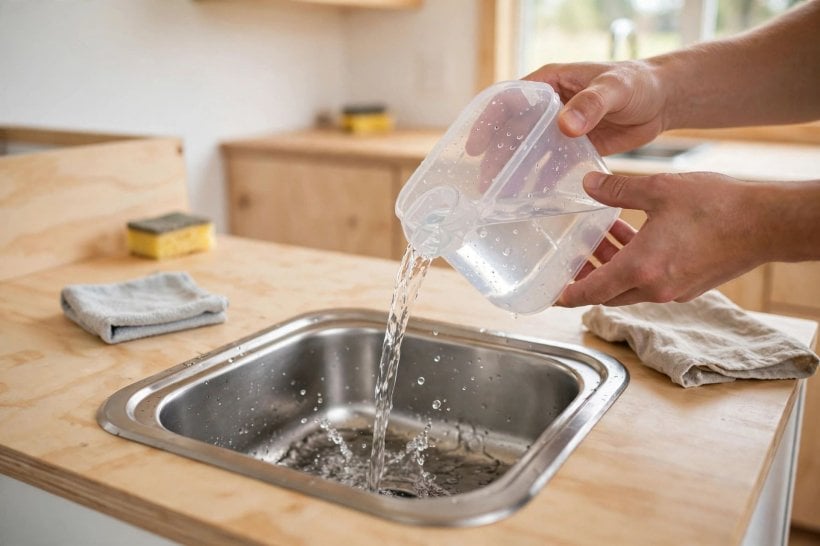
The other two readouts follow just as mechanically. At 55°F the temperature sits below the 60-degree line, so the recommended technology is a desiccant unit — a compressor would have frozen in the very house described. And 24 pints a day through a 4-pint bucket is six empties a day, well past the twice-a-day threshold, so the drain-hose tip appears. One default screen, three answers, each tracing to a single input: condition set the base, people doubled it, temperature chose the technology, and the bucket exposed the chore. Change any one input and watch which answer moves. The tool belongs to the same family as the floor insulation calculator for a tiny house: small instruments, each built around one decision a tiny house cannot borrow from ordinary-house rules.
10. When the Number Is Not Enough: Mold, Air and the Hose
A correctly sized dehumidifier is one layer of moisture defense, not the whole of it, and the tool’s own mold visualizer is the reminder. If your condition grade is Wet or Extremely Wet, water is already standing where it should not — and while a dehumidifier dries air, it does not move air. Stagnant corners, closed lofts and sealed bathrooms keep their damp even in a dried room, which is why ventilation is the dehumidifier’s partner rather than its rival: the case is made in our guide to tiny house ventilation with HRV and ERV systems. The same partnership shows up in other small structures — the yurt problem in condensation control in yurts is the tiny house problem wearing canvas — and at the surfaces, where the flash coat and mold prevention simulator models the coating side of the defense.
The common mistakes all ignore one of the tool’s four questions. Sizing from floor area alone repeats the ordinary-house error the AHAM adaptation exists to fix. Grading your condition kindly — calling a wet house damp — shaves four pints off the base and buys a machine that loses slowly. Forgetting the people factor because the house is “only small” misses the largest single load in the calculation. Choosing a compressor for a house that sits cold all week buys a unit that freezes in the season it was bought for. And skipping the drain hose on a five-empty day guarantees the machine gets switched off by Christmas. Answer all four questions honestly and the number it returns is the rare kind — one you can buy against.
The Dehumidifier Sizing & Technology Calculator: Run Your Own Numbers
Now run it on your own home. Measure the floor you actually live in, grade your condition by the worst evidence you have seen — smell, clamminess, streaming glass, puddles — count every person who breathes and cooks in the space, and set the coldest temperature your winter delivers. Four honest answers are all it asks, and in return it names the technology, the pints per day, and the chore you would sign up for without a hose. In a house this small, moisture is the climate you live in — size for it properly.
This tool is specifically tailored for Tiny Houses, where high occupant density and small air volume create unique moisture challenges. It uses the AHAM (Association of Home Appliance Manufacturers) sizing guidelines, adapted for small spaces, to determine the exact “Pints Per Day” removal capacity you need.
Features for Tiny House Builders:
- Moisture Load Calculation: It sums up moisture from square footage plus the critical “People Factor” (breathing/cooking in a small box adds huge humidity).
- Compressor vs. Desiccant Logic: It asks for your “Winter Indoor Temp.” If you keep your tiny house cool (or if it gets cold while you’re away), the tool recommends a Desiccant unit, preventing the common issue of compressor units freezing up and failing in winter.
- Tank Reality Check: It calculates how many times per day you’d have to empty the tiny bucket, encouraging users to install a continuous drain hose.
- Mold Visualizer: If the conditions are “Wet” or “Extremely Wet,” animated green mold spores appear in the visualizer, reinforcing the urgency of the problem.
Tiny House Dehumidifier Sizer
Compressor vs. Desiccant: Find the right tech for your space.
1. Moisture Load
Breathing/cooking adds ~5 pints per person!
2. Environment
Compressor vs. Desiccant
Works like an AC or Fridge. Great for warm weather (>65°F).
Tiny House Flaw: If your house drops below 60°F (common in winter or when away), the coils freeze up and it stops working, just when you need it most.
Uses a silica wheel to absorb moisture, then a heater to dry the wheel.
Tiny House Win: Works down to 34°F. It also blows out warm dry air, acting as a small supplemental heater.


3 Comments