

Some ducks lay like it is their life’s work, and some merely contribute. If eggs are the point of your flock, breed choice is the biggest decision you will make. The best ducks for eggs combine generous laying with a temperament and size that suit your ground.
Here are the proven layers compared honestly, with no promised numbers, because output always varies by bird and by care.
1. Egg-Laying Ducks at a Glance
Four names come up whenever laying ducks are discussed, and each earns its place for a different reason. The Khaki Campbell is the specialist, a prolific layer bred for output above all. The Indian Runner is the character, an upright, busy forager that is also a genuinely great layer. The Welsh Harlequin is the calm one, a beautiful, steady layer that beginners handle with confidence. And the Buff, standing for a wider group of steady traditional breeds, is the dual-purpose choice, laying respectably while remaining a solid, useful farm duck in every other way too.
| Breed | Character | Known For |
|---|---|---|
| Khaki Campbell | Prolific layer | Top output |
| Indian Runner | Upright forager | Great layers |
| Welsh Harlequin | Calm layer | Beginner pick |
| Buff and others | Steady ducks | Dual purpose |
Judge any laying breed on four key factors, not on a single headline: output, temperament, foraging and noise. Output decides your egg basket, but temperament decides whether you enjoy the birds on the way to it, foraging decides how much of their living the land provides, and noise decides how the neighbours feel about your flock. For eggs alone the Campbell is hard to beat; for charm the Runner wins hearts. Most real homesteads need a blend of all four factors, and the breed portraits that follow are written to help you find yours.
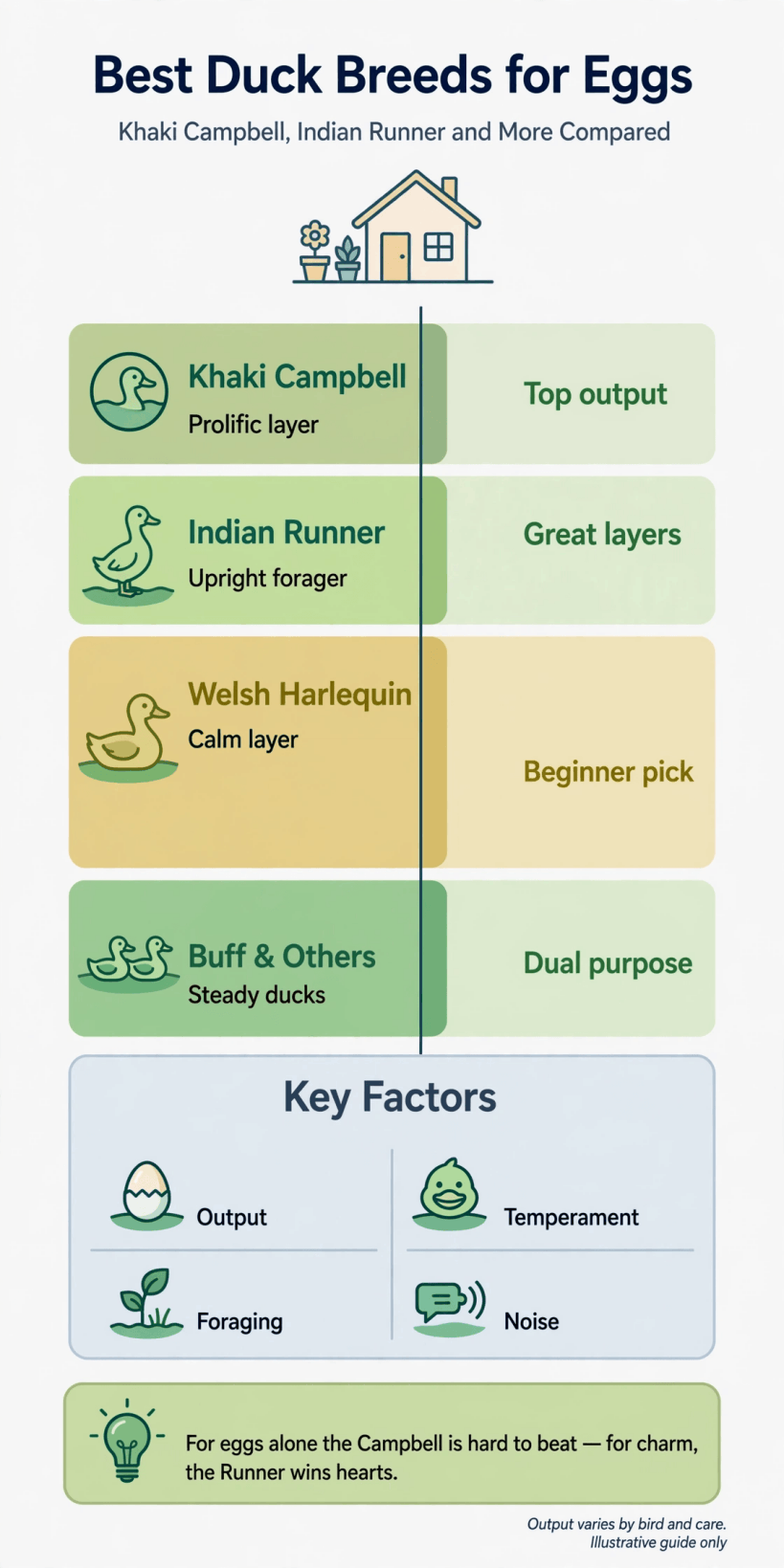
Four proven laying breeds at a glance, and the four factors that matter more than any single claim about output.
2. Khaki Campbell: The Prolific Layer
The Khaki Campbell is the laying specialist of the duck world, developed purely for eggs and wearing its purpose in its build: a neat, active, medium-sized bird, khaki-feathered, alert and businesslike. Campbell ducks forage keenly, settle into a routine readily and convert their days into eggs with an efficiency no other breed quite matches. If your honest goal is the fullest egg basket a duck flock can give you, this is the breed the shortlist starts with, and for many keepers it is also where the shortlist ends.
The Campbell’s energy is also its caveat. These are busy, sometimes flighty birds, livelier to handle than the calm heavy breeds, and they reward a keeper who values output over cuddles. They thrive in a well-run yard with room to forage and a settled routine, and they are best kept as what they are: working layers. New duck keepers who want the full picture of daily duck care before committing will find it in our guide to raising ducks for beginners, because a prolific breed simply makes good routine more valuable, turning feed, water and clean bedding into eggs at the fastest rate of any duck here.
3. Indian Runner: The Upright Forager
No duck turns heads like the Indian Runner. It stands bolt upright like a bottle on legs, runs rather than waddles, and moves around the garden in a single-file procession that never stops being entertaining. What surprises new keepers is that this comic exterior belongs to a genuinely great layer, a breed kept for generations in Asia precisely for eggs, and one whose laying sits just behind the specialist Campbell while its foraging leaves every other breed on this page standing still. A Runner flock is a working flock with a sense of theatre.
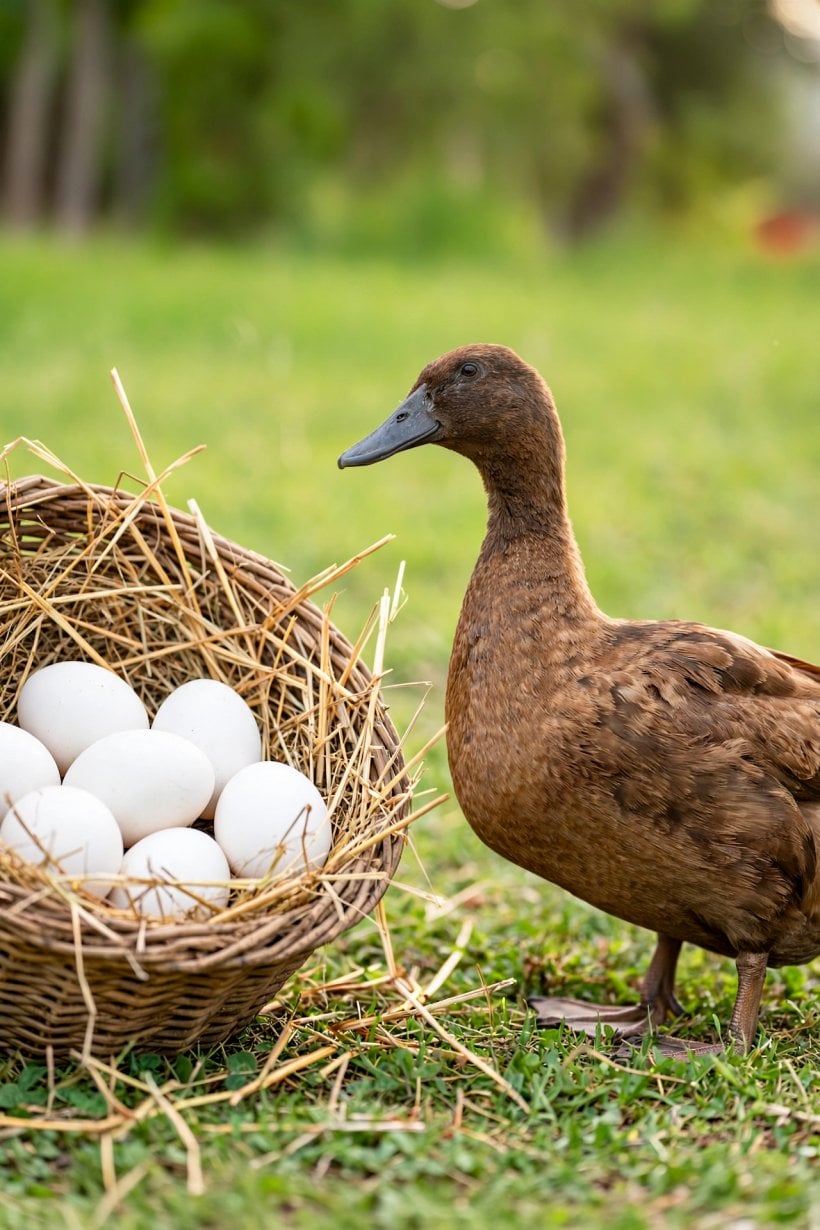
Upright, tireless and full of character, the Runner layers almost as well as it forages, which is saying a great deal.
Runners are alert and can be skittish with strangers, though a flock raised quietly from ducklings settles to its own people and its own routines. They are lighter birds, so they are easier on wet ground than heavy breeds, and their slug-hunting appetite makes them favourites of gardeners. Choose Runners when you want eggs and entertainment in one bird and your ground rewards an athlete. Choose something calmer if small children will be doing the handling, if the flock must be caught often, or if you simply prefer a duck that waddles about its business at a stately, traditional pace.
4. Welsh Harlequin: The Calm Beginner Pick
The Welsh Harlequin is the breed experienced keepers hand to first-timers, and the reason is temperament wrapped in good laying. Harlequins are calm, friendly, unhurried ducks that tolerate handling, children, dogs under control and general farmyard life with a steadiness the livelier breeds cannot match. They are also strikingly pretty birds, pale and patterned, and behind the gentle manner sits a thoroughly respectable layer, developed from Campbell blood, that gives a beginner an egg basket to be proud of without demanding a specialist’s confidence to manage the flock.
Harlequins forage well without ranging as frantically as Runners, mother well when allowed to sit, and generally fit the rhythm of a family smallholding better than any other bird here. If there is a trade-off it is only that their output, while strong, does not chase the Campbell’s, and that their calm can make them the flock’s peacekeepers rather than its leaders. For a household choosing its first laying ducks, that is rarely a trade-off at all. A calm first flock teaches good habits, stays where it is put and makes the daily round a pleasure, which is why this breed wears the beginner pick label so comfortably.
5. Buff and Other Steady Dual-Purpose Ducks
Behind the three headline layers stands a whole supporting cast of steady traditional breeds, the Buff at their head, that lay a perfectly useful number of eggs while earning their keep in other ways. These are dual-purpose ducks in the honest old sense: good-sized, calm, hardy birds that lay through the season, forage without fuss, make excellent table birds from surplus drakes and sit and mother their own ducklings when a keeper wants the flock to renew itself. No single talent leads; the whole package is the talent.
Other names in this steady group, the Cayuga with its dark plumage, the Swedish breeds, Saxony and Silver Appleyard among the larger ducks, share the same bargain: laying that serves a household well, in exchange for a bigger appetite and a heavier tread on wet ground than the light specialists. Keepers with land, a garden that needs patrolling and a freezer as well as an egg basket often find their answer here rather than at the top of the output table. And a keeper whose heart is set on something altogether more unusual should read our Muscovy duck guide before ordering, because Muscovies are a different kind of duck entirely, quieter, broodier and kept to a different rhythm.
6. Output in Real Life: Season, Age and Daylight
Every laying breed on this page shares the same honest footnote: output varies by bird and by care. A duck lays most strongly in her earlier seasons and in the lengthening days of spring and summer, eases back in the dark of winter, and responds visibly to feed quality, water, calm and health. Two flocks of the same breed on two different holdings will not lay alike, and any source promising you an exact basket from an exact breed is selling certainty that ducks do not deal in. Judge breeds by reputation earned over generations, as this guide does, not by figures.
What a keeper controls is the conditions. A settled flock, shut safe at night, fed properly, never chased by dogs or short of water, lays close to its breed’s honest potential; a stressed, hungry or frightened flock does not, whatever its pedigree. The same truth governs the henhouse, and readers comparing poultry plans across species will recognise it from our look at the best chicken breeds for eggs, where the lesson is identical: breed sets the ceiling, and daily care decides how close to it you actually live. Buy the breed for the ceiling, then keep it for the care.
7. Temperament, Noise and Neighbours
Temperament has appeared in every portrait so far because it shapes daily life with a flock more than any laying record. A calm breed makes catching, treating, moving and simply enjoying your ducks easy; a flighty one turns each of those into a small rodeo and teaches beginners to dread jobs that should take minutes. Think honestly about who will handle these birds, how close the neighbours are, and whether the flock shares ground with children, dogs or other poultry, then let the answers weigh at least as heavily as output when the order is placed.
Noise deserves its own paragraph because ducks have a reputation here that is only half earned. The true quack belongs to the females, and some light, lively breeds, Campbells included, can be talkative at greeting and feeding times, while drakes make only a quiet, raspy sound and the heavy breeds generally keep their opinions to themselves. No duck is silent, but a small flock in a contented routine is a farmyard sound, not a nuisance, provided it is not kept hungry, frightened or shut in long past dawn. Choose the calmer breeds, keep the routine kind, and neighbourliness usually takes care of itself.
8. Foraging, Feed and Water for Laying Ducks
A laying duck builds an egg out of what she eats, so feeding a layer flock is feeding the basket. Keep the proper waterfowl ration at the centre, the ration that supplies the niacin ducks need for their legs and general soundness, and let foraging do what it does best around it. All four breeds here forage, the Runner brilliantly, the Campbell keenly, the Harlequin and Buff steadily, taking grass, weeds and a great many slugs and snails, but forage is a contribution, not a complete diet, and laying falls away on charm and fresh air alone.
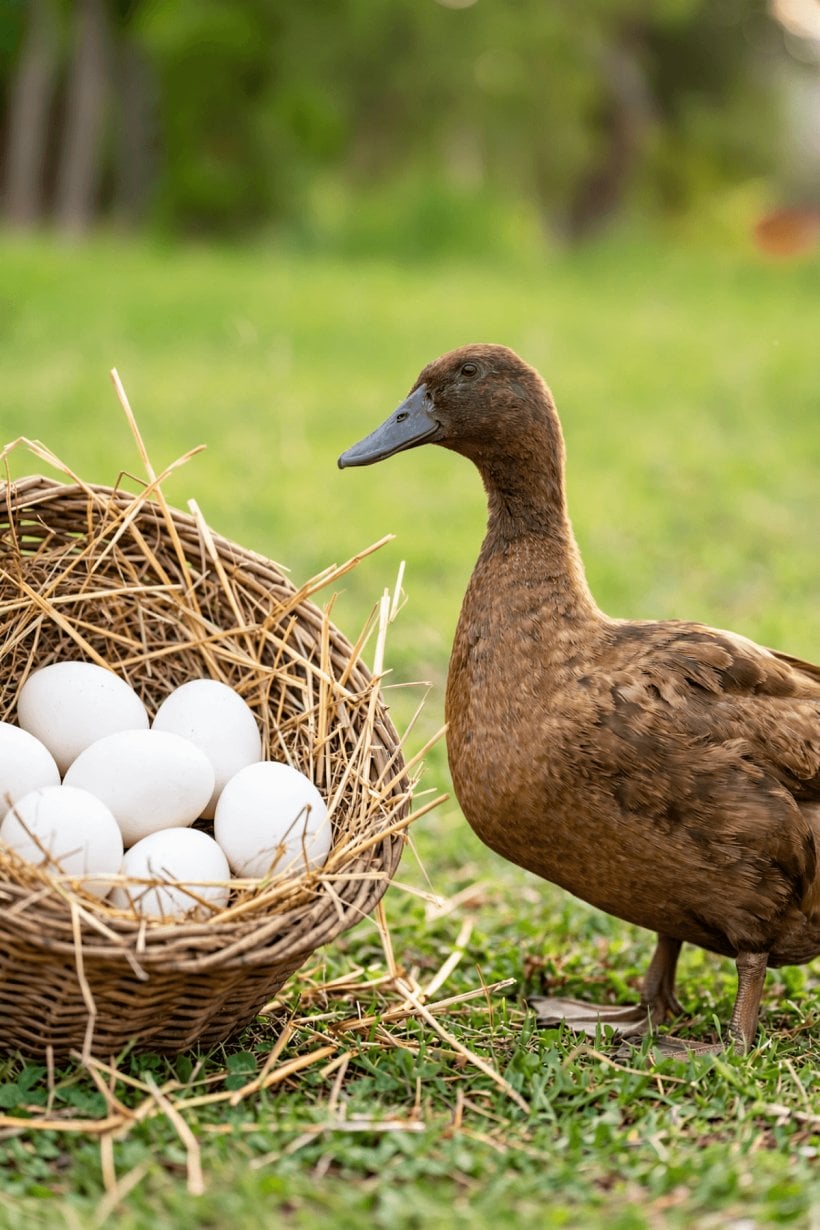
Feed the layer properly, let her forage widely, and keep head-deep water beside every meal.
Water belongs in every feeding conversation, because a duck eats with water, washing each mouthful down and clearing her bill and nostrils as she goes. Feed without deep drinking water beside it is food half wasted and a bird half uncomfortable. For the full menu, layer extras, garden foods and the handful of things ducks should never be fed, work through what do ducks eat before the flock arrives. Keep feed dry, water fresh, treats modest and grit available to confined birds, and your layers will show you the difference in the nest corner within the season.
9. Housing, Nesting and Collecting the Eggs
Laying ducks are undemanding tenants. The same simple, dry, secure house that suits any duck suits a layer, with one addition: a quiet, straw-filled corner at floor level where the flock is encouraged to lay. Ducks lay mostly in the early hours, commonly before the keeper’s morning round, and a defined nest corner means eggs in one findable place instead of buried treasure hunts through deep bedding or, worse, eggs laid out on the run where weather and crows get to them first. Keep that corner’s bedding clean and dry above all, because a duck egg in damp straw is an egg half spoiled.
Collect daily, in the morning where you can, and store eggs cool and unwashed until use, because the shell’s natural coating is the egg’s own protection. A house that shuts fast at night protects the layers as much as the eggs, and a secure flock is a laying flock, so let our guide to chicken predator protection inform the latches, mesh and routine you build around them. Keepers adapting an existing poultry house will find the bones of a good conversion in established chicken coop plans: lower the fittings to floor level, widen the door, deepen the bedding, and a hen house becomes a duck house in a weekend.
10. Choosing Your Breed: A Simple Way to Decide
Decide by elimination, in this order. First, eggs above everything: then the Khaki Campbell is your bird, and the only question is whether its liveliness suits your household. Second, eggs with character and a garden patrolled like it matters: the Indian Runner, provided its skittish streak is welcome in your setup. Third, a first flock, a family flock, a calm flock that still lays well: the Welsh Harlequin, the beginner pick for a reason. Fourth, eggs as part of a wider homestead bargain, meat, mothers and hardiness included: a Buff or one of its steady dual-purpose cousins, and no apology made to the output table.
The common mistakes are choosing on a promised figure, mixing too many breeds in a tiny flock, keeping a drake where none is needed, and forgetting that every breed here still needs the same dry house, deep water, right feed and locked nights. A small, single-breed flock is easier to feed, easier to read and easier to breed on from than a floating mixture. And if you are building the whole poultry enterprise from the ground up, how to raise chickens covers the sister flock many duck keepers run alongside, because eggs from two species, in two seasons of plenty, is the homestead’s happiest surplus.
Final Considerations
For eggs alone, the Campbell is hard to beat; for charm, the Runner wins hearts; for calm, the Harlequin; for the all-round bargain, the Buff and its cousins. None of them will lay to a promise, and all of them will lay well for a keeper who feeds, waters and shelters them properly. Choose the bird whose temperament fits your days as well as its laying fits your basket, and the best ducks for eggs for your homestead will prove themselves one honest season at a time.


0 Comments