

Ducks are hardy, cheerful and far simpler to keep than their splashy reputation suggests, provided the water and bedding are planned before they arrive. Raising ducks for beginners succeeds on four things: a dry house, water deep enough to dip a whole head, the right feed and a short daily routine.
Work through those four in order and your first small flock will largely look after itself.
1. Ducks at a Glance
A backyard duck asks for less than almost any other farmyard bird. It needs no perch, no nest box architecture and no pond. It needs a dry, secure house with deep bedding it can nestle into, because ducks sleep on the floor. It needs drinking water it can submerge its whole head in, which is how a duck keeps its eyes, nostrils and bill clean and healthy. It needs proper waterfowl feed, where the niacin that ducks require in greater measure than chickens is properly supplied. And it needs a few minutes of routine a day: eggs collected, water refreshed, birds counted and looked over.
| Need | What It Means | Why It Matters |
|---|---|---|
| Housing | Dry house, deep bedding | Simple needs |
| Water | Head-deep always | Splash managed |
| Feeding | Waterfowl feed | Niacin matters |
| Routine | Eggs and checks | Daily minutes |
Four key factors hold the whole system together: water, bedding, feed and security. Water is the one beginners underestimate, because ducks do not just drink, they dabble, splash and drill in mud, turning any badly placed drinker into a swamp within days. Bedding is the answer to that mess as much as the water itself: deep, dry bedding in the house and a sensible, drained spot for water in the run. Get water and bedding right before the ducks arrive and everything else in this guide becomes straightforward daily habit rather than repair work.
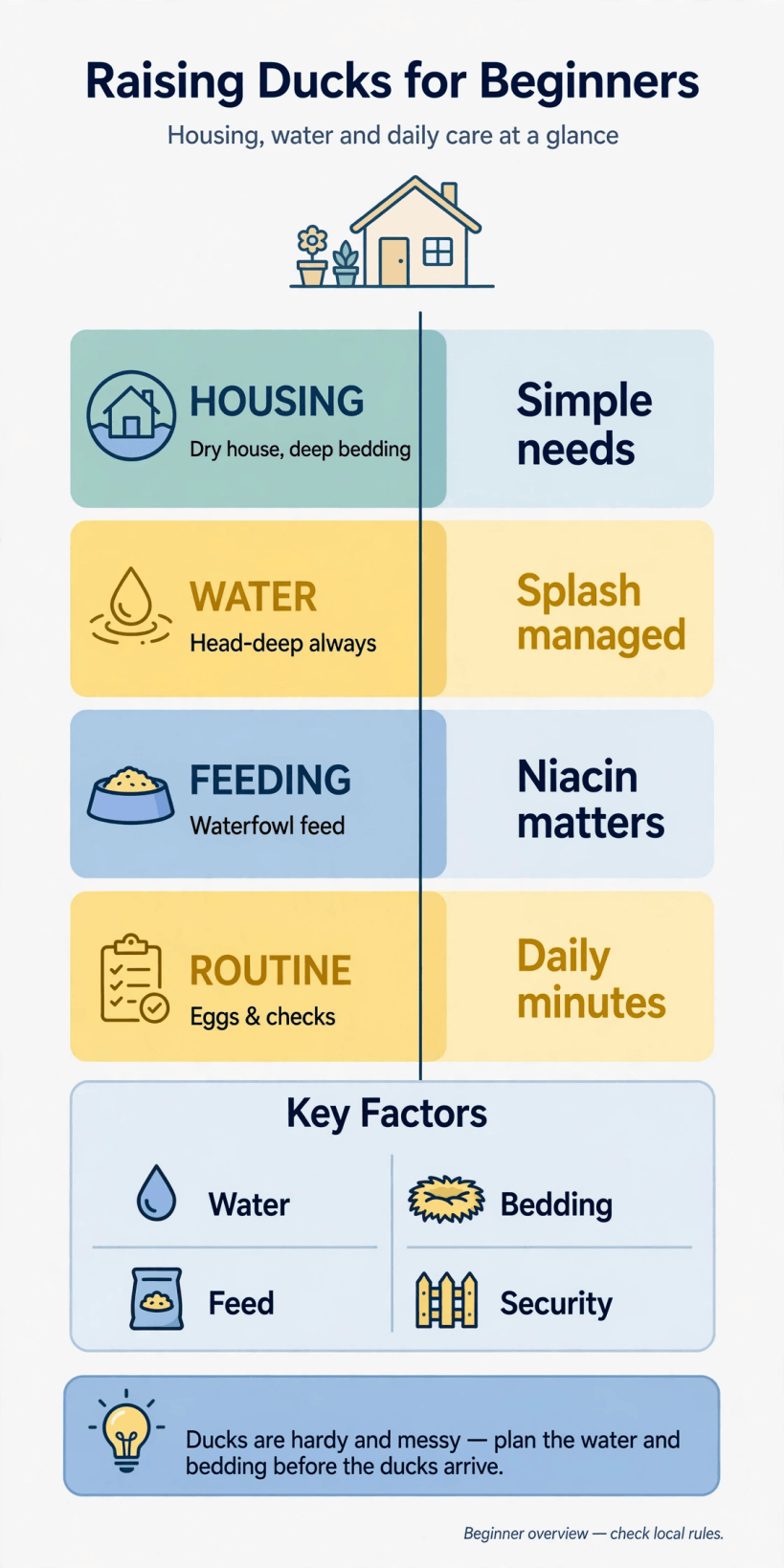
Housing, water, feeding and routine at a glance, plus the four factors that keep a duck yard clean and calm.
2. Why Ducks Suit a First Flock
Ducks earn their beginner-friendly reputation honestly. They are notably hardy birds, well insulated, unbothered by rain that sends chickens sulking indoors, and generally robust when their few real needs are met. They are social and comic, following a routine and their keeper with equal enthusiasm, and a small flock has a calm, flocking nature that makes handling and herding surprisingly easy: ducks move together, and a slow walk behind them steers them almost anywhere. Most domestic breeds cannot fly in any meaningful way, so fencing can be lower and simpler than for hens.
They are also genuinely useful. Laying breeds produce rich eggs through much of the year, the flock patrols the garden eating slugs and snails with relish, and their soiled bedding and pond water make a gardener’s liquid feed and compost ingredient. Compared with chickens they scratch far less, so a lawn or vegetable patch survives them better, though their love of dabbling in wet ground is its own kind of gardening. If you are weighing the two birds against each other, the groundwork in how to raise chickens covers the hen side of that choice, and most of its lessons about routine, housing and observation carry straight across to ducks.
3. Housing: A Simple Dry House
A duck house is the simplest poultry building you will ever make: a low, dry, draught-free shelter with a wide door, ventilation high up, and a floor that can carry deep bedding. Ducks do not roost, so there are no perches to build, and they lay their eggs in a quiet corner of bedding rather than demanding fitted nest boxes, though a defined, straw-filled corner encourages them to lay where you can find the eggs. What the house must do above all is stay dry and shut securely at night, because a duck on the ground is an easy target for anything hunting after dark.
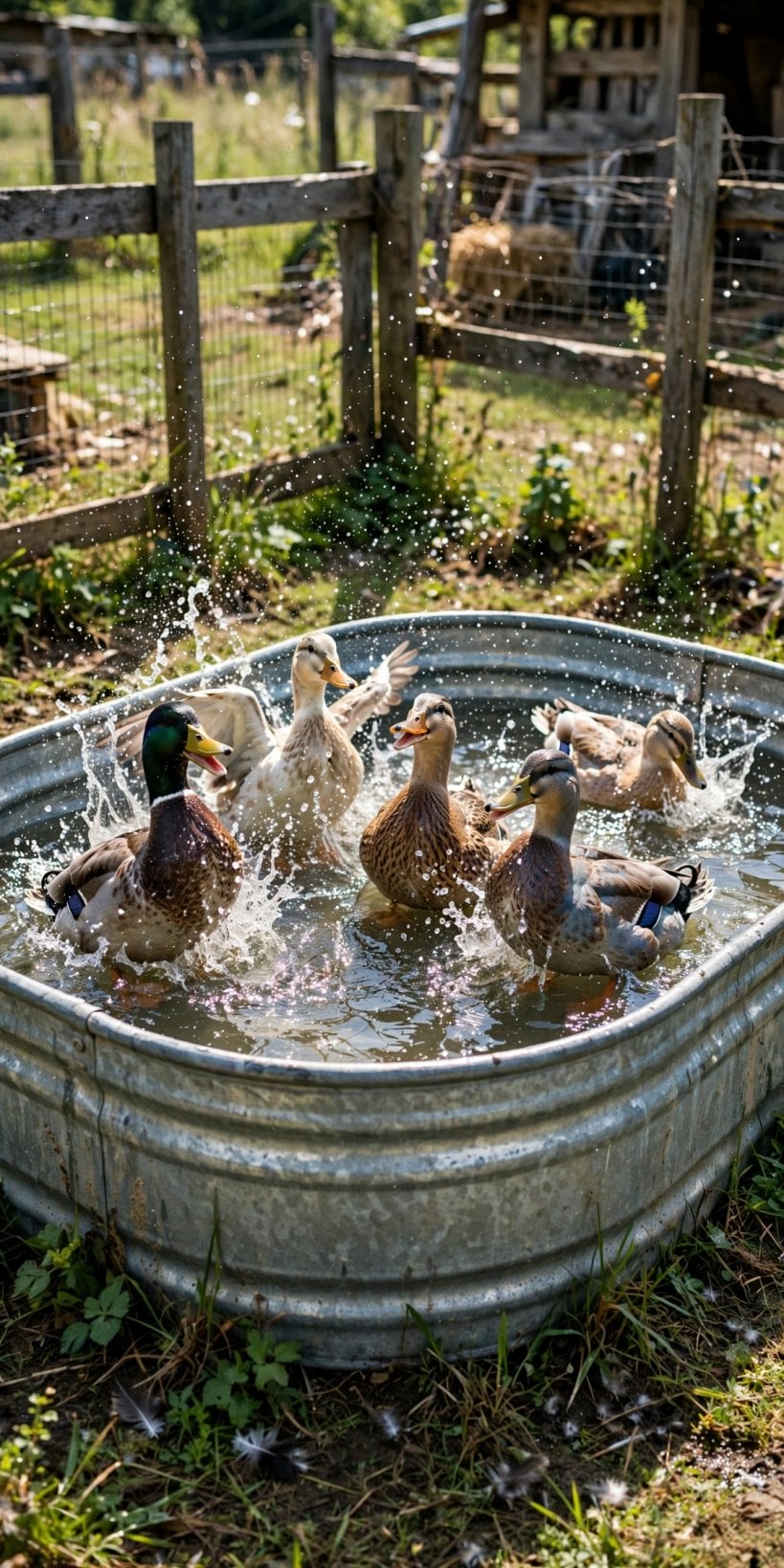
A duck house needs no perches and no fittings, just dry depth of bedding and a door that shuts fast at night.
Size the house for the flock you will actually keep and the nights they will spend shut in during bad weather, and put it where the ground drains rather than ponds. A ramp is unnecessary if the step is low, and low matters, because heavy breeds are not agile climbers. Many keepers adapt a garden shed, a large kennel or a simple timber shelter, and the construction principles in good chicken coop plans, solid roof, sound floor, ventilation without draughts, adapt to a duck house almost unchanged, minus the perches and pop-hole and plus a much wider, ground-level door.
4. Water: Drinking, Head-Dipping and Splash
Water is the centre of a duck’s day, and it comes in two kinds that must not be confused. The first is essential and non-negotiable: drinking water, available all day, in a vessel deep enough for the bird to dip its entire head. Ducks wash their eyes and clear their nostrils and bills as they eat and drink, and a duck that cannot submerge its head cannot keep itself clean or eat comfortably. A sturdy bucket or trough they cannot tip, refreshed daily and set where spillage drains away, covers this need completely.
The second kind, swimming water, is a pleasure rather than a requirement. Domestic ducks kept without a pond stay perfectly healthy, and a simple shallow paddling tray or small tub, filled fresh and emptied onto the garden, gives them their bath and their joy without the silting, cleaning and fencing burden of a permanent pond. Manage the splash wherever water lives: stand drinkers on a grid, gravel or the most free-draining corner of the run, move them before the ground turns to soup, and accept a degree of cheerful mess as the price of the happiest birds on the homestead. Clean drinking water, always, matters far more than any amount of swimming water.
5. Feeding: Waterfowl Feed and Why Niacin Matters
Feed ducks a proper waterfowl or duck ration wherever you can get one. The detail that matters most is niacin, a B vitamin ducks need in greater amounts than chickens, and one that is essential for strong legs and sound growth, especially in young birds. Feeds formulated for waterfowl supply it properly; where a general poultry feed is used, keepers commonly add a niacin source as experienced duck keepers and feed suppliers advise. Treat this as the one nutritional point never to improvise on, because leg problems in growing ducklings are so often a feeding problem wearing a disguise.
Beyond the bag, ducks feed themselves enthusiastically. On range they take grass, weeds, slugs, snails and insects, and this forage is a real part of their diet, not a garnish. Offer feed near water, never far from it, because ducks wash food down as they eat and will carry mouthfuls back and forth if the drinker is distant, wasting both. A fuller tour of the duck menu, greens, grains, garden extras and the foods to keep away from them, lives in our guide to what do ducks eat. Keep treats modest, grit available where birds are confined, and the main ration always the centre of the bowl.
6. The Run, Grazing and Managing the Mess
Ducks are grazing birds at heart, and a run that gives them grass, shade and room to wander in a loose, busy line is a run they will use happily all day. Rotate or rest ground where you can, because a fixed small run is quickly eaten down and churned in wet weather, and bare mud is the one surface that makes ducks, bedding and keeper equally miserable. Site the run so its wettest use, the water corner, sits on the best-drained ground, and give the flock a dry dust-free patch of straw or woodchip to loaf on in winter when the grass has gone.
Thinking of the duck yard as part of a whole holding helps more than any single purchase. Water points, fencing, the house, the compost heap that receives the bedding and the garden that receives the pond water all belong in one plan, and sketching a simple livestock farm layout before you build shows up the muddy mistakes, a gate in the wet corner, a house at the bottom of a slope, while they are still lines on paper. Ducks are hardy and messy in equal measure; the whole craft of keeping them well is arranging the ground so the mess lands where it does no harm.
7. The Daily Routine: Eggs and Checks in Minutes
A duck routine is measured in minutes, and it is the same every day, which is precisely why ducks love it. Morning: let the flock out, refresh drinking water, check feed, and glance at every bird as it files past, bright, even on its legs, keen to get out. Ducks lay early, usually before or around dawn in the house bedding, so egg collecting belongs to the morning visit, and a quick rake or top-up of the nest corner keeps eggs clean and findable. A midday glance in passing covers water again on hot days, because a splashed-empty bucket by noon is the commonest duck-keeping failure of all.
Evening: top up feed if your system feeds twice, refresh or settle the swimming water, and shut the flock in as dusk falls, counting heads as they waddle in, because ducks will cheerfully bed down outside if allowed and the night shift of predators knows it. A weekly few minutes more covers bedding, a look at feet, and the condition of fences and the house door. That is the entire job on paper. Its power is not in any single task but in the looking: a keeper who sees the flock twice a day notices the one bird standing apart, off its feed or limping, while there is still something simple to be done about it.
8. Ducklings and Growing Birds
Ducklings are sturdier than chicks in some ways and needier in others. They need warmth in their first weeks from a brooder, constant shallow water they can dip bills in but never fall into or chill in, and their waterfowl starter feed from day one, because the niacin question matters most in these fast-growing weeks. They grow startlingly quickly, outgrowing boxes and brooders that looked generous at the start, so plan space in stages and keep bedding relentlessly dry: a wet duckling is a chilled duckling, and their talent for soaking their surroundings begins on the first day.
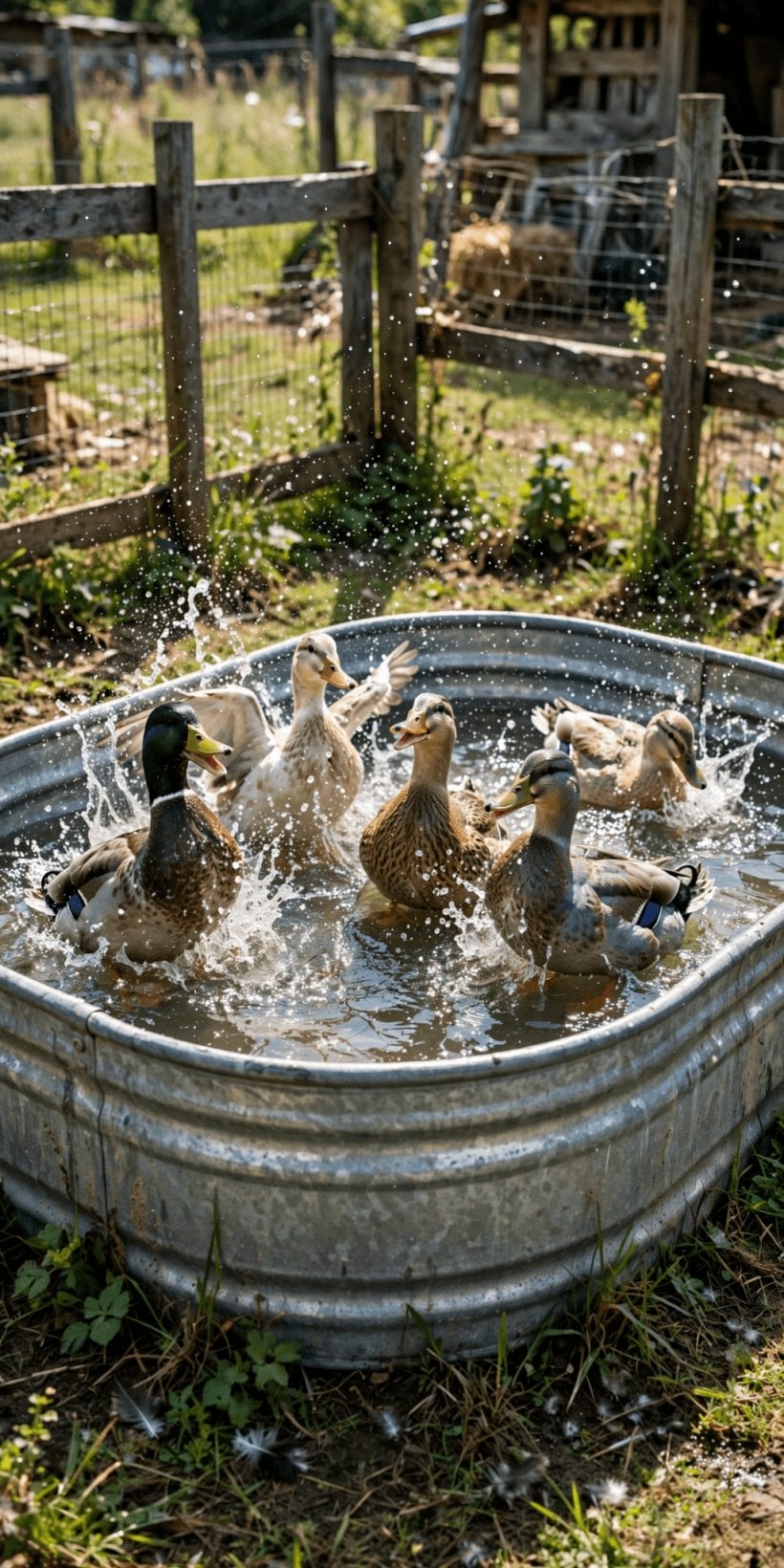
Ducklings grow fast and splash faster: warmth, shallow water, dry bedding and room in stages.
As growers graduate outside, the choices widen. Many beginners start ducklings of a laying breed, and choosing which breed those are repays a little homework before ordering, because a bird chosen for eggs differs in build and temperament from one chosen for the table or for ornament. Our comparison of the best ducks for eggs walks through the proven laying breeds so your first ducklings can be the right ducklings. Whichever breed arrives, keep groups of youngsters together, move them as a flock, and let them learn the yard’s routines before they must share it fully with adult birds.
9. Health, Weather and Seasonal Care
Healthy ducks kept on dry bedding with clean water are remarkably trouble-free, and most health care is really housing and feeding care done on time. Watch for the simple signs: a bird off its food, standing hunched and apart, walking unsteadily or with swollen joints, or with eyes or nostrils that look dirty because it could not wash its head properly. Each points first to the basics, water depth, feed, bedding, company, before it points anywhere else, and a bird that does not improve promptly deserves proper advice from a vet familiar with poultry. Keep new birds apart from the flock until you are sure they are well, and wash boots and equipment between groups as ordinary good practice.
Seasons suit ducks better than most poultry. Their waterproofing and insulation laugh at rain, and a wet autumn day is duck weather in a way it never is for hens, provided they can also get out of the mud onto dry bedding. Winter asks for unfrozen water, checking drinkers on frosty mornings, extra bedding depth and shelter from the worst wind. Summer asks for shade and for water checked twice, and breeding season asks for a little diplomacy where drakes are kept, keeping the balance of males to females kind and watching hens for over-attention. None of it is complicated; all of it is in the diary rather than in the medicine cabinet.
10. Security and the Mistakes Beginners Make
A duck is slow, ground-dwelling and unable to fly away from trouble, which makes security the one area where beginners must think like an adult from day one. The house must shut fast every single night, without exception and without a single broken latch tolerated, and the run’s fencing and any gaps under gates deserve the same respect. Ducks are at their most vulnerable exactly when they are most relaxed, asleep on the floor of the house or dabbling at dusk. Read our full guide to chicken predator protection before your flock arrives; every principle in it, sound housing, tight mesh, locked nights, applies to ducks with double force.
The classic beginner mistakes are all water-shaped: a drinker too shallow for head-dipping, water placed where its splash ruins the bedding, swimming water left to go foul, or ducklings raised on the wrong feed. Add choosing a breed on looks alone, and keeping a single lonely duck, a flock animal that should always have company of its own kind. Keepers tempted by a characterful breed as their second step often land on the Muscovy, and our Muscovy duck guide explains how that distinctive bird differs from the mallard-derived breeds this guide has followed. Avoid the short list of errors and ducks are, truly, easy.
Final Considerations
Begin with the ground and the water, not the birds: a dry house with deep bedding, a run that drains, head-deep drinking water and the right feed in the store. Add a small flock of a breed chosen for your purpose, keep the twice-a-day routine, and shut them safe every night. Do those things and raising ducks for beginners stops being a project and becomes what experienced keepers promise it is: the simplest, happiest livestock on the place.


0 Comments