
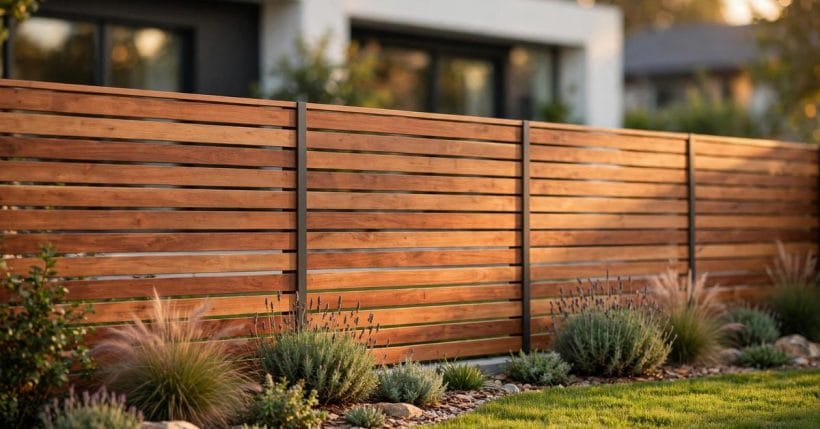
A cedar fence gives a garden a warm, living boundary. The timber arrives with a honeyed tone and a grain that catches light differently through the day, so the fence reads less like a barrier and more like a piece of the garden itself. Over time that colour softens, the grain settles into the weather, and the boundary takes on the character of the place it encloses. Cedar suits gardens that want warmth without formality, and it works as well around a cottage plot as around a contemporary house, because the material itself does the softening.
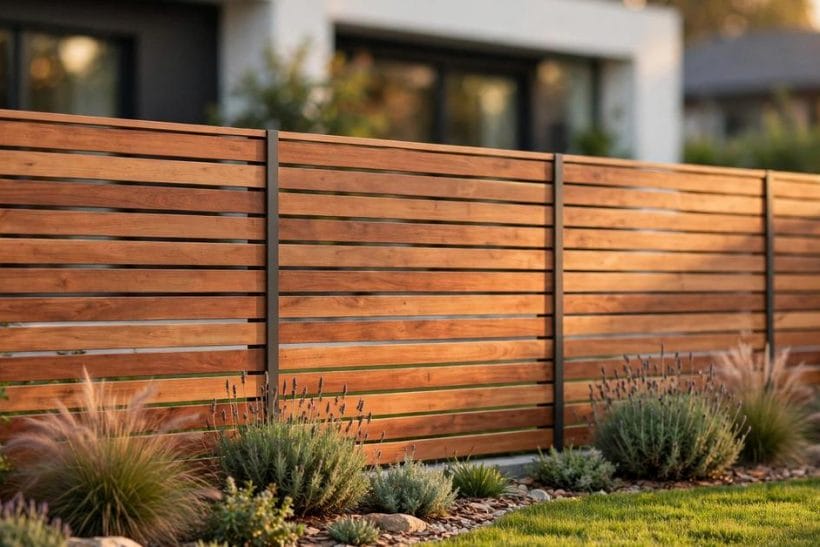
This guide stays with the cedar fence itself: its material and form only. It covers why cedar is chosen for boundaries, how its colour and grain behave, the main board styles from open pickets to close boards and slats, the posts and rails that hold a run true, slopes and corners, planting against the fence, finishes in general terms, and the seasonal care that keeps a cedar boundary looking considered. It does not stray into wrought iron, arbors, bridges, porch roofs or terracing, which are separate subjects with their own guides, and it makes no promises about how any fence will perform in a particular garden.
1. Why Cedar Suits a Garden Boundary
Cedar is chosen for fences first for how it looks. The boards carry a warm, mid-toned colour with visible grain, and that warmth changes the feel of a whole garden. A pale or grey boundary can feel hard and distant, while cedar brings the boundary closer, making a garden feel sheltered rather than shut in. The effect is strongest where the fence is seen from seating areas and paths, because the eye rests on the timber again and again through the day.
The timber also has a reputation among gardeners for coping well outdoors, and that reputation is part of its appeal. It is worth stating plainly, though, that no timber is beyond the weather. Cedar boards still respond to sun, rain and damp ground, and a fence built in a wet, shaded corner will behave differently from one built in open sun. What cedar offers is a material that tends to weather gracefully, taking on character rather than simply looking tired, when it is built well and given ordinary care.
Another reason gardeners choose cedar is how it works under the hand. The boards are comparatively light to handle and pleasant to cut and fix, which matters on a long run where dozens of boards must be set evenly. That workability helps the finished fence too: boards can be replaced singly when one is damaged, without disturbing its neighbours, so a cedar fence can be kept in good order board by board rather than rebuilt all at once.
2. Colour, Grain and the Way Cedar Weathers
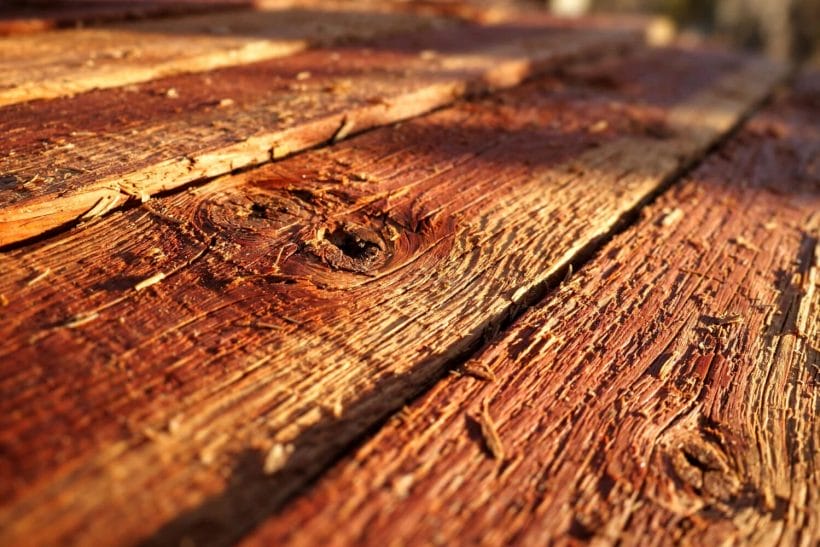
Cedar colour is not one colour. Boards vary from warm honey tones to deeper reddish browns, and that variation is part of the material rather than a fault in it. A run built from mixed boards will show gentle shifts of tone along its length, and in most gardens that variation reads as natural and lively. Boards chosen for a very even colour are possible, but they ask for more sorting at the outset, and even then the sun will even out differences over time in its own way.
Grain is cedar’s other visible quality. Straight, fine grain gives a calm, contemporary surface, while boards with more figure give a rustic, textured feel. Knots appear in some boards and not in others, and they change how light moves across the run. None of this affects the fence’s role as a boundary in a simple garden sense, but it does affect how the fence looks from the house, so it is worth looking at boards in daylight before fixing them, rather than judging from a single sample.
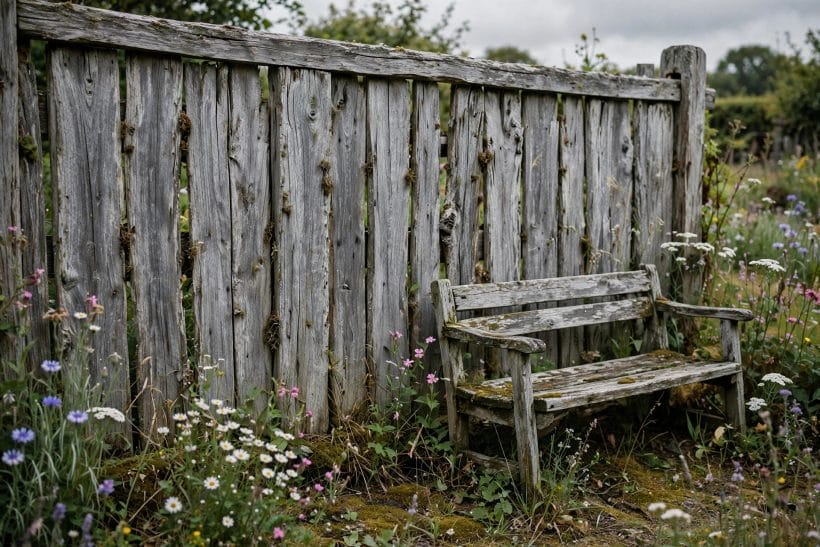
Left without a finish, cedar gradually changes colour, moving toward a soft grey-silver tone. That change happens unevenly at first, since boards facing the sun change faster than boards in shade, and a fence can look patchy for a while before it settles. Gardeners who like the silvered look often welcome that stage as part of the process, while gardeners who want to hold the warm colour choose a finish instead. Either way, the weathering is a slow change to expect, not a fault to chase, and it is one of the reasons cedar fences tend to sit comfortably in older gardens.
3. Picket and Open Cedar Styles
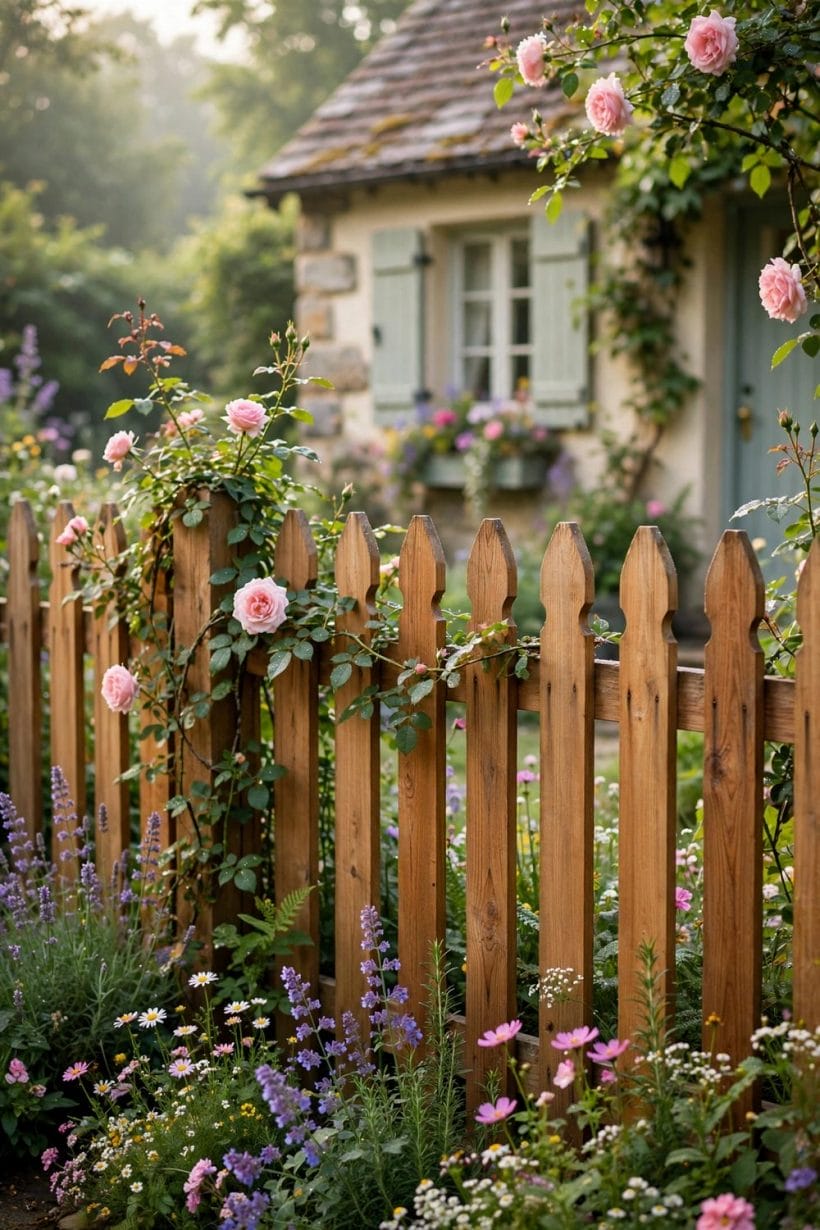
An open cedar picket fence is the friendliest form a boundary can take. Spaced upright boards with shaped or flat tops mark the edge of a garden without closing it off, so the garden still reads as part of the street or lane beyond. Picket fences suit front gardens especially well, where a full barrier would feel unwelcoming and where the house itself wants to be seen. The warm cedar tone keeps even a simple picket run from looking stark.
Spacing sets the character of a picket run. Narrow gaps give a more enclosed feel and read as a proper boundary, while wider gaps give an airier, more decorative line that suits a garden whose real boundary is planting rather than timber. The tops matter too: pointed, rounded or flat tops each give a different silhouette against the sky, and the choice should echo the house, whether that means a cottage profile or a plainer contemporary line.
Open styles also suit internal divisions within a larger garden. A low cedar picket run can separate a vegetable patch from a lawn, or mark a path, without blocking light or views across the garden. Used this way, the fence becomes garden furniture on a larger scale, a structure that organises space rather than defending it. For a related open-boundary idea, see our garden screen ideas, which cover lighter screens and panels in a similar spirit.
4. Close-Board and Privacy Styles
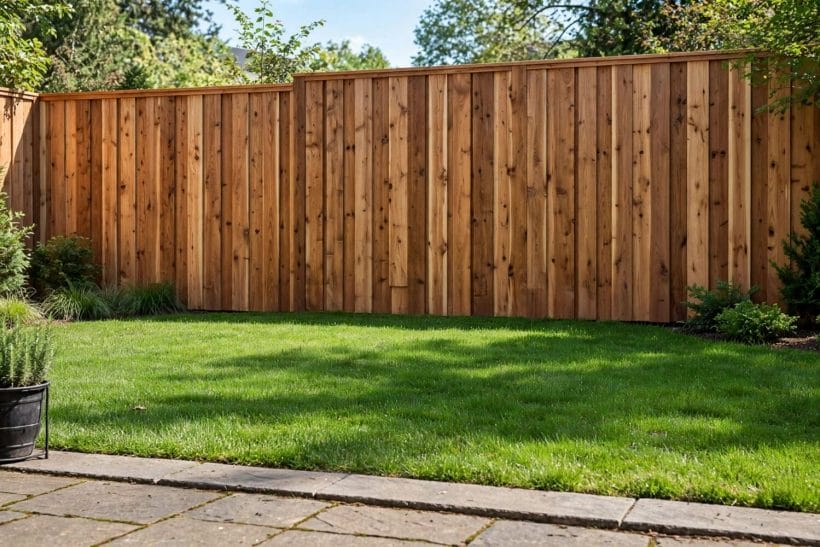
Where privacy is the point, cedar close-board fencing is the familiar answer. Boards set edge to edge, or overlapping, form a continuous timber wall that screens a seating area or a whole garden from neighbouring views. The warmth of cedar matters here more than anywhere, because a long run of close boards is a large surface, and a cold material would dominate the garden. Cedar keeps that surface gentle, especially when planting softens its base.
Close-board runs ask more of their structure than open styles do, because a solid run catches wind. Posts and rails carry that load, and the run should be built with that in mind from the outset rather than strengthened afterwards. The boards themselves also move with moisture through the seasons, swelling and shrinking slightly, so fixings that allow a little movement tend to serve a close-board fence better than fixings that pin every board rigidly.
Privacy need not mean a uniform wall along the whole boundary. Many gardens use close boards where they matter most, around a terrace or a seating corner, and lighter styles elsewhere, so the garden keeps light and air where it can. That variation also breaks up a long boundary visually, giving the eye places to rest. For the wider privacy picture, see our privacy fence ideas, and for a board pattern that gives privacy with airflow, see our shadow box fence ideas.
5. Slatted and Lattice-Top Styles
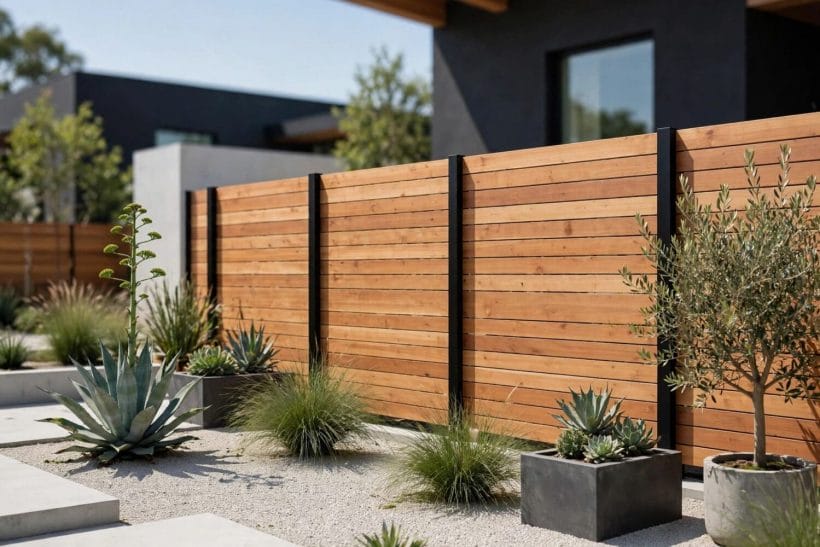
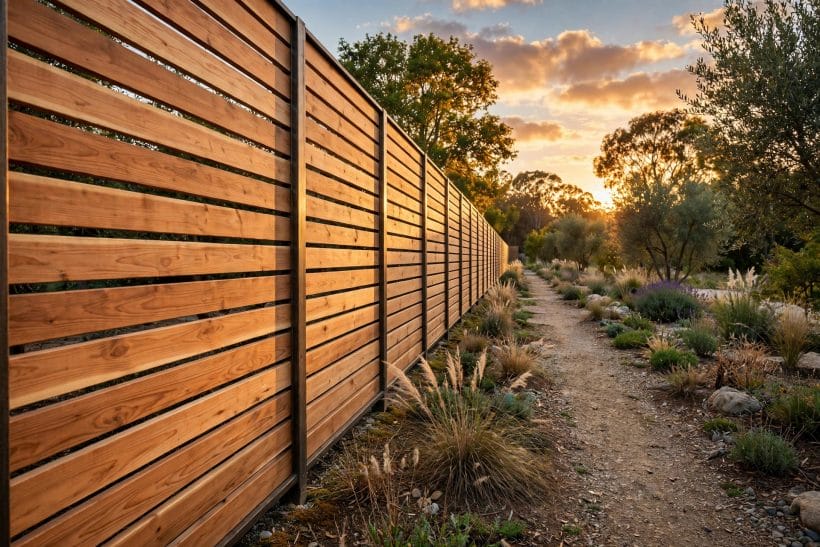
Slatted cedar fences sit between open and closed. Boards set with even gaps let air and dappled light through while still screening direct views, and the horizontal or vertical rhythm of the slats gives a contemporary feel that suits modern houses. The gaps also relieve wind pressure, which can be a real advantage on an exposed boundary where a solid run would take the full force of a storm.
A lattice-top fence is a variation worth considering where a little extra height is wanted without a full wall of timber. A close-board or slatted run topped with a lattice section gives screening at eye level and an open, patterned top that lets light through and supports climbing plants. The lattice softens the top line of the fence against the sky, which matters on a long run, and it gives the boundary a finished, deliberate look rather than a cut-off one.
Both styles reward even spacing. The eye is quick to catch a gap that wanders, and a slatted run with uneven gaps looks careless even when the timber is good. Spacers during fitting and a string line along the run are simple habits that keep the rhythm true. For the horizontal version of this rhythm in full, see our horizontal wood fence guide, which covers long board lines and their particular detailing.
6. Posts, Rails and Fixings That Hold the Line
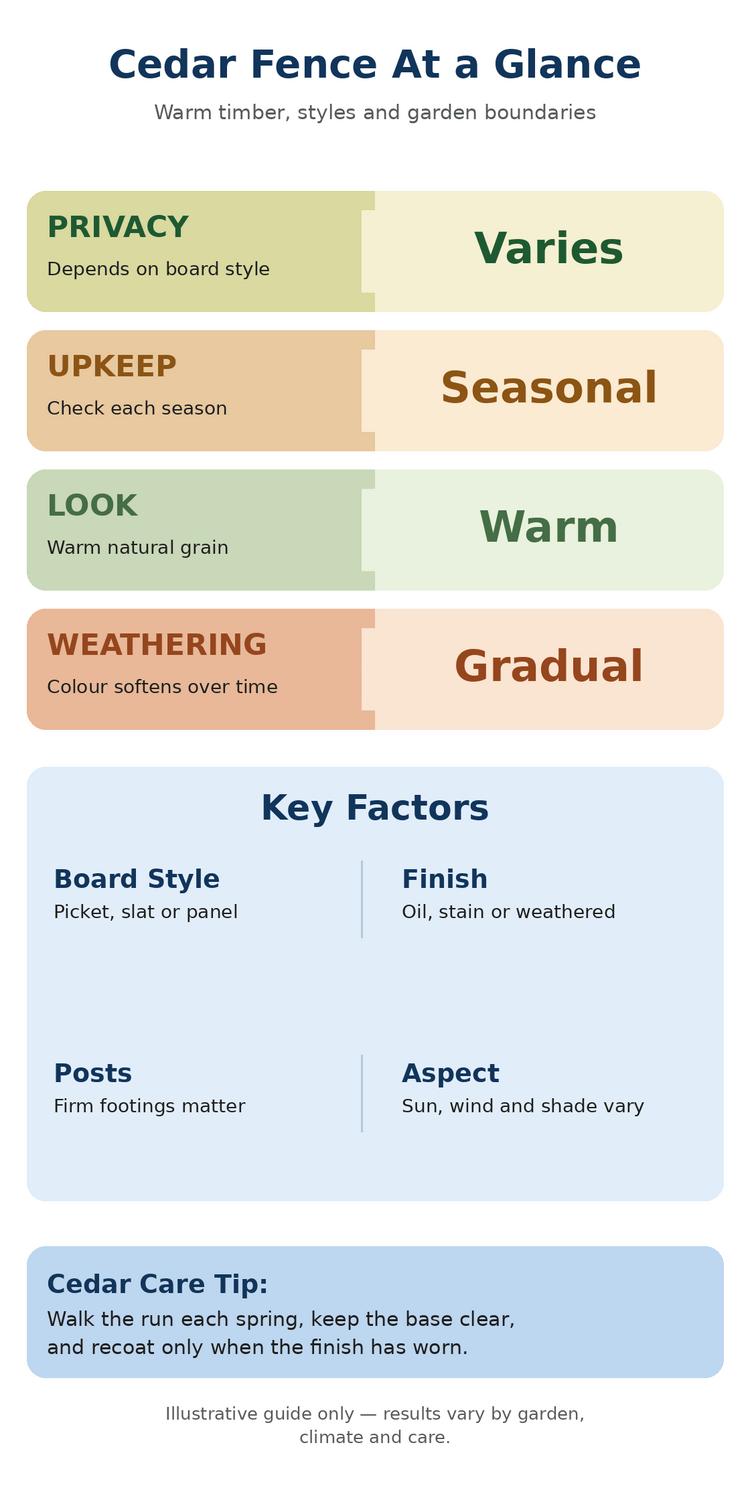
A cedar fence is only as good as its posts. The boards are the visible part, but the posts carry the run, hold it upright against wind, and decide whether the fence stays straight or leans within a few seasons. Posts should be set firmly and deeply enough for the ground they stand in, and that ground matters: soft or wet soil asks for a firmer footing than firm, dry soil, and a fence on a slope asks more of its posts than one on level ground.
Rails run between the posts and carry the boards. Their spacing and fixing decide whether boards stay flat or bow and twist as timber moves with moisture. Boards fixed to well-spaced rails with fixings suited to outdoor timber tend to hold their line, while boards fixed too sparsely can ripple along a long run. The fixings themselves should suit exterior use, since a fixing that stains or loosens will mark the timber and loosen the board it holds.
Post tops deserve a small thought that pays off over time. A flat post top holds water, and standing water is unkind to any timber, while a sloped top or a cap sheds water and keeps the post drier. It is a modest detail, but posts are the part of a fence that is hardest to replace, since a failed post takes a whole section with it, while boards can be swapped singly. For the boundary as a whole, see our backyard fence ideas, which set posts and panels in the wider garden context.
7. Slopes, Corners and Long Runs
Few garden boundaries are perfectly level, and cedar fences handle slopes in two broad ways. Boards can follow the slope in a continuous rake, stepping gently with the ground, or the run can step down in level sections, each panel horizontal and the next one lower. Raking suits gentle falls, where the angle is barely noticeable, while stepping suits steeper ground, where level panels look cleaner and any opening in the run sits more easily in a level section.
Stepped runs leave triangular gaps beneath each step, and those gaps need a decision rather than being left to chance. They can be filled with boards cut to shape, planted out, or accepted as part of the stepped look where the ground cover is dense. Raked runs avoid those gaps but change the gap pattern between boards along the slope, which shows most on a slatted fence. Walking the boundary before building, and noting where the ground falls and rises, prevents most of these surprises.
Corners and long runs bring their own habits. A corner post carries loads from two directions and should be treated as a structural post rather than an ordinary line post, and a very long straight run benefits from a braced post at intervals, which stops the whole run leaning in one direction. Long runs also show any drift in height or alignment, so checking the line with a string as the run grows is worth the few minutes it takes.
8. Planting Against a Cedar Fence
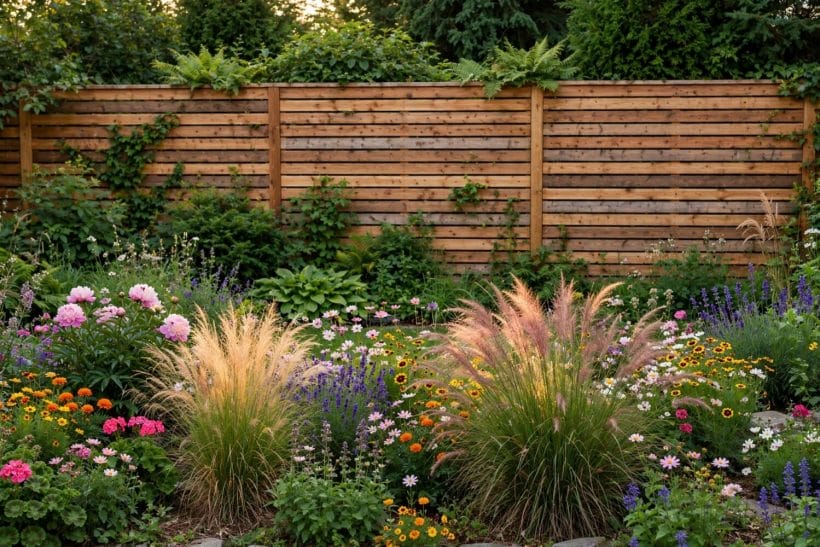
Planting is what turns a cedar fence from a boundary into a garden feature. Shrubs in front break up a long run, grasses and perennials hide the base and the ground line, and climbers add green height without demanding a separate structure. The warm timber makes a generous backdrop for planting, since green foliage reads richly against honey and silvered tones alike, and the fence recedes behind the planting it supports.
It is worth keeping a little air between planting and boards where possible. Climbers grown directly on boards can trap moisture against the timber, and shrubs planted hard against the base can hold damp there too. A trellis set slightly off the fence, or a planting gap wide enough for a brush and airflow, is kinder to both fence and plants. That gap also makes seasonal care easier, since boards can be inspected and recoated without fighting through dense growth.
Plant choice should suit the fence’s aspect as much as its style. Sun-loving plants suit a south-facing run, while shade-tolerant planting suits the shadow side, and the two sides of one fence can carry quite different planting. Low, spreading plants echo a horizontal run, while upright forms contrast it, and either can work when the choice is deliberate. For the wider garden setting, see our front yard landscaping ideas, and for a contemporary counterpart, see our modern fence ideas.
9. Finishes: Oil, Stain and Leaving Cedar to Weather
Finishing a cedar fence is a choice between holding its warm colour and letting it change. An oil finish keeps the grain visible and the colour warm, and it is generally straightforward to renew, since a maintenance coat goes over a sound existing coat without stripping. A stain offers more colour choice, from tones close to natural cedar to deeper shades, and it tends to sit on the surface a little more, which changes how it wears and how it is renewed.
Paint is a third route, and it gives a colour statement rather than a timber one. Paint covers the grain entirely, which suits gardens where the fence should match a house colour or disappear into a planted scheme, but painted timber asks for more preparation when it is renewed, since failing paint usually needs attention before a fresh coat goes on. The choice between oil, stain and paint is therefore as much about future care as about first appearance.
Leaving cedar unfinished is a legitimate finish in its own right, not a neglected one, provided the silvering is wanted and the uneven stage is accepted. Unfinished boards need no recoating, and the fence simply changes with the weather. Gardeners who choose this route should still keep the base clear and the boards clean, since dirt and debris held against timber do it no favours whatever the finish. No finish, and no recipe, can be promised to suit every garden, and the honest test is a small, inconspicuous area before committing to a whole run.
10. Seasonal Care and Small Repairs
Seasonal care for a cedar fence is mostly inspection and small jobs done in good time. In spring, a walk along the run shows posts that have moved, boards that have split or loosened, and finishes that have worn thin, and those are the jobs to catch early. Summer is for trimming growth back from boards and keeping the base clear, autumn for clearing leaves that gather against the bottom boards, and winter for checking after storms, when wind and wet test fixings hardest.
Cleaning is simple and should stay gentle. Brushing off dirt and surface growth, washing with water, and letting boards dry before any recoating covers most of what a cedar fence needs. Aggressive washing too close to the surface can damage timber and drive water into joints, so restraint serves the fence better than force. A fence cleaned regularly and recoated when its finish wears tends to keep its good looks, while one left dirty and uncoated weathers faster and less evenly.
Small repairs are where a cedar fence repays its design. A split or damaged board can be removed and replaced singly, ideally with a board from the same batch if spares were kept, since timber colour varies between batches and a new board may stand out at first. Posts that move should be investigated rather than simply pushed back, since movement usually points to a footing or ground problem that will return. Done promptly, these small jobs keep a fence from becoming a large one.
Final Considerations
A good cedar fence is a warm line drawn well: boards chosen for their colour and grain, a style matched to the garden’s need for openness or privacy, posts and rails built to hold the run true, and a finish chosen with future care in mind. The material does much of the work, softening the boundary and giving the garden a sheltered feel, but the details, even spacing, firm posts, clear bases and prompt small repairs, decide how well that first impression holds.
Start from the garden itself rather than from a photograph. Walk the boundary, note the slope, the wind and the aspect, and choose the style, height and finish for that ground and that light. Build the posts properly, keep planting a little clear of the boards, and keep up the small seasonal jobs. A cedar fence built and kept that way becomes a backdrop the garden can rely on, warming the boundary in every season without demanding more attention than an ordinary garden structure should.




0 Comments