

There is a special heartbreak in watching a pretty garden plant melt into a puddle of rot by July. Alpine plants do not forgive wet feet, and most backyard soil is a swamp by mountain standards. The good news: a mountainside is easier to fake than you would think — a few square yards of well-placed stone can become a landscape that thrives on exactly the neglect that kills everything else.
1. Alpine Rock Garden at a Glance
An alpine rock garden recreates a mountainside in a few square yards: stone outcrops, scree slopes, and tough little plants that thrive on neglect. For tiny home lots — where every square foot must earn its keep — it is close to the perfect landscape: no mowing, minimal water, and year-round structure. Everything about the design serves one master principle, drainage, and everything else — the stone, the gritty mix, the plant palette — is chosen to protect it. The table gathers the whole system in one place; the sections after it take each part, from excavation to upkeep, apart in turn.
| Attribute | Detail |
|---|---|
| The Principle | Drainage is everything — alpines evolved in scree, shattered rock with perfect drainage |
| The Excavation | 12–18 inches dug out; the existing soil goes, because clay is the enemy |
| The Base Layer | 6 inches of coarse rubble and gravel — the drainage reservoir |
| The Growing Medium | 6–10 inches of gritty mix: 50% coarse grit/sharp sand, 30% gravel, 20% lean topsoil |
| The Top Dressing | 1–2 inches of stone chips — keeps crowns dry, suppresses weeds, looks right |
| The Stone Rule | One stone type only, every stone buried one-third deep, arranged 1-3-9 |
| The Plant Palette | Sedums, sempervivums, saxifraga, dianthus and dwarf conifers — tough, tiny, thrifty |
| The Site | The sunniest, best-drained spot; 6+ hours of sun; a mound giving 18–24 inches of rise |
| The Upkeep | 15 minutes of weeding a month in season; no fertilizer, no mowing, no irrigation |
| The Cost | $400–$1,100 complete for a 6×10 ft bed — the cheapest dramatic landscape per square foot |
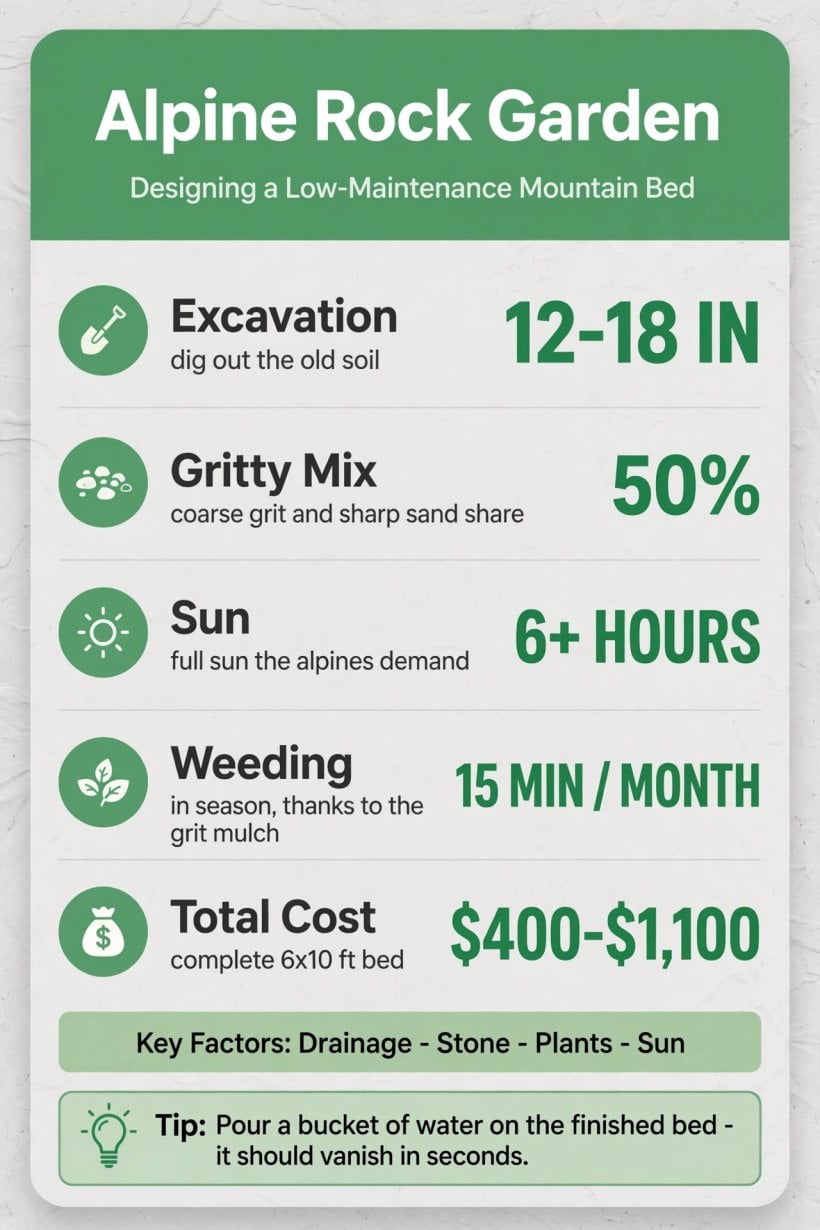
Dig 12–18 inches down, build the bed in three gritty layers, and the mountain mostly looks after itself.
Read the table as a sequence rather than a shopping list. The excavation creates the drainage; the layers preserve it; the stone gives the bed its geology; the plants are chosen because they evolved for exactly these conditions; and the maintenance is light precisely because nothing in the system fights the site. Skip the first step and the rest cannot save you — a beautiful planting in undrained soil is a slow-motion failure. Get the ground right, and the rest of this guide is refinement.
2. The Alpine Principle: Drainage Is Everything
Alpine plants evolved in scree — the shattered rock that accumulates on mountainsides — and scree has one defining property: water never sits in it. Rain hits a scree slope and is gone, down through the stones, in moments. The plants that evolved there built their whole physiology around that fact: crowns that rot in standing moisture, roots that expect air as much as water, and a tolerance for drought that lawn plants would call abuse. Bring an alpine home to ordinary garden soil and you have reversed its world — the moisture it never meets on the mountain now sits against its crown all winter and all summer.
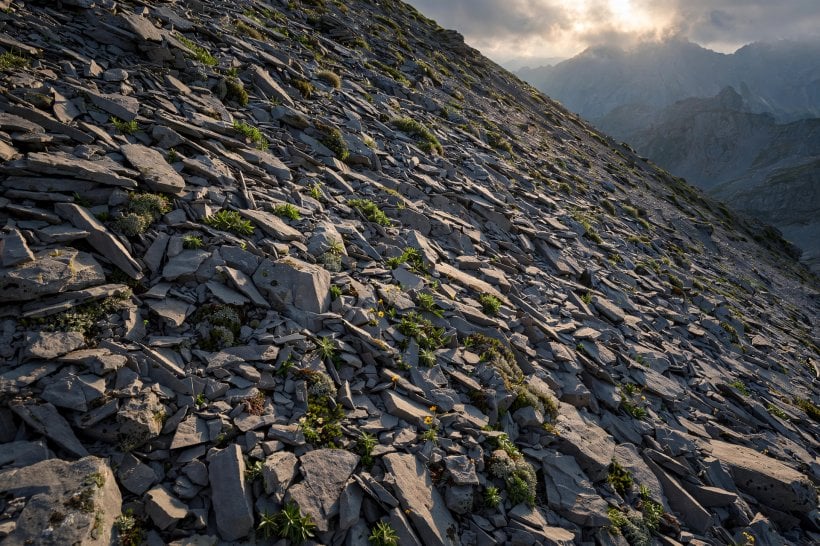
That is why the original method states its test so bluntly: pour a bucket of water on the finished bed, and it should vanish in seconds. If it puddles, the drainage failed and the alpines will rot — no plant choice, however tough, rescues a bed that holds water. Drainage is not one factor among many in this design; it is the factor the entire construction exists to create. Every layer in the next section, every handful of grit in the mix, every stone chip on the surface is there to keep water moving down and away from the crowns of the plants.
The principle also explains the garden’s famous indifference to neglect. A bed engineered to shed water cannot be overwatered by weather, and plants adapted to lean, dry, stony ground do not ask to be fed or cosseted. The same drainage that keeps them alive is what frees their owner — the mountain does the work that irrigation timers and fertilizer schedules do in an ordinary garden.
3. Building the Bed: Excavation and the Three Layers
Construction starts with removal. Excavate 12–18 inches and take the existing soil out — clay is the enemy, and leaving it under the bed builds a bathtub that fills from below. What goes back in is a deliberate stratigraphy of three layers, each with a drainage job. The base layer is 6 inches of coarse rubble and gravel: the drainage reservoir, the empty space at the bottom of the bed where water collects and disperses instead of standing against roots.
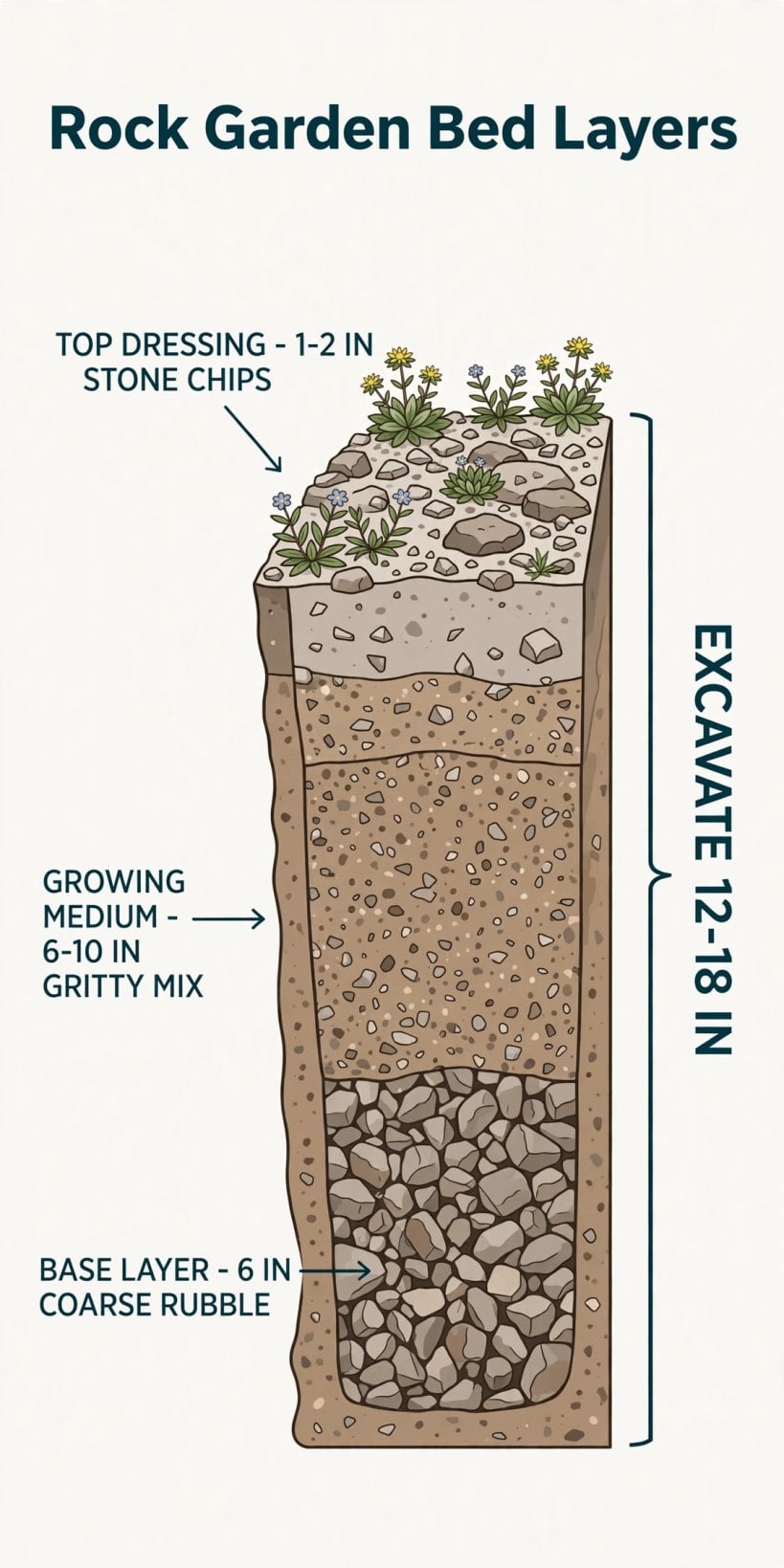
Above the reservoir goes the growing medium: 6–10 inches of gritty mix at 50% coarse grit or sharp sand, 30% gravel and only 20% lean topsoil. The proportions are the recipe’s heart. The mix should feel like crunchy gravel, not soil — squeeze a handful and it should crumble, never clump. That 20% of topsoil is all the fertility the plants will ever get, and it is deliberately lean: richer medium grows softer plants and happier weeds. The finished surface is the third layer, a top dressing of 1–2 inches of stone chips, which keeps crowns dry, suppresses weeds and gives the bed its finished, mountain look.
Build the layers in order and resist improving them. More topsoil feels generous and is the single most common way these beds are killed before they are planted; the failures section at the end of this guide returns to it. The bed you are building is mostly stone, top to bottom — the plants live in the small fraction that is not.
4. Stone Selection: One Geology Per Mountainside
Walk a real mountainside and you will not find three kinds of rock jumbled together. One geology made that slope — one stone type, weathered one way, in one palette. The design rule follows the geology exactly: use one stone type — limestone, sandstone, or granite — because mixing types looks artificial. Nature uses one geology per mountainside, and the eye reads a mixed bed as a collection of rocks rather than a piece of landscape.
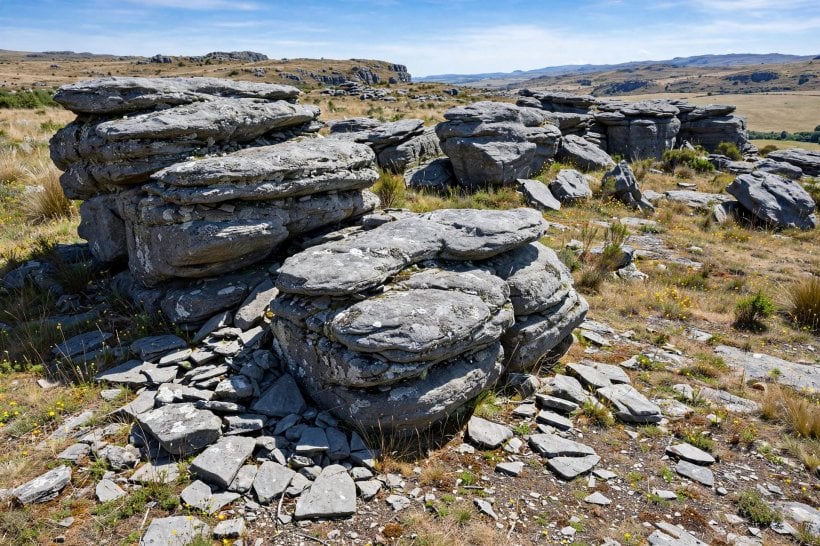
Within the one type, size does the storytelling. A few large feature boulders form the outcrop — the exposed bedrock the slope is supposedly made of. Medium stones form the structure beneath and around them, and small rubble becomes the scree, the shattered apron at the outcrop’s feet. The three sizes are not decoration categories; they are the anatomy of a real slope, where big rock breaks down into smaller rock and smaller rock into gravel. Choose the stone for the outcrop first and let the rest of the bed be, literally, its fragments.
5. Placing Stone: Buried Thirds and the 1-3-9 Ratio
Placement is where most rock beds fail as theatre. The governing rule: bury one-third of every stone. Stones sit IN the ground, not on it — the buried look is what makes a bed read as geology, not decoration. A stone resting on the surface announces itself as placed; a stone emerging from the ground, its lowest third hidden, announces itself as bedrock that was always there. The difference costs nothing but digging, and it is the difference between a rock pile and a mountainside.
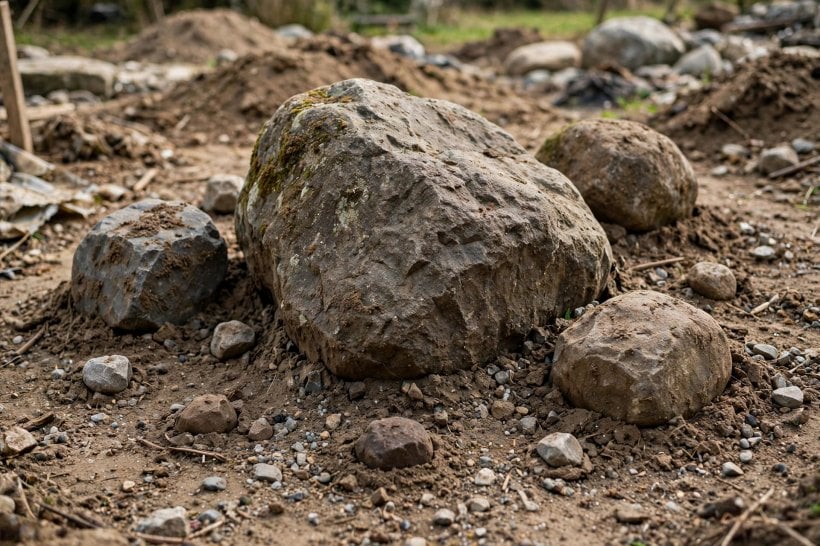
The arrangement follows the 1-3-9 ratio: one hero boulder, three mediums, nine smalls per section. The ratio keeps the gradation honest — every outcrop is mostly small stone with a few giants, never a row of equal boulders standing like exhibits. Where the stone is layered, tilt the strata consistently: if using sedimentary stone, tilt all pieces the same direction, mimicking real sedimentary dip, so the whole bed leans the way one geology would lean. And as you place, leave planting pockets — gaps between stones where the gritty mix shows. Those pockets are not unfinished business; they are where the plants live. The finer craft of making placed boulders look inevitable is worked through in the guide to laying out big landscape rocks, and its core lesson is this section’s: the stone should look found, not delivered.
6. The Plant Palette: Sedums, Saxifraga and Dwarf Conifers
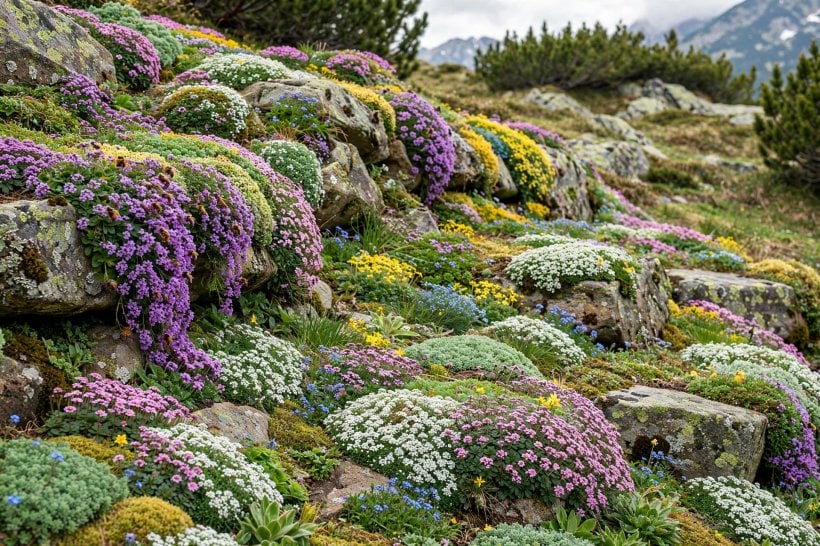
The backbone of the planting is two genera that ask for almost nothing. Sedums and sempervivums — stonecrop and hens-and-chicks — survive drought, cold, and total neglect, and spread politely through the pockets and across the scree. Onto that backbone go the alpine classics: aubrieta, arabis, phlox subulata and dianthus, the spring colour that cascades over stone just as the bed wakes up. Saxifraga are the true alpines of the list — tiny rosettes that belong in crevices, tucked into the cracks between stones where their wild ancestors live.
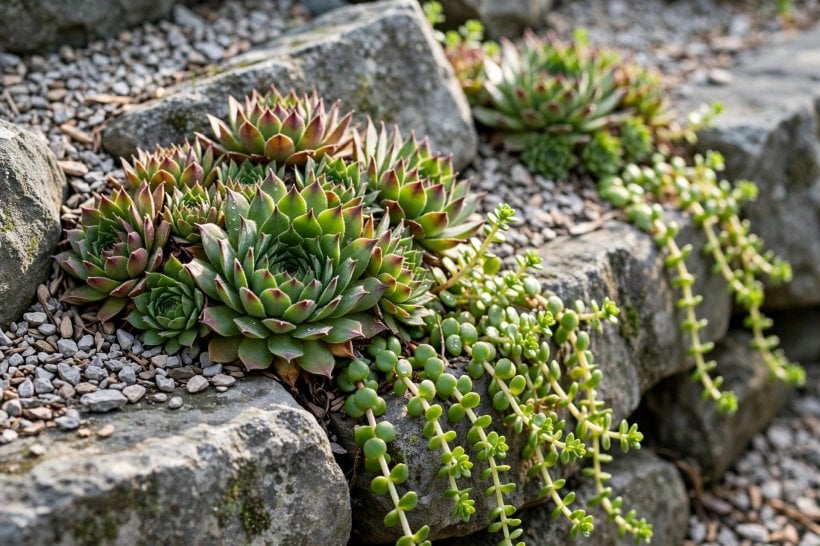
Structure comes from the dwarf conifers — mugo pine and dwarf spruce — the year-round architecture that holds the bed’s shape in winter when the flowers are gone. And in the shade pockets, between north-facing stones where the sun never quite reaches, mosses give the soft contrast to all that stone. The palette is deliberately narrow: every plant on it evolved for thin, dry, stony ground, which is why the bed can be left alone. Widening the palette is possible without leaving the principle — the drought-tolerant perennials and groundcovers in the guide to native plants for rock gardens obey the same rules of grit and neglect. Where a bed sits in more shade than the classics forgive, the palette changes rather than the principle, and the shade planting guide for rock gardens in low light works that variation through.
7. Planting Technique: High Crowns and Tight Spacing
Two planting rules protect everything the construction built. The first: plant high. Crowns sit above the grit, never buried in it, because alpines rot at the crown — the junction where stem meets root is the plant’s most vulnerable point, and it must stay dry. The stone-chip mulch of the top dressing is the crowns’ insurance: rain splashes onto chips and drains, instead of sitting in soil against the crown. Set each plant a fraction proud of where instinct puts it, firm the gritty mix around its roots, and let the chips finish the job.
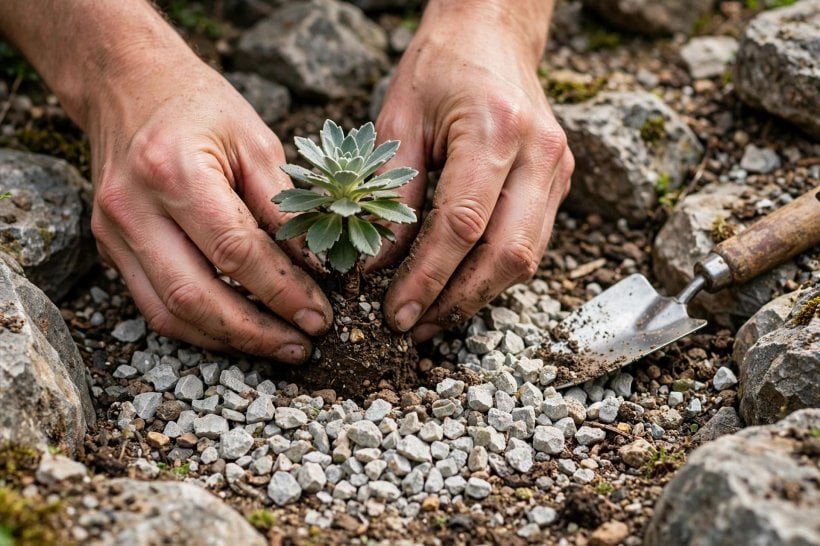
The second rule: plant tight. Alpines want to knit together, and the spacing should assume they will — bare grit invites weeds, while a closed canopy of plants shades its own ground and leaves weeds nowhere to root. Aim for full coverage in two seasons. Tight planting looks generous at the start and correct by the second year, when the pockets have closed into continuous mats of rosettes and cushions with the stone emerging through them. The plants, in other words, are planted for the garden they will become, not the garden they make on planting day — small, cheap and close together, then left to do what they evolved to do.
8. Designing for the Tiny Home Lot: Scale, Sun and Paths
The scale is the surprise: even a 6×10 ft bed makes a real rock garden of this kind, because the plants are small and the garden reads larger than it is. Sixty square feet of mound, outcrop and cascade carries more landscape incident than a lawn ten times its size — which is exactly the arithmetic a tiny home lot needs, where the ground around the house must earn its keep in interest rather than area. Site it in the sunniest, best-drained spot: a south-facing slope is ideal, and if the lot is flat, build the bed as a mound — 18–24 inches of elevation change creates the mountainside the design pretends to be.
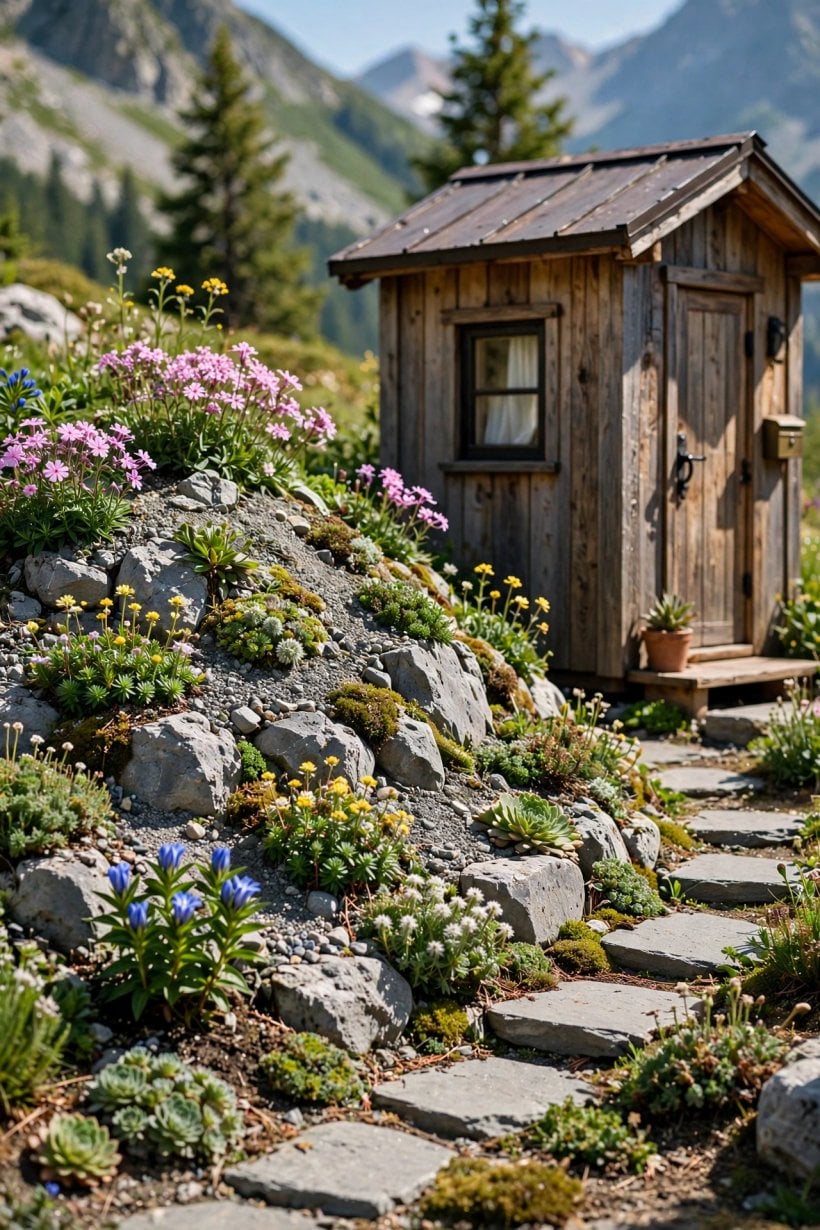
The edges decide whether the bed belongs to the landscape. Use stone edging buried flush, so the bed emerges from the landscape rather than sitting in a timber box — and no railroad ties: they rot and look suburban. The viewing path matters as much as the planting, because these are small plants that reward close looking: stepping stones through or beside the bed put the viewer at kneeling height, face level with the rosettes. Water, finally, is designed out: none is needed after establishment — the whole point is a rain-fed garden, with first-season watering only. In the wider composition of a small lot, this bed plays the permanent, sculptural role among the plantings gathered in the tiny house landscaping ideas collection, and it pairs naturally with the stone-first thinking of small backyard rockscaping — one builds the mountain, the other arranges the foothills.
9. The Low-Maintenance System: Weeding, Division and No Fertilizer
The maintenance list for this garden is short enough to state completely: weeding, and admiring. The gritty top dressing suppresses most weeds before they start, and the few that root in the grit take 15 minutes a month in season to pull. There is no fertilizer — alpines want lean conditions, and fertilizer makes them leggy and weak; the gritty mix feeds them enough. No mowing, no edging, no irrigation: the three chores that own every other garden’s calendar simply do not exist here. Keeping even that small weeding chemical-free is its own discipline, worked through in the guide to natural weed control for rock gardens.
The one recurring task is generous rather than tedious. Every 3–4 years, divide congested sempervivums and sedums — and the divisions are free plants for expansion, so the garden propagates itself and the bed can grow by its own surplus. Stone care is none: stone does not need anything, beyond a pressure-wash for algae every few years if you care. Compare that calendar with any other dramatic landscape — the lawn’s weekly cut, the border’s feeding and staking, the hedge’s clipping — and the design’s promise comes into focus. The low maintenance is not a feature added to the garden; it is the direct consequence of drainage, lean soil and plants that evolved to be left alone.
10. Cost, Sourcing and the Failures to Avoid
The complete 6×10 ft bed costs $400–$1,100 — the cheapest dramatic landscape per square foot. Stone is the largest line at $200–600 for a small garden: quarries sell by the ton, at $50–150/ton for fieldstone, while landscape yards charge more per piece. Stone can also be free — construction sites, farm field-clearing piles, and Craigslist or Facebook “free rocks” listings — and the sourcing routes are mapped in the guide to sourcing free landscaping rocks. Grit and gravel run $100–200 in bulk from a quarry; bags from the garden center cost 5× more. Plants are $100–300 — alpines are cheap at $4–8 per pot, and the instruction is to buy small, because they spread.
The failures list is the mirror of the method, and each failure is a rule broken. Too much soil is the #1 killer: rich soil plus alpines equals rot and weeds, so when in doubt, add more grit. Flat placement — stones sitting on the surface — reads as a rock pile, not a mountainside; bury one-third, always. Wrong plants fail in both directions: regular perennials in the scree mix either die of drought or outgrow the alpines, so keep the palette alpine. Shade defeats most of the palette: most alpines demand full sun at 6+ hours, and a shady bed needs the different palette of mosses, ferns and shade sedums instead. And overwatering — an irrigation system on this garden — defeats the purpose and rots the crowns; hand-water new plants only, through their first season, and then let the rain take over.
Final Considerations
Excavate for drainage, use one stone type buried one-third deep, plant the gritty mix with true alpines, mound it for elevation, and then leave it alone. This is the landscape that gets better the less you do — no mowing, no feeding, no irrigation, a quarter-hour of weeding a month, and a bed that knits tighter and looks more like a mountainside every season. For a tiny home lot it may be the closest thing to a self-maintaining garden there is. Build the mountain; let the mountain be.


2 Comments