
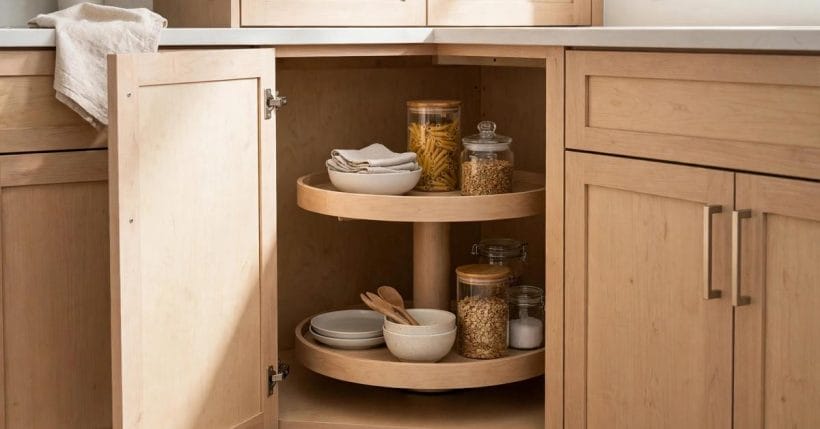
A corner base cabinet is one of the hardest-working spots in a kitchen. It holds everyday plates, bowls, jars and pans, yet it sits in a corner where light is poor and reaching the back takes effort. When the rotating shelf inside it starts to drop, the whole cupboard can feel awkward: the door may catch, the shelf may tilt, and items at the back may become hard to reach. If you have ever opened a corner cupboard and found the lazy susan cabinet door dragging along the frame or the floor of the cabinet, you will know how quickly a small annoyance can turn into a daily frustration. The good news is that many such problems can be understood with a calm, step-by-step look before any tools come out. This guide walks through that look in general terms, explains what to check, and describes the simple adjustments that are often worth trying first. It does not promise a particular result, and it does not ask you to rebuild a cabinet or change its structure. Where the cabinet itself looks damaged, or where you are unsure about what you are seeing, the sensible step is to stop and ask a professional for advice.
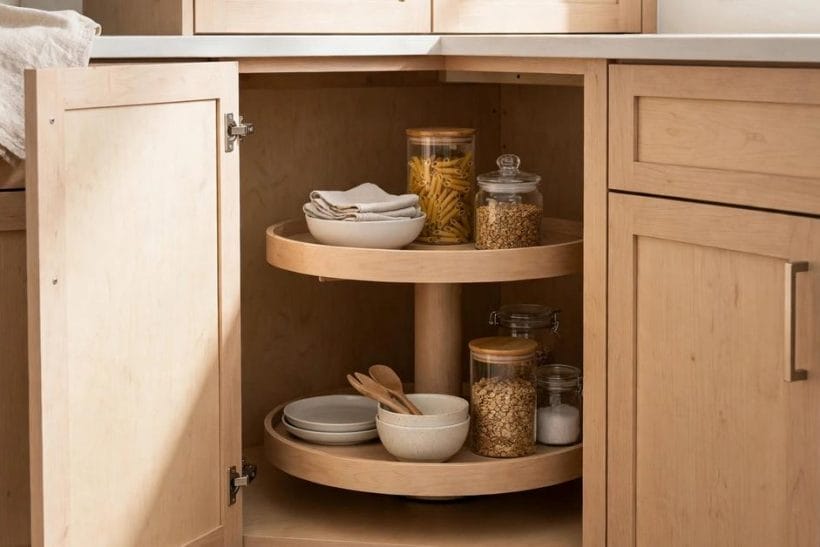
Before you start, it helps to set expectations. A rotating shelf is a moving part inside a fixed box. Over time, use, weight, cleaning and small knocks can all change how it sits. A door that once swung freely may start to rub. A shelf that once turned smoothly may start to wobble or sit lower on one side. None of this automatically means the cabinet is broken beyond help, and none of it automatically means a single adjustment will put everything right. The aim here is to find out, in order, what has actually changed, and to deal with the simplest and most visible causes first. Work slowly, keep the parts you remove in one place, and test the door and the shelf after each small change. That patient rhythm matters more than speed, because a cabinet that is adjusted in a rush can easily end up worse than it started.
1. Notice What Has Changed Before You Touch Anything
Start by using the cabinet exactly as you normally would, and simply watch. Open the door slowly and notice where it moves freely and where it hesitates. Does it catch at the bottom, at the side, or only when it is nearly closed? Does the shelf turn smoothly when it is empty, or does it feel stiff in one part of the turn? Does the shelf sit level, or does one edge look lower than the rest? Does the problem appear every time, or only when the shelf is fully loaded? These observations sound simple, but they narrow the search a great deal. A door that catches only when the shelf is full may be pointing to loading rather than to the door itself. A shelf that wobbles even when empty may be pointing to a loose fixing or to a shelf that is no longer sitting squarely on its support. A door that has started to sag on its hinges will often show an uneven gap along its edge, with the gap wider at one end than at the other.
It is also worth looking at the cabinet in the context of the kitchen around it. Has anything changed nearby? A new floor covering, a swollen board after a leak, a heavy item stored on top of the worktop, or a door that has been bumped by a chair can all change how a cabinet behaves, even if the cabinet itself has not been touched. In a compact kitchen, where every cupboard earns its place, a corner unit often carries more than its fair share, and a small change in what is stored inside can show up as a change in how the door closes. Take a photograph of the gaps around the door before you begin, if that helps you compare later. The point is not to diagnose everything at once, but to arrive at the adjustment stage with a clear picture of the symptoms, so that you can tell whether each small change has made things better, worse, or no different at all. For broader ideas on making a small kitchen work harder, tiny kitchen ideas can be a useful place to browse before you settle on a plan.
2. Empty the Shelves and Give the Cabinet a Clear Look
Once you have watched the problem, empty the shelves completely. Take everything out, set it aside in groups, and give the inside of the cabinet a wipe with a damp cloth. An empty cabinet is far easier to judge than a full one, because weight can hide a tilt and tall items can block your view of the fixings. With the shelves clear, crouch down and look inside with a torch. Check the floor of the cabinet for crumbs, spills, or small items that may have slipped behind the shelf. Check the back and sides for marks where a shelf or a door may have been rubbing. Check for any sign of water damage, swelling, or softness in the boards, because a board that has softened will not hold a fixing firmly, however carefully you tighten it. If you find damage of that kind, do not try to force a repair; note it, and consider professional advice before going further.
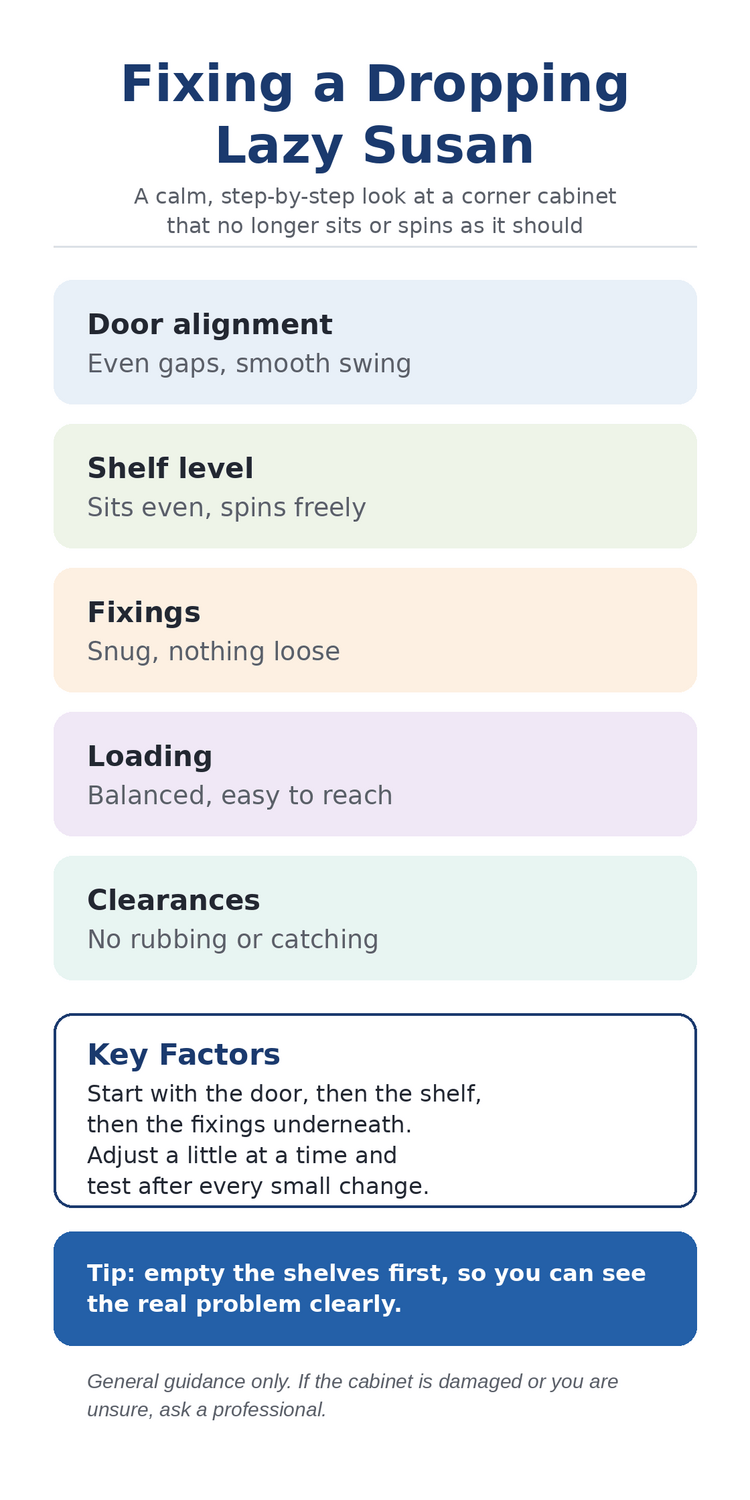
Emptying the cabinet also gives you a chance to sort what goes back. Heavy jars, stacks of plates and bulky pans often end up in a corner cupboard simply because there is nowhere else for them, but a rotating shelf works best when its load is spread sensibly and the heaviest items are not all on one side. You do not need to throw anything away or buy new storage to make this point useful. Simply notice which items you reach for most often, which items are heaviest, and which items have been pushed to the back and forgotten. That sorting will matter later, when you reload, and it will also make the checking stages easier, because you will not be working around a crowd of dishes. Keep the door open while you work, keep children and pets out of the way, and give yourself enough light to see the corners of the cabinet clearly.
3. Check the Door, Its Hinges and the Way It Sits
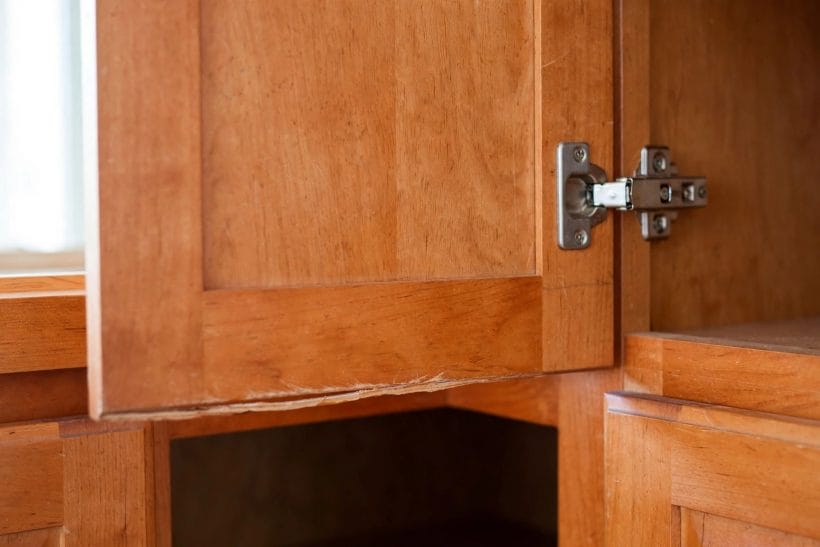
With the cabinet empty, turn your attention to the door. Open and close it slowly several times, and watch the gaps around all four edges. In a well-set door, the gaps look fairly even, and the door meets its neighbour without a step. If one corner sits lower than the rest, or if the door rubs at the bottom while the top gap looks wide, the door may have moved on its hinges. Look closely at each hinge, at the plates that fix it to the door and to the cabinet side, and at the screws that hold those plates. Are any screws loose, or turning without gripping? Is any plate bent, or sitting at an angle? Is there dust or debris in the hinge that could be stopping it from moving freely? Do not force a stiff hinge, and do not remove a door unless you are comfortable putting it back. For many people, simply noticing a loose screw is the most useful finding at this stage.
It helps to compare the corner door with the doors beside it. Stand back and look along the run of cabinets. Does the corner door sit proud of its neighbours, or sunk back from them? Does it line up with the drawer above or the panel beside it? A door that is out of line with its neighbours is often easier to judge than a door viewed on its own. If the door itself looks sound but its position has shifted, a small hinge adjustment may be enough to bring it back, and that adjustment is covered later in this guide. If the door is cracked, warped, or badly worn at its lower edge, adjustment alone may not help, and a replacement door may be worth discussing with a cabinet maker or a kitchen specialist. The related guide to refaced cabinet doors and how a kitchen can change when doors are replaced shows how much difference a door alone can make to the look of a kitchen, even when the cabinets behind it stay the same.
4. Look at the Shelf, Its Post and Its Fixings
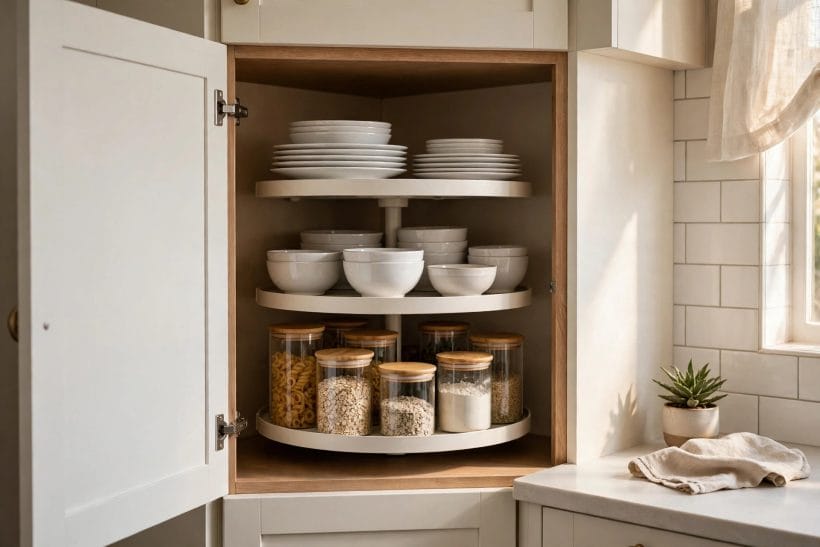
Next, look at the rotating shelf itself. Most corner units use one or two round shelves turning on a central post, or a shelf that is fixed to the door so that it swings out with it. Whichever form yours takes, the same general checks apply. Does the shelf sit level when you look across it? Does it turn through a full circle without catching on the cabinet sides, the door, or the items stored below? Does it rock when you press gently on opposite edges? Does the central post feel firm, or does it move when the shelf is turned? Look underneath the shelf, where the fixings are, and look at the top and bottom of the post, where it meets the cabinet. A fixing that has worked loose will often show as a small gap, a screw that no longer sits flush, or a plate that has shifted slightly from its original position.
Be careful not to assume that a particular part is at fault before you have looked. A shelf that drops on one side may be sitting unevenly because it is not fully seated on its support, rather than because anything is broken. A shelf that catches may be catching because an item stored beneath it has shifted, or because the shelf above it has been loaded unevenly. A post that feels loose may simply need its fixings tightened, or it may be telling you that the board it fixes into has softened. Each of these possibilities leads to a different next step, which is why the checking stage matters. If you lift a shelf out, note how it came out and in which order its parts were arranged, and set the parts down in that order. A photograph at this point can save a great deal of confusion later, especially in a corner unit where the shelf shape makes it hard to see how everything fits together.
5. Tighten, Re-Seat and Adjust in Small Steps
When you have a clear idea of what is loose or out of place, work in small steps. Tighten any loose screws gently, using a screwdriver that fits well, and stop as soon as the screw feels snug. Over-tightening can strip the hole or crack a board, and a stripped hole will hold far less well than a screw that was simply snug. If a shelf has lifted off its support, lower it back carefully and check that it sits squarely before you load it again. If a hinge offers a small adjustment, move it a fraction at a time, and close the door after each move to see what has changed. The aim is not to make one large correction, but to make a series of small ones, each of which you can judge before moving on. Keep a note of what you adjusted, even if it is only a mental note, so that you can undo a change that made things worse.
Some cabinets allow the door to be raised, lowered, or moved sideways by a small amount through the hinge, and some allow the shelf height to be changed. If yours does, adjust one direction at a time. Raising a door that rubs at the bottom may help, but raising it too far can open a gap at the top or cause it to catch elsewhere. Moving a shelf up or down can help with clearance, but it can also change how easily you can reach what is stored on it. After each adjustment, spin the shelf, open and close the door, and look at the gaps again. Patience at this stage often pays off, because a cabinet that is adjusted gradually tends to settle into a position that works, while a cabinet that is forced into a new position in one go can spring back or develop a new rub somewhere else. For a sense of what sound construction looks like before you judge your own cabinets, the guide to kitchen cabinet construction and the quality checks worth making is a helpful general reference.
6. Test the Spin, the Swing and the Clearances
Testing is not a single check at the end, but something to repeat after each change. With the cabinet still empty, turn the shelf slowly through a full circle, and listen and feel for any catch. Open the door fully, close it gently, and watch whether it meets the frame evenly. Check that the shelf does not touch the door as it turns, and that the door does not touch the shelf as it swings. Check the clearance above the shelf, so that items stored on it will not scrape the shelf above or the top of the cabinet. If you find a rub, note exactly where it happens: at the start of the turn, halfway round, or only when the door is nearly closed. That detail will tell you whether the problem is with the shelf, the door, or the way the two meet.
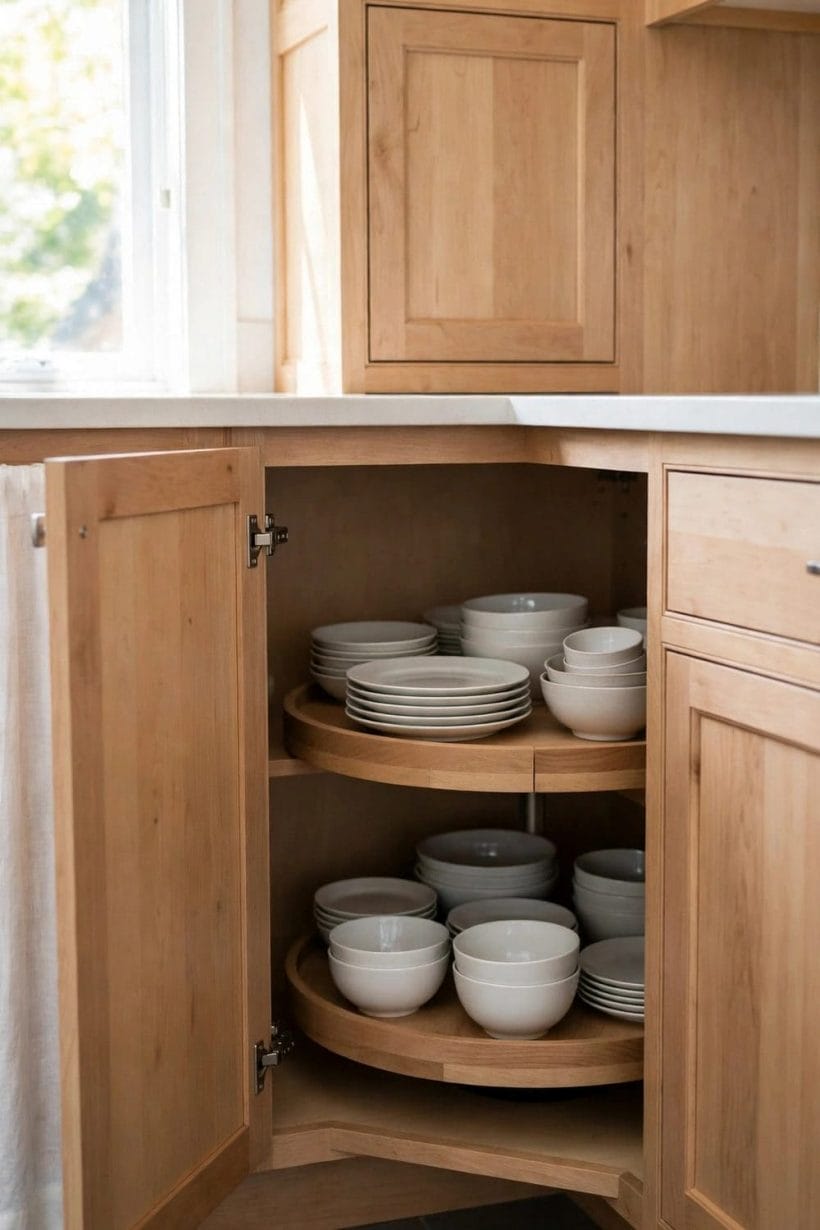
It can help to test with a few everyday items in place, but only after the empty tests feel smooth. Put two or three plates on the shelf, turn it again, and see whether the extra weight changes anything. If the shelf drops or wobbles only under load, the issue may be with how the shelf is supported rather than with the door, and that is useful information to pass to a professional if you decide to seek help. If the shelf turns well empty but catches when loaded, try moving the items to spread the weight more evenly before you adjust anything else. Testing in this gradual way, from empty to lightly loaded to fully loaded, gives you a much clearer picture than loading everything back at once and wondering which item caused the problem. In a small home, where a corner cupboard may be the main store for daily dishes, that gradual test also keeps the kitchen usable while you work.
7. Reload With Balance in Mind
Reloading is part of the fix, not an afterthought. A rotating shelf that is loaded heavily on one side will always tend to sit unevenly, and a shelf that is stacked too high will always risk catching the shelf above it. Put the heaviest items low and close to the centre of the shelf, where they are best supported, and keep lighter items towards the edge. Spread plates, bowls and jars around the shelf rather than piling them all in one place. Leave a little space above each stack, so that you can lift items out without dragging them across the shelf below. Keep the items you use every day where you can reach them without spinning the shelf through a full turn, and move rarely used items to the back or to a higher shelf. These are not rules, but habits that can help a corner unit feel calmer and easier to use.
Think about what actually belongs in a corner cupboard. Items that are used daily, that are a comfortable weight to lift, and that fit the round shape of the shelf will usually work well there. Very heavy, very tall, or very awkward items may be better stored in a straight cupboard where they can be lifted straight out, and that is a perfectly sensible choice rather than a failure of the corner unit. If your kitchen is compact, you may need to be more selective about what lives in the corner, and browsing kitchen ideas for small and busy rooms can spark ideas for moving a few items elsewhere without losing storage overall. The goal of reloading is not to fill every inch of the shelf, but to leave the shelf able to turn freely, the door able to close cleanly, and the items able to be reached without a struggle. A shelf that is three-quarters full and easy to use is worth more than a shelf that is packed tight and hard to turn.
8. Deal With Rubbing, Catching and Uneven Gaps
Even after tightening and reloading, a cabinet may still show a small rub or an uneven gap. Before you adjust further, check the simple causes once more. Is anything stored on the shelf tall enough to catch the shelf above? Has a jar lid or a plate edge slipped over the rim of the shelf? Is the door catching on a neighbouring door or drawer, rather than on its own frame? Is there a crumb, a spill, or a small object lodged in a hinge or under the shelf? These small causes are easy to miss, and they are also easy to put right. A quick wipe, a moved jar, or a plate turned the other way round can sometimes clear a rub that looked like a hinge problem.
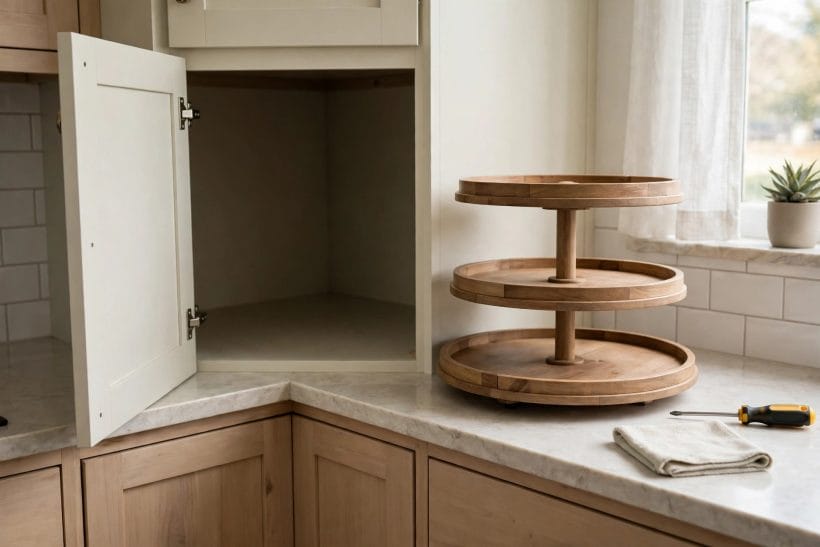
If the rub persists, go back to the gaps. Compare the door with its neighbours again, and check whether the gap that looked even when the cabinet was empty has changed now that it is loaded. A gap that changes under load may be telling you that the shelf support, rather than the door, needs attention. A gap that stays the same, loaded or empty, may be pointing more towards the door position. Either way, resist the urge to plane, sand, or cut anything. Removing material from a door or a shelf is hard to undo, and it can weaken the very part you are trying to help. If a rub will not clear with gentle adjustment and sensible loading, that is a good point to pause and seek advice, rather than to force a solution. A cabinet that rubs slightly but works safely is better than a cabinet that has been cut or forced and no longer closes properly.
9. Know When to Stop and Call a Professional
There is a clear line in this kind of work between a simple adjustment and a repair that needs skill, tools, or new parts. Stop and seek professional help if the cabinet boards are soft, swollen, cracked, or water-damaged. Stop if a fixing will not grip, if a screw hole has stripped, or if a plate has pulled away from the board. Stop if the door or the shelf is warped, cracked, or broken. Stop if the unit is fixed to a wall or a worktop in a way you do not understand, or if removing it would disturb plumbing, wiring, or gas fittings. None of these are failures on your part. They are simply signs that the job has moved beyond gentle adjustment, and a cabinet maker, a kitchen fitter, or a general tradesperson will be able to judge the cabinet in person and suggest a repair that suits its actual condition.
When you do call someone, your earlier observations will help a great deal. Being able to say where the door catches, whether the shelf drops when empty or only when loaded, and what you have already tightened or adjusted will save time and will help the tradesperson focus on the real problem. Take the photographs you made at the start, and note anything you noticed about water, swelling, or soft boards. If a replacement part or a replacement door is suggested, ask what it will be made from, how it will be fixed, and how it will affect the doors beside it, so that the repair blends in rather than standing out. The guide to replacement cabinet fronts, their materials and measuring explains, in general terms, the kinds of questions worth asking before any front is ordered. A good repair should leave the corner unit working smoothly, looking consistent with its neighbours, and able to carry a normal daily load without strain.
10. Keep the Corner Working Well After the Fix
Once the cabinet feels better, a few quiet habits can help it stay that way. Avoid overloading the rotating shelf, and avoid piling heavy items on one side. Wipe up spills promptly, so that boards do not soften over time. Check the hinges and fixings from time to time, perhaps when you give the kitchen a deeper clean, and tighten anything that has worked slightly loose before it becomes a larger problem. Spin the shelf occasionally and notice whether it still turns smoothly, rather than waiting until it starts to catch. Keep the door swing clear, so that the door is not repeatedly knocked by chairs, bins, or other doors. These habits take little effort, and they can extend the useful life of a corner unit that is already working well.
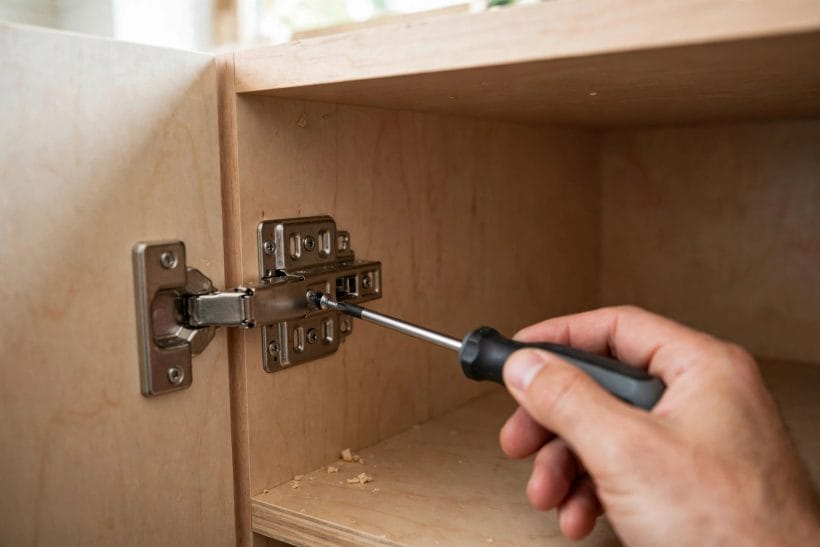
It is also worth reviewing what lives in the corner from time to time. Kitchens change: new dishes arrive, old ones are rarely used, and cooking habits shift. A corner cupboard that was once perfect for one set of items may become awkward for another, and a small reshuffle can be enough to restore ease of use. If your cabinets are older, or if a matching front is no longer available, the guide to what to do when kitchen cabinets are discontinued offers general ideas for matching, blending, and refacing that may help you plan ahead. In a compact home, where storage is precious, keeping a corner unit in good order is not a minor matter. It is one of the simplest ways to keep daily cooking calmer, and to make a small kitchen feel larger than it is.
Final Considerations
A dropping rotating shelf and a door that will not sit straight can be frustrating, but they are often worth investigating calmly before assuming the worst. Watch first, empty the cabinet, check the door and the shelf in turn, adjust in small steps, and test after each change. Reload with balance in mind, and do not be tempted to force, cut, or over-tighten anything that resists. If the cabinet shows damage, if a fixing will not hold, or if you are unsure at any point, pause and ask a professional. That caution protects both the cabinet and the kitchen around it, and it usually leads to a better result than a hurried repair.
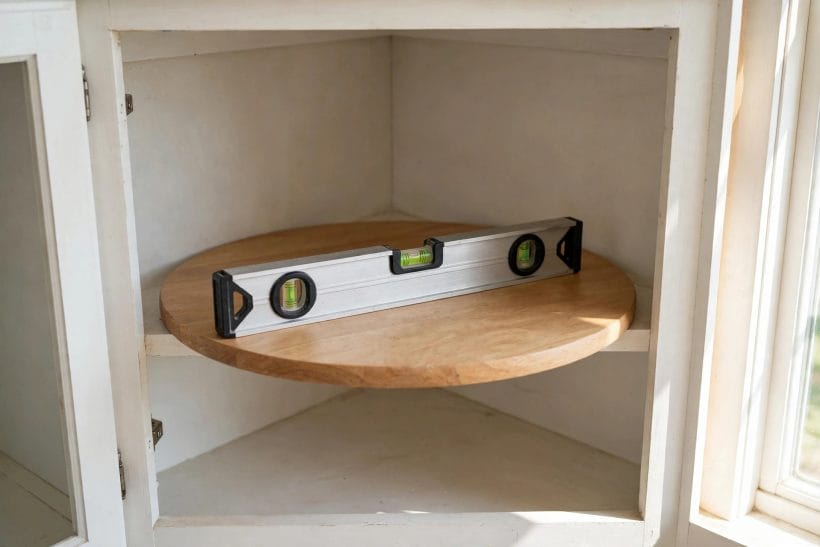
For many households, the real reward of this work is not a perfect cabinet, but a corner cupboard that is pleasant to use again: a door that closes without a catch, a shelf that turns without a struggle, and dishes that can be reached without kneeling and searching. If you find yourself facing a lazy susan cabinet door dragging again in the future, the same calm sequence will serve you well: notice what has changed, look at the door and the shelf separately, adjust a little at a time, and reload with balance in mind. And if the day comes when the corner needs more than adjustment, you will at least know exactly what to describe, and you will have a kitchen that has been looked after with care in the meantime. For readers planning a compact kitchen around a corner like this one, the condo kitchen ideas collection offers a broader look at cabinets, colours and storage in smaller rooms, and it pairs naturally with the general approach set out here.





0 Comments