

A wood stove changes how a living room is arranged: sofas turn toward it, the rug gathers round it, and every lamp and cushion answers to its glow. It is furniture, hearth and focal point in one black box.
These seventy-five ideas are about styling a living room around that stove — hearths, surrounds, seating arcs, colour, light and log storage as decoration — with the safety framing kept plain and professional throughout, and fitting left to qualified installers.
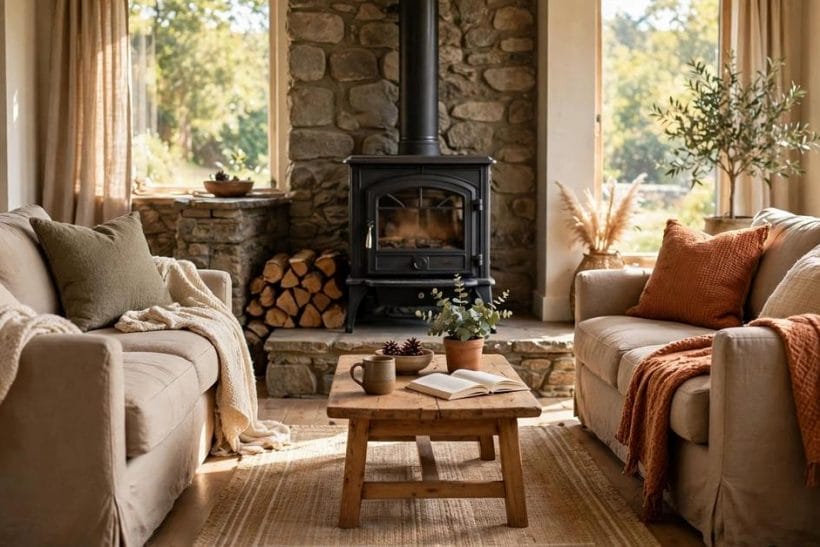
1. Wood Stove Living Room Ideas at a Glance
A living room built around a wood stove has five working parts: the hearth it stands on, the surround behind it, the seating turned toward it, the log storage that feeds the picture as much as the fire, and the safety checks underneath all of it. Style the four visible parts in sympathy and the room settles; the fifth is planned first and never styled at all.
For the wider fireplace family, start with the pillar post on the fireplace living room, and the general living room ideas collection for everything beyond the hearth.
| Family | Character | What it means |
|---|---|---|
| The Hearth | Stone or tile beneath the stove | Grounded |
| The Surround | Brick, tile or plain plaster | Honest |
| Seating | Chairs angled to the warmth | Cosy |
| Log Storage | A basket or built-in log nook | Ready |
| Safety Checks | Clearances, alarms, servicing | Professional |
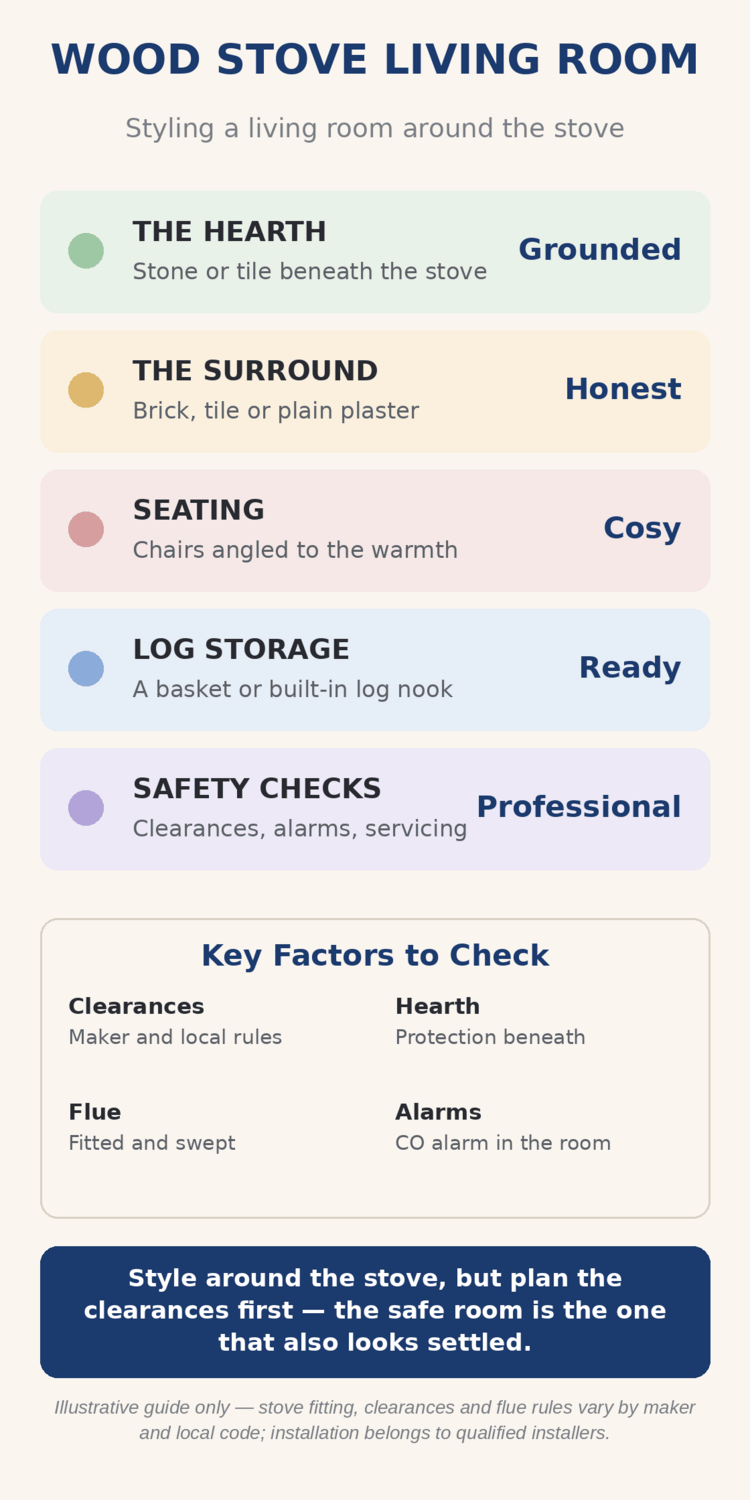
Scope, so the lanes stay clear: this post owns styling a living room around a wood stove — arrangement, materials and mood. Fireplace Makeovers owns renovation before-and-afters, and Rustic Fireplace owns the rustic style alone; a stove room may borrow from both, but neither does this post’s job. The safety framing, in general terms: keep the clearances the manufacturer and local rules require, give the stove the hearth protection it needs, keep a carbon-monoxide alarm in any room with a stove, and leave installation and flue work to qualified installers.
2. Layouts and Seating Around the Stove
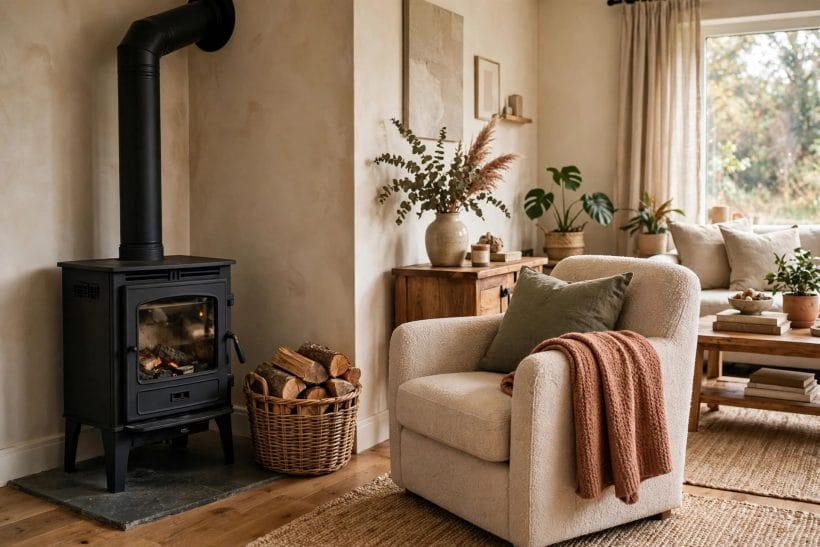
The stove is the room’s second sun: seating turns toward it almost without being asked. These layouts arrange that turn deliberately, the way the corner fireplace ideas arrange a corner hearth.
1. Two Sofas Angled to the Stove
The classic stove arrangement: two sofas set at a gentle angle, neither square to the walls nor to each other, both facing the hearth between them. Conversation and warmth share the same axis, and the room finally has a geometry with a reason.
2. A Corner Stove with a Chair Beside It
A stove in the corner frees the room’s centre and makes a natural one-chair fireside: an armchair angled out of the corner, a small table, a lamp behind the shoulder. Small rooms suit this best — the corner focusses for free.
3. The Sofa Facing the Hearth, Square On
Where the stove sits mid-wall, let the main sofa face it directly and build the room symmetrically outward: matched chairs, matched lamps. Formality suits a stove — its black regularity anchors the pairing.
4. An L of Seating Wrapped Round the Hearth
A corner sofa or a sofa-and-chaise L wraps two sides of the hearth zone, leaving the third open to the room. It is the family arrangement: room to stretch toward the warmth, room to talk across it.
5. Armchairs Swapped for the Second Sofa
Two generous armchairs instead of a second sofa keep the seating arc light and movable — turned to the stove in winter, to the garden in summer. Stove rooms benefit from furniture that changes its mind with the seasons.
6. A Rug that Draws the Seating Boundary
Let the rug, not the walls, draw the fireside: seating on it belongs to the stove, seating off it belongs to the rest of the room. Choose its placement with the hearth protection in mind and the maker’s guidance in hand.
7. A Low Coffee Table that Keeps Sightlines Open
Between sofa and stove, keep the table low and open-legged so the fire stays visible from every seat. Glass, slatted timber or a simple bench-table all work; a tall solid block murders the view.
8. The Window Seat Kept in the Conversation
If the room has a window seat or a deep armchair away from the hearth, angle one fireside chair toward it so the two zones talk. A stove room should feel like one gathering, not a warm end and a cold one.
3. Hearths, Surrounds and Backdrops
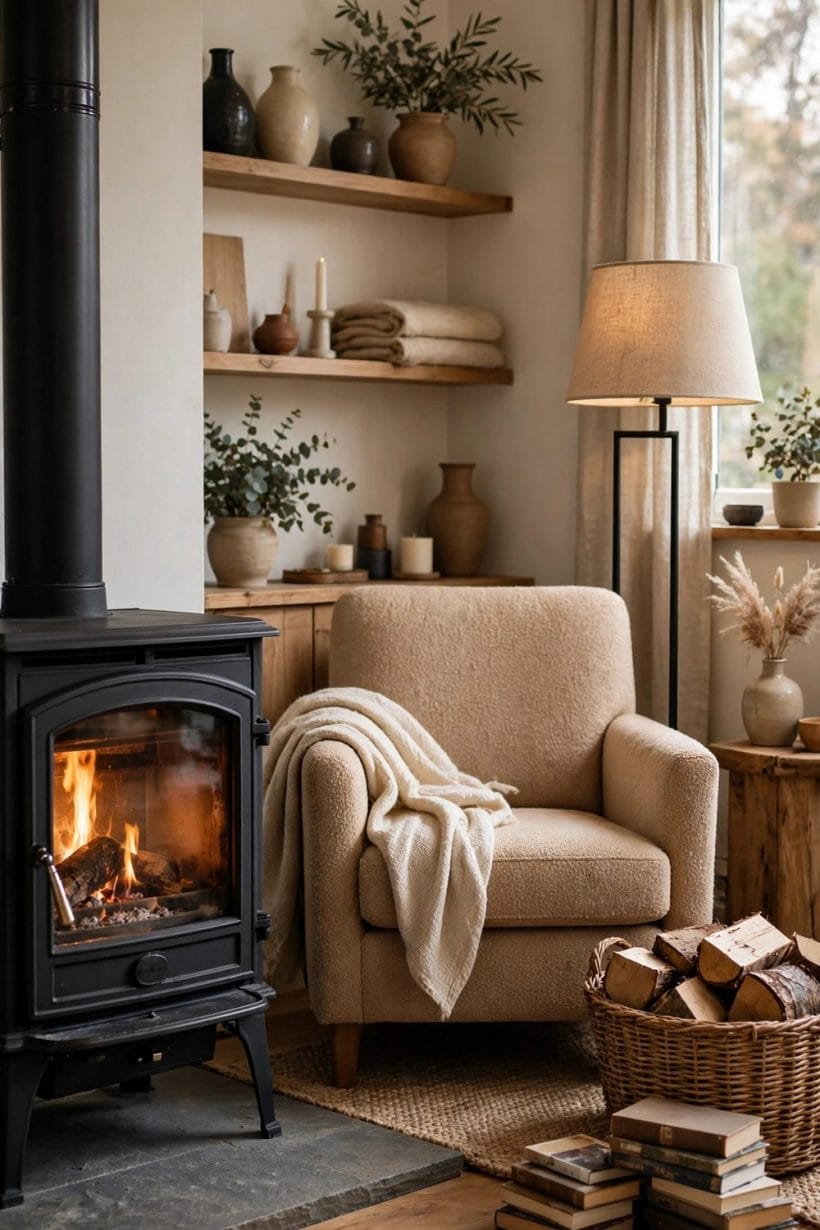
What the stove stands on and stands against decides whether it looks installed or marooned. The stone fireplace ideas and fireplace hearth ideas posts cover the wider family; here the focus is the stove’s own setting.
9. A Stone Hearth Slab as the Stove’s Stage
A single stone slab under the stove gives it a stage and the room a foundation line. The hearth is protection as much as picture: its material and extent belong to the manufacturer’s requirements and local rules, settled before styling.
10. A Tiled Surround in a Deep Colour
Tiles behind and beneath a stove bring colour the black box cannot: deep green, slate blue or warm terracotta. Tile also shrugs off the hearth’s hard life, and a handmade glaze catches firelight beautifully.
11. Plain Plaster, Honestly Finished
The quietest backdrop is no surround at all beyond the protection the stove requires: plain plaster, painted in a warm neutral, letting the stove’s silhouette do all the talking. Scandinavian rooms prove the restraint eloquent.
12. A Brick Backdrop behind the Stove
Exposed brick behind a stove gives it a workshop honesty and a texture that flat paint never will. Keep the brick warm-toned and the mortar pale, and the black stove reads as the room’s full stop.
13. A Raised Hearth that Lifts the Fire into View
A hearth raised a little lifts the stove’s fire window into the seated eye-line — a styling gain with a practical root. Any change of hearth level belongs to the installation — the qualified installer and the maker’s requirements, not the decorator.
14. A Dark Hearth against Pale Floors
A dark slate or stone hearth on pale boards draws a deliberate boundary around the stove zone and hides the ash-dust of daily life between cleanings. The contrast also grounds floaty furniture schemes that might otherwise drift.
15. The Alcove Backdrop, Lined in Stone or Brick
Where a stove sits in a former fireplace alcove, lining the alcove’s back and sides in stone or brick turns a leftover opening into the room’s shrine. The flue’s route through it is the installer’s territory.
16. A Simple Steel or Stone Back Panel
A single back panel — stone, or a heat-appropriate material the installer specifies — gives a stove on an open wall a finished, framed look without building a full surround. Minimal rooms suit it best: one rectangle, one stove.
4. Colour Palettes that Suit Stove Light
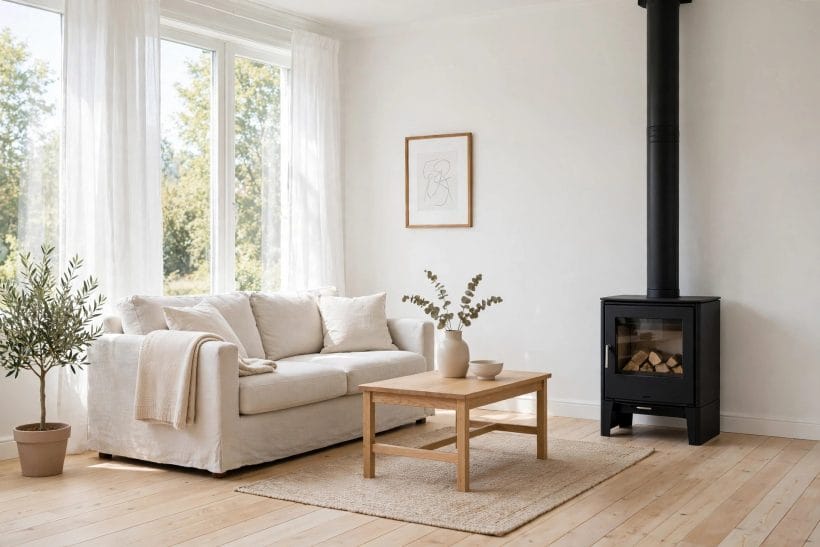
Firelight is warm, moving and unforgiving of cold colours. These palettes sit happily in both daylight and the stove’s evening register.
17. White Walls and a Black Stove, Scandinavian Style
The northern formula: white or near-white walls, pale timber, one black stove. The contrast is total and the calm is real — softness comes from textiles and wood tones, not wall colour.
18. Warm Greys that Flatter Firelight
Warm grey walls take firelight and return it doubled: the orange glow sits naturally on a grey with brown in it, where a blue-grey would fight it. Test greys by lamplight, not daylight, in a stove room.
19. Deep Green as the Stove’s Backdrop
A deep green wall behind a black stove is the library scheme: moody, bookish and endlessly flattering to brass, leather and timber. Keep the green on the hearth wall only; other walls stay lighter.
20. Terracotta and Clay Tones
Clay, terracotta and brick-red textiles echo the fire’s own palette without matching it literally. In cushions, throws and a rug, these tones make a pale room feel fired even when the stove rests.
21. Cream and Natural Linen Neutrals
Cream walls, linen upholstery and undyed wool make the softest stove rooms: everything pale except the stove itself, which becomes the room’s one dark note. Texture does the decorating colour declines to do.
22. A Charcoal Hearth Wall in a Light Room
Painting only the stove’s wall in charcoal gives a light room a drawn-in, fireside depth and makes the black stove disappear into its own backdrop — the fire, lit, appears to float in the dark.
23. Ochre and Mustard Accents
Ochre cushions, a mustard throw, a brass lamp: warm yellows are firelight’s cousins and keep a grey or white scheme from chilling. Use them in the seating zone only, so warmth gathers where people gather.
24. Blue as the Deliberate Cool Note
A single cool note — slate-blue cushions, a denim throw — steadies an all-warm scheme and makes the fire’s warmth read warmer by contrast. Keep it textile, not paint: walls stay on the fire’s side.
5. Mantels, Shelves and Log Storage Styling
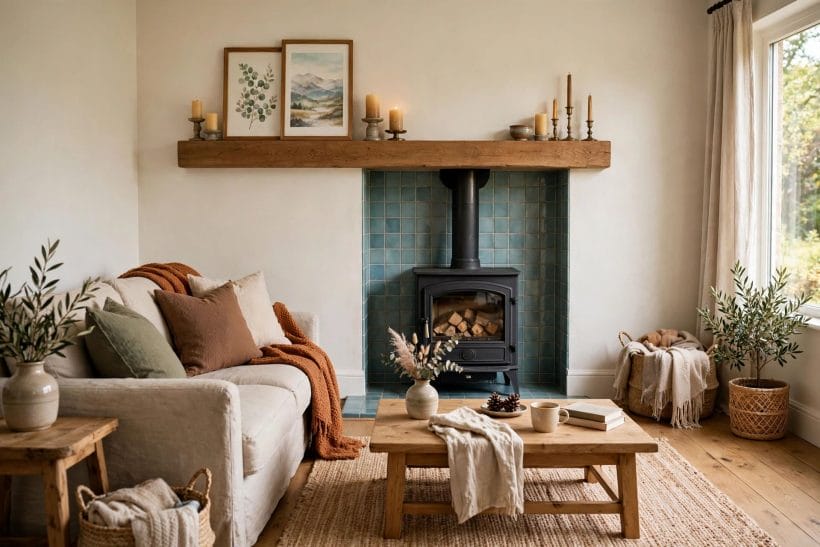
A stove has no mantel of its own, so the room borrows one: a shelf, a beam, the surround’s ledge. The fireplace mantel ideas post covers the classic shelf; here it adapts to the stove, with log storage styled into the picture.
25. A Floating Timber Shelf Above the Stove
A chunky timber shelf on the wall above the stove gives the arrangement its mantel moment: candles, a framed print, a plant. Its height and placement follow the manufacturer’s requirements for the stove below — the installer confirms both.
26. A Reclaimed Beam as the Mantel Line
An old beam fixed above the surround brings the rustic note without turning the whole room rustic. Dress it sparsely — the beam itself is the ornament — with everything on it pale against its dark grain.
27. Candles and Lanterns on the Shelf
Unlit candles and lanterns above a stove sound like a joke and look like a poem: flame shapes echoed in still life. Keep them as decoration on the shelf only, well within the clearances the manufacturer requires.
28. A Woven Log Basket as a Styled Object
The log basket is the stove room’s hardest-working ornament: woven, generous and kept honestly filled, it signals readiness. Place it where the manufacturer’s guidance allows — near the stove’s picture, never against its heat.
29. A Built-In Log Nook Beside the Hearth
A log nook built into the surround or the alcove’s side turns fuel into architecture: a stacked, timber-textured panel that changes as it is used. As part of the hearth build, its position belongs to the installation.
30. Logs Stacked as a Textural Panel
Where a nook exists, stack its logs with the cut ends outward in a calm, even face — the ends’ rings and tones make a natural artwork. Restack loosely rather than tight; the nook is a working store wearing a good face.
31. A Mirror Above the Surround
A mirror over the shelf doubles the firelight and the lamplight both, and gives a small stove room a second reflected hearth. Frame it in timber or black metal to keep it in the stove’s family of materials.
32. Art Hung Low, Close to the Warmth
Hang the room’s one good picture lower and closer to the hearth than gallery habit suggests, so the seated eye finds stove, shelf and picture in one glance. The grouping, not any single piece, is the composition itself.
6. Lighting Layered with the Stove Glow
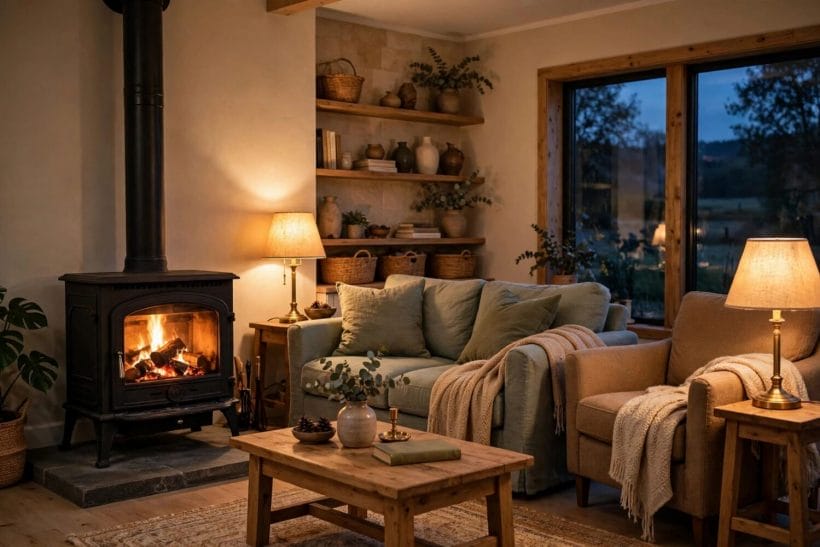
A lit stove is a light source with opinions: low, warm and flickering. Room lighting should layer around it rather than compete with it, unlike the cooler schemes in the modern fireplace ideas post.
33. Table Lamps at Sofa Height
Lamps whose shades sit at seated eye height spread a low, even pool that agrees with firelight’s register. One at each end of the sofa balances the stove’s glow instead of fighting it from a single bright corner.
34. A Floor Lamp Behind the Reading Chair
The reading chair by the stove wants its own light thrown over the shoulder: a floor lamp with a warm shade, placed behind and beside. Firelight is atmosphere; lamplight is what the book gets read by.
35. Wall Lights Washed Up the Surround
Soft wall lights washing the surround’s brick, stone or tile give the backdrop a second life after dark and model its texture. Keep them dim and warm — the wall should glow, not glare at all.
36. Candles on the Coffee Table, Away from the Hearth
Real candles belong on the coffee table and the shelf, where they echo the stove’s flicker at a safe, social distance from its heat. Grouped in threes in glass holders, they carry the flame theme onward.
37. Warm Lamps Throughout, Without Exception
Whatever the fittings, choose warm lamps in a stove room: cold light greys the timber, flattens the textiles and makes firelight look orange and stranded. Warmth is the room’s register after dark.
38. A Dimmer for the Main Light
If the room has a ceiling light at all, put it on a dimmer and treat it as daylight’s stand-in, lowered to a murmur by evening. The stove and the lamps should win the room after dark, clearly.
39. Fairy Lights in the Log Nook’s Off Season
In the months the stove rests, a string of warm fairy lights tucked along the log nook or the shelf keeps the hearth zone luminous without a fire. The room keeps its focal point all summer.
40. Low Light at the Room’s Far End
One small, warm light at the room’s far end — a lamp on a sideboard, a lit alcove — stops the stove end from becoming a bright island in darkness. The eye should travel the whole room by warm stages.
41. No Bare Bulbs Anywhere Near the Hearth
Exposed filament fittings have their place, but not competing with a real flame nearby. Shaded, diffused light elsewhere lets the stove’s glass be the room’s only naked light — and its star.
7. Alcoves, Nooks and Built-In Seating
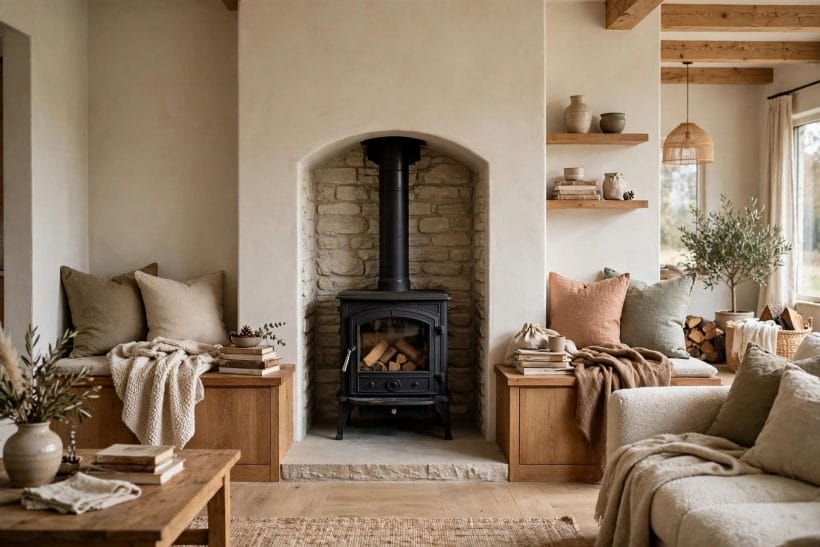
Stoves often inherit the old fireplace alcove, a gift: a ready-made room within the room, waiting for benches, shelves and cushions.
42. Built-In Benches Flanking the Alcove
Benches built into the chimney breast’s sides give the stove a settled, inglenook feeling and the room its best seats: close to the warmth, backs to the wall, the gathering in view.
43. Cushions and Throws that Live on the Benches
Dress the flanking benches as permanent seating, not storage: fitted cushions, a throw folded at each end, a book left open. Lived-in benches make the alcove the room’s social centre, not its frame.
44. Shelves in the Alcove’s Upper Reaches
The breast’s sides above bench height carry shelves for books, pottery and plants — the collected layer a stove room wears so well. Keep the styling airy; the stove below is heavy enough for both.
45. A Single Deep Armchair in a Purpose-Built Nook
Where the alcove is narrow, give it one deep armchair across the stove’s warmth instead of two benches: the nook becomes a private fireside for one, with its light borrowed from a lamp beside it.
46. The Under-Bench Drawer or Basket Row
Benches with drawers or a row of baskets beneath swallow blankets, games and the room’s clutter at the exact point of sitting down. Storage serving the seat above it never looks like storage.
47. A Painted Alcove Interior, Darker than the Room
Painting the alcove’s inside a shade or two darker than the room draws the eye into the hearth and makes the stove’s glow pool there after dark. The room beyond can stay pale.
48. Stone or Brick Left Bare Inside the Alcove
If the alcove’s lining is honest stone or brick, leave it bare and let paint stop at the breast’s face. The material change marks the hearth’s territory more clearly than colour could.
49. A Small Side Table Built into the Bench End
A bench that ends in a small fixed table — for the cup, the book, the spectacles — completes the inglenook’s self-sufficiency. Fireside seats fail on nowhere to put things down; build the answer in from the start.
8. Reading Corners and Layered Comfort
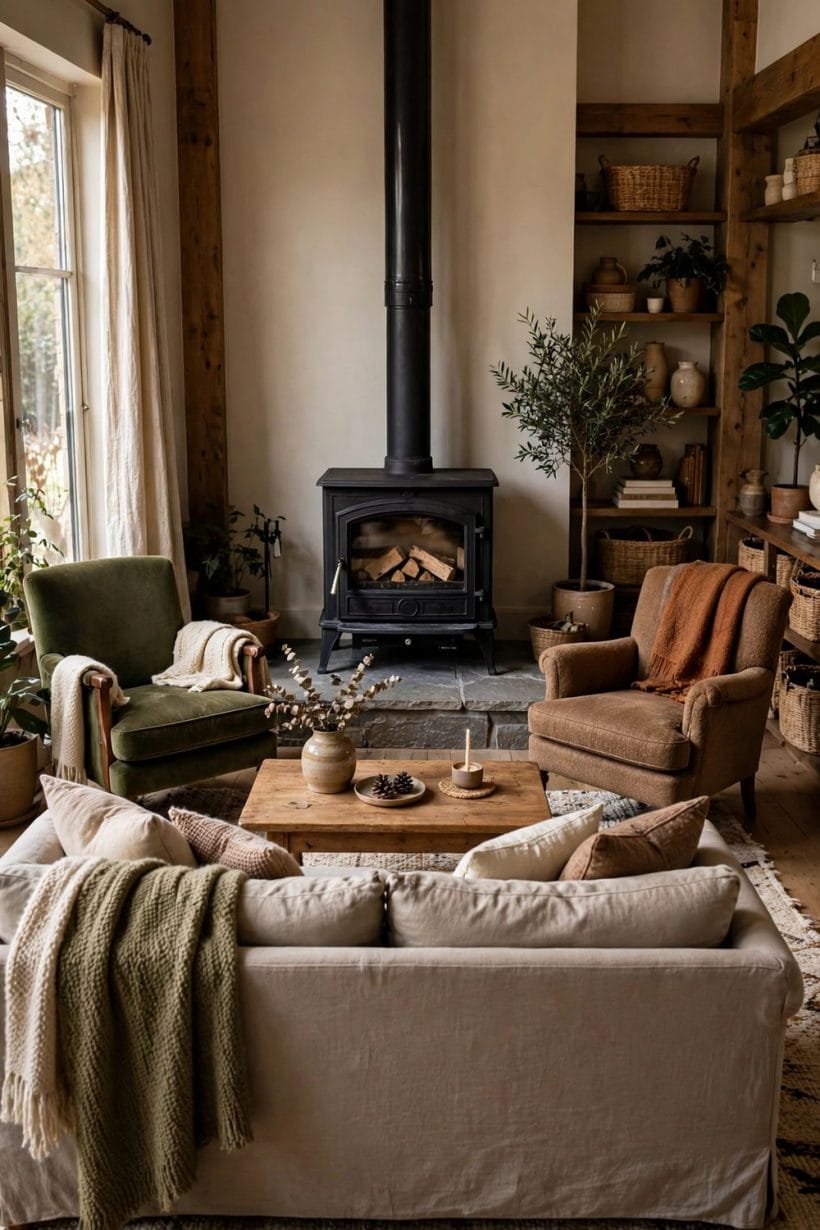
Every stove room grows a favourite chair, and the chair grows a corner around itself: light, layers, a table, a footstool. These ideas dress that corner deliberately.
50. The Wing Chair Turned Half to the Fire
A wing chair angled halfway between the stove and the room is the classic fireside seat: its wings cut the draughts, its angle includes both the warmth and the conversation. Upholster it in something that glows — rust, ochre or deep red, say.
51. A Footstool that Matches Nothing and Suits Everything
A footstool in a contrasting fabric — leather against linen, pattern against plain — gives the reading corner its relaxed, unmatched note. Fireside comfort should look gathered over years, not bought in an afternoon.
52. Throws Layered by Weight, Not Just Colour
Layer the corner’s throws by weight: a light cotton for autumn shoulders, a heavy wool for deep winter. The pile on the chair’s arm is the season’s barometer; reaching for the right one is a small daily pleasure.
53. A Bookshelf Within Arm’s Reach
Books belong beside the fireside chair the way logs belong beside the stove: a low shelf or a stack on the floor within arm’s reach, so the reader never leaves the warmth mid-chapter.
54. A Side Table Sized for a Cup and a Book
The fireside table’s whole brief is a cup, a book and perhaps a pair of glasses — size it to exactly that and it will never collect clutter. A small round timber table has done this job for centuries now.
55. A Cushion in the Small of the Back
The unglamorous secret of every beloved fireside chair is a small, firm cushion at the lower back. Choose its cover as the corner’s one bright accent, and the practical detail becomes the decorative one.
56. A Plant to Soften the Stove’s Black Geometry
A green plant on the shelf or the floor beside the seating softens the stove’s hard black lines and proves the room is alive in daylight too. Place it for its own light needs, clear of the hearth zone.
57. The Corner Kept Deliberately Unscreened
Keep the television and the screens out of the fireside corner’s sightline if the room allows it: the stove is the original screen, and a reading corner facing it keeps an older contract with the evening.
9. Rustic Timber Rooms and Country Styling
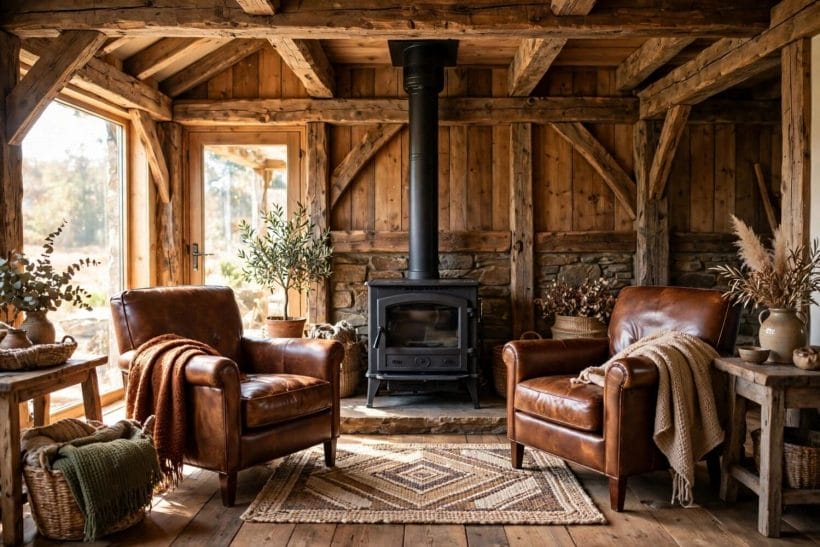
Timber rooms and stoves were made for each other. These ideas keep the country register honest — beams, leather, wool, worn wood — without tipping into theme-park rustic.
58. Leather Armchairs that Improve with Warmth
Leather and stove heat are old friends: two leather armchairs angled to the hearth in a timber room need nothing but a rug and a side table each. Leather’s sheen by firelight is the whole decoration.
59. Exposed Beams Left Dark Above a Pale Room
Dark beams over pale walls pull the ceiling down to fireside height and give the stove’s flue a visual family to join. If the beams are pale, leave them: existing timber beats manufactured age.
60. A Woven Wool Rug in Earth Tones
Under a rustic seating arc, a woven wool rug in earth tones — undyed browns, rust, moss — grounds the furniture and keeps the hearth zone’s edge soft. Its placement respects the hearth protection and maker’s guidance, as every rug near a stove must.
61. Timber Side Tables with Honest Wear
Side tables of worn, unpolished timber suit a stove room better than fine furniture: they take hot cups, book piles and the occasional log basket without complaint, and their scars read as biography.
62. Wool, Linen and Nothing Shiny
The rustic textile rule: wool blankets, linen cushions, cotton throws — and no shiny fabrics anywhere near the hearth’s picture. Matt textures absorb firelight; shiny synthetics argue with it all evening.
63. Antler-Free, Trophy-Free Restraint
Country styling curdles when it reaches for props. Skip the novelty rustic accessories entirely: the stove, timber, logs and leather are already the whole story, without a single gimmick.
64. A Stone Wall Section behind the Stove
In a timber room, a section of stone behind the stove — as its required backdrop, built as part of the installation — marries the room’s two materials at exactly the right point. Wood elsewhere, stone at the fire: the old way.
65. Plaid Used Once, Well
One plaid throw or a single plaid cushion is the country note played at the right volume. Twice is a pattern; five times is a gift shop. Let the one piece be good wool, working alone.
66. The Ceiling Kept Low in Feel, Whatever Its Height
Tall timber rooms can feel barn-like around a stove. Hang the lights lower, keep the seating low and the rug generous, and the fireside gathers at human height, beams above.
10. Practical Care, Safety and Everyday Upkeep
The practical section, stated as it should always be: in general terms, the technical side left to the manufacturer, the local rules and qualified professionals.
67. Clearances Planned Before Furniture
The seating arc, the rug and the log basket all take their positions from the clearances the manufacturer and local rules require around the stove. Plan those first, on the installer’s advice, and style everything else inside what remains — the safe room is the one that also looks settled.
68. Hearth Protection Treated as Non-Negotiable
The protection beneath and around the stove is part of its installation, specified by the maker and the local rules — never a styling choice to be traded away for a prettier floor. Choose its material for looks only after performance is settled by the professionals.
69. A Carbon-Monoxide Alarm in the Room
A carbon-monoxide alarm belongs in any room with a stove, as surely as a chair and a rug do. Fit it, test it as its maker directs, and treat it as permanent furniture — the quietest, most important object in this post.
70. Installation and Flue Work Left to Qualified Installers
Fitting the stove, its hearth and its flue belongs to qualified installers working to the manufacturer’s instructions and local rules — full stop. The decorator’s job starts when theirs ends; no idea here is a fitting instruction.
71. Regular Servicing and Sweeping, Booked Like Clockwork
A stove and its flue want regular professional servicing and sweeping, booked as routinely as any household essential. The room stays pleasanter for it, and the checks give a professional regular sight of all the styling covers.
72. Ash and Dust Managed as a Daily Habit
A stove room stays beautiful by small habits: ash handled as the manufacturer directs, dust lifted from the hearth with a soft brush, textiles shaken out away from the seating. Five unglamorous minutes keep the other seventy-four ideas looking their best.
73. Furniture Fabrics Chosen with the Hearth in Mind
Choose the fireside chairs’ fabrics for the life they will actually live — ash dust, wood-basket scuffs, warm dry air — and keep loose, flowing textiles out of the hearth’s working zone altogether, where the manufacturer’s clearances draw the line.
74. The Stove’s Glass Kept Clean for the View
The fire behind glass is the room’s evening picture, and a clean glass — cleaned as the manufacturer directs, with the stove cold — keeps it worth watching. It is the cheapest regular upgrade a stove room offers its owner.
75. A Room that Rests Well in Summer
When the stove rests, the room should not: keep the seating arc, stand a plant or a candle group where the basket stood, and let the black stove read as sculpture. A well-styled stove room earns its keep every season, lit or not.
Final Considerations
A living room styled around a wood stove succeeds on two levels: it looks gathered — seating turned to the warmth, logs stacked like texture, lamplight agreeing with firelight — and it rests on quiet, professional foundations underneath. Keep them in that order and the room feels as settled as it looks.
The framing bears repeating plainly, once: keep the clearances the manufacturer and local rules require, keep a carbon-monoxide alarm in the room, and leave installation and flue work to qualified installers. Within that frame, everything else here is pleasure — arrange the chairs, choose the tiles, stack the basket, and let the stove do the rest.

0 Comments