

Luxury vinyl plank looks simple in the showroom: neat boards, a wood-like grain, a smooth promise underfoot in every display. The differences that decide how it lives are quieter, hidden in layers, edges and paperwork rather than in the picture on the surface.
This guide works through the whole checklist around the plank itself, in plain qualitative terms and with no figures to memorise, so you can compare any ranges side by side calmly, room by room and question by question, before you buy.
Related Guide: Buying SmartCore Flooring at Lowe's: Ranges, Shelf Labels and In-Store Checks
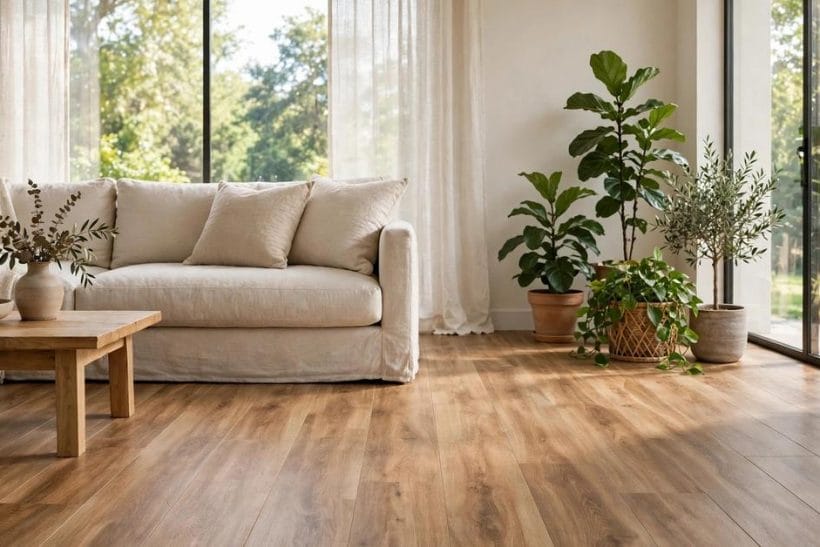
1. Luxury Vinyl Plank at a Glance
Scope first. This post covers the whole checklist for choosing luxury vinyl plank: the wear layer in plain terms, the core families, how planks join and fix, plank size and pattern repeat, underlayment and subfloor checks, finishes and textures, room-by-room suitability, and the warranty and specification paperwork to read before you buy. One split is stated plainly here: the dedicated vinyl flooring wear layer guide owns the deep dive on wear layers and specifications, while everything below stays with the broader checklist that surrounds it, described qualitatively throughout.
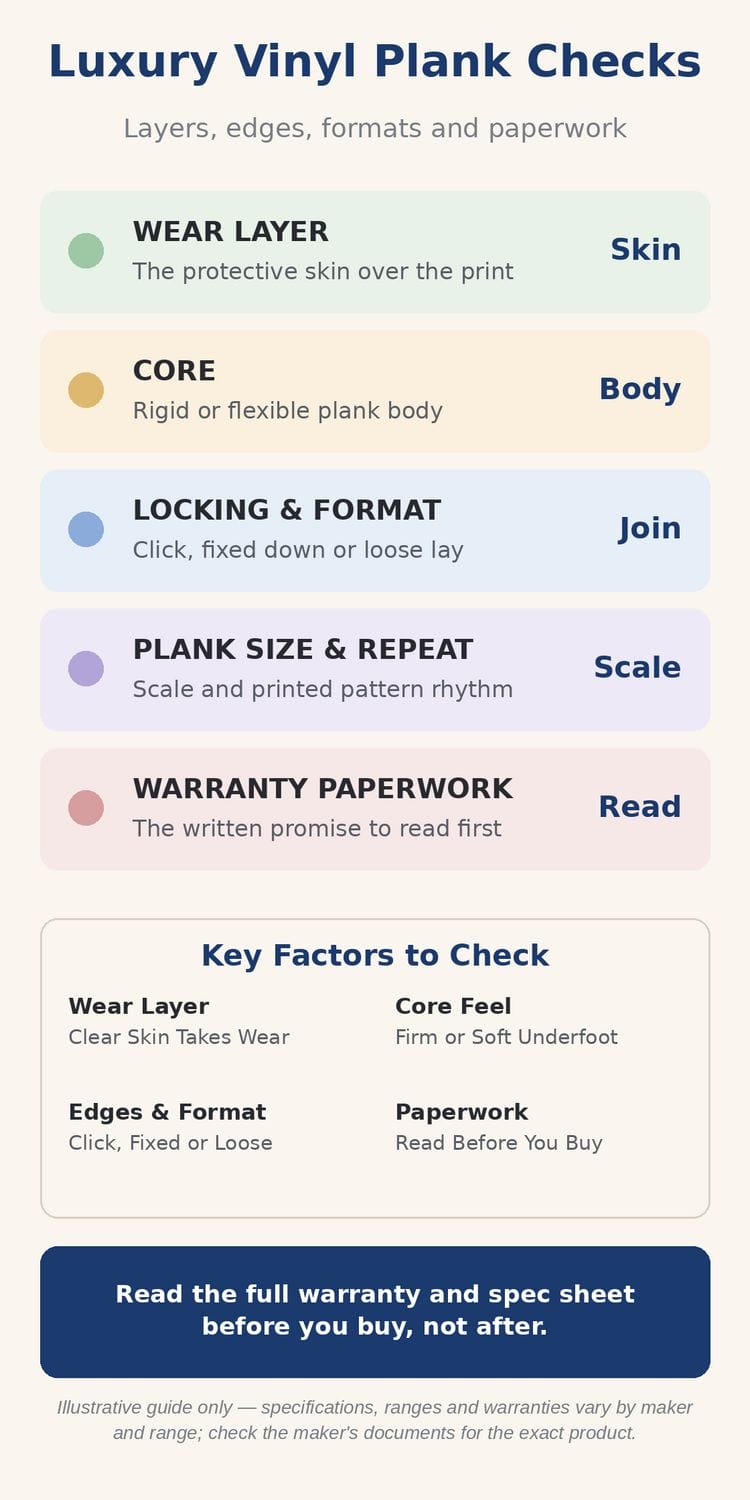
The five rows in the table are the checklist in miniature. Work down them in order and most showroom conversations become easier to compare, because each row names a different question rather than a different sales claim.
| Check | Character | What it means |
|---|---|---|
| Wear Layer | The Protective Skin | The clear top layer that takes scuffs, scratches and everyday wear before the printed design beneath it is reached |
| Core | The Plank Body | The middle that gives each plank its feel underfoot, from firm rigid cores to softer flexible planks |
| Locking and Format | How Planks Join | Whether planks click together and float, or are fixed down, and how the edges meet at every joint |
| Plank Size and Repeat | Scale and Pattern | How plank proportions and the repeating printed pattern shape the look of a finished room |
| Warranty Paperwork | The Written Promise | The warranty and specification documents that state, in writing, what the maker stands behind and where |
2. The Wear Layer in Plain Terms
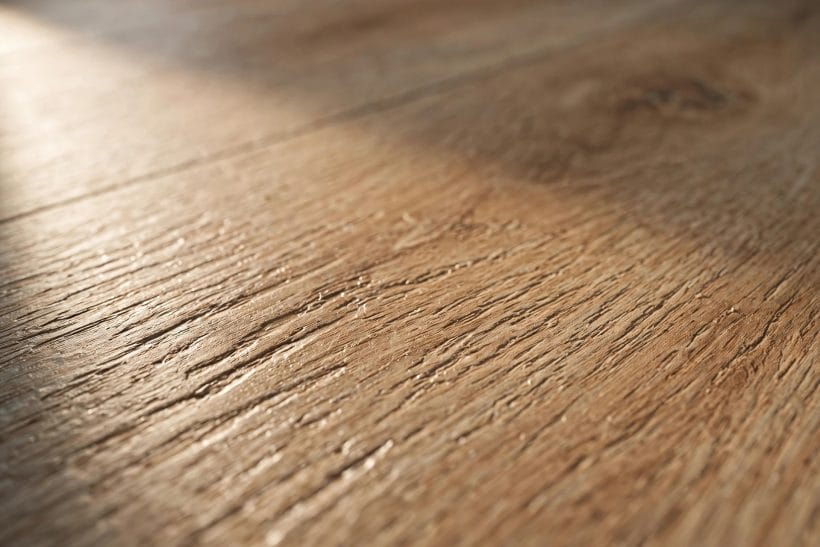
Every luxury vinyl plank is a sandwich. At the top sits a clear protective skin, beneath it a printed layer that carries the wood or stone look, and beneath that the body of the plank. The top skin is the part your shoes, chair legs and daily life actually meet.
A clear skin over a printed picture
The wear layer is transparent, so what you see is the design printed below it. That arrangement is why surface wear matters in a particular way: gentle wear dulls the skin first, and only deeper damage reaches the picture itself. When you handle a sample, look across it in raking light. A calm, even sheen suggests a tidy surface, while visible cloudiness or early scratching on a handled display piece tells its own quiet story about how the surface has coped with showroom life.
Scuffs, scratches and the feel of the surface
Makers describe wear layers in their own documents, and the dedicated guide linked in the opening section reads those descriptions in depth. Here the check stays practical: run a fingertip across the sample, tilt it under light, and ask how the finish is meant to handle grit, pet claws and dragged furniture in ordinary words. A surface that marks when you press a fingernail firmly into an offcut corner is giving you honest information, and it is better learned on a sample than on a finished floor.
Why the top layer is only part of the story
A generous wear layer cannot rescue a plank whose core, edges or backing are poorly suited to your room. Treat it as the opening check, not the whole verdict. Floors fail at joints, at damp subfloors and under the wrong use far more often than they fail because a clear skin was simply too modest, which is why the sections that follow give equal weight to structure, fitting and paperwork.
3. Core Families: Rigid and Flexible Planks
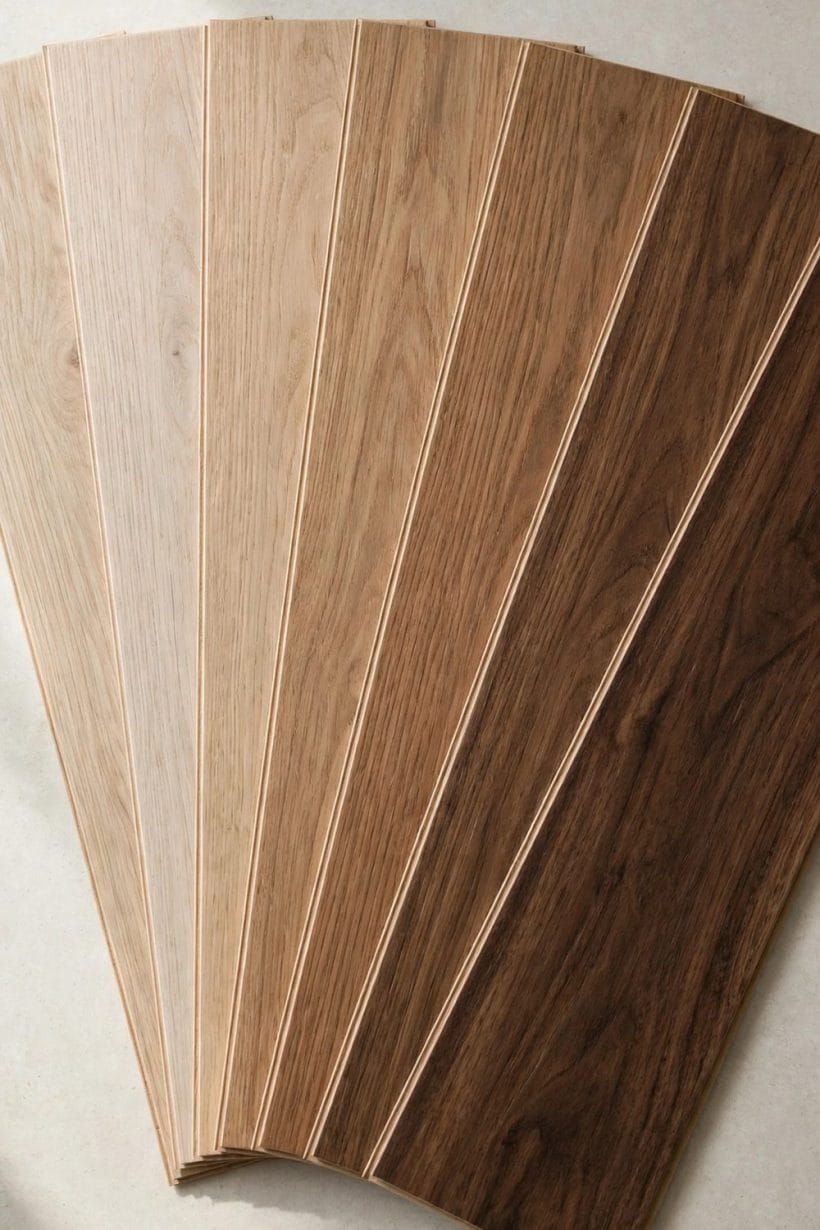
Beneath the printed design sits the core, and the core decides how a plank feels, how forgiving it is of an imperfect subfloor, and how it behaves when the room warms and cools. Reading listings through the online flooring guide helps here, because core names are used loosely in listings and the family matters more than the label.
Rigid stone-plastic cores
Rigid planks built around a stone-plastic composite body feel firm and dense in the hand, hold a crisp edge profile, and tend to feel steady underfoot. That firmness is a character, not a crown: a rigid plank bridges small subfloor ripples calmly, yet it also telegraphs bigger lumps rather than settling over them, and it can feel hard and cool in rooms where you stand barefoot for a long while.
Wood-plastic cores
Wood-plastic composite cores sit in the same rigid family but with a slightly softer, warmer temperament. They share the click-together convenience of their firmer cousins while feeling a touch more cushioned and quiet. The practical check is comparative: stand on samples of each family in your own shoes, on your own floor, and notice which temperament suits the room, rather than assuming one family suits every house.
Flexible planks
Flexible planks bend noticeably in the hand and are usually fixed down rather than floated. Their softness lets them follow a sound, smooth subfloor closely, and they feel warm and quiet underfoot. The trade is that they ask more of the surface beneath them: every ripple and grit speck can show through a soft plank, so their suitability is decided as much by your subfloor as by the plank itself.
4. Locking Edges and Fitting Formats
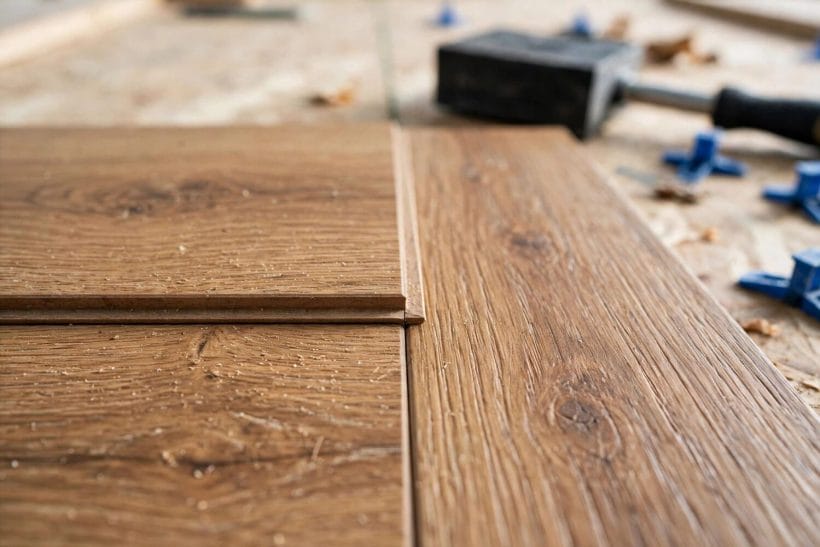
How planks join shapes both the fitting day and the years that follow. Edges are easy to overlook in a showroom because samples are often shown as single boards, yet the joint is where a floor either stays tight and quiet or begins to gap, lift and click underfoot.
Click-locking edges and floating floors
Click-lock planks angle or fold together along profiled edges and are laid as a floating floor, resting on the subfloor without being fixed to it. The checks are tactile: join two samples by hand and feel whether the seam closes flush, tug gently to sense how positively the profile holds, and look along the joint for any lip where one plank sits proud of its neighbour. A joint that feels vague on a sample will not become crisper across a whole room.
Glue-down and loose-lay formats
Glue-down planks are fixed across their whole underside, which gives a very settled feel and suits flexible planks and busy rooms, at the cost of a slower fitting and a harder removal later. Loose-lay planks rely on weight and a grippy backing to stay put, and they lift individually for access or replacement. Neither format is a shortcut: each simply moves the care to a different place, from edge profiles to adhesive coverage or backing grip, and the paperwork should say plainly which format you are buying.
5. Plank Size, Pattern and Repeat
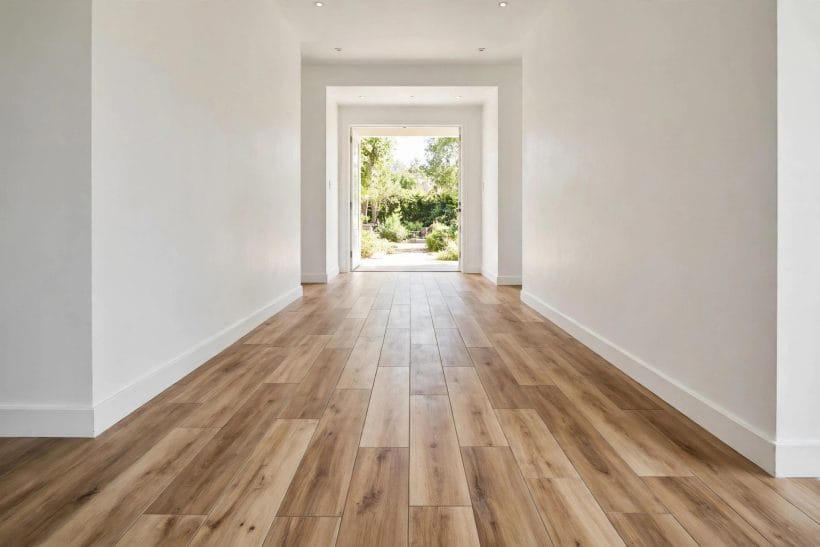
Two floors made from similar planks can look entirely different because of scale and repetition. Size and pattern are aesthetic checks, but they are also practical ones, since they decide how many joints a room shows and how noticeable the printed design becomes at a glance.
Proportions and the scale of a room
Long, broad planks give a calm, expansive feel and fewer seams, which suits open rooms and simple layouts. Shorter, narrower planks show more joints and a busier rhythm, which can feel characterful in small rooms and hallways. Judge scale in the room itself where you can: lay several samples end to end along the longest wall, step back to the doorway, and let the room, not the single board, tell you whether the proportion feels settled.
Pattern repeat and printed grain
The wood look is printed, so the same knot and grain figure returns again and again across the floor. A short repeat becomes obvious quickly, especially in a large room viewed from standing height. Shuffle a handful of samples and look for repeated characters: the same dark knot appearing in a regular rhythm will keep catching your eye for years. Ranges vary widely in how many distinct printed boards they rotate, and asking how the pattern varies is a fair, simple question with a visible answer in the samples.
6. Attached Underlayment and Subfloor Checks
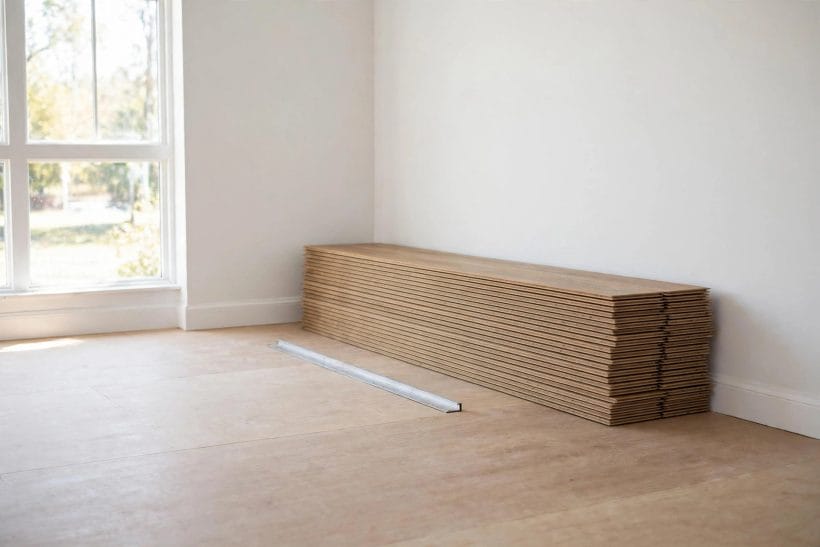
Many planks arrive with a soft backing already attached, and every plank, backed or not, depends on the floor beneath it. This is the least glamorous part of the checklist and the part most closely tied to whether a finished floor feels solid, quiet and even.
Attached underlayment and backing
An attached pad adds softness and sound dulling, and it simplifies fitting by combining two layers in one board. Check its character by hand: a pad should feel resilient rather than spongy, sit evenly across the plank, and be described in the documents as suited to your subfloor and to any underfloor warmth. Where no pad is attached, a separate underlayment may be part of the system, and mixing products the maker has not paired is a question to settle before fitting, not during it.
Flatness, dryness and cleanliness
Subfloor checks are plain ones. The surface should feel flat under a straight board, dry to every reasonable test the fitter trusts, and swept clean of grit that could grind or show through. Moisture deserves particular respect in ground-floor rooms and in the wet rooms gathered in the bathroom flooring ideas collection, where splashes above the floor and damp below it are both part of daily life. A day spent preparing the base is rarely visible in photographs and almost always visible in how the floor feels.
Doorways, trims and expansion space
Floating floors need breathing room at their edges, hidden under trims and thresholds, and doors may need clearance once plank and pad sit on the subfloor. Walk the room and note radiators, fitted units and door swings before fitting day. These small clearances decide whether the finished floor looks planned or squeezed in, and they belong on the checklist while samples are still in your hand.
7. Surface Finishes and Textures
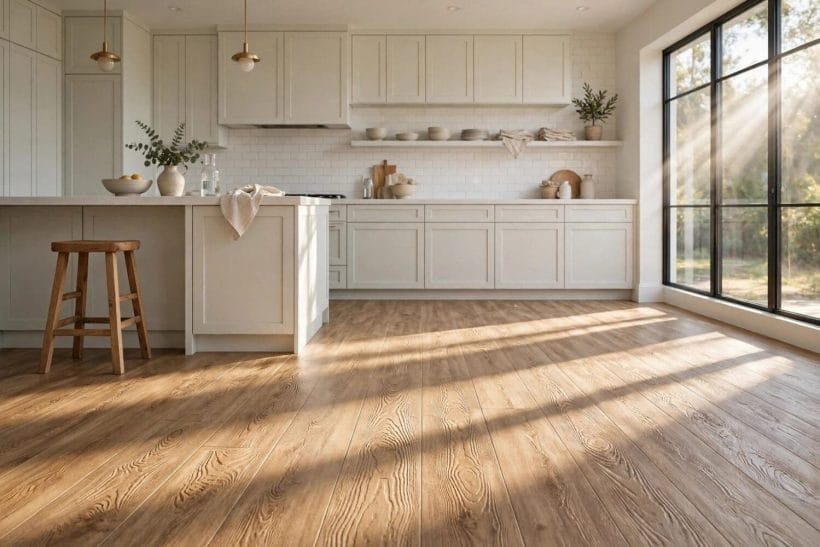
The finish is what light, feet and cleaning meet every day. Gloss level, surface texture and the way the printed grain is embossed together decide whether a floor looks like timber at a glance, how it grips under socks, and how honestly it shows dust and paw prints.
Matt, satin and glossier finishes
Matt finishes scatter light, hide small marks kindly and read as natural timber in most rooms. Satin finishes return a gentle sheen that can lift a darker room. Glossier surfaces look striking in photographs yet show every crumb, swirl and footprint, and they can feel less secure under damp feet. Choose with your own light in mind: a finish that looks calm under showroom spots may glare beside your windows or disappear into gloom in a north-facing room.
Embossing and texture you can feel
Some planks carry a light surface texture, while others are embossed so the texture follows the printed grain, with grooves where the picture shows them. The second approach looks convincing up close because sight and touch agree. Run your palm across samples with your eyes closed, then look: where feel and picture match, the illusion holds from standing height too. Texture also gives a little grip, which matters in hallways and kitchens, provided the grooves are not so deep that they hold dirt against ordinary sweeping.
8. Suitability by Room
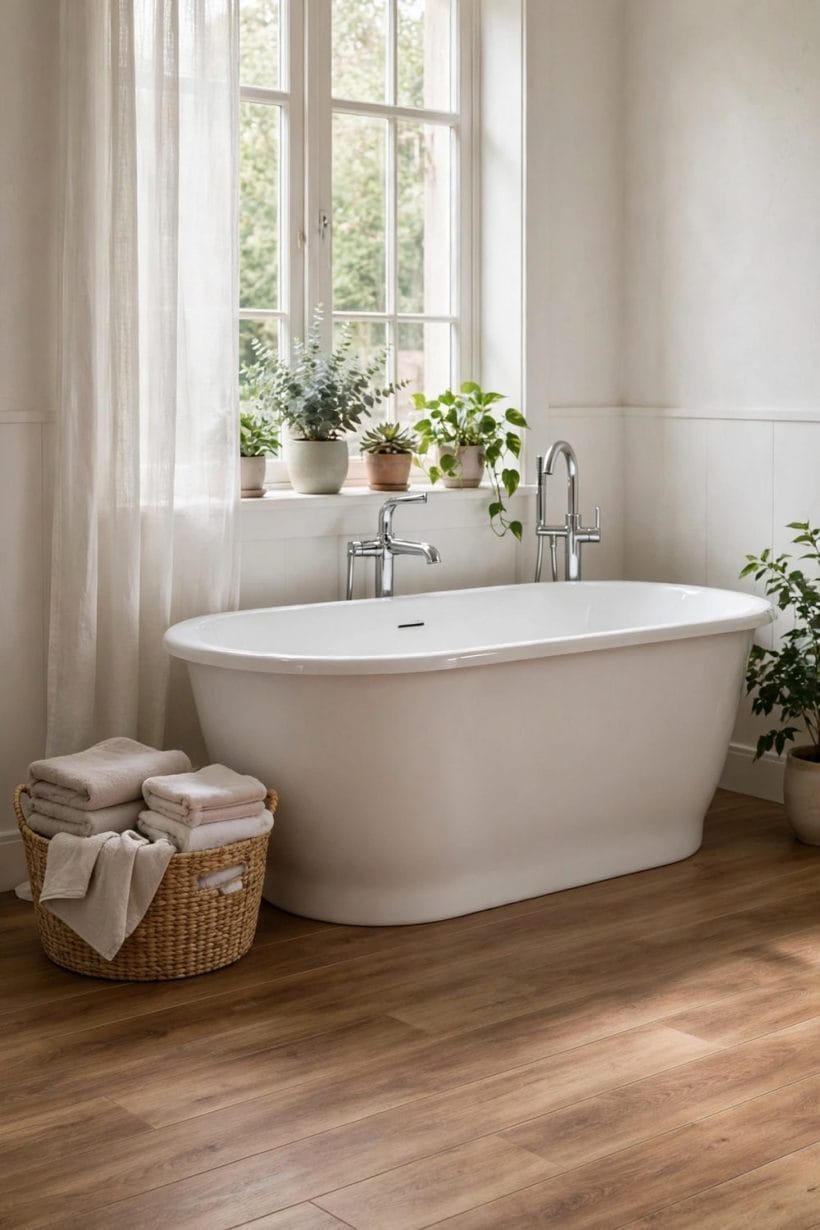
No plank is simply suitable or unsuitable in the abstract. Suitability is a match between a plank’s character and a room’s life: its water, its traffic, its furniture and how long people linger there in bare feet or outdoor shoes.
Kitchens and hallways
Kitchens combine dropped pans, gritty doorways and long standing spells, so a firm core, a calm joint and a finish that forgives crumbs all earn their keep. Hallways take the hardest traffic in the house in the smallest area, including wet shoes and wheeled bags. In both rooms, judge samples harshly: drag a gritty shoe sole lightly across an offcut, stand on it while you cook a meal at home, and let everyday evidence outweigh showroom impressions.
Bathrooms and utility spaces
Vinyl’s tolerance of splashes makes it a natural candidate where water is part of the routine, but suitability turns on the details: how joints behave around standing water, what the maker states in writing about wet rooms, and whether edges and fixtures are sealed and finished as the documents describe. A plank suited to a kitchen splash may not be documented for a family bathroom, and the distinction lives in the paperwork, not in the sales conversation.
Living rooms and bedrooms
In quieter rooms the questions soften. Warmth and quiet underfoot matter more than armour, pattern repeat shows across larger unobstructed areas, and furniture sits still long enough to leave its mark if pads are forgotten. A slightly softer core or an attached pad can feel generous here, and the floor’s look carries more weight because you live facing it, seated, at close range, in changing daylight.
9. Samples, Batches and Everyday Living
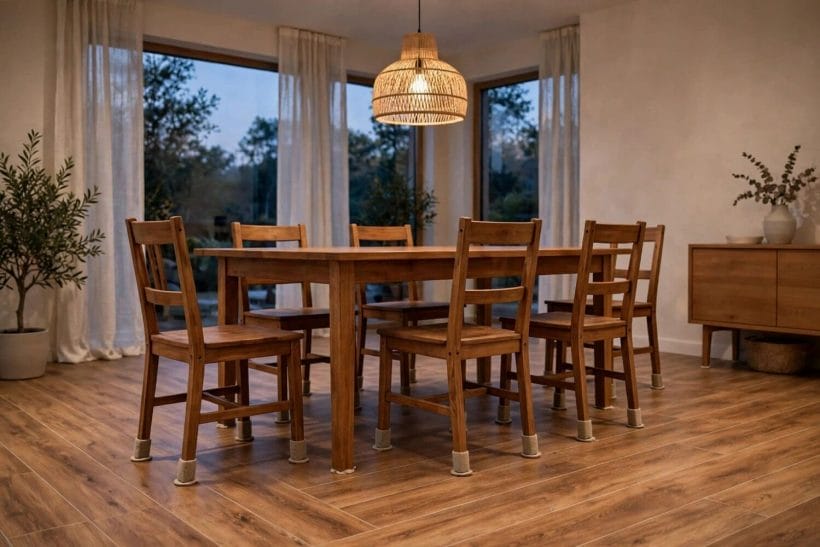
The last checks before paperwork are domestic ones. Floors are bought in boxes but lived with as whole rooms, and small habits at the sampling stage prevent the familiar disappointments of shade shifts, marked surfaces and rooms that are harder to keep than expected.
Living with samples before you commit
Take samples home and live beside them. Move them between rooms and light, leave one by the door where grit arrives, put a chair leg on one, and look at them morning and evening. When you weigh the wider budget, the drivers gathered under flooring installation cost help you separate the price of the planks from the price of preparation and fitting, while a look at laminate flooring cost gives a useful comparison for how a different floor family divides its own costs.
Colour batches and spares
Printed floors are made in batches, and gentle shade differences between batches are a known character of printed products. Order the whole room from one batch where you can, open boxes and shuffle planks from several packs as you lay, so any gentle variation spreads as natural variety rather than gathering as a visible patch. Keep a few spare planks from the same batch afterwards: a damaged board replaced from its own batch disappears, while a later purchase may sit visibly apart.
10. Questions to Ask and Paperwork to Read
Close the checklist by turning impressions into documents. A good retailer or fitter welcomes plain questions, and the answers that matter should exist in writing, in the maker’s own specification sheet and warranty, ready to keep with your household papers.
Questions to ask before you buy
Ask which core family the plank belongs to and why it suits your subfloor; whether the format floats, fixes down or rests loose; what underlayment, attached or separate, the system expects; and what the maker states about wet rooms, underfloor warmth and heavy furniture. Ask, too, how pattern variation runs across the range, and whether a contrasting surface such as those in the epoxy flooring ideas collection would serve a utility space better, or whether pale timber looks like the ones in the light wood floor living room ideas collection match the light you hope for in a sitting room. Clear answers now prevent crossed purposes later.
The warranty and specification sheet
Read the full warranty and specification sheet before you buy, not after. Note where the cover applies, which rooms and uses it names, what it asks of fitting and care, and what would count as outside its terms. Read the care guidance in the same sitting, since a warranty often assumes it. Keep both documents with the batch details and a note of where spares are stored, so the floor you chose on paper is the floor you can still explain, repair and stand behind years later.
Final Considerations
Luxury vinyl plank rewards a calm, whole checklist: a protective wear layer understood in plain terms, a core whose temperament suits your rooms, edges and a format you have felt close in your own hands, and a scale and pattern you have judged at room size rather than board size.
Give the unglamorous checks their full weight as well: a prepared subfloor, honest paperwork, samples lived with at home and spares kept from the same batch. Chosen that way, the floor underfoot is not a gamble on a single claim, but the settled result of many small, clear-eyed questions asked in the right order.


0 Comments