

A tiny house on wheels is only as safe as the number most owners never measure. Tiny house tongue weight — the downward force your house presses onto the hitch — decides whether the trailer tracks calmly behind the truck or sways toward disaster. This guide explains what that number means, how two scale certificates reveal it, and how to bring yours into the safe band before the next tow.
1. Tiny House Tongue Weight at a Glance
Tiny house tongue weight is the share of your home’s weight that rests on the hitch instead of the trailer axles. The calculator on this page works it out with the CAT scale method: weigh the truck and house together, then weigh the truck alone, and subtract. The difference is the tongue weight. Divided by the total weight of the house, it becomes a percentage — and that percentage, held between 9% and 15%, is what makes the rig stable. Everything that follows — the certificates, the five inputs, the results — exists to produce and explain that one figure.
| Aspect | The Answer |
|---|---|
| The entity | Tongue weight (TW) — the downward force the house applies to the truck’s hitch |
| The second result | Total tiny house weight, found by comparing the two certificates |
| The method | The CAT scale method: two weighings at a certified scale |
| Certificate #1 | Truck and house attached: steer (A), drive (B) and trailer axles (C) |
| Certificate #2 | Truck only, detached: steer (D) and drive axles (E) |
| The formula | Tongue weight = (A + B) − (D + E) |
| The target | 9% – 15% of the total weight carried on the tongue |
| Too little | Under 9%: a tail-heavy trailer that sways (fishtails) at speed |
| Too much | Over 15%: the truck’s rear is pushed down and its steering wheels lift |
| The ceiling | The trailer’s GVWR — never exceed it |
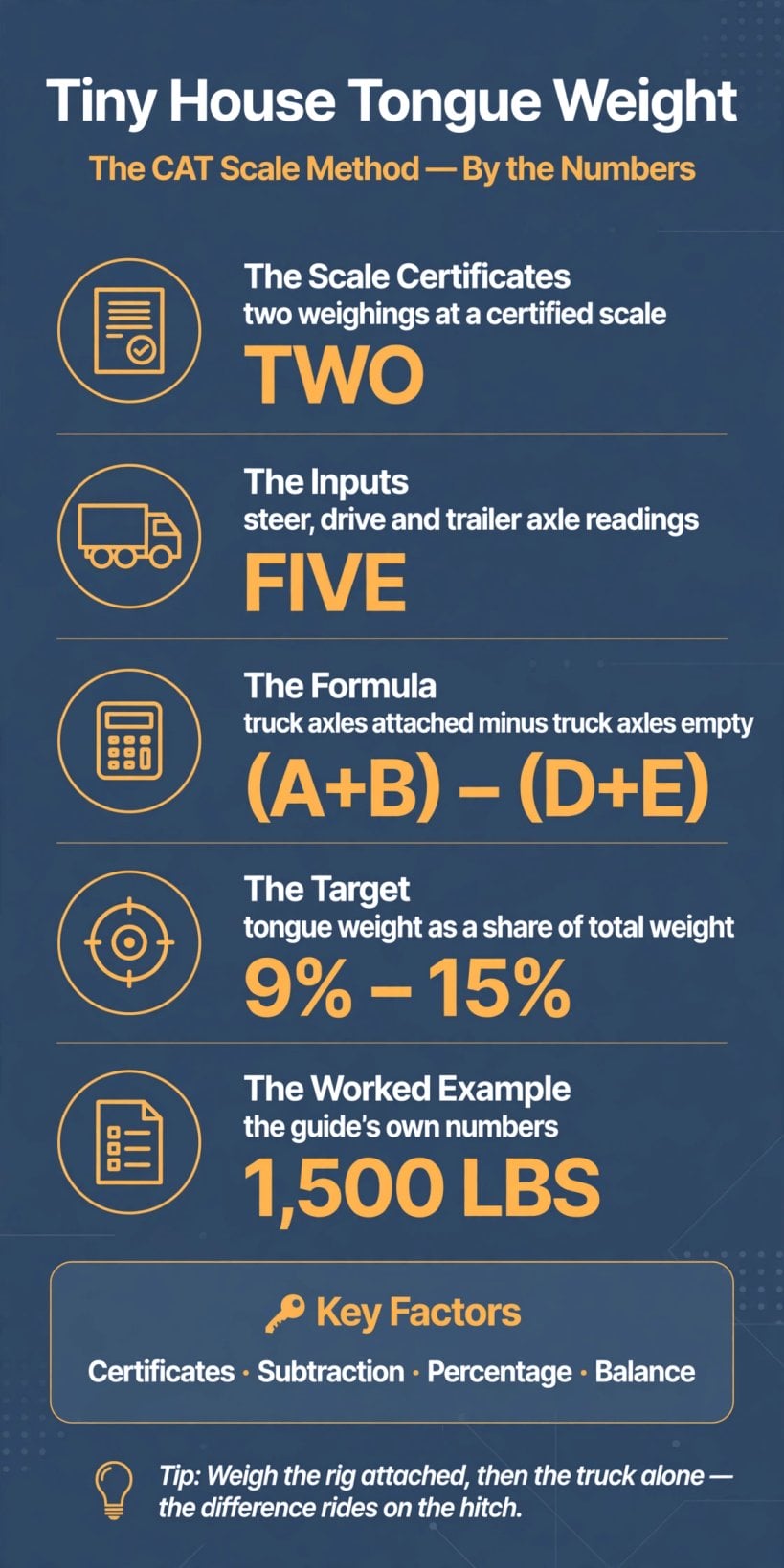
The method on one card: two certificates, five readings, one subtraction — and the 9% to 15% band the answer has to land in.
2. What Tongue Weight Is, and What It Is Not
Tongue weight (TW) has a simple definition in the original guide: it is the downward force your house applies to the truck’s hitch. When a tiny house sits on its trailer, its weight splits two ways. Most of it rides straight down through the trailer’s own axles into the road. The rest travels forward along the trailer frame and presses down through the coupler onto the hitch ball. That forward share is the tongue weight, and it is the only part of the house the truck itself has to carry.
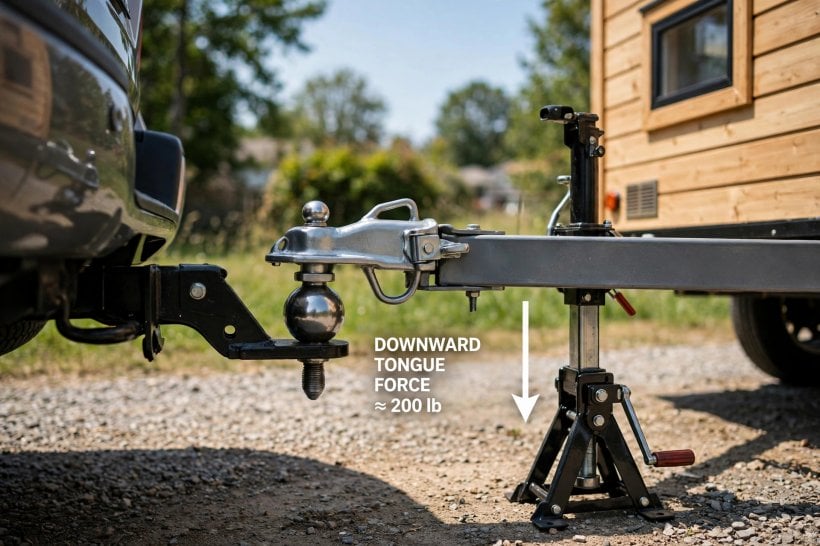
The guide gives that force a second job: it acts as a pivot point for stability. A trailer is a lever balanced near its axles, and the downward press at the coupler is what keeps the front of the lever planted and the whole rig tracking straight. Tongue weight is therefore not the same as total weight — the total is everything the house weighs, while the tongue weight is only the front-carried slice — and it is not payload or a rating either. Ratings belong to the trailer and truck; tongue weight is a measurement of this house, on this trailer, loaded this way. Choosing the right trailer in the first place is covered in our guide to what trailer to use for a tiny house.
3. Why the Target Is 9% to 15%
The calculator prints the target beside the result: 9% – 15%. That band is where the pivot effect described above is strong enough to stabilise the trailer without overloading the truck. Below it, the guide’s warning is blunt — under 9% is labelled dangerous. The trailer becomes “tail-heavy”: with too little of its weight pressing the coupler down, the back of the trailer outweighs the front, and at highway speeds the trailer begins to sway violently (fishtail), often leading to loss of control.

Above the band, the failure flips direction. Over 15%, the trailer pushes the back of the truck down, lifting the front steering wheels. Weight that should be pressing the steering tyres into the road is levered off them, and the guide spells out the cost: reduced steering control and braking power, from the very wheels responsible for both. The band is therefore a balance, not a maximum — enough tongue weight to keep the trailer honest, not so much that the truck loses its grip on the road. The wider towing picture, from truck choice to hitch ratings, is covered in our guide to towing a tiny house: trucks and hitch weights.
4. The CAT Scale Method: Two Certificates
You cannot weigh a tongue directly while the house is hitched — there is no scale that fits under a coupler in mid-tow. The method on this page solves that problem with paperwork instead: two weight certificates from a certified scale, like a CAT scale. Certificate #1 is the full rig, truck and tiny house attached, and it records three readings: the steer axle (A), the drive axle (B) and the trailer axles (C). Certificate #2 is the truck on its own, detached, and records two: the steer axle (D) and the drive axle (E).
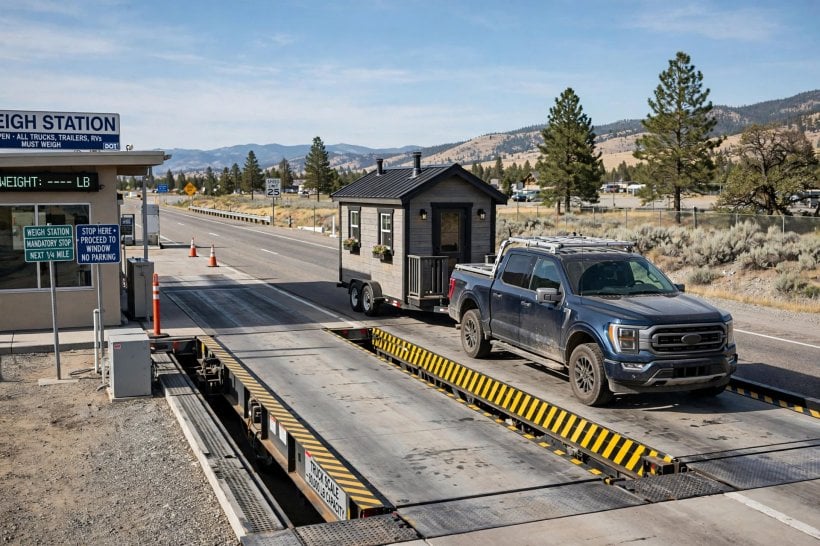
Two weighings, five numbers. Everything the calculator needs is printed on those two slips, which is why the weighing trip itself deserves care: the house should be in its travelling state, the truck carrying its usual load, so the certificates describe the rig as it will actually tow. Owners still at the shopping stage can see how a trailer’s ratings frame these numbers in the tiny house trailer buying guide.
5. The Five Inputs, in Plain Language
The calculator’s form asks for exactly what the certificates give you, in the same order. A is the steer axle reading from certificate #1 — the truck’s front axle with the house attached. B is the drive axle from the same certificate — the truck’s rear axle, the one sitting under the hitch load. C is the trailer axles reading: what the house’s own axles carry. Then the second certificate: D is the steer axle of the truck alone, and E is its drive axle alone. There is one optional extra: if you know your trailer weight rating (GVWR), you can enter that too, and the calculator will check your total against it.
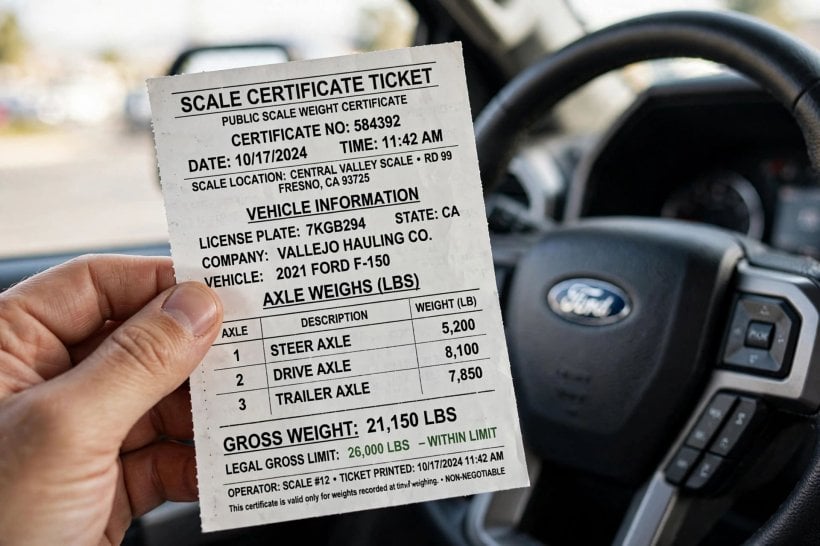
Each field is labelled in pounds, and each maps to one printed line on one certificate. No estimating, and no measuring of the house itself: if a number is on the slip, it goes in the matching box. The rating field works differently: it stays hidden until you tick the box saying you know your trailer weight rating (GVWR). Leave it unticked and the calculator simply reports the weights and the percentage, with no limit check — the rating is an optional referee, not a required input.
6. The Math: (A + B) − (D + E)
Here is the trick the whole method rests on, in the guide’s own framing: this calculator uses the physics of your truck’s suspension to “weigh” the tongue without lifting it directly. When the house is hitched, its tongue weight presses down through the truck, and the truck’s axles carry it — so the truck’s combined axle reading rises by exactly the tongue weight. Subtract the truck-only reading from the truck-and-house reading and the truck itself cancels out: Tongue Weight = (Truck Axles Attached) − (Truck Axles Empty).
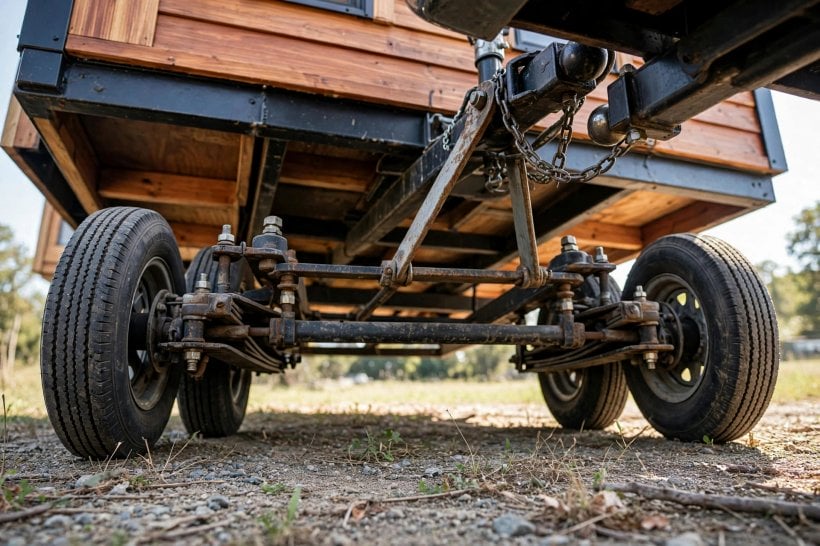
The guide’s worked example makes it concrete: if your truck axles weigh 7,000 lbs with the house attached, but only 5,500 lbs when empty, that extra 1,500 lbs is the weight of the tiny house pushing down on the hitch. The same two certificates also produce the total: set the full rig against the truck alone and the difference is everything the house and trailer weigh together. Dividing the tongue weight by that total and multiplying by a hundred gives the tiny house tongue weight percentage the 9% – 15% target judges. Estimating the total before a house exists is a separate exercise, covered in how to calculate the weight of a tiny house.
7. Reading the Three Results
Press calculate and the calculator returns three numbers: the total tiny house weight, the tongue weight in pounds, and the TW percentage, shown with a bar that fills toward the target band. The pounds figure tells you what the hitch and truck are carrying; the percentage tells you whether the load is balanced. Two houses of identical total weight can tow completely differently if one carries a small share on the tongue and the other a large one — which is why the percentage, not the pounds, is the result to act on.

Below the results, the page keeps its weight alert — a panel on understanding safety limits — and, when you entered a GVWR, a limit status that measures your total against the trailer’s rating. The advice line translates the percentage into a verdict: inside the band, or out of it in one of the two failure directions the guide describes. How those ratings interact with axles and the tow vehicle is set out in weight limits for tiny houses: GVWR, axles and the tow vehicle.
8. Moving the Number: Load Placement
A percentage outside the band is not a verdict on the house — it is a verdict on where its weight sits, and weight can be moved. Because the trailer behaves as a lever around its axles, heavy items stored ahead of the axles add tongue weight, and the same items stored behind the axles subtract from it. To raise a low percentage, shift the dense things — batteries, water, tools, the heavy furniture — forward. To lower a high one, move them back toward and behind the axle line.

Small moves count double near the ends of the lever, so adjust in steps and re-weigh rather than rearranging the whole house at once. Where the axles themselves sit under the house decides how much room to manoeuvre you have — the subject of our axle placement guide. After any real change, run the two certificates again: the percentage is only honest about the load you actually weighed.
9. Common Mistakes That Ruin the Reading
Most wrong answers from this calculator are not arithmetic errors — they are weighing errors. The classic is weighing the house empty and towing it full: water, food, gear and furniture all arrive after the certificate, and every one of them moves both the total and the split. The second is skipping certificate #2, or weighing the “empty” truck carrying a different load — passengers, fuel, a bed full of tools — than it carried during certificate #1, which corrupts the subtraction at the heart of the method.
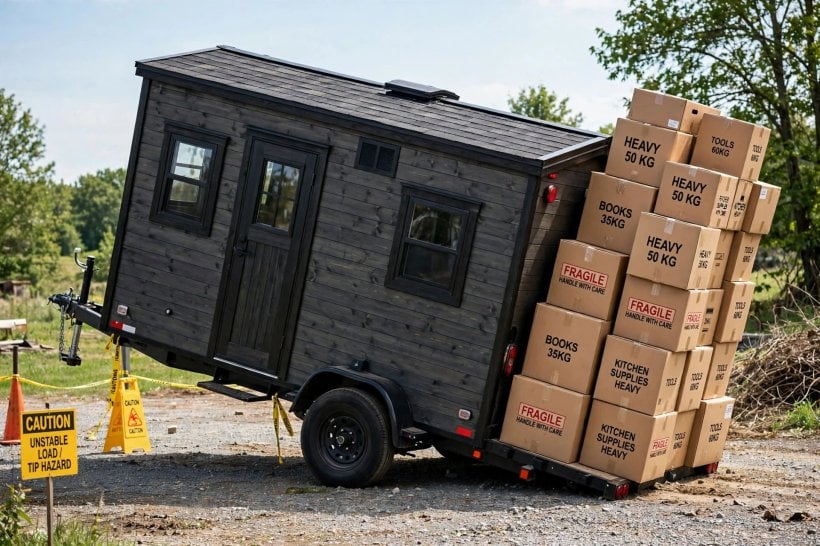
Then come the clerical errors: pasting the detached readings into the attached boxes, or reading the trailer axle line into a truck field. And the quietest mistake is ignoring the optional GVWR field — without it, the calculator can balance your load but cannot warn you that the total itself is over the trailer’s rating. The full moving-day routine that surrounds a weighing is laid out in how to transport a tiny house.
10. Before You Tow: Ratings Beyond the Percentage
A percentage inside the band is necessary, but the guide’s closing note sets the wider condition: always respect your trailer’s GVWR. The total from your certificates must sit within the rating of the trailer as a whole, and the same check runs down the parts list — check your axles, tires and safety chains to ensure they are rated for your total tiny house weight. A balanced house on an under-rated trailer is still an overloaded rig; the percentage judges the split, the ratings judge the sum.
That is why the weighing habit is worth keeping for the life of the house: re-weigh after a renovation, after adding batteries or tanks, after any change that adds real mass. Choosing components with headroom in the first place is covered in choosing trailer axles for a tiny house.
The Tiny House Tongue Weight Calculator
Everything above exists to serve the tool below. The calculator takes the five readings from your two certificates, runs the subtraction this guide has explained, and returns your total weight, your tongue weight and the percentage that decides how the rig behaves — with the target, 9% – 15%, printed beside it. Weigh the rig the way you tow it, enter the numbers exactly as the certificates give them, and let the result tell you whether to drive — or to move the load and weigh again.
Tiny House Weight Calculator
Calculate Tongue Weight & Total Weight using the CAT Scale Method.
How this works
You need two weight certificates from a certified scale (like a CAT scale).
- Steer Axle (A)
- Drive Axle (B)
- Trailer Axles (C)
- Steer Axle (D)
- Drive Axle (E)
Results
Total Tiny House Weight
Tongue Weight (TW)
Target: 9% – 15%
Calculation Breakdown
Weight Alert
Understanding Safety Limits
Why 9% – 15%?
Tongue Weight (TW) is the downward force your house applies to the truck’s hitch. It acts as a pivot point for stability.
- Under 9% (Dangerous): The trailer becomes “tail-heavy.” At highway speeds, this causes the trailer to sway violently (fishtail), often leading to loss of control.
- Over 15% (Stressful): The trailer pushes the back of your truck down, lifting the front steering wheels. This reduces your steering control and braking power.
How the Math Works
This calculator uses the physics of your truck’s suspension to “weigh” the tongue without lifting it directly.
Example: If your truck axles weigh 7,000 lbs with the house attached, but only 5,500 lbs when empty, that extra 1,500 lbs is the weight of the Tiny House pushing down on the hitch.


3 Comments