

Two materials dominate the tiny house insulation debate, and they could not be more different: closed cell spray foam, rigid and structural, and sheep’s wool, soft and breathing. The right choice depends on your wall depth, your climate, and how your home travels. This guide unpacks the trade-off the tool below scores — R-value, rigidity, and moisture — so your comparison starts from understanding, not guesswork.
Foam vs. Wool: At a Glance
The tool below compares the two heavyweights of the tiny house world across the three measures that decide how a small wall actually performs. Closed cell spray foam is the structural king: it delivers the higher R-value per inch and glues the wall assembly together as it cures. Sheep’s wool is the moisture management queen: it gives back less R per inch, but it actively buffers the humidity that builds up inside tight spaces. Neither material wins outright — the winner is the one whose strengths match your frame, your climate, and your road. The table gathers the whole contest in one place; the sections after it take each row apart.
| Attribute | Closed Cell Spray Foam | Sheep’s Wool |
|---|---|---|
| R-Value per Inch | R-6.5 per inch | R-3.7 per inch |
| R-Value in a 2×4 Wall (3.5″ Cavity) | R-22.8 | R-13.0 |
| R-Value in a 2×6 Wall (5.5″ Cavity) | R-35.8 | R-20.4 |
| Structural Rigidity | High — bonds to studs and sheathing | Zero — no structural bond |
| Racking Strength | Up to 300% increase | Frame stands 100% on its own |
| Moisture Management | None — it is a vapor barrier | Active — a hygroscopic buffer |
| Behavior When Wet | Traps water; the wall cannot dry out | Absorbs up to 30% of its weight, releases it later |
| Density | ~2.0 lbs/ft³ | ~1.5 lbs/ft³ |
| On the Road | Built to stiffen a moving structure | Light and forgiving; the frame does the work |
| Deciding Factor | Maximum R and structure per inch | Humidity control in tight spaces |
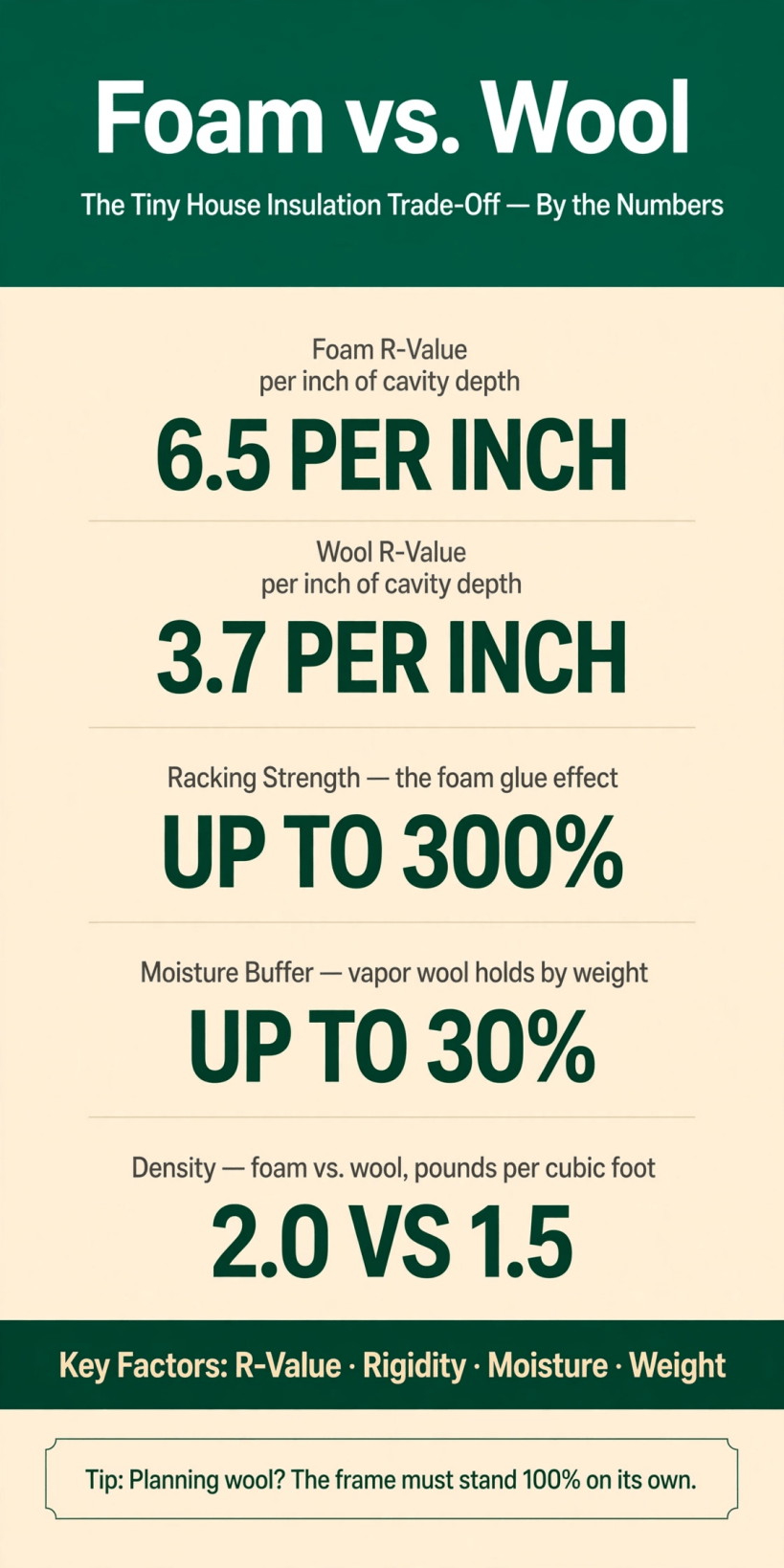
R-6.5 against R-3.7 per inch, a racking gain of up to 300% against a moisture buffer of up to 30% — the whole foam-versus-wool trade-off on one card.
1. Two Contenders, Two Philosophies
Every insulation decision in a tiny house is really a decision about what a wall is for. The foam philosophy says the wall should work: sprayed into the cavity, closed cell foam cures into a rigid solid that insulates, seals, and strengthens the assembly all at once. The wool philosophy says the wall should breathe: a natural fiber batt that insulates more gently, but manages the air itself, taking in moisture when humid and giving it back when dry. One treats the wall as structure; the other treats it as a lung.
That is why a simple “which is better?” never survives contact with a real build. A house that tows across the country lives a different life from one parked permanently under trees, and a wall in a dry mountain climate faces a different enemy from a wall in a wet coastal one. There are also third paths for builders who want thin walls above all — vacuum insulated panels chase maximum R in minimum thickness — but for most tiny builds the honest contest is the classic one this page scores: foam’s rigidity against wool’s breathability.
2. Start With the Cavity: The 2×4 and 2×6 Decision
The first input is stud size, and it comes first because the cavity is the one thing you cannot change later. Insulation in a stud wall can only ever be as thick as the framing is deep, so the depth you build with caps the R-value you can reach before a single material is chosen. A 2×4 stud gives a 3.5″ cavity; a 2×6 stud gives 5.5″. Those two extra inches are the largest single lever you have — they multiply whatever per-inch rating your material carries.
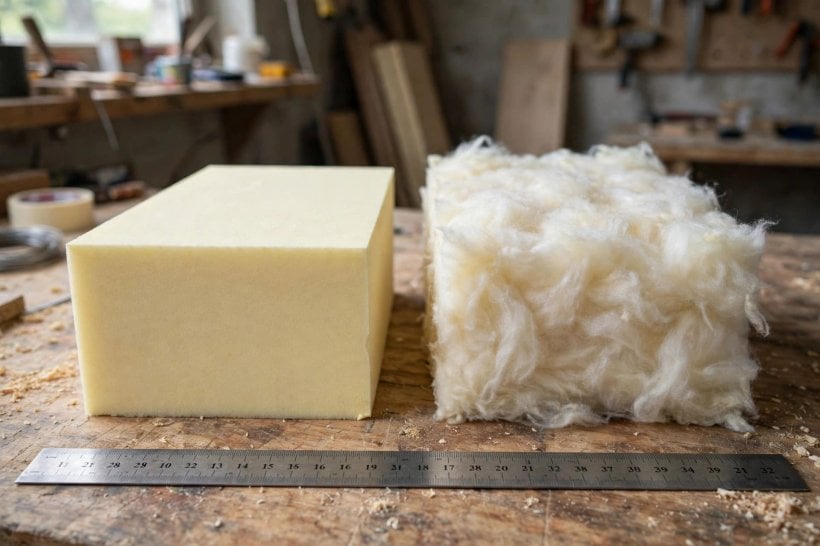
The trade is interior room. In a conventional house, thicker walls are a rounding error; in a tiny house, wall thickness is measured against a floor plan with nothing to spare, and deeper studs take their inches from rooms that are already small. This is the quiet reason the depth question matters more here than anywhere else in building: you are not choosing a stud, you are choosing how much of your home is wall. Settle the cavity first, honestly, and the material contest that follows becomes a fair fight.
3. The R-Value Math: What Each Inch Is Worth
R-value is thermal resistance — the wall’s ability to slow heat moving through it — and the comparison runs on two ratings. Closed cell spray foam is credited at R-6.5 per inch, the closed cell average. Sheep’s wool batts are credited at R-3.7 per inch. Multiply rating by depth and the four possible walls fall out: in a 2×4 cavity, foam reaches R-22.8 against wool’s R-13.0; in a 2×6 cavity, foam reaches R-35.8 against wool’s R-20.4. The gap is real, and on warmth per inch, foam wins every round.
The second input, total wall and ceiling area in square feet, works differently. It does not change the R-value — resistance is a property of the build-up, not of how much wall you own — but the comparison will not run without it, because scale is what turns a rating into a build decision. A rating tells you how a wall behaves; an area tells you how much material, money, and trailer weight that behavior costs. Read the R numbers for performance; let the area keep you honest about cost.
4. The Glue Effect: Rigidity and Racking Strength
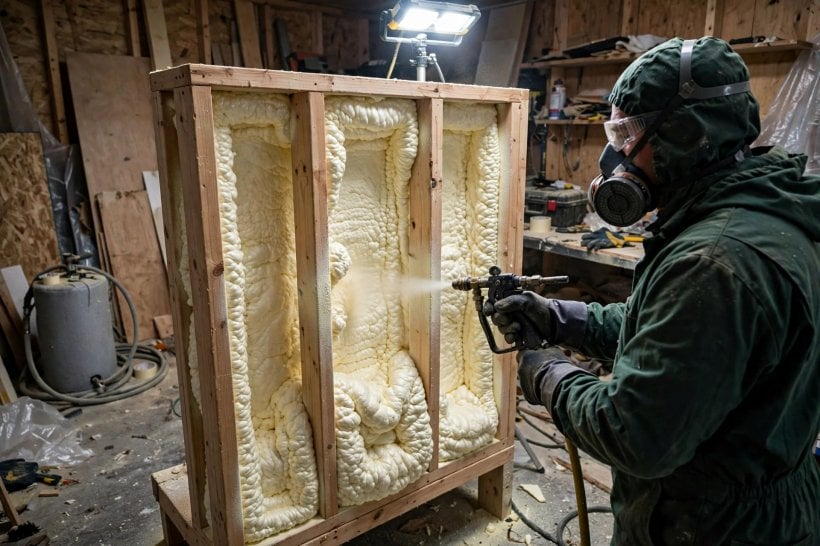
Foam’s second talent is structural. Sprayed against studs and sheathing, it adheres tenaciously and cures hard, effectively gluing the entire wall assembly into a monolithic block. The measured effect is racking strength — a wall’s resistance to wind and sway — increased by up to 300%. For a mobile tiny home it is close to a feature built for the purpose: a house on a trailer takes earthquake-like highway vibrations for hours at a time, and a wall that resists racking keeps its joints, seals, and finishes intact.
Wool sits at the opposite pole: the results score its structural rigidity at zero, because a soft batt creates no bond at all. That is not a flaw — it is a design condition to be respected. Choose wool and the frame must stand 100% on its own, engineered and braced as if the insulation were not there, because structurally it is not. Choose foam and the insulation becomes part of the structure. Neither answer is wrong; building as if the other were true is where the trouble starts.
5. Moisture: The Buffer vs. the Barrier
If foam wins the strength round, wool wins the water round — and in a tiny house, water is the more patient enemy. Small interiors concentrate moisture: cooking, showering, drying clothes, and simply breathing all load a very small volume of air. Sheep’s wool is hygroscopic, which means its fibers can absorb up to 30% of their own weight in water vapor from that air and release it later when conditions dry — all without feeling wet and without losing R-value. The wall itself becomes a humidity buffer, smoothing the daily peaks that otherwise condense on cold surfaces and feed mold in tight spaces.

Foam’s relationship with moisture is the mirror image: it is a vapor barrier and blocks moisture completely, which the results panel scores, bluntly, as moisture management: none. A sealed wall is a fine thing until water arrives from the wrong direction — a plumbing leak, a roof drip, a failed seal. Trapped inside a foam wall, that water cannot dry out, and wood that cannot dry will eventually rot in the dark. The lesson is not that foam walls fail; it is that foam walls forgive nothing. Detailing, flashing, and leak discipline have to be perfect, because the wall has no second mechanism to save you.
6. Weight: The Density Question on a Trailer
Both materials are light compared with wood or metal, but they are not equal. Spray foam is the denser of the two at roughly 2.0 lbs per cubic foot, against wool batting at roughly 1.5 lbs per cubic foot. Spread across every wall and ceiling cavity in the house, that half-pound gap is a real number on a real scale — and on a trailer, every number is audited against the chassis rating, the axle, and the tow vehicle.

The original guidance on this point is refreshingly calm: the difference is usually negligible next to the structural benefits gained. In other words, weight is a reason to check the arithmetic, not a reason to decide the contest by itself. Where weight does earn its keep as a deciding factor is at the margins — a build already running close to its trailer limit, where the lighter wall is the one that keeps the project legal and towable. Run your area figure through that lens before you commit, not after the house is framed.
7. Walls, Ceiling and Floor: One Strategy per Assembly
The comparison is framed around wall and ceiling area because those are the surfaces it scores — but a tiny house is a box of six sides, and each side argues for its own emphasis. Walls carry the depth question in full: the cavity is deepest here, the racking forces are strongest here, and the foam-versus-wool contest is at its purest. The ceiling answers to a simpler logic — warm air rises and presses against it all winter — so whatever material you choose, the roof assembly is where skimping shows up first on a cold night.
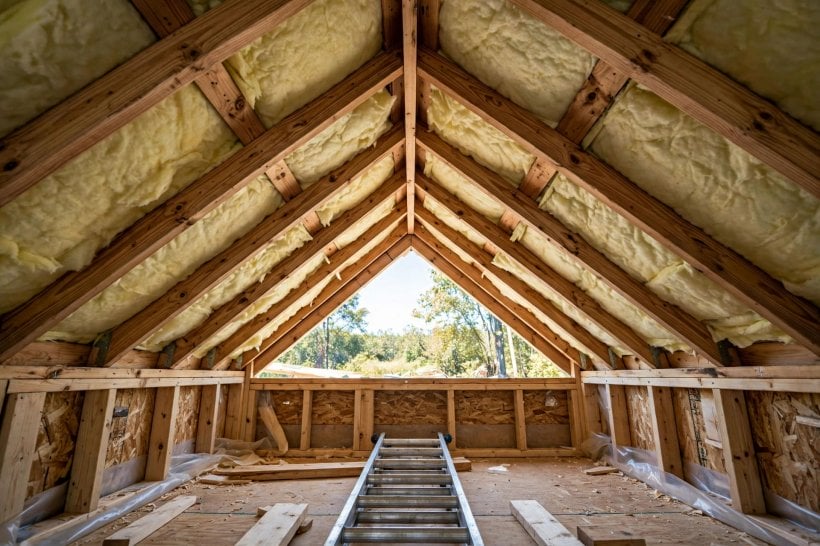
The floor lives by different rules again: it sits close to the ground or the road, takes splash and cold air from beneath, and is usually insulated to its own plan. The companion floor insulation calculator for a tiny house runs that surface on its own terms, and the wheel well insulation calculator handles the awkward boxes over the wheels, where the envelope bends and standard batts and sprays both need help. Strategy, in the end, is per-assembly thinking: one material may win your walls while another wins under your feet.
8. Climate: Matching the Wall to the Weather You Roam
A fixed house gets one climate; a tiny house on wheels can collect several in a single week of driving. That mobility changes what a good wall is. In serious cold, the contest tilts toward raw resistance: depth and per-inch rating dominate, and the deep-cavity foam wall’s R-35.8 is a difficult number to argue with. The layouts in these tiny house plans for cold climates show how insulation and heating are planned together when winter is the main event — and details like tiny house skirting options protect the pipes and floor edge that the wall strategy cannot reach.

Heat asks a different question. Summer comfort leans on keeping heat out and letting a small interior shed moisture — the mirror problem covered in our guide to tiny home summer prep — and in humid regions wool’s buffering earns real respect, because the enemy is not the temperature outside but the damp inside. The honest conclusion is that climate loads the dice rather than picking the winner: know the worst weather your wall will actually meet, and weight the three scores — R-value, rigidity, moisture — in that order of threat.
9. Reading Your Results: Bars, Scores and the R-40 Scale
The results panel is built to stop a one-number decision. Yes, it leads with thermal resistance: two R-values, one per material, each drawn as a bar scaled against an R-40 maximum — so the 2×6 foam wall’s bar runs near full, and the visual gap between the bars is the honest size of foam’s warmth advantage. But the panel refuses to let that be the whole story, scoring two more axes beside it: structural rigidity, where foam reads High and wool reads Zero, and moisture management, where foam reads None and wool reads Active.

Read the three scores as a triangle, not a podium. Every wall sits somewhere inside it: maximum warmth and strength with no moisture forgiveness at one corner, maximum buffering with no structural help at another, and most real builds negotiating between. The right reading of your result is therefore not “which bar is longer” but “which weakness can my design afford?” A frame engineered to stand alone can afford wool’s zero. A build detailed carefully enough to never leak can afford foam’s none. The panel’s job is to make you name the weakness before the wall does it for you.
10. Common Mistakes: Where the Choice Goes Wrong
The first mistake is chasing R alone — treating the longest bar as the answer and discovering the moisture or rigidity score the hard way, one winter later. The second is its mirror: choosing wool for its natural story while quietly assuming the wall will feel stiffer for it, when the material contributes nothing to the frame. The third is sealing a foam wall and then being careless with the details — every penetration, flashing, and joint in a vapor-barrier wall has to be right, because the assembly has no drying path when one is wrong.
The fourth mistake is measuring badly: guessing at the wall and ceiling area, or forgetting the ceiling altogether, and pricing a strategy against numbers that were never real. The fifth is believing the contest has a universal winner at all — most tiny house myths survive exactly that way, by turning a trade-off into a slogan. Foam and wool are both proven materials with opposite gifts. The strategy is not finding the winner; it is matching the gifts to the house, the frame, and the weather in front of you.
The Insulation Strategy Analyzer: Run Your Own Wall
Now run it on your own numbers. Pick the stud size you are actually building with, enter your total wall and ceiling area — the tool’s own example is 1,000 square feet — and compare all three scores together: the R-value for warmth, the rigidity score for the road, and the moisture score for the air you will breathe inside those walls. Two minutes with your real figures will tell you more than a week of opinions, because the right wall is never the famous one. It is the one whose strengths cover your build’s weaknesses.
This tool compares the two heavyweights of the tiny house world: Closed Cell Spray Foam (the structural king) vs. Sheep’s Wool (the moisture management queen). It calculates the resulting R-Value based on your wall depth and visualizes the critical trade-off: Rigidity vs. Breathability.
It includes a comprehensive “Science of the Wall” section at the bottom to explain why these factors matter specifically for mobile structures.
Insulation Analyzer: Foam vs. Wool
Compare R-Value, Structural Strength, and Moisture Control.
1. Wall Configuration
Enter dimensions to see the comparison.
Thermal Resistance (R-Value)
The Science of the Wall
Structural Rigidity (The “Glue” Effect)
Closed Cell Foam is rigid. When sprayed, it adheres tenaciously to the studs and sheathing, effectively gluing your entire wall assembly into a monolithic block. This increases the “Racking Strength” (resistance to wind/sway) by up to 300%. For mobile tiny homes constantly subjected to earthquake-like highway vibrations, this is a massive durability advantage.
Wool creates no structural bond; the frame must stand 100% on its own.
Moisture Management (Hygroscopic vs. Hydrophobic)
Sheep’s Wool is hygroscopic. The fibers can absorb up to 30% of their weight in water vapor from the air (humidity) and release it later when the air is dry, all without feeling wet or losing R-value. This acts as a natural humidity buffer, preventing mold in tight spaces.
Foam is a vapor barrier. It blocks moisture completely. If water gets trapped inside the wall (from a leak), it cannot dry out, leading to rot.
Weight Considerations
Both materials are relatively light compared to wood or metal, but Spray Foam is denser (~2.0 lbs/ft³) than Wool batting (~1.5 lbs/ft³). However, the difference is usually negligible for the structural benefits gained.


2 Comments