

An orchard is the slowest decision on a homestead: a tree planted in the wrong place is still in the wrong place many years later. Spacing, pollination partners and water decide whether the rows stay generous and productive, or crowd into shade and struggle.
These orchard layout plans work through those choices step by step: read the site first, set spacing by mature size, pair the pollinators, run the rows with the sun, and lay irrigation where the roots will actually grow.
1. The Homestead Orchard at a Glance
Begin with the whole orchard on one page, because every decision in an orchard touches every other one. The size a tree will reach decides its spacing, spacing decides the rows, the rows decide the alleys and access, and access decides how easily the orchard is pruned, mulched and picked for decades. The summary below, taken from the orchard’s own plan, fixes those relationships before a single hole is dug.
| Spacing | By mature size, with room to grow |
| Pollination | Partners nearby, for better fruit set |
| Rows | North-south lines, for even sun |
| Access | Mower-wide alleys, for easy harvest |
| Key factors | Tree size, pollinators, sun and access |
The homestead orchard at a glance: spacing set by mature size, pollination partners nearby, rows running north to south for even sun and mower-wide alleys for easy harvest.
Read the four working rows as promises the layout has to keep. If spacing is truly set by mature size, canopies meet as a managed edge instead of a tangled thicket, and light keeps reaching the fruiting wood. If pollination partners are truly nearby, blossom is visited and fruit sets reliably instead of sparingly. If rows truly run with the sun, both sides of every tree ripen evenly. And if alleys are truly mower-wide, grass, mulch and harvest all move through the orchard on wheels.
The tip printed on the summary is the whole philosophy in one line: plant for the tree at year ten, not the sapling at year one. A young orchard always looks too empty, and that emptiness is the plan working. The gaps that tempt you to squeeze in one more tree are exactly the light, air and working room the mature orchard will need, so the discipline of the layout is mostly the discipline of leaving those gaps alone.
2. Read the Site First: Sun, Slope, Soil and Water
Choose and read the site before drawing a single row. Fruit trees are sun crops above all else: blossom, fruit colour, flavour and the ripening of new wood all run on light. Walk the ground at different hours, mark where shadows from trees, buildings and higher land actually fall in the growing season, and keep the orchard block inside the ground that stays lit from morning through the afternoon.
Slope comes next, and a gentle fall is the orchard’s friend. Cold air drains downhill on still, frosty nights, so blossom on a slope escapes the frost pockets that settle in hollows. Rain leaves instead of standing around roots, and a working route up and down the block stays passable in wet weather. Steep faces and frost hollows fight back every season; if the holding offers one clearly kinder slope, the orchard belongs there.
Soil and water finish the survey. Dig in several places and compare depth, texture and drainage, because trees occupy the same soil for decades and cannot be moved when it disappoints. The deepest, freest-draining ground takes the rows; shallow or wet corners become the headland, the compost corner or the turning space. On a wider holding this is the same site-reading used for the home ground in the eight acre homestead layout, concentrated here onto the one block where soil and drainage matter most, with the nearest dependable water source paced and noted before any pipe is planned.
3. Set the Spacing by Mature Size
Spacing is the orchard decision that cannot be revised, so it is set by one measure only: the size each tree will be when fully grown. Canopy spread and root spread grow together, and a tree given its full circle grows balanced, fruitful and easy to work around. A tree given half its circle leans, shades its neighbour, fruits on the far side and turns every pruning session into an argument with the tree beside it.
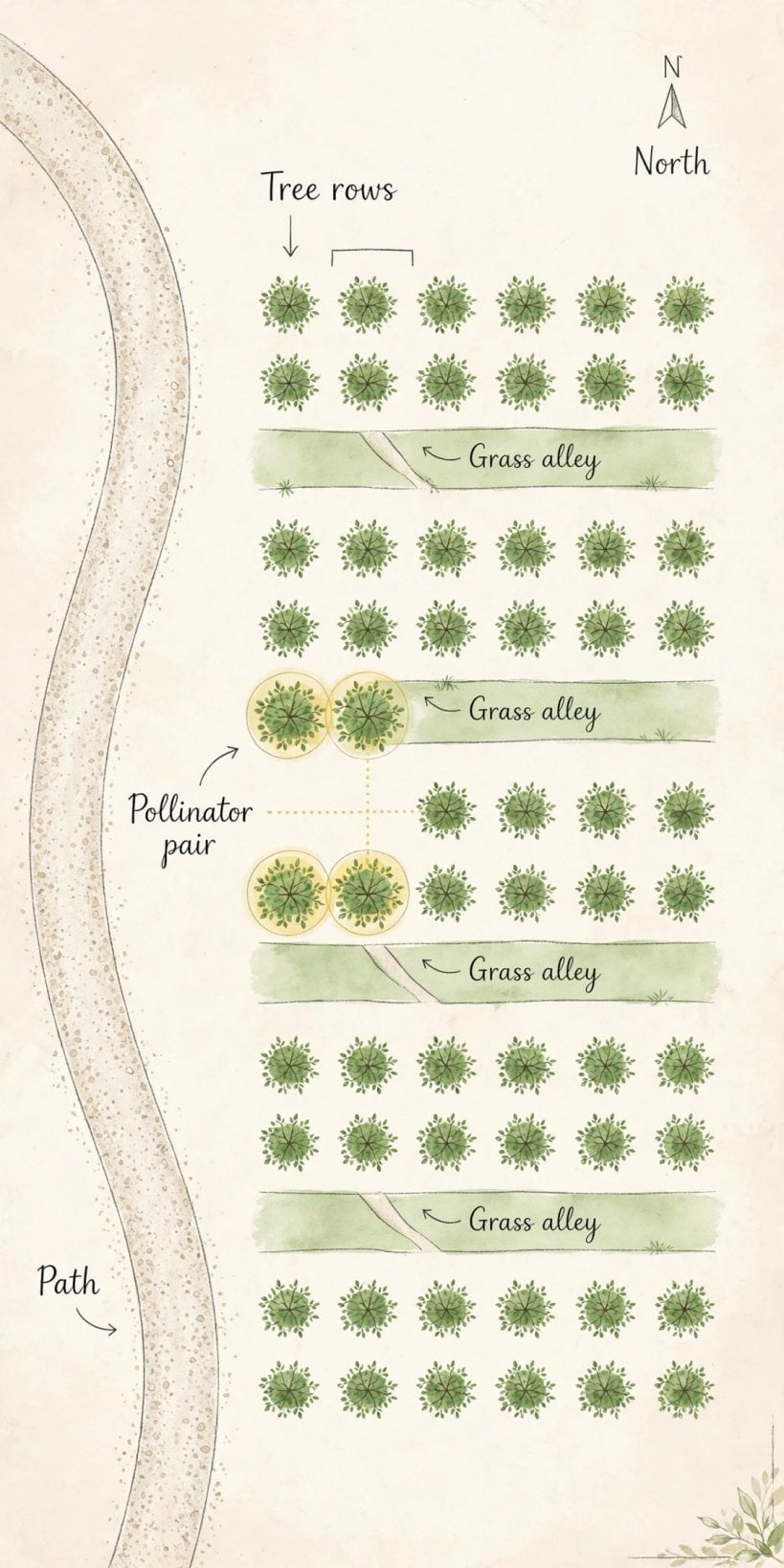
The labelled orchard diagram: rows and alleys drawn to mature canopy size, with pollination partners kept inside the same block and access left mower-wide throughout.
Work variety by variety, because mature size follows the rootstock and the kind of tree, not the label on the nursery pot. Smaller-growing trees can stand closer in a tighter block, while full-size trees demand the generous end of the plan, and mixing the two in one row without adjusting the gaps gives an uneven, awkward line. This is the same standard-size thinking that makes the beds in the market garden layout fast to work: one honest measure, repeated everywhere, so every tool and routine fits every row.
Mark the spacing out on the ground before ordering trees. Stakes, string and a walk-through reveal what paper hides: a row that ends in the wet corner, an alley that pinches at the gate, a canopy circle that swallows the path. Adjust the plan while it is still string. Once trees are planted, the layout is fixed for a generation, and the only corrections left are the saw and a lost tree.
4. Plan Pollination Before You Plant
Most fruit is made by partnership. Many tree fruits set a full crop only when pollen arrives from a different, compatible variety flowering at the same season, and even self-fertile kinds crop more heavily with a partner nearby. That makes pollination a layout question, settled on the plan, not a surprise discovered after years of disappointing blossom that never becomes fruit.
Draw the partnerships into the rows themselves. Partners belong inside the same block, close enough that bees working the blossom move between them as a matter of routine, and their flowering seasons must overlap rather than merely neighbour each other on a catalogue page. A pollinator planted at the far end of the holding, however excellent its pollen, is decoration. Group each variety with its partners around it, and note the pairing on the plan so a replacement tree, years later, keeps the partnership intact.
Then plan for the workforce that carries the pollen. Bees need blossom in sequence around the orchard season, shelter from wind while they work, and an orchard floor that is not sprayed or mown bare at flowering time. Keep insecticide thinking away from blossom entirely, let the earliest flowers under and around the trees stand for the first foragers, and remember that a calm, sunny, sheltered block is not only pleasanter to pick in; it is measurably better pollinated than an exposed one, because the bees can actually work it.
5. Run the Rows North to South
Row direction decides how sunlight is shared, and on reasonably level ground the answer is simple: run the rows north to south. The morning sun takes one side of the row, the evening sun takes the other, and both faces of every canopy are lit in turn. Fruit colours and ripens evenly, wood ripens along the whole tree, and no side of the orchard lives in permanent shade cast by its own neighbours.
East-west rows do the opposite on flat ground: the sunny side bakes while the shaded side stays green, damp and reluctant, and each row shadows the ground behind it. The exception is genuinely sloping ground, where rows should answer the slope first, following the contour so soil, mulch and water stay where they are put instead of washing down the alleys. Sun is the priority on the flat; keeping the hillside in place is the priority on a bank, and an honest plan says which ground it is dealing with.
Row direction also sets the orchard’s daily feel. Alleys aligned with the light stay drier and warmer underfoot, blossom shows against the morning sun so bee activity is easy to read, and the harvest moves down lit rows with ripe and unripe fruit easy to tell apart at a glance. Draw the compass line on the plan before anything else, because every later decision, from the gate position to the irrigation mainline, hangs off the direction of the rows.
6. Lay Irrigation Where the Roots Will Grow
Young trees need water at the rootball; mature trees drink from a wide circle under the whole canopy. Irrigation laid only where the sapling stands will be stranded inside dry ground within a few seasons, so lay the system for where roots are heading: lines along the rows that can be extended and emitters that can be moved outward as each canopy widens, ending with water delivered around the drip line, where the feeding roots actually work.
Zone the watering the way the orchard itself is zoned. New plantings, thirsty in their first seasons, belong on their own zone so they can be watered deeply and often without drowning the established block; mature trees on theirs, watered less often and more deeply; and any trees on lighter, faster-draining soil grouped together so one schedule serves them all. This shared water thinking runs across the whole holding, and the orchard mainline is easiest planned alongside the supply drawn up in the livestock farm layout, so one dependable source serves trees and animals without competing lines.
Finish with the surface. Mulch along the rows holds the water the system delivers, keeps the root zone cool and cuts the mowing in the one place mowing is awkward. Keep mulch pulled back from the trunks themselves, keep the irrigation lines where the mower and the ladder feet can be seen not to trip on, and walk the whole system at the start of each dry season. An orchard rarely loses trees to a failed plan in a wet year; it loses them in the first dry summer the watering was not ready for.
7. Paths, Alleys and Access for Harvest
An orchard is worked from its alleys, so the alleys are designed, not left over. Keep them mower-wide as the summary promises, because grass under trees is managed by mowing more than by any other single task, and an alley the mower cannot enter becomes a thicket that harbours wasps, hides windfalls and keeps the ground damp around the trunks. Headlands at the row ends need room to turn with a barrow or a mower without backing into a tree.
Harvest access shapes the rest. Picking means ladders or picking platforms, full crates and repeated trips along the rows at the orchard’s busiest and often wettest season. Put the gate where the harvest naturally exits, keep the route from row to store as short and level as the ground allows, and think through where crates are staged, where the vehicle waits, and how the last row is reached when the first is already picked and its alley is full of ladders.
The orchard floor can also be worked by animals in rotation. Poultry ranged under mature trees hunt insects, clear windfalls and fertilise as they go, and a mobile shelter moved through the blocks turns the orchard into part of the holding’s rotation; the practical side of keeping those birds is covered in how to raise chickens, and a movable shelter from the chicken coop plans suits orchard rotation well. Keep birds out at blossom and harvest peaks, ring young trees against scratching, and the partnership pays both ways.
8. Fences, Shelter and Protection
More young orchards are lost to teeth than to weather. Deer browse leaders and rub bark, rabbits ring young trunks in winter, and livestock lean, rub and strip what they can reach. The orchard fence is therefore part of the layout, drawn before planting, not an emergency after the first damage: a perimeter that genuinely excludes browsing animals, with individual guards on young trees as the second line while trunks are thin and bark is tender.
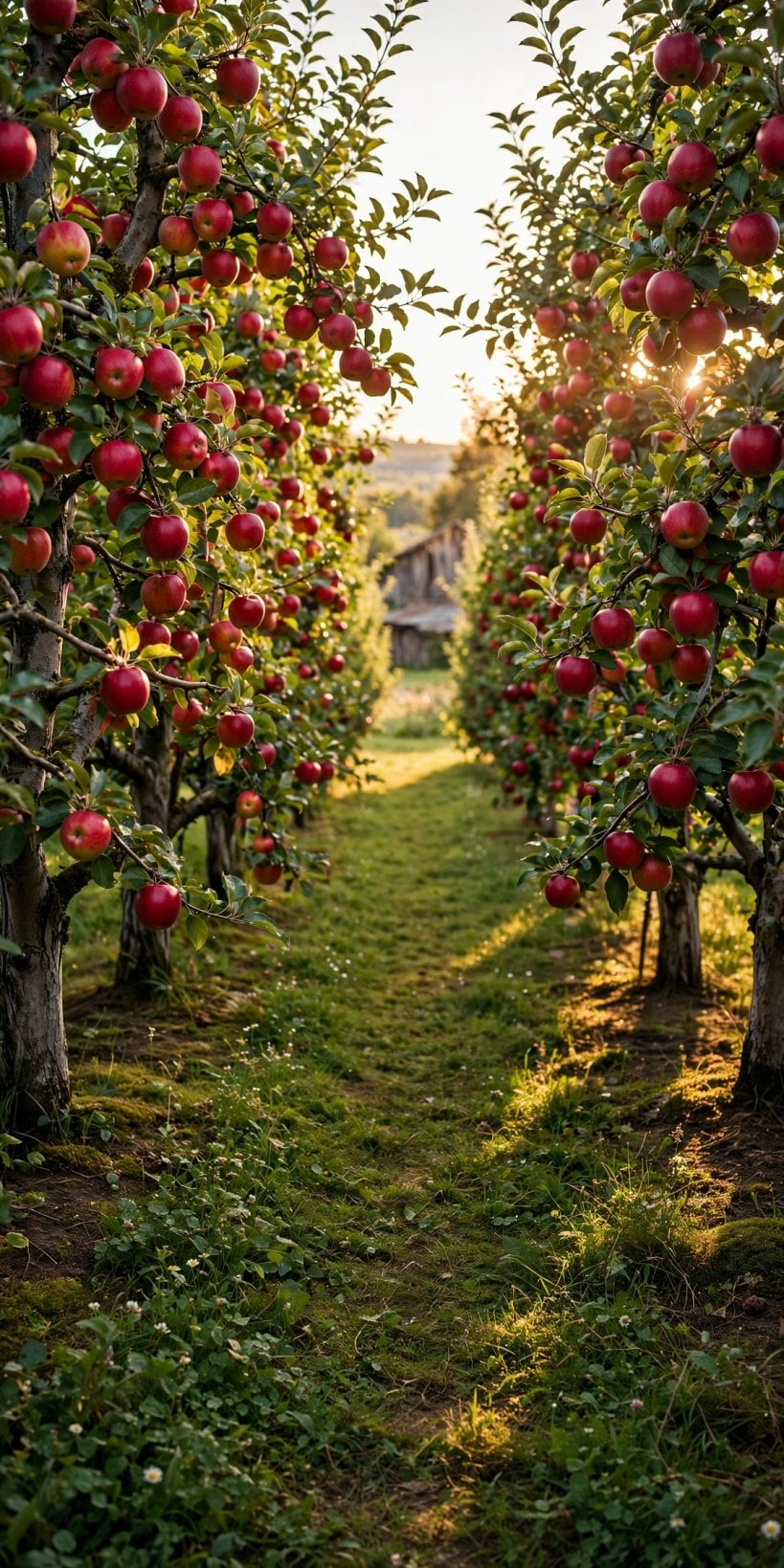
The planted orchard in its first seasons: guards on young trunks, shelter softening the wind, and the generous gaps of the plan still open around every tree.
Shelter is the softer half of protection. A windbreak on the prevailing side, set far enough back that it neither shades the rows nor competes with their roots, calms the block: blossom stays on the trees, bees work more days, fruit is less marked by rubbing, and ladders are safer at harvest. Use the shelter planting itself productively where the holding allows, but never let it creep inward; a windbreak that becomes the orchard’s biggest shade is a layout error growing at full speed.
Protection continues at fruit level. Netting or bagging the most bird-loved fruit, picking promptly, and clearing windfalls so wasps and pests are not fed at ground level all belong in the working plan. None of it is complicated, but all of it is seasonal and unforgiving of delay, so the layout helps by keeping every tree reachable: a tree you cannot get a ladder or a net to is a tree you have quietly decided to share.
9. Understorey, Ground Cover and Orchard Companions
What grows under the trees is part of the orchard, not a gap in it. A managed grass and clover floor holds the soil on slopes, takes the traffic of barrows and mowers, feeds pollinators in its flowers between mowings and keeps dust and mud off the fruit season. Letting the floor go to scrub invites the opposite: bramble in the alleys, pests wintering at the trunk line and an orchard that is work to walk through before any real work starts.
Manage the floor in zones like everything else. A mulched circle under each young tree keeps competition away while roots establish; the alleys stay in mown ground cover that can be cut and left as a green feed for the soil; and flowering strips at the block edges hold the beneficial insects that patrol the trees. Mow in rotation rather than all at once outside blossom time, and something is always in flower somewhere in or around the block from the first blossom to the last pick.
Companion animals complete the floor team when they are chosen and timed well. Larger poultry ranged through a mature block clear fallen fruit and hunt the insects that winter in it, and the mixed-flock questions that raises are worked through in can turkeys live with chickens, while what do turkeys eat covers feeding them properly on range. Rest each block between grazings, protect young trees until trunks are sturdy, and the understorey stays a working surface instead of a battleground.
10. The First Years: Planting Order and Aftercare
Plant in the order the infrastructure demands, not the order enthusiasm suggests. Fence first, water second, shelter started early because it grows slowest, and trees last, into ground that is already protected and watered. Where the budget or the season forces phases, plant whole blocks at a time rather than scattering single trees, so each finished block can be fenced, watered, mulched and recorded as one unit, and the orchard layout plans drawn at the start stay visible on the ground as the planting grows into them.
Aftercare is where young orchards are actually made. Water deeply through the first dry seasons even when the trees look settled, because roots are still shallow and a sapling has no reserves. Keep the mulched circle topped up and weed-free, formative-prune little and often so the framework of each tree is open and balanced from the start, and replace failures promptly with the planned partner variety, so spacing and pollination survive the losses every new orchard has.
Keep the plan itself alive as a record. Label every tree on the ground and on the paper copy, note variety, rootstock character and planting season, and record what cropped well and what sulked. In ten years the orchard’s memory is that sheet of paper, and the keeper who inherits the block, or the older self who planted it, will be grateful the layout was treated as a document and not a daydream.
Final Considerations
An orchard layout is a promise made to your future self: spacing honest about mature size, partners planted where bees can work them, rows run with the sun, water laid where roots will grow, and alleys wide enough for every job the trees will ever ask of you. Draw it once, draw it carefully, and then plant the plan rather than the impulse. The trees will take their time, and if the layout was right, time is all they need.


0 Comments