

Big, curious and always first to the feeder, turkeys eat with an enthusiasm that can fool a new keeper into giving them whatever the chickens are having.
Learning what do turkeys eat at each age — a strong start for poults, a steady grower for youngsters, a breeder ration for adults — keeps that appetite working for you.
1. Feeding Turkeys at a Glance
Our infographic organises turkey feeding by stage of life, because a turkey’s needs change more across its first year than almost any other bird on the holding. It follows the protein as it steps down — highest for the newly hatched poult, steadier for the growing youngster, and settled for the adult — and it names four key factors that run through every stage: the protein stage itself, forage, grit and water.
| Stage | Main feed | Approach |
|---|---|---|
| Poults | High-protein starter | Start strong — the richest ration of the bird’s life, for its fastest growth. |
| Growers | Mid-protein grower, plus forage | Grow steady — a stepped-down ration widened by what the birds find on range. |
| Adults | Layer and breeder ration, plus range | Range free — the adult ration supported by daily ranging and grazing. |
The four key factors explain how the table works in practice. Protein stage comes first, because feeding the right level at the right age is the whole system: too little early protein cannot be made up later, and rich starter fed too long wastes money and burdens growing frames. Forage is the second factor, widening the diet as growers and adults range. Grit is the third, the grinding stones every bird needs once whole foods and forage join the ration. And water is the fourth — constant, clean and close to the feed, because a turkey that cannot drink cannot digest.
One warning runs underneath the whole chart, and it shapes several sections of this guide: turkeys outgrow ordinary chicken feed quickly, and their protein is meant to step down on a planned schedule, not by guesswork. Keep the stage table somewhere visible, judge every feed decision against the birds’ age first and their enthusiasm second, and the rest of turkey feeding becomes straightforward daily routine.

Feeding turkeys at a glance: a high-protein starter for poults, a mid-protein grower plus forage for growers, and a layer and breeder ration plus range for adults.
2. Poults: Start Strong on a High-Protein Starter
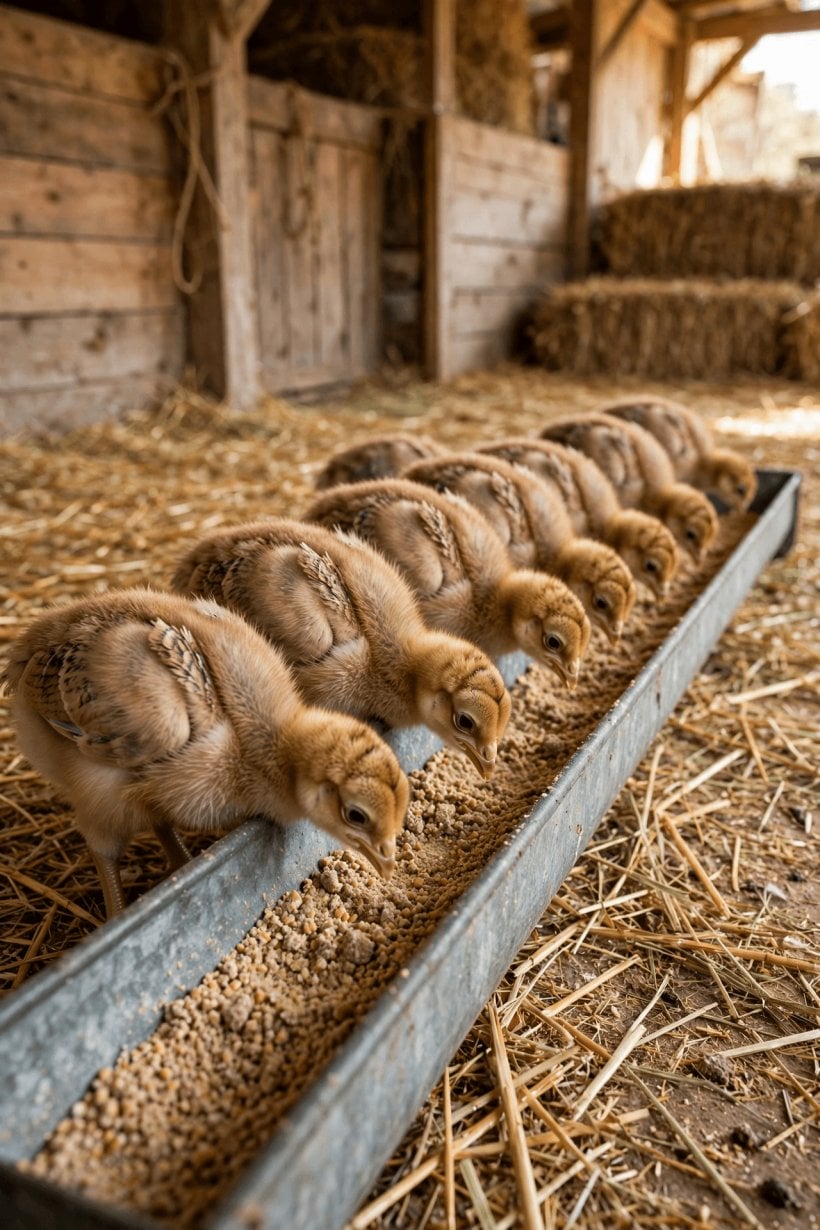
A turkey poult is one of the most demanding youngsters in the poultry yard. It hatches small and leggy, then has to build a very large frame at speed, and only a high-protein starter gives it the material to do that well. Put poults straight onto a proper turkey or gamebird starter — the richest ration they will ever eat — and keep it in front of them constantly through the early weeks. This is the start strong stage, and short-changing it is the commonest cause of poults that grow slowly, feather poorly and never quite catch up.
Poults also need feeding equipment scaled to them: shallow feeders they can reach into without climbing, set where every bird can eat at once, because a dominant few can quietly monopolise a single small trough. Sprinkle starter on a flat tray or rough paper for the first days, keep the brooder feed close to the warmth so the birds never have to choose between eating and staying warm, and top up little and often so the feed they meet is always fresh, dry and appetising.
Other young poultry make the same point at a smaller scale. Our guide to what to feed baby quail in the first six weeks, from starter feed to grit shows baby quail depending on a rich, finely ground starter in exactly the same way — the species differ in size, but the principle that the youngest birds get the richest feed is one of the fixed rules of the brooder, whatever hatches in it.
3. Teaching Poults to Eat and Drink
For all their later boldness, newly hatched poults can be slow to understand the brooder. A poult does not always connect the dish in front of it with food, and the keeper’s first job is teaching: dip each tiny beak gently in the water as you place the bird down, scatter bright crumbs where the light catches them, and tap the feeder with a fingertip to draw a crowd. Once a few poults are eating and drinking confidently, the rest learn by copying — the brooder teaches itself, if you start the lesson.
Bright, safe details help. A few clean marbles or pebbles in a shallow drinker catch the light and tempt poults to peck at the water’s surface, which is how drinking starts; the same pebbles keep the dish shallow and safe. Keep the water itself at brooder temperature for the first days if you can — a chilled drink is one more discouragement to a bird you are trying to teach — and place drinkers where poults pass them constantly, between the warmth and the feed.
Watch for the poults that have not learned. A bird standing apart, eyes half closed, cheeping in a high, lost note while the others feed, needs patient, individual help: beak dipped again, crumbs offered from your fingers, a moment held near the feeder until it pecks for itself. A little of this on the first day is worth a week of worry later, because a poult that starts eating on day one almost always becomes the turkey that thunders to the gate at feeding time for the rest of its life.
4. Why Chicken Feed Is Not Enough
The infographic’s closing warning deserves its own section, because it is the mistake almost every mixed-flock keeper is tempted to make. Turkeys and chickens look similar at the feeder, eat side by side quite happily, and are often housed within sight of each other — so why not one bag for both? Because a growing turkey’s needs run ahead of a chicken’s at every stage. The poult needs a richer starter than a chick, the grower needs its protein stepped down on its own timetable, and the adult needs a ration that supports a much larger, heavier bird.
Feed a turkey on a chicken’s ration and nothing dramatic happens at first, which is exactly the trap. The birds eat, they grow — but slowly, unevenly, and without the frame their breeding promises. Legs carry more weight than the ration budgeted for, feathers come in ragged, and growers drift behind the schedule the stage table describes. By the time the difference is obvious at a glance, the early weeks when it could have been corrected are gone, and early weeks, in turkey keeping, are the ones that count.
The practical answer is separation at the trough, not separation of the whole flock. Feed turkeys their own ration in their own feeder, in a space the chickens cannot easily raid, and let the species mix on range where forage belongs to everyone. One extra bag in the feed store and one extra feeder in the pen is a small price for birds grown at the pace they were built for.
5. Growers: A Mid-Protein Grower, Plus Forage
Once poults are feathered, sturdy and past the fragile stage, they become growers — and the infographic steps their protein down to a mid-protein grower ration, widened by forage. This is the grow steady stage: the frame is still lengthening and filling, but the frantic pace of the first weeks eases, and the ration eases with it. Change feeds gradually, mixing the grower into the starter in increasing proportions over several days, so appetites never falter at the swap.
Growers are big, active, increasingly confident birds, and the feeder needs to keep up with them. Move to troughs or hoppers with room for the whole group to feed shoulder to shoulder, raise feeders as backs and legs grow so birds eat at a comfortable height, and site the main feeder somewhere dry and sheltered where feed stays clean between visits. A ration can be perfect in the bag and still fail in a muddy corner, so feeder placement is feeding, in every sense that matters.
Split the day sensibly at this stage. The grower ration is the anchor — measured, consistent, always available — and forage is the widening circle around it, not a replacement for it. A grower that fills up on range pickings all morning and ignores its ration is not being thrifty; it is unbalancing the very diet that is supposed to grow it steadily. Feed the ration first, let range time follow, and the two halves of the grower stage support each other exactly as the chart intends.
6. Forage, Range and Greens
Turkeys are natural rangers. Given ground, a growing or adult turkey will work it methodically — grazing greens, taking insects and seeds, scratching and turning the surface as it goes — and this forage is a genuine part of the diet, named in the infographic for both growers and adults. Range adds variety, exercise and occupation, and a bird that has spent the day ranging comes home with part of its living honestly earned and a great deal of its restlessness spent.
Good range is managed, not just opened. Rotate the ground if you can, so grass and forage plants recover between grazings; keep the richest grazing for the growing birds whose stage benefits most from it; and remember that range quality changes with the seasons, which means the bagged ration matters most exactly when the ground offers least. Our half acre homestead layout with zones for gardens, animals and water shows how poultry range can be planned into a smallholding’s rotation rather than left as whatever ground the fence happened to enclose.
Waterfowl keepers plan forage the same way. Our guide to what do ducks eat for backyard ducklings and adult ducks treats grazing and greens as the widening circle around a solid base ration, and the parallel is exact: for ducks and turkeys alike, range is the bonus that makes the diet complete and the birds content, while the measured ration at the feeder is the foundation that makes range safe to enjoy.
7. Grit and Water: The Quiet Essentials
Grit earns its place among the infographic’s key factors the moment forage and whole foods join the diet. A turkey has no teeth; its gizzard does the grinding, and it grinds with small, hard stones the bird picks up and stores there. Birds on open range usually find their own, but growers in pens, birds on soft or worn ground, and any turkey eating plenty of whole forage should have grit offered in its own small hopper, always available, so each bird can take what it needs.
Water is the other quiet essential, and turkeys need a great deal of it — a large bird, eating dry feed, often in warm weather, drinks long and often. Keep drinkers big enough for the flock’s size, clean enough that you would be willing to cup your hand in them, and placed so every bird can drink without queuing through mud. In hot spells, check water twice as often as feed; a feeder can stand full for a day unnoticed, but an empty drinker is an emergency within hours for a bird of this size.
Treat grit and water as part of the ration, audited whenever the ration changes. New stage, new feeder — check the grit hopper and the drinker size at the same visit. Birds stepping up to grower or breeder feed are bigger birds, with bigger appetites for everything, and the quiet essentials are the ones that fail first simply because nobody remembered they were part of the feeding plan at all.
8. Adults: Layer and Breeder Ration, Plus Range
For adult turkeys the infographic’s answer is a layer and breeder ration, plus range — the range free stage. A breeder ration is blended for birds whose job is now fertility and eggs as much as growth: hens in lay, and the stags kept with them, eating the same balanced feed from the same trough. This is the settled, final ration of the system, and a flock that has been fed by stages arrives at it in the condition to make it work — well-framed, well-feathered and neither lean from underfeeding nor soft from a grower ration kept too long.
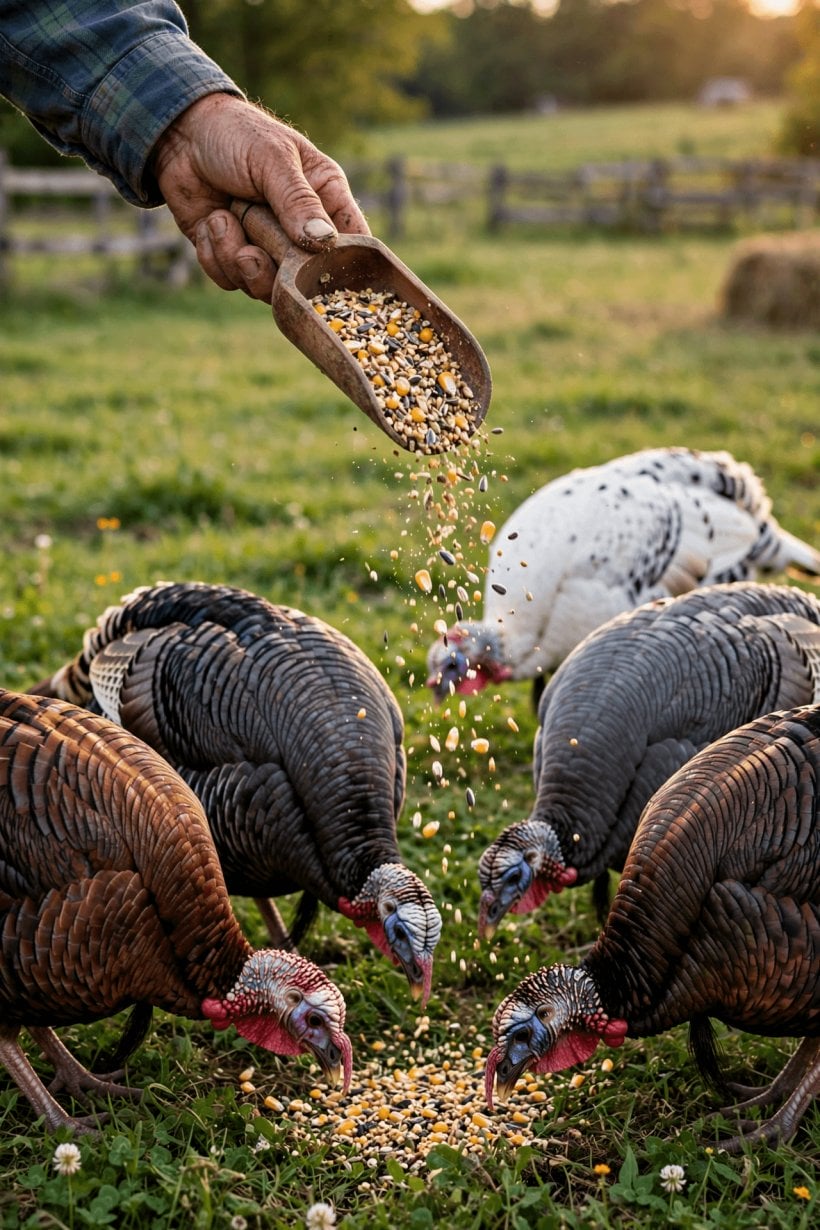
Feed adults with the same discipline as growers, adjusted for range. The breeder ration stays available as the anchor; the range contributes its daily share of greens, seeds and insects; and the keeper watches body condition over the backs and breasts of the flock, adjusting the balance if birds begin to run heavy or light. Breeding birds in hard condition — fit, active, bright-eyed — produce the fertile eggs and strong poults that start this whole guide over again next season.
Housing and feeding meet in the adult pen, so plan them together. A dry, draught-free shelter with room at the trough for every bird, feeders that stay clean under a roof or canopy, and water that never freezes or runs dry are the adult version of the brooder rules. Keepers designing that shelter will find our turkey coop and shelter ideas for roosts, runs and space a practical companion to this feeding guide — the coop is where the ration is served, after all, and it should be built around the feeder as much as around the roost.
9. Treats, Scraps and What to Avoid
Turkeys are bold, comic characters at feeding time, and they will learn within days that the keeper’s bucket might contain something interesting. Treats have their place — a scatter of greens from the garden, surplus soft fruit, or a handful of whatever the flock loves best, given after the ration has been eaten — as training, as a way of gathering birds quickly, and as simple pleasure for keeper and flock alike. The rule is proportion: treats are the garnish on a stage-based diet, never a course of their own.
The avoid list is short and firm. Nothing mouldy or spoiled, however thrifty it feels to offer it; nothing salty or heavily processed from the kitchen; nothing that has sat wet in a trough from the day before. Do not let well-meaning visitors feed the flock unsupervised — a turkey’s charm invites offerings, and its stomach did not evolve for party leftovers. And never let treats creep upward until growers are waiting at the gate for scraps while their grower ration sits untouched behind them.
This is, happily, the stage where turkeys become personalities, and naming them helps a keeper track who eats well, who hangs back and who has quietly become the flock’s ringleader. Our collection of chicken names for hens, roosters and the whole flock is full of ideas that suit a turkey’s dignity — or its comedy — just as well. A named bird is an observed bird, and at the feeder, observation is what separates feeding a flock from simply filling a trough.
10. Stepping Protein Down on Schedule
Everything in this guide hangs on one habit: change the feed when the stage changes, on schedule, not by guesswork. The infographic’s three stages — start strong, grow steady, range free — are a timetable as much as a menu. Write the expected change dates on the feed-store calendar when the poults arrive, judge the birds against them as each date approaches, and make each change gradually, mixing old and new across several days so no appetite ever stalls at the swap.
Keep the stages straight when several species share a holding, because their timetables differ. Quail youngsters move out of the brooder and onto adult ground while turkey growers from the same season are still months from their final ration — which is why our guide to quail coop ideas for housing, space and predator proofing makes a useful shelf-mate to this one, each covering the moment its species leaves the nursery stage behind. And keepers whose next project is waterfowl can carry the same stage thinking into our muscovy duck guide to temperament, care and eggs, where age and purpose shape the ration just as they do here.
Judge the system by its results and adjust with confidence. A flock fed by stages looks even: birds of a size with each other, feathers tight and clean, legs strong, appetites reliable, and a pen that comes to the gate as one body when the keeper appears. That evenness — more than any single bag or brand — is the sign that protein, forage, grit and water were each given at the right time, in the right measure, to the right birds.
Final Considerations
Feed turkeys by stage and the job becomes simple: a high-protein starter to start poults strongly, a mid-protein grower plus forage to grow youngsters steadily, and a layer and breeder ration plus range for adults, with grit and water always beside the feed. Respect the timetable, resist the chicken-feed shortcut, and watch the flock at the trough every day — big, bright, well-grown turkeys are the most convincing proof a feeding system can offer.


0 Comments