

They strut, they scratch, they share the same yard in a thousand farm photographs, so can turkeys live with chickens in real life, on real ground, without it ending in heartbreak? Yes, sometimes, and the keepers who manage it share one habit: they respect the conditions.
This guide explains those conditions in full, from blackhead disease and separate brooding to space, feed protein, roosting and clean ground, so you can decide with your eyes open before the two flocks ever meet.
1. Turkeys With Chickens at a Glance: Works, With Conditions
So, can turkeys live with chickens safely over a whole season? The honest answer is the one in the summary below: calm mixed flocks are genuinely possible, the risk is a specific disease carried in shared ground, and the fix is management, not luck. Brood them apart, range them smart, and remember that the disease risk lives in the soil, not in the birds standing in front of you looking perfectly healthy.
| Aspect | What It Means for the Keeper |
|---|---|
| The Good | Calm mixed flocks are possible |
| The Risk | Blackhead disease from shared ground |
| The Fix | Separate brooding, rotation and clean ground |
| Key Factors | Disease, space, feed protein and roosting |
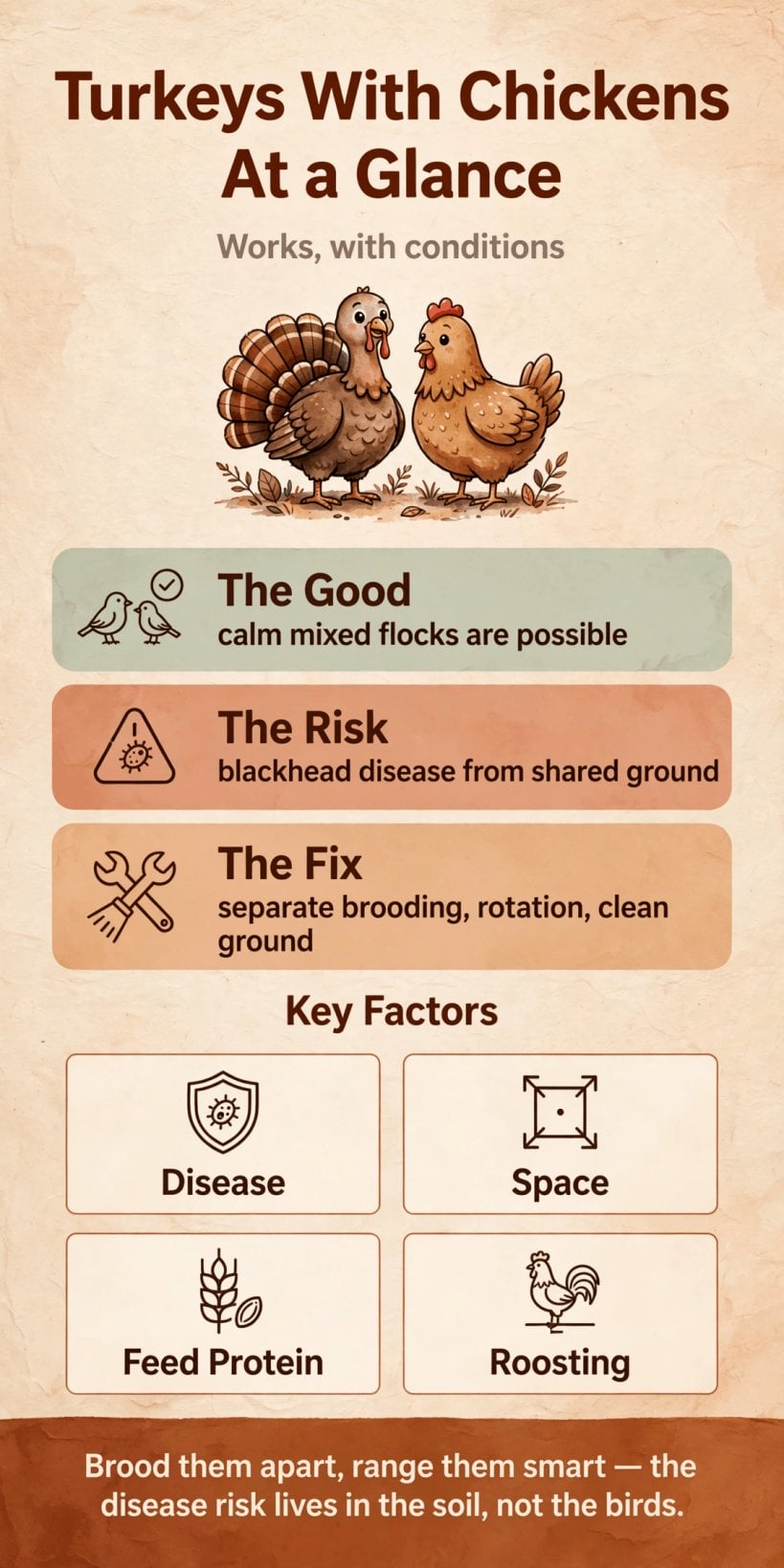
Works, with conditions: brood them apart, range them smart, and keep the ground clean, rested and rotated.
Work through the table in order and you have the whole argument of this guide in four lines. The good is real: turkeys and chickens are both social, ground-loving birds, and in a spacious yard with sensible management they settle into a shared routine with remarkably little drama. The risk is also real, and it is not bad temper or bullying, as most beginners assume. It is a disease with a long memory, written into the soil of a run by birds that may never have looked ill themselves.
The fix row is where your power lies. You cannot change the biology of either species, but you control where poults are brooded, which ground each flock uses, how long that ground rests and how feed, water and roosts are arranged. Keepers who accept those jobs from the start are the ones posting the peaceful mixed-flock photographs. Keepers who skip them often lose turkeys in a way that feels sudden and mysterious until somebody explains the soil history of the pen to them afterwards.
2. Blackhead Disease: The Risk That Decides Everything
Blackhead, known to vets as histomoniasis, is the disease that makes this whole question worth an article. It is caused by a microscopic parasite that travels with the common cecal worm, and its cruelty lies in the difference between the two species sharing your yard. Chickens usually carry the worm and its passenger with little obvious harm, shedding eggs into the soil in their droppings for a very long time. Turkeys, meeting the same parasite, are far more vulnerable, and young turkeys most of all: a poult can fade with frightening speed on ground that the hens have used happily for years.
Earthworms complete the chain, which is why the risk is described as living in the soil. Worms swallow the parasite’s eggs as they work the ground, birds swallow the worms as they forage, and the cycle quietly renews itself in any run that stays stocked, damp and unrotated. A turkey that droops, stops eating, stands with its head drawn in and passes the mustard-yellow droppings keepers are taught to dread is a bird in urgent trouble, and proper veterinary advice, not home remedies from a forum, is the right response that same day.
None of this means the two species can never share a farm. It means the sharing must be designed. Ground with no recent chicken history is safer for turkeys. Rested, rotated, well-drained ground is safer than a permanent mixed pen. And a worming programme for the chicken flock, planned with a vet who knows poultry, lowers the traffic in the whole system. Treat blackhead as the first design constraint, ahead of coop colour and breed choice, and every other decision in this guide falls sensibly into place behind it.
3. Separate Brooding: Never Start Poults With Chicks
The youngest turkeys are the most vulnerable birds on the place, so the first rule of the fix is absolute: brood poults apart. A brooder that holds only turkey poults, on clean litter, with their own feeders and drinkers, gives them the protected start their slower, more delicate early days demand. Poults are famously slow to find feed and water compared with the bright, self-starting chick, and a mixed brooder stacks every disadvantage at once: the chicks outcompete them at the dish while the shared litter begins the disease story this guide exists to prevent.
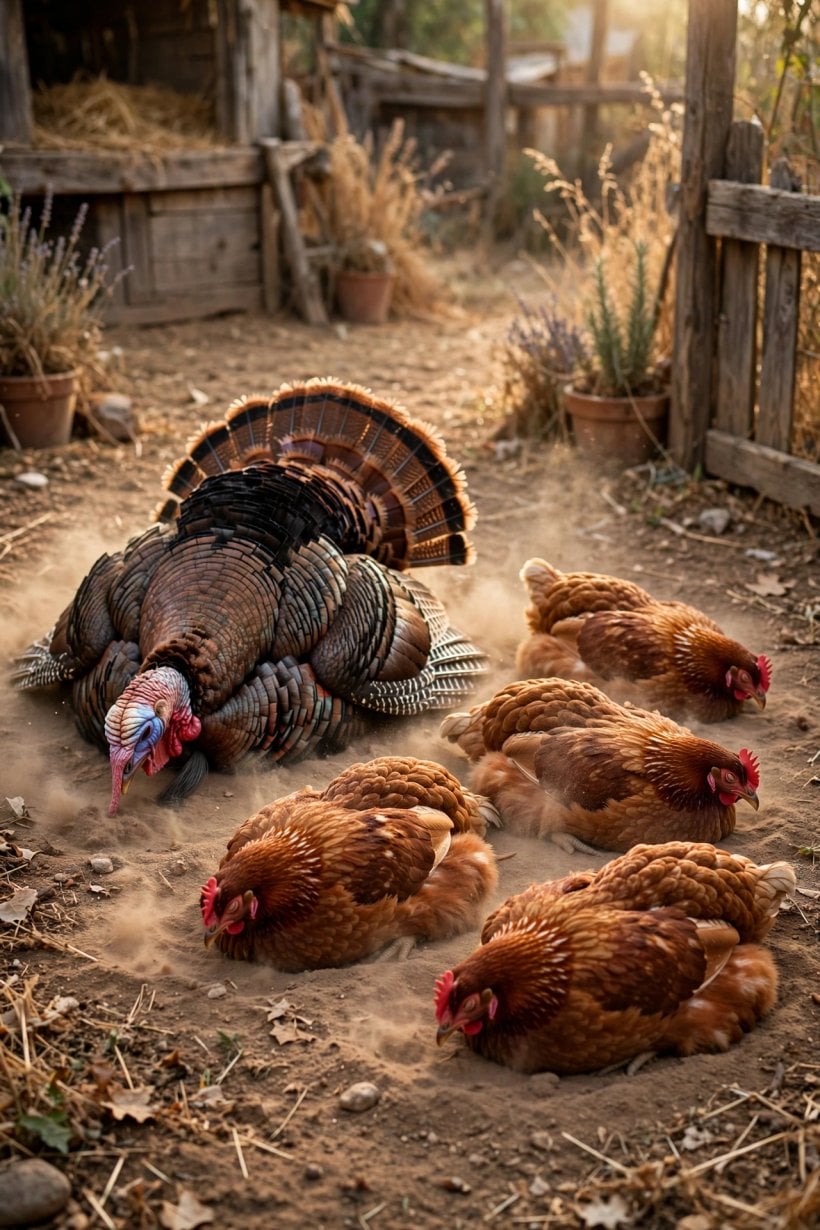
Separate brooding also lets you feed each species what it actually needs, a theme this guide returns to in the feeding section. Poults need a richer starter ration than chicks to build their large frames properly, and in a shared pen the keeper ends up feeding one ration that is wrong for somebody. Keep the groups apart until the poults are sturdy, well-feathered youngsters with size and confidence on their side, and use the waiting weeks to prepare the ground they will eventually range, rather than hurrying an introduction nobody benefits from.
Keepers raising several kinds of young poultry at once will recognise the principle from what to feed baby quail in the first weeks: every species starts best in its own clean box, on its own ration, at its own pace. Quarantine belongs in this section too. Any new bird, chick, poult or adult, should live apart and be watched before it joins a flock, because introductions are how most disease arrives on a small farm, whatever the species, and a fortnight of patience is cheaper than a season of losses.
4. Space, Stocking and Ground Rotation
Space is the second great condition, and mixed flocks need more of it than either flock alone. Turkeys are big, active, ranging birds that think nothing of covering a whole field in a day, and chickens confined with them in a small pen create exactly the conditions blackhead loves: concentrated droppings, bare worn soil and birds picking constantly over the same few metres of ground. Give a mixed system room to breathe, with the turkeys ranging wide and the hens ranging with them or beside them, and the disease pressure falls simply because everything is diluted across more land.
Rotation turns space into clean ground. Resting a pen lets sun, frost and time work on what the birds left behind, and moving flocks between rested strips keeps any patch from becoming a permanent poultry yard in the worst sense. The rotation thinking in a half acre homestead layout that pairs pasture with garden beds applies directly here: strips, rest periods and a plan drawn before the birds arrive, not improvised after the first pen turns to mud and stays there all winter.
Stocking density is the quiet multiplier in every problem in this guide. Two species in one system is not a licence to double the birds on the same ground. If anything, a keeper planning turkeys alongside chickens should stock lighter than a single-species yard, keep the sacrifice area near the houses drained and gravelled if it must exist at all, and hold some ground permanently in reserve for turkeys only. Land looks empty in spring and priceless in a wet October, and the keeper who saved it is always glad they did.
5. Feed and Protein: Two Species, Two Rations
Ask what each bird eats and the mixed flock’s third condition appears. Growing turkeys need a notably richer ration than growing chickens, with poults in particular depending on a high-protein start to build frame, feather and immunity at the speed their bodies demand. Adult turkeys, too, do their best on feed formulated for them rather than on layers’ pellets borrowed from the hen house. A keeper who feeds one middling ration to both species is quietly short-changing the turkeys, and the bill arrives as poor growth, poor feathering and birds with less resilience when any other challenge shows up.
The full feeding picture for the turkey side is laid out in what turkeys eat from poults to adults, and it repays study before the first poult arrives. In a mixed yard, the practical answer is separate feeding stations: turkey feed where turkeys eat, chicken feed where hens eat, and enough height, fencing or routine separation at feeding time to keep each flock mostly honest. Total honesty is impossible, an occasional stolen beakful harms nobody, but the daily ration each bird actually lives on should be its own.
Grit, clean water and minerals follow the usual rules, doubled. Provide oyster shell for the laying hens in their own area, grit where both species can reach it, and water points far enough apart that a dominant turkey cannot guard the only drinker on a hot afternoon. Watch the smallest hens and the youngest turkeys at feeding in the first weeks of any shared arrangement. In mixed systems, the bird at the back of the queue is your early-warning system, and it is telling you about feeder space, not about its own character.
6. Roosting, Housing and Night-Time Arrangements
Night housing is where the size difference between the species stops being a statistic and becomes carpentry. Turkeys need broad, sturdy roosts set at a height they can manage, room to turn and settle without crushing a hen beneath them, and headroom that respects a tall bird. Chickens need their own perches, nest boxes in peace and a pop hole they can use without running a gauntlet of turkey feet at dawn. Many successful keepers house the species in adjoining sections of one building, sharing a roof and a keeper’s routine while keeping nights separate, and it is hard to argue with the results.
The detailed housing thinking in turkey coop and shelter ideas for a mixed poultry yard covers roost strength, run design and space in depth, and it pairs naturally with this guide: read it for the building, read this for the biology. Nest boxes deserve a specific mention, because a turkey hen investigating a chicken’s nest box can wreck eggs and box in one heavy visit, while ground-nesting turkeys in a shared house invite trampling. Separate laying arrangements, like separate brooders and separate feeders, are this system quietly repeating its one great lesson.
Ventilation and dryness protect both species equally and deserve the same effort in either house. Damp litter breeds trouble for feet, lungs and the parasite cycles this guide is trying to starve, so bedding management in a mixed system is not housework, it is disease control wearing an apron. Clean out on a rhythm, keep drinkers from soaking the litter, and let the houses stand empty and aired between batches of young birds whenever the calendar allows it. An empty, rested house is worth as much as rested ground, and for the same reasons.
7. Behaviour: Size, Temperament and the Pecking Order
With disease managed, most keepers are pleasantly surprised by the behaviour question. Turkeys are generally calm, curious and remarkably tolerant flock animals, and chickens are generally too busy to pick fights they cannot win. A mature turkey hen or a gentle tom presiding over a yard of hens looks alarming on paper and is usually peaceable in feathers. The friction points are predictable: feeders in the first minutes, dust baths in high demand, and any arrangement where a bird cannot simply walk away from an argument it is losing.
Size still demands respect in both directions. A turkey can injure a hen by accident, treading on her during an excited moment at the gate or in a scramble, and a broody hen can make a poult’s life miserable if young birds are introduced carelessly. Introduce across a fence first, let the flocks learn each other’s shapes and sounds for days before they share ground, and make the first meetings happen in the largest space you have, in the morning, with feed scattered wide so nobody has to compete for the privilege of being there.
Breed and individual character shade everything in this section. Heritage turkeys raised calmly by hand are different neighbours from flighty birds of any species, and the little comparisons in bantam chickens vs standard chickens for size, eggs and space remind the keeper that even within one species, size changes social life: a bantam hen in a turkey yard needs escape routes and refuges a standard hen does not. Choose placid stock, raise it quietly, and the mixed yard usually settles into the calm, faintly comic society the photographs promise.
8. Clean Ground, Worms and Soil Management
Everything in this guide eventually returns to the ground, so give it a section of its own. The parasite at the heart of the blackhead story persists in soil and in the worms that work it, which means ground management is not a finishing touch but the main treatment a smallholder actually controls. Drainage first: wet, poached, permanent runs are the enemy, and any yard that cannot be drained should not carry a permanent mixed flock. Rested, grassed, rotated ground is the goal, with the birds always able to move onto a cleaner bite of the farm.
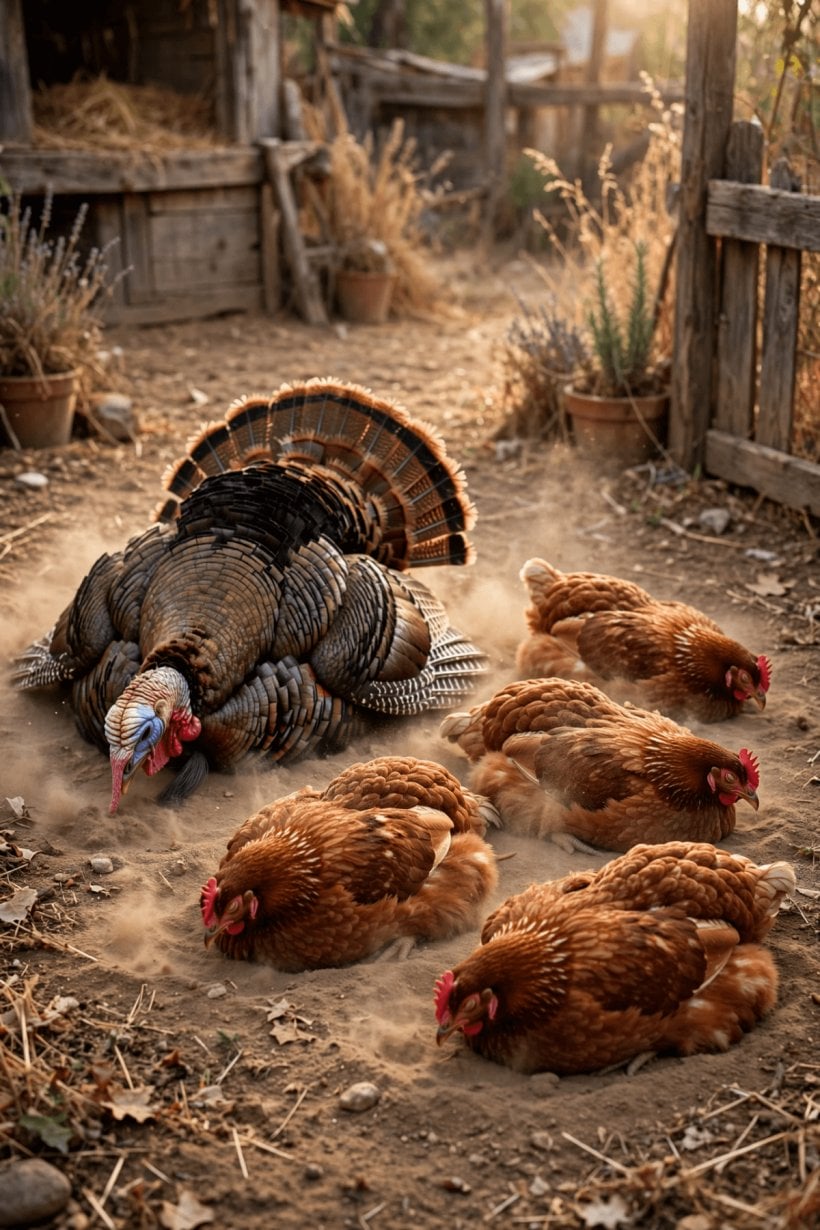
Worming belongs in a vet-guided plan for the whole system, aimed mainly at the chicken flock whose droppings drive the cycle, with records kept of what was used and when. Do not borrow doses, intervals or products from a neighbour’s sheep, a forum or a feed sack for another species: poultry worming done wrong wastes money and can do harm, while done right, on advice, it quietly lowers the pressure on every bird you keep. Note, too, that a run can look beautifully clean on top while carrying its history underneath, which is why rest periods are measured in seasons, not weekends.
Practical soil habits add up. Feed on the cleanest ground or in trays you can move, site drinkers where spillage drains away, harrow or rest bare patches before they become permanent, and keep a genuine turkey-only paddock in reserve if your land allows it: ground that chickens never use is the safest card a mixed keeper holds. The grazing discipline in what geese eat on a grass-first homestead teaches the same respect for rotated, rested pasture, and waterfowl keepers and turkey keepers end up nodding at each other over the fence about it.
9. Safer Ways to Keep Both: Side-by-Side Systems That Work
Plenty of keepers conclude, honestly and successfully, that the best mixed flock is one that shares a farm rather than a fence line. Side-by-side systems give you both species with a fraction of the risk: adjoining houses, separate runs, a shared routine and a gate between the worlds that opens only when you decide it should. The hens work the orchard, the turkeys range the big pasture, each flock eats its own ration and sleeps in its own house, and the keeper gets the full farmyard picture with the biology kept firmly on their side.
Variations suit different farms. Some keepers range both species on the same large ground in different seasons, turkeys following rested land the hens used long before. Some let adult birds share a big field by day in summer while keeping nights, feeders and young stock strictly separate, accepting a managed middle course with full knowledge of the trade. Some keep turkeys on ground that has never carried chickens at all and let the hens live on the older yards nearer the house, which is often how the land wanted to be organised anyway.
Whichever pattern fits, borrow the housing common sense from quail coop ideas for small poultry spaces and from every good small farm: build for the bird’s size, keep the routine walk short, and make the safe thing also the easy thing. Systems fail when the safe option is exhausting, because tired keepers take shortcuts on wet November evenings. Design the separation into fences, gates and feed stores so thoroughly that doing it properly is simply what happens when you walk the round, and the system will hold for years.
10. A Keeper’s Checklist Before You Mix the Flocks
Run this list before any turkey shares ground with any chicken on your farm. First, the ground: do you know its history, can you rotate and rest it, and is some of it chicken-free for the turkeys if trouble ever appears? Second, the young stock: can you brood poults entirely apart, on their own ration, until they are strong? Third, the rations: are separate feeding stations planned, with turkey feed actually bought in, not borrowed from the hens’ sack and called good enough?
Fourth, the housing: roosts strong and roomy enough for turkeys, nest boxes safe from heavy visitors, litter kept dry and houses rested between batches. Fifth, the health plan: a vet who knows poultry, a worming programme for the hens, quarantine for every newcomer and the honesty to act the same day a turkey looks wrong. Sixth, the behaviour plan: introductions across a fence, meetings in big spaces, feed scattered wide and refuges for the smallest birds, including names recorded in the flock book from chicken names for small and standard flocks alike so every bird is an individual you actually watch.
If the checklist gives you yeses, mix with confidence and enjoy one of farming’s most sociable sights. If it gives you maybes, choose the side-by-side system and lose nothing but a little romance, which the birds will never miss. The question was never really whether the two species like each other. Left to themselves, they mostly do. The question is whether the keeper has built the ground, the housing and the routine that let them live together safely, and that is a question entirely within your power to answer well.
Final Considerations
Brood them apart, range them smart, and respect the soil, and turkeys and chickens can share a farm, and often a field, in genuine peace. The disease risk is real but manageable, the space and feeding differences are simple carpentry and routine, and the reward is a varied, lively, useful yard. Go in with the conditions met, keep watching the birds at the back of the queue, and let clean ground do quietly, season after season, the work that no medicine can do for you afterwards.


0 Comments