

Small birds, simple needs, and a dozen ways to get their housing wrong — quail reward a keeper who thinks through the coop before the first bird arrives.
A good quail coop is dry, draught-free, easy to clean and proof against everything that hunts at night, and this guide walks through each decision in turn.
1. The Quail Coop at a Glance
Our infographic reduces coop design to three core decisions — how much space each bird gets, how tall the coop should be, and what the floor is made of — supported by four key factors every finished coop must handle: ventilation, predator proofing, egg roll-out and cleaning. Get the three decisions right and the four factors looked after, and almost any design, bought or built, will keep quail well.
| Design decision | Guidance | Why it matters |
|---|---|---|
| Space | About a square foot per bird indoors | Enough room for every bird to feed, rest and lay without crowding or bullying. |
| Height | Low ceilings, or a tall flight space — never in between | Quail flush straight upward when startled, so ceiling height is a safety decision, not a style one. |
| Flooring | Wire or deep litter, chosen deliberately | Each floor has trade-offs for cleanliness, comfort and labour, covered in section 4. |
The four key factors run underneath every row of that table. Ventilation keeps the air inside fresh and dry without blowing across the birds. Predator proofing protects a small, defenceless bird from a long list of night hunters. Egg roll-out, in designs that use it, rolls eggs gently away to a collection point, clean and unpecked. And cleaning shapes the weekly reality of keeping quail: a coop that is easy to clean gets cleaned, and a coop that gets cleaned stays healthy.
One idea from the chart is worth fixing in mind before any timber is cut: a startled quail does not run, it launches — straight up, at speed. A ceiling at the wrong height meets that launch halfway and injures the bird; a low ceiling stops the launch before it gathers force, and a properly tall aviary lets it become a harmless short flight. Every design in this guide respects that single fact of quail nature.
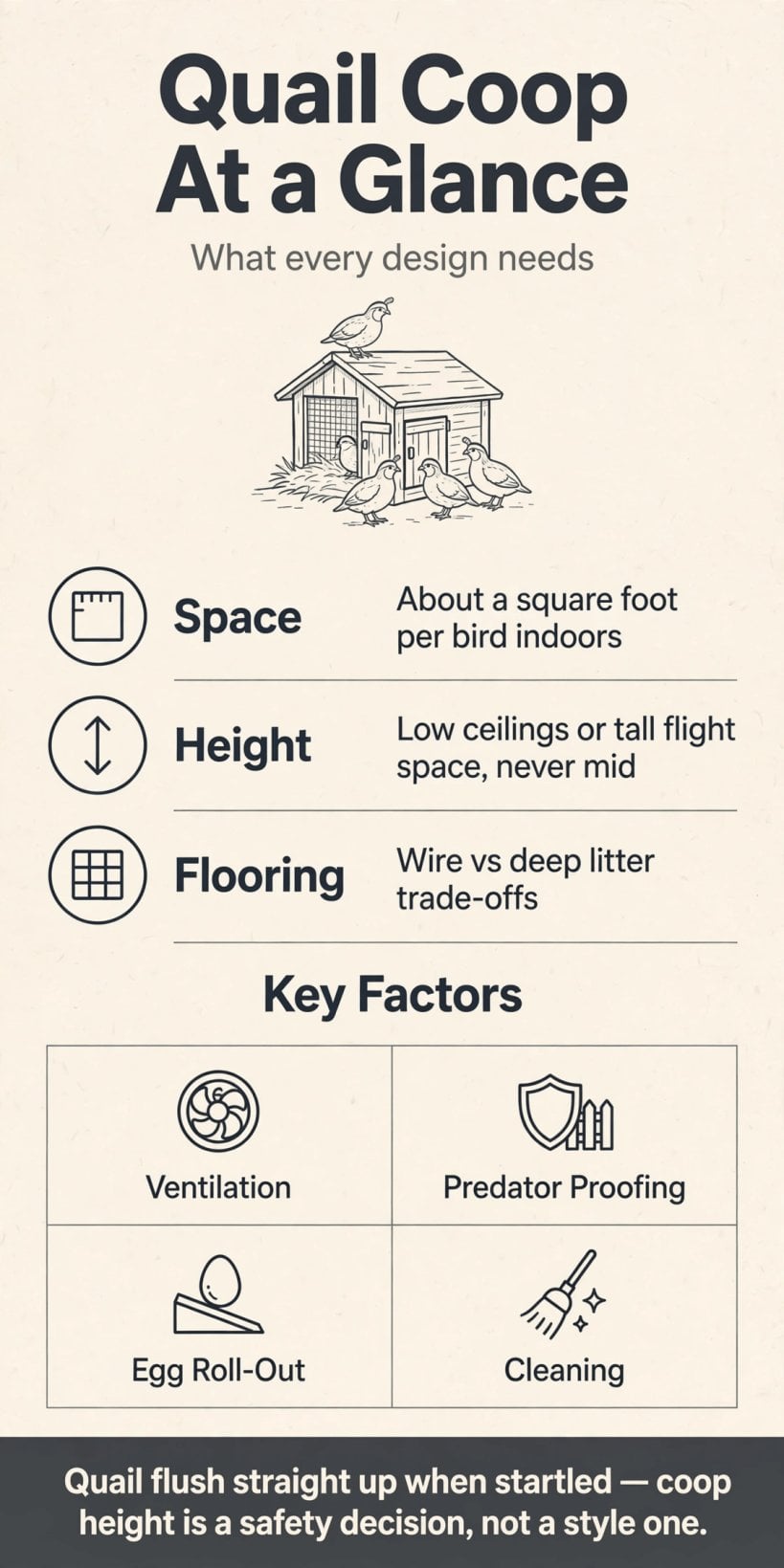
A quail coop at a glance: about a square foot per bird indoors, low ceilings or a tall flight space, and a floor chosen between wire and deep litter — with ventilation, predator proofing, egg roll-out and cleaning as the key factors.
2. Space: Room to Move Without Waste
The infographic’s starting point is about a square foot of indoor space per bird, and it is a good, honest figure to plan around. Quail are ground birds that live their whole lives at floor level, so it is floor area that counts — not volume, not perches, not clever levels they will never use. Count your planned flock, multiply, and you have the indoor footprint your coop needs before a single extra luxury is considered.
Space is about behaviour as much as health. In a well-spaced coop each bird can reach the feeder without a confrontation, find a quiet corner to lay in, and dust-bathe or rest without being walked over. Crowding shows itself quickly in quail: feather-pecking, restless pacing, eggs laid anywhere and everywhere, and a flock that startles at nothing because it already lives on edge. A little more floor is the cheapest calm you will ever buy a flock.
Plan the space as part of the whole holding, not in isolation. Where the coop stands decides how pleasant that space is to use — close enough to the house for twice-daily checks in all weathers, on ground that drains, with water and feed storage within a short carry. Our half acre homestead layout with zones for gardens, animals and water shows how small livestock housing sits best when it is placed by routine rather than by leftover corners, and quail, checked more often than almost any other bird, benefit most of all.
3. Height: Low Ceilings or a Real Flight Space
Height is the decision new keepers get wrong most often, because a quail coop looks like a small chicken coop and behaves like nothing of the sort. The infographic’s rule is simple: keep ceilings low, or give the birds a genuinely tall flight space — and never settle in between. A startled quail launches vertically with real force; a low ceiling, just above the keeper’s hands as they work, means the bird rises a few inches and settles. A tall aviary roof means the launch becomes a flight that ends in a landing.
The dangerous design is the one in the middle — a coop tall enough for a launching bird to reach full speed, with a hard roof exactly where its flight peaks. That is how scalps are torn and necks are broken, in a coop that looked generously sized on paper. If you are converting an existing shed or hutch, measure its internal height honestly and either lower a false ceiling of soft mesh into it or commit to the building’s full height as a flight pen with ground cover to land in.
Soft ceilings deserve a special mention for smaller coops. A layer of flexible netting or mesh stretched below a solid roof cushions any bird that does flush, and it costs almost nothing to add at build time. Combine it with calm habits — announce yourself as you approach, open doors slowly, avoid sudden reaches from above, since predators come from above and quail know it — and height stops being a hazard and becomes what it should be: a settled, boring feature of a safe coop.
4. Flooring: Wire or Deep Litter
The infographic sets flooring out as a genuine choice with trade-offs on both sides, and it is worth thinking through for your own routine rather than copying a neighbour’s. A wire floor lets droppings fall through to a tray or the ground below, keeping the birds’ living surface clean and dry with very little daily effort, and it suits hutches and stacked units where eggs and droppings are collected from outside. Its cautions are comfort and cold: wire must be fine and smooth enough for small feet, and birds need the design to block the draughts that rise through an open floor in winter.
Deep litter works the opposite way: a generous bed of shavings or chopped straw on a solid floor, topped up as needed, with droppings absorbed and composted in place. Birds scratch in it, dust-bathe in its dry corners and rest on a soft, warm surface, and many keepers find it the more natural life. Its cautions are moisture and labour in a different form — litter must be kept dry, because damp litter under quail quickly becomes ammonia and sore feet, and the whole bed needs changing out on schedule, not on impulse.
Either floor succeeds when it is managed as a system: wire with a tray you actually empty, litter with a fork you actually use. Choose the one that fits the time you honestly have, the climate the coop stands in, and the birds you keep — layers housed for eggs are often happiest where collection is clean and quick, while breeding groups on the ground make fine use of deep litter’s space to scratch, court and settle.
5. Ventilation Without Draughts
Ventilation is the first of the infographic’s key factors, and it is a balance rather than a maximum. A coop needs a steady exchange of air to carry away moisture and ammonia and to keep bedding and litter dry, because damp, stale air is behind most of the respiratory trouble and sour smells that give small coops a bad name. Aim for openings high in the structure, above the birds’ heads, so air moves through without ever blowing across the flock at roosting level.
Draughts are ventilation’s unwelcome twin: cold air arriving at bird height, in a stream, usually through gaps at doors and low cracks the builder never noticed. Quail tolerate dry cold far better than damp wind, so the test is simple — on a still, cold evening, the air inside should feel fresh but the birds should be sitting in stillness, fluffed and settled, not huddled away from one wall. Seal the low gaps, keep the high vents open, and the balance mostly looks after itself.
Mesh choice does double duty here, because every vent is also a potential doorway. Cover ventilation openings with the same fine, strong mesh used for predator proofing rather than wide chicken wire, fix it so no edge can be peeled back, and check it when you clean: a vent panel quietly rusting through is a failure of two key factors at once, and the coop will not warn you about either until the morning it matters.
6. Predator Proofing Every Gap
Predator proofing is the key factor with the least forgiving arithmetic: the keeper has to win every night, and a fox, rat or mink only has to win once. Quail are small, they cannot fight, and they panic upward into danger, so the coop itself has to be the whole defence. Work through it as an intruder would — every gap around doors, every corner where wire meets timber, the floor, the roof line, the latches a clever paw can lift.
Use fine, welded mesh rather than woven chicken wire, which determined predators can tear or reach through; bury or skirt wire at ground level where digging is the local habit; fit bolts that cannot be nudged open, rather than simple catches; and close any gap a small head could enter, because predators test a coop with their smallest scouts first. A coop raised on legs gains a dry floor and a clear view underneath, while one at ground level gains simplicity — both work, if the proofing is honest.
The same discipline scales up to bigger builds. Our guide to turkey coop and shelter ideas for roosts, runs and space works through proofing for a far larger bird, and the overlap is instructive: mesh, latches, floors and roof lines decide safety at every scale, and a keeper who learns to audit a small coop properly will spot the weak point in a big one at a glance. Do the audit in daylight, on a schedule, torch in hand, looking for rust, chew marks and soil freshly moved against the wire.
7. Egg Roll-Out and Easy Collection
Egg roll-out earns its place among the key factors because of how quail lay. A hen quail drops her egg wherever she happens to be standing, with none of a chicken’s interest in a nest box, so in a plain coop the day’s eggs are scattered through litter and droppings, waiting to be trodden on, buried or eaten. A roll-out design answers this with a gently sloped floor: the egg, once laid, rolls slowly away under a barrier into a covered collection tray outside the birds’ reach.
The result is eggs that are clean, whole and findable — collected from outside the coop without opening a door, disturbing the flock or hunting through bedding with your fingers. For keepers collecting eating eggs daily, and especially for anyone gathering fertile eggs for hatching, where a cracked or soiled shell can end an embryo’s chances, the difference is not convenience but yield: more of the eggs the hens laid arrive in the kitchen or the incubator in usable condition.
Roll-out is a specialism of laying cages and hutches rather than aviary floors, so weigh it against your design honestly: ground-level and deep-litter coops can simply be searched daily, and many keepers enjoy that small treasure hunt. Ducks, by contrast, mostly oblige with nests — keepers comparing laying habits across species will enjoy our muscovy duck guide to temperament, care and eggs, where egg-laying is managed in straw and seclusion rather than by slopes, trays and gentle engineering.
8. Cleaning: Design for the Weekly Routine
Cleaning is the least glamorous key factor and the one that decides whether the other three keep working. A coop that stays clean has dry litter or clear trays, vents that are not furred with dust, and corners the keeper can actually reach — and all of that is decided at build time, by door size, panel fixings and floor choice, months before the first awkward clean-out teaches the lesson the hard way.
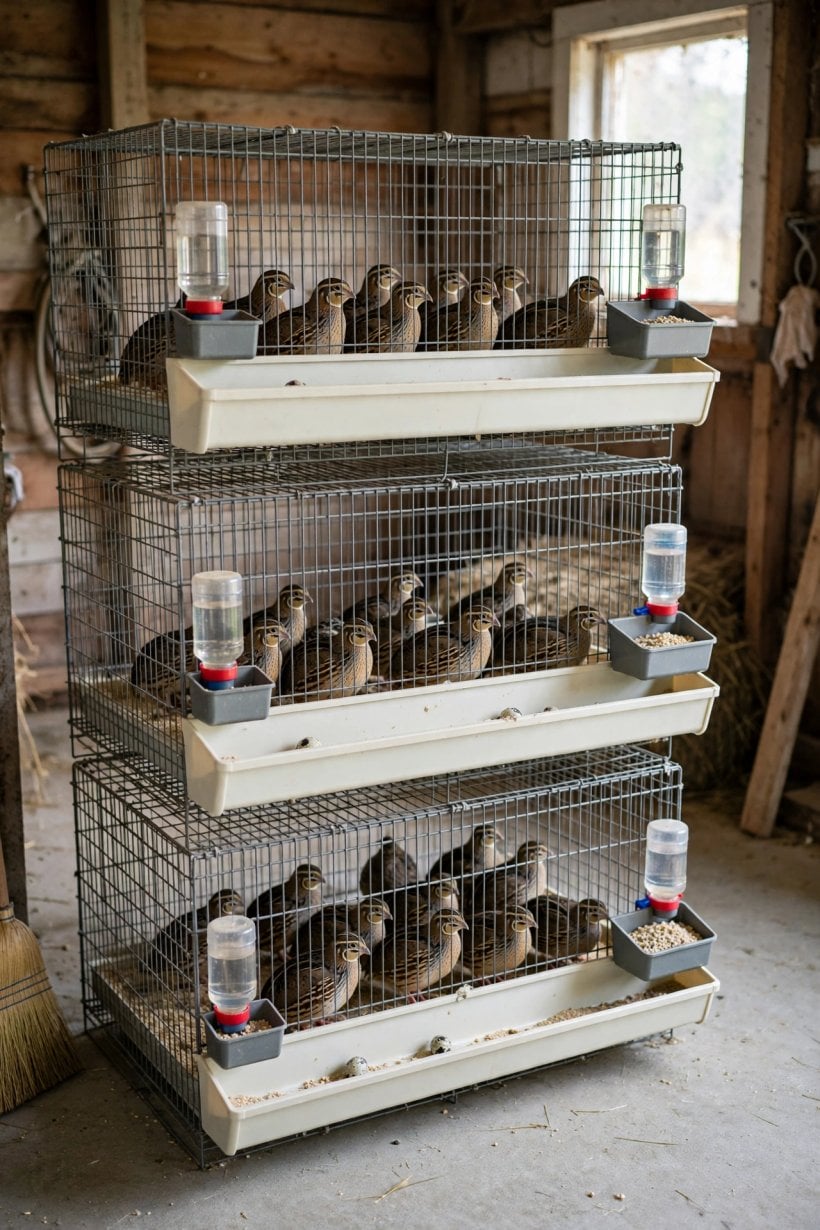
Design for your own back and patience. Doors that open wide enough for a scraper and a bucket, trays that slide without spilling, roosting and feeding gear that lifts out for washing, and a floor you can sweep or hose without dismantling the flock’s whole world — these are not luxuries, they are what makes the weekly routine a ten-minute job instead of an hour’s resentment. Work at a height that suits you, too: raised hutches and waist-high units exist because keepers’ knees wrote the specification.
Build the routine around the design and keep it boringly regular: droppings trays emptied before they cake, litter forked and topped up while it is still dry, drinkers scrubbed, feeders checked for damp feed in the corners, and a deeper clean, with every removable part out in the daylight, whenever the season turns. A clean coop is also an inspected coop — the weekly routine is when loose mesh, early rust and a bird that is not herself are all noticed in time.
9. Feeders, Drinkers and Dust Baths Inside
A well-planned coop equips its birds as carefully as it shelters them. Feeders should keep feed dry, contained and off the floor — quail are enthusiastic scratchers and will bill expensive feed into the litter within the hour if it is offered in an open dish — so troughs with lips or bars, or hoppers the birds eat from by the head, earn their keep quickly. Site the main feeder where every bird can eat at once, because crowding at the trough is where the space calculations of section 2 are tested twice a day.
Drinkers need the same thought: fresh water, kept clean in a coop where bedding is always on the move. Raised or nipple-style drinkers stay cleaner than open dishes on the floor, and any open water must be shallow and stable, because a quail coop is no place for deep water — the lesson every keeper of youngsters learns in our guide to what to feed baby quail in the first six weeks, from starter feed to grit, where drinker safety is a matter of pebbles and common sense. Adults are hardier, but the habit of safe, clean water should never lapse.
Add a dust bath and you have given the flock its own maintenance department. A shallow tray of dry sand or fine, dry soil lets quail do what they are built to do — work dust through their feathers to keep skin and plumage in order — and it doubles as the flock’s favourite social spot. Turkeys, incidentally, are just as devoted to theirs, and feeder placement for those much larger appetites is covered in our guide to what do turkeys eat for poults, growers and adult turkeys; the shared moral is that furniture, rightly placed, is half of husbandry.
10. Siting the Coop and Settling the Birds
The last decisions are about place and introduction. Site the coop on ground that drains after rain, in shelter from the prevailing wind, with shade for hot afternoons and sun for winter mornings if your climate offers both, and where you can reach it in the dark, in the wet, with a bucket in each hand — because you will, twice a day, in all weathers. A beautiful coop at the far end of a swampy garden loses to an ordinary one by the path, every single week of the year.
Settle new birds in calmly. Move quail in a covered, darkened box, release them into the finished coop with feed and water already in place, and let them find their bearings without handling or visitors for the first day. Coming from the brooder, youngsters should arrive fully feathered and hardened to outdoor temperatures, with their feeding routine unchanged for the first days — the transition our baby-quail guide ends with, handing over to the housing this guide describes, is the classic two halves of one job.
Finally, let the flock make the coop a home, and learn its characters as you go. Quail keepers are often surprised by how individual these small birds are — the bold inspector, the devoted dust-bather, the hen who always lays in the same impossible corner — and our collection of chicken names for hens, roosters and the whole flock is a pleasant place to find names worthy of them. For the wider picture of ground-living birds on range, our guide to what do ducks eat for backyard ducklings and adult ducks makes a fine companion read, since ducks and quail share more housing logic — dry floors, safe water, proofed fences — than their sizes suggest.
Final Considerations
Build around the birds’ nature and a quail coop almost designs itself: about a square foot per bird, a ceiling that is low or honestly tall, a floor chosen with its trade-offs understood, and ventilation, predator proofing, egg collection and cleaning planned from the first sketch. Do that, site it where your daily rounds pass anyway, and the result is a quiet, healthy flock in a coop that serves you as faithfully as it shelters them.


0 Comments