

Build a chicken coop a bit bigger, the thinking goes — and then a fully grown stag turkey tries to roost in it, and the whole idea collapses, sometimes literally.
A turkey coop is its own design problem, and this guide covers it properly: floor space, scaffolding-strong roosts, secure range and quiet nest areas.
1. The Turkey Coop at a Glance
Our infographic sets out the space and shelter rules as three design decisions — how much floor each bird gets indoors, how its roosts are built, and how much range it needs outside — supported by four key factors: ventilation, roost height, nest areas and predators. Work through the three decisions with the four factors in mind and you have a coop plan in an afternoon.
| Design decision | Guidance | Why it matters |
|---|---|---|
| Floor space | Generous room indoors — about 3–5 sq ft per adult turkey | Space keeps big birds calm and reduces the pecking that crowding invites. |
| Roosts | Wide, sturdy perches, all at one level — about 8–12in wide | Heavy birds need a continuous, level perch; tiers cause crowding and falls. |
| Range | Secure fencing — about 8–10ft of outdoor run per bird | Turkeys wander, so the run must be generous and fenced to deter diggers. |
The four key factors refine those headline numbers. Ventilation must keep the air dry and moving gently, free of the moisture and ammonia that build up under big, warm birds. Roost height wants care — the chart places roosts around 2–4ft high, high enough to satisfy a roosting bird, low enough for safe landings. Nest areas should be quiet, dark boxes lined with straw, roughly one for every four or five hens. And predators set the standard for locks, covered runs and hardware-cloth barriers throughout.
One line of the chart deserves memorising before a single post is dug: turkeys roost heavy and high, so build roosts like scaffolding, not shelves. A big stag dropping onto a perch at dusk delivers a load no light batten was ever meant to take, night after night, for years. Every dimension in this guide flows from respecting the sheer weight and height of the bird it houses.
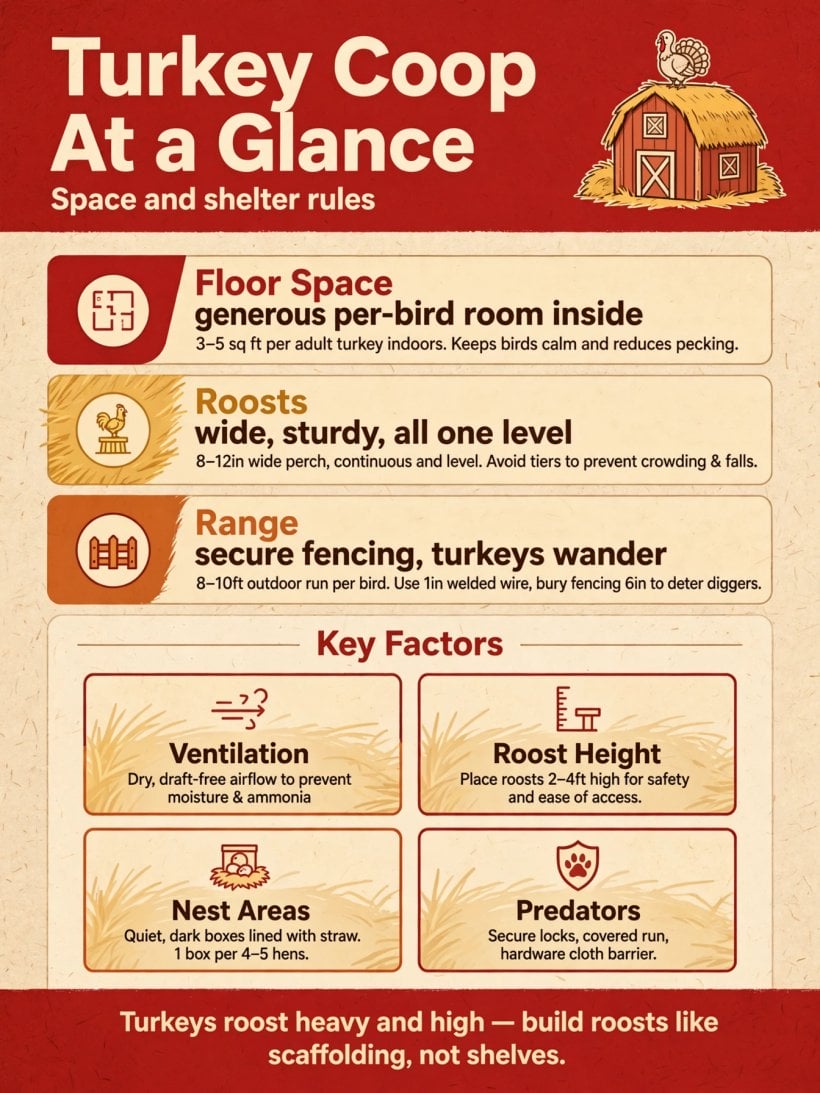
A turkey coop at a glance: about 3–5 sq ft of floor space per adult, wide sturdy roosts at one level, and 8–10ft of secure range per bird — with ventilation, roost height, nest areas and predators as the key factors.
2. Floor Space: Think in Square Feet per Bird
Start with the infographic’s indoor allowance — roughly three to five square feet per adult turkey — and treat it as the honest minimum for a contented flock, not a target to shave. Turkeys are big, social and surprisingly peaceable in good space, and surprisingly quarrelsome out of it. Measure the internal floor you actually have, once nest boxes, feeders and drinker stands have taken their share, and let that number, divided by the allowance, tell you how many birds the building can honestly hold.
Space is also a health decision. Air volume above a roomy floor stays fresher between cleans, litter lasts longer before it turns, and birds can keep the small distances from each other that turkey etiquette requires — a hen can step out of a stag’s courtship display, a young bird can eat without being shouldered off the trough. Pecking, feather damage and restless pacing at the door are almost always the flock’s review of the floor plan, written in behaviour.
Keep the contrast with smaller poultry in mind when you plan mixed housing areas. Our guide to quail coop ideas for housing, space and predator proofing works to about a square foot a bird — a reminder that poultry housing scales with the bird, and that a turkey’s footprint, in every sense, is several times a quail’s. Design each species’ space by its own arithmetic, and never by the size of the shed that happens to be empty.
3. Roosts: Wide, Sturdy and All One Level
If the coop has a heart, it is the roost. The infographic’s specification is precise: a wide perch — around eight to twelve inches across the top — sturdy, continuous, and all at one level. Width matters because a turkey does not grip a branch like a songbird; it settles its broad feet flat and rests its weight down through them, often with the keel lowered onto the perch for balance. A wide, flat-topped timber is a bed; a narrow pole is a tightrope, and heavy birds asked to tightrope all night arrive at morning footsore and cross.
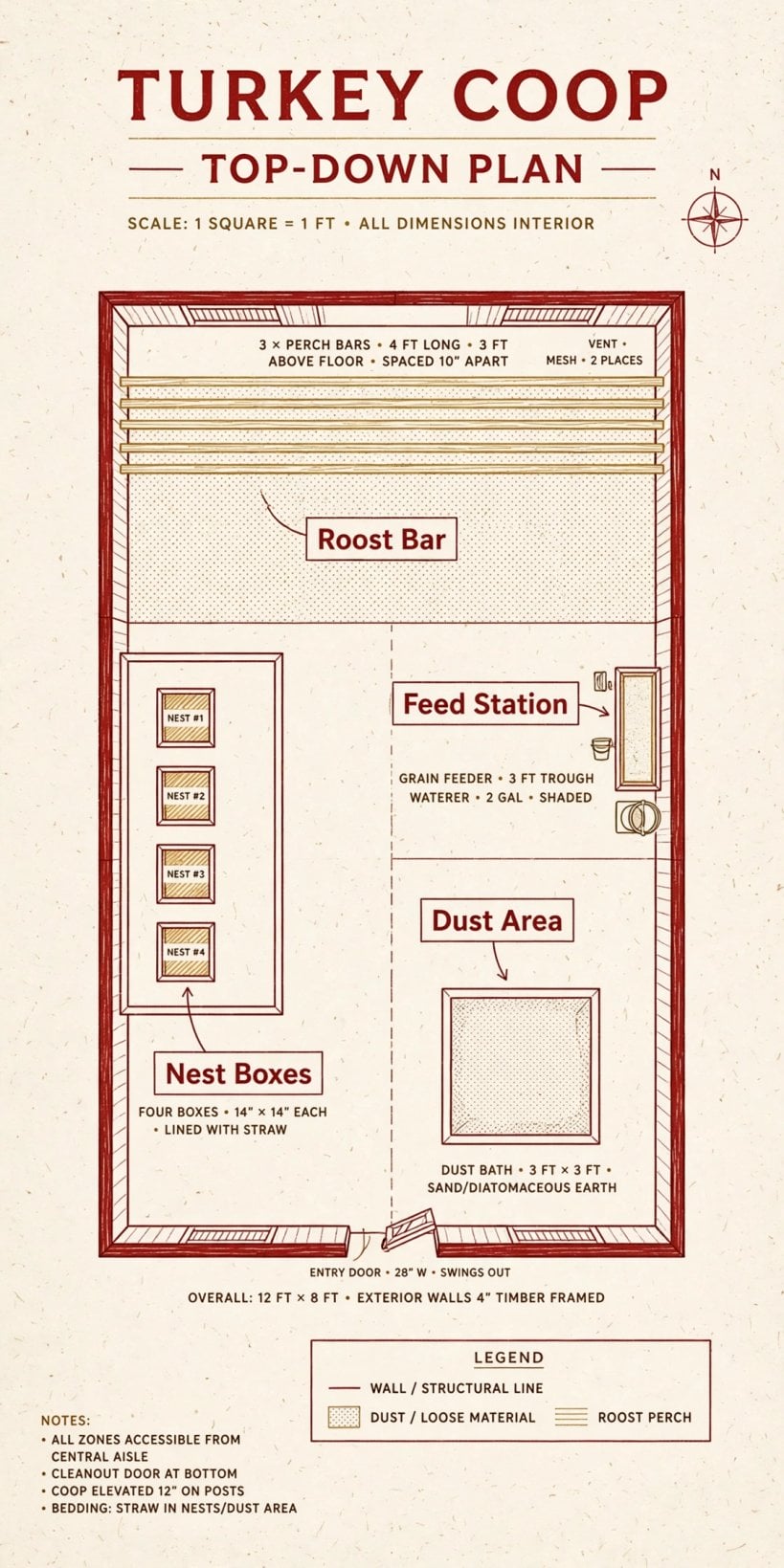
One level matters just as much. Tiered perches invite the whole flock to compete for the top row, and turkeys compete with their whole weight — birds are pushed, landings are fumbled, and the lowest, latest birds end up sleeping in the draught by the door. A single, continuous run of perch at one height, with room for every bird to stand shoulder to shoulder and a little to spare, turns roosting into the calmest hour of the turkey’s day: a shuffle, a settle, a few soft calls, and quiet.
Build it like the scaffolding the chart describes. Substantial timbers, properly supported at close intervals, fixings that cannot work loose under a season of heavy landings, and edges softened so feet and feathers are not worn by splinters. Then inspect it as you would any load-bearing structure — a perch that flexes, creaks or lists is a perch in the process of failing, and it will choose the middle of a winter night, with the whole flock aboard, to finish the job.
4. Roost Height: High Enough to Please, Low Enough to Land
Roost height is one of the chart’s key factors, and its guidance — around two to four feet — threads a needle between the bird’s instincts and its safety. Turkeys are roosting birds by ancestry; wild ancestors slept in trees, and a domestic flock still wants to sleep up, off the ground, in a row. A perch at this height satisfies that instinct completely: birds hop and flap up at dusk with evident satisfaction, and look down on their world from a proper throne.
The landing is the other half of the calculation. A turkey coming down at dawn is a heavy body on broad wings, not a helicopter: it needs a clear, unobstructed descent and room to land running if it must. Keep the floor beneath and before the perch clear of feeders, drinkers and nest boxes, keep the litter deep enough there to forgive a clumsy arrival, and never raise perches higher to gain floor space — the birds pay for the keeper’s extra square feet in bruised keels and worse.
Other roosting poultry make the same negotiation at different scales. Muscovy ducks, unusually among ducks, also take to low perches, and our muscovy duck guide to temperament, care and eggs describes housing built around that habit — broad, low roosting for a heavy bird, exactly the turkey principle in a smaller, quieter package. Keepers housing both species will find the design language transfers: width, strength, one sensible height, and a soft place to land.
5. Range: Secure Fencing for Wandering Birds
Outside the coop, the infographic allows roughly eight to ten feet of run per bird and insists on the point its title makes: turkeys wander. A turkey flock given a gate carelessly latched will be touring the garden, the lane and the neighbours’ flowerbeds by mid-morning, in good order and with no malice, simply because walking and grazing is what the day is for. The range must therefore be both generous and genuinely enclosed — roomy enough that grass survives, fenced well enough that the flock stays its tenant.
Fence for the threats as much as for the birds. The chart specifies fine welded wire — one-inch mesh — with fencing buried several inches to deter diggers, and that specification is aimed at predators as much as escapees: a fence a turkey cannot breach is also a fence a fox cannot stroll through. Walk the line looking for the gaps a wandering bird finds first — gate bottoms, corners, the spot where ground dips away under a run of wire — because the flock’s daily patrol will find them all, in order.
Manage the ground inside the fence as pasture, not as a yard. Rotate the flock onto fresh sections if your layout allows, rest worn ground before it turns to mud, and site dust-bathing hollows, shade and water where the birds naturally gather. A range that stays green keeps turkeys occupied, supplements their diet with grazing, and spreads their manure as fertiliser instead of concentrating it as a problem — the fence merely draws the boundary; the management inside it is the husbandry.
6. Ventilation: Dry Air for Big Birds
Ventilation earns its key-factor place in any turkey building because big birds make big weather indoors: a flock of large, warm bodies breathes out moisture all night, and droppings under the roost add ammonia to the mix. The chart’s rule — dry, draught-free airflow that prevents moisture and ammonia building up — is achieved with openings placed high, above roost height, so air exchanges steadily without a cold stream ever crossing the birds at rest.
Judge ventilation by smell and touch, the keeper’s two reliable instruments. A well-aired turkey house smells of straw and birds, faintly; a failing one catches the back of your throat at the door and shows condensation on cold mornings. Deep, dry litter is ventilation’s partner — it absorbs what the air cannot carry — so fork it, top it up, and treat a damp patch under the perch as a ventilation fault to fix, not a cleaning failure to mop.
Mesh every opening as if a predator had already read the plans, because vents are the holes in the armour that get forgotten. Hardware cloth, fixed firmly, turns a vent back into wall for security purposes while leaving it open for air. Check vents in the seasonal rounds — feathers and dust fur them, spiders web them, ivy climbs them — since a ventilation system quietly ceasing to ventilate will announce itself, eventually, in the flock’s breathing rather than your diary.
7. Nest Areas: Quiet, Dark and Lined With Straw
A laying turkey hen wants what the chart promises her: a quiet, dark box lined with straw, at ground level, in the calmest corner of the building. The allowance is roughly one box for every four or five hens, and the boxes should be sized for the bird — broad and tall enough for a large hen to enter, turn and settle without ceremony. A hen that approves of her box uses it faithfully; a hen that does not will lay in the range’s most inventive hiding places, and the egg hunt becomes a daily sport you did not enter.
Keep nests inviting and eggs findable. Fresh straw, renewed as it flattens or soils; a design that lets you collect from outside or from a rear hatch, so gathering does not disturb a sitting hen’s neighbours; and a daily collection rhythm that keeps eggs clean and discourages any hen from upgrading her laying corner into a sitting project before you are ready. In season, a turkey hen’s mind turns to section 8’s neighbour topic soon enough — a full nest is an invitation to broodiness, and a broody turkey is a force of nature.
Position nest areas away from the roost’s drop zone and the door’s traffic, in the building’s natural quiet, and expect the hens to grade your work honestly. A row of boxes all in use by mid-morning, eggs arriving clean and in one place, hens slipping in and out without argument — that is the review you want. Empty boxes and eggs in the hedge bottom are also a review, and the correct response is to move the boxes, deepen the straw, darken the corner, and let the hens mark the new draft.
8. Predators: Locks, Covered Runs and Hardware Cloth
Predators are the fourth key factor, and a turkey coop must be designed as if the local foxes, dogs and other hunters have already cased it — because given a season, they will. The chart’s specification is a system, not a single trick: secure locks that paws cannot work, a covered run so nothing can drop or climb in, and hardware-cloth barriers in place of any wide or flimsy mesh. Turkeys are big, but size is no defence asleep, and a flock roosting in the open run on a warm night is relying entirely on the fence you built.
Work the perimeter like an intruder with time. Latches get bolts or clips that need two different motions; mesh gets buried or skirted where digging is the habit; corners, door edges and the junction of run and house get the closest look, because those are where builds are lazy and predators are diligent. A covered run does triple duty — it excludes climbers and fliers, keeps litter and dust baths dry, and gives the flock a secure outdoor room for the days when the free range is not on offer.
Audit on a schedule and after every storm. Wind loosens what paws then explore; ground shifts, wire sags, timber rots quietly at the soil line. Our guide to quail coop ideas for housing, space and predator proofing makes the same argument at miniature scale, and the two together cover the keeper’s whole duty: the smallest bird and the biggest bird on the holding are each exactly as safe as the weakest latch on their door, and the audit is what keeps every latch honest.
9. Feeders, Drinkers and Dust Baths
Furnish the coop and run around the birds’ day. Feeders should be troughs or hoppers with room for the whole flock to eat at once — turkeys are peaceable at a long trough and pushy at a short one — raised as the birds grow so they feed at a comfortable height, and sheltered so the ration stays dry. What goes in them is a subject of its own, covered fully in our guide to what do turkeys eat for poults, growers and adult turkeys; the coop’s job is simply to serve that ration cleanly, at bird height, without waste or queuing.
Drinkers for turkeys must match the drinker: big birds, big appetites for water, and a thorough mess made in enjoying it. Sturdy, stable vessels they cannot tip or foul by standing in — or a drinker design that keeps feet out entirely — set on ground that drains, refreshed daily and scrubbed on the cleaning round. Waterfowl make the same point with more splash: our guide to what do ducks eat for backyard ducklings and adult ducks pairs every meal with water, and turkey keeping follows the same rule — feed and water are one station, planned together, checked together.
Finish with the flock’s favourite appliance: a dust bath. A shallow, dry hollow of soil and sand in a sunny, sheltered corner will be used daily and communally, birds queuing for a turn to work dust through their feathers. It costs nothing but the corner, it keeps plumage and skin in order, and a dust-bathing flock is a flock at ease with its home — which, in the end, is the truest certificate any coop design can earn.
10. Siting, Shelter Styles and Settling the Birds
Put the whole structure where it will work for a decade. Level, drained ground; shelter from the worst wind with the door turned from the weather; summer shade over part of the run; and access you can manage with a barrow, a feed sack and a bucket in January. On a planned holding, the turkey pen belongs near enough to the daily round to be checked without expedition — our half acre homestead layout with zones for gardens, animals and water shows how the biggest birds’ housing fits a smallholding’s map without dominating it.
Style follows the same rules at every budget. A converted shed, a purpose-built timber house and a sturdy hoop shelter can all succeed if the fundamentals travel with them: the floor allowance, the scaffolding roost at one height, ventilation high and proofed, nest boxes in the quiet, locks a paw cannot work. Judge any design — bought, built or converted — by walking its specification against sections 1 to 9 of this guide, and distrust any that asks you to compromise a key factor for a saving.
Settle birds in as carefully as you built for them. Young turkeys arrive from the brooder stage our guide to what to feed baby quail in the first six weeks, from starter feed to grit parallels for the smallest youngsters — the principle of a gradual, watched move to adult housing is the same, at twenty times the size. Show the flock the roost at dusk for the first evenings, keep feed and water routines familiar, and let confidence accumulate. Within a week they will be processing home at nightfall in order of rank, ready to be named — and our collection of chicken names for hens, roosters and the whole flock has ended more than one keeper’s evening happily occupied with the shortlist.
Final Considerations
A turkey coop succeeds by respecting the bird: three to five square feet a bird indoors, a wide perch built like scaffolding and kept at one level and one sensible height, eight to ten feet of honestly fenced range, dry air, dark straw-lined nests and locks that mean it. Build those in from the first post hole, and the result is a calm, healthy flock in a shelter that serves keeper and birds alike for years.


0 Comments