

Tiny, fast-growing and hungry from the moment they dry off, baby quail chicks need the right feed from day one, not leftovers borrowed from the chicken run.
Knowing what to feed baby quail in those first six weeks — finely ground starter, safe water and steady warmth — is what turns fragile hatchlings into strong, feathered youngsters.
1. Feeding Baby Quail at a Glance
Our infographic maps the first six weeks into two simple feeding stages, with one constant running through both of them: safe water, always. It also names four key factors that shape every decision in the brooder — the protein level of the starter, the size of the grind, the warmth of the brooder, and the safety of the water dish. Learn those four and the rest of this guide becomes a set of easy daily habits.
| Stage | What to offer | How it is given |
|---|---|---|
| Week 0–3 | High-protein gamebird starter | Finely ground, so tiny bills can pick it up and swallow it safely. |
| Week 3–6 | Starter plus grit access | The same starter, with grit available so growing birds can grind food in the gizzard. |
| Water | Shallow dishes with pebbles | Available always, kept shallow so chicks can drink without any risk of drowning. |
The four key factors deserve a closer look before the detail begins. Protein comes first: the infographic puts the starter at 24–28% for the first three weeks, because a quail chick is building feathers, muscle and bone at remarkable speed. Grind size comes next — fine and crumb-like for week 0–3, matched to a bill that is smaller than a thumbnail. Warmth underpins appetite: 95°F in the first week, reduced by 5°F each week, keeps chicks feeding instead of huddling. And water safety is non-negotiable: shallow, with pebbles, because quail chicks can drown in deep water and the pebbles in the dish are not optional.
Keep this table as your brooder-door summary. If a chick is in its first three weeks, it gets fine, high-protein starter and shallow water. If it is past three weeks, it still gets starter, but grit joins the menu and the heat steps gently down. Nothing else is needed in these weeks, and that simplicity is the point: a short, reliable routine, repeated calmly every day, grows healthier quail than any complicated feeding experiment.
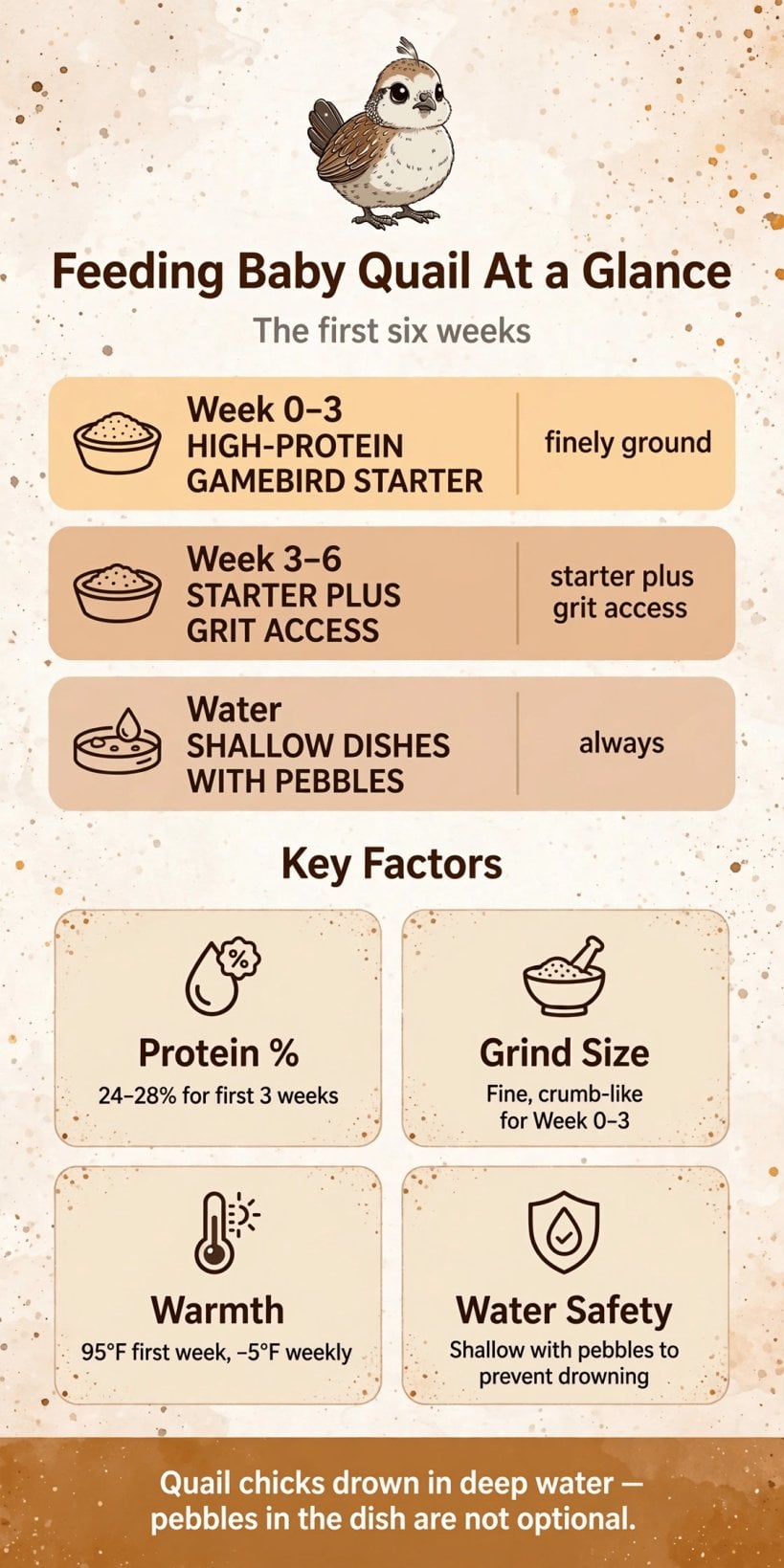
Feeding baby quail at a glance: high-protein gamebird starter finely ground for week 0–3, starter plus grit access for week 3–6, and shallow water with pebbles at all times.
2. The First Feed: High-Protein Gamebird Starter
The first feed a baby quail should meet is a starter made for gamebirds, not a general poultry crumb borrowed from another pen. Quail chicks grow faster, feather sooner and stay smaller than most backyard chicks, and a gamebird starter is blended with that pace of growth in mind. Offer it as soon as the chicks are dry, fluffy and moving confidently around the brooder, and make sure every chick can reach the feeder without climbing, stretching or competing with a crowd of siblings.
For the first day or two, sprinkle a little starter on a sheet of rough paper or a shallow tray as well as in the feeder itself. Chicks learn to peck at what is under their feet, and a scattered dusting teaches them what food looks like far faster than a full hopper in the corner. Tap the feed gently with a fingertip the way a mother hen calls her brood, and watch for the moment each chick starts picking up crumbs on its own — that small milestone settles a keeper’s nerves more than anything else in the first week.
Keep the starter fresh, dry and always available. Top the feeder up little and often rather than filling it deep, tip out any feed that has been scratched through bedding or dampened near the drinker, and store the bag sealed, cool and away from pests. Where the brooder sits matters too: our half acre homestead layout with zones for gardens, animals and water shows how a sheltered, draught-free corner for young birds fits naturally into a smallholding’s daily rounds, close enough to check several times a day without turning each visit into an expedition.
3. Grind Size: Fine Crumbs for Tiny Bills
A feed can be perfect on paper and still fail a baby quail if the pieces are too big to eat. In the first three weeks the grind should be fine and crumb-like, closer to coarse sand than to the pellets or cracked grains an adult bird handles easily. Run a pinch between your fingers before you fill the feeder: if you can find lumps a chick would have to wrestle with, the batch needs grinding down before it goes anywhere near the brooder.
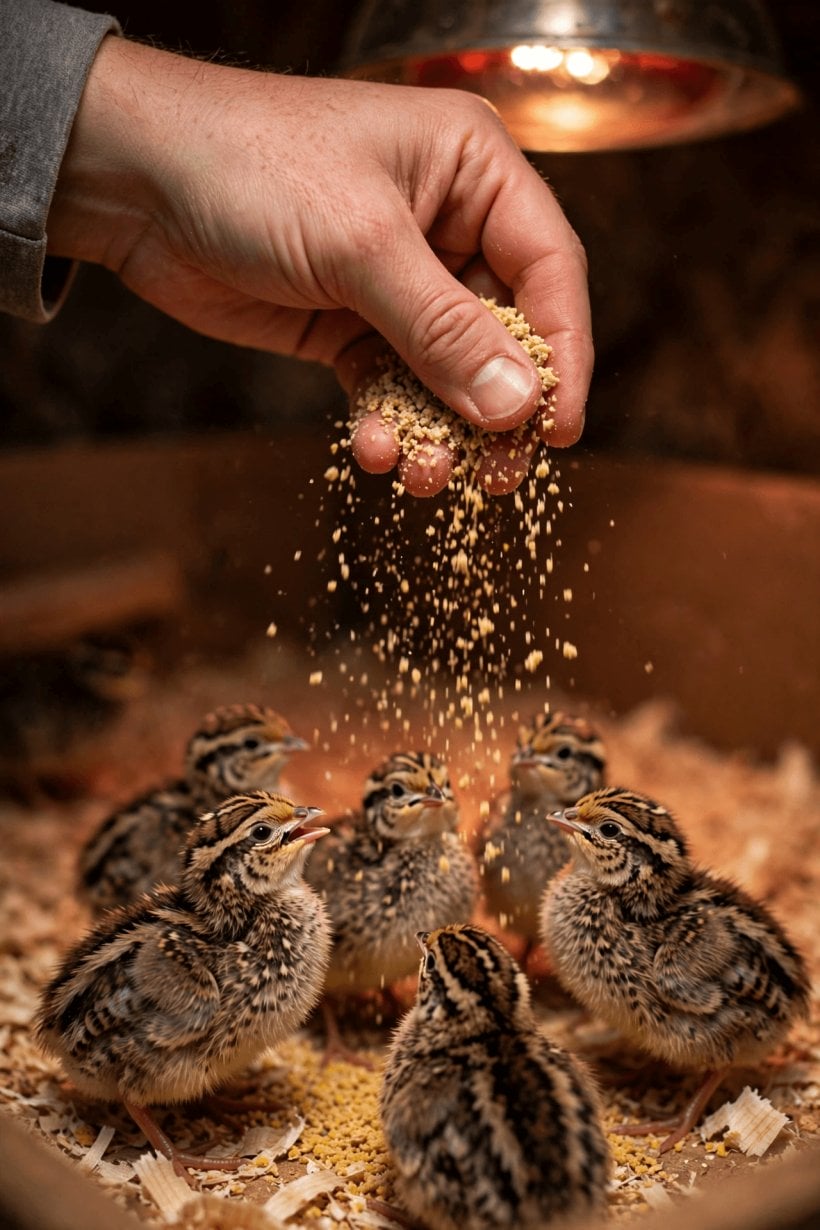
Grinding starter at home is simple kitchen work. A short burst in a blender or food processor, a few turns in a clean grinder kept for feed, or a steady session with a mortar and pestle for a small hatch will all bring coarse crumbs down to size. Work in small batches so the feed stays fresh, and aim for an even crumb rather than flour: chicks need pieces they can pick up, not dust that cakes on wet bills, coats the drinker and gets wasted in the bedding.
Watch the feeder as carefully as you watch the chicks. If crumbs are being flicked aside and only the finest dust disappears, the grind is still too coarse; if the tray empties evenly and little crops are round at roosting time, you have it right. As the birds grow through weeks three to six their bills strengthen and the standard starter crumb becomes manageable on its own, which is why the infographic only insists on the fine grind for the earliest stage. Growing up, for a quail, is measured in small changes of bill and appetite as much as in visible size.
4. Protein in the First Three Weeks
Protein is the engine of the first three weeks. The infographic sets the starter at 24–28% for this stage, and everything you see in a healthy brooder follows from it: pin feathers pushing through down within days, legs strengthening under a body that seems to grow between morning and evening checks, and a bright, busy appetite at the feeder from first light. A chick is not simply getting bigger in these weeks — it is building the whole frame it will live in.
That is why diluting the starter early is such a costly mistake. Filling the feeder with grains, greens or kitchen extras might look kind and varied, but every beakful of low-value food is a beakful of starter not eaten, and the protein the chick needed that day never arrives. Treats, scraps and foraging extras all have their season later in a quail’s life; in the first three weeks the menu is deliberately plain. Starter, water, warmth — and nothing competing with them.
Read the bag before you buy, and again when you open it. Choose a gamebird starter whose stated level matches the infographic’s range for the early weeks, check that the bag is in date and smells fresh and clean, and resist stretching an old bag by mixing it with whatever is left in another bin. If chicks look slow to feather, feel light in the hand or drift listlessly away from the feeder, look first at the feed itself — its protein, its freshness and its grind — before you look anywhere else.
5. Water Safety: Shallow Dishes and Pebbles
Water is the second food in the brooder, and for baby quail it is also the biggest everyday danger. The infographic is blunt about it: quail chicks drown in deep water, and pebbles in the dish are not optional. A chick that slips into a deep drinker, gets its down soaked and cannot climb out can be lost in a shockingly short time, so the water station deserves the same careful design as the feeder, not whatever spare dish happens to be nearby.
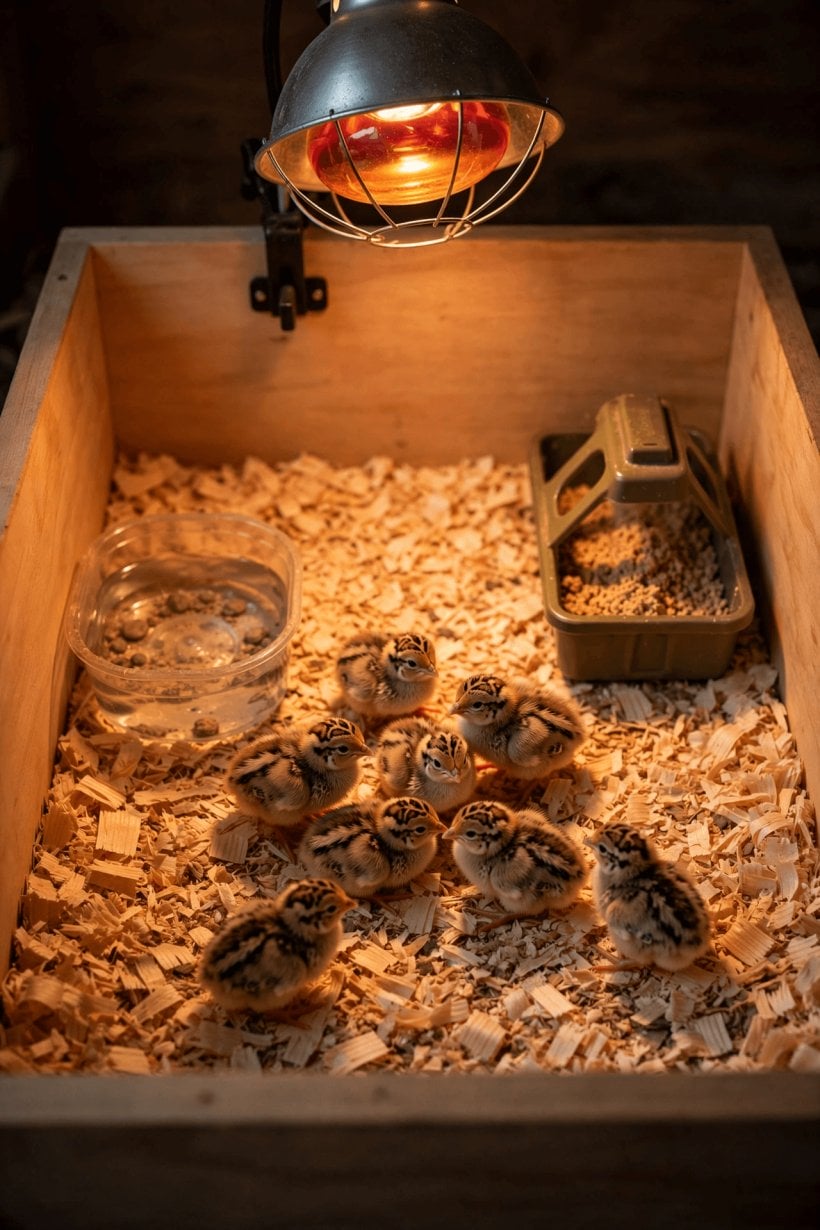
Build the drinker like this: a shallow dish or chick drinker base, filled only deep enough to drink from, with clean pebbles or marbles spread across the bottom so there is nowhere a chick can actually submerge. The birds step among the pebbles, sip from the gaps and stay dry. Refresh the water at least daily — more often when bedding keeps getting kicked into it — and set the dish on a flat, stable spot away from the busiest scratching area, raised just enough to stay clean without becoming a climbing challenge.
Keepers of other poultry will recognise the principle, even if the scale is smaller. Our guide to what do ducks eat for backyard ducklings and adult ducks makes fresh water a key factor for waterfowl too, because birds that eat dry feed need water beside it at every meal. For quail chicks the rule is the same, with one addition: the water must be as safe as it is fresh, and a chick standing in its drinker is a sign to add more pebbles, not to add more water.
6. Warmth, Feeding and the Brooder Routine
A cold chick does not eat, and a chick that does not eat cannot grow, however good its starter is. The infographic sets the brooder at 95°F for the first week, stepping down by 5°F each week after that, and the chicks themselves will show you whether the setting suits them. Spread out comfortably between the heat and the feeder, feeding, drinking and dozing in loose groups — that is the picture you want. Huddled tightly under the heat and cheeping loudly means too cold; pressed to the far edges and panting means too hot.
Arrange the brooder so the birds can choose. Heat at one end, feed and water in the cooler zone, and enough floor space that no chick has to cross a scrum to eat. Check the routine in a steady order — heat, water, feed, bedding — morning and evening, and you will catch most problems while they are still small: a drinker tipped empty, a feeder buried in bedding, a chick that has stopped joining the rush when fresh crumbs land.
Change only one thing at a time as the weeks pass. The weekly step down in warmth is a change; so is a new feeder as bills grow. Keeping the rest of the routine steady lets you see the effect of each adjustment clearly, and lets the chicks meet it calmly. Quail are creatures of pattern, and a brooder that runs on a calm, predictable rhythm produces birds that feed confidently, rest properly and handle the bigger changes of week six — new housing, new ground — without drama.
7. Week Three to Six: Starter Plus Grit Access
From week three the infographic adds one item to the menu: grit access, alongside the same starter the chicks have eaten from the start. Grit is not food and it carries no nutrition; it is the tool the gizzard uses to grind food down, a small store of hard, sharp-edged particles the bird keeps inside itself. Offer it in a separate small dish rather than mixing it through the feed, so each bird can take what it needs, when it needs it, the way it would pick up tiny stones on open ground.
Keep the starter itself unchanged through this stage. It is tempting, once chicks look sturdy and half-feathered, to rush them onto an adult ration or whatever the older birds are eating, but weeks three to six are still growth weeks — feathers completing, frames filling out — and the starter’s balance still fits the job. The change in this stage is access and independence, not ingredients: grit in its dish, water kept safe, heat stepping down, and feeders and drinkers raised or enlarged as the birds outgrow the chick-sized set.
Other young poultry follow the same broad pattern of a starter stage, then a gradual widening of the diet, which is why keepers who raise several species plan their feed store as one system. Our guide to what do turkeys eat for poults, growers and adult turkeys walks through the turkey version of that journey, and reading the two side by side is a good way to keep each species’ timetable straight in a busy season. For the quail themselves, mark the weeks on a calendar by the brooder: week three, grit goes in; week six, the next chapter begins.
8. What Not to Feed Baby Quail
The list of what not to feed is short, and most of it is common sense once the starter-first principle is clear. Never offer feed that is mouldy, damp, sour-smelling or past its best — a chick’s small body has no reserve for coping with spoiled food. Never offer whole grains, large cracked pieces or adult pellets in the early weeks, however eagerly an older bird elsewhere on the holding devours them; a food a chick cannot pick up, swallow or grind is not a treat, it is a hazard and a wasted meal.
Do not substitute rations meant for a different job. Feeds blended for laying birds, for adult maintenance or for another species altogether are built around different priorities from a growing chick’s, and using them as the main diet in the first six weeks quietly unbalances everything the starter was chosen to provide. The same applies to filling the brooder with bread, salty scraps or sugary kitchen leftovers: they take up room in a tiny crop that should be full of starter, and they teach chicks to wait for novelties instead of eating the feed that grows them.
Be equally careful with well-meant extras from the garden. A chick in the brooder does not need greens, insects, fruit or seeds, even though adult quail will enjoy variety later in life. If it is not starter, grit or clean water, it does not belong in the first six weeks — that single rule prevents almost every feeding mistake a new keeper can make, and it keeps the diagnosis simple if growth falters: when the menu never changes, the cause is rarely the menu’s variety.
9. Watching Growth: Appetite, Crops and Droppings
Your eyes are the best feeding tool you own. Healthy baby quail are busy: they make short, purposeful trips between warmth, feed and water, they peck with intent, and by evening their crops — the small pouches at the base of the neck — feel gently full and rounded. A crop that is flat at roosting time, morning after morning, is an early question to ask about grind, warmth or competition at the feeder, long before it becomes a problem you can see from across the room.
Pick chicks up briefly and kindly as part of the routine. A growing chick feels solid for its size, breastbone present but not sharp, legs sturdy under it. Compare birds within the brood rather than against a chart: the chick that feels noticeably lighter than its siblings, or that is always last to the feeder, is the one to watch, to feed check first and to give a clear, unhurried run at the crumbs. Droppings, too, are information — steady, formed droppings on clean bedding are part of the normal picture, and a sudden change across the whole brood points back to feed, water or warmth before it points anywhere else.
This is also the stage where a flock starts to become individuals. Keepers who name their birds early learn their characters at the feeder — the bold, the shy, the crumb thief — and our collection of chicken names for hens, roosters and the whole flock is a cheerful place to borrow naming ideas while your quail are still in the brooder. A named chick is an observed chick, and observation, repeated daily, is what turns feeding from a chore into genuine stockmanship.
10. Moving On: From Starter to Grower and Outdoor Life
At around six weeks the infographic’s timetable ends, and the keeper’s judgement takes over. Feathered, active young quail no longer need brooder heat in mild weather or finely ground feed, and the move onto a grower or adult quail ration should be made gradually: mix the new feed into the starter in growing proportions over several days, keep grit available throughout, and watch that every bird makes the change without losing its appetite or its place at the feeder.
Housing changes at the same pace as feeding. The youngsters’ first home outside the brooder should be dry, draught-free and secure against predators reaching through wire or under doors — our guide to quail coop ideas for housing, space and predator proofing works through those housing decisions in full. Introduce the new ground on a calm, mild day, keep the familiar feed and water style for the first days outdoors, and let confidence build before you expect the birds to use every corner of a larger pen.
Quail rarely stay the only poultry project for long, and the feeding habits learned here transfer well. Keepers planning larger birds will find the housing side covered in our turkey coop and shelter ideas for roosts, runs and space, while those tempted by waterfowl can settle in with our muscovy duck guide to temperament, care and eggs. Whatever joins the holding next, the lesson of the first six weeks stays the same: match the feed to the bird and its age, change one thing at a time, and watch the flock tell you whether you got it right.
Final Considerations
Feed baby quail simply and consistently: high-protein gamebird starter, finely ground at first, grit from week three, shallow water with pebbles always, and warmth that steps down gently week by week. That is the whole system, and its simplicity is its strength. Keep the routine steady, watch the birds at the feeder every day, and the tiny chicks that arrived as balls of down will repay you as strong, bright, well-grown young quail, ready for everything life outdoors has to offer them.


0 Comments