

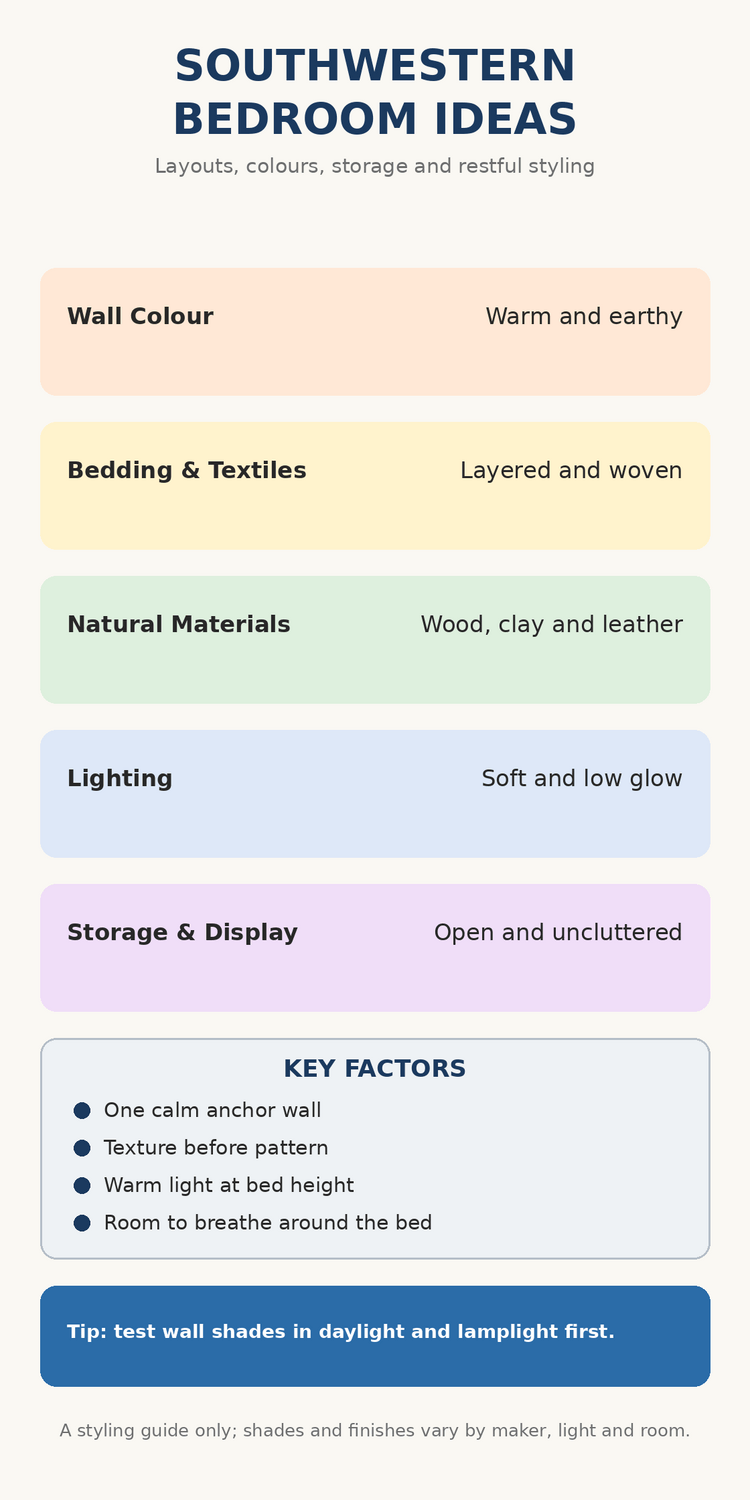
A southwestern bedroom feels like a desert evening brought indoors: warm plaster, woven pattern, low light and honest natural materials that ask nothing flashy of the eye. This guide gathers seventy-five ideas for rooms in that spirit, covering wall colour, beds, bedding, layouts, texture, lighting and storage, so you can build a room that feels grounded by day and restful by night, whether you are starting from a single woven blanket or planning a whole room around terracotta walls.

Related Guide: 10 Asian Bedroom Ideas: Calm Layouts, Natural Materials and Restful Styling
The ideas below stay close to what makes this look work in a real home rather than a showroom. Warmth comes from a few strong choices repeated calmly, not from filling every surface, and restfulness comes from leaving breathing room around the bed, keeping light low in the evening, and letting one or two woven patterns do the talking while everything else stays quiet.
1. Wall Colour and Plaster
Every room in this style starts with the walls, because plaster colour sets the temperature of everything placed against it. Terracotta, sand, clay and warm white each give a different kind of warmth, and the choice should follow the light your room actually gets, the wood tones you already own, and how bold you want the bed wall to feel when you walk in.
| Item | What it is |
|---|---|
| A terracotta anchor wall | Let one terracotta wall carry the room and keep the remaining walls calm and pale, so the eye has a single warm focus behind the bed. |
| A warm sand wash on every wall | When a room is small or short on windows, a warm sand wash on every wall can feel more restful than a single bold feature wall. |
| Whitewashed adobe glow | Whitewashed plaster softens strong sunlight and gives a room an old adobe calm that suits both rustic wood and cleaner modern furniture. |
| Rust depth behind the bed | A rust wall behind the bed acts like a headboard in itself, grounding the bed and giving cushions and throws something rich to sit against. |
| Ochre warmth for a dim room | Rooms that face away from the sun can feel flat in pale colours, and a soft ochre wash brings back the warmth the light withholds. |
| Clay plaster texture | Clay plaster adds a soft, matte texture that paint alone cannot give, with a surface that catches light differently across the day. |
| Deep colour low, pale colour high | Painting the lower part of a wall in a deep desert shade and the upper part in a pale wash gives a room structure without a hard feature wall. |
| Limewash softness | Limewash gives walls a cloudy, mineral softness that suits this style beautifully, especially in rooms where you want warmth without weight. |
| A low wooden platform bed | A low platform bed keeps the room feeling close to the ground and calm, which suits the desert character of this style better than a tall, imposing frame. |
| A leather headboard | A leather headboard in a warm tan or deep brown brings instant southwestern character and softens the wall behind the bed. |
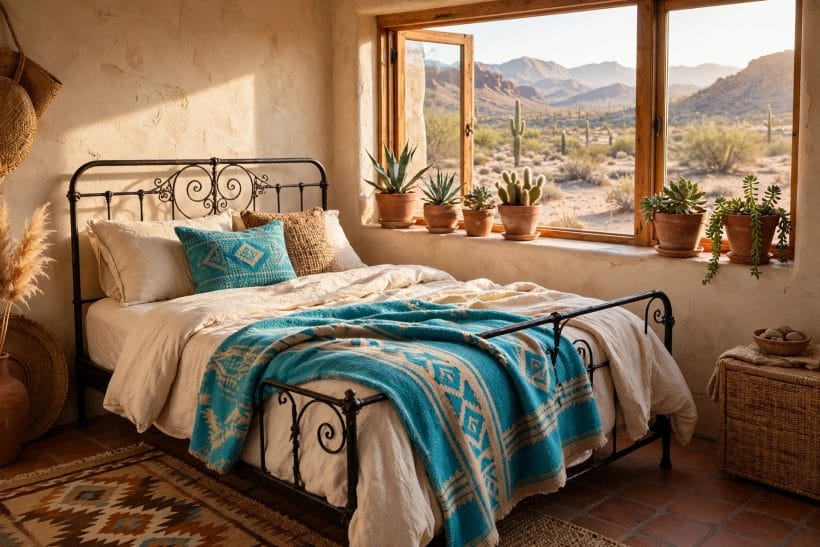
| A wrought-iron frame | A wrought-iron frame adds a light, open silhouette that suits rooms where a heavy wooden bed would feel too much. |
| A carved wooden headboard | A carved wooden headboard becomes the room's centrepiece, especially when the carving is bold but not fussy. |
| An upholstered headboard in natural linen | When the walls and bedding already carry strong pattern, an upholstered headboard in natural linen calms the composition and gives a soft place to lean while reading. |
| A bed facing the window view | If your room has a view worth waking to, turn the bed to face it rather than pushing the bed against the window wall by habit. |
| A bed centred on the longest wall | Centring the bed on the longest wall gives the room its natural symmetry and leaves balanced space for a nightstand on each side. |
| A four-poster frame in dark wood | A four-poster frame in dark wood suits a larger room, where its height can be enjoyed without crowding the space. |
| A geometric woven blanket as the hero | Choose one geometric woven blanket with a bold diamond or stepped pattern and let it be the room's hero, folded across the foot of the bed or spread fully on display. |
| Layered throws instead of matched sets | Layering two or three throws in related earth tones looks more collected and lived-in than a perfectly matched bedding set. |
| A cream linen base | Cream linen bedding gives every woven layer a calm foundation and keeps a warm room feeling fresh rather than heavy. |
| Rust and cream cushions | Rust and cream cushions are the easiest way to bring desert colour onto a pale bed without repainting anything. |
| A turquoise accent used sparingly | Turquoise is the classic cool note in this warm palette, but it works best as a single accent: one cushion, one throw stripe, or one vase on the nightstand. |
| A handwoven rug beside the bed | A handwoven rug beside the bed gives bare feet a soft landing and extends the room's pattern from the bed onto the floor. |
| A woven wall hanging above the bed | A woven wall hanging above the bed softens the wall, absorbs sound and adds pattern at eye level without the formality of framed art. |
| A basket-weave throw at the foot | A basket-weave throw folded at the foot of the bed adds chunky texture that contrasts beautifully with smooth linen sheets. |
| Terracotta with cream | Terracotta with cream is the most forgiving pairing in this style, because cream cools the terracotta just enough to keep it liveable on large surfaces. |
| Rust with sage green | Rust with sage green borrows the desert itself, where red earth meets scrubby green, and the pairing feels natural rather than decorated. |
| Sand with turquoise | Sand with turquoise suits bright rooms, where the pale neutral base lets a small amount of turquoise feel like clear sky over desert ground. |
| Ochre with charcoal | Ochre with charcoal gives a room a grounded, evening feel, with the deep grey making the warm yellow glow rather than shout. |
| Clay with soft white | Clay with soft white is the quietest pairing here and suits rooms meant purely for rest, where even terracotta might feel too loud. |
| Desert rose with warm wood | Desert rose, a dusty pink drawn from desert stone, softens this style beautifully when paired with warm wood tones. |
| Deep brown with pale plaster | Deep brown leather and wood against pale plaster gives a room instant depth, because the dark furniture reads clearly against the light walls. |
| A clear path on both sides of the bed | Leave a clear path on both sides of the bed whenever the room allows it, so neither sleeper climbs over the other and the bed feels accessible rather than wedged in. |
| A reading chair by the window | A reading chair by the window turns an unused corner into the room's favourite seat, especially when paired with a small side table and a soft lamp. |
| A dresser opposite the bed, not beside the door | Placing the dresser opposite the bed gives you something pleasant to face on waking, while a dresser beside the door crowds the entrance and makes the room feel smaller. |
| Nightstands matched in height | Nightstands matched in height to the top of the mattress make lamps easy to reach and keep the bed wall looking intentional. |
| A bench at the foot of the bed | A bench at the foot of the bed gives you a place to sit while dressing, lay out tomorrow's clothes, or fold a throw at night. |
| A bed kept out of the door's direct line | Keeping the bed out of the door's direct line makes the room feel private the moment you enter, because the bed is discovered rather than confronted. |
| A mirror placed to bounce light, not face the bed | A mirror placed to bounce daylight from a window brightens the room without the unease of a mirror facing the bed through the night. |
| A quiet corner for a slow morning | Reserve one quiet corner for slow mornings: a chair, a small table and nothing that demands attention. |
| Exposed wooden ceiling beams | Exposed wooden ceiling beams give a room instant warmth and a sense of shelter, drawing the eye upward and making even a plain room feel crafted. |
| Clay pots with desert plants | Clay pots with desert plants bring living green into a warm palette and suit the dry-air character of this style better than thirsty tropical plants. |
| Leather details, used sparingly | Leather details, a headboard, a bench seat or a pair of drawer pulls, add richness without overwhelming the room when used sparingly. |
| Woven baskets for everyday storage | Woven baskets hold throws, magazines and laundry in plain sight while still looking like decoration, which makes them ideal for a style built on texture. |
| A stone fireplace corner | A stone fireplace corner gives a larger room a natural gathering point and a reason to linger in the evening. |
| A cowhide or woven rug underfoot | A cowhide or woven rug underfoot anchors the bed and adds a layer of pattern that the eye meets before the bedding. |
| Raw wood nightstands | Raw wood nightstands, with visible grain and simple shapes, suit this style better than lacquered or painted pieces. |
| Linen curtains that filter light | Linen curtains filter sunlight into a soft, warm glow that suits desert colours far better than heavy drapes or bare glass. |
| Clay lamps on both nightstands | Clay lamps on both nightstands give the bed wall symmetry and a warm, earthy glow at exactly the height where evening light flatters. |
| Low, warm bulbs throughout | Low, warm bulbs throughout the room keep the palette golden in the evening, while cool white bulbs can turn terracotta harsh and clinical. |
| A dimmer for the evening wind-down | A dimmer on the main light lets you lower the room gradually as bedtime approaches, which helps the body settle and keeps the room's mood flexible. |
| A lantern on the dresser | A lantern on the dresser adds a second pool of warm light and a decorative object that belongs to the style even when unlit. |
| Flameless candles for a safe glow | Flameless candles give the flickering warmth of candlelight without any fire risk near bedding and curtains. |
| Morning light through sheer curtains | Morning light through sheer curtains wakes a room gently, filtering the sun into a warm haze rather than a sharp beam. |
| A wall-mounted reading light | A wall-mounted reading light beside the bed frees the nightstand for a lamp or a book and gives the reader precise light without disturbing a sleeping partner. |
| No harsh overhead glare at night | Skipping harsh overhead light at night is the single easiest way to make a warm room feel restful, because overhead glare flattens texture and colour alike. |
| Built-in shelves for pottery | Built-in shelves for pottery turn a collection into architecture, giving clay pieces a permanent home rather than a crowded dresser top. |
| A basket beneath the bench | A basket beneath the bench hides extra throws and slippers in the most useful spot in the room, right where you sit to dress. |
| A dresser with turquoise pulls | A dresser with turquoise pulls adds the room's cool accent in a place you touch every day, without committing a whole wall or bed to the colour. |
| Open shelving with an edited display | Open shelving works only when the display is edited, so choose a handful of objects you genuinely love and give each one space. |
| Under-bed boxes in natural fabric | Under-bed boxes in natural fabric hide out-of-season bedding and spare blankets without introducing plastic shine into a natural-material room. |
| Hooks for hats and robes | Hooks for hats and robes on the back of the door or a side wall keep daily items accessible without a chair draped in clothes. |
| One drawer kept only for bedding | Keeping one drawer only for bedding means fresh sheets, pillowcases and throws are always easy to find on change day. |
| One pattern only in a small room | One pattern only in a small room keeps the eye calm, because competing geometrics shrink a space faster than any furniture choice. |
| A shelf above the bed for books and pottery | A shelf above the bed gives a small room storage without stealing floor space, holding books and a few clay pieces where they are easy to reach. |
| Light walls with dark bedding | Light walls with dark bedding suit small rooms beautifully, because the pale walls push outward while the dark bed anchors the centre. |
| Folded throws as decoration | Folded throws stacked on a bench or shelf act as decoration that is also useful, adding colour and texture without taking wall space. |
| A mirror to widen a narrow room | A mirror to widen a narrow room works best when it reflects a window or a woven textile rather than a blank wall. |
| A single statement textile | A single statement textile, one remarkable blanket or wall hanging, can carry a whole small room without any other decoration. |
| A floor kept visible | A floor kept visible makes a small room feel larger, because the eye travels uninterrupted from door to window. |
| Desert artwork in simple frames | Desert artwork in simple frames brings the landscape indoors without competing with woven pattern. |
| Dried grasses in a tall vase | Dried grasses in a tall vase add height and movement to a dresser or corner, echoing the desert plants outside without needing water or care. |
| A woven tray on the dresser | A woven tray on the dresser corrals small essentials, a watch, keys and a lip balm, into one tidy place that still looks like decoration. |
| A cedar drawer liner for fresh bedding | A cedar drawer liner keeps stored bedding smelling fresh and adds a subtle woody scent each time the drawer opens. |
| A fresh plant by the window | A fresh plant by the window adds living green that softens the warm palette and marks the seasons as it grows. |
| One surface left deliberately empty | One surface left deliberately empty, a clear nightstand top or an unadorned stretch of dresser, gives the eye a resting place and makes the decorated surfaces look more intentional. |
1. A terracotta anchor wall
Let one terracotta wall carry the room and keep the remaining walls calm and pale, so the eye has a single warm focus behind the bed. The depth of the colour matters more than its exact name, so test a generous patch in daylight and lamplight and live with it for a few evenings before committing the whole wall.
2. A warm sand wash on every wall
When a room is small or short on windows, a warm sand wash on every wall can feel more restful than a single bold feature wall. The even colour lets woven bedding and wooden furniture stand out without competition, and it keeps the room feeling sunlit even on grey mornings when the sky gives little help.
3. Whitewashed adobe glow
Whitewashed plaster softens strong sunlight and gives a room an old adobe calm that suits both rustic wood and cleaner modern furniture. Keep the wash slightly uneven rather than flat and perfect, because the gentle variation is what stops white walls from feeling cold and makes the room feel hand-finished.
4. Rust depth behind the bed
A rust wall behind the bed acts like a headboard in itself, grounding the bed and giving cushions and throws something rich to sit against. Pair it with cream bedding so the bed stays bright, and keep artwork on that wall minimal, since the colour already does the decorative work.
5. Ochre warmth for a dim room
Rooms that face away from the sun can feel flat in pale colours, and a soft ochre wash brings back the warmth the light withholds. Ochre sits happily beside dark wood and leather, and it flatters skin tones in lamplight, which matters in a room where you begin and end each day.
6. Clay plaster texture
Clay plaster adds a soft, matte texture that paint alone cannot give, with a surface that catches light differently across the day. It suits a bed wall or a whole small room, and it pairs naturally with woven textiles and raw wood, because all three materials share the same hand-made, slightly irregular character.
7. Deep colour low, pale colour high
Painting the lower part of a wall in a deep desert shade and the upper part in a pale wash gives a room structure without a hard feature wall. The deep band anchors furniture and bedding, the pale upper wall keeps the ceiling feeling high, and the join line gives you a natural place to hang a long woven runner.
8. Limewash softness
Limewash gives walls a cloudy, mineral softness that suits this style beautifully, especially in rooms where you want warmth without weight. Apply it in thin, overlapping passes so the colour builds gently, and let the natural variation stay visible rather than correcting every patch into flatness.
2. Beds and Headboards
The bed is the largest object in the room, so its frame and headboard decide whether the style reads as southwestern or merely warm. Low wooden platforms, leather, wrought iron and carved wood all belong here, and the right choice is the one that leaves the room feeling grounded rather than crowded. Looking at tiny bedroom ideas beside your own floor plan helps, because a bed that fits a small room gracefully matters more than any single piece of furniture.
9. A low wooden platform bed
A low platform bed keeps the room feeling close to the ground and calm, which suits the desert character of this style better than a tall, imposing frame. Choose warm-toned wood with a simple profile, dress it with layered bedding, and let the low silhouette make even a modest room feel spacious and settled.
10. A leather headboard
A leather headboard in a warm tan or deep brown brings instant southwestern character and softens the wall behind the bed. Leather ages gracefully and pairs with both woven blankets and crisp linen, so it stays versatile even if you change the bedding colours with the seasons.
11. A wrought-iron frame
A wrought-iron frame adds a light, open silhouette that suits rooms where a heavy wooden bed would feel too much. Keep the ironwork simple rather than ornate, let cream or sand bedding soften the dark metal, and add a woven throw so the bed still reads warm rather than stark.
12. A carved wooden headboard
A carved wooden headboard becomes the room’s centrepiece, especially when the carving is bold but not fussy. Let it stand against a plain plaster wall so the detail shows, keep the bedding quieter than the headboard, and repeat the wood tone once more in a nightstand or bench so the piece feels connected.
13. An upholstered headboard in natural linen
When the walls and bedding already carry strong pattern, an upholstered headboard in natural linen calms the composition and gives a soft place to lean while reading. The neutral fabric lets a geometric blanket take centre stage, and it keeps the bed comfortable for long, lazy mornings.
14. A bed facing the window view
If your room has a view worth waking to, turn the bed to face it rather than pushing the bed against the window wall by habit. Waking to sky, trees or open land sets a restful tone for the day, and the window itself becomes the room’s artwork without costing a thing.
15. A bed centred on the longest wall
Centring the bed on the longest wall gives the room its natural symmetry and leaves balanced space for a nightstand on each side. The arrangement feels settled the moment you walk in, and it makes the bed wall easy to dress with a single hanging textile or a pair of matching lamps.
16. A four-poster frame in dark wood
A four-poster frame in dark wood suits a larger room, where its height can be enjoyed without crowding the space. Keep the posts bare rather than draped for a cleaner desert feel, and balance the dark wood with pale bedding so the bed reads as a strong frame rather than a heavy block.
3. Bedding and Woven Textiles
Bedding is where this style earns its warmth, because woven pattern carries more character than any painted wall. One strong geometric blanket, layered over calm linen, will do more than a drawer full of competing prints, and the layering itself is what makes the bed look inviting. A room with brick wall bedroom ideas in mind shows the same principle: one textured surface, given room to breathe, beats several surfaces shouting at once.
17. A geometric woven blanket as the hero
Choose one geometric woven blanket with a bold diamond or stepped pattern and let it be the room’s hero, folded across the foot of the bed or spread fully on display. Keep the rest of the bedding calm so the pattern has space to shine, and echo one of its colours in a single cushion rather than repeating the whole pattern everywhere.
18. Layered throws instead of matched sets
Layering two or three throws in related earth tones looks more collected and lived-in than a perfectly matched bedding set. Drape one across the foot of the bed, fold another at the pillows, and let the slight mismatch suggest a room built slowly over time rather than bought in one afternoon.
19. A cream linen base
Cream linen bedding gives every woven layer a calm foundation and keeps a warm room feeling fresh rather than heavy. Linen softens with washing and suits the natural-material character of the style, and its gentle wrinkles read as relaxed rather than untidy in a room built around texture.
20. Rust and cream cushions
Rust and cream cushions are the easiest way to bring desert colour onto a pale bed without repainting anything. Mix sizes rather than buying a uniform row, include one woven or fringed cushion for texture, and keep the total count low so the bed still invites you to lie down rather than demanding a cushion ritual first.
21. A turquoise accent used sparingly
Turquoise is the classic cool note in this warm palette, but it works best as a single accent: one cushion, one throw stripe, or one vase on the nightstand. Used sparingly it refreshes the whole room, while used everywhere it competes with the terracotta and rust that should lead the scheme.
22. A handwoven rug beside the bed
A handwoven rug beside the bed gives bare feet a soft landing and extends the room’s pattern from the bed onto the floor. Choose a flat weave for easy cleaning, let its colours echo the bedding without matching it exactly, and size it so it runs at least the length of the bed.
23. A woven wall hanging above the bed
A woven wall hanging above the bed softens the wall, absorbs sound and adds pattern at eye level without the formality of framed art. Hang it centred and slightly above the headboard, keep its width narrower than the bed, and let its fringe or tassels add gentle movement to an otherwise still wall.
24. A basket-weave throw at the foot
A basket-weave throw folded at the foot of the bed adds chunky texture that contrasts beautifully with smooth linen sheets. The weave catches light and shadow through the day, giving the bed depth even in a plain colour, and it is easy to reach for on a cool evening without disturbing the whole bed.
4. Colour Pairings
Pairing is where warm rooms succeed or fail, because desert colours are strong and need calm companions. The safest rule is one warm lead, one pale companion and one small accent, repeated consistently through bedding, walls and objects. Rooms with bohemian bedroom ideas at their heart follow a looser version of the same discipline, layering pattern freely but still returning to a steady palette so the eye can rest.
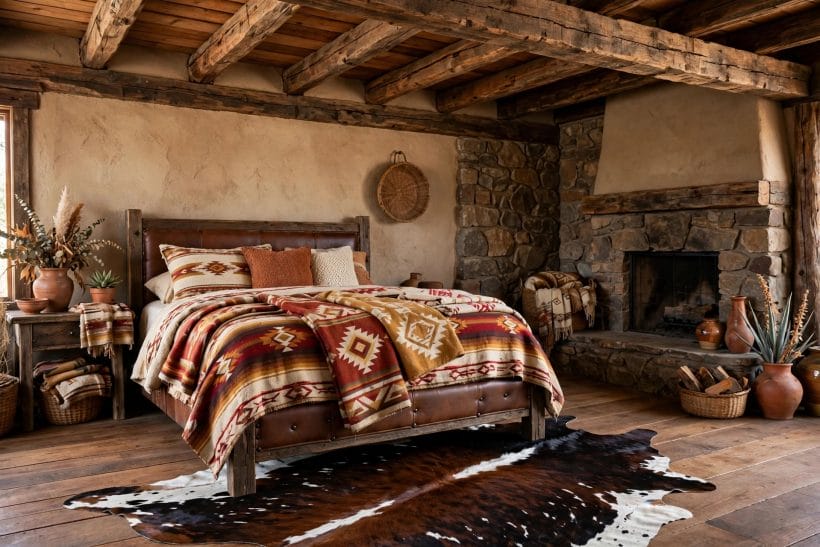
25. Terracotta with cream
Terracotta with cream is the most forgiving pairing in this style, because cream cools the terracotta just enough to keep it liveable on large surfaces. Use cream for bedding and curtains, terracotta for the wall or the blanket, and add wood tones in between so the contrast feels warm rather than sharp.
26. Rust with sage green
Rust with sage green borrows the desert itself, where red earth meets scrubby green, and the pairing feels natural rather than decorated. Keep the sage muted and the rust warm, use green mainly in plants, cushions or a single chair, and let the rust lead through bedding and wall colour.
27. Sand with turquoise
Sand with turquoise suits bright rooms, where the pale neutral base lets a small amount of turquoise feel like clear sky over desert ground. Keep the sand warm rather than grey, limit turquoise to two or three small touches, and add natural wood so the scheme stays earthy rather than beachy.
28. Ochre with charcoal
Ochre with charcoal gives a room a grounded, evening feel, with the deep grey making the warm yellow glow rather than shout. Use charcoal for a headboard, a bench or picture frames, keep ochre on bedding and walls, and soften the contrast with cream linen so the room never feels dark.
29. Clay with soft white
Clay with soft white is the quietest pairing here and suits rooms meant purely for rest, where even terracotta might feel too loud. Soft white walls and bedding let clay-coloured pottery, baskets and throws provide all the warmth needed, and the result feels calm without feeling empty.
30. Desert rose with warm wood
Desert rose, a dusty pink drawn from desert stone, softens this style beautifully when paired with warm wood tones. It works well on a single wall or in bedding, especially in rooms with generous daylight, and it keeps the desert character while making the room feel gentler and more romantic.
31. Deep brown with pale plaster
Deep brown leather and wood against pale plaster gives a room instant depth, because the dark furniture reads clearly against the light walls. Keep the plaster warm rather than stark white, repeat the brown in two or three pieces rather than one, and let woven textiles bridge the gap between dark and light.
5. Layouts That Rest Well
A restful layout is less about furniture and more about movement: clear paths, balanced sides and nothing blocking the light. Walk the room as you would at night, half asleep, and remove anything that interrupts that walk, because a room that is easy to move through is a room that is easy to sleep in. The same balance guides white walls bedroom ideas, where pale surfaces only feel calm when the layout itself is calm first.

32. A clear path on both sides of the bed
Leave a clear path on both sides of the bed whenever the room allows it, so neither sleeper climbs over the other and the bed feels accessible rather than wedged in. The paths need not be wide, but they should be genuinely clear, with no baskets, shoes or charging cables spilling into the walkway.
33. A reading chair by the window
A reading chair by the window turns an unused corner into the room’s favourite seat, especially when paired with a small side table and a soft lamp. Choose a chair in leather or woven fabric that matches the room’s palette, and keep a throw folded over its arm so the corner always looks ready to use.
34. A dresser opposite the bed, not beside the door
Placing the dresser opposite the bed gives you something pleasant to face on waking, while a dresser beside the door crowds the entrance and makes the room feel smaller. The opposite wall also gives artwork or a mirror a natural home above the dresser, completing the room’s balance.
35. Nightstands matched in height
Nightstands matched in height to the top of the mattress make lamps easy to reach and keep the bed wall looking intentional. They need not match each other exactly, but their heights should be close, and each should hold only a lamp, a book and a glass of water rather than a drift of clutter.
36. A bench at the foot of the bed
A bench at the foot of the bed gives you a place to sit while dressing, lay out tomorrow’s clothes, or fold a throw at night. Choose woven, leather or simple wood to match the room, keep its height below the mattress top, and leave the space beneath it open so the room still feels airy.
37. A bed kept out of the door’s direct line
Keeping the bed out of the door’s direct line makes the room feel private the moment you enter, because the bed is discovered rather than confronted. Angle the bed or shift it along the wall until the doorway frames a dresser or a chair first, and the whole room will feel more considered.
38. A mirror placed to bounce light, not face the bed
A mirror placed to bounce daylight from a window brightens the room without the unease of a mirror facing the bed through the night. Hang it on a side wall where it catches the window’s reflection, and choose a wooden or leather frame that belongs to the room’s material palette.
39. A quiet corner for a slow morning
Reserve one quiet corner for slow mornings: a chair, a small table and nothing that demands attention. The corner need not be large, but keeping it deliberately uncluttered gives the room a place for reading, prayer or simply sitting with a warm drink before the day begins.
6. Natural Materials and Texture
Natural materials are the soul of this style, because wood, clay, leather, wool and stone age with character instead of wearing out. Mix them generously but keep each surface honest, letting grain, weave and patina show rather than hiding them under polish. A wall of shiplap wall bedroom ideas shows the same instinct in a different material, where the texture of the boards matters as much as their colour.
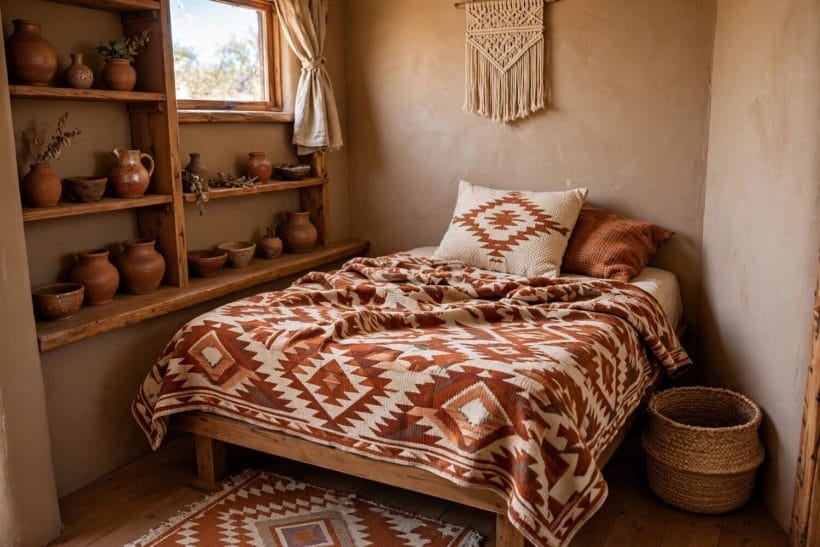
40. Exposed wooden ceiling beams
Exposed wooden ceiling beams give a room instant warmth and a sense of shelter, drawing the eye upward and making even a plain room feel crafted. If your ceiling already has beams, let them show rather than boxing them in, and if not, a few well-placed faux beams in warm wood can give the same feeling.
41. Clay pots with desert plants
Clay pots with desert plants bring living green into a warm palette and suit the dry-air character of this style better than thirsty tropical plants. Group pots in odd numbers on a windowsill or dresser, vary their heights, and let the terracotta of the pots echo the bedding colours.
42. Leather details, used sparingly
Leather details, a headboard, a bench seat or a pair of drawer pulls, add richness without overwhelming the room when used sparingly. Choose warm tan or saddle tones, let the leather develop its own patina over time, and balance each leather piece with woven or linen textures nearby.
43. Woven baskets for everyday storage
Woven baskets hold throws, magazines and laundry in plain sight while still looking like decoration, which makes them ideal for a style built on texture. Choose sturdy seagrass or willow baskets in natural tones, keep their contents tidy, and place one large basket rather than several small ones that read as clutter.
44. A stone fireplace corner
A stone fireplace corner gives a larger room a natural gathering point and a reason to linger in the evening. Keep the mantel simple, with one or two clay pieces rather than a crowded display, and let the stone’s rough texture contrast with the soft bedding nearby.
45. A cowhide or woven rug underfoot
A cowhide or woven rug underfoot anchors the bed and adds a layer of pattern that the eye meets before the bedding. Lay it so it extends beyond the bed on both sides, choose tones that sit inside the room’s palette, and let its irregular shape soften the room’s straight lines.
46. Raw wood nightstands
Raw wood nightstands, with visible grain and simple shapes, suit this style better than lacquered or painted pieces. Their honest finish pairs with clay lamps and woven baskets, and the slight roughness of the wood keeps the room feeling hand-made rather than showroom-perfect.
47. Linen curtains that filter light
Linen curtains filter sunlight into a soft, warm glow that suits desert colours far better than heavy drapes or bare glass. Hang them high and wide so the window feels generous, choose cream or sand tones, and let them move gently with the air rather than hanging stiff and formal.
7. Lighting for Warm Evenings
Lighting decides whether a warm room feels restful or merely orange, because desert colours change dramatically between daylight and lamplight. Aim for several low, warm light sources rather than one bright ceiling light, and let the evening room glow gently from bed height. The same low-light discipline shapes peach bedroom ideas, where soft peach walls only stay restful when the light stays soft with them.
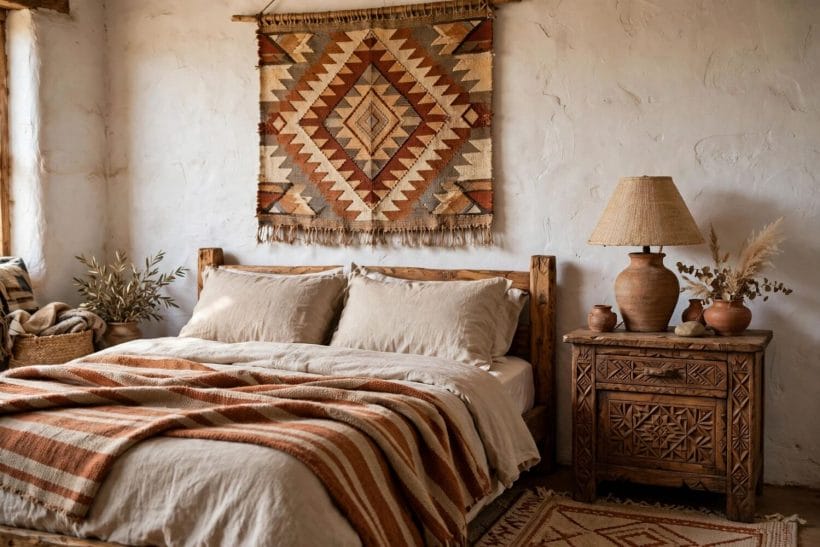
48. Clay lamps on both nightstands
Clay lamps on both nightstands give the bed wall symmetry and a warm, earthy glow at exactly the height where evening light flatters. Choose lamps with a simple handmade shape, fit warm-toned bulbs, and keep the shades plain so the light stays soft rather than patterned.
49. Low, warm bulbs throughout
Low, warm bulbs throughout the room keep the palette golden in the evening, while cool white bulbs can turn terracotta harsh and clinical. Check the warmth of every bulb in the room, including any in the closet or bathroom doorway, so the whole evening experience stays consistent.
50. A dimmer for the evening wind-down
A dimmer on the main light lets you lower the room gradually as bedtime approaches, which helps the body settle and keeps the room’s mood flexible. Dim the overhead light first, let the bedside lamps carry the room, and enjoy how the woven textures deepen in the softer light.
51. A lantern on the dresser
A lantern on the dresser adds a second pool of warm light and a decorative object that belongs to the style even when unlit. Choose a metal or wooden lantern with clear glass, place it where it will not be knocked over, and light it in the evening as a small ritual that marks the end of the day.
52. Flameless candles for a safe glow
Flameless candles give the flickering warmth of candlelight without any fire risk near bedding and curtains. Group them on a tray on the dresser or windowsill, switch them on together in the evening, and let their gentle flicker soften the room’s edges as you wind down.
53. Morning light through sheer curtains
Morning light through sheer curtains wakes a room gently, filtering the sun into a warm haze rather than a sharp beam. Keep sheers in cream or sand, let them cover the full window, and enjoy how they make even an ordinary morning feel calm and golden.
54. A wall-mounted reading light
A wall-mounted reading light beside the bed frees the nightstand for a lamp or a book and gives the reader precise light without disturbing a sleeping partner. Choose a simple arm in dark metal or wood, mount it at shoulder height when seated, and aim it at the book rather than the room.
55. No harsh overhead glare at night
Skipping harsh overhead light at night is the single easiest way to make a warm room feel restful, because overhead glare flattens texture and colour alike. Rely on lamps and lanterns after sunset, keep the ceiling light for cleaning and dressing, and notice how much calmer the room feels.
8. Storage That Stays Beautiful
Storage in a restful room should disappear into the style rather than announce itself, because visible clutter breaks the calm faster than any colour mistake. The best storage here is woven, wooden or built-in, with closed fronts for the messy things and open display only for objects beautiful enough to earn it.
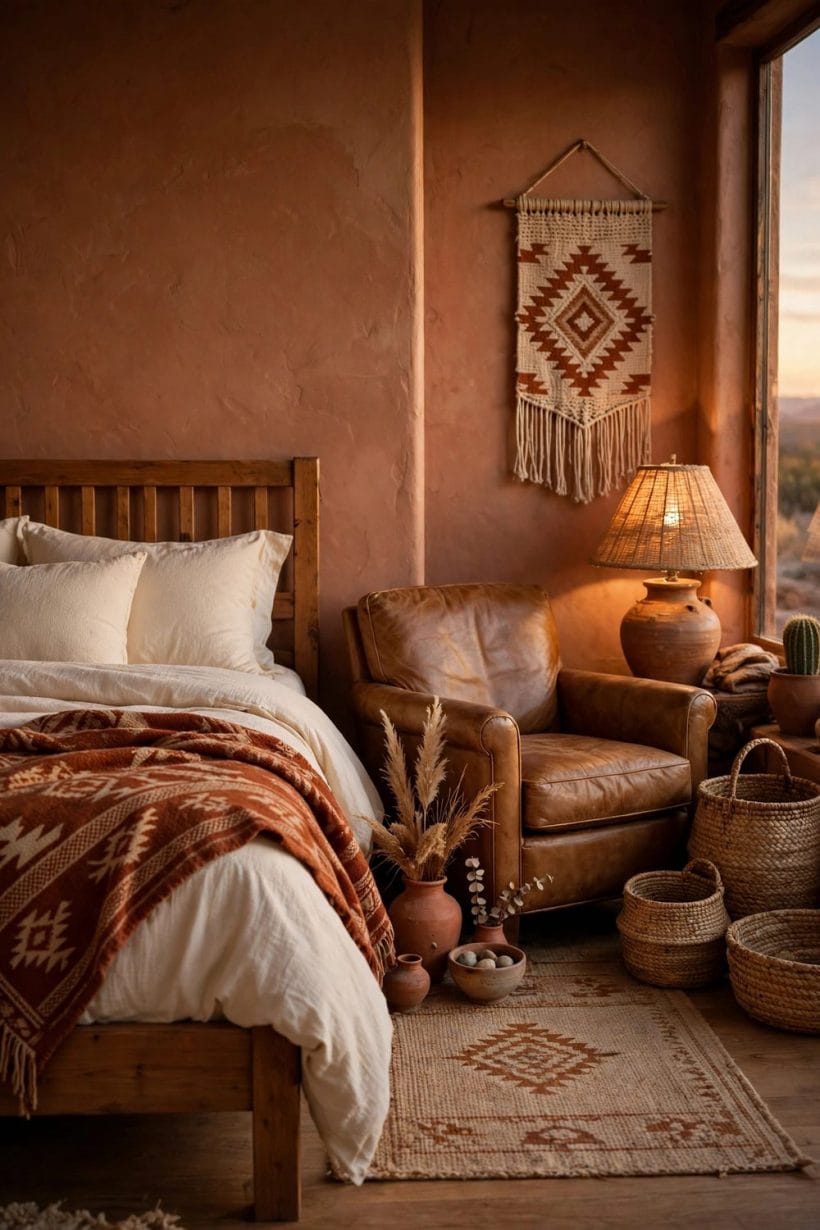
56. Built-in shelves for pottery
Built-in shelves for pottery turn a collection into architecture, giving clay pieces a permanent home rather than a crowded dresser top. Space the shelves generously, group pieces by colour rather than size, and leave one shelf partly empty so the display breathes.
57. A basket beneath the bench
A basket beneath the bench hides extra throws and slippers in the most useful spot in the room, right where you sit to dress. Choose a basket that slides out easily, keep it to one per bench, and let its woven texture add to the room rather than looking like an afterthought.
58. A dresser with turquoise pulls
A dresser with turquoise pulls adds the room’s cool accent in a place you touch every day, without committing a whole wall or bed to the colour. The small flashes of turquoise against warm wood feel collected rather than decorated, and they tie the dresser to a turquoise cushion across the room.
59. Open shelving with an edited display
Open shelving works only when the display is edited, so choose a handful of objects you genuinely love and give each one space. Remove anything that does not earn its place, dust the shelves as part of the weekly routine, and let the empty space around each object make it look more valuable.
60. Under-bed boxes in natural fabric
Under-bed boxes in natural fabric hide out-of-season bedding and spare blankets without introducing plastic shine into a natural-material room. Label them discreetly, keep them shallow enough to slide out easily, and check their contents with each season change so they never become forgotten storage.
61. Hooks for hats and robes
Hooks for hats and robes on the back of the door or a side wall keep daily items accessible without a chair draped in clothes. Choose wooden or wrought-iron hooks that match the room’s hardware, limit each hook to one item, and keep the arrangement to one tidy row.
62. One drawer kept only for bedding
Keeping one drawer only for bedding means fresh sheets, pillowcases and throws are always easy to find on change day. Fold them neatly, slip a cedar block inside to keep them fresh, and resist letting the drawer absorb stray items that belong elsewhere in the house.
9. Small Rooms and Quiet Corners
Small rooms suit this style surprisingly well, because warm colour and woven texture make a compact space feel cosy rather than cramped. The discipline is restraint: fewer patterns, lighter walls and one strong textile, so the room feels intentional rather than crowded. High ceilings help too, and vaulted ceiling bedroom ideas show how vertical space can make even a modest footprint feel generous.
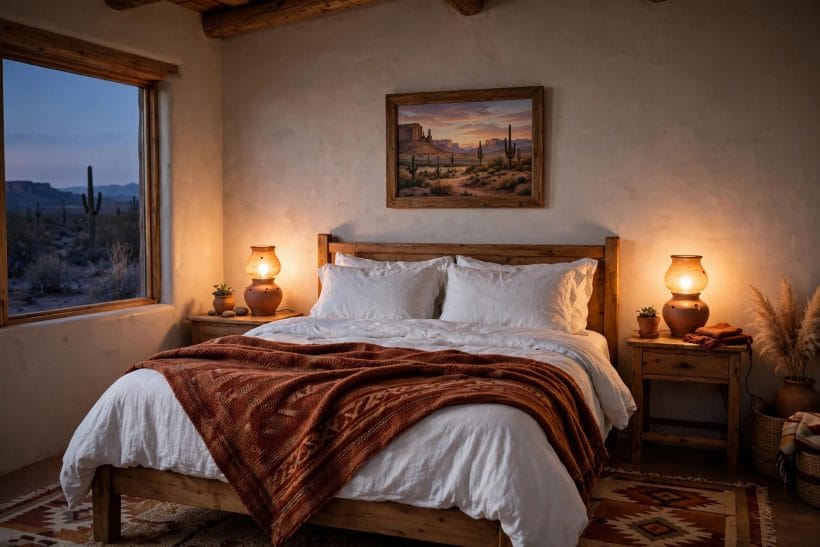
63. One pattern only in a small room
One pattern only in a small room keeps the eye calm, because competing geometrics shrink a space faster than any furniture choice. Let the blanket or the rug carry the pattern, keep everything else plain or textured, and watch how much larger the room feels with a single clear voice.
64. A shelf above the bed for books and pottery
A shelf above the bed gives a small room storage without stealing floor space, holding books and a few clay pieces where they are easy to reach. Keep the shelf shallow, secure it well, and leave breathing room between objects so the display feels curated rather than crammed.
65. Light walls with dark bedding
Light walls with dark bedding suit small rooms beautifully, because the pale walls push outward while the dark bed anchors the centre. Choose rust or deep brown bedding rather than black, soften it with cream pillows, and let the contrast give the small room a clear, restful focus.
66. Folded throws as decoration
Folded throws stacked on a bench or shelf act as decoration that is also useful, adding colour and texture without taking wall space. Fold them neatly with their patterns facing out, stack no more than three, and rotate the top throw with the seasons so the display always feels fresh.
67. A mirror to widen a narrow room
A mirror to widen a narrow room works best when it reflects a window or a woven textile rather than a blank wall. Hang a generous mirror on the long wall, frame it in wood that matches the bed, and let the reflected light and pattern double the room’s sense of space.
68. A single statement textile
A single statement textile, one remarkable blanket or wall hanging, can carry a whole small room without any other decoration. Spend your attention on choosing it well, hang or fold it where it catches the light, and let the rest of the room stay quiet enough to show it off.
69. A floor kept visible
A floor kept visible makes a small room feel larger, because the eye travels uninterrupted from door to window. Choose furniture with legs rather than pieces that sit flat on the floor, keep rugs to one main piece, and resist storing boxes or baskets along the walls where they break the line of sight.
10. Finishing Touches
Finishing touches are the smallest choices in the room and often the most memorable, because they are the details you notice when you are already comfortable. Keep them few, keep them natural, and keep them personal, so the room feels like yours rather than a catalogue page.
70. Desert artwork in simple frames
Desert artwork in simple frames brings the landscape indoors without competing with woven pattern. Choose prints or paintings in the room’s own palette, frame them in plain wood, and hang one generous piece rather than a crowded gallery wall that fights the bedding for attention.
71. Dried grasses in a tall vase
Dried grasses in a tall vase add height and movement to a dresser or corner, echoing the desert plants outside without needing water or care. Keep the arrangement loose and tall, choose a clay or woven vase, and trim the stems so the grasses sit comfortably below the ceiling line.
72. A woven tray on the dresser
A woven tray on the dresser corrals small essentials, a watch, keys and a lip balm, into one tidy place that still looks like decoration. The tray’s texture suits the room, its edges stop small items drifting across the dresser, and emptying your pockets onto it becomes a pleasant evening habit.
73. A cedar drawer liner for fresh bedding
A cedar drawer liner keeps stored bedding smelling fresh and adds a subtle woody scent each time the drawer opens. Cut the liner to fit, replace it when the scent fades, and enjoy the small luxury of opening a drawer that smells as good as the room looks.
74. A fresh plant by the window
A fresh plant by the window adds living green that softens the warm palette and marks the seasons as it grows. Choose a plant that suits your light and your watering habits, pot it in clay, and give it a saucer that protects the sill while letting the pot’s colour show.
75. One surface left deliberately empty
One surface left deliberately empty, a clear nightstand top or an unadorned stretch of dresser, gives the eye a resting place and makes the decorated surfaces look more intentional. Resist the urge to fill it, and notice how the whole room feels calmer for having one quiet spot.
Final Considerations
A southwestern bedroom succeeds when warmth and rest share the room equally: one anchor wall, one strong textile, natural materials underfoot and overhead, and light kept low and warm after sunset. Start with the walls and the bed, add layers slowly, and stop before the room feels finished in a showroom sense, because a room with a little breathing room left is a room you will actually rest in. Keep the palette steady, the storage honest and one surface empty, and the desert calm you were chasing will follow you to sleep each night.


0 Comments