
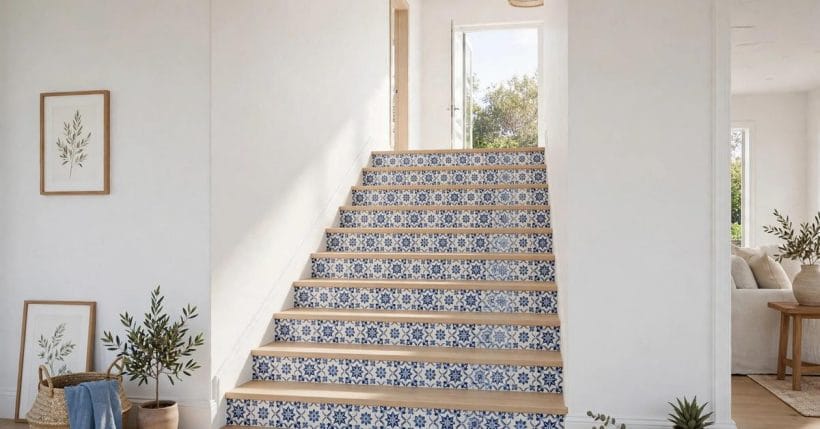
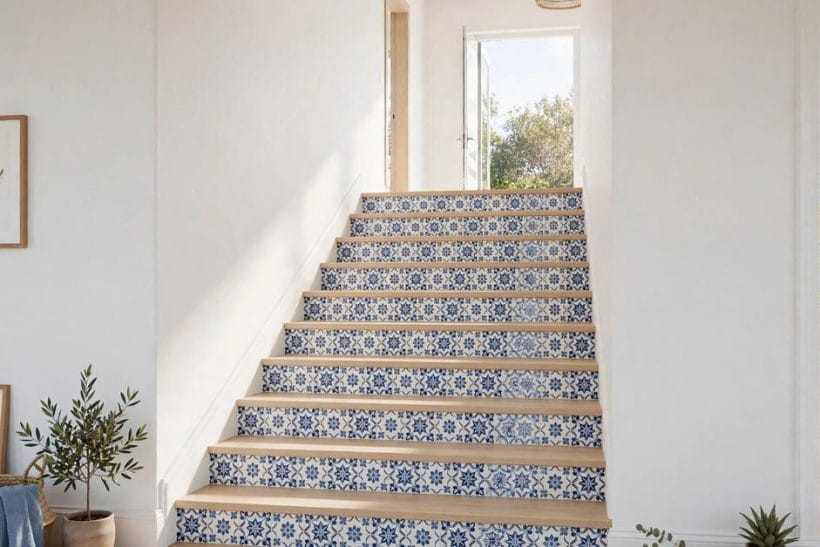
Climb a staircase and your feet meet the treads, but your eyes meet the risers. Those upright faces between one step and the next are the part of the stair you actually look at, step after step, and dressing them in tile turns a plain flight into a feature. Tiled stair risers are a simple idea with a surprising range: a hard-wearing, washable, endlessly coloured surface on the one part of the stair that takes no foot traffic at all. This guide stays with that finish alone. It covers tile types, colour and pattern, layouts, the partnership with treads and nosings, grip and safety in general terms, care, and the factors that move cost, without straying into general stair design or into fitting instructions, which belong to a qualified professional who can see your stair in person.
The appeal is easy to understand. Risers take scuffs from shoes, knocks from bags and vacuum cleaners, and the daily brush of passing feet, yet they never bear weight the way a tread does. Tile suits that job: it wipes clean, it resists scuffs better than paint, and it holds its colour in a hall that gets strong sun. It also gives a stair a rhythm. A repeated tile, a running pattern or a single accent colour on every riser can tie a hall together, echo a kitchen splashback, or carry the colour of a room upstairs down into the entrance. Done quietly, it looks like it was always there. Done boldly, it becomes the talking point of the house.
| Item | What it is |
|---|---|
| What a Tiled Riser Is — and Is Not | The riser is the vertical face between two treads. |
| Tile Types That Suit a Riser | Because a riser takes no foot traffic, the choice of tile is freer than it would be for a floor. |
| Colour and Pattern: Quiet, Bold, or Somewhere Between | Colour is where a tile riser earns its keep, and the first decision is one of volume. |
| Layouts: Straight Flights, Turns and Landings | On a straight flight, tiled risers are at their simplest and most satisfying. |
| Treads, Nosings and the Riser–Tread Partnership | A riser never stands alone; it is always seen against the tread below it and the nosing that caps it. |
| Grip, Glare and Everyday Safety | Safety on a stair is mostly about the tread, the handrail and the light, but risers play a supporting role that deserves honest attention. |
| Grout, Sealing and Cleaning | Grout is the quiet partner of any tile job, and on a riser it is more visible than on a floor because it sits at eye level on every step. |
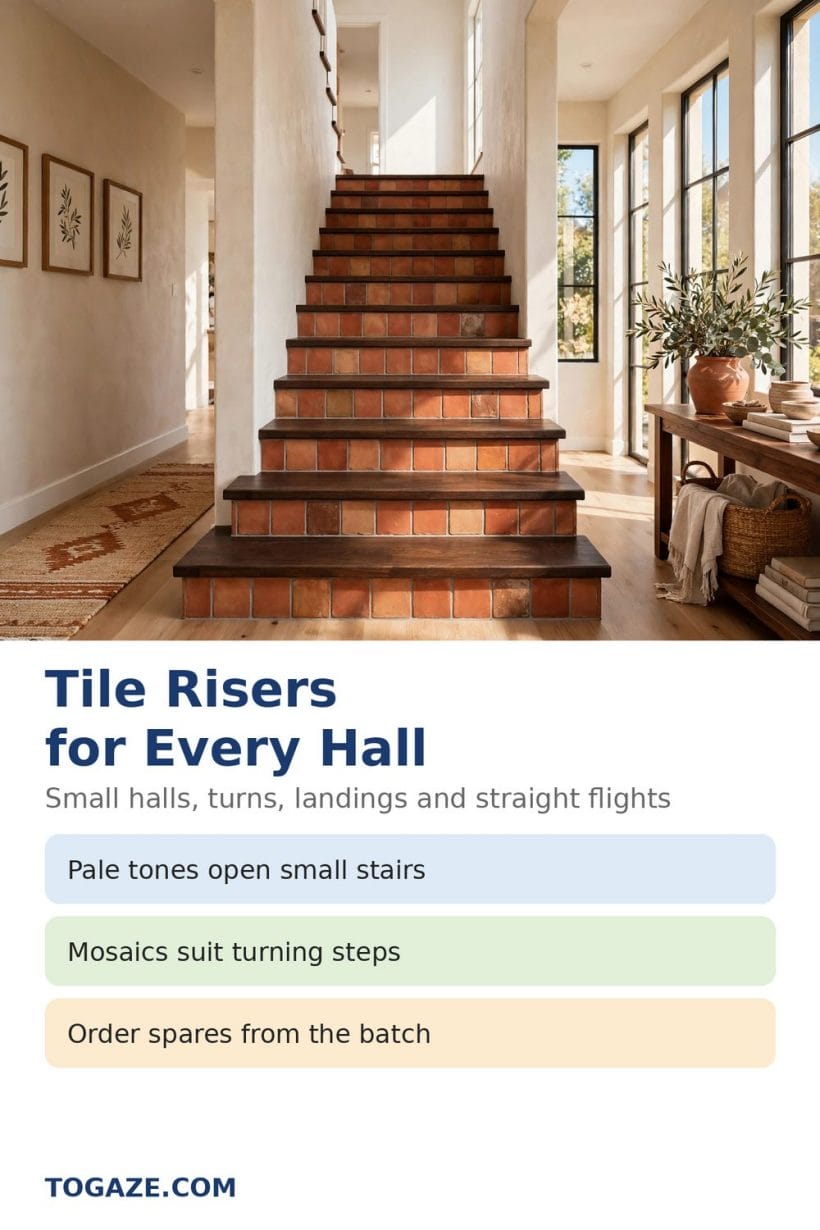
| Small Halls, Narrow Stairs and Light | Small stairs benefit most from tiled risers, and suffer most from the wrong choice, so they deserve a section of their own. |
| Costs in General Terms: What Moves the Figure | The cost of a tiled riser finish is driven by a handful of factors rather than by any single figure, and understanding them helps you judge any quotation fairly. |
1. What a Tiled Riser Is — and Is Not
The riser is the vertical face between two treads. On most stairs it is a flat board or a plastered face, painted or papered like the rest of the hall. Tiling it means fixing tile to that face only, leaving the tread — the part you step on — in timber, stone, carpet or another tread material. That distinction matters, because it sets the whole character of the finish. Tile on a riser is decoration and protection for a surface nobody walks on; tile on a tread would be a different proposition altogether, with grip and wear questions that this guide does not need to answer.
A tiled riser finish also differs from a fully tiled stair, where treads and risers alike are tiled, and from a painted riser, where colour comes from a coat of paint. Compared with paint, tile offers a harder surface, a wider choice of pattern and texture, and a finish that does not need recoating every few years. Compared with a fully tiled stair, it keeps the warmth and grip of a timber or carpeted tread underfoot while giving the eye the colour and pattern of tile. For many homes that middle path is the most comfortable one, and it is the path this guide follows throughout.
One more boundary is worth stating plainly. A stair is a structural element, and anything that changes its structure — its framing, its supports, its handrail and guard — is work for a qualified professional, full stop. This guide describes finishes and appearances only. It does not instruct anyone to alter, rebuild or fit a stair, and any project that touches the structure of the stair, the guard or the handrail should be planned and carried out by someone qualified to judge it on site. Check local building requirements with that professional before work begins, since rules vary by place and by the age and construction of the home.
2. Tile Types That Suit a Riser
Because a riser takes no foot traffic, the choice of tile is freer than it would be for a floor. Glazed ceramic is the workhorse: affordable in general terms, available in almost every colour and pattern, easy to wipe clean, and light enough to fix neatly to a vertical face. Porcelain is denser and harder, and it suits homes where durability matters most, including halls that take heavy daily use and stairs near an outside door where grit and damp arrive with every visitor. Both are sensible starting points, and the difference between them is usually felt in toughness and in price drivers rather than in appearance.
Handmade and artisan tiles bring a different quality. Slight variations in glaze, edge and tone give a stair a living surface that machine-made tiles cannot quite match, and on a small flight that variation reads as warmth rather than untidiness. The trade is consistency: shades can vary between batches, so ordering enough tile for the whole flight, plus spares for later repairs, is a practical step worth taking at the start. Cement-style tiles offer bold pattern and a matt, chalky character that suits Mediterranean and farmhouse halls, but they are porous and need sealing, which adds a maintenance step that glazed tiles do not require.
Mosaic and small-format tiles deserve a mention of their own. On a narrow riser, a sheet of small mosaics can bend around the geometry of the stair more forgivingly than a large tile, and it can carry intricate pattern into a small space without overwhelming it. Glass mosaic adds light and sparkle, which suits a dark hall, though it needs careful grouting to look its best. Large-format tiles, by contrast, suit wide, modern flights where a single slab-like face on each riser reads as calm and architectural. The right size is the one that fits your riser height with the fewest awkward cuts, a judgement a professional tiler makes quickly once the stair is measured.
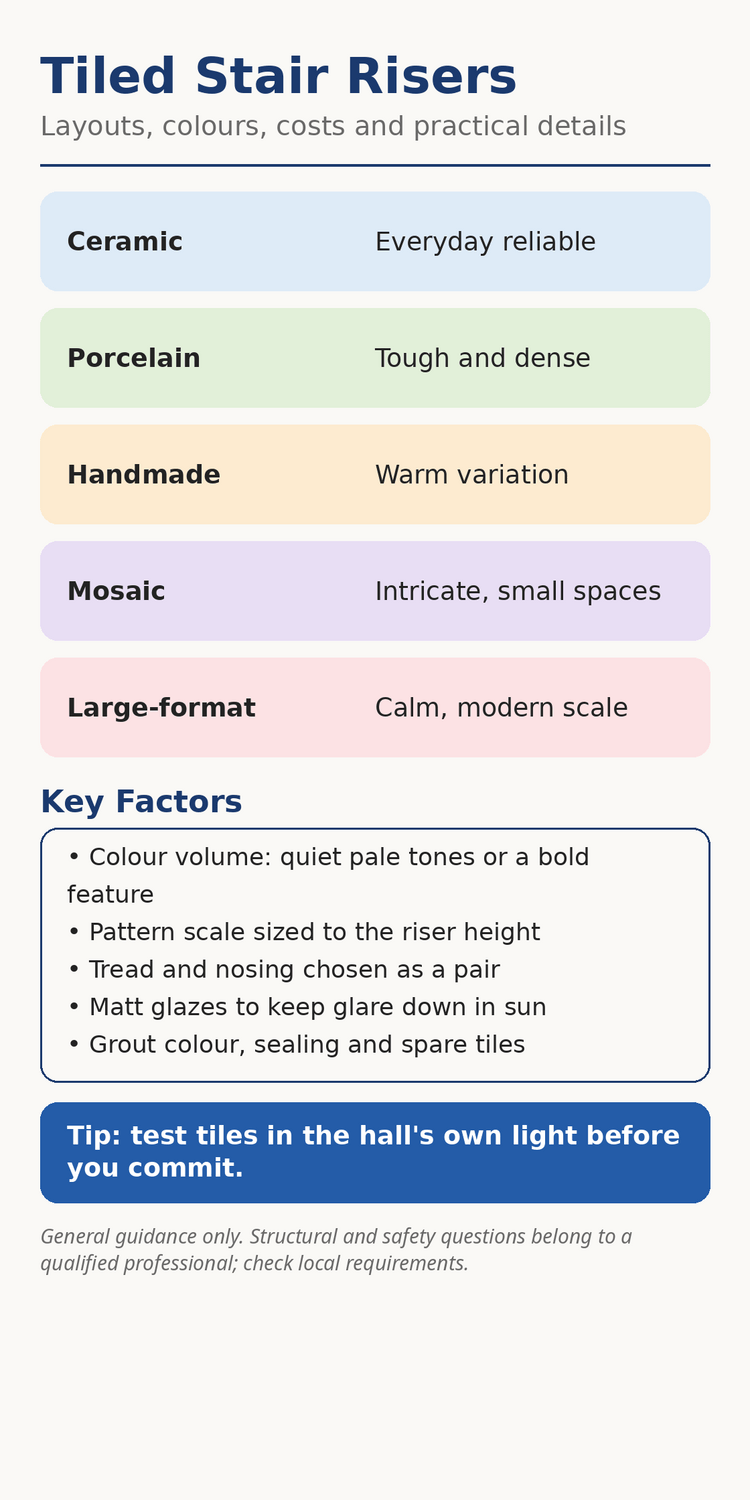
The infographic above sums up the five tile families covered in this guide, from the everyday reliability of glazed ceramic to the calm scale of large-format tiles, with the key factors to weigh before choosing.
3. Colour and Pattern: Quiet, Bold, or Somewhere Between
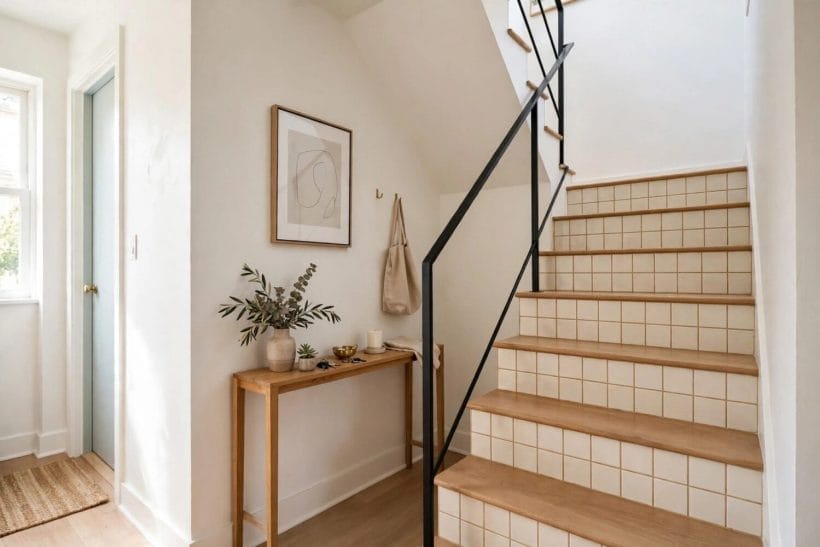
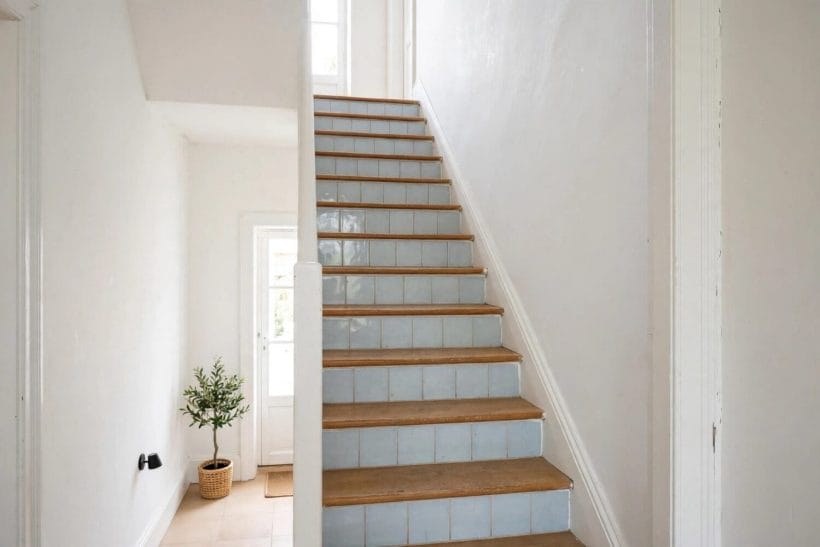
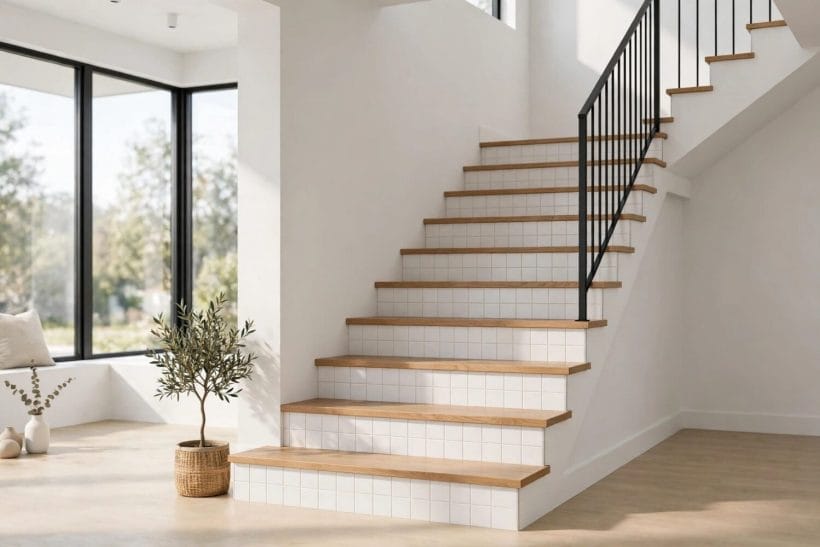
Colour is where a tile riser earns its keep, and the first decision is one of volume. A quiet riser — white, cream, pale grey or a soft sage — recedes and lets the treads, the handrail and the hall do the talking. It suits small halls, where a bold pattern on every step could feel busy, and it suits homes where the stair is a passage rather than a showpiece. A quiet tile also forgives: a pale riser in a hard glaze wipes clean after scuffs, and it keeps a narrow stair feeling open rather than tunnel-like.
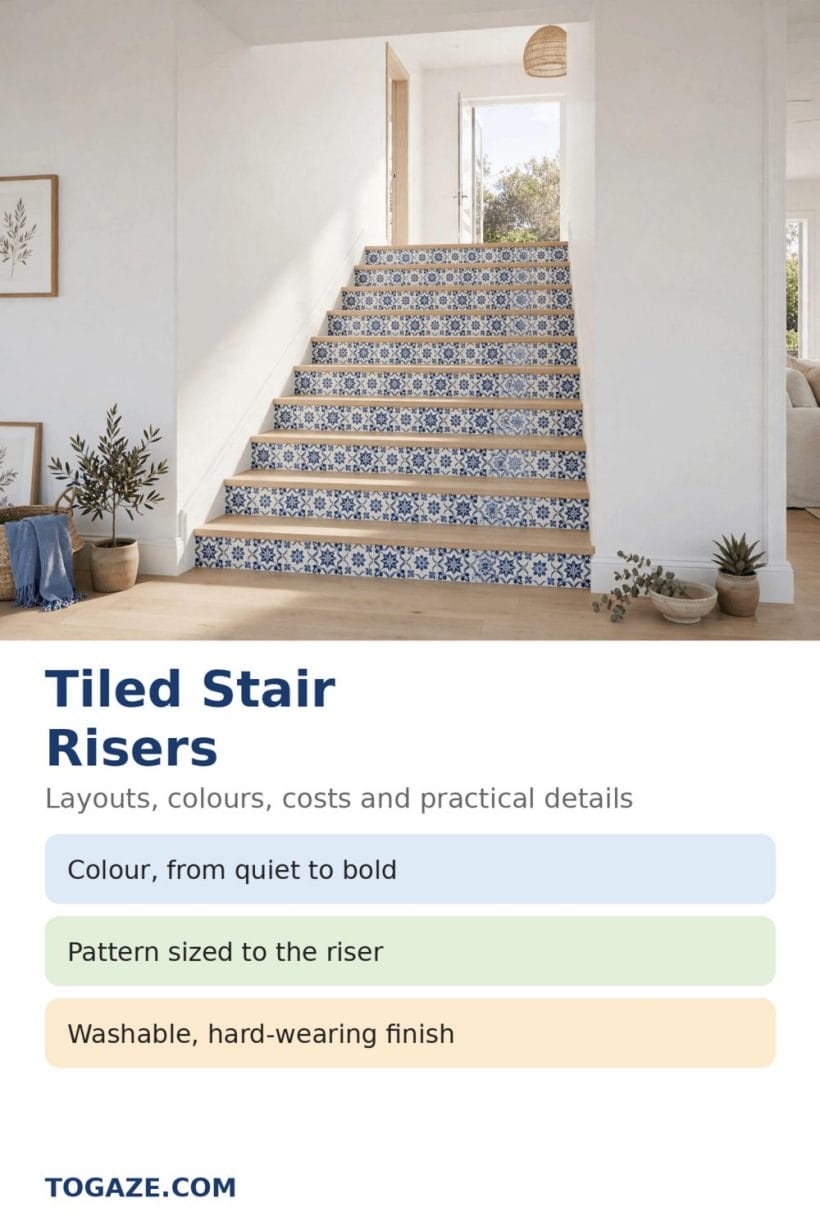
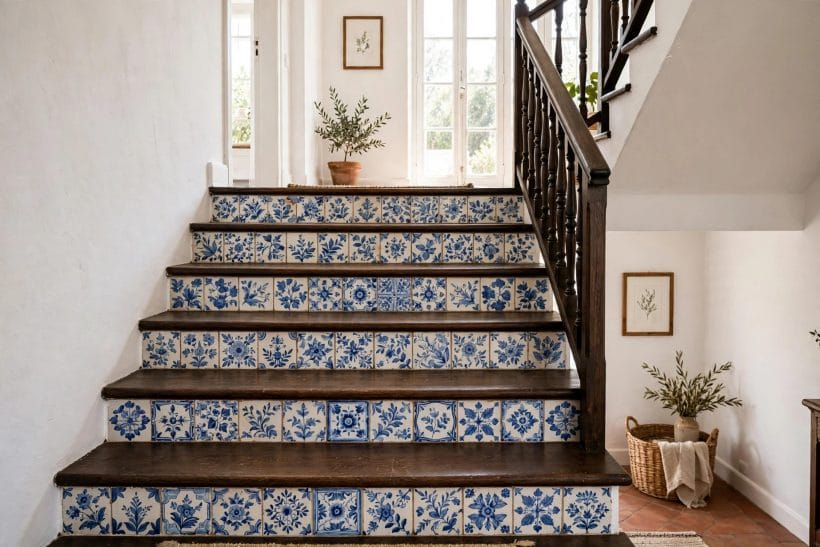
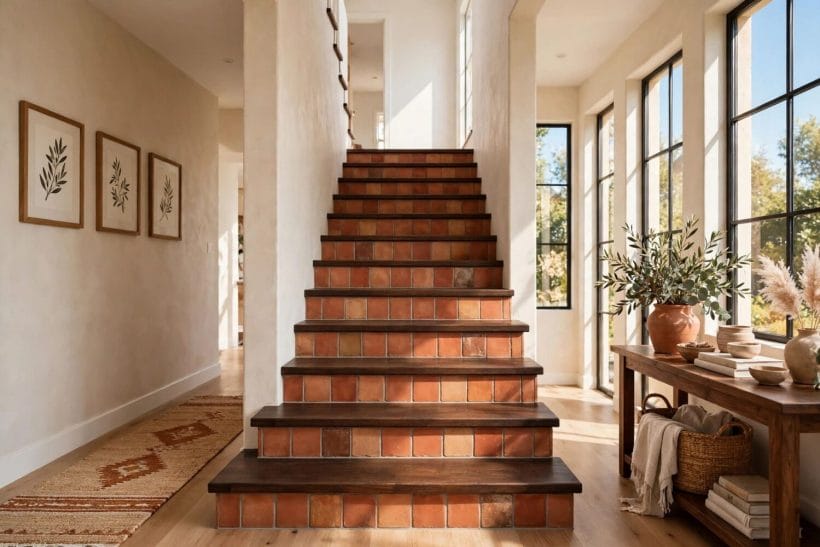
A bold riser does the opposite job, deliberately. A deep blue, a terracotta, a black-and-white pattern or a Moroccan-style motif turns the stair into the room’s centrepiece, and it works best where the stair has room to breathe: a wide flight, a generous hall, or a stair seen from a living space. Bold does not have to mean loud on every step. An alternating rhythm — a patterned riser on every other step, or a single accent colour that repeats at intervals — gives movement without monotony, and it can make a long flight feel shorter by breaking it into a visible beat.
Pattern needs a plan for the edges. A tile pattern that runs beautifully across a wide riser can look clipped and awkward where it meets the string, the wall or the nosing above, so the pattern’s scale should be chosen with the riser height in mind. A small repeat survives cropping gracefully; a large motif needs room to show itself, and may suit a taller riser or a flight where the pattern can be centred on each step. Test the idea before committing: lay a few tiles against the risers, step back to the foot of the stair, and look at the flight as a whole rather than at one step in isolation. A pattern that charms close up can shimmer or dazzle from below, especially in strong light, and a pattern that looks plain in the hand can come alive when repeated fourteen times up a flight.
4. Layouts: Straight Flights, Turns and Landings
On a straight flight, tiled risers are at their simplest and most satisfying. Every riser is the same size, the pattern repeats cleanly, and the stair reads as one long ribbon of colour. The eye travels up the flight in a single movement, which is why straight stairs suit bold patterns so well: nothing interrupts the rhythm. A straight flight also makes it easy to carry a colour from elsewhere in the home — a kitchen tile, a bathroom accent, a front-door colour — up through the house in a way that feels intentional rather than copied.
Stairs that turn ask a little more thought. At a landing, the risers change direction, and the pattern must decide what to do at the corner: continue around it, pause, or change. The calmest solution is usually to let the same tile continue without fuss, treating the landing risers as part of the same flight. Where a landing is wide enough to be a small room in its own right, it can carry a different treatment — a border tile, a single feature riser, or a change of colour — that marks the turn as a moment. Either way, the landing deserves the same attention as the flight, since it is the part of the stair you stand on and look at longest. A landing treated as a small room, with clear space, daylight and calm styling, makes the whole stair feel considered, and the ideas in our guide to stair landing design pair naturally with a tiled finish.
Winders, the wedge-shaped steps that turn a stair without a landing, are the trickiest case for tile. Their risers vary in width, so a pattern that repeats perfectly on a straight flight must be adapted step by step, and a large motif can be cut awkwardly by the taper. Small-format tiles and mosaics cope best here, since their small repeat survives the changing widths, and a plain or near-plain tile avoids the problem altogether. If your stair has winders, raise the question early with your tiler: the answer will shape the tile size and pattern for the whole flight, not just for the turning steps.
5. Treads, Nosings and the Riser–Tread Partnership
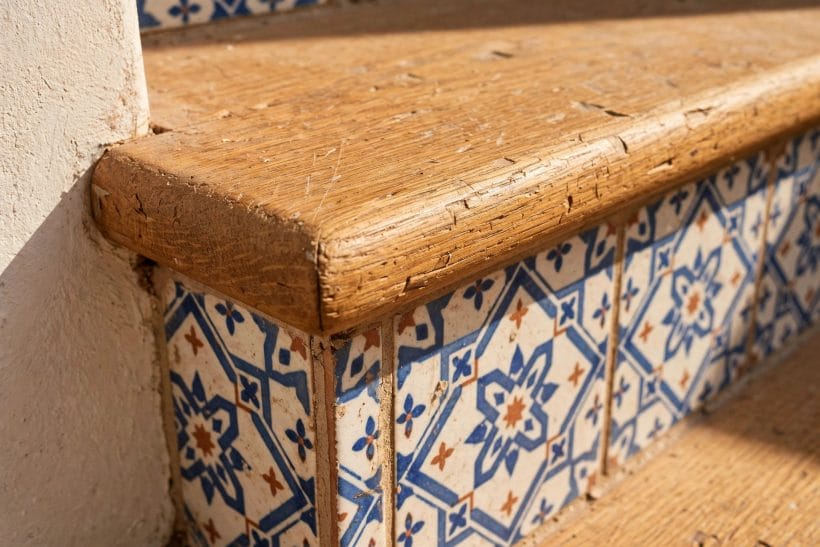
A riser never stands alone; it is always seen against the tread below it and the nosing that caps it. The partnership between the two is what makes a tiled stair feel finished rather than stuck-on. Pale timber treads with white or cream risers read as light and Scandinavian. Dark walnut treads with deep blue or black risers read as dramatic and formal. A mid-tone oak tread with a terracotta riser reads as warm and Mediterranean. In each case the tread sets the temperature and the riser supplies the colour, and the pairing should be judged together, in the hall’s own light, rather than tile by tile in a showroom.
The nosing — the rounded or squared edge where tread meets riser — is the detail that joins the two. On a tiled stair it is usually part of the tread material, and its colour and profile decide whether the stair reads as a series of crisp lines or as a softer, rounded sequence. A nosing that contrasts with the riser draws a sharp line under each step and makes the stair’s geometry legible, which helps in a dim hall. A nosing that matches the tread lets the riser colour dominate, which suits a stair meant to be a feature. Either choice is legitimate; the mistake is to leave the nosing as an afterthought, since it is the edge your eye follows all the way up.
For homes where softness underfoot matters, a carpeted tread can pair surprisingly well with a tiled riser, giving warmth underfoot and washable colour at eye level. The combination needs care at the junction, where carpet meets tile, and it suits halls where the stair is used barefoot or by small children. Our guide to carpeted staircase ideas explores that softer side of stair design, and it is worth reading alongside this one if you are weighing a mixed finish. Whatever the tread material, keep the junction clean and consistent from step to step: a stair reads as well made when every step repeats the same detail, and as improvised when each step improvises its own.
6. Grip, Glare and Everyday Safety
Safety on a stair is mostly about the tread, the handrail and the light, but risers play a supporting role that deserves honest attention. A glossy tile on a riser does not make a tread slippery, since nobody steps on the riser, yet glare from a highly polished riser can dazzle in strong sun, especially on a stair facing a window or a glazed door. A matt or satin glaze avoids that problem and is usually the calmer choice for a sunny hall. If your stair catches direct sun for part of the day, look at tile samples in that light before deciding, and favour finishes that stay readable rather than reflective.
Contrast is the riser’s quiet safety contribution. A riser that contrasts clearly with the tread helps the eye judge each step, which matters most at the top and bottom of a flight and for anyone with weaker vision. A white riser under a dark tread gives strong definition; a tone-on-tone pairing looks elegant but can blur the edge of each step in dim light. Neither is wrong, but the trade is real, and it is worth weighing alongside colour preference, particularly on stairs used by older relatives or young children. Good lighting multiplies the benefit: a well-lit stair with clear riser contrast is easier to use than a dim stair in any finish.
The guard and handrail frame all of this, and they should be treated as safety equipment first and decoration second. A handrail that is continuous, comfortable to grip and firmly anchored matters more than any tile choice, and any looseness, damage or missing section should be put right by a qualified professional rather than lived with or improvised around. Keep the stair clear of clutter, keep the lighting even from top to bottom, and check local requirements with a professional if you are unsure what applies to your stair. Those general points, rather than any tile detail, are what keep a beautiful stair a safe one, and they apply whether your risers are tiled, painted or plain.
7. Grout, Sealing and Cleaning
Grout is the quiet partner of any tile job, and on a riser it is more visible than on a floor because it sits at eye level on every step. Colour choice matters: a grout that matches the tile gives a calm, continuous surface, while a contrasting grout draws a grid that can either sharpen a pattern or chop it up. On a busy patterned tile, matching grout usually wins, since it lets the pattern speak. On a plain tile, a contrasting grout can add the structure the tile itself lacks. Either way, the grout lines should be even and consistent from step to step, since the eye catches a wandering joint on a stair faster than on a wall.
Sealing depends on the tile. Glazed ceramic and porcelain need no sealing on the glazed face, which is one of their practical advantages, and their grout lines can be sealed to resist staining in a busy hall. Unglazed, cement-style and natural-stone-look tiles are more porous and generally need sealing, with re-sealing at intervals that depend on use and on the product chosen. Ask your supplier or tiler what your chosen tile needs, and treat sealing as part of the purchase rather than an afterthought, since a tile bought for its look and then starved of its protection will not age the way you hoped.
Day-to-day cleaning is the reward for choosing tile. A damp cloth deals with most marks on a glazed riser, and a mild cleaner handles the rest, while paint would need touching up and wallpaper would need replacing after the same knocks. Avoid harsh abrasives on glazed surfaces, since they can dull the glaze over time, and wipe spills promptly on unglazed tiles. Grout lines repay a periodic scrub, and a small brush kept with the cleaning kit makes the job quick. Keep spare tiles from the original batch for repairs: a cracked riser tile is a small job when the matching tile is in the cupboard, and a long search when it is not.
8. Small Halls, Narrow Stairs and Light
Small stairs benefit most from tiled risers, and suffer most from the wrong choice, so they deserve a section of their own. On a narrow flight, every design decision is magnified: a bold pattern that would be lively on a wide stair can feel crowded on a narrow one, while a pale, quiet tile can make the same stair feel wider and taller than it is. Vertical stripes of colour, a pale riser under a light tread, and a gloss-free finish that does not bounce light around all help a small stair breathe. The same discipline serves compact homes generally, and our guide to small staircase ideas covers the wider question of fitting a stair gracefully into a small home.
Light is the other half of the small-stair question. A stair with a window at the top or a glazed door at the foot changes character through the day, and tile responds to that change more visibly than paint. A tile that looks perfect in a showroom can look cold in a north-facing hall or washed out in strong southern sun, so judge samples in place, at different times of day, before committing. A mirror or a pale wall colour opposite the stair can bounce light onto the risers and show the tile at its best, while a dark wall can swallow the pattern and leave only the tread visible. Light first, tile second, is a good order for a small hall.
Storage and display often compete with the stair in a small home, and the wall beside a tiled flight is prime territory for both. A slim console, a row of hooks or a gallery of pictures can sit happily beside tiled risers, provided the wall treatment does not fight the tile pattern. Keep the wall calm if the risers are bold, and let the wall carry colour if the risers are quiet. The stair itself should stay clear: nothing stored on the steps, nothing hanging over the handrail, and a clear path from foot to head at all times. A beautiful riser is wasted if the stair it dresses cannot be used comfortably.
9. Costs in General Terms: What Moves the Figure
The cost of a tiled riser finish is driven by a handful of factors rather than by any single figure, and understanding them helps you judge any quotation fairly. Tile itself comes first: plain glazed ceramic sits at the accessible end of the range, porcelain a step above it, and handmade, artisan or imported patterned tiles further up, with rarity and batch variation adding to the driver. The number of risers matters too: a short flight between two close floors needs far fewer tiles than a tall flight with a landing, and a flight with winders needs more cutting and more waste allowance than a straight flight of the same height.
Labour is the second half of the story, and it is the half most often underestimated. Fixing tile to a vertical face, cutting it neatly around strings and nosings, and keeping grout lines level across a whole flight is skilled work, and a stair with turns, winders or awkward junctions takes longer than a straight flight. Preparation also counts: a riser surface that is sound, flat and clean is quicker to tile than one that needs repair or levelling first. A quotation that covers tile, grout, sealant where needed, cutting, waste and finishing is not comparable with one that covers tile alone, so compare like with like and ask what each figure includes.
Two cautions keep costs honest. First, treat an unusually low figure as a question, not a bargain, since a riser tile that is poorly fixed will loosen, crack or stain, and putting it right costs more than doing it well once. Second, remember the spares: ordering extra tiles from the same batch for future repairs is a small addition now that prevents a mismatched repair later, and it is worth including in the budget from the start. For the wider question of what a stair costs in different materials, the companion guides to marble staircase ideas and painted staircase ideas set the tiled finish in context, since stone and paint sit at different points of the same range of choices.
10. Choosing Your Finish: A Short Decision Path
With so many tiles to choose from, a short decision path helps. Start with the room, not the tile: is the hall small or generous, bright or dim, traditional or modern? A small, dim hall points toward pale, quiet, matt tiles. A generous, bright hall can carry bold pattern. A traditional room suits handmade glazes and classic motifs; a modern room suits large formats and restrained colour. Let the room narrow the field before you fall for a single tile, since a tile chosen in isolation is the one most likely to disappoint in place.
Next, settle the tread partnership. Choose the tread material and colour alongside the riser tile, not after it, and judge the pair in the hall’s own light. Then settle the pattern scale: small repeats for winders and narrow risers, larger motifs only where the riser height gives them room. Then settle the practical questions — glaze finish for glare, grout colour for calm or structure, sealing needs for the tile family you have chosen — and confirm them with your tiler. Each decision narrows the next, and by the end the choice usually makes itself.
Finally, look at the stair as a neighbour. A tiled riser finish sits beside the newel posts, the handrail and the balustrade, and it should get on with them. A bold riser with a bold post can overwhelm a hall; a quiet riser lets a beautiful post shine. Our companion piece on newel posts for stairs covers that anchoring piece of the stair in its own right, and reading it alongside this guide helps you balance the two features rather than letting one shout over the other. For a contemporary stair, where slim lines and open treads set the tone, our guide to modern staircase ideas shows how a restrained tile riser can complete the look without breaking it. Balance, in the end, is the whole game: a stair where every part is confident and none of them shouts.
Final Considerations
A tiled riser is a small surface with an outsized effect. It takes the part of the stair you look at most and gives it colour, pattern, durability and easy cleaning, without changing anything about the way the stair feels underfoot. The families in this guide give you a language for choosing: ceramic for everyday reliability, porcelain for toughness, handmade tiles for warmth and variation, mosaics for intricate pattern in small spaces, and large formats for calm modern scale. Colour and pattern then decide the volume, from a quiet pale riser that opens a small hall to a bold motif that makes a wide flight the centrepiece of the house.
Choose slowly, test tiles in the hall’s own light at different times of day, and keep the structural and safety questions with a qualified professional who can see the stair in person. Order spares from the same batch, keep grout lines even and consistent, and let the tread, the nosing, the handrail and the riser agree with each other rather than compete. Done that way, a tiled riser finish will do its quiet job for years: taking the scuffs, holding the colour, and giving you a small lift of pleasure every time you climb the stair.



0 Comments