

Wyoming tests a tiny house with wind first and questions later. Distances are long, services can be far away, and an unanchored, leaky house will announce itself in the first storm. Comparing tiny house builders wyoming by type shows who designs for that exposure, who builds, and what work stays yours.
This guide compares the four builder types, explains costs in relative terms only, and lists the checks that matter on the high plains before you sign.
1. Wyoming Builder Types at a Glance
Builders serving Wyoming fall into four broad types. They differ in design control, in how much of the work you take on, and in where they sit on the cost scale. Reading the comparison first shortens every later conversation, because questions about wind, insulation, off-grid systems and warranty are answered differently by each type.
| Builder Type | What They Do | Cost Position | Best For |
|---|---|---|---|
| Custom builders | Full design and build around your land and brief | Highest | Buyers who want the most control and an exposure-tuned, one-off house |
| Semi-custom builders | Proven plans with menus of layouts, finishes and systems | Mid-range | Buyers who want choice without a blank-page design process |
| Shell builders | A weather-tight structure that you finish inside | Lower | DIY finishers who want the structure built professionally |
| Kit and plan sellers | Material packages or plans that you build from | Lowest | Self-builders with space, tools and time |
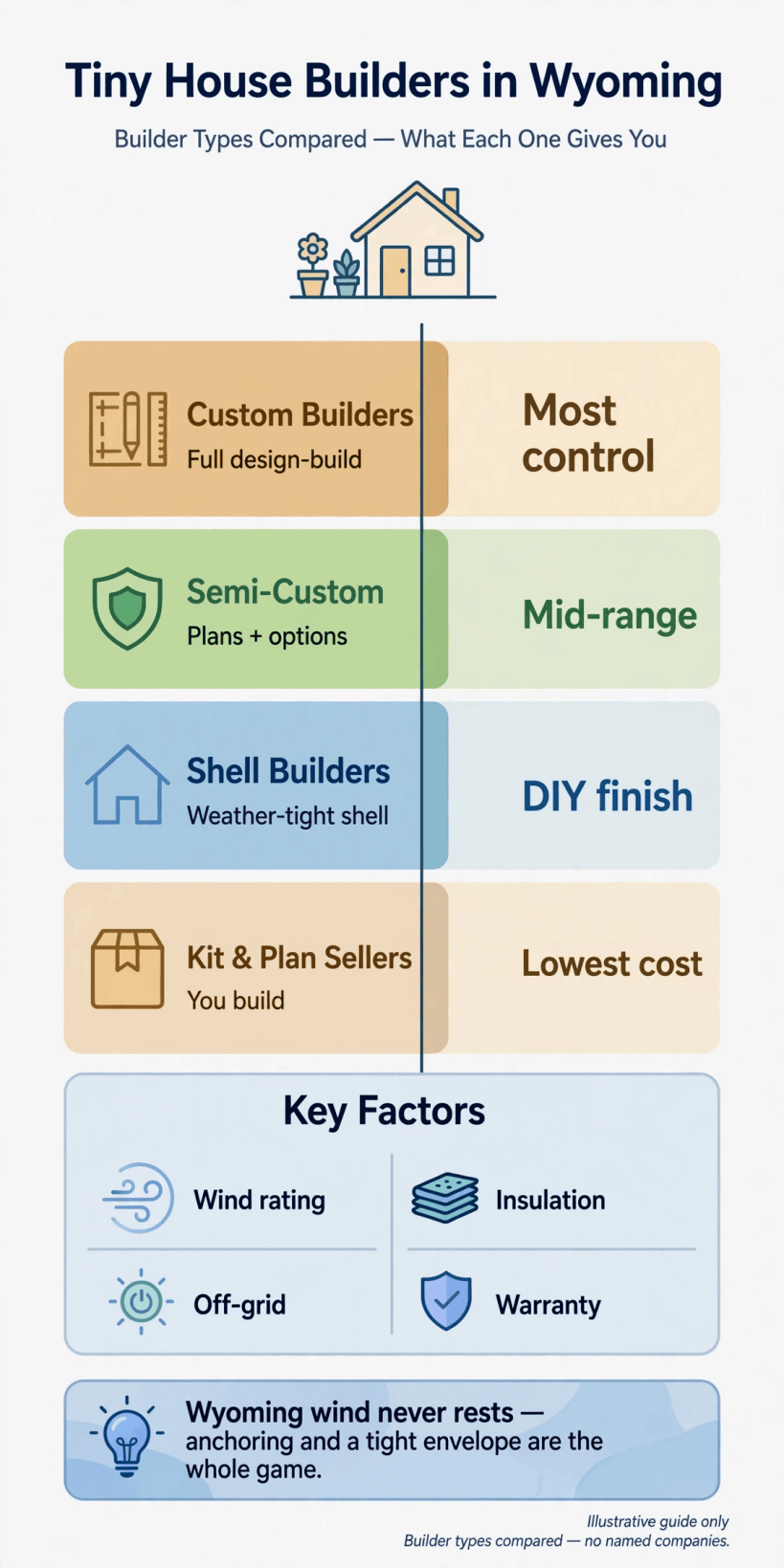
The four Wyoming builder types compared, with the factors that dominate here: wind resistance, insulation, off-grid readiness and warranty.
The theme that links the table together is exposure. On open Wyoming ground the wind works on a house every day, so anchoring and a tight, well-sealed envelope are not upgrades to consider later; they are the starting point. Each type can deliver a house that stands up to it, but who is responsible for the anchoring design, the sealing details and the warranty behind them differs, and that is worth pinning down early.
2. Wind, Distance and Self-Reliance: The Wyoming Context
Start any Wyoming conversation with the site itself. How exposed is the land, which direction do the worst winds come from, and how will the house be oriented and anchored once it arrives? Ask how the structure is tied down, how skirting or a foundation handles wind underneath the floor, and what the builder assumes about ground conditions, from rocky plots to deep winter frost.
Distance shapes the rest of the plan. Deliveries travel far in Wyoming, materials for finishing work may not be available around the corner, and a warranty visit is a journey rather than a quick call-out. Many Wyoming tiny houses also sit where grid power and water are limited or absent, so off-grid readiness, from power generation and storage to water and waste solutions, belongs in the first specification conversation rather than the last.
Cold completes the picture: insulation, protected plumbing and a heating system sized for real winter nights. If you are organising the whole project, work through building a tiny house: the complete checklist from land to move-in so that exposure, services and access are settled before you compare builder quotes.
3. Custom Builders: Designed for Your Exposure
A custom builder designs and builds a one-off house around your land and your life. On an exposed Wyoming parcel that control is practical, not indulgent: the house can be oriented for shelter, detailed with a tight envelope, planned with anchoring suited to the ground, and arranged so doors, storage and systems all make sense for remote living through a hard winter.
The trade-offs are time and cost position. One-off design, engineering and problem-solving take longer than repeating an existing plan, and custom work sits at the top of the qualitative cost ladder because little carries over from the previous job. Ask how design stages are charged, when a firm build figure is offered, how changes during the build are priced, and which parts of the wind and anchoring specification the builder designs versus expects your site contractor to handle.
Ask to see houses already living in open country, and talk to their owners about storms and winters rather than finishes. A builder whose houses sit quietly through Wyoming wind seasons has evidence that matters. The custom route is compared for a neighbouring high-plains state in our guide to tiny house builders in Colorado.
4. Semi-Custom Builders: Proven Plans, Chosen Systems
Semi-custom builders work from a set of existing plans with options layered over them. You may choose between layout variants, select cladding and roofing from a menu, and pick finishes, appliances and heating or off-grid systems from option lists. Because the engineering already exists, this route usually quotes faster and sits mid-range on cost, while the finished house still reflects your priorities.
The essential homework is the boundary of the flexibility. A builder might let you upgrade insulation and windows freely while keeping structural details fixed, or allow finish choices but not dimension changes, because the frame and trailer system are standardised. Ask for the standard specification and the full options list in writing, and price the winter and wind options you genuinely need before comparing one builder’s total with another’s.
This route suits buyers who like a builder’s existing work and want the confidence of a design that has been built and lived in before. A documented, repeatable house can also simplify conversations with lenders, insurers and local officials. Compare the approach with our guide to tiny house builders in Utah, where distance and off-grid questions are similarly prominent.
5. Shell Builders: A Tight Shell, Finished by You
A shell builder delivers the structure in weather-tight form: base or trailer, framing, roof, cladding, windows and doors, with the interior left open. In Wyoming a shell has one non-negotiable quality: it must be genuinely sealed. A shell that keeps wind-driven dust and snow out from the first day protects everything you install later, so ask exactly how joints, penetrations and the underside are detailed and finished before delivery.
The cost position is lower because you are buying fewer hours, but the finishing spend remains real: insulation if it is not part of the shell, interior lining, kitchen and bathroom, flooring and services. Some stages may need licensed trades depending on the rules that apply to your project. Clarify what the shell includes, whether anchoring hardware or instructions are supplied, and what condition the house is in for transport over long distances.
Plan the finishing phase around distance. Materials runs are longer in Wyoming, winter interrupts outdoor work, and a part-finished house needs secure storage and a realistic order of trades. The sequence in the tiny house build checklist helps you price a shell honestly instead of mistaking a shell figure for a finished-house figure.
6. Kit and Plan Sellers: Building It Yourself, Far From Town
Kit and plan sellers supply the design side of the project: drawings, or drawings plus a materials package, with the building done by you. This is the lowest-cost route in cash terms because the labour is yours, and it suits Wyoming’s self-reliant building culture. It also demands the most planning, because every missing item is a long trip or a long wait.
Read the contents list line by line. Kits range from framing packages to near-complete sets, and membranes, fixings, cladding and roofing may sit outside the headline figure. For plans, check what engineering is included and what you must arrange for your conditions, including wind exposure. Delivery of a bulky package to a rural address, and dry, secure storage for it through the seasons, both belong in the plan from the start.
Choose this route if you have real building experience, a level covered workspace, and time you can protect. Without those, a shell or semi-custom build often finishes sooner and can cost less once corrections, hire and delays are counted. The self-build questions are similar across the interior West, as our guide to tiny house builders in Montana shows.
7. What Tiny Houses Cost in Wyoming: A Qualitative Guide
This series does not publish prices, because a responsible figure depends on specification, site and timing, and invented numbers would mislead you. Think in relative terms. Custom design-build sits highest, semi-custom sits in the middle with options deciding the exact place, shells sit lower with your finishing budget still to add, and kits and plans are the lowest entry point with your labour and remaining materials still to fund.
Around the build, Wyoming budgets should allow for delivery over long distances, for anchoring and site work suited to exposed ground, for utility solutions that may be conventional connections or full off-grid systems, and for permit and inspection costs that vary locally. Distance quietly inflates everything from materials trips to trade visits, so a sensible contingency matters more here than in a city build.
Compare scope before totals. Ask each builder to list inclusions and exclusions in writing, and treat an attractive figure with a vague scope as a risk. Our guide to tiny house builders in South Dakota uses the same qualitative ladder, which makes the plains states easy to compare side by side. With Wyoming, this series now covers builder types in all fifty states.
8. Permits, Codes and Placement in Wyoming
Placement rules for tiny houses in Wyoming are local. Counties and municipalities decide how a tiny house is classified and where it may be lived in, and the answer can differ between a house on a foundation and one on wheels, between a principal dwelling and an accessory building, and between town lots and open rural land. Wind and snow requirements may also be part of local expectations, which is another reason the anchoring conversation matters.
Check with your county or city before you commit to a design or a delivery date. Ask about minimum dwelling sizes, foundation or anchoring expectations, water and septic or off-grid arrangements, and how a tiny house on wheels is treated where your land sits. This article is general guidance, not legal advice, and local officials are the authority for your parcel.
Cover the practical questions in the same conversation: setbacks, access for a delivery vehicle across open ground, and services. A builder who regularly delivers into Wyoming will have had these discussions before and can tell you what previous buyers needed to show. Design is affected by size rules early, so read tiny house dimensions: legal sizes, road limits and room minimums before fixing a footprint.
9. What to Check Before You Sign a Contract
The contract should tie the price to a named design, drawings and a complete specification, with inclusions and exclusions listed and a clear process for requesting and pricing changes. Payment stages should follow visible progress. Ask about the build slot, the realistic timeline and what could move it, including weather windows for long-distance delivery.
Warranty deserves direct questions in a state of distances: what is covered for structure, weather-tightness, systems and appliances, for how long, and how a claim is actually serviced when the nearest workshop is hours away. Ask about insurance during the build and in transit, and whose policy carries the risk at each stage. Get the wind, anchoring and insulation specification written into the agreement, so the house discussed is the house delivered.
Finish with ordinary business checks: how long the builder has traded, whether you can see a finished house, whether past buyers will talk to you, and whether the workshop is real and visitable. Good builders expect these questions. They connect naturally to the complete building a tiny house checklist, which links contract checks to land, finance and delivery.
10. Questions to Ask Any Wyoming Builder
Ask every builder the same questions so the answers can be compared. How is the house designed and anchored for strong wind on open ground? How tight is the envelope, and what insulation and heating specification is standard? What exactly is included in this quote, and what is excluded by name? How are changes during the build priced and approved, and what are the payment stages?
Continue with distance and aftercare. How far do you deliver, what does the site need for access, and what happens on delivery day? If the house will live off-grid, which systems do you fit and support? What warranty covers structure, weather-tightness and systems, and how is a claim handled from a rural address? Can I visit the workshop and see work in progress?
Close by asking what the builder would check first if the land were theirs. In Wyoming the credible answers begin with wind, water and anchoring rather than finishes, which tells you the priorities are right. Set the answers against the comparison in section one, and the right type for your project should be obvious. Start the wider series from tiny house builders in Washington if you are comparing across states.
Final Considerations
Wyoming rewards buyers who plan for exposure, distance and self-reliance from the first conversation. Choose the builder type that matches your skills and your land, compare written scope rather than headline figures, insist on anchoring and a tight envelope in the specification, and check the rules with your county or city before you sign. Do that, and your tiny house will stand quiet through the wind seasons it was bought for.


0 Comments