

This tool helps builders justify the high price tag of units like the Lunos e2. It visualizes the “Energy Penalty” of ventilating a tiny house by cracking a window versus using a Heat Recovery Ventilator.
It features a “Ceramic Core Simulator” that demonstrates exactly how the Lunos system captures heat from stale exhaust air and transfers it to fresh incoming air, retaining up to 90% of your energy.
A tiny house is a small, tightly sealed box — and that is exactly why it needs deliberate ventilation. Every shower, meal and sleeping breath loads the air with moisture and stale air, yet cracking a window in winter throws your expensive heat straight outside. A heat recovery ventilator solves both problems at once, and the tiny house HRV efficiency calculator below shows what that choice is worth in real monthly dollars.
1. At a Glance: HRV Efficiency in Brief
Ventilation always costs energy: the fresh air you bring in must be heated to room temperature, and the stale air you push out takes its warmth with it. The only question is how much of that outgoing heat you capture on its way out. The simulator at the bottom of this page compares the three practical ways to ventilate a tiny house — an open window or basic fan, a cross-flow HRV, and a regenerative ductless unit — and turns the difference into two simple outputs: the temperature of the incoming air, and the monthly heat loss cost. Here is the short version before you run the numbers yourself.
| Ventilation Method | Heat Recovery Efficiency | What That Means for Your Heat |
|---|---|---|
| Open Window / Fan | 0% | Every bit of warmth in the exhaust air is lost. Incoming air arrives at full outdoor temperature and your heater pays for all of it. |
| Panasonic FV-04 (Cross-Flow HRV) | 66% | Two air streams pass each other in a radiator-like core and trade heat through thin fins, recovering about two-thirds of the energy — but the system needs ductwork. |
| Lunos e2 / TwinFresh (Regenerative HRV) | 90% | A ceramic core stores heat from the exhaust air and gives it back to the incoming air, retaining up to 90% of your energy with no ducts at all. |
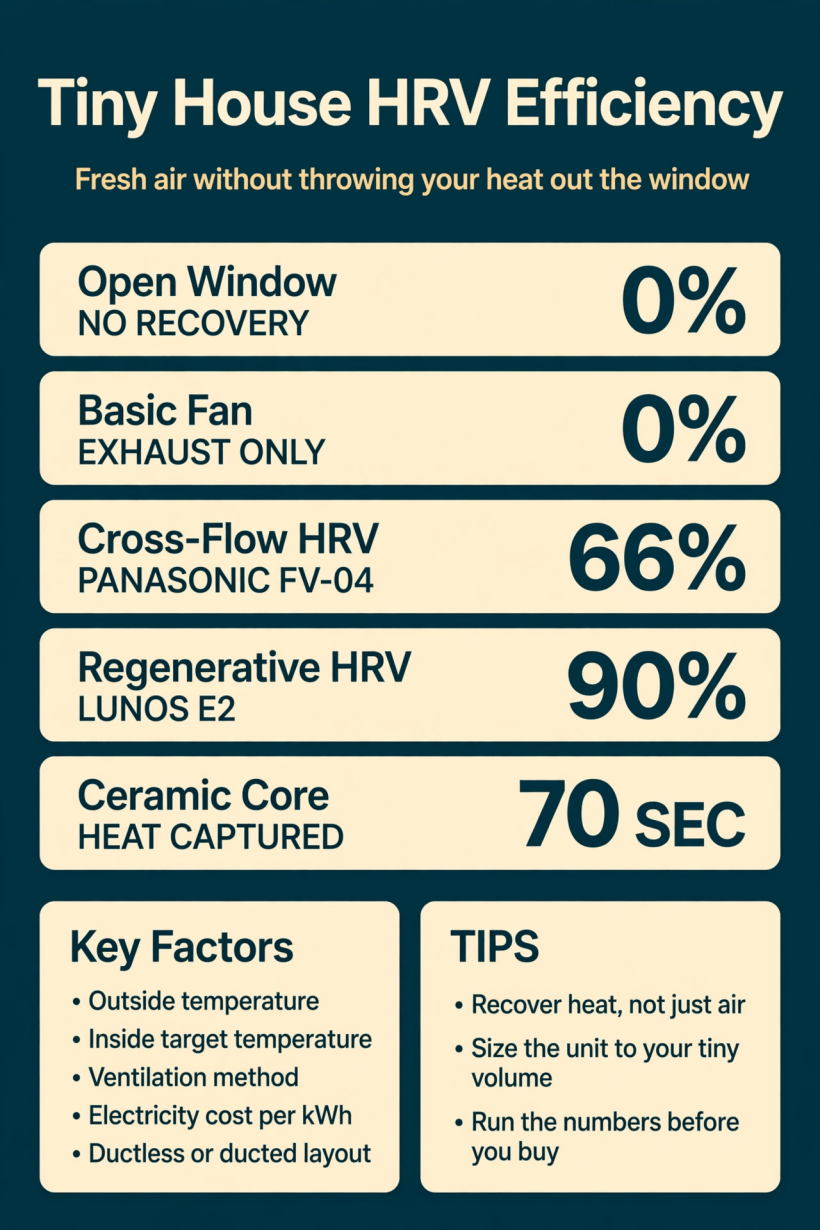
HRV efficiency at a glance: an open window recovers nothing, a cross-flow unit recovers 66%, and a regenerative ceramic core recovers up to 90%.
2. Heat Recovery Ventilation: How the Ceramic Core Captures Heat
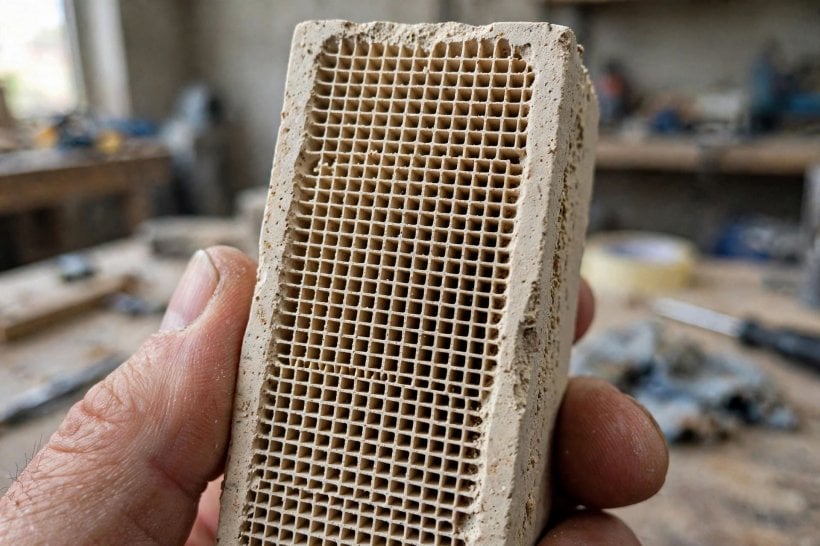
The regenerative system in the simulator works in a repeating two-part cycle rather than a constant two-way flow. For 70 seconds, a fan pushes stale warm air out of the house, and as that air passes through a ceramic stone core, the core soaks up its heat like a sponge. Then the fan reverses. Now it pulls fresh cold air in through the hot stone, and the stored heat transfers into the incoming air before it ever reaches the room. The core alternates between charging with heat and discharging it, which is why the tool labels the first phase “CYCLE: EXHAUST (Charging Core).”
Because the heat is stored in a solid core instead of being exchanged between two moving air streams, a regenerative unit can retain up to 90% of the energy that would otherwise leave with the exhaust air. In practical terms, on a 20°F day with a 70°F target inside, the air coming back through a charged ceramic core arrives far closer to room temperature than air through an open window — and that gap between incoming air temperature and indoor target is precisely what your heater has to pay to close. The better insulated and more airtight the shell, the more ventilation dominates the remaining heat loss, which is why HRV choice belongs in the same conversation as your insulation strategy for a tiny house.
3. Ductless HRVs: Through-Wall Units Like the Lunos e2
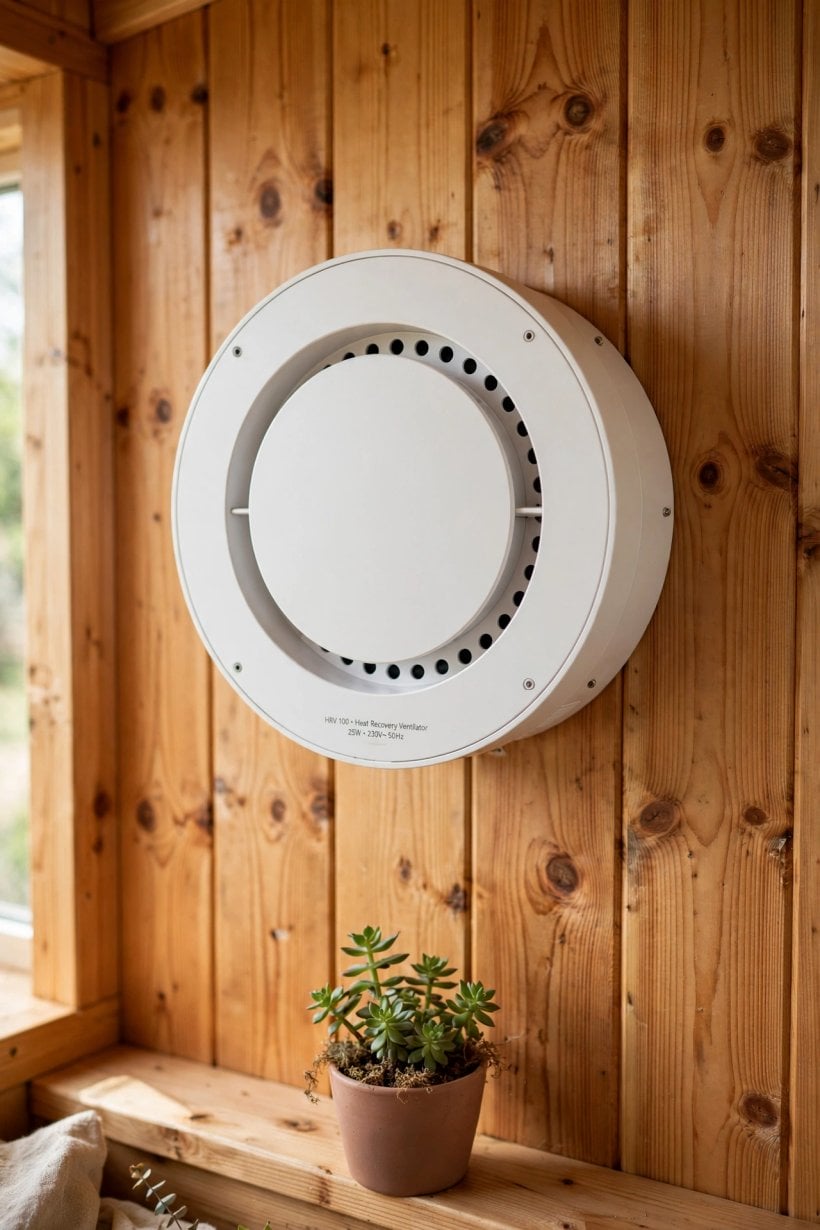
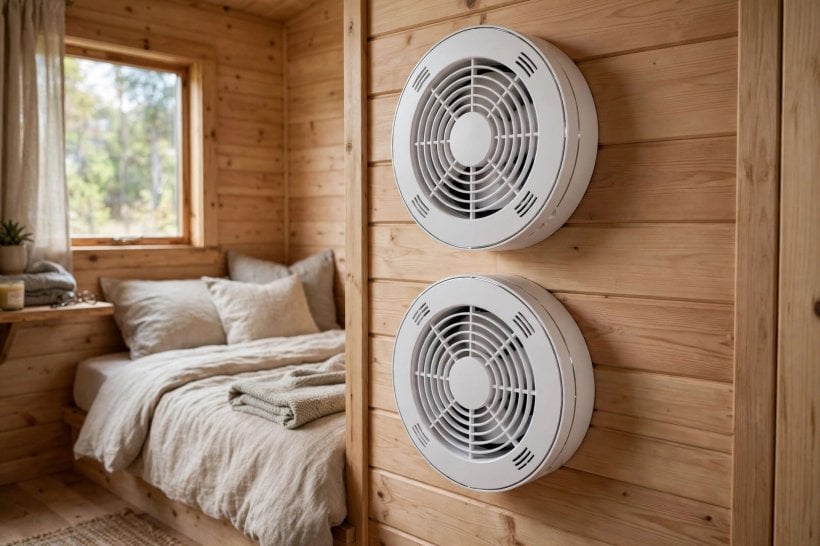
The Lunos-style system is built around pairs of small through-wall fans rather than a central unit. Each pair works in coordination: while one unit runs its 70-second exhaust phase and charges its ceramic core, its partner handles the intake side, and then the two reverse together so the house gets a balanced exchange of air without ducts anywhere in the building. The original guide puts it plainly — no ducts required — and for a tiny house that is a major structural advantage, because there is no ceiling space to surrender and no duct runs to design, seal and insulate.
The trade-off is that a ductless unit serves the space it is installed in. Air reaches the rooms where the pairs are mounted, so placement becomes part of the design: the wet, steamy rooms that generate the most moisture and the sleeping area where you spend the most hours are the natural candidates. Retrofitting is also far simpler than with a ducted system, since each unit needs a wall penetration rather than a network of ducts — one reason regenerative units have become the default recommendation for tiny houses that were framed before anyone thought about ventilation.
4. The Energy Penalty: Ventilating With an Open Window
The simulator’s first method — Open Window / Fan, rated at 0% efficiency — exists to make a hidden cost visible. Ventilating by cracking a window or running a plain exhaust fan does bring in fresh air, but the incoming air arrives at the full outdoor temperature and the outgoing air carries 100% of its heat with it. The tool calls this the “Energy Penalty,” and it grows with the temperature gap: the colder it is outside relative to your inside target, the more you pay every month for the same fresh air.
This penalty is easy to ignore because it never arrives as a single bill. It hides inside your heating costs, spread across every hour of every cold day. It also creates a bad behavioural loop: because opening a window feels expensive on a cold night, people ventilate less than the house needs, and the moisture and staleness problems quietly build instead. Heat loss through ventilation sits alongside heat loss through the structure itself — if you have ever wondered how much warmth leaks through cold steel framing, the steel frame thermal bridge simulator quantifies that half of the equation. An HRV breaks the loop by making fresh air cheap enough that you actually use it.

5. Ducted Cross-Flow HRVs: The Panasonic Approach
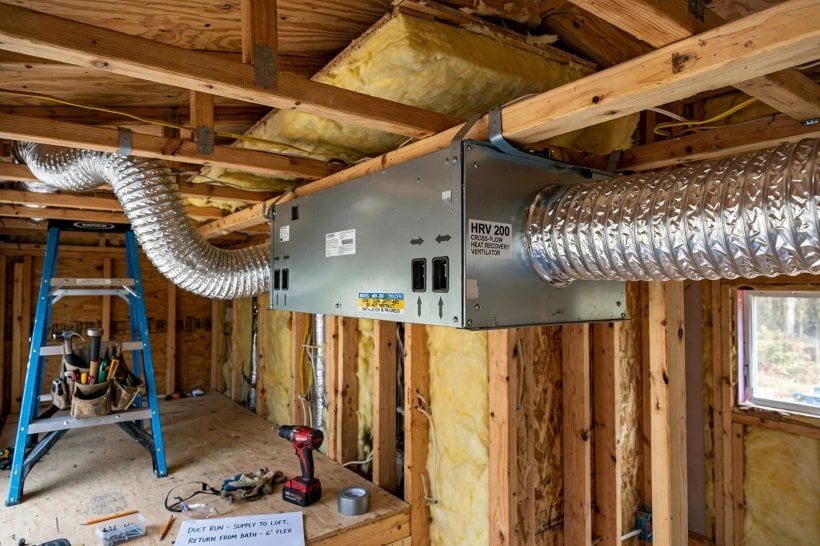
The cross-flow design, represented in the tool by the Panasonic FV-04 at 66% efficiency and described for systems like Panasonic and Zehnder, takes the opposite approach to the regenerative core. Instead of one air stream at a time, warm exhaust air and cold fresh air flow past each other continuously inside a radiator-like core, never mixing, with heat transferring through the thin metal or plastic fins that separate them. The result is a constant, simultaneous exchange — fresh air in and stale air out at the same moment.
Constant flow is the cross-flow’s real strength: ventilation never pauses for a cycle change, and a ducted layout can deliver fresh air to several rooms from one central unit. The cost of that convenience is written into the guide as well — it takes up ceiling space for ducts. In a tiny house, ceiling space is some of the most contested real estate in the building, shared with loft headroom, lighting and storage. Ducts also have to be planned before the walls close, which makes cross-flow systems a design-stage decision rather than a retrofit. At 66% efficiency, the cross-flow sits squarely between the open window and the regenerative unit: a genuine recovery system that trades some efficiency for distribution.
6. Ductless vs. Ducted: Choosing Your Layout
The original post frames the decision as “Ductless vs. Ducted,” and the simulator’s numbers give you the efficiency side of it: 90% for the regenerative ductless approach against 66% for the ducted cross-flow. But efficiency is only one attribute. A ducted system distributes air evenly to every corner of the house and runs continuously, which suits a larger tiny house or one with separated rooms. A ductless pair concentrates its work where it is mounted, installs through a wall with no duct design at all, and can be added after the build is finished.
Think about the rest of the envelope while you decide. A ducted system’s benefit shrinks if the surrounding structure leaks heat everywhere else; the floor is a common weak point, and the floor insulation calculator helps you check whether your underfloor build-up is holding up its end. The honest way to choose is to weigh the efficiency gap from the simulator against your floor plan: if your tiny house is essentially one open volume, a ductless pair covers it well and wins on recovery. If it has a closed bathroom, a separate bedroom and a loft, the cross-flow’s distribution may be worth more than the percentage points it gives up.
7. The Calculator’s Inputs: Temperature, Method and Electricity Cost
The simulator asks for four inputs, and each one maps to a real variable in your build. The Outside Temp defaults to 20°F and the Inside Target to 70°F — together they set the temperature gap your heating system must bridge, and the wider that gap, the more every percentage point of recovery is worth. The Ventilation Method selector is where the three systems compete: Open Window / Fan at 0%, the Panasonic FV-04 at 66%, and the Lunos e2 / TwinFresh at 90%. The Electricity Cost field, in dollars per kWh, converts the physics into money using your own rate.
Run the tool the way you would test any design decision: hold the temperatures steady, switch only the method, and watch the Heat Loss Cost change. Then push the outside temperature down to the coldest night your house will realistically face and see how the gap between methods widens — efficiency differences that look modest on a mild day become decisive in a cold snap. If you want to go deeper on what healthy fresh air actually means for the space once the numbers are run, the tiny house air quality simulator explores the air itself rather than the energy.
8. Reading Your Results: Incoming Air Temperature and Heat Loss Cost
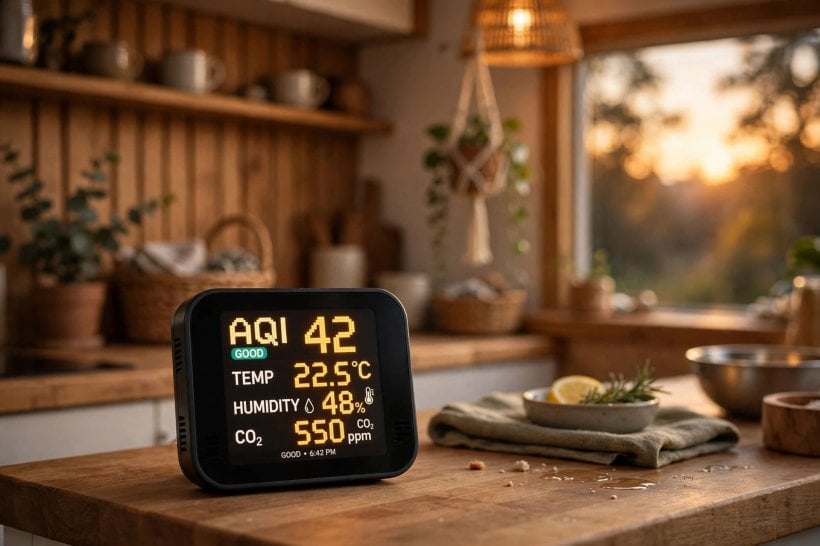
The tool returns two outputs, and they answer two different questions. Incoming Air Temp tells you how cold the fresh air will feel when it enters the room. With an open window on a 20°F day, that air arrives at 20°F — a cold draft your heater then has to tame. Through a charged ceramic core, the incoming air has already absorbed the stored exhaust heat, so it enters dramatically closer to room temperature. That is a comfort number as much as an energy number: ventilation air that arrives pre-warmed does not create the icy stream across the bed or the desk that makes people switch systems off.
Heat Loss Cost, shown in dollars per month, is the justification number — the one the original tool was built to produce, in its own words, to help builders justify the high price tag of units like the Lunos e2. A premium HRV looks expensive on the shelf and cheap across a winter: if the monthly saving between 0% and 90% recovery is significant at your electricity rate, the payback period stops being abstract. Compare the methods at your real outside temperature and your real tariff, and the calculator turns a sales pitch into arithmetic.

9. Moisture, Condensation and Mold: Ventilation’s Second Job
Energy is only half the reason a tiny house needs controlled ventilation. A small sealed volume concentrates moisture fast: cooking, showering and simply breathing in a space this size can push indoor humidity to the point where it condenses on the coldest surfaces — windows first, then wall corners and any thermal bridge. An HRV manages that moisture continuously, exchanging the damp indoor air for drier outdoor air while keeping the heat, which is something neither an open window in winter nor a closed-up house can do.
This is where ventilation connects to the rest of your moisture strategy. If you are already seeing fogged glass, the tiny house window condensation and HRV calculator works through that specific problem, and the vapor barrier placement guide covers the wall-side half of moisture control. Ventilation, vapor management and insulation work as a system: the HRV removes the moisture, the barrier keeps what remains out of the wall assembly, and the insulation keeps surfaces warm enough that condensation has nowhere to form.

10. Mistakes to Avoid When Ventilating a Tiny House
The most common mistake is treating ventilation as optional in a tight build. A well-sealed tiny house does not “breathe” through cracks the way an old drafty house does — if you do not plan the air exchange, it does not happen, and the moisture and staleness arrive on schedule. The second mistake is judging an HRV by its price tag alone instead of running it through a tiny house HRV efficiency calculator: the honest comparison is purchase price against the monthly energy penalty of the 0% alternative, at your temperatures and your electricity rate.
Third, do not assume the highest efficiency number automatically wins. The regenerative unit’s 90% recovery is real, but if your layout leaves a closed room unserved, a ducted cross-flow at 66% that actually reaches every space can serve the house better. Fourth, remember that ventilation is one layer of moisture defence, not the whole of it — surface protection matters too, which is what the flash coat mold prevention simulator explores for the walls themselves. Finally, run the simulator before you buy, not after: change the method, the temperatures and the electricity cost until you can see exactly which system your climate justifies.
Final Considerations
A tiny house asks you to choose between stale air and lost heat only if you ventilate the old way. A heat recovery ventilator — regenerative and ductless, or cross-flow and ducted — keeps the fresh air and keeps most of the warmth with it, whether that is 66% through a finned core or up to 90% through a charged ceramic one. The right choice depends on your climate, your layout and your electricity rate, and it is a decision you can make with numbers instead of guesses. Scroll down to the simulator, set your real temperatures, and compare the methods side by side before you spend anything.
HRV Efficiency Simulator
HRV Efficiency Simulator
Window vs. Lunos: Calculate heat loss & savings.
Lunos uses a regenerative ceramic core to capture heat.
Ductless vs. Ducted
How it works: It uses pairs of fans. For 70 seconds, Fan A pushes stale warm air out, heating up a ceramic stone core. Then, the fans reverse. Fan A pulls fresh cold air IN through the hot stone, pre-heating the air before it enters your home. No ducts required.
How it works: Requires ductwork. Warm exhaust air and cold fresh air pass each other in a radiator-like core without mixing. Heat transfers through the thin metal/plastic fins. Great for constant flow, but takes up ceiling space for ducts.




3 Comments