

This tool tackles the “Crying Windows” problem—why tiny homes wake up with puddles on the windowsills in winter. It combines a physics engine that calculates the Dew Point of your interior air against the Surface Temperature of different window types (Single vs. Triple Pane).
It also visualizes the specific role of an HRV (Heat Recovery Ventilator), showing how it mechanically lowers humidity without freezing you out, unlike opening a window.
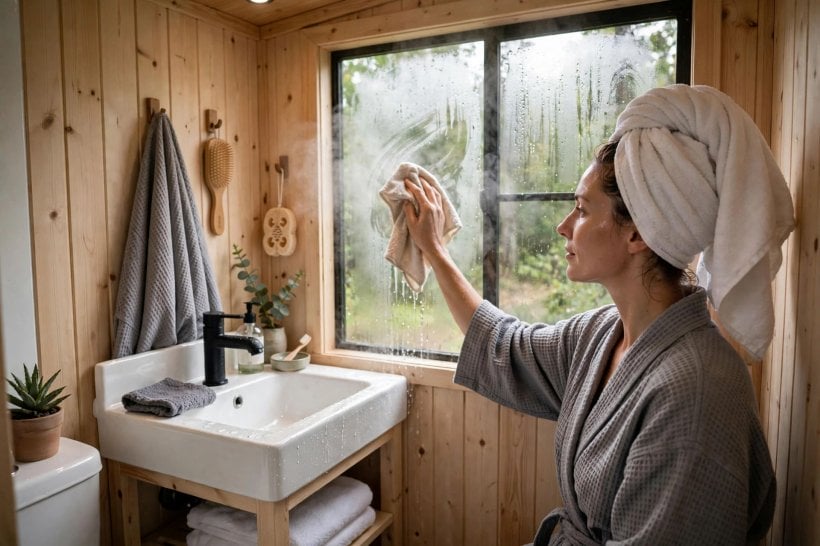
Waking up to puddles on the windowsills is the classic tiny house winter problem — the “crying windows” effect. In a very small, tightly sealed home, everyday moisture has nowhere to go, so it settles on the coldest surface it can find: the glass.
This guide explains the physics behind the drips, and how the window condensation HRV pairing — warmer glass plus mechanical ventilation — works together to keep sills dry all winter.
1. At a Glance: Crying Windows, Dew Point and Glass Temperature
Condensation is not a window defect. It is a comparison the air makes every minute of every winter day: the temperature at which your indoor air would start releasing its moisture — the dew point — against the actual temperature of your glass surface. When the glass is colder than the dew point, water appears on it. When the glass stays warmer, the pane stays clear. Everything in this article, and everything in the solver below, comes back to that single comparison.
| Factor | What the solver uses | Why it matters |
|---|---|---|
| Outdoor temperature | Slider from -20°F to 50°F, starting at 20°F | The colder it is outside, the colder your interior glass becomes |
| Indoor humidity | Slider from 20% to 80%, starting at 60% | Tiny homes spike to 60%+ just from cooking and breathing |
| Window type — Single | R-1 | One sheet of glass offers almost no resistance to the cold |
| Window type — Double | R-3 | The standard choice, but it can still condense at high humidity |
| Window type — Triple | R-5 | Keeps the interior glass surface significantly warmer |
| The comparison | Dew point of the indoor air vs glass surface temperature | Glass below the dew point means condensation forms |
| Ventilation option | HRV / Lunos mechanical ventilation, on or off | Lowers indoor humidity without opening a window in winter |
| The warning | A “CONDENSATION!” verdict | Standing water on sills brings a real mold risk |
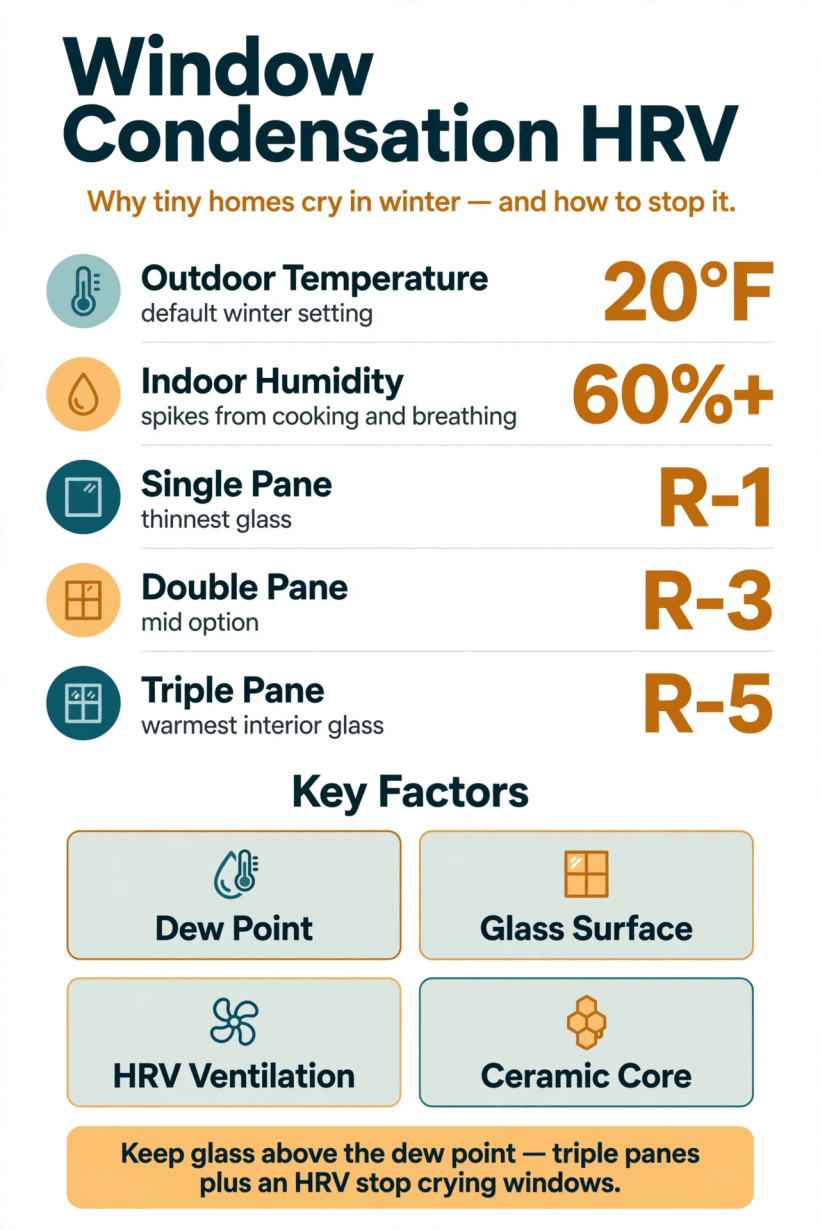
The whole problem on one page: outdoor cold, indoor humidity and glass R-value decide the dew point race, while an HRV works on the humidity side of the equation.
Two levers, then, decide whether your windows cry. You can raise the temperature of the glass — that is the window choice — or you can lower the moisture content of the air — that is the ventilation choice. Most tiny houses need some of both, because the moisture load in a small space is unusually intense, and winter cold pushes glass temperatures down night after night. The sections below take each lever in turn, then show how to read the solver’s verdict for your own combination.
2. Why Tiny Homes Cry: Moisture in a Very Small Box
A conventional house dilutes its moisture across thousands of cubic feet of air. A tiny house produces a similar daily load of water vapour — from breathing, cooking, showering and drying clothes — into a fraction of that volume. The solver states it plainly: tiny homes spike to 60%+ humidity just from cooking and breathing. That is not a lifestyle failure; it is arithmetic. And a tight, well-sealed modern envelope keeps heat in — and moisture in with it, since the vapour cannot drift away through draughty gaps that no longer exist.
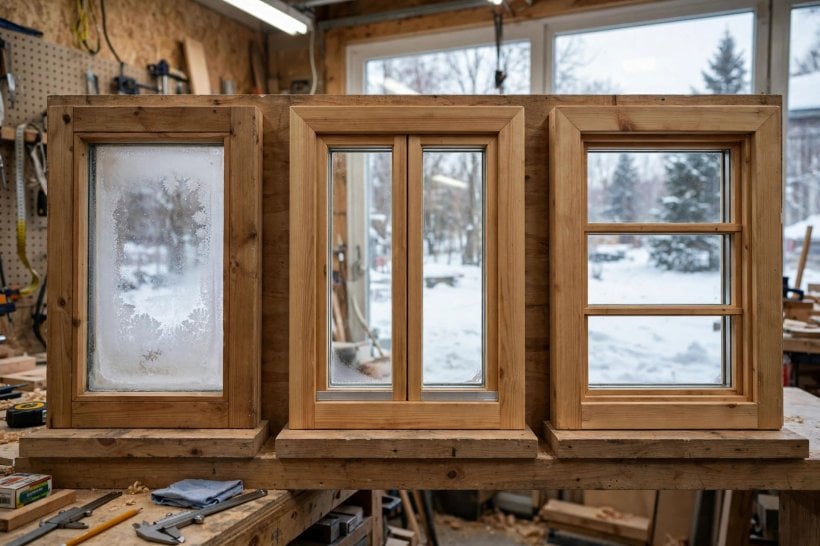
Windows are the weak point of that envelope. Walls are thick, insulated and layered; glass is thin, even in its best form. So on a cold night the pane becomes the coldest indoor surface in the home, and the air touching it cools below its dew point and lets go of its water — first as a fine fog, then as droplets, then as rivulets that run down and pool on the sill by morning. Moisture management runs across the whole envelope, and it pairs closely with the thinking in our guide to vapor barrier placement for a tiny house, where the same vapour is managed inside the wall assembly itself.
3. Dew Point Explained: The Temperature Where Air Lets Go of Water
Warm air can hold more water vapour than cold air. That single fact explains the entire problem. As air cools, its capacity shrinks, and at one specific temperature — the dew point — the air is holding exactly as much vapour as it can. Cool it one degree further and the excess water has to go somewhere: it condenses out as liquid on the nearest surface.

The dew point is not fixed. It rises as the air gets more humid and falls as the air dries out, which is why the solver’s humidity slider runs from 20% at the “Dry” end to 80% at the “Sauna” end — that slider is really a dew point slider in disguise. Push humidity up and the dew point climbs toward room temperature, until even a moderately cool pane collects water. Your room can feel perfectly comfortable while your windows stream, because comfort is about air temperature and the dew point is about moisture content.
4. Glass Surface Temperature: The Other Half of the Equation
The second number in the comparison is the temperature of the inside face of your glass. It is never as warm as the room: heat leaks outward through the window all night, so the interior surface sits between the indoor and outdoor temperatures — and how close it sits to the cold end depends almost entirely on the window’s insulating value. The solver models outdoor temperature from -20°F up to 50°F, starting at 20°F. Every degree colder outside drags the glass surface down, while the dew point inside stays where your humidity put it. The gap closes, then crosses — and the moment the glass falls below the dew point, the pane fogs.
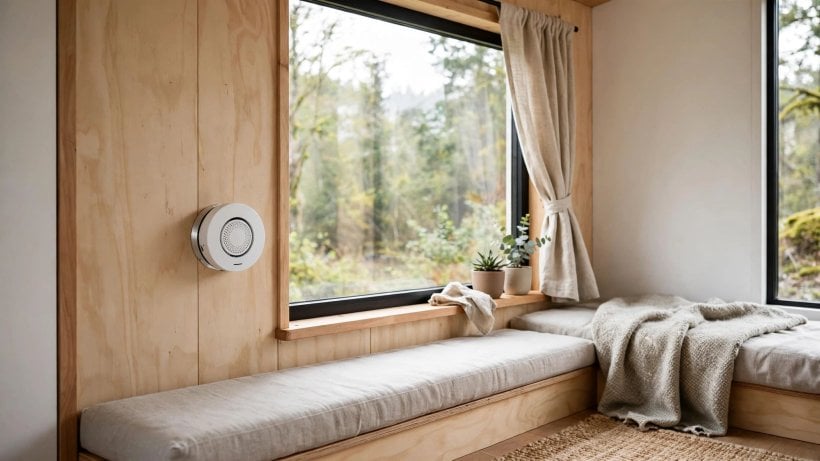
Anything that keeps the glass surface warmer pushes that crossing point further away. Better glazing is the main defence, covered next, but the room side matters too: warm air needs to wash over the pane, which is why heavy coverings closed tight against the glass all night can leave the glass colder, not warmer. Our guide to the thermal curtain calculator explores that balance — curtains save heat, but the glass behind a sealed curtain sits in a pocket of still, cooling air, so how you hang and open them matters on the coldest nights.
5. Single, Double and Triple Panes: R-1, R-3 and R-5 in Practice
The solver offers three window types, and the R-values it assigns them tell the story in miniature. A single pane is rated R-1: one sheet of glass between your warm room and the winter night. Its interior surface tracks the outdoor temperature closely, so it reaches the dew point easily and condenses first, heaviest and longest. Single panes belong to sheds and summer cabins, not to a lived-in tiny house in a cold climate. A double pane, at R-3, traps a sealed layer between two sheets of glass, and that trapped layer slows the heat leak enough to keep the inner surface noticeably warmer.
A triple pane, at R-5, adds a third sheet and a second trapped layer, and the inner glass ends up warmer again — often, as the solver’s notes put it, staying above the dew point even in freezing weather. Each step up moves the condensation threshold to a colder, rarer night. There is a weight side, too, because glazing is heavy and a house on wheels counts every pound: window decisions sit inside the same whole-build picture as the framing choices in our steel vs wood framing weight comparison and the wall assemblies in the SIPs vs stick framing analyzer.
6. Why Double Pane Is Not Always Enough in a Tiny House
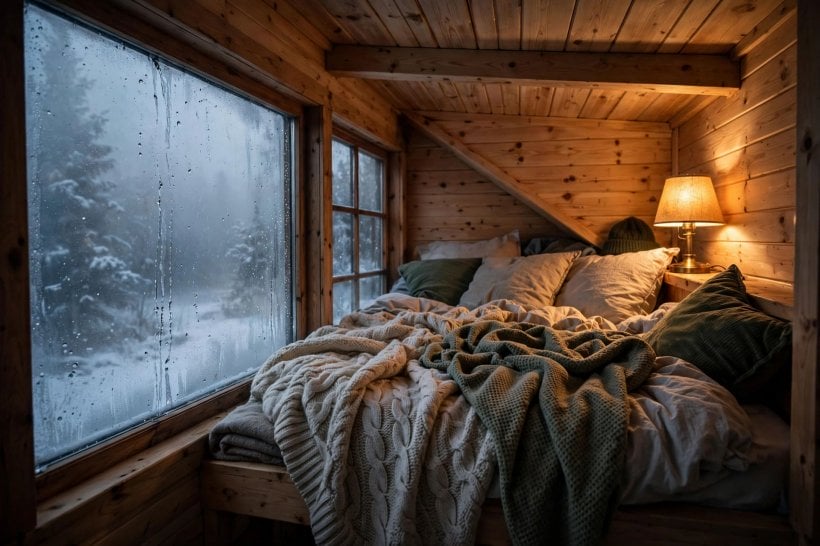
Double glazing has a good reputation, and in a conventional house it is usually earned. The solver’s own notes make the distinction precisely: double pane windows are fine for normal houses, but in a tiny house with 60% humidity, they get cold enough to condense water. The window did not change — the air did. A normal house rarely sustains tiny-house humidity, so its dew point stays low and an R-3 pane stays ahead of it. Concentrate cooking steam and overnight breathing into a tiny footprint, and the dew point climbs until it meets the double pane’s surface temperature.
This is the trap for builders who copy conventional specifications into a tiny build: details that are comfortably adequate at house scale get overwhelmed at tiny scale, because moisture concentration is the variable that changed. The solver’s defaults make the point deliberately — it opens at 60% humidity, not a mild average, because that is the realistic condition to design for. In a mild climate, with disciplined ventilation, an R-3 window can still stay clear all winter; the decision is conditional on your coldest nights, your real humidity, and whether you will run ventilation consistently — exactly what the solver answers, combination by combination.
7. The HRV Solution: Drying the Air Without Dumping the Heat
If warmer glass is one lever, drier air is the other — and drying the air in winter has an obvious problem. The solver names it directly: you cannot just “crack a window” in winter without freezing. Open ventilation absolutely drops humidity, but it throws away the expensive heat you have been generating, chills the room, and creates cold draughts — and in a tiny house there is no far corner to escape the draught to.
A heat recovery ventilator solves the contradiction mechanically. It swaps stale, moist indoor air for fresh, dry outdoor air, but the two streams pass through a core that captures heat from the outgoing air and hands it to the incoming air. The moisture leaves; most of the warmth stays. Run one and the humidity in your real home starts moving toward the dry end, the dew point falls with it, and glass that was marginal suddenly has a comfortable safety margin.
Ventilation is also a heating question, which is why this topic connects to our guide on heating a tiny home in winter: every ventilation strategy is really a decision about how much heat you will trade for dry air, and the HRV’s whole purpose is to make that trade small. If you want to go deeper on sizing and efficiency once the condensation question is settled, our companion tiny house HRV efficiency calculator examines the same ventilator’s heat recovery performance in detail.
8. The Lunos e2 and the Ceramic Core: How Heat Recovery Works
The solver singles out one style of unit by name: an HRV like the Lunos e2, which swaps stale moist air for fresh dry air through a ceramic core that captures the heat. Units of this type suit tiny houses particularly well because they work in compact, ductless arrangements rather than needing a central duct system — a real constraint when your entire home is a single open volume with a loft.

The ceramic core is the heart of it. As warm indoor air is pushed out through the core, the ceramic absorbs its heat. The flow then reverses, and incoming fresh air passes back through the same warmed ceramic, picking that stored heat up on its way in. The rhythm repeats — exhale, inhale, exhale — and with each cycle the house trades moisture-laden air for dry air while surrendering only a fraction of the heat an open window would lose. In the solver, this is the “Install Lunos/HRV?” toggle: flip it on and the dew point drops, and combinations that flashed a condensation warning come back clear — without changing the window at all.
9. Reading the Solver: Inputs, Outputs and the Condensation Verdict
The solver asks for four things: outdoor temperature, from a hard freeze up to a mild 50°F; indoor humidity, from dry to sauna; window type — single, double or triple, with their R-1, R-3 and R-5 ratings; and whether mechanical ventilation from an HRV is installed. Those four inputs describe almost any tiny house winter night you are likely to face, which is what makes the tool useful as a design check rather than a curiosity.
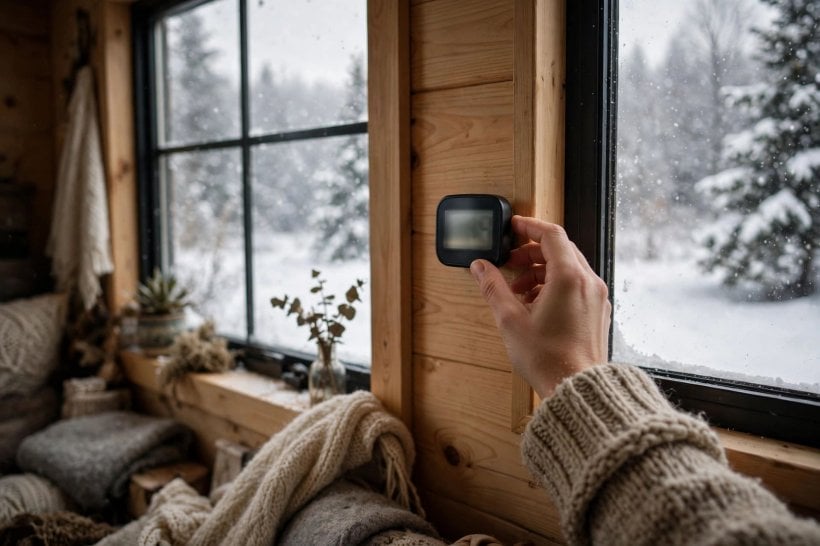
It answers with two numbers and a verdict. The glass surface temperature tells you how cold your pane’s inner face will run; the dew point tells you the temperature at which your indoor air starts releasing water. Glass warmer than the dew point means a clear window; glass colder means the tool shows its verdict in plain language — “CONDENSATION!” — along with the warning that matters most: mold risk on sills. Use it as a stress test, not a fair-weather check: set the coldest realistic night and the honest humidity level, then test your planned window, toggling the HRV on and off, before a single window is ordered.
10. Habits That Help: Cooking, Showers and Everyday Moisture Control
Hardware sets the boundaries, but daily habits decide where inside them you live. The solver’s note that tiny homes spike to 60%+ just from cooking and breathing points at the sources you can manage. Cooking releases moisture at the pot; a lid on the pan and ventilation running during cooking — not after the windows fog — keeps much of that vapour from ever joining the room air. Boiling, simmering and kettle-filling are the peak events, and they are predictable, which makes them manageable.
Showers are the other peak: a short shower in a tiny bathroom loads a small volume of air to saturation quickly, and that steamy air then migrates to the coldest glass in the home. Ventilate during the shower and for a while afterwards, and give wet towels and clothes a drying path that does not involve the whole house’s air. Wipe sills dry on mornings when condensation does appear, and let the ventilator run on cold nights instead of switching it off for silence: those are precisely the nights the dew point race is closest. Sunshine helps when it comes, too — solar gain warms the room and the pane, a small overlap with the principles in our tiny house passive solar simulator.
Final Considerations
Crying windows are information. They tell you that, on the nights in question, your glass ran colder than your air’s dew point — and both sides of that comparison are within your control. Warmer glass, from double or triple panes, raises one number; ventilation, from a window condensation HRV setup, lowers the other. The tiny houses that stay dry in winter are not the ones with a single miracle product. They are the ones where glazing and ventilation were chosen together, with the moisture load of a small, tight, fully lived-in space honestly admitted from the start.
Run your own combination through the solver below before you commit to windows or a ventilator. Test the coldest night, the steamiest cooking session, the realistic 60% humidity rather than the hopeful figure. If the verdict flashes, you now know the two ways to change it — and changing it on a screen costs nothing.
Window Condensation Solver
Window Condensation Solver
Why Tiny Homes need Triple Panes & HRVs.
Tiny homes spike to 60%+ just from cooking/breathing.
Why Tiny Homes “Cry”
Double pane windows are fine for normal houses, but in a tiny house with 60% humidity, they get cold enough to condense water. Triple Pane keeps the interior glass surface significantly warmer, often staying above the dew point even in freezing weather.
You cannot just “crack a window” in winter without freezing. An HRV (Heat Recovery Ventilator), like the Lunos e2, swaps stale moist air for fresh dry air through a ceramic core that captures the heat. It lowers humidity without losing your expensive heat.




2 Comments