

This tool is a reality check for off-grid builders. It visualizes the massive power difference between Electric Mats (which can drain a $5,000 battery bank in 3 hours) and Hydronic Systems (which use propane for heat and sip tiny amounts of electricity for the pump). It includes a “Battery Drain Simulator” to show exactly how fast your lights will go out if you try to run electric floor heat on solar.
Warm floors are the heating upgrade every tiny house owner dreams about — until the power bill arrives in amp-hours. Radiant heat feels luxurious, but one version of it can empty an off-grid battery bank before morning while the other barely sips power. This guide breaks down the difference, then hands you the analyzer to run your own floor.
1. At a Glance: Electric vs Hydronic in Brief
Every radiant floor does the same job — it turns the whole floor into a low, gentle heat source — but the two systems that deliver that heat could not be more different in what they ask of your electrical system. A radiant floor heating power analyzer exists because the gap is so extreme: electric mats convert your stored battery power directly into heat, while hydronic systems make their heat from propane or diesel and spend electricity only on a small circulation pump. The original guide below calls the tool a reality check for off-grid builders, and the table sums up why.
| System | How it makes heat | What it costs your batteries |
|---|---|---|
| Electric Mat (Resistance) | Electricity becomes heat directly in the mat — simple install, uses 120V AC | A 50 sq ft mat pulls ~600 watts — enough to kill a standard solar battery bank before morning |
| Hydronic (Water + Propane) | A propane or diesel boiler heats water; a 12V pump circulates it through tubes in the floor | The pump draws a tiny 15–30 watts — easily sustainable on even a modest solar setup |
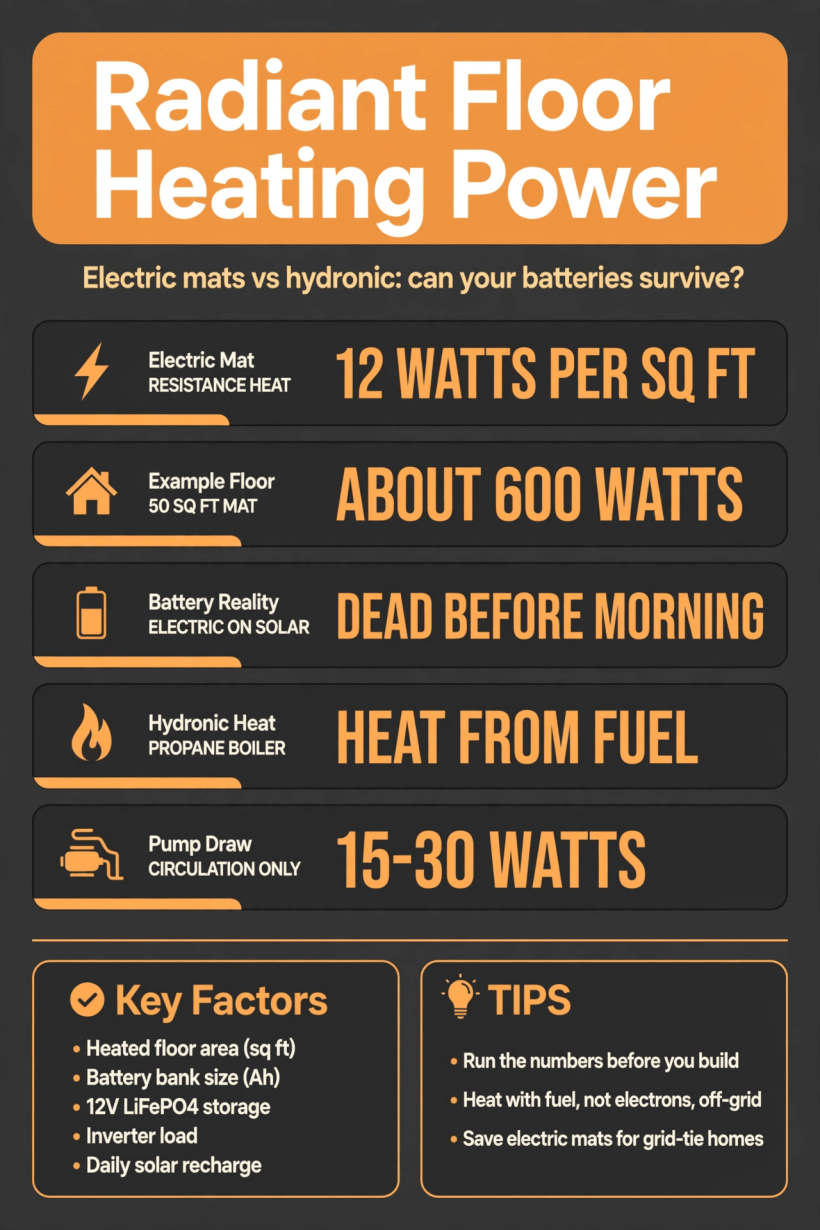
The whole argument on one card: the same warm floor, two completely different power appetites.
2. What Radiant Floor Heating Is — and Why Tiny Houses Love It
Most heating systems warm the air and hope some of it reaches you. Radiant floor heating works the other way around: the floor itself becomes the heat source, warming your feet, the furniture and everything in contact with it, and the room feels comfortable without the air ever getting stuffy. In a tiny house that idea is especially attractive. The floor is the largest single surface in the home, ceilings are low, and there is no spare corner for a bulky heater eating into the floor plan — a heated floor takes up no living space at all.
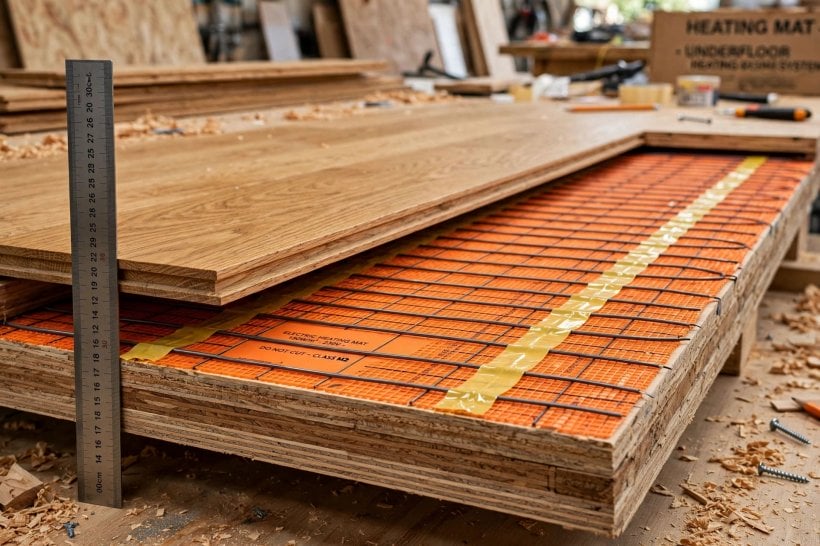
It also rewards the way tiny houses are actually lived in. Bare feet on a cold morning floor is the moment occupants feel most, and a warm floor removes it. But a radiant system is only ever as good as the floor build-up underneath it: heat that leaks downward is heat you paid for twice. That is why floor heating decisions belong in the same conversation as the insulation beneath the subfloor — run your build-up through the floor insulation calculator for tiny houses so the warmth goes up into the room, not down into the trailer. And because a tight, well-heated tiny house still needs fresh air, the balance is covered by the tiny house HRV efficiency calculator.
3. Under the Floor: Electric Mats vs Water Tubes
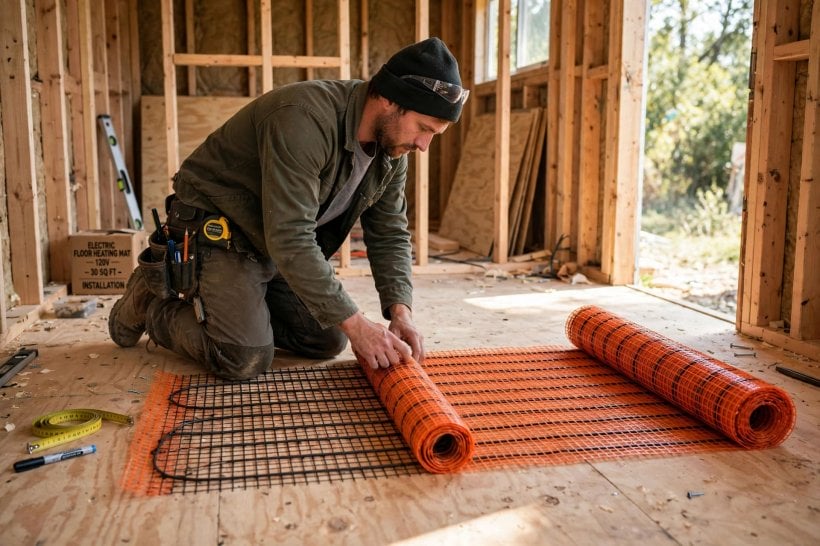
Physically, the two systems hide in the same place — inside the floor build-up, between the subfloor and the finished surface — but what you bury there is very different. An electric system is a mat or cable carrying a resistance element: pass current through it and it warms up, exactly like the element in a kettle or a space heater, spread flat under your floorboards. The mat itself is thin, quick to roll out and easy to fit around a tiny, awkward floor plan, which is a large part of its appeal for self-builders.
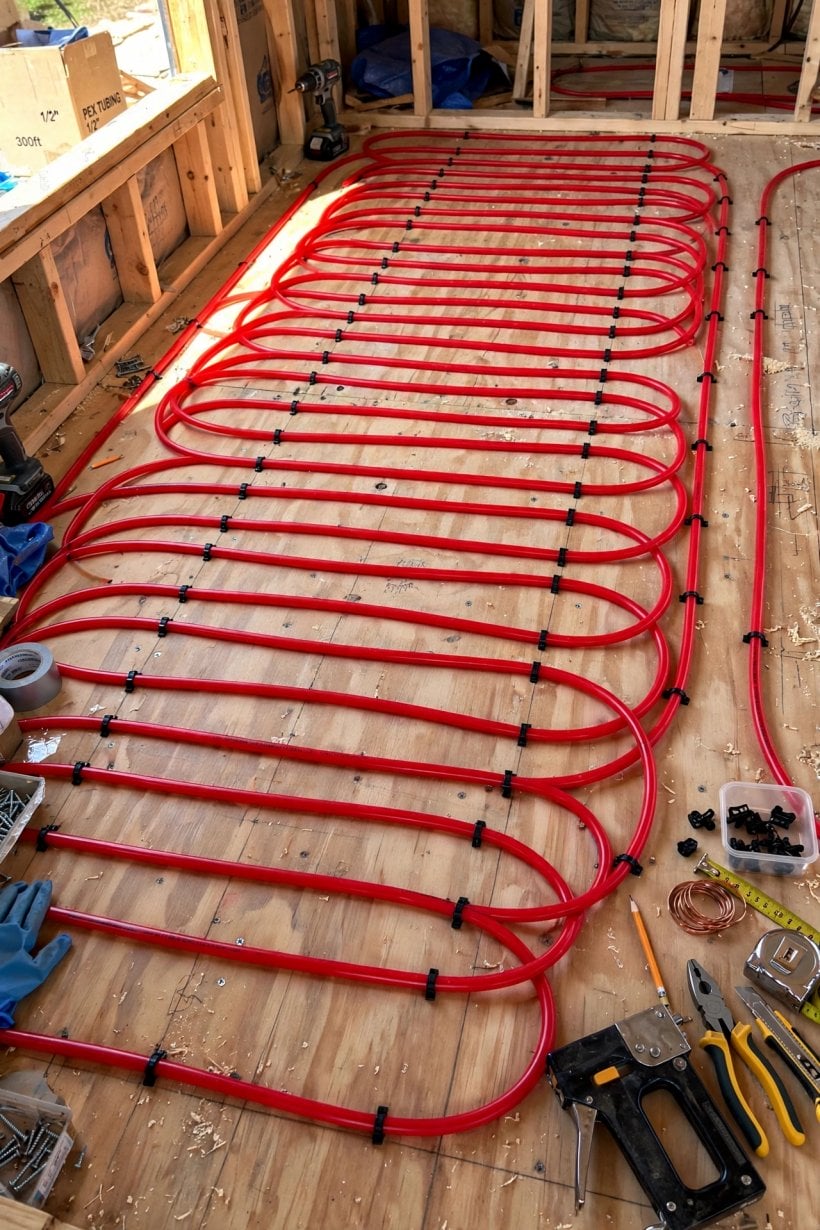
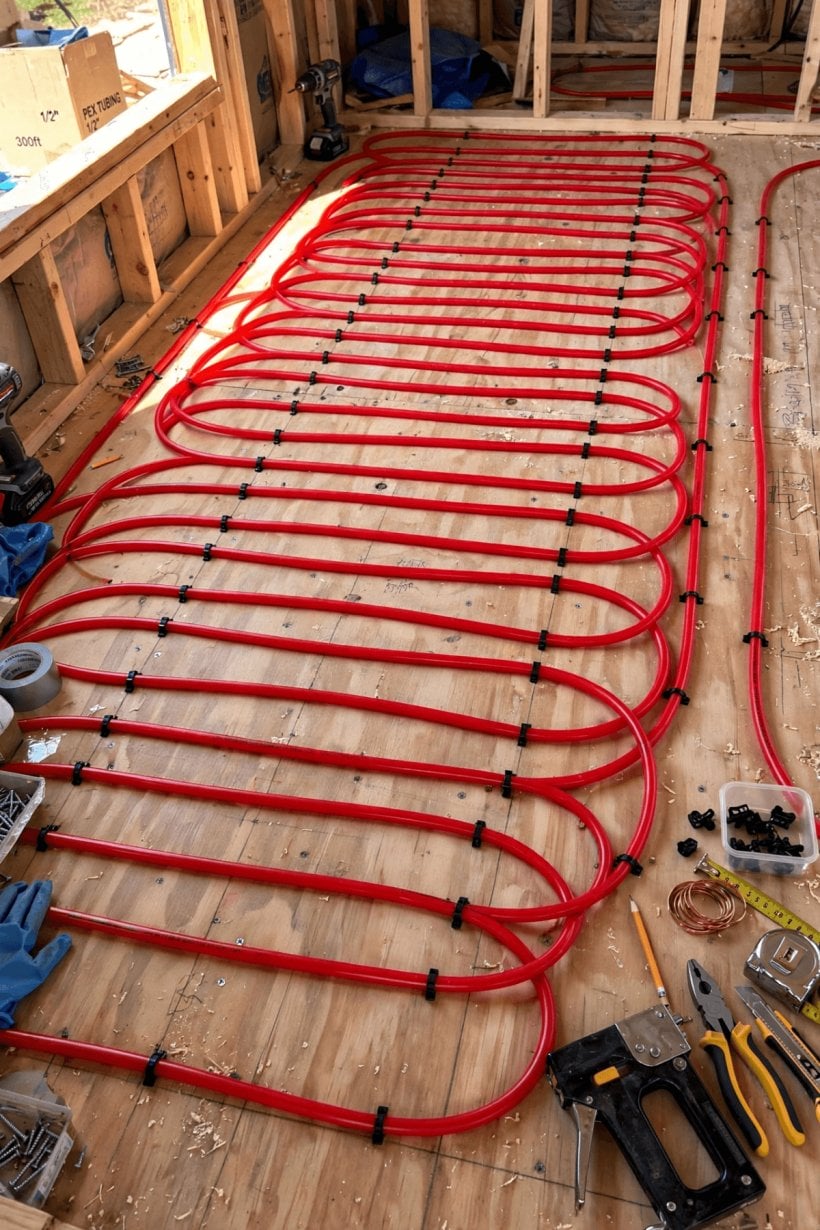
A hydronic system buries plumbing instead: loops of tubing laid in even serpentine rows, carrying warm water out from a boiler and back again. There is nothing electrical in the floor at all — the heat arrives dissolved in water. That difference sounds minor until you follow the energy. In the electric floor, the floor covering is the heater and your battery is the fuel tank. In the hydronic floor, the floor is just a delivery network, and the fuel is a propane or diesel supply that was never part of your electrical budget. Everything else in this guide — the wattages, the runtimes, the warnings — flows from that single distinction.
4. Hydronic Systems: A Boiler Does the Work, a Pump Sips the Power
A hydronic radiant setup has three working parts. A boiler — the original guide names propane or diesel as the fuel — heats the water. A manifold splits that hot water into the separate tube loops in the floor and gathers the cooler return water. And a small circulation pump keeps it all moving. The pump runs on your 12V system, and it is the system’s only real electrical appetite.
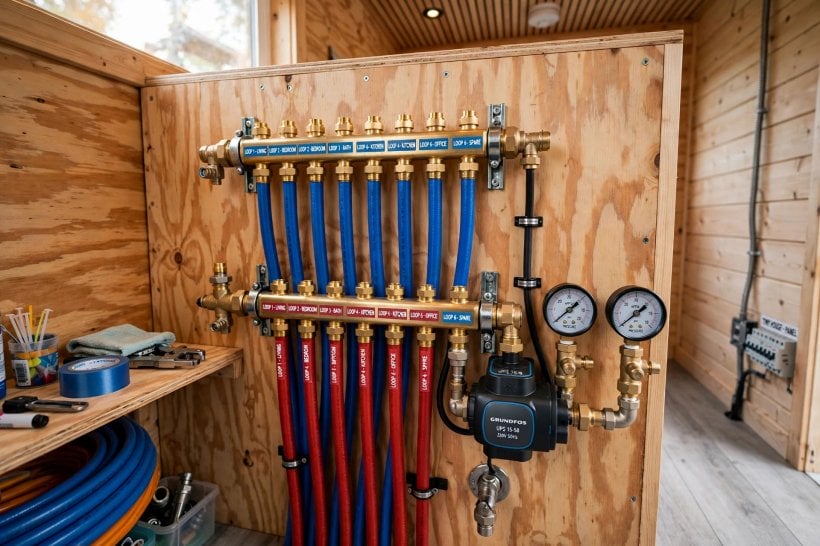
That appetite is remarkably small. As the guide below puts it, the circulation pump draws a tiny 15–30 watts — the analyzer models it at 30 watts — which it describes as easily sustainable on even a modest solar setup. Compare the shape of the two loads: the electric mat asks your batteries for hundreds of watts of heat, continuously, for as long as the floor is on. The hydronic system asks your batteries for a pump’s worth of watts and asks your propane tank for the heat. Fuel and electricity stop competing for the same storage, and that is why hydronic keeps winning the off-grid argument despite being, as the tool notes, the complex install of the two.
5. Fuel Choices: Propane or Diesel Heat
Because a hydronic system separates heat from electricity, the fuel question becomes its own decision. The tool’s own description frames it plainly: a propane heater plus a 12V pump. Propane is the familiar tiny house fuel — the same supply many owners already carry for cooking and hot water — and a compact boiler can share that infrastructure. The original explainer also names diesel boilers as the alternative, which suits owners whose vehicle and heating plans already run on diesel.
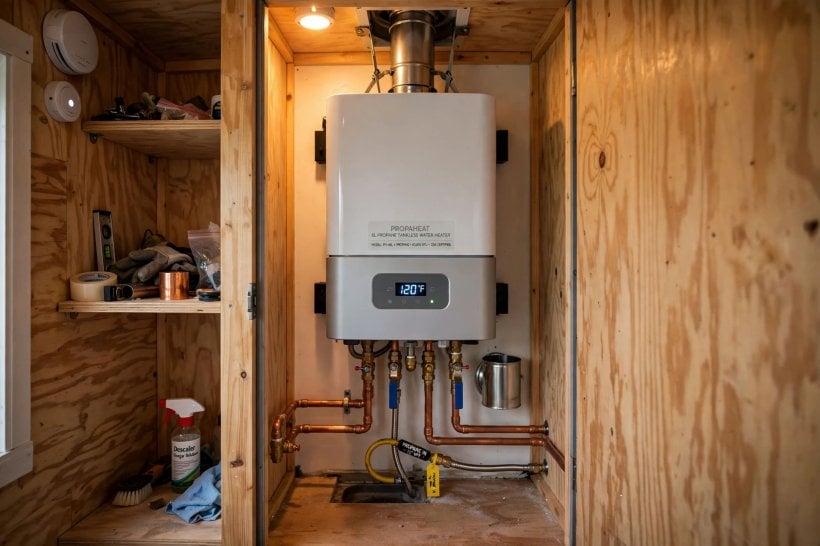
Either way, the strategic point is the same: burning fuel for heat is something fuel is good at, while storing heat in batteries is something batteries are bad at. Owners comparing heat sources often weigh a hydronic boiler against the other combustion option in a tiny house, the forced-air furnace — the RV furnace efficiency and noise simulator shows how that appliance behaves, including the noise a radiant floor avoids entirely. A radiant hydronic system delivers its heat silently, with no fan and no blast of hot air, because the only moving part on the electrical side is a pump you will never hear through the floor.
6. The Power Math: From Watts per Square Foot to a Dead Bank
Now the numbers, all of them from the tool below. Electric mats are what the guide calls resistive loads: they turn electricity directly into heat, and the analyzer prices that conversion at 12 watts per square foot of heated floor. Multiply up and the example it gives is sobering — a small 50 sq ft mat pulls about 600 watts. The guide’s comparison is the one that sticks: that is like running 60 LED bulbs continuously. And a heated floor is not a load that runs for ten minutes. It runs for hours, every cold evening, at full draw.
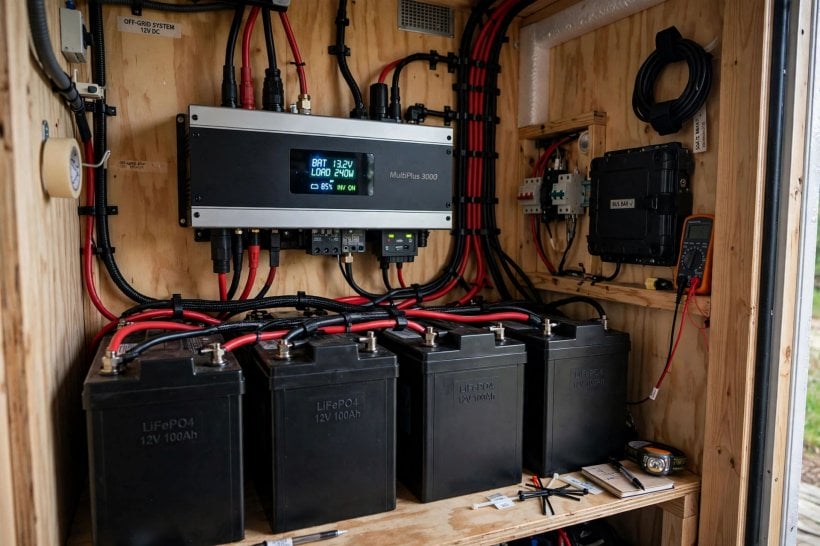
Set that draw against storage and the shape of the problem appears. Your battery bank holds a fixed pool of watt-hours; a 600-watt load drinks from it at 600 watts for every hour the floor is warm. The tool’s headline warning makes the scale concrete: electric mats can drain a $5,000 battery bank in 3 hours. Its verdict for the standard case is blunter still — a draw like that will kill a standard solar battery bank before morning. This is not an argument that electric heat is badly made. It is arithmetic: resistance heat spends the scarcest resource in an off-grid house — stored electricity — on the one job that fuel does far more cheaply.
7. Battery Bank Size: 100Ah, 400Ah or 800Ah
The analyzer’s third input is your battery bank, offered at three sizes that read like a short history of off-grid ambition: 100Ah, labelled basic; 400Ah in the middle; and 800Ah, labelled pro. Its battery math works on a 12-volt LiFePO4 bank. Doubling the bank doubles the runtime — but read that against Section 6 and you see why bank size alone cannot rescue electric floor heat: it only changes whether the mat drains you in a couple of hours or somewhat more of them. The warning in the tool appears long before even a pro-sized bank looks comfortable.
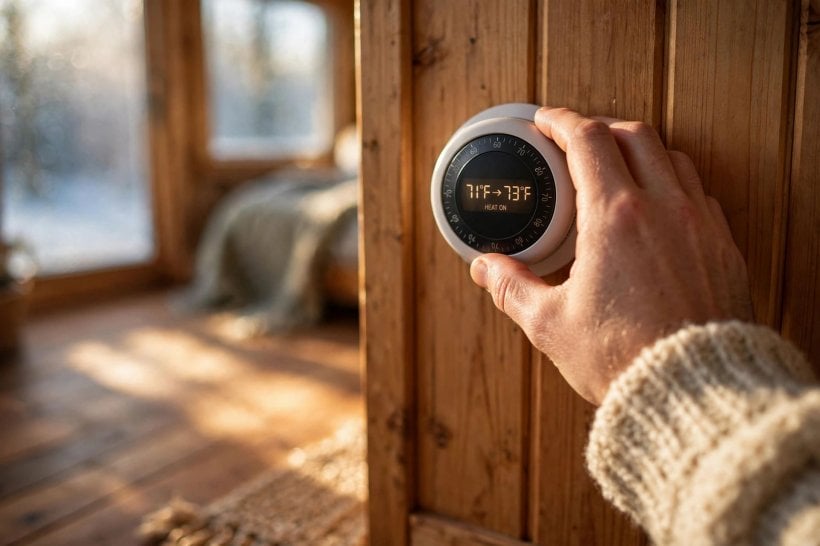
The honest way to use bank size is in the other direction: choose the heating system your storage can actually feed, then size the bank for your real loads — lights, pump, devices, refrigeration — with the modest solar input a tiny roof can offer. The sizing conversation starts with the array itself, which is why our guide to how much solar panels cost for a tiny house is the natural companion read. A thermostat can stretch runtime by cycling the floor, but no control strategy changes the underlying exchange rate of 12 watts per square foot.
8. Grid-Tie vs Off-Grid: Where Each System Belongs
None of this makes electric mats a bad product — it makes them a product with an address. The guide below is explicit in its heading: electric is for grid-tie. On shore power or a grid connection, the mat’s simplicity is a genuine virtue: no boiler, no plumbing, no manifold, just a thin mat, a thermostat and a 120V AC supply that never runs out overnight. For a parked tiny house on a powered site, electric radiant is arguably the easiest warm floor you can install.
Off-grid, the verdict flips completely, and the same simplicity becomes a trap: the easy install hides an impossible running cost. This is also where radiant stacks up well against the other off-grid heat sources. A wood stove asks for clearances and daily tending — plan one with the wood stove clearance calculator — while a hydronic floor asks only for fuel in the tank. And whatever heats the house, keeping the heat in is a separate battle fought underneath the trailer, where the tiny house skirting for winter calculator deals with the cold air that chills floors from below.
9. Installation and Planning Mistakes
The mistakes cluster predictably. The biggest is choosing the floor by installation effort alone — the mat wins that contest easily, which the tool acknowledges with its “simple install” label — and discovering the running cost in the first winter. The second is sizing the heated area by the whole floor plan rather than the area that needs heat: since the draw scales at 12 watts per square foot, every unnecessary square foot is a permanent tax on the bank. The third is assuming a bigger bank fixes it, when the tool’s own sizes show the drain outrunning even the pro option.
Hydronic builds have their own failure mode: underestimating the “complex install” the tool warns about. Tube loops, a manifold, a boiler and a pump are plumbing, and plumbing planned badly leaks, airlocks or heats unevenly — it has to be designed as a system, not improvised as an afterthought. Finally, plan for the cold itself, not just the heating: a house whose heat fails mid-winter risks frozen plumbing within hours, which is the scenario the heat tape and pipe freeze simulator exists to rehearse. Warm floors are the comfort layer of a winter plan, never the whole plan.
10. How to Use the Analyzer Below
The radiant floor heating power analyzer below asks for three things. Your heated floor area in square feet — the area the system will actually cover, not the whole footprint. Your heating system: the electric mat, or hydronic with its propane heater and 12V pump. And your battery bank size, slid between 100Ah and 800Ah. Press “Check Power Draw” and it returns the two numbers this whole article has been circling: the power draw in watts, and the runtime on battery in hours — backed by its Battery Drain Simulator, which shows how fast the bank empties, down to the “RAPID DRAIN! Dead in…” warning when the maths turns fatal.
Run it like a skeptic. Start with your real floor area and the electric mat, on your real bank size, and read the runtime honestly. Then switch the system to hydronic and watch the same floor drop to a 30-watt pump draw and a runtime measured in days of background load rather than hours of countdown. Finally, drag the battery slider and confirm the lesson of Section 7 for yourself: bigger storage delays the electric verdict; it never overturns it. Two minutes with those three inputs will tell you which warm floor your house can actually afford.
Final Considerations
Radiant floor heat is not one decision but two: how the floor feels, and what the floor eats. Electric mats eat stored electricity at 12 watts per square foot and belong on grid power; hydronic loops eat propane or diesel and ask your batteries only for a pump’s 15–30 watts. In a tiny house, where every watt-hour is harvested from a small roof, that difference is the whole story. Decide which house you are building — grid-tie or off-grid — then scroll down, enter your floor area and your bank, and let the analyzer’s runtime readout make the final call.
Radiant Floor Power Analyzer
Radiant Floor Power Analyzer
Electric vs. Hydronic: Can your batteries survive?
Off-Grid Reality Check
Electric floor mats are “Resistive Loads.” They turn electricity directly into heat, which is extremely inefficient for batteries. A small 50 sq ft mat pulls ~600 Watts. That’s like running 60 LED bulbs continuously. It will kill a standard solar battery bank before morning.
Hydronic systems use a propane or diesel boiler to create the heat. The only electricity used is for the circulation pump, which draws a tiny 15-30 Watts. This is easily sustainable on even a modest solar setup.


1 Comment