

A tiny house can be framed beautifully and still tow badly if its weight sits in the wrong place. This axle placement guide starts from one simple idea: the axles should sit slightly behind the middle of the deck, so the finished house presses down on the hitch with steady force instead of lifting, pushing or wagging behind the tow vehicle.
1. At a Glance: Axle Placement in Brief
Axle placement is the decision about where, along the length of the trailer deck, the axle or axle group is mounted. That single position sets the balance point of the whole build. Put the axles too far forward and the rear of the house becomes heavy, the tongue goes light, and the trailer can sway. Put them too far back and the tongue becomes excessively heavy, overloading the hitch and the rear suspension of the tow vehicle. The goal is a calm middle ground: most of the weight carried by the axles, a useful share carried by the tongue, and nothing left to chance once the house is fully fitted out.
| Concept | Rule of thumb | Why it matters |
|---|---|---|
| Axle position on the deck | Axle centre around 60% of the deck length back from the front, 40% ahead of the rear — the widely used 60/40 split | Leaves a modest forward weight bias so the trailer follows the tow vehicle instead of steering it |
| Tongue weight | Commonly around 10–15% of the total loaded trailer weight for conventional ball-hitch towing | Too little invites sway; too much overloads the hitch, coupler and tow vehicle rear axle |
| Measurement basis | Measure the flat deck only, not the tongue or drawbar | The 60/40 split describes the load-carrying deck; including the tongue shifts the result and the balance |
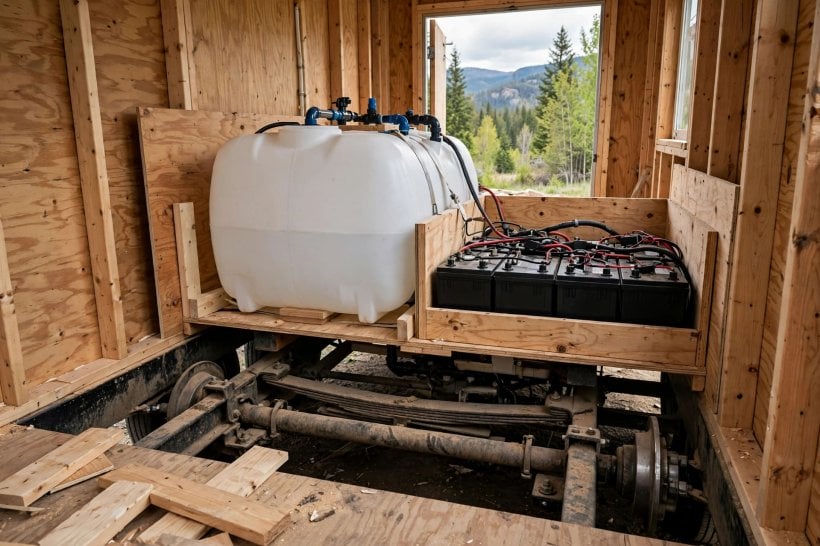
| Load placement | Heaviest fixed systems close to the axles | Weight near the balance point changes tongue weight least and reduces pitching and wagging |
| Final check | Weigh the finished, loaded house — total weight and tongue weight | Calculations made on an empty shell rarely survive contact with appliances, water and belongings |
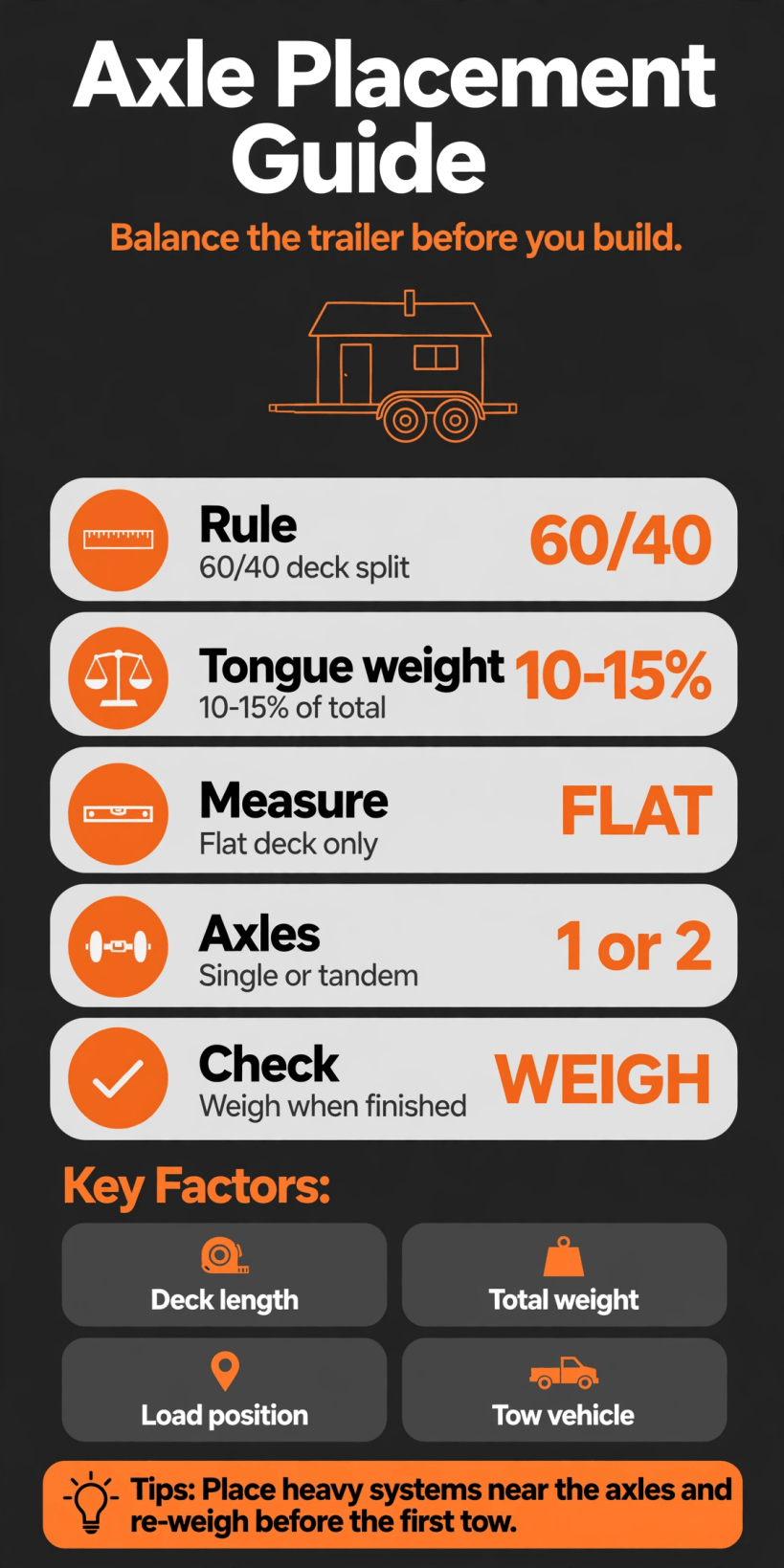
The balance rules at a glance: split the deck roughly 60/40, keep tongue weight in its target band, and confirm everything on a scale once the build is finished.
Everything that follows in this axle placement guide expands those five rows: how to measure, how to calculate, how single and tandem setups differ, and how to recognise and correct a trailer whose balance is wrong.
2. Why Axle Position Controls Towing Behaviour
A trailer is a lever. The coupler at the front rests on the tow vehicle, the axles act as the fulcrum, and every kilogram of the house sits somewhere along the beam between and beyond those points. Weight ahead of the axles pushes the tongue down; weight behind them lifts it. Axle position decides how much of the house falls on each side of that fulcrum, which is why a difference of a few inches in placement can change the character of a tow from settled to nervous.
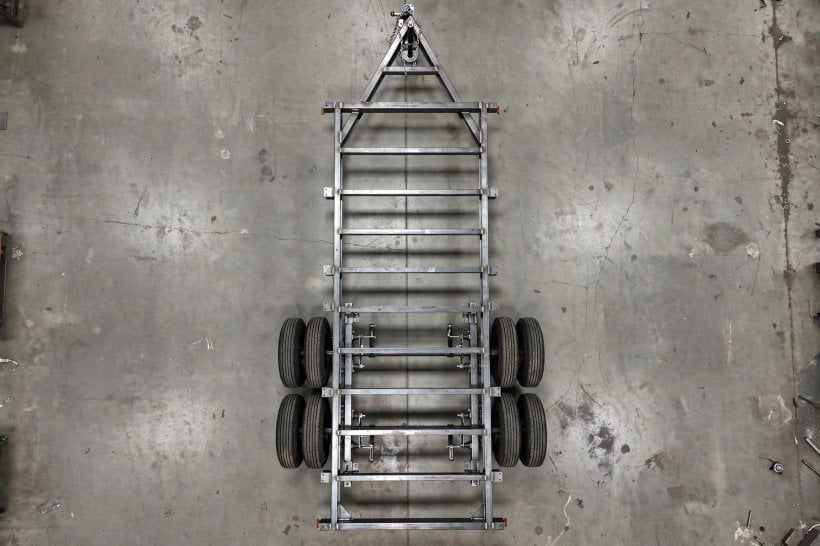
Three behaviours trace back to this balance. The first is directional stability: a trailer with adequate tongue weight wants to run straight, because the hitch point is being pulled into line by the load behind it. The second is pitching — the see-saw motion over bumps — which grows when heavy items sit at the far ends of the deck, far from the fulcrum. The third is how the combination brakes and turns: a balanced trailer loads its own tyres evenly and leaves the tow vehicle’s steering axle with the grip it was designed to have. When you choose a chassis using a tiny house trailer buying guide, axle position is one of the specifications worth confirming in writing, because moving welded suspension mounts later is far harder than choosing correctly at the start. A sketched tiny house weight distribution diagram for your own layout makes the lever visible before any steel is cut.
3. The 60/40 Rule Explained: Measuring the Deck
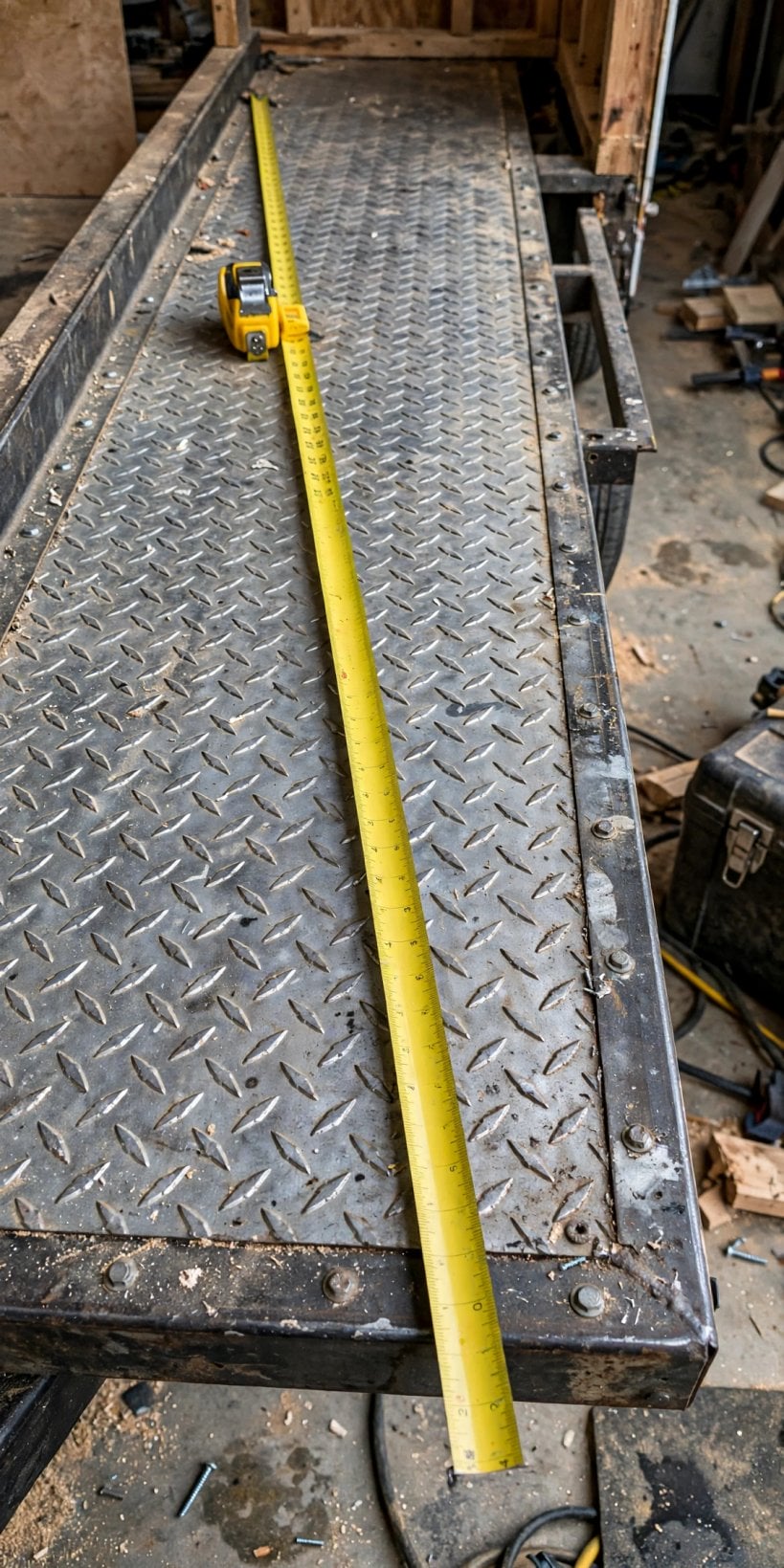
The 60/40 rule is the common starting point for positioning axles under a load-carrying deck. Measure the flat deck from its front edge to its rear edge — the part that will actually carry the house — and mark the point 60% of that distance back from the front. The axle centreline goes at, or very near, that mark. On a tandem setup, it is the centre of the axle group, midway between the two axles, that sits on the mark; the equaliser and hangers then spread the pair evenly around it.
Two details of the measurement matter. First, the tongue is excluded. The drawbar and coupler sit ahead of the deck and carry no house load, so including them pulls the calculated point too far forward and quietly removes tongue weight. Second, the rule is a starting point for balance, not a guarantee. It assumes the finished house is loaded roughly evenly along its length. A build with a heavy rear bathroom, water tanks behind the axles and a light front loft will balance differently from the bare-deck maths, which is why experienced builders treat 60/40 as the opening estimate and then check the result against real tongue weight before committing to final weld positions where the design allows adjustment.
Worked qualitatively, the method runs like this: measure the deck, find the 60% mark, note where your heaviest fixed items will fall relative to it, and shift the plan — not blindly, but deliberately — so that heavy systems cluster near the mark rather than at the rear wall. If the layout forces weight rearward, the honest options are to move the axle group slightly rearward within sensible limits, relocate the heavy items, or accept a longer conversation with the trailer manufacturer about the frame you actually need.
4. Tongue Weight: Target Range and How to Measure It
Tongue weight is the downward force the coupler applies to the tow ball, and for conventional towing it is commonly kept around 10–15% of the trailer’s total loaded weight. Below that band, the trailer tends to wander and can develop sway, because the connection point is not loaded firmly enough to keep the combination tracking straight. Above it, the coupler, hitch and tow vehicle rear suspension carry more than they should, the front wheels of the tow vehicle go light, and steering and braking suffer.
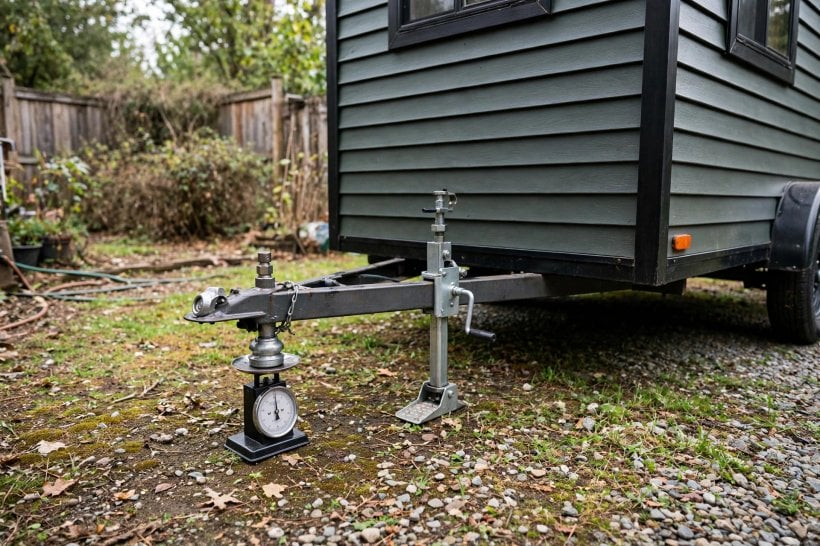
Measuring it is straightforward. A dedicated tongue weight scale under the coupler, at normal towing height, gives a direct reading. A bathroom scale with a simple lever arrangement can work for lighter trailers, and a public weighbridge session can establish both total weight and, with the trailer positioned carefully, axle and tongue figures. Our tiny house tongue weight calculator helps you estimate the target band for a given total weight before you travel to a scale. Whichever method you use, measure in towing trim: water tanks filled to the level you actually travel with, batteries, gas bottles and belongings aboard. A tongue weight measured on an empty shell describes a trailer that will never exist again once the build is finished.
5. Single vs Tandem Axles: Placement Differences
A single axle carries the whole load at one point, so its position is the balance point in the most literal sense: the 60/40 mark and the axle centreline are the same thing, and small placement errors show up directly as tongue weight errors. Single-axle tiny houses are usually the lighter builds, and their simplicity comes with sensitivity — the trailer pitches more readily, and a flat tyre leaves no partner to share the load.
A tandem pair spreads the load over two axles joined by an equaliser, and placement is judged by the centre of the group. Tandems track straighter, pitch less and carry heavier houses, but they introduce their own requirements: the group must be mounted square to the frame centreline, both axles must share the load evenly, and the trailer must sit level when hitched, because a nose-up or nose-down tandem quietly overloads one axle and its tyres. When comparing rated options, the discussion in choosing trailer axles for a heavy tiny house is a useful companion. In both configurations the logic is identical — position the fulcrum so the finished, loaded house balances with the right share of its weight on the tongue — only the hardware and the tolerances differ.

6. Weighing the Finished House and Re-Checking Balance
Every placement calculation is a prediction; the weighbridge is the test. Weighing the finished house establishes three numbers that matter: total weight, weight carried on the axles, and tongue weight. The difference between the first two is the third, and together they tell you whether the trailer sits inside its own ratings, inside the ratings discussed in weight limits for tiny houses — GVWR, axles and tow vehicle, and inside the tongue weight band described above.

Re-checking matters because builds drift. A kitchen fitted heavier than planned, a tile shower substituted for an acrylic tray, a battery bank doubled at the last minute — each change moves the balance point, usually rearward, because living spaces and storage tend to grow at the back of the plan. If the finished numbers fall outside the target band, the corrections in order of preference are: move movable heavy items toward or away from the axles, adjust what travels in the house versus the tow vehicle, and only then consider hardware changes. Weigh again after any correction, and record the figures with the trailer’s documents so future owners inherit facts rather than folklore.
7. Frame, Suspension and Clearance Considerations
Axle position does not act alone; it works through the frame and suspension. The axle group should sit where the frame is genuinely strong — under main rails and cross-members that can take suspension hanger loads — and the hangers themselves must be mounted square and in line, or the trailer will dog-track, pulling slightly sideways and scrubbing tyres even with perfect balance. Fastening quality matters here as much as geometry: the recommendations in securing a tiny house to its trailer frame cover the standard of fixing the connection between house and chassis deserves.

Clearances complete the picture. The tyres need room to travel through their full suspension movement without meeting the deck, wheel boxes or plumbing; the axle needs room at full compression; and anything routed low — water lines, grey tanks, brake wiring — should be planned around the suspension’s moving parts rather than discovered by them. Ground clearance at the rear also interacts with placement: a long overhang behind the axles grounds out on steep driveways, one more reason the 40% portion behind the axle deserves respect rather than extension. Finally, brakes and breakaway systems belong in the same conversation, since a balanced trailer that cannot brake in proportion is only half solved.
8. Step-by-Step Placement Workflow
For a builder ordering a trailer or positioning a new axle set, the workflow condenses to eight steps. One: fix the deck length and measure the flat deck only. Two: mark the 60% point from the front of the deck. Three: sketch the finished layout and estimate where the heavy fixed systems — water, batteries, appliances, masonry heaters if any — will sit relative to the mark. Four: adjust the layout first and the mark second, keeping heavy items near the intended axle centre. Five: position the axle centreline, or the centre of a tandem group, on the agreed mark, mounted square to the frame centreline. Six: build, keeping a running note of weight added ahead of and behind the axles. Seven: weigh the finished house and measure tongue weight in towing trim. Eight: correct by moving load, then re-weigh and record.

Builders framing their own floor over a bought chassis will find the sequence in how to frame a tiny house on a trailer slots naturally between steps five and six. The common thread is that no step is skipped because an earlier one felt precise: tape measures start the job, but only scales finish it.
9. Symptoms of Wrong Placement: Sway, Porpoising and Uneven Tyre Wear
A trailer whose balance is wrong usually announces it. Sway — a rhythmic side-to-side movement that can grow with speed, crosswinds or passing trucks — is the classic symptom of too little tongue weight, often from axles placed too far forward or too much load behind them. It is the most serious symptom on this list: sway that builds rather than settles is a stop-and-fix problem, not a drive-slower-forever problem, although slowing down is the correct immediate response.
Porpoising, the pitching bounce over undulating roads, points to heavy masses at the extreme ends of the deck or to a balance point that fights the tow vehicle’s own pitching rhythm. Uneven tyre wear is the slow symptom: tyres scrubbing on one edge suggest alignment or dog-tracking, while one axle of a tandem pair wearing faster than the other suggests the group is not sharing load, often because the trailer does not tow level. A nose-down stance, a tow vehicle squatting heavily at the rear, and light, vague steering complete the catalogue of a tongue carrying too much. Each symptom maps back to the same small set of causes — axle position, load position, level stance — which is good news: the diagnosis tree is short.
10. Common Mistakes and Corrections
The most common mistake is measuring from the coupler instead of the front of the deck, which builds a forward error into the axle position before anything is welded. The second is calculating placement for the empty shell and never re-checking after fit-out, when the real weight distribution arrives. The third is placing the heaviest systems — full water tanks, battery banks, a wood stove with its hearth — at the rear for layout convenience, then wondering why the tongue is light. The fourth is assuming a tandem group forgives a trailer that tows nose-up or nose-down; it does not, it simply overloads one axle quietly.
Corrections follow the same order as the workflow: re-measure honestly, weigh the trailer as it actually travels, move the movable heavy load toward the axles or forward as the numbers require, set the hitch height so the trailer tows level, and verify tyre ratings and pressures against the real axle loads. Moving welded axle mounts is the last resort — possible for a fabricator, but expensive enough that the entire point of planning placement carefully is to never need it.
Final Considerations
Axle placement is a small measurement with an outsized effect: a deck split around 60/40, tongue weight held in its commonly used band, heavy systems kept near the fulcrum, and a finished house that has actually been weighed. None of it requires exotic equipment — a tape measure, a scale session and the discipline to check the result. Do those things, and the trailer stops being a variable in every journey and becomes what it should be: the quiet foundation the house was built on.
Trailer Axle Placement Calculator
Trailer Axle Placement Guide
Calculate the ideal axle position using the 60/40 rule.
Measure the flat deck only (do not include the tongue).
Axle Center Location
From the FRONT of the deck.


3 Comments