

A conventional asphalt driveway is a heat island that sheds every drop of rain straight into the storm drain. It works, but it works against everything an eco-homestead stands for. Better surfaces exist — surfaces that drain, cool, and in several cases cost less than the slab they replace. This guide designs the driveway that drinks the rain.
1. Eco-Friendly Driveway at a Glance
An eco-friendly driveway starts from a refusal: the refusal to pave the land with an impervious scar. Where asphalt and concrete shed stormwater as runoff and bake in the sun as heat islands, the alternatives in this guide are chosen to do the opposite — let rain vanish into the ground, keep the surface cooler, and in most cases undercut the conventional options on price. Five surfaces carry the argument: gravel, permeable pavers, grass pavers, recycled asphalt and concrete, and wood chips. Around them sits a design discipline — narrow, crowned, contoured, edged — that matters as much as the material. The table below gathers the whole system; the sections after it take each surface, the layout, the drainage and the costs apart in turn.
| Attribute | Detail |
|---|---|
| The Problem | The conventional driveway — an impervious scar of stormwater runoff, heat island and petroleum asphalt |
| Gravel | $1–3/sq ft installed — the cheapest; fully permeable, with annual grading as its maintenance |
| Permeable Pavers | $5–12/sq ft — concrete or plastic grids with grass or gravel infill; 100% drainage, zero runoff |
| Grass Pavers | $4–8/sq ft — reinforced turf in a plastic grid; the invisible, living driveway |
| Recycled Asphalt | $2–4/sq ft, crushed RAP at $15–30/ton — hard and cheap, a petroleum compromise |
| Wood Chips | Nearly free — a 6″ mulch layer with a 2–3 year life; for paths, not cars |
| The Conventional Baseline | Asphalt $7–13/sq ft and concrete $8–15/sq ft — the runoff and the impervious, priced |
| The Width | 10 ft for a single drive — the minimal; a 20-ft double is extravagance |
| The Crown | A 2% crowned slope — sheet flow off the surface, no puddles |
| The Edge | Timber or stone edging — the surface contained, the line crisp |
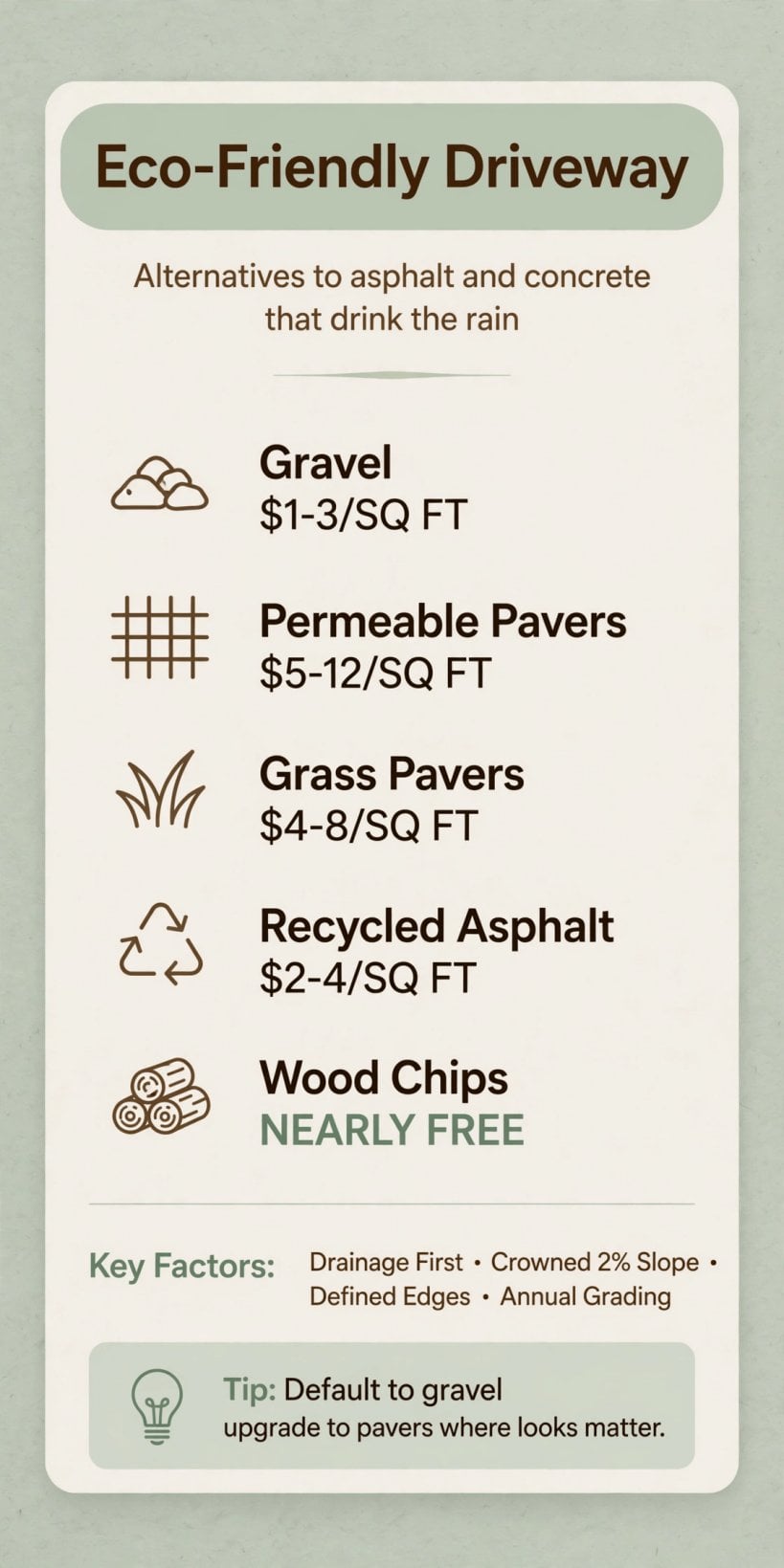
Gravel at $1–3 a square foot, pavers that drain 100%, and a 2% crown — the driveway that drinks the rain, on one card.
Read the table as a ladder with a conscience. At the bottom sits gravel — cheap, permeable, rural — and at the top sit the engineered grids, bought where looks and regulations matter. Between them, the recycled and living surfaces trade purity for practicality in different directions. But the material is only half the design: the same discipline of width, curve, crown and edge runs underneath every option, and it is decided before the first load is delivered — ideally before the land itself is finalised, since the siting logic in the guide to where to buy land for eco-living treats access and drainage as part of the parcel’s score.
2. Gravel: The Homestead Standard
Gravel is the default because it wins on the two numbers that matter most: cost and permeability. At $1–3 per square foot installed, it is the cheapest surface in this guide — the DIY option, delivered by the dump truck and spread where it falls. And its drainage is total: the rain vanishes. A gravel drive produces no runoff, because there is nothing for water to run off; every drop passes between the stones and recharges the ground beneath, which is precisely the behaviour the conventional slab abolishes. For the rural homestead, that combination — cheapest to lay, nothing to shed — has made gravel the standard surface for generations.
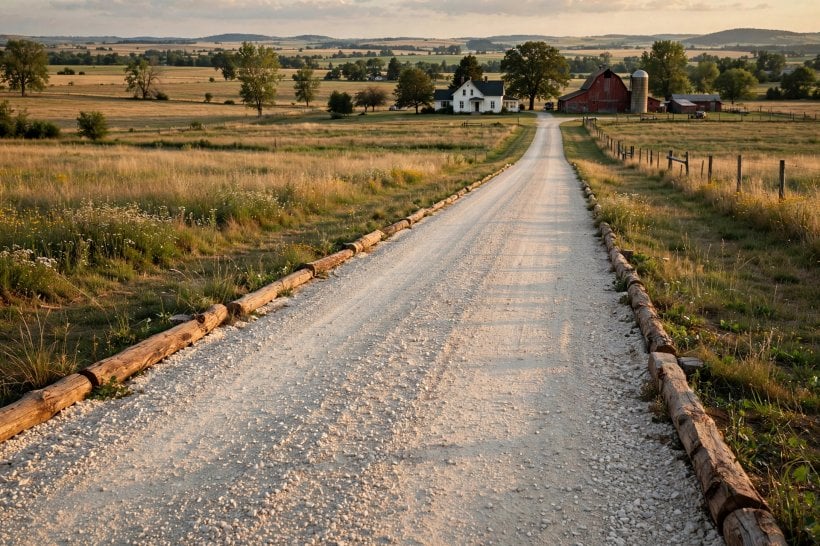
The honesty is in the maintenance. Gravel is not a lay-and-forget surface: it asks for grading, annually, with a box blade — the pass that pulls displaced stone back into the wheel tracks, levels the crown, and manages the potholes that traffic and weather carve into it. That annual rhythm is the whole contract, and it suits the long rural drive best: the 200-ft driveway that would bankrupt its owner in pavers is economical in gravel, and the grading that keeps it true is an hour’s work with equipment the homestead already owns. The cost logic is the same land-first arithmetic worked through in the homesteading economics guide — spend on what the land needs, maintain with what you already have.
3. Permeable Pavers: The Engineered Option
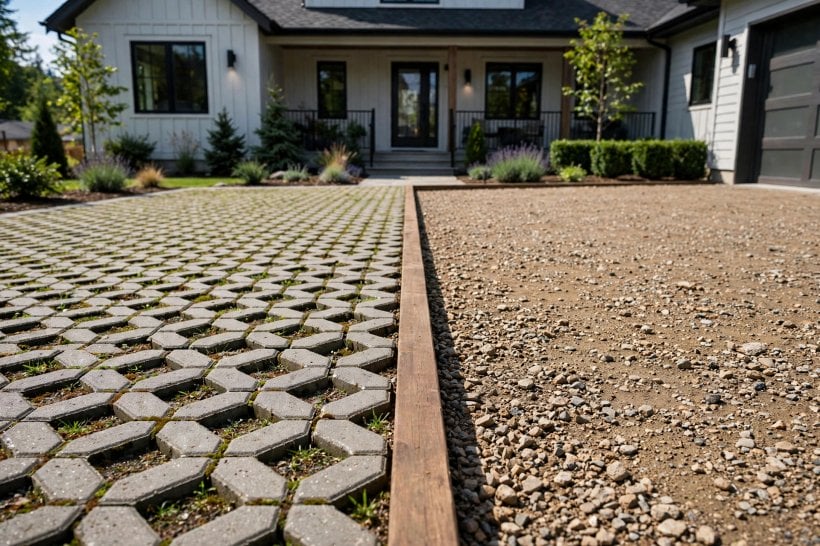
Where gravel is the vernacular answer, permeable pavers are the engineered one. The construction is a grid — concrete or plastic cells laid over a prepared base and filled with grass or gravel — so the surface is structured: the grid carries the load, the infill carries the water. The price reflects the engineering: $5–12 per square foot installed, the premium option in this guide, and the beautiful one, with the crisp geometry that gravel cannot offer. What the premium buys, beyond appearance, is drainage stated as a figure: 100%. The stormwater goes down, not away — zero runoff from a surface that looks, to any passer-by, like a finished paved drive.
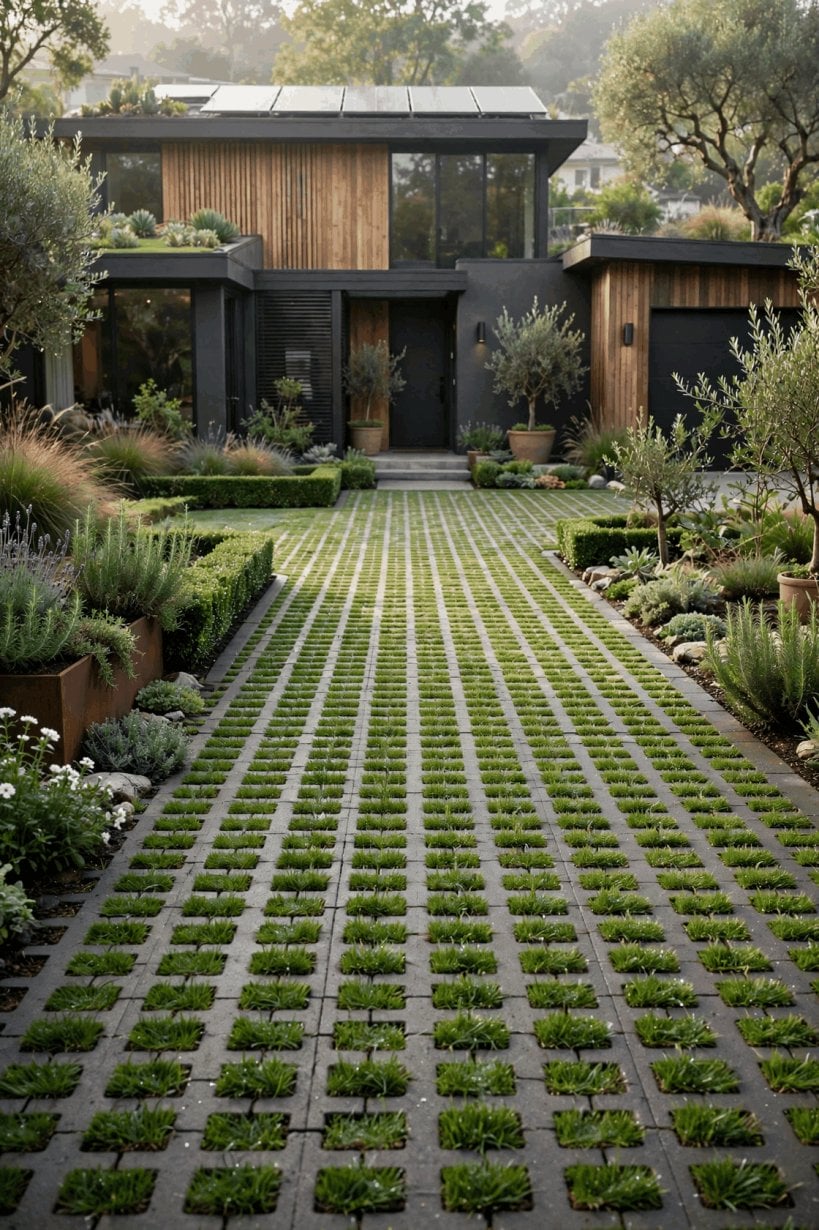
That combination — paved looks, total drainage — is why the original points permeable pavers at one setting in particular: the suburban-eco driveway, where the visible matters. Curb appeal is a real constraint in a street of conventional drives, and so are regulations: a growing number of jurisdictions count impervious area against a property, and a grid system that drains 100% is the compliant answer that still reads as a proper driveway. The local rules are worth checking before the design is fixed — the same code-checking discipline the guide to navigating building codes for unconventional eco-structures applies to the buildings themselves. Buy the pavers where the street, the rules or your own eye demand them; the grid earns its premium exactly there.
4. Grass Pavers: The Living Driveway
Grass pavers push the idea one step further: the driveway that disappears. The construction is reinforced turf — a plastic grid laid over the ground, filled and seeded, so grass grows through the cells and the grid carries the vehicle on the rare occasions one passes. From the street, there is no drive at all: just lawn, continuous with the lawn around it — the invisible driveway, the green one. The price sits in the middle of the range, $4–8 per square foot installed, and the maintenance is the lawn’s own: mowing. The drive is cared for exactly as the grass it is, an extension of the yard rather than a separate surface with a separate routine.
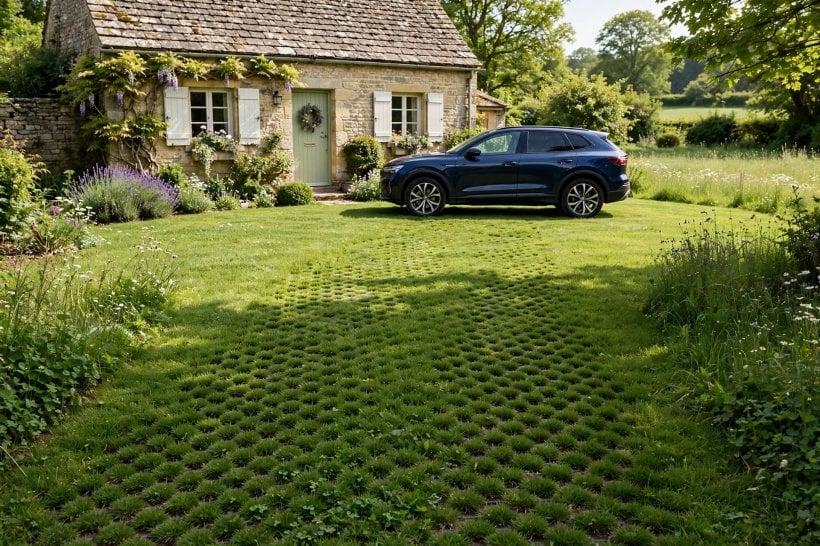
The honest limit is use. A living surface is reinforced, not armoured: it carries light traffic well and daily heavy traffic badly, because tyres on the same line, day after day, defeat what the grid is protecting. So the original assigns grass pavers to the light-use roles — the occasional drive, the guest parking that fills twice a month, the fire lane that must carry a vehicle in an emergency and grass the rest of the year. For the main drive that carries the daily car, choose gravel or the engineered grid; for the second access and the overflow, let the lawn do it.
5. Recycled Asphalt and Concrete: The Reused Surface
The recycled option begins at the demolition site. Old asphalt and concrete are crushed and sold as recycled material — RAP, recycled asphalt product, at $15–30 a ton — and spread and compacted as a driveway surface at $2–4 per square foot, second only to gravel on price. Its virtues are the ones the original lists without romance: it is cheap, and it is hard. Where loose gravel shifts and ruts, the crushed material compacts into a firm, nearly dust-free surface — dust-free-ish, in the original’s careful phrasing — that behaves far more like a paved drive than its price suggests. And every ton of it is a ton of demolition waste diverted into a second working life.
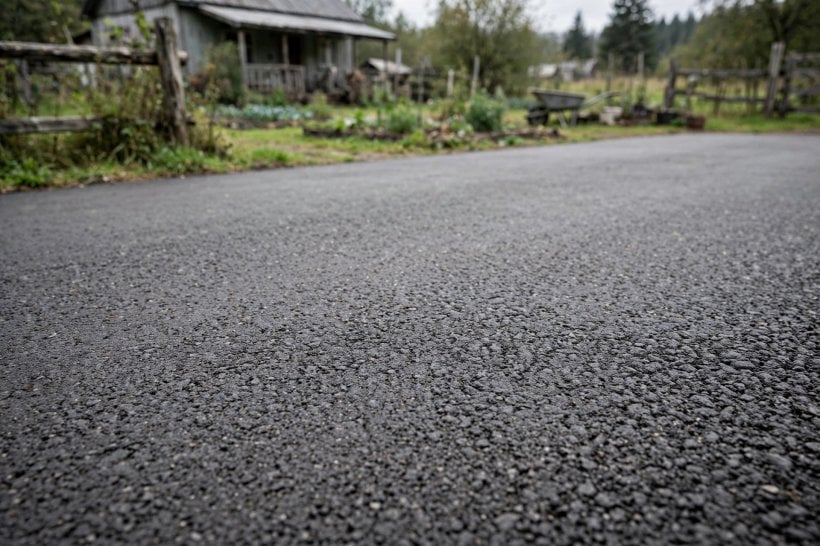
The con is stated just as plainly, and the original insists on the honesty: the petroleum. Recycled asphalt is still asphalt — the binder that makes it hard is a petroleum product, carried over from its first life rather than newly laid, but present all the same. So this is the not-fully-green option, the compromise: it keeps material out of landfill, costs little and wears well, and does not pretend to be pure. On a homestead budget, that trade is frequently the right one — the surface that gets built this year beats the perfect surface that stays a plan.
6. Wood Chips and Bark: The Temporary Surface
The last material is barely a purchase at all. A wood chip drive is a mulch drive — a layer of chips and bark, 6 inches deep, laid soft over the ground in the woodland manner. The cost is the original’s happiest figure: nearly free. Arborists produce chips as a by-product and will often deliver a load free to be rid of it, so the surface that costs nothing arrives by the truckload. Underfoot and under tyre it is what mulch is — soft, quiet, unmistakably temporary — and it drains as completely as the soil it covers, because there is nothing in it to stop the water.
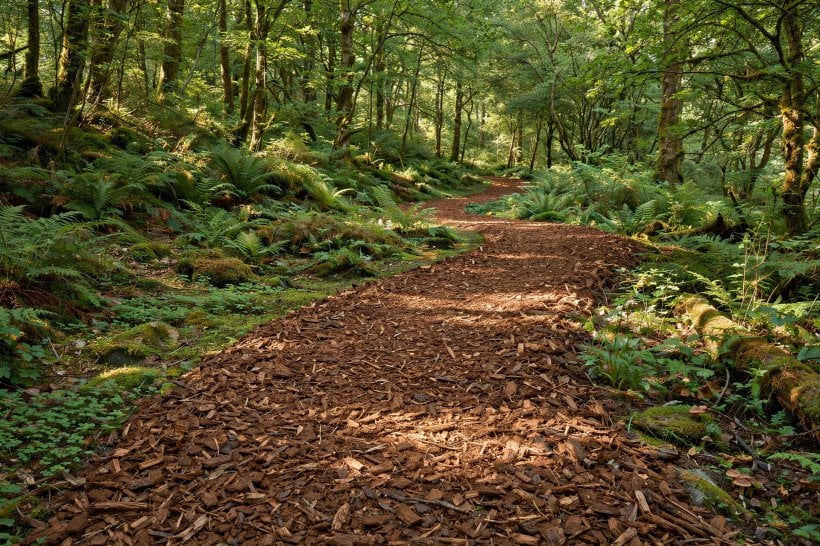
Temporary is the operative word, and the original prices it: a life of 2–3 years. Wood decomposes; that is its nature and, in the garden’s terms, its virtue — but a driveway made of it is a sacrificial surface, topped up as it thins and eventually absorbed by the ground it covered. So the assignment is careful: best for the path — the foot route, the bike route — and not for the car. A wood chip drive under daily vehicle traffic ruts, churns and disappears faster than its 2–3 years. Used honestly, though, it is the perfect provisional surface: the access track for a build in progress, the woodland path, the route that will become something else later. And when its life ends, it ends as soil — the chips feed the ground the way the composting guide’s chemistry of turning organic waste into soil describes, the only driveway material that finishes its service by improving the land.
7. Design and Layout: Width, Curve and Contour
Before the material comes the geometry, and the original’s layout rules begin with restraint: width. A single drive needs 10 feet — the minimal, the width a car actually uses — while the conventional 20-ft double is named for what it is: extravagance, twice the surface, twice the cost, twice the ground taken out of the land’s work. Every foot of width not laid is a foot that stays permeable, planted or simply itself. The second rule is the curve: gentle, following the land’s contour. A drive that bends with the slope avoids the cut-and-fill work that a rigid straight line demands — no bank carved away, no hollow filled, the surface draped over the ground’s own shape instead of imposed against it.
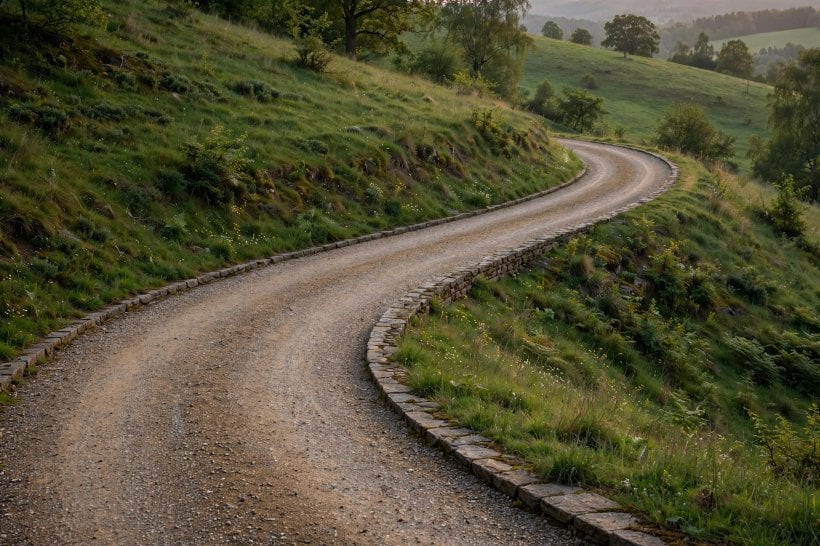
The third element is the edge: defined. Timber or stone, laid along both sides, doing two jobs at once — containing the surface, so gravel stays on the drive and mulch stays in the layer, and crispening the line, so the drive reads as a deliberate piece of design rather than a spill. Edging is what makes the cheapest surfaces look intentional. Together the three rules describe a way of thinking that runs through the whole site: the driveway as one piece of ground infrastructure among the others, sized to its job and fitted to its slope, the same philosophy that organises the systems in the guide to tiny house utilities for power, water and off-grid sewage. Design narrow, curve gently, edge firmly — then argue about materials.
8. Drainage by Design: The Crown and the Sheet Flow
Permeability is the material’s contribution to drainage; the crown is the design’s. The original’s figure is 2%: the drive is built crowned, its centre a fraction higher than its edges, so water that lands on it sheets off sideways in a shallow flow rather than gathering. Sheet flow is the goal stated positively; the no-puddles rule is the same goal stated as the failure to avoid. A puddle is water standing where the surface failed — softening a chip layer, churning a gravel rut deeper, freezing in winter into the exact spot a tyre must cross. The crown is cheap insurance built in at grading time, and on the permeable surfaces it works as the second line of defence: rain too heavy to soak through instantly still leaves, gently, in a sheet, instead of carving a channel.
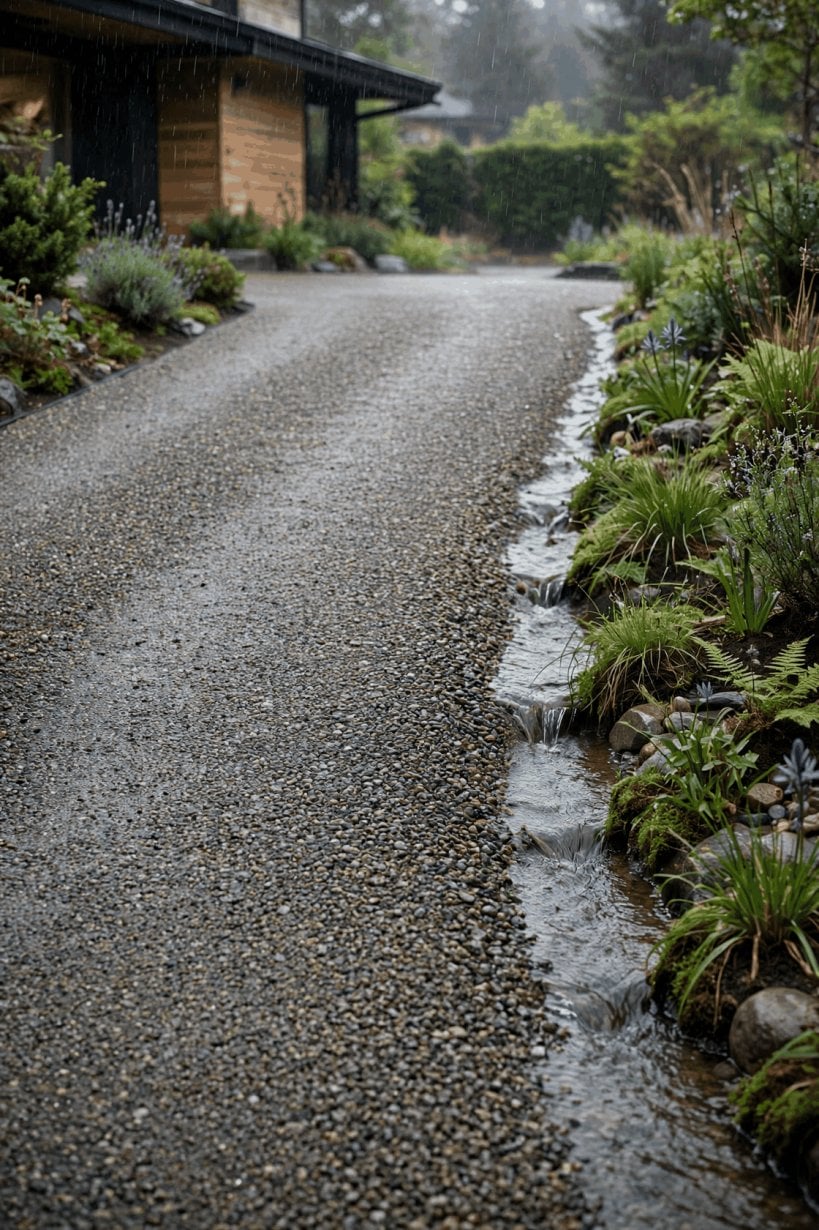
Where the sheet flow ends up matters as much as where it starts. A well-sited drive sheds toward ground that wants the water — the garden, the swale, the catchment — rather than toward the road and the storm drain the whole design exists to bypass. That makes the driveway one element of the property’s rain system, and the planning connects directly to the roof side of the same ledger: the catchment arithmetic in the guide to rainwater harvesting and tank sizing sizes the roof’s contribution, while the drive decides whether the ground’s share soaks in or runs off. One caution travels with the connection — in some jurisdictions the rules follow collected water wherever it is directed, which is why the state-by-state picture in the legality of collecting rainwater is worth a read before the drains are dug. Crown the surface, aim the sheet flow, and the driveway stops exporting the storm.
9. Costs Compared: The Whole Table
Set side by side, the original’s cost table tells the argument in six lines. Gravel: $1–3 per square foot — the cheapest, the rural default. Recycled asphalt: $2–4 — the hard one, the compromise, priced just above the loose stone it out-wears. Grass pavers: $4–8 — the green one, the light-use surface, in the middle. Permeable pavers: $5–12 — the engineered one, the suburban answer, at the top of the alternatives. And then the two baselines the whole guide is arguing against: asphalt at $7–13 per square foot, the conventional, the runoff; concrete at $8–15, the permanent, the impervious. The eco options do not merely compete with the conventional ones on price — the four cheapest surfaces in the table are all alternatives.
Two honest qualifications belong under the table. The first is that these are installed figures as the original frames them — gravel’s $1–3 assumes the DIY pattern, the dump truck and your own spreading, while the pavers’ $5–12 buys the grid, the base and the finish together. The second is that sticker price is not whole-life price: gravel’s low figure comes with the annual grading hour attached, wood chips undercut everything and then expire in 2–3 years, and concrete’s high figure buys a surface that asks nothing for a long time while charging the land for every storm. Read the table as cost against drainage, maintenance and use, and the ranking mostly holds: the driveway that drinks the rain is also, line by line, the cheaper driveway.
10. Choosing and Maintaining: Matching the Surface to the Life
The choice, assembled, is a matching exercise between three things: the traffic, the setting and the years. Traffic first: the daily car on the main drive wants a real surface — gravel for the rural default, recycled asphalt where a harder wear is worth the compromise, permeable pavers where the street demands a finish — while light and occasional traffic opens the living options. Setting second: the long rural drive prices itself into gravel by length alone, the suburban plot into the grid by regulation and appearance, the woodland path into chips by costing nothing. Years third: a provisional route can be sacrificial; a permanent one should be chosen as if the maintenance rhythm — the annual grading, the mowing, the top-up — is part of the purchase, because it is.
That maintenance realism is the thread the original runs through every option, and it is the right place to end the comparison. No surface in this guide is maintenance-free; each simply chooses its chore. Gravel owners grade, grass-paver owners mow, chip-path owners top up, and even the engineered grid asks to be kept clear so its drainage stays at the 100% it was bought for. The conventional slab’s promise of doing nothing is the most expensive illusion in the table — its maintenance arrives anyway, as cracks, runoff damage and the storm drain’s bill, charged to everyone downstream. Choose the chore you will actually do, on the surface your traffic actually needs, and the maintenance becomes what it is on the rest of the homestead: a rhythm, not a burden — the same long-view trade-offs weighed in the solar versus wind comparison for the homestead, where the right answer also depends on the site, the budget and the life being lived on it.
Final Considerations
Default to gravel — the cheap, the permeable, the rural. Upgrade to permeable pavers where looks matter — the engineered, the compliant, the beautiful. Try grass pavers for light use — the living, the invisible. Take recycled material for the honest compromise and wood chips for the path that costs nothing. And design every one of them the same way: narrow at 10 feet, curved to the contour, crowned at 2%, edged in timber or stone. The green driveway doesn’t fight the rain — it drinks it.

0 Comments