

This tool helps builders calculate the often-overlooked weight of the plumbing system. While PEX vs. Copper is a debate, the real weight killer is water itself. This tool calculates the massive weight penalty of towing with full tanks (Fresh/Grey/Black) and demonstrates why “Traveling Dry” is the golden rule for tiny houses.
Most builders weigh their walls, their roof and their appliances — then forget the pipes entirely.
That is a mistake, because the heaviest part of a tiny house plumbing system is not the pipe. It is the water. This plumbing weight calculator adds up pipes, tanks and every gallon they hold, so you can see the load before it surprises you at the scale.
1. At a Glance: Pipes, Tanks and Water, Weighed
The calculator below breaks a plumbing system into two parts: the hardware you install once — pipes and empty tanks — and the water that comes and goes. Its own figures, gathered in the table, show why the second part dominates. Pipe material matters, and it gets a fair hearing in the sections that follow, but gallons are where the real weight lives. Gallons are also the one part of the load you can choose to leave behind.
| Part of the system | What the tool counts | The figure it uses |
|---|---|---|
| Water | Every gallon sitting in tanks and heater | 8.34 lbs per gallon |
| Fresh tank | A standard 40-gallon tank, filled | 334 lbs of water |
| Copper pipe | Type M, per foot of run | ~0.30 lbs/ft |
| PEX pipe | Plastic, per foot of run | ~0.05 lbs/ft |
| Material choice | PEX instead of copper, average tiny house | Saves ~25 lbs |
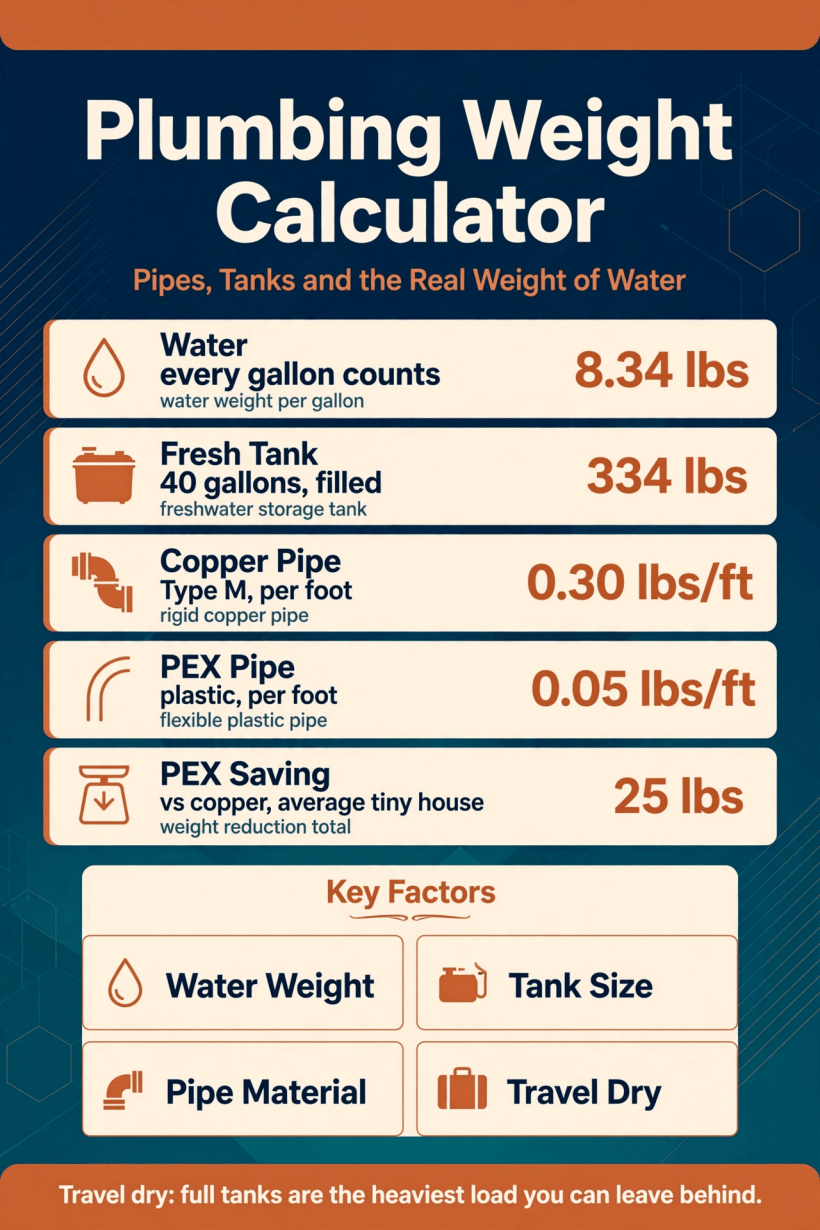
Pipes, tanks and water at a glance: a gallon of water weighs 8.34 lbs, a filled 40-gallon tank adds 334 lbs, and PEX saves about 25 lbs over copper across a whole tiny house.
Read the table top to bottom and the order of priorities writes itself. First manage the water, then place the tanks, then choose the pipe. The sections that follow take each layer in turn — what it weighs, how it behaves on the road, and how to keep the total honest from the first sketch to the first tow.
2. The System Nobody Weighs
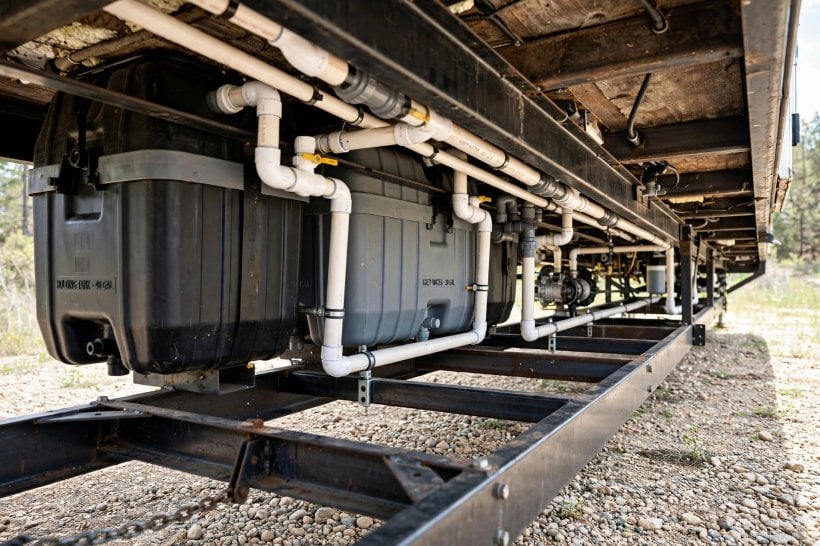
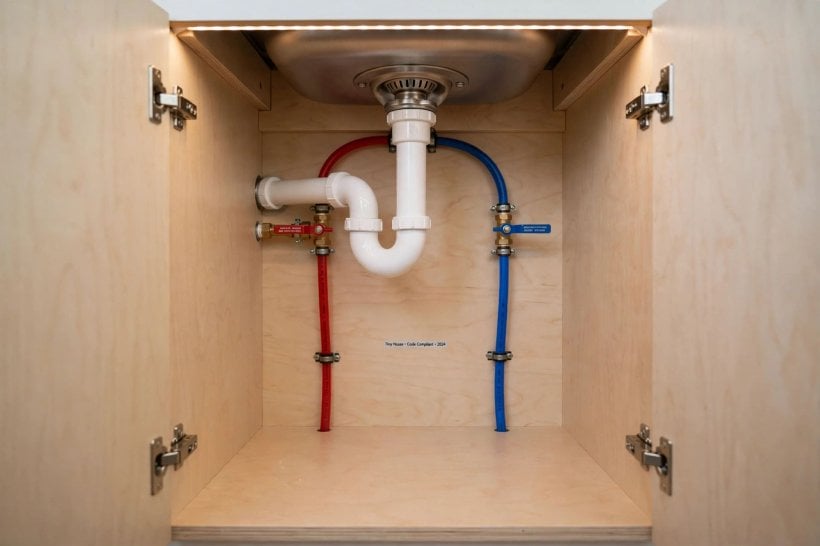
Plumbing is easy to forget because it disappears. The pipes run inside walls and under the floor, the tanks hang beneath the trailer, and once the house is finished none of it is visible. Builders carefully total framing, cladding, insulation and appliances, because those arrive as visible purchases. Plumbing arrives in coils, fittings and tanks spread across weeks of work, and nobody ever writes down its total.
That blind spot matters twice over. First, the total: a finished house has to stay inside the trailer’s rated capacity, and the honest way to check is the full ledger described in our guide to calculating GVWR for tiny homes. An uncounted system quietly eats the margin you thought you had. Second, the distribution: plumbing weight is not spread evenly. The pipe runs weigh very little, while the tanks concentrate hundreds of pounds in one or two places — and where those places sit along the frame changes how the trailer tows, as a tiny house weight distribution diagram makes clear.
This is why the tool on this page splits its answer in two. The dry weight — pipes plus empty tanks — is the load you can never remove. The wet weight adds the water, the load you control. Everything useful in this guide hangs on the gap between those two numbers.
3. Pipes First: What the Runs Themselves Weigh
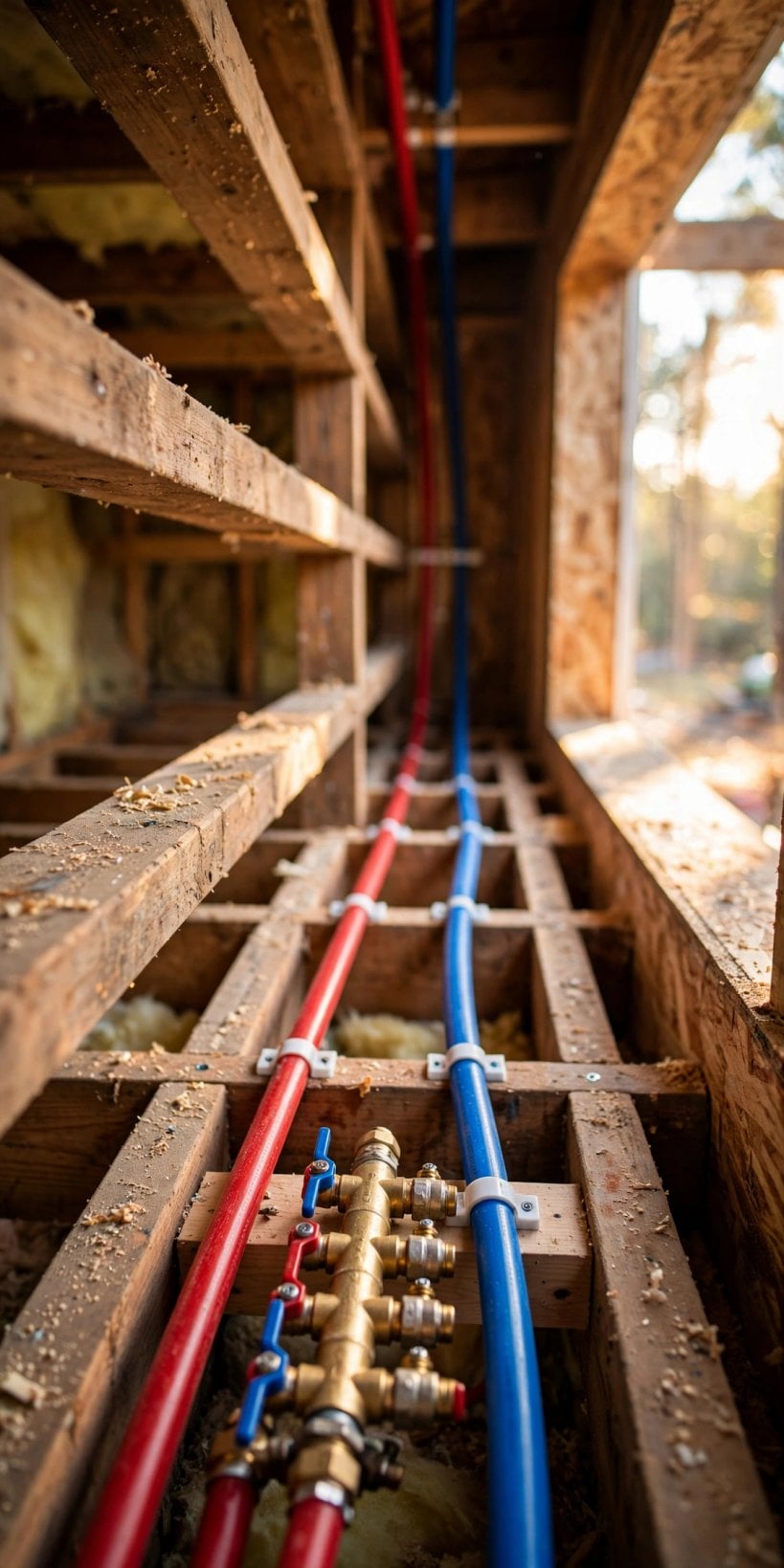
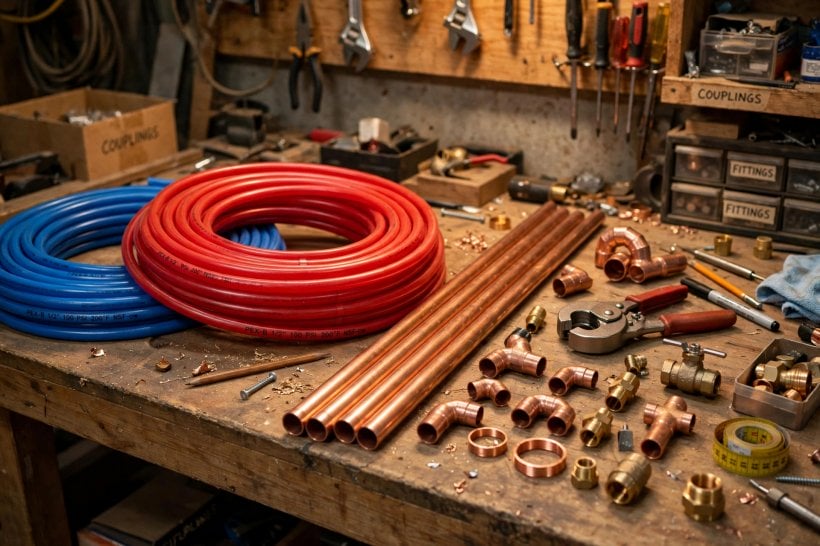
Start with the part you install once. The calculator asks for the total length of your pipe runs in feet, and one material choice: PEX (plastic) or copper (Type M). On the tool’s figures, copper weighs about 0.30 lbs per foot and PEX about 0.05 lbs per foot, so foot for foot the copper run is roughly six times heavier. Neither number is large on its own; the question is what they add up to across every hot and cold run in the house.
Across an average tiny house, the tool puts the saving at around 25 lbs for choosing PEX over copper — real, but modest next to a single filled tank. It also notes that PEX saves hours in labor, because flexible pipe bends around framing instead of being cut, fitted and soldered joint by joint. Weight decisions elsewhere in the build follow the same pattern of small per-foot differences compounding into a total, as the steel vs wood framing weight comparison shows for the structure itself.
The materials differ in behaviour as much as in weight. The tool describes PEX as light, flexible and freeze resistant, and copper as heavy and prone to freeze burst. In a house that may sit unheated between trips, that freeze behaviour can matter more than the 25 lbs. Choose pipe for the whole picture — weight, working time and winter resilience — not for the scale alone.
4. The Water Inside the Pipes: A Rounding Error
New builders often worry about a hidden load: the water standing inside the pipes themselves, filling every run from tank to tap. It sounds like it should add up. The tool answers the worry directly: a 100 ft run of 1/2″ pipe holds only about a gallon of water. Against the tens of gallons sitting in the tanks, the volume inside the pipework is, in the tool’s own word, negligible.
That single fact simplifies the whole subject. You do not need to model pipe runs as water storage, and you do not save meaningful weight by shortening a run by a few feet. Draining the lines still matters — but for freeze protection in an empty, cold house, not for the scale. The pipes are plumbing; the tanks are the reservoir.
So the weight conversation moves to where the water actually waits: the storage you fill before a trip and empty, or fail to empty, before the drive home. That is the subject of the next two sections, and it is where almost all of the controllable weight in the system lives.
5. Tanks: Fresh, Grey and the Water Heater
The calculator’s second input is holding tanks, entered in gallons, in three parts: Fresh, Grey and Heater. The fresh tank is your supply — the clean water you carry for drinking, cooking, washing and showering. The grey tank is its mirror: the used water collected from sinks and shower, held until it can be emptied at a proper drain point. The heater is the hot water store, entered separately because it behaves differently from the other two, as the next-but-one section explains.
Notice what the three-part split teaches. Water in a tiny house does not disappear when you use it; it mostly moves, from the fresh tank through the taps into the grey tank. A house that leaves home with a full fresh tank and an empty grey tank still carries nearly the same water weight at the end of the trip — it has just relocated it. The total only truly falls when tanks are emptied out of the house altogether.
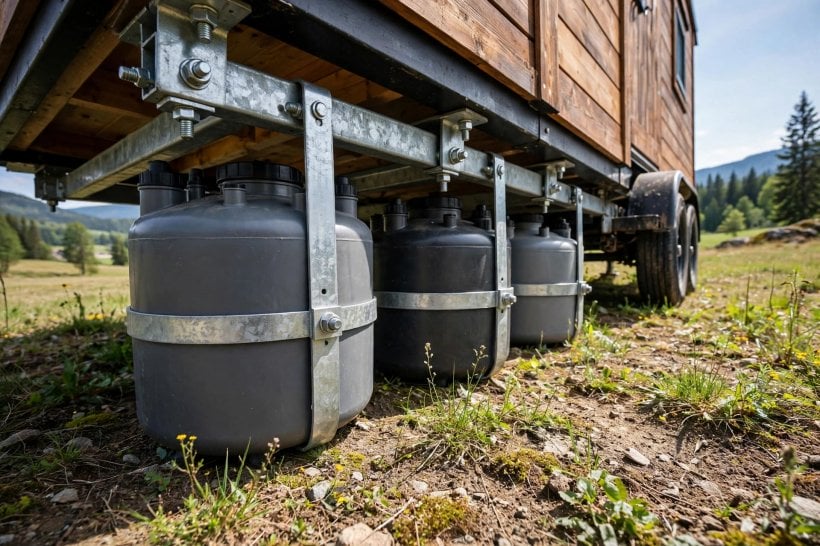
Placement deserves the same care as capacity. Tanks belong low in the build, secured between or over the axles where their concentrated weight helps rather than harms the balance; our axle placement guide explains the geometry they have to fit. A tank hung carelessly at the very back or front turns its hundreds of pounds into leverage against the hitch.
6. Water Itself: 8.34 Pounds in Every Gallon
Here is the number the whole system turns on: water weighs 8.34 lbs per gallon. It is not an estimate or a rule of thumb inside the tool — it is the conversion behind every wet-weight figure it produces. Multiply any tank size by it and you have the travelling weight of the water alone, before the tank, the pipes or anything else is counted.
The tool’s own example makes it vivid: a standard 40-gallon fresh water tank adds 334 lbs when filled. That is more than many single appliances in the house, and it arrives or vanishes at the turn of a valve. Fill the grey side during a trip as well, and the water on board can be the largest single variable in the entire build weight — larger than the difference between framing materials, larger than the flooring choice, and changeable on the morning of a tow.
This is why capacity decisions are really weight decisions. Every gallon of tank you specify is a gallon you will sometimes carry, at 8.34 lbs each, eating payload that could have gone to food, tools, batteries or belongings. Size tanks for how you actually live — how often you can refill and empty — rather than for the longest imaginable stretch off grid, and the system stays honest.
7. The Water Heater: The Tank That Stays Full
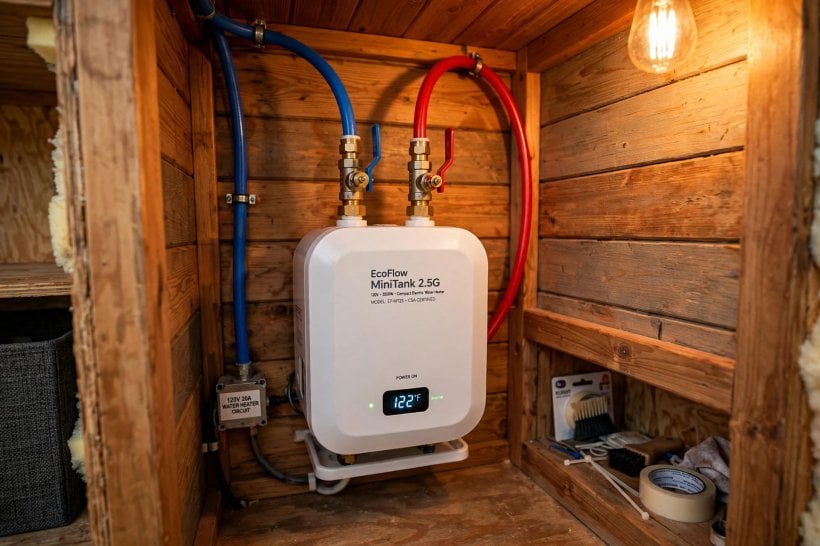
The heater earns its own line in the calculator because it is the one tank that is full by design whenever the system is in service. Fresh and grey levels rise and fall with your habits, but the heater’s store of hot water sits there permanently, heating and reheating, and its gallons ride along on every trip the house takes while the plumbing is live.
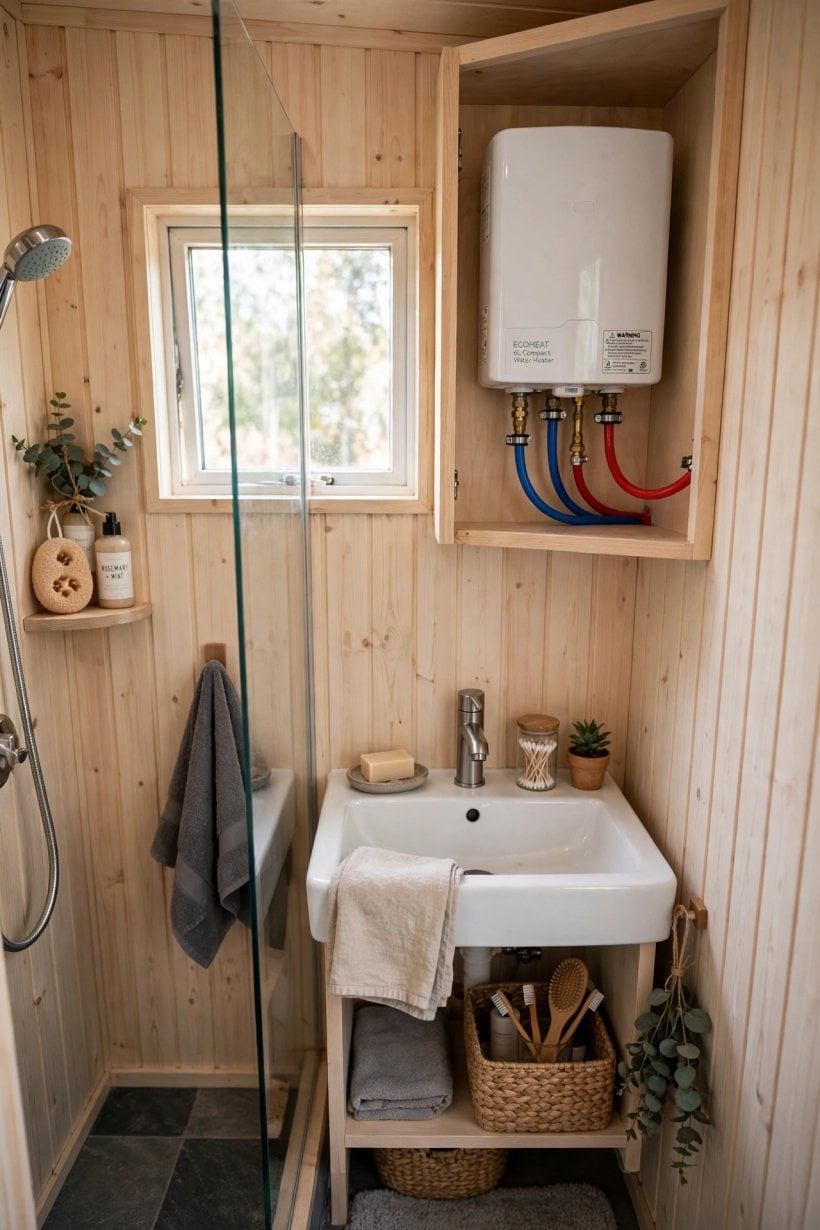
That permanence makes its position and size part of the fixed weight budget, like a heavy appliance. It belongs near the centre of the plan, where its steady mass does no harm — the same thinking behind an appliance placement strategy for stoves and fridges — and close to the bathroom and kitchen it serves, so hot runs stay short and less water waits in the pipes. As part of the wider heating picture, it also belongs in the planning covered by our guide to heating a tiny home in winter.
The heater does get one vote in the travel decision: drained, it joins the dry weight; filled, it joins the wet. When you prepare the house to move, draining the heater is part of going properly dry — and part of protecting it in freezing weather while the house sits empty.
8. Slosh, G-Forces and the Straps That Hold It All
A parked house only has to hold its water still. A towed house has to hold it against braking, cornering, potholes and swerves — and water answers every one of those by moving. The tool carries an explicit Heavy Load Warning: towing with full tanks adds significant weight, and your tank straps must be rated for dynamic loads — the G-forces of the road — not just for the static weight of a tank sitting in a driveway.
Treat that warning as a build specification. A full tank pressing down at rest presses sideways in a turn and surges forward under braking, multiplying the forces its mounts must resist. Straps, brackets and the frame they bolt to all need to be chosen and fitted for a moving load, with fixings that cannot work loose under vibration. A tank that shifts even slightly changes the balance of the trailer while it is moving, which is the worst possible time to discover it.
Position softens the problem. Tanks mounted low and close to the axles move the least and disturb the tow the least, and their weight is carried where the trailer is strongest. If the balance still needs fine adjustment after the tanks are placed, the tongue weight tuner shows how smaller movable loads can trim what the big fixed ones decide.
9. Travelling Dry: The Golden Rule
The tool states its conclusion plainly: travelling dry is the golden rule for tiny houses. The wet weight it calculates — full fresh, full grey, full heater — is presented as a penalty, the massive extra load of towing with full tanks. The dry routine avoids it: fill up when you arrive, empty before you leave, and let the trailer cross the miles carrying pipes and empty tanks instead of hundreds of pounds of water.
In practice that means a simple rhythm. Travel with only the small amount of water you genuinely need for the road, refill from a trusted supply at the destination, and empty the grey tank at a proper drain point before the return trip — never into the ground at a pitch. Our overview of towing a tiny house, trucks and hitch weights puts the same discipline in the wider picture of what the tow vehicle has to manage.
There are honest exceptions. A long off-grid stretch with no refill point may require travelling wet, and if so, the answer is not guilt — it is arithmetic. Run the wet figure through the calculator, check it against the trailer’s remaining capacity, secure the tanks for dynamic loads, and tow knowing exactly what you are carrying and why.
10. Dry Weight, Wet Weight: Using the Calculator on Your Build
Using the tool takes three honest inputs. First, your total pipe length in feet — pace out or measure every hot and cold run, supply and waste, and add them together. Second, the material: PEX (plastic) or copper (Type M). Third, your holding tanks in gallons: Fresh, Grey and Heater, entered separately so you can see what each one contributes.
The tool returns two numbers. System Dry Weight is the pipes plus the empty tanks — the permanent plumbing load your trailer always carries. Total Wet Weight adds the water, shown as its own figure, for travelling with full tanks. Compare the two: the difference is the weight you personally decide about on every trip, and the number to hold against the margin left in your build’s weight budget.
Finally, verify. A calculator gives you a planning figure; a real weighing gives you the truth. Once the house is built and loaded the way you travel, weigh it properly using the method in our CAT scale weighing guide and simulator, and compare the ticket with the tool’s estimate. If the two disagree, believe the scale — and enjoy knowing your plumbing’s share of the difference down to the gallon.
Final Considerations
Plumbing weight feels mysterious only because it hides. Added up honestly, it is one of the most manageable loads in a tiny house: the pipes are a modest, one-time figure — around 25 lbs lighter in PEX than in copper, with hours of labor saved as a bonus — and everything else is water, which you can count at 8.34 lbs a gallon and choose to carry or leave behind. Specify tanks you will genuinely use, mount them low and strap them for the moving road, and let travelling dry be the default rather than the exception.
Run your own numbers through the tool before the build is fixed and again before the first long tow. The builders who get caught out are never the ones whose plumbing weighed a little more than expected — they are the ones who never weighed it at all.
Plumbing Weight Calculator
Plumbing Weight Calculator
Calculate the weight of pipes, tanks, and water loads.
1. Piping Material
2. Holding Tanks (Gallons)
PEX vs. Copper & The “Slosh” Factor
Water is heavy. A standard 40-gallon fresh water tank adds 334 lbs. A 100ft run of 1/2″ pipe holds only ~1 gallon of water, so the pipe volume is negligible compared to the tanks.
- Copper: ~0.30 lbs/ft (Heavy, prone to freeze burst)
- PEX: ~0.05 lbs/ft (Light, flexible, freeze resistant)
PEX saves ~25 lbs on an average tiny house vs copper, but saves hours in labor.


1 Comment