

Your tiny house does not need a hurricane to lose its roof — it only needs a highway. Air rushing over the roof at speed drops in pressure and sucks upward, trying to peel the deck off the walls. Toe-nails cannot hold against that pull. This guide explains uplift, and the ties, straps and fasteners that keep a small roof attached.
1. At a Glance: Tying a Roof Down
Uplift works in the opposite direction to every other roof force. Rain, snow and the roof’s own weight all press down; uplift pulls up, and on a house that travels it arrives every time the wheels turn. A roof uplift hurricane tie calculator turns that invisible suction into a simple comparison: how many pounds of force each rafter connection has to resist at highway speed, set against how many pounds your chosen connector can actually hold. The four connection methods the calculator compares are summarised below.
| Connection method | How it resists uplift | Approx. capacity in the calculator |
|---|---|---|
| Toe-nails (3 nails) | Friction only — nails being pulled straight out | ~200 lbs |
| Standard hurricane tie (Simpson H2.5A) | Mechanical connection — nails loaded in shear through steel | ~550 lbs |
| Structural screw (6 inch) | Mechanical connection — threads engaged in the plate | ~600 lbs |
| Heavy-duty hurricane tie (Simpson H1) | Mechanical connection — larger tie, more steel, more nails | ~1,050 lbs |
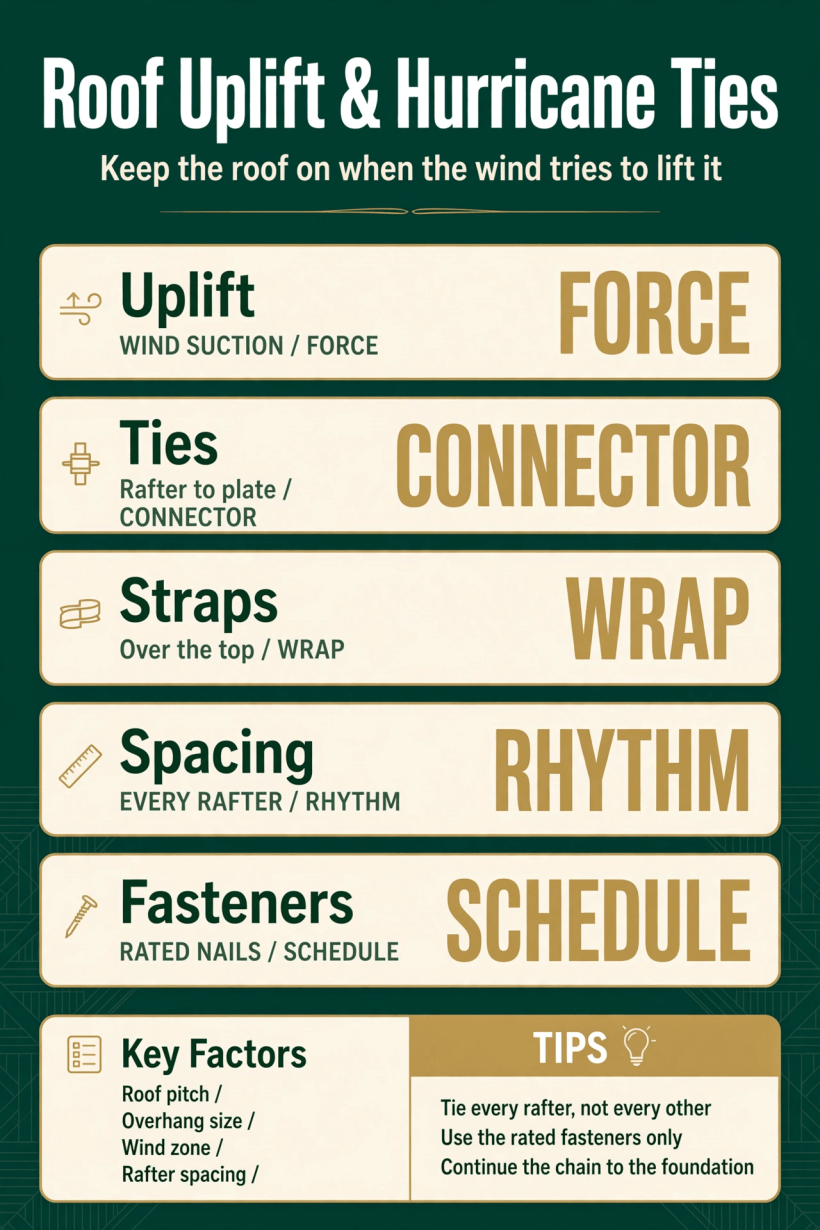
The five ideas that decide whether a roof stays on: suction, the connector, the strap’s wrap, the spacing rhythm, and the fastener schedule.
2. What Uplift Is — and Why Small Roofs Are Vulnerable
A roof in moving air behaves exactly like an airplane wing. As air rushes over the pitch, pressure above the roof drops, and the higher pressure inside and beneath pushes up into that low-pressure zone. The original guide calls this the Wing Effect: the force is suction, not impact. Nothing strikes the roof; it is pulled off nail by nail, starting wherever the connection is weakest — usually an eave, a corner or a gable end where the airflow separates and suction peaks.
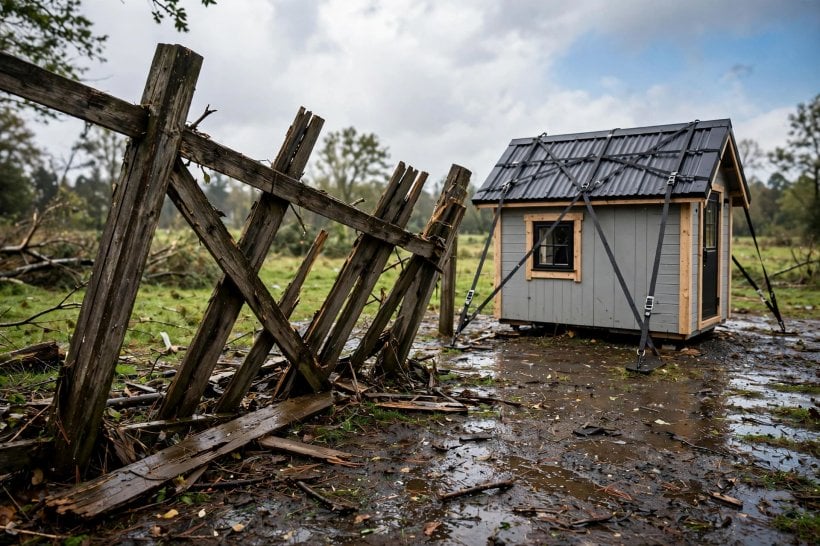
Site-built houses get some free help against this force: they are heavy, and gravity is a tireless fastener. A tiny house has almost none of that advantage. The structure and the roof deck are light, with little dead weight pressing the assembly down onto the walls. Worse, the tiny house meets its worst wind on the road. A storm is an event a fixed house waits out; for a house on wheels, highway speed manufactures storm-force airflow on every single trip, in calm weather, for hours at a time. The calculator models exactly that scenario, simulating a 65 mph wind and working with an uplift pressure in the 20–30 psf range that such speeds can generate on a small structure, using a conservative 25 psf. It is the same wind story told from the wall’s point of view in our tiny house wind load and shear calculator — pressure and suction are two faces of one load, and a build has to answer both. And because the uplift battle is fought while towing, it belongs in the same planning pass as the axle placement guide: a house that tows beautifully but sheds its roof at speed has solved the wrong half of the journey.
3. How Hurricane Ties Work
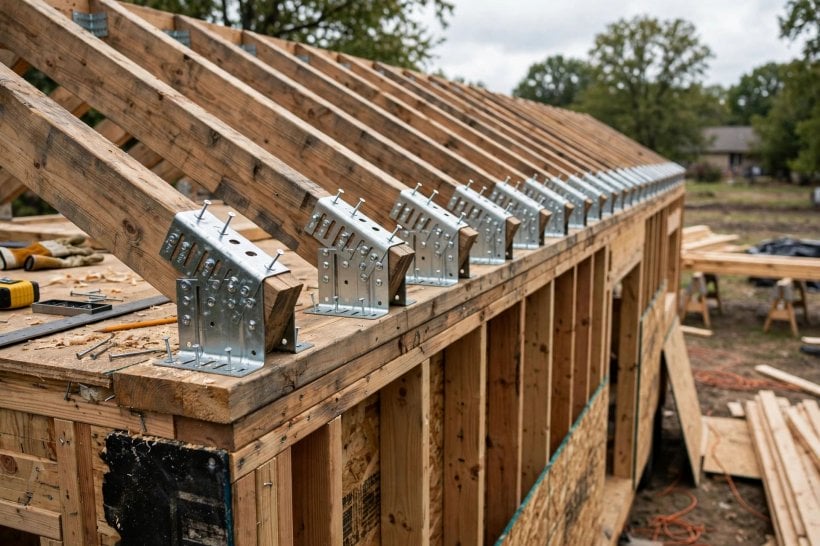
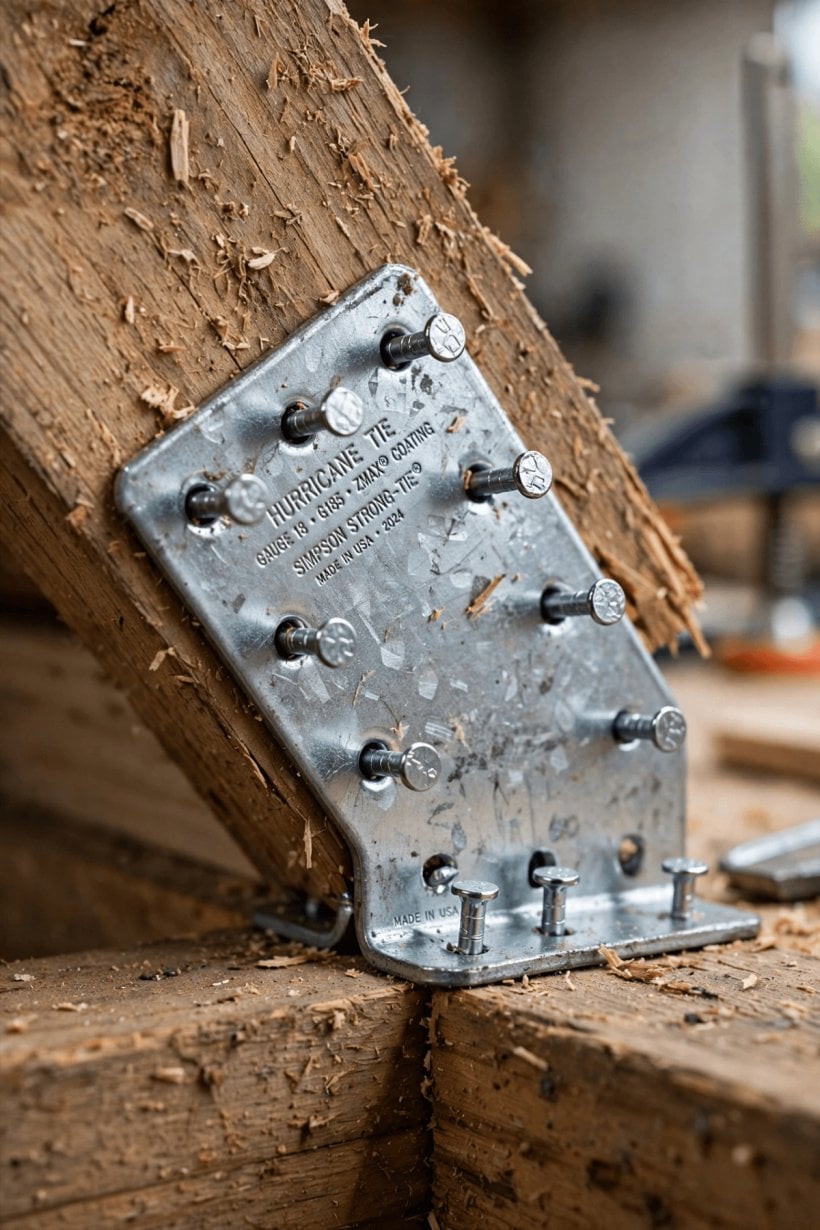
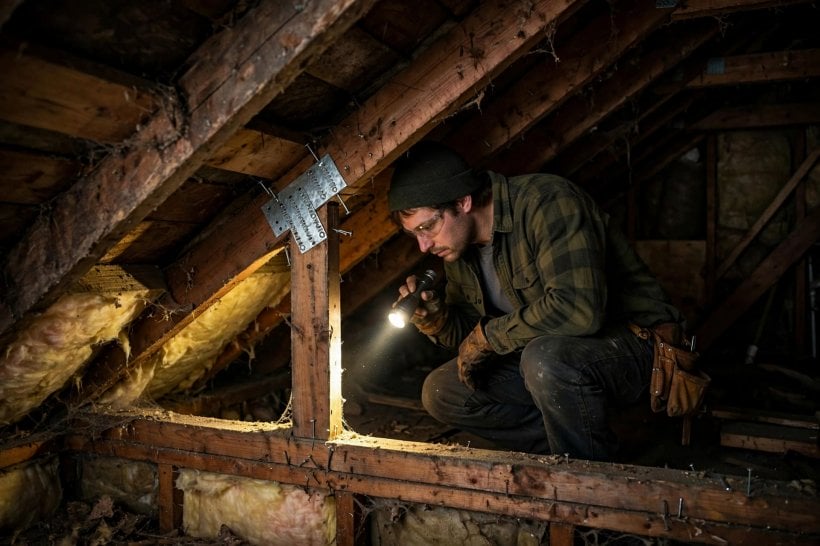
A hurricane tie is a small piece of folded galvanised steel with an outsized job. One leg nails to the face of the rafter or truss; the other leg nails to the wall’s top plate, so the two members are mechanically locked together by a steel bridge. The arrangement changes how the fasteners work. A toe-nail resisting uplift is being withdrawn — pulled straight out of the wood along its own axis, held only by friction, which is the weakest way a nail can be loaded. A tie’s nails, by contrast, are loaded in shear: the force tries to slide the steel sideways across the nail shanks, and the nails resist with the full bending strength of the steel they are made from. Same nails, same wood, completely different physics — and several times the holding power, as the table shows.
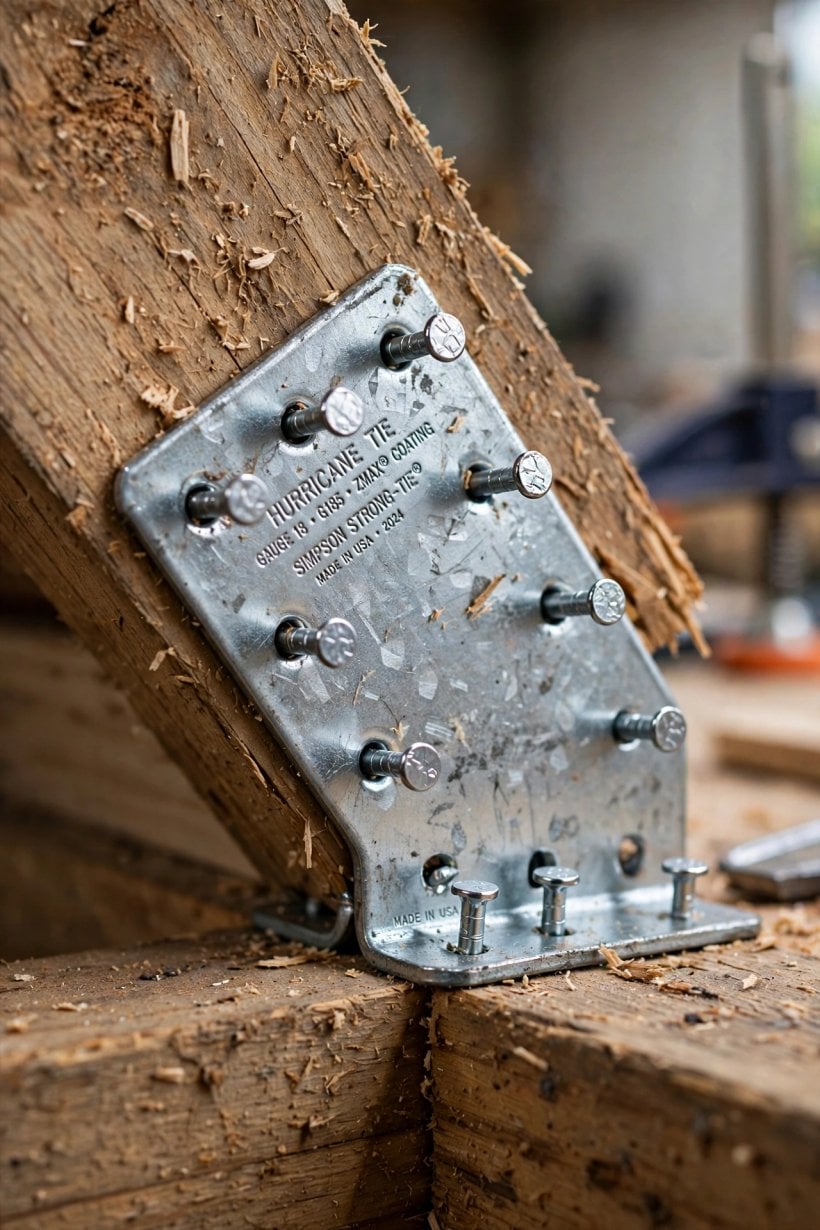
Ties also fail gracefully, which matters. A friction connection gives no warning and lets go all at once; a mechanical connection creaks, works and deforms before it surrenders, and it holds its rated load connection after connection rather than depending on how enthusiastically one carpenter swung a hammer on one afternoon. Install a tie and you are not hoping the joint is strong — you are bolting a known number onto the building, and that number is what the calculator compares against the wind’s number.
4. Ties vs Straps vs Clips — and the Screw Option
The tie is the famous member of the family, but it has relatives worth knowing. A strap is a longer, narrower strip of the same galvanised steel that wraps over the top of the rafter and nails down both faces of the wall below. Because the steel passes over the rafter rather than beside it, a strap resists uplift in near-pure tension, and its length lets it reach past the top plate into the stud itself — where, as the load-path section explains, the force ultimately wants to go. Straps ask for more careful bending and nailing, so they are usually a framing-stage decision rather than an afterthought.
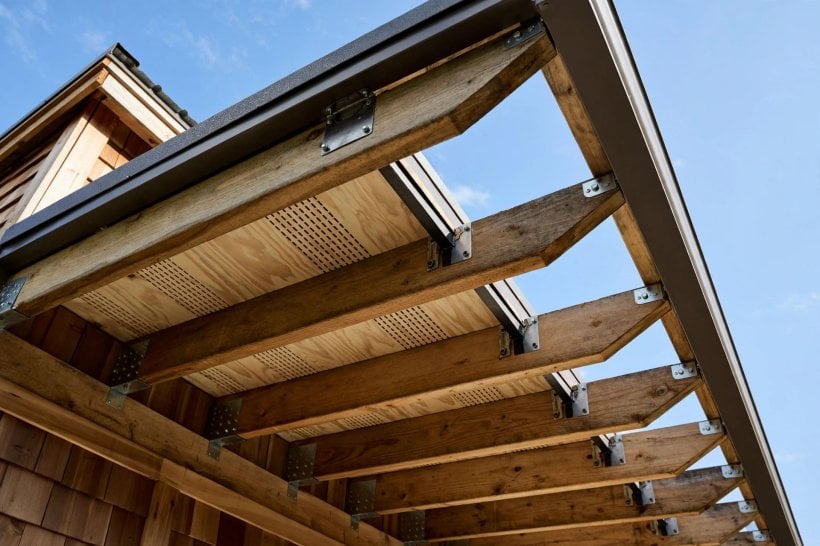
Clips are the tie’s smaller cousins: lighter angles for where loads are modest and a full tie would be overkill — the same mechanical virtue at a smaller capacity. The calculator’s fourth option cuts across all three categories: a long structural screw driven up through the top plate into the rafter end, its threads engaging the wood along their whole length, so withdrawal resistance comes from the thread bite rather than smooth-shank friction — landing its capacity in the same league as a standard tie. Whichever hardware you favour, the principle the tool keeps testing is identical: friction is not a connection, and a number you can look up beats a hope you cannot.
5. The Nailing Schedule and Rated Fasteners
A connector is only ever as strong as the fasteners that install it, and this is where tidy builds quietly go wrong. Every hole stamped into a tie or strap exists because the rating assumes a nail through it. Leave holes empty and you have not installed a slightly weaker connector — you have installed an unrated one, with a capacity nobody can state. The schedule is the specification — the fastener count and type that turn a piece of bent steel into a number in a table. Fill every hole, every time.
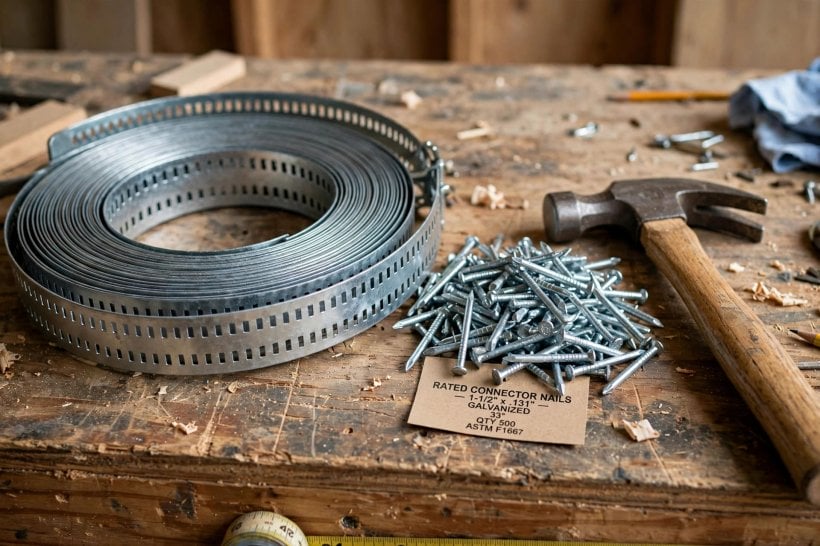
Equally important is what the fasteners are. Connector ratings are earned with specific nails — the short, stout, purpose-made connector nails the hardware is tested with. The classic field substitution, whatever smooth nail happens to be in the pouch, silently rewrites the rating, and screws never meant for structural connections are worse still, being hard and brittle where a nail is ductile and forgiving. The discipline costs almost nothing: the correct nails are cheap, and the correct pattern is drawn by the holes themselves. Fastening discipline is a theme across the whole shell — the same fill-every-hole thinking governs the deck above, whose own weight and fixings are tallied in our sheathing weight calculator. Gravity loads and uplift loads meet at the same nail heads.
6. Spacing: A Tie at Every Rafter
The calculator asks one deceptively simple question: are your rafters spaced at 16 inches on centre, or 24? The wind does not care about your framing layout — it applies its pressure to the whole roof area, and that total force is shared among however many connections exist to resist it. Space the rafters wider and each remaining connection inherits a larger share; halve the number of rafters and you roughly double the force trying to extract each one. Spacing is not a framing preference; it is the denominator of the uplift equation.
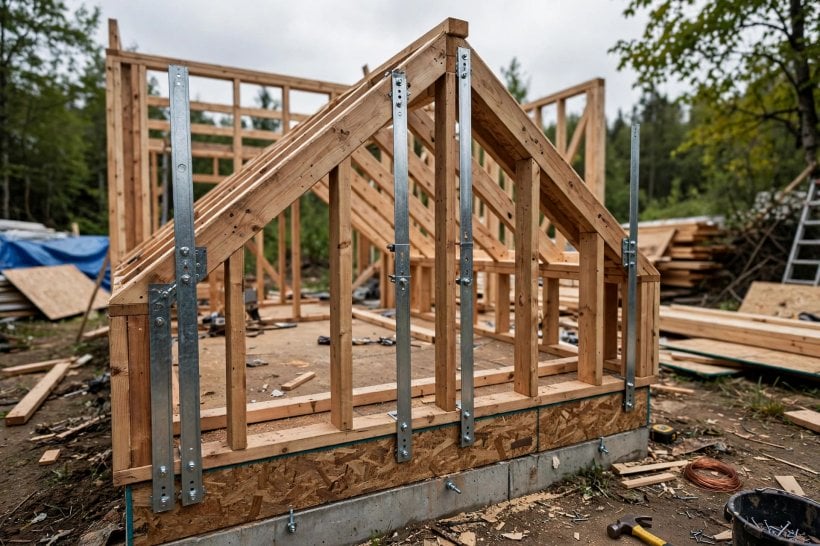
Which is why the rhythm rule is absolute: a connector at every rafter, not every other one. Skipping alternate rafters — a real shortcut seen in the wild, usually justified by the ties being “strong enough” — does not halve your cost and keep your safety. It doubles the load on the ties you did install while leaving the skipped rafters held by toe-nails alone, and the roof departs from exactly those unheld points. Uplift failure is sequential: one rafter end lifts, the deck peels, the next connection inherits the freed load plus the wind now getting under the deck, and the assembly unzips. Every-rafter rhythm is what turns individual connections into a system. Count the rafters, buy that many connectors — and then buy spares.
7. Gable Ends and Overhangs: Where Suction Peaks
Not all square feet of roof are equal in the wind’s accounting. The edges — eaves, rakes, corners and the gable ends — are where airflow separates from the surface and suction concentrates, which is why storm photographs so often show roofs that began peeling from a corner rather than the middle. The gable end deserves special respect: a tall triangular wall capped by the roof’s most exposed edge, whose end rafter is frequently the least-connected member in the building, resting on outlookers or a ladder frame rather than a full wall plate.
Overhangs multiply the problem in a way builders consistently underestimate. An eave overhang is roof area with wind pressure pushing up from beneath it as well as suction pulling from above — the one part of the roof the wind grips from both sides. The calculator is blunt about this: its width input comes with the instruction to include the eaves and overhangs, because the wind certainly includes them. A roof measured wall-to-wall but built eave-to-eave has uncounted area generating uncounted force on every connection. Detail the edges like they matter — continuous ties along both eaves, straps at the gable ends carried down the end wall, overhangs kept honest in the arithmetic — because the edges are where the wind starts its work.
8. Continuing the Load Path to the Trailer
A hurricane tie wins its local battle and can still lose the war, because the tie only moves the force — it does not delete it. The uplift arriving at the top plate still has to travel somewhere, and the original guide draws the required route as an unbroken chain: roof to top plate, top plate to stud, stud to bottom plate, bottom plate to trailer frame. Every link must be a mechanical connection; if any single link is merely nailed in the friction sense, that link — not the tie you so carefully installed — becomes the failure point, and the house separates there instead.
This is why the straps from Section 4 earn their keep on a tiny house: a long strap can stitch rafter, plate and stud in one piece of steel, collapsing two links of the chain into one continuous connector. Lower down, the chain ends at the one foundation a tiny house has — its trailer — and the frame connection deserves the same seriousness as the roof’s. The chassis that receives these loads is the subject of our trailer frame rigidity and subfloor visualizer, and the two tools reward being read together: a roof chained to a frame that flexes is a chain with a moving anchor. Retrofitting an existing build follows the same map in reverse: work the chain link by link, adding ties at the rafters, strapping the plate-to-stud joints wherever walls are open or accessible, and verifying the sill-to-frame connection you may never have seen. A retrofit rarely matches a designed-in chain, but a chain with every link improved beats a chain with one link perfected.
9. Using the Calculator
The roof uplift hurricane tie calculator below asks for four things. Your roof’s length and its total width — overhangs included, as Section 7 insists. Your rafter spacing, 16 or 24 inches on centre. And your connection method, from plain toe-nails through the standard and heavy-duty ties to the structural screw. Press the button and it simulates a 65 mph wind: the roof area is multiplied by the uplift pressure, the total force is divided across your connections, and each connection’s burden is compared against its capacity. The roof on screen either shudders and holds, or lifts — and the readout gives the margin in pounds, on both sides of the contest.
Run it like a sceptic. Start with your actual plan and the weakest plausible hardware, watch it fail, then upgrade the connection method — not the hope — until the margin is comfortable. Then stress the inputs: widen the spacing, stretch the overhangs, and see how quickly the per-rafter force climbs. It is also worth running the roof in the opposite direction: the calculator here tests the wind trying to remove the roof, while our roofing weight impact calculator weighs what the roof itself asks of the structure beneath — the two numbers together describe a roof that is neither too heavy for its walls nor too loose for its sky.
10. Mistakes That Let Roofs Leave
The mistakes are few, familiar and almost tenderly preventable. Toe-nailing because that is how site-built houses are framed — the founding error, mistaking a friction habit for a connection, on the one building type that drives through its own storm. Skipping alternate rafters. Filling most of a tie’s holes. Substituting whatever fasteners were at hand. Measuring the roof wall-to-wall while the overhangs fly uncounted. And perfecting the rafter connection while the chain below it — plate to stud, stud to sill, sill to frame — remains plain nailing all the way down. Each mistake shares a shape: one link treated as exempt from the arithmetic that governs all the others.
Behind them all sits a budgeting mistake: treating connection hardware as a place to save. The full set of ties or straps for a tiny roof is one of the smallest line items in the entire build — trivial beside the trailer, the windows or the appliances weighed in our guide to calculating GVWR for tiny homes — yet it alone decides whether the roof arrives at the destination. There is no other component where so little money buys so much consequence. Spend it, count it, fill every hole.
Final Considerations
A tiny house roof lives a double life: a lid in a storm, and a wing on the highway. Tying it down properly is not exotic engineering — it is a known force, a rated connector at every rafter, the right nails in every hole, and an unbroken mechanical chain from the ridge to the trailer frame. Make them with the numbers in front of you: scroll down to the Roof Uplift Calculator, enter your own roof, and let the simulation argue with your hardware choices before the highway does.
Roof Uplift Calculator
This tool visualizes the “Wing Effect”—how highway speeds create low pressure above your roof, generating massive lift forces that try to rip the roof deck off the walls. It demonstrates why simple “toe-nailing” (the standard for regular houses) is completely insufficient for a Tiny House on the highway, and calculates exactly how much force each rafter anchor needs to resist.
Roof Uplift Calculator
Don’t let your roof fly off on the highway.
1. Roof Config
Include eaves/overhangs!
Analysis Result
Why Toe-Nailing Fails
A roof acts exactly like an airplane wing. As air rushes over the curve/pitch, pressure drops, sucking the roof upwards. This “Uplift Force” pulls nails straight out. Toe-nails rely on friction; Metal Ties rely on the shear strength of the steel, which is vastly stronger.
In a Tiny House, you must mechanically connect: Roof -> Top Plate -> Stud -> Bottom Plate -> Trailer Frame. If any link in this chain is just “nailed,” that is where the house will come apart in a storm or on the highway.


0 Comments