

A tiny house can be finished, furnished and photographed — and still be illegal to tow. The number that decides it is not on the brochure. It is stamped on a small plate, waiting to be added up honestly.
This guide explains tiny house GVWR in plain terms: find the rating, weigh the empty build, count the hidden load, and leave a real margin before you hitch up.
1. At a Glance: The Weight Budget in Brief
Think of the whole problem as a budget with one fixed limit and several changeable costs. The limit is the gross vehicle weight rating set for your trailer. Everything else — the empty house, the water in the tank, the propane, your belongings, the battery bank — is a line that spends part of that limit. When the lines add up to more than the limit, the trailer is overweight, even if it tows smoothly and nothing looks strained. The table below is the budget in its simplest form.
| Budget line | What it means | How you get it |
|---|---|---|
| GVWR | The maximum legal weight of trailer plus load | Read it from the VIN sticker on the trailer |
| Dry weight | Weight of trailer, framing and finishings, empty | Estimate honestly, then confirm on a scale |
| Water | Fresh water carried in the tank | Tank size in gallons, full or part-full |
| Propane | Full propane tanks fitted for travel | Choose the tank setup you actually carry |
| Belongings | Clothes, books, kitchenware, mattress and everyday gear | Estimate, then weigh what you can |
| Batteries / solar | Battery bank and solar equipment | Add the system as fitted, not as planned |
| Remaining capacity | GVWR minus everything above | Must stay positive, with margin to spare |
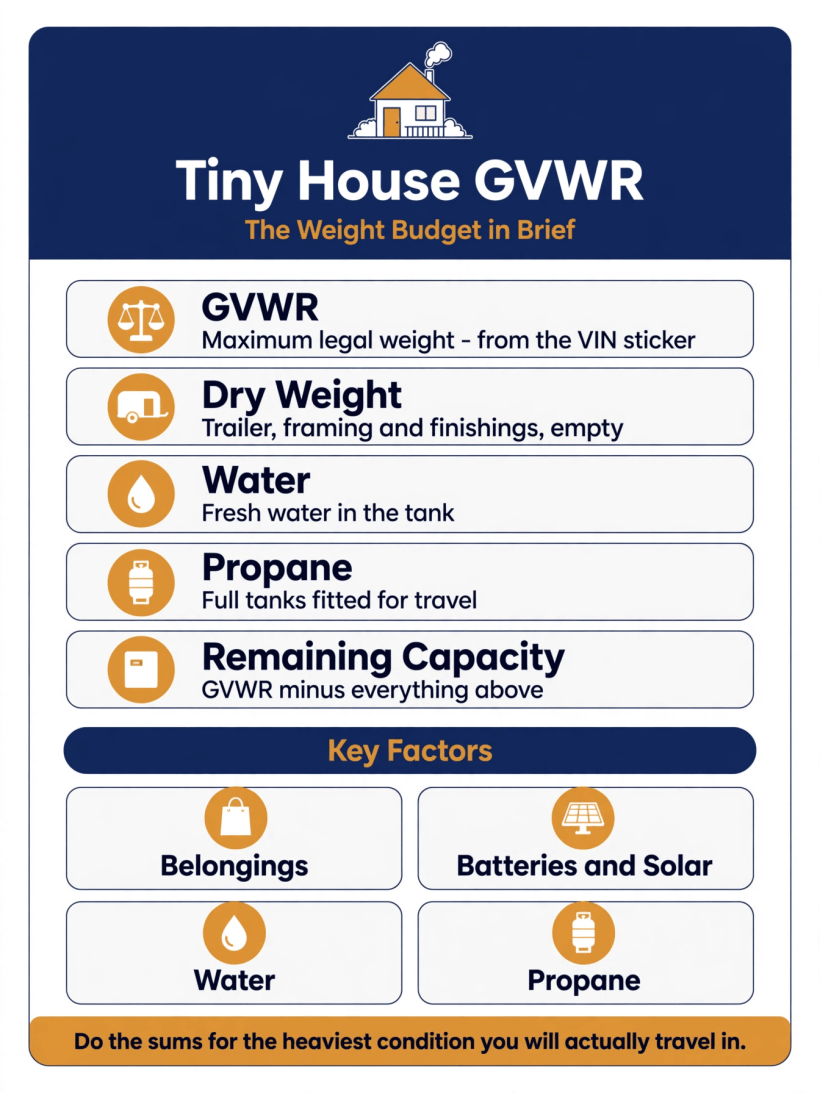
The weight budget at a glance: start with the rating, add the dry build, count water, propane, belongings and batteries, and protect what remains.
Two habits make this budget trustworthy: work from real numbers — a plate reading, a scale ticket, a checkable tank size — and do the sums for the heaviest condition you will actually travel in, not the lightest day you can imagine.
2. What GVWR, GAWR and Payload Actually Mean
GVWR stands for gross vehicle weight rating: the maximum total weight the trailer is designed and rated to carry, including its own structure and everything loaded onto it. It is a limit set by the trailer manufacturer for that specific frame, its axles, its coupler and its tyres working together. Exceeding it does not just bend a rule — it asks every one of those components to work beyond the condition they were rated for.
GAWR is the companion rating: the gross axle weight rating for a single axle. A trailer can sit under its overall rating and still overload one axle if the load is placed badly, which is why total weight and weight placement are separate questions. Our guide to a clear tiny house weight distribution diagram shows how position changes the load each axle actually carries, and an axle comparison tool helps you judge whether the axles under a design are matched to the job at all.
Payload is what remains between the empty weight and the rating: the carrying capacity available for water, fuel, belongings and systems. It decides daily life in the finished house — a structure built close to the limit leaves almost no payload, so every later addition becomes a negotiation with the rating.

3. Finding Your Rating: The VIN Plate and Trailer Documents
The calculator below starts from one instruction: take the GVWR from the VIN sticker. That sticker — the certification label fitted to the trailer — is the authoritative source, because it records the rating for your exact frame as it left the factory, not for a similar model in a catalogue. Look for the label on the trailer frame or tongue area, photograph it before the build buries it behind skirting or storage, and keep that photograph with your build documents.
The label typically sits alongside the vehicle identification number and the axle ratings, so one reading gives you the whole starting picture. If it is faded, try the trailer paperwork and the manufacturer record for that VIN — never guess a round number from trailer size, because two trailers of the same length can carry quite different ratings.
Write the rating down where the build team will see it — taped inside a cabinet door, or on the build wall — so every material decision happens in sight of the limit. A heavy finish then stops being just a finish and becomes pounds spent from a named budget.

4. Dry Weight Honesty: What the Empty House Really Weighs
Dry weight, in the calculator’s words, is the weight of the trailer plus framing plus finishings, empty. It is also the line most often flattered. Desk estimates remember the big items and forget the accumulation: adhesive, fasteners, trim, sealant, the heavier door substituted late, the subfloor upgrade nobody recalculated. Together, those small items are the difference between a plan that fits and a house that does not.
The structure itself is the largest single choice. Framing material, sheathing and interior lining all spend weight before a single belonging arrives, which is why weight comparisons belong at design stage: a frank steel vs wood framing weight comparison, a careful run through a sheathing weight calculator, and a clear-eyed SIPs vs stick framing analysis each attack a different layer of the same stack. Flooring deserves the same treatment — a flooring weight calculator turns a finish you chose by eye into a number you can budget.
Then weigh the result. An estimate is a plan; a scale ticket is a fact. If the finished house comes in heavier than estimated — and first builds often do — update the budget immediately, not at moving time. The rating will be enforced against the real house, not the spreadsheet.

5. The Hidden Payload Lines, One by One
The calculator calls its third section the hidden weight, and the name is earned. Belongings are the largest hidden line for most households: clothes, books, kitchenware and a mattress, in the tool’s own list. Books and kitchenware are deceptively dense, and a small house concentrates them — there is no spare room diluting the load. Weigh boxes as you pack them if you can, or load in stages and re-check, rather than trusting a single hopeful guess for the whole contents.
Propane is smaller but exact, because the tool names the options it expects you to choose between: no tank, one or two 20 lb tanks at roughly 37 lb and 74 lb full, or one or two 30 lb tanks at roughly 55 lb and 110 lb full. The lesson inside those figures is that the rating counts the full travelling setup, not the nominal size printed on the tank. Choose the setup you will actually carry, at the weight it actually travels.
Batteries and solar form the third hidden line, and the one most likely to grow after the build. A modest system fitted at build time can become a much heavier bank a year later, and panels, mounts and cabling add their share too. Planning how much solar power a tiny house needs alongside its weight, rather than after it, keeps the upgrade path inside the budget. Appliances belong in this audit as well: where heavy items sit matters as much as what they weigh, and an appliance placement strategy helps you place them over or near the axles instead of at the ends.

6. Water: The Swing Weight That Changes Everything
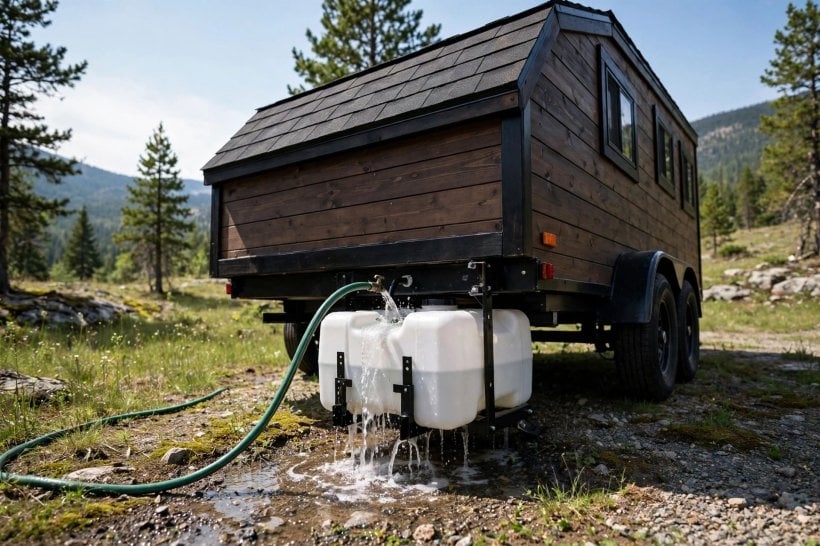
Water deserves its own section because it is the one major weight you control on the day of travel. The structure is fixed, the belongings change slowly, but the tank can be full in the morning and empty by the evening — and that swing can be the whole of your remaining margin. The calculator’s worked example makes the point plainly: a builder whose sums were right for the house itself forgot a full 40-gallon freshwater tank, and that single omission pushed the total over the trailer limit.
Treat the tank as a decision, not a default. If your budget only works with the tank empty, then travelling empty is a rule of the house, written down and shared with anyone who might fill it before a trip. If you need to travel with water — for a dry campsite, a long drive, a move with no hookup at the far end — then the budget must be built with the tank full, and other lines must make room for it.
Position matters alongside quantity. A tank mounted low and near the axles adds its weight where the trailer handles it best; the same gallons at the front or rear change the balance as well as the total. Re-check that balance after any layout change.
7. Weighing for Real: Scales, Axles and Tongue Weight
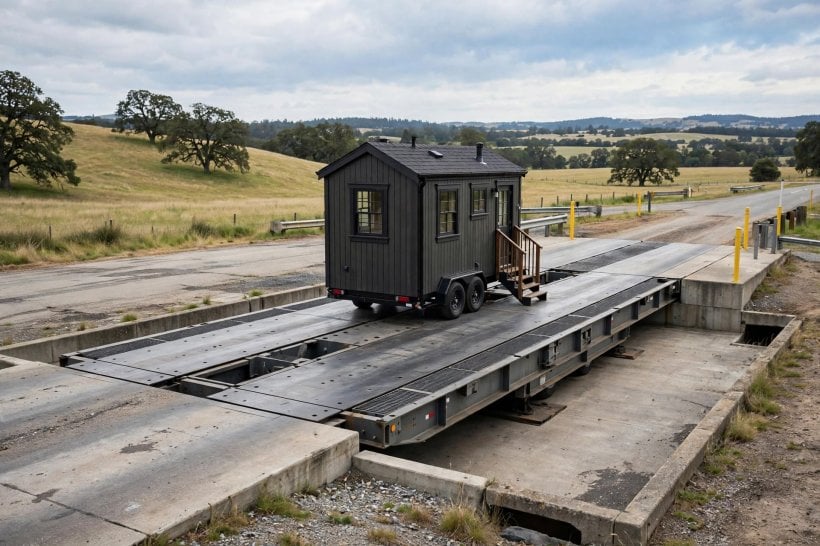
Calculation plans the build; weighing proves it. Once the house is finished — and again once it is loaded for a real trip — take it to a scale and weigh it in travelling condition: tanks as you intend to carry them, belongings aboard, propane fitted. A step-by-step CAT scale weighing guide walks through how a platform scale reading is taken and read, so the first visit feels like a routine errand instead of an exam.
Weigh more than the total. Per-axle figures show whether the load is shared as it should be, and tongue weight shows how much of the total presses down through the coupler onto the tow vehicle — too little and the trailer can sway, too much and the tow vehicle’s own limits come into play. A tongue weight tuner helps you adjust placement until that figure sits in its proper share of the total, and an axle placement guide explains the geometry behind why moving heavy items even a short distance changes the readings.
Keep the tickets. A dated scale record is a build document and a useful reference after any renovation: reweigh after major changes, not just after the first build. Weight creeps in through small upgrades, and the scale is the only audit that never flatters you.
8. The Legal and Insurance Consequences of Running Overweight
The calculator states the risks without decoration, and they are worth repeating exactly as it frames them. On insurance: if you are involved in an accident and your trailer is found to be over its GVWR, your insurance company can deny your claim, leaving you personally liable for damages. That single sentence should govern how much margin you accept. A trailer a little over its rating is not a paperwork technicality after a crash; it is the detail on which the whole claim can turn.
On enforcement, the tool is equally direct: DOT officers can pull over non-commercial vehicles if they appear unsafe, and if you are weighed and found overweight, you may face fines and be forced to drop the trailer immediately until another truck or trailer arrives. Picture your home unhitched at the roadside, waiting for rescue, and the appeal of margin stops being abstract.
There is also the mechanical consequence the law is trying to prevent. The tool’s example ends by noting the overweight total put the axles at risk of failure on highway bumps. Ratings exist because components have limits; running close to them on every trip, over every rough surface, spends the safety reserve the manufacturer built in. Legal, insured and mechanically sound are three descriptions of the same decision: stay inside the rating.

9. Designing Backwards From the Rating
Every section so far points to one working method: start from the rating and design backwards. Fix the GVWR first, subtract a realistic dry weight, subtract the travelling payload in its heaviest honest form — full water if you will ever carry it, full propane, real belongings, the battery bank as planned — and look at what remains. If nothing remains, the design changes on paper, where changes are cheap: lighter finishes, a different structure, a smaller tank, a larger-rated trailer chosen before the build begins.
Designing backwards also protects the house after the build. Leave deliberate headroom and future upgrades stay possible: a second battery, a better mattress, new books. Spend the entire rating on day one and every later pleasure becomes a negotiation. Treat the remaining capacity line as a feature of the design, not an accident of arithmetic.
When a move is planned, design thinking meets road thinking. Choosing the right tow vehicle and hitch setup is covered in our guide to towing a tiny house, trucks and hitch weights, and the logistics of the day itself in the tiny house moving guide — both assume the homework in this article is already done, with a weighed house travelling inside its rating.

10. Common Mistakes and Using the Calculator Well
The mistakes repeat so reliably that they read as a checklist. Trusting a brochure weight instead of the VIN sticker. Estimating dry weight once and never weighing the finished house. Forgetting water, or counting the tank at the level it happens to sit today. Counting propane by its name instead of its full travelling weight. Leaving belongings as a single hopeful guess. Adding batteries, panels and appliances after the sums were closed. Any one of these can consume the whole margin; together they explain most overweight surprises.
The calculator below exists to break those habits in order. It walks the same path as this article — rating first, dry weight second, hidden payload line by line — and returns a total, a remaining capacity and a breakdown you can argue with. Use it early, while the build is still lines on paper, and use it again whenever a major choice changes: a different structure, a bigger tank, a heavier bank of batteries. The tool turns tiny house GVWR from an abstract limit into a set of decisions you can still change.
Run the honest version, not the flattering one. Enter the full tank if you might travel full, the belongings you own rather than the ones you plan to declutter, and the dry weight you measured rather than the one you hoped for. If the result leaves you a comfortable remainder, the house and its rating are in agreement. If it does not, the calculator has done you a favour at the only moment when fixing the problem is still easy.
Final Considerations
A weight rating is not bureaucracy pasted onto a creative project; it is the line where design, law, insurance and mechanical safety all agree. Find the number on the plate, build the budget around it, weigh the finished house, and keep the margin you promised yourself. Then use the tool below with your own figures, and let the arithmetic — not optimism — give the final verdict.
GVWR & Payload Calculator
GVWR & Payload Calculator
Are you legally overweight? Add up the “hidden” cargo.
Payload Breakdown
- Dry House: 0 lbs
- Water: 0 lbs
- Propane: 0 lbs
- Belongings: 0 lbs
- Solar/Batt: 0 lbs
The Legal Risks of Being Overweight
Real-World Example
“The Full Tank Mistake”
A DIY builder calculated their weight perfectly at 13,800 lbs for a 14k trailer. However, they forgot to account for their 40-gallon freshwater tank being full before hitting the road.
Result: Total weight hit 14,133 lbs. They were legally overweight, putting their axles at risk of failure on highway bumps.


7 Comments