

This tool helps builders visualize the difference between a standard “echo box” wall and a properly soundproofed assembly. It demonstrates two key physics concepts: Mass (using dense Rockwool instead of light fiberglass) and Decoupling (using Resilient Channel to break the vibration path so sound can’t travel through the studs).
It includes a “Noise Dampening Visualizer” that shows sound waves trying to penetrate your wall, illustrating how each layer strips away decibels before they reach your ears.
A tiny house has thin walls and nowhere to hide from noise. Highway traffic hisses straight through them, and heavy rain turns a metal roof into a drum. Yet two walls built from the same studs can perform completely differently.
The difference is not luck. It is physics — mass and decoupling — and that is what tiny house soundproofing really comes down to.
1. At a Glance: The Echo Box vs the Soundproofed Wall
The simulator below was built to make one comparison visible: a standard “echo box” wall against a properly soundproofed assembly. It lets you pick a noise source, choose an insulation, decide how the drywall is mounted, and then watch sound waves try to penetrate the wall in its Noise Dampening Visualizer — each layer stripping away decibels before they reach your ears. Its two outputs are an Estimated STC rating and a Noise Reduction percentage — every combination is summarized here.
| Wall assembly | Estimated STC | Noise reduction | The tool’s verdict |
|---|---|---|---|
| Closed cell foam, direct mount | 35 | 40% | Poor — you will hear conversations outside |
| Standard fiberglass, direct mount | 36 | 40% | Poor — rain will be loud |
| Rockwool, direct mount | 40 | 75% | Decent — muffled, but loud trucks still heard |
| Closed cell foam + resilient channel | 45 | 75% | Decent |
| Fiberglass + resilient channel | 46 | 75% | Decent |
| Rockwool + resilient channel | 50 | 90% | Excellent — near silence, faint whispers only |
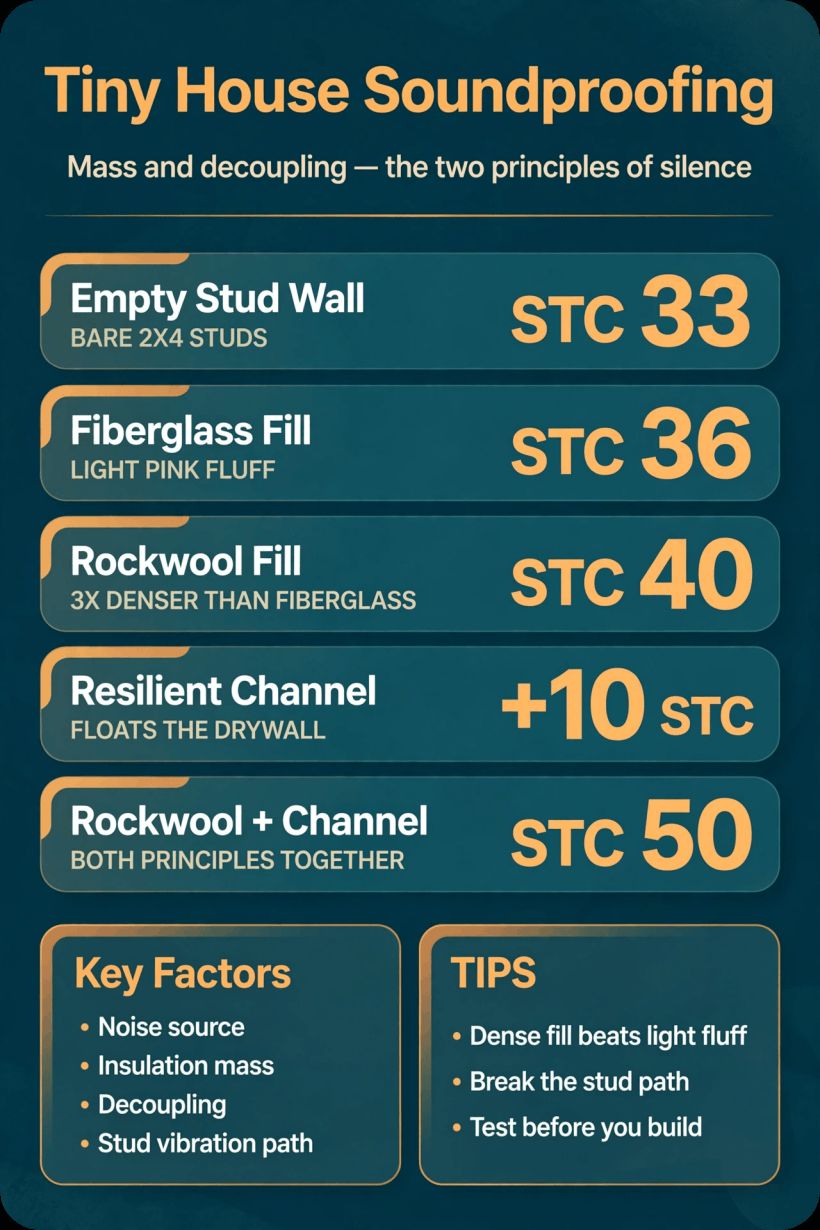
Soundproofing at a glance: an empty stud wall starts at STC 33, dense rockwool lifts it to STC 40, resilient channel adds 10 more — and both principles together reach STC 50.
Read the table top to bottom and the whole subject falls into place. The cheap, standard build sits in the Poor band. Changing only the insulation, or only the mounting, moves you one band. Only the build that does both — dense fill and a floated drywall — reaches the Excellent band. The sections below explain why each half of that recipe matters, and why neither half works alone.
2. Two Ways Sound Gets In: Airborne and Impact Noise
The simulator opens with a choice that is the first real design question: what noise are you defending against? It offers two sources. Highway Traffic is labeled airborne — sound traveling through the air as pressure waves that strike the wall and push through it. Heavy Rain is labeled impact — sound that begins as physical strikes on the building’s skin, each raindrop a tiny hammer blow entering the structure directly.
The distinction matters because the two kinds of noise attack the wall differently. Airborne noise tests the wall’s ability to absorb energy in its layers. Impact noise tests how well the structure refuses to carry vibration — and a tiny house gives it plenty to carry, because the same light framing that makes the house towable also makes it an efficient vibration path. In a small interior there is no distance to dilute either kind.
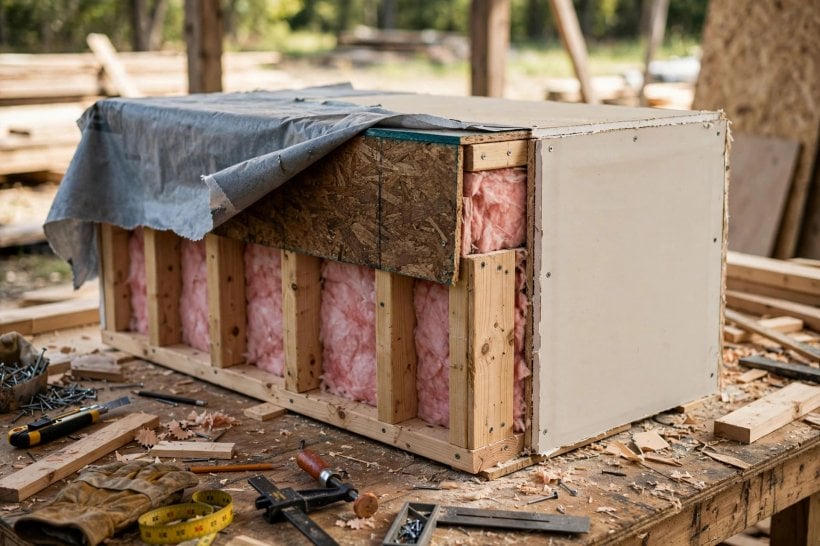
Rain deserves special respect in a tiny house, because the roof is usually metal and always close overhead. If the drumming of a storm is your main enemy, our container rain simulator for tiny houses explores that impact noise on its own. The simulator below tests both sources against the same wall — a wall that quiets traffic but sings in the rain has only solved half your nights.
3. The First Principle: Mass — Why Rockwool Beats Pink Fluff
The tool’s guide text states the first principle in one sentence: sound is energy, and to stop it you need heavy, dense material to absorb that energy. That is the mass principle — and it makes the insulation choice a density choice. Its three options are Standard Fiberglass — labeled, affectionately, “Pink Fluff” — Rockwool (mineral wool), and Closed Cell Foam, labeled rigid.
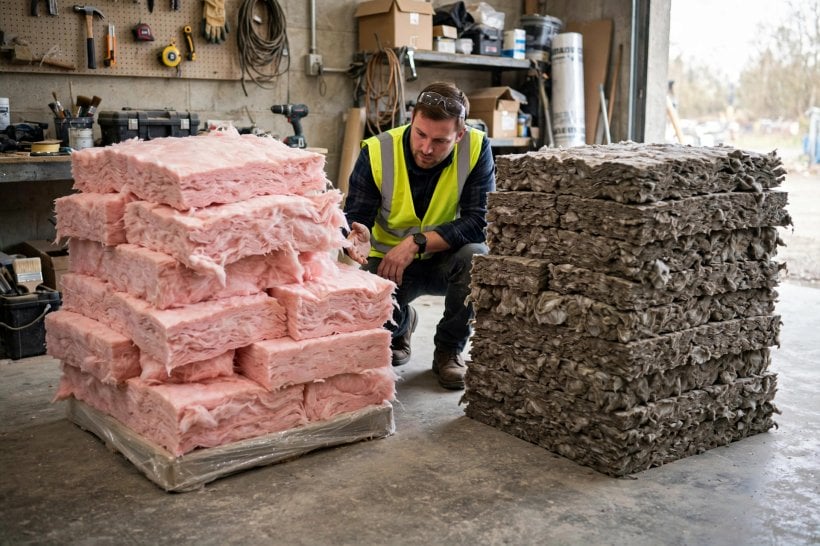
The numbers under those labels tell the story. Beside the insulation menu the tool notes that rockwool is 3x denser than fiberglass, and its ratings follow from that density: on the tool’s baseline wall, fiberglass adds 3 STC points while rockwool adds 7. The guide explains where that density pays off — rockwool absorbs mid-to-high frequencies, traffic hiss and voices, far better than foam or fiberglass. Those are exactly the frequencies that make a parked tiny house feel exposed.

Closed cell foam is the instructive failure. It is an excellent thermal material, but here it adds only 2 STC points — the least of the three — because, as the tool’s own note puts it, a rigid connection transmits sound. A stiff fill couples the two faces of the wall together instead of soaking up energy between them. If you are weighing these same materials for heat, our guide to insulating a tiny house with spray foam, rockwool or sheep’s wool covers the thermal side; for sound, density and softness win, and mass is the mechanism.
4. The Second Principle: Decoupling — Breaking the Stud Path
Mass alone has a blind spot, and the tool’s guide names it: low frequency noise — thunder, engine rumble, bass — travels through solid studs like electricity. Your insulation barely matters if the drywall is screwed hard against the same studs the outside wall vibrates on. The vibration walks around your fill, through the wood, and re-radiates from the interior panel.
The simulator’s second control answers that path directly. Direct Mount means the drywall is screwed to the studs — the standard build, and the open door for structure-borne sound. Resilient Channel (RC-1) is a springy metal strip that separates the drywall from the studs: the channel is fixed to the studs, the drywall is fixed to the channel, and the two never rigidly touch. In the tool’s words, it breaks the vibration path, stopping sound from jumping from the outside wall to the inside wall.
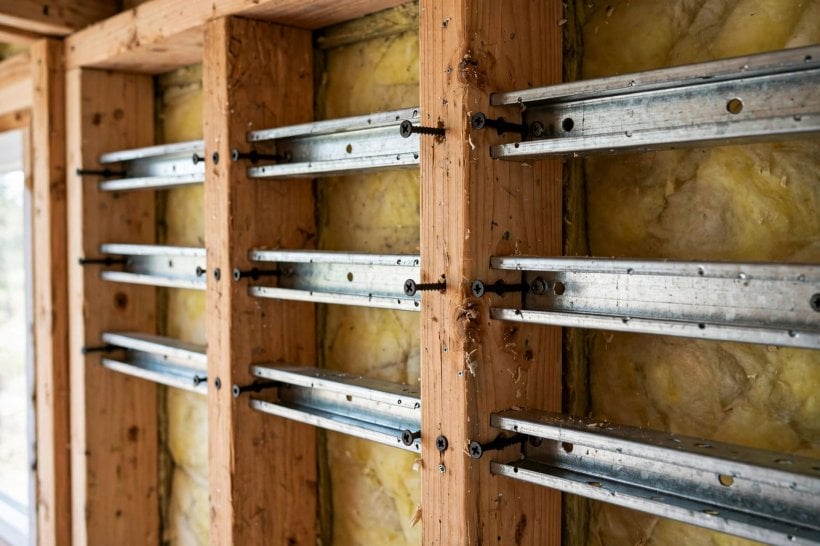
The payoff is the largest single jump in the tool: resilient channel adds 10 STC points to any of the three insulations. The parallel with heat is worth noting — a stud is a bridge for whatever flows, and our steel frame thermal bridge simulator shows the same skeleton leaking warmth. Here the flow is vibration. Float the inner skin, break the bridge, and the wall’s two faces stop behaving like one drum.
5. Reading the Numbers: STC and Noise Reduction
The simulator reports two figures, and they reward a careful read. Estimated STC is the headline: a single-number rating of how much sound the wall blocks. The tool builds it from a stated baseline — a 2×4 wood stud wall at 16 inches on center starts empty at STC 33 — then adds the contribution of your insulation and, if you chose it, the resilient channel. That is why the results are so legible: 33 empty, 36 with fiberglass, 40 with rockwool, 50 with rockwool on channel.
The tool’s own reference scale gives those numbers meaning. At STC 30, loud speech outside is understood. At STC 40, loud speech is audible but unintelligible. At STC 50, loud speech is barely heard — and STC 60 is silence. So the jump from 36 to 50 is the jump from following a conversation through your wall to barely knowing one is happening.

The second figure, Noise Reduction, translates the rating into bands: walls under STC 40 return 40%, the STC 40s return 75%, and an STC 50 wall returns 90%. Read it as the tool’s plain-language summary rather than a laboratory measurement — STC is a logarithmic scale, so each step up is a bigger real-world change than the tidy percentages suggest. The verdict line says it best, in the tool’s own three voices: Poor, Decent, or Excellent.
6. Pick Your Enemy: Highway Traffic or Heavy Rain
Because the simulator makes you choose a noise source before it tests anything, it forces the right planning habit: design for the noise you actually live with. A house parked long-term near a highway fights airborne sound all day — the hiss and rumble of traffic, mid-to-high hiss plus a low-frequency undertow. For that enemy, mass does the heavy lifting on the hiss, and decoupling handles the rumble that mass cannot catch.
A house under trees in a wet climate fights the other war. Heavy rain is impact noise delivered across the whole roof and wall skin at once, feeding vibration straight into the frame. Against impact, the floated inner skin earns its keep, because the energy arrives through the structure rather than the air.

The visualizer even colors the two enemies differently — red waves for traffic, blue for rain — as they stream at the wall from the OUTSIDE side and fade toward the INSIDE. Run your wall against both sources before you commit to a build: most sites have a primary enemy and a secondary one, and the winning assembly handles the primary without embarrassing itself against the second.
7. Six Assemblies, Tested: From Echo Box to Near Silence
Walk the table from §1 as a series of decisions and it becomes a build sequence. Start where most tiny houses start: fiberglass batts and drywall screwed straight to the studs. The tool rates that wall STC 36, 40% reduction, verdict Poor — “You will hear conversations outside. Rain will be loud.” That is the echo box from the tool’s introduction — the default outcome of treating sound as an afterthought.
Change one variable at a time. Swap fiberglass for rockwool and the same direct-mounted wall reaches STC 40 and the Decent band at 75% — mass alone buys a full verdict grade. Keep the fiberglass but float the drywall on resilient channel and you reach STC 46, also Decent, and slightly ahead: decoupling alone buys even more. Closed cell foam trails in both configurations, the rigid connection tax showing up every time.

Combine both principles and the wall changes character: rockwool plus resilient channel reaches STC 50, 90% reduction, and the tool’s top verdict — “Excellent! Near silence. Rain and traffic will be faint whispers.” The two principles are not alternatives competing for your budget. They address different paths — air and structure — and the wall only goes quiet when both paths are closed. The same layered thinking runs through the rest of the envelope: our flash coat mold prevention simulator shows a thin foam layer doing moisture duty inside a wall build-up, and the floor insulation calculator for tiny houses extends the assembly thinking underfoot.
8. Where Quiet Matters Most in a Tiny House
In a conventional house you can retreat from a noisy wall. In a tiny house the bed is often in a loft directly under the roof skin, the living space shares walls with everything, and there is no spare room to move to. That is why the rain verdict matters so much here: the surface being drummed is frequently the ceiling of your bedroom, a few feet above the pillow.
Sleep is the use case that justifies the full assembly. A Decent wall muffles the world; an Excellent wall reduces rain and traffic to faint whispers, which is the difference between sleeping through a storm and being kept company by it. Near a road, that test is every night, all night.

The wall only handles noise from outside, remember. A tiny house also generates its own soundtrack, and placement and equipment choices decide how loud it is: the RV furnace efficiency and noise simulator compares heaters that roar against heaters that whisper, and the tiny house cooling analyzer weighs a window unit’s racket against a mini-split’s hush. Quiet is a whole-house budget — the wall keeps the world out, and calm equipment keeps the inside calm.
9. Mistakes That Waste a Soundproofing Upgrade
The simulator quietly exposes the common errors. The first is buying insulation by thermal habit: reaching for closed cell foam because it insulates heat so well, then discovering its rigid connection makes it the weakest sound choice in the tool. Sound rewards soft, dense fill — the opposite instinct from a rigid foam board.
The second mistake is stopping at mass. Rockwool with direct-mounted drywall stalls at STC 40, because low frequency energy ignores the fill and rides the studs. The third is the mirror error: floating the drywall over cheap, light fill and leaving the airborne path under-defended against voices and traffic hiss. The tool’s table is unforgiving — every single-principle wall tops out at Decent.
The fourth mistake is vaguer but just as common: choosing materials before choosing the enemy. A wall tuned for traffic hiss and a wall tuned for rain impact emphasize different principles, and “soundproofing” without a named noise is how budgets get spent on the wrong layer. Name the noise, then spend.
10. Using the Simulator: Test Your Wall Before You Build
Working the Tiny House Soundproofer below takes under a minute. First choose your noise source — Highway Traffic (Airborne) or Heavy Rain (Impact) — thinking of your actual site. Then set the Wall Assembly: pick an insulation type, Standard Fiberglass, Rockwool, or Closed Cell Foam, and choose your decoupling, Direct Mount or Resilient Channel (RC-1). Press Test Wall.
The tool answers with your Estimated STC, your Noise Reduction percentage, a verdict line, and the visualizer: waves streaming from OUTSIDE toward INSIDE, fading as each layer strips away decibels. Then do what the tool is really for — experiment. Hold the insulation constant and toggle the channel to feel decoupling’s value. Hold the channel and swap fiberglass for rockwool to price the value of mass. Two minutes of toggling teaches the whole table in §1.
Test before the walls are closed, while the answers are still cheap. The decisions this tool models — fill density, channel or no channel — are nearly free to change on paper and painful to change behind finished drywall, in the same way the layer order in our vapor barrier placement guide for a tiny house must be settled before the lining goes on. Run the wall you were planning, then run the wall the physics wants, and compare verdicts before you buy a single batt.
Final Considerations
A quiet tiny house is not built from a miracle product. It is built from two ordinary principles applied together: enough mass in the cavity to absorb airborne energy — where dense rockwool, at 3x the density of fiberglass, is the tool’s clear winner — and a broken vibration path, where a springy strip of resilient channel floats the drywall and adds the single biggest jump in the ratings. Either principle alone earns a Decent. Together they earn near silence.
So let the simulator be the first step of the build rather than a curiosity after it. Choose your enemy, assemble your wall, press Test Wall, and do not settle for a verdict you would not want to sleep inside. That discipline — test, compare, then build — is tiny house soundproofing done properly, and your future self, asleep under a drumming roof in a house that stays quiet, will thank you for it.
Tiny House Soundproofer
Tiny House Soundproofer
Rockwool vs. Fiberglass & The Magic of Resilient Channel.
1. Noise Source
2. Wall Assembly
Rockwool is 3x denser than fiberglass.
The Two Principles of Silence
Sound is energy. To stop it, you need heavy, dense material to absorb that energy. Rockwool (Mineral Wool) is about 3x denser than standard fiberglass. It absorbs mid-to-high frequencies (traffic hiss, voices) far better than foam or fiberglass.
Low frequency noise (thunder, engine rumble, bass) travels through solid studs like electricity. Resilient Channel is a springy metal strip that separates the drywall from the studs. It breaks the vibration path, stopping sound from jumping from the outside wall to the inside wall.


0 Comments