

This tool illustrates the “Jet Engine Effect” of standard RV furnaces (Suburban/Atwood) compared to quieter alternatives. It calculates not just the Propane Cost, but also the Battery Drain (a massive hidden cost of forced-air systems) and visualizes the Decibel Level to show why you might need earplugs to sleep.
The furnace fitted to most RVs is cheap to buy and expensive to live with: it roars like a vacuum cleaner, burns propane all night and quietly eats your battery bank alive. The simulator below prices all three costs — noise, battery drain and propane — across four heater types, so you can hear the difference before you pay for it.
1. At a Glance: RV Furnace Costs in Brief
Heat in a tiny house is never just about warmth. Every heater trades in three currencies at once: the fuel it burns, the electricity its fan or blower draws, and the noise it makes in a space small enough that the bed is never more than a few feet from the furnace. An RV furnace efficiency and noise simulator lays those three currencies side by side for the heaters builders actually choose between, which is what the table below summarises. The tool itself — the RV Furnace Reality Check — then lets you feed in your own propane price, battery bank and winter severity to see your personal version of the bill.
| Heater | Figures in the simulator | The trade-off |
|---|---|---|
| Standard RV Furnace (Suburban/Atwood) | 30,000 BTU · 75 dB · 8.0 amps · 75% efficiency | Cheap to buy, expensive to run — very loud, high amp draw |
| High-Eff RV Furnace (95% AFUE) | 20,000 BTU · 60 dB · 3.5 amps · 95% efficiency | Quieter and lower on power, but expensive to buy |
| Direct Vent Wall Heater (Dickinson) | 12,000 BTU · 35 dB · 0.4 amps · 80% efficiency | Tiny fan, radiant heat, very quiet |
| Diesel Heater | 18,000 BTU · 50 dB · 1.5 amps · 85% efficiency | Efficient, moderate noise with a ticking fuel pump |
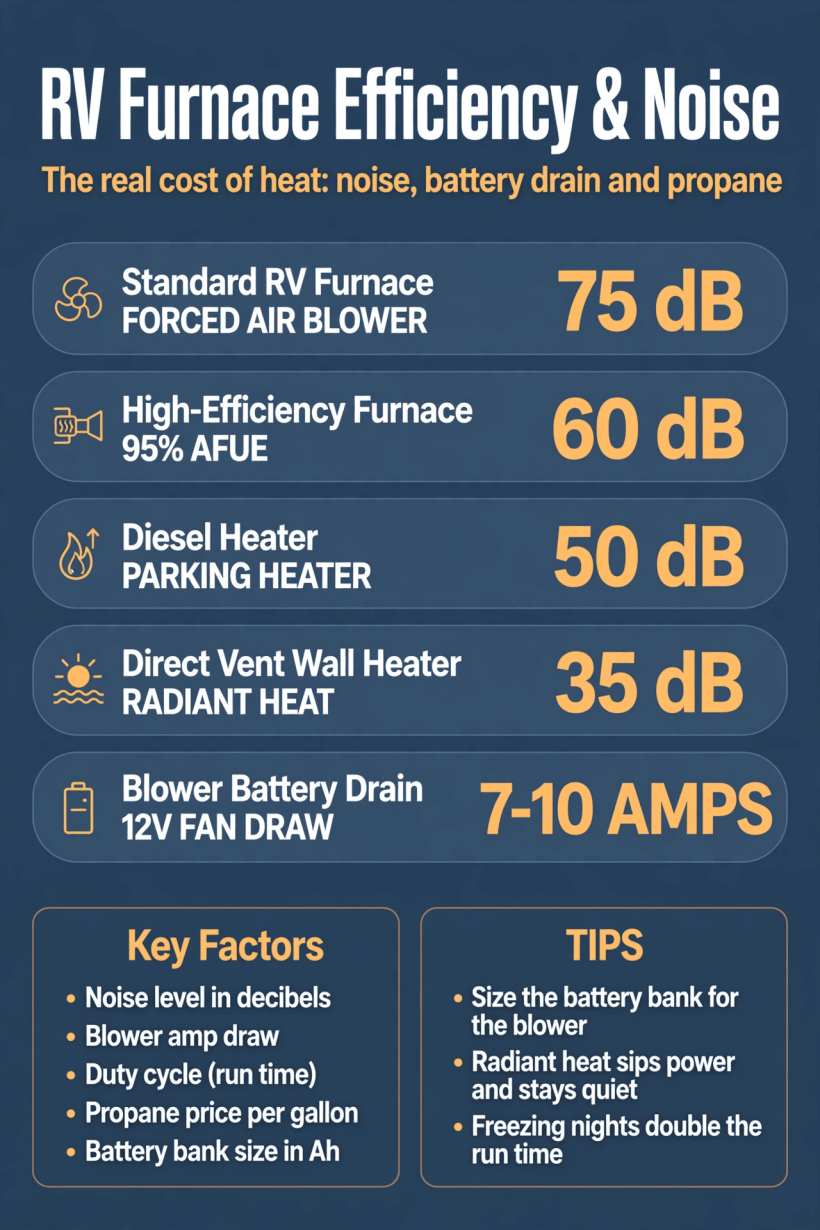
Four heaters, three currencies: the simulator’s own figures for noise, blower draw and efficiency, before your propane price and battery size enter the picture.
2. How a Forced-Air RV Furnace Heats a Tiny House
The standard RV furnace is a forced-air machine. Propane burns in a sealed chamber, a heat exchanger captures that energy, and a 12V blower fan pushes the warmed air through small ducts to registers around the cabin. The propane holds the heat energy, as the original guide below puts it, but the blower does all the delivering — and that division of labour is where every strength and weakness of the design begins. Forced air heats a small space quickly and evenly, reaches every corner the ducts touch, and works from a thermostat exactly like a house system.
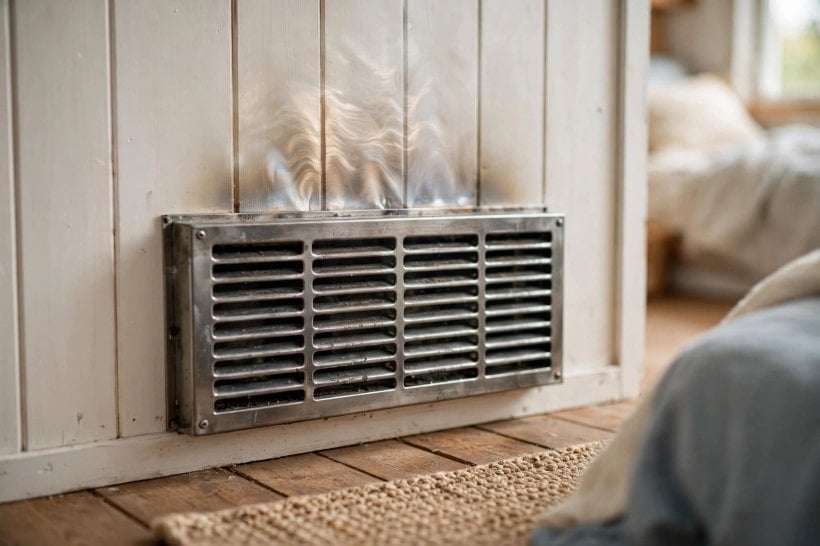
It also runs in cycles. The thermostat calls for heat, the blower spins up, the burner fires, the cabin warms, and the whole machine shuts down again — then repeats the sequence all night, every night, a few feet from where you sleep. Everything in the sections that follow flows from those two facts: a high-speed blower doing the work, and a machine that starts and stops rather than murmuring along. The alternatives in the next section each remove one part of that formula — a smaller, slower fan, a radiant panel with almost no fan at all, or a different fuel entirely.
3. The Four Heaters the Simulator Compares
The standard RV furnace from Suburban or Atwood is the incumbent: 30,000 BTU of output, the largest heater in the comparison, and the one the tool describes without sentiment — cheap to buy, expensive to run, a forced-air blower that is very loud with a high amp draw. The high-efficiency RV furnace, the 95% AFUE class the tool associates with Truma, answers with a smaller 20,000 BTU output, less than half the blower draw and a much calmer voice, at a purchase price the tool simply flags as expensive.
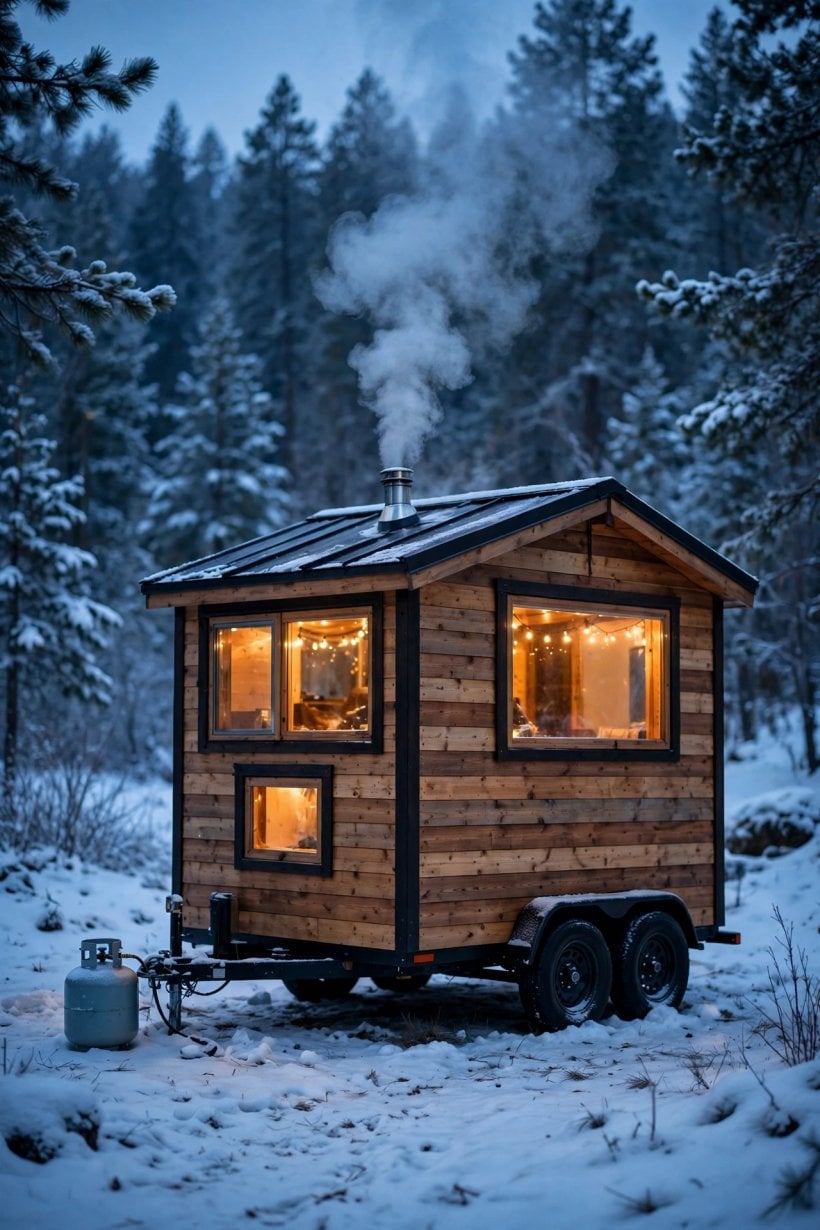
The direct vent wall heater, the Dickinson pattern, changes the physics instead of refining them: a compact 12,000 BTU radiant unit with a tiny fan, drawing almost nothing and heating people and surfaces directly rather than warming air that then has to be pushed somewhere. The diesel heater, included for comparison, burns diesel in an 18,000 BTU parking-heater format — efficient and moderate in both draw and noise, with a ticking fuel pump as its signature sound. Builders weighing heat sources outside this family entirely should also run the numbers on a wood stove and its clearance requirements and on in-floor systems with a radiant floor heating power analyzer, because the right answer depends on the house, not the catalogue.
4. Noise: The Jet Engine Effect
The original guide names the problem with unusual honesty: the Jet Engine Effect. A standard RV furnace uses a high-speed blower to force air through small ducts, and the result is a noise level of 70–75 dB — comparable, in the guide’s words, to running a vacuum cleaner next to your bed. In a full-size house the furnace hides in a basement or a closet. In a tiny house or RV it sits under a bench or a bed, inside the same small room where you are trying to sleep, and there is no door to close between you and it.
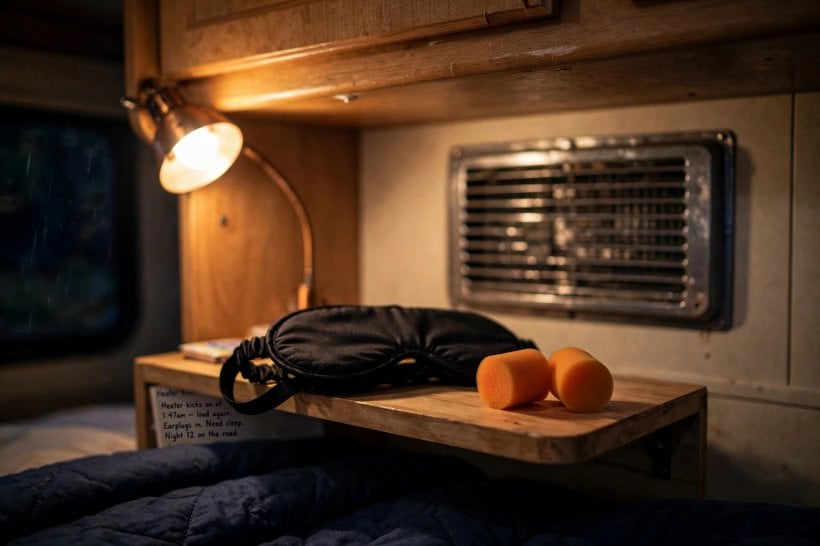
Worse than the volume is the pattern. A steady sound fades into the background of sleep; a cycling sound does not. The furnace roars up, runs, dies away, and roars up again, and each transition is a small alarm your brain checks against the quiet. That is why the tool visualises the decibel level alongside a sleep indicator — and why its introduction jokes, only half-joking, that you might need earplugs to sleep. Against that 75 dB benchmark, the comparison is stark: 60 dB for the high-efficiency furnace, 50 dB for the diesel unit with its ticking pump, and just 35 dB for the direct vent wall heater, the closest thing to silence a combustion heater offers.
5. Battery Drain: The Amp Hog Problem
Here is the cost almost nobody budgets for. Propane contains the heat energy, but the 12V blower fan that delivers it requires huge amounts of electricity — 7–10 amps, in the guide’s figures, with the simulator modelling the standard furnace at 8.0 amps of continuous draw while it runs. A heater that burns no electricity in its flame can still be the largest single load on your battery bank, larger than lights, water pump and device charging combined, simply because it runs for hours.
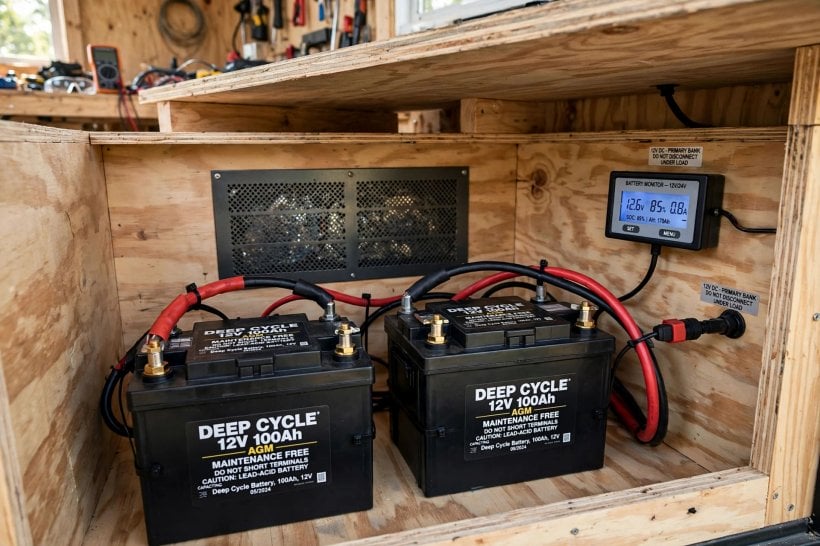
The guide’s warning deserves quoting in spirit: running a standard furnace for one cold night can completely drain a 100Ah lead-acid battery, leaving you with dead lights in the morning — in the cold, in the dark, in the house the furnace was supposed to protect. The simulator turns that warning into your own arithmetic with its Battery Runtime readout: feed in your bank size (the tool starts at 200 Ah) and it shows how many hours of blower your batteries can actually carry. The alternatives transform the equation — 3.5 amps for the high-efficiency furnace, 1.5 for the diesel, and 0.4 amps for the direct vent heater, a draw so small it nearly vanishes from the budget. If your bank is the constraint, size it with the same care using our guide to sizing an off-grid battery bank for a tiny home, counting the blower as a first-class load.
6. Propane Cost and the Duty Cycle
Fuel is the cost everyone expects, and the simulator prices it monthly — but the number that drives it is not the furnace’s size, it is the duty cycle: the share of each day the heater is actually running. The tool’s slider runs from 10% to 100%, anchored by two honest descriptions of winter. At one end sits a mild winter; at the other, freezing. Its default, 50%, means the furnace runs 12 hours out of every 24 — a figure that surprises people who picture their heater as an occasional appliance rather than a half-time worker.
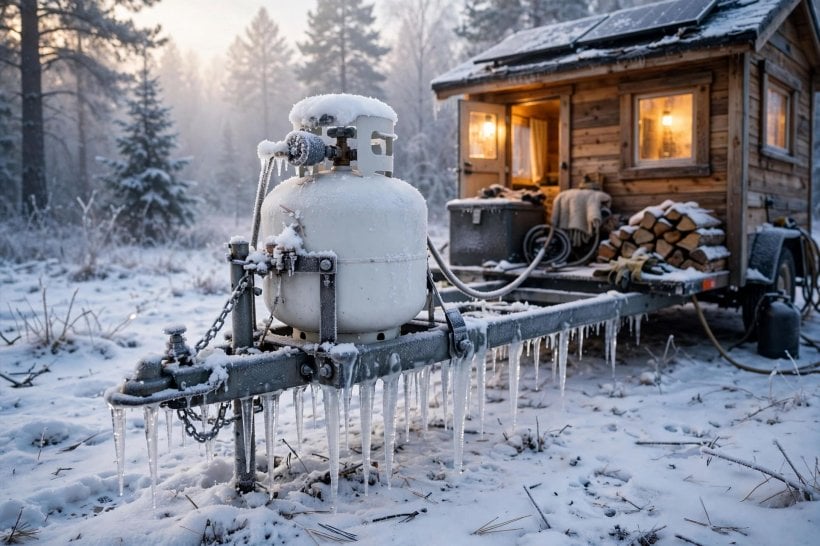
Set the slider where your climate really lives and the monthly propane cost follows from three inputs: how long the burner runs, how much fuel it burns while running (where the efficiency figures from the table bite — a 75%-efficient furnace needs more gallons to deliver the same heat as a 95%-efficient one), and what you pay per gallon, with the tool starting at $3.50. Anything that shortens run time cuts the bill at the source, which is why cold air washing under an unskirted trailer matters so much: working through tiny house skirting for winter is, indirectly, a propane-saving measure, because a warmer underfloor means a furnace that cycles less.
7. Ducting: Small Ducts, Big Consequences
The ductwork is the standard furnace’s quiet accomplice in both its noise and its losses. To move enough air through the small ducts an RV can hide, the blower has to spin fast — velocity is what makes the roar, and it is designed in, not a defect of one brand. Lengthen or kink the runs and the blower works harder still. The same runs carry heat through the coldest part of the structure, the underfloor and wall cavities, shedding warmth into spaces you never meant to heat before the rest arrives at the register.
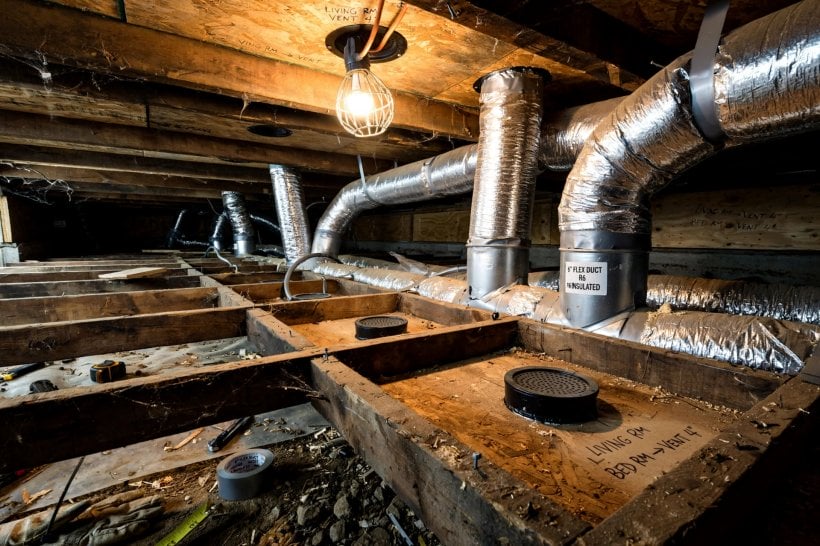
This is the structural reason the alternatives sound and perform so differently. The direct vent wall heater has no ducts at all: nothing to roar through, nothing to leak heat along the way, just a tiny fan and a radiant surface. It is also why the floor build-up around the ducts matters — the choices in our floor insulation calculator for tiny houses decide how much of the heat travelling under your feet is lost before it ever reaches a register. When you compare heaters, compare the whole delivery system: burner, blower and ducts together, against a panel that simply glows.
8. Efficiency: What the AFUE Numbers Really Buy
Efficiency is the quietest of the three currencies, and the simulator states it plainly for each heater: 75% for the standard furnace, 95% for the high-efficiency unit, 80% for the direct vent wall heater and 85% for the diesel. Read as fuel arithmetic, the gap is simple — for every unit of heat the room receives, the 75% furnace burns roughly a third more fuel than the 95% one. Over a mild month that difference is a nuisance; over a freezing season at a high duty cycle, it is whole extra tanks of propane, which is why efficiency and the duty cycle from Section 6 must always be read together.

Delivery complicates the headline numbers in one important way. A radiant wall heater rated at 80% sends its heat straight onto people, furniture and the floor, with no duct run skimming a share away first — so its felt efficiency in a tiny, single-room space is better than the percentage suggests. The forced-air furnace’s 75% is measured before the ducts take their cut. And in a tightly built tiny house, any combustion heater belongs in the same conversation as fresh air and moisture: pairing heating decisions with a tiny house HRV efficiency check keeps the warm air from quietly becoming stale, damp air.
9. Choosing Your Heater: Match It to How You Live
There is no best heater in the simulator — there is a best match between a heater and a life. Live plugged into shore power through mild winters, and the standard furnace’s sins shrink: its amp draw lands on the campground’s supply rather than your batteries, and its propane appetite stays modest at a low duty cycle. Live off-grid through freezing winters and the same machine becomes a nightly threat to a small battery bank, while the direct vent heater’s 0.4-amp draw and 35 dB murmur start to look less like compromises and more like the whole point.
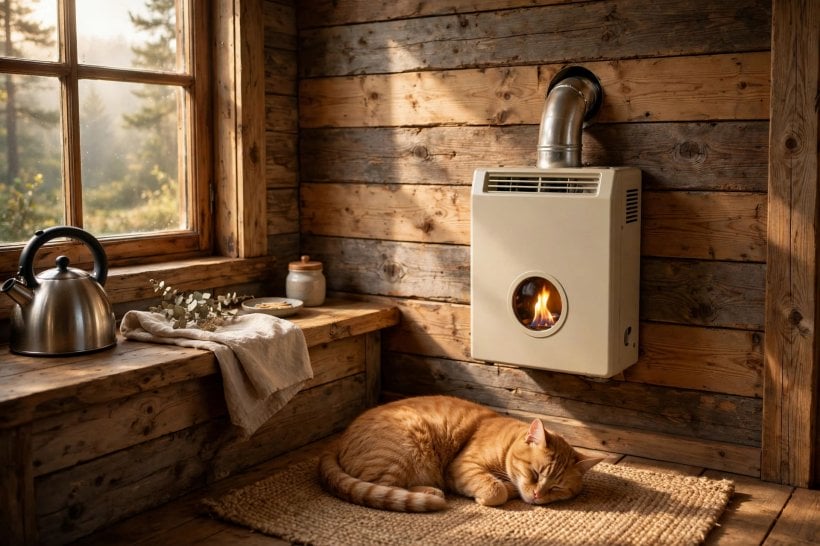
Sleep quality deserves a vote of its own. If the bed sits within a few feet of the heater — and in a tiny house it always does — weight the decibel column as heavily as the fuel column, because a heater you dread hearing at 3 a.m. will be run less, and a cold house is its own kind of failure. Whichever heater wins, it performs inside an envelope: the better the insulation strategy from our guide to insulating a tiny house with spray foam, rockwool or sheep’s wool, and the more completely you protect pipes and tanks with measures like those in the heat tape and pipe freeze simulator, the less any furnace has to run at all.
10. Using the Simulator — and the Mistakes It Catches
Working the RV furnace efficiency and noise simulator takes under a minute. Choose your heater type and read its plain-language description. Set the duty cycle slider honestly — mild winter or freezing, not the winter you wish for. Enter your real propane price and your real battery bank size, then press Run Simulation. The four readouts answer together: Noise Level in decibels, Battery Drain as amps of continuous draw, Propane Cost per month, and Battery Runtime in hours. Change one input at a time — swap only the heater, then only the duty cycle — and watch which of your assumptions was carrying the cost.
The mistakes it exists to catch are consistent. Judging a furnace by purchase price, when the tool’s own summary of the standard unit is cheap to buy, expensive to run. Forgetting the blower entirely and budgeting electricity as if the flame were the only cost. Setting a gentle duty cycle for a climate that will impose a savage one. Quoting noise figures without the cycling — it is the starting and stopping, as much as the 75 dB, that ruins sleep. And comparing heaters on output alone, when the 30,000 BTU incumbent is not obviously better than a 12,000 BTU radiant panel at heating the one small room you actually live in.
Final Considerations
A tiny house furnace is three purchases disguised as one: a noise level you will sleep beside, an electrical load your batteries must survive, and a fuel bill your winter will set. The standard forced-air furnace wins on price and familiarity and charges for both, nightly, in decibels and amp-hours. The high-efficiency furnace, the radiant wall heater and the diesel unit each buy back quiet and power at their own prices. Before you commit to any of them, scroll down to the RV Furnace Reality Check and run your own winter through it — your propane price, your battery bank, your coldest honest duty cycle — and let the readouts argue with your assumptions while arguing is still free.
RV Furnace Reality Check
RV Furnace Reality Check
Noise, Battery Drain, and Propane Cost Calculator.
Cheap to buy, expensive to run. Forced air blower.
The Hidden Costs of “Cheap” Heat
Standard RV furnaces use a high-speed blower to force air through small ducts. This creates a noise level of 70-75 dB, comparable to running a vacuum cleaner next to your bed. It cycles on and off all night, destroying sleep quality.
Propane contains the heat energy, but the 12V Blower Fan requires huge amounts of electricity (7-10 Amps) to push that heat. Running a standard furnace for one cold night can completely drain a 100Ah lead-acid battery, leaving you with dead lights in the morning.



1 Comment