

This tool helps tiny house owners understand why their headlights are pointing at the sky when they hook up their trailer. It visualizes “Rear Sag” (Squat) and demonstrates how upgrades like Airbags or Helper Springs restore level towing, steering control, and braking efficiency.
It includes a Headlight Aim Visualizer to show the real-world safety impact of a squatting truck.
Hook up a tiny house and many trucks answer the same way: the rear sinks, the nose rises, and the headlights go looking for the sky.
That squat is more than ugly. It steals steering feel and braking bite. The right towing suspension upgrade levels the truck again — and this guide shows how to choose it.
1. At a Glance: Airbags vs. Helper Springs in Brief
Every comparison in this guide starts from one simple fact: tongue weight presses down on the hitch, and the truck’s rear suspension carries that press. Leave the factory setup to cope on its own and the rear of the truck sags — the squat. Add the right support and the truck sits level again, with its steering and braking back where the manufacturer intended them. The simulator below lets you test three suspension setups against your truck class and tongue weight, paired with a headlight aim visualizer, so you can see what a squatting truck does to the road ahead — and to drivers coming the other way.
| Suspension option | Type | How it works in the tool | Watch out for |
|---|---|---|---|
| Stock Suspension (Factory) | Factory baseline | No added support — this is the setup that shows the squat | Rear sag under tongue weight, and headlights aimed high |
| Helper Springs (Timbren/Sumo) | Passive | Replace your bump stops and engage only when loaded — “set and forget” | Not adjustable, and can cause a harsher ride on big bumps |
| Airbags (Adjustable) | Active | Fully adjustable — pump them up to level a heavy tiny house, then deflate them for a smooth ride when empty | More expensive, more parts to fail (leaks), and requires maintenance |
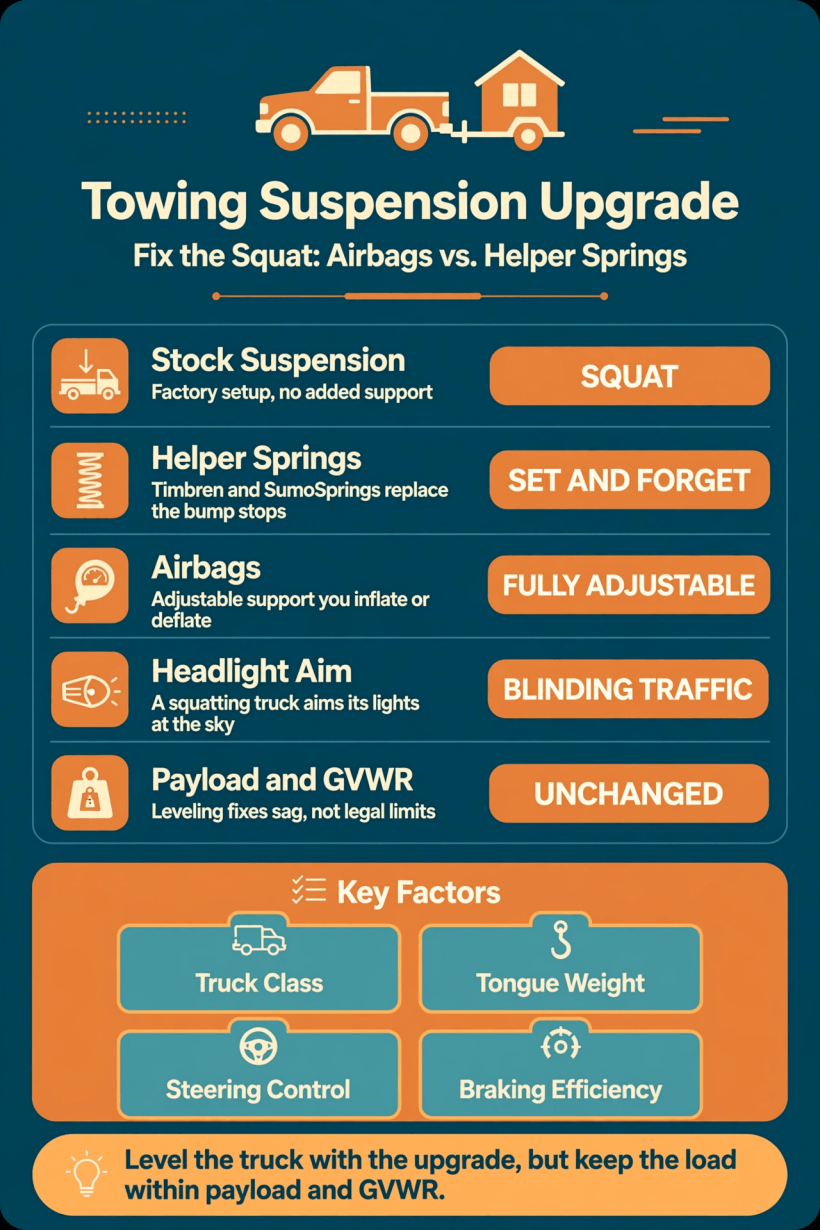
The two fixes at a glance: helper springs engage only when loaded, airbags adjust to whatever you ask of them — and neither one changes your payload or GVWR.
Read the table as two philosophies rather than a winner and a loser. The passive option asks nothing of you after fitting day; the active option hands you control and asks for a little care in return. The sections below walk through the problem, both fixes, and the one limit neither of them can move.
2. What Rear Sag Really Is, and What Causes It
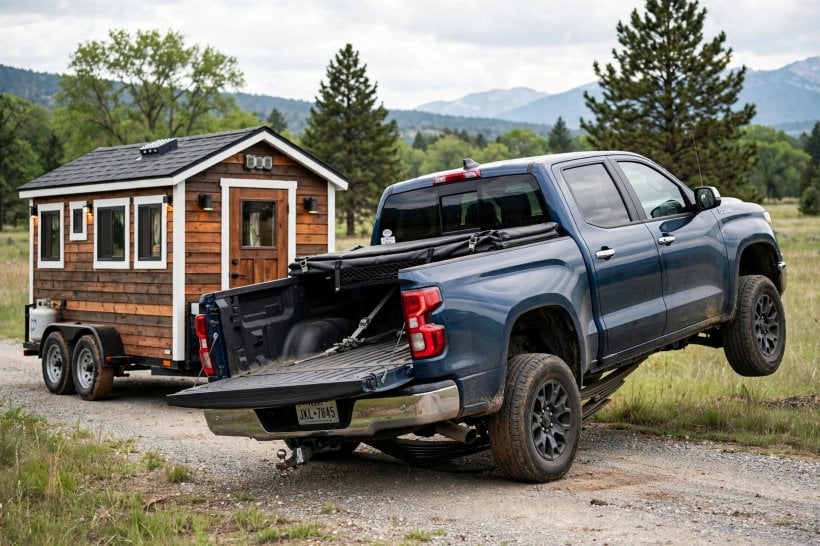
Rear sag — the tool also calls it squat — is what happens when the weight pressing down on the hitch compresses the truck’s rear springs beyond the stance the truck was designed to hold. A trailer does not rest its whole weight on its own axles: a share of it rides on the coupler, straight down through the hitch into the rear of the tow vehicle. Our tiny house weight distribution diagram shows how that split between axles and hitch works, and why the same house can feel calm behind one truck and unsettled behind another.
As the rear springs compress, the truck’s whole geometry changes. The back sits lower, the nose rises, and weight effectively shifts away from the front axle — the axle that steers and does much of the braking. Nothing has broken. The truck is simply standing in a posture it was never aligned for, and every system that depends on that posture, from headlight aim to steering geometry, now works from a tilted starting point. You can spot it without instruments: the nose-up stance in the driveway, steering that feels lighter and vaguer than it does unhitched, headlights that lit the road when empty now lighting the treetops. All of it traces back to the same few inches of compressed spring.
3. Why a Squatting Truck Is a Safety Problem, Not a Cosmetic One
It is tempting to treat squat as an appearance issue — the rig just looks overloaded. The simulator’s Headlight Aim Visualizer corrects that idea. When the nose rises, the headlight beams rise with it, and the tool gives the result a blunt label: “Blinding Traffic!” Your lights stop illuminating your lane and start shining into the eyes of oncoming drivers, while the road you need to see goes darker. On a night tow, that is a genuine hazard in both directions.
The second problem is control. The tool’s whole premise is that the right support restores “level towing, steering control, and braking efficiency.” A front axle unloaded by sag has less grip to steer with, so the truck responds later and less precisely at exactly the moment a trailer is pushing it from behind. Braking suffers the same way: a truck standing nose-high cannot press its front brakes into the road as designed, and stopping distances grow.
None of this requires an extreme load. Sag is a matter of inches, and the effects begin with the first inch, not the fifth — which is why the fix is worth taking seriously even when the squat looks modest in the driveway. The road at night, in rain, with an oncoming driver dazzled by your lights, is where those inches collect their payment.
4. Start With Your Truck Class and Your Real Tongue Weight
The simulator asks for two facts before it shows you anything, and getting them right matters more than the choice between products. The first is your truck class. The tool offers three: a 1/2 Ton truck, in the F150/1500 class; a 3/4 Ton, in the F250/2500 class; and a 1 Ton, in the F350/3500 class. Heavier classes leave the factory with more capacity in reserve, so the same trailer usually squats them less — but no class is immune, because sag is about the match between load and springs, not about badges.
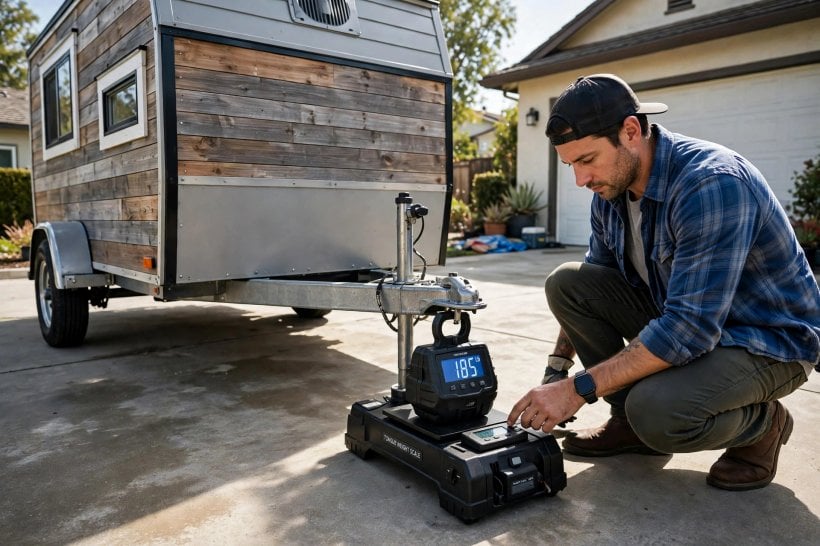
The second fact is tongue weight, which the tool defines plainly as the weight pressing down on the hitch. This is the number that actually compresses your rear springs, and it is routinely guessed wrong in both directions. If you do not know yours, measure it before you buy anything — our tongue weight tuner helps you understand what the figure means and how load placement changes it. The honest order is: know the load, know the truck, then choose the support. Our guide to calculating GVWR for tiny homes walks through how tongue weight counts against the truck as well as the trailer.
5. Stock Suspension: The Honest Baseline
Every simulator run begins with the factory setup, and that is deliberate. Stock suspension is not a failure — it is a compromise tuned for a truck that spends most of its life running empty or lightly loaded, riding comfortably, and only occasionally towing near its limits. For a small trailer on a big truck, the factory setup may be all you ever need, and the simulator will tell you so.
The value of the stock run is that it gives you a measured starting point. The tool’s Check Sag result reports your rear squat directly — a level truck reads “Rear Squat 0″” and “Level” — so instead of arguing about whether your rig sags, you can see how much correction you are shopping for. A small squat calls for a different answer than a dramatic one, and plenty of owners discover their problem is smaller, or larger, than it felt from the driver’s seat.
Run the stock setting first, with your real truck class and tongue weight, and sit with the result. It is the baseline every upgrade has to beat, and it protects you from two classic mistakes: buying support you did not need, and buying too little for the sag you actually have.
6. Helper Springs: The Passive Fix That Engages Only When Loaded
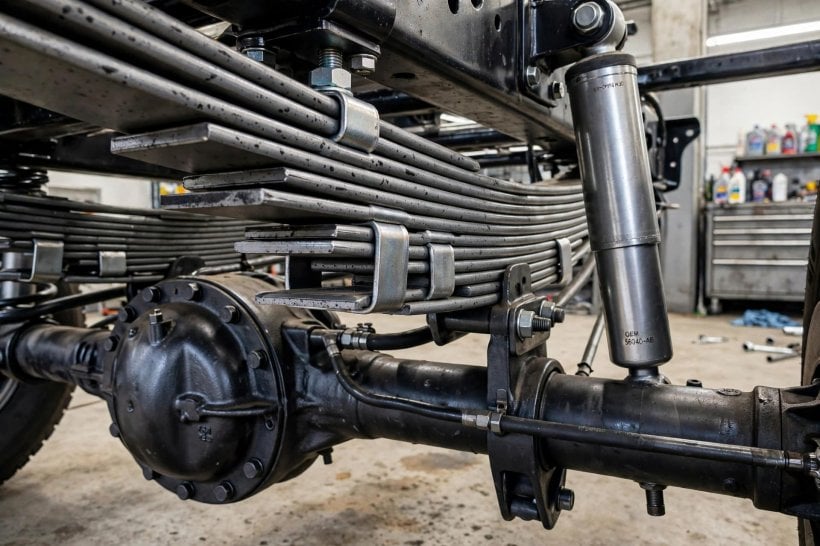
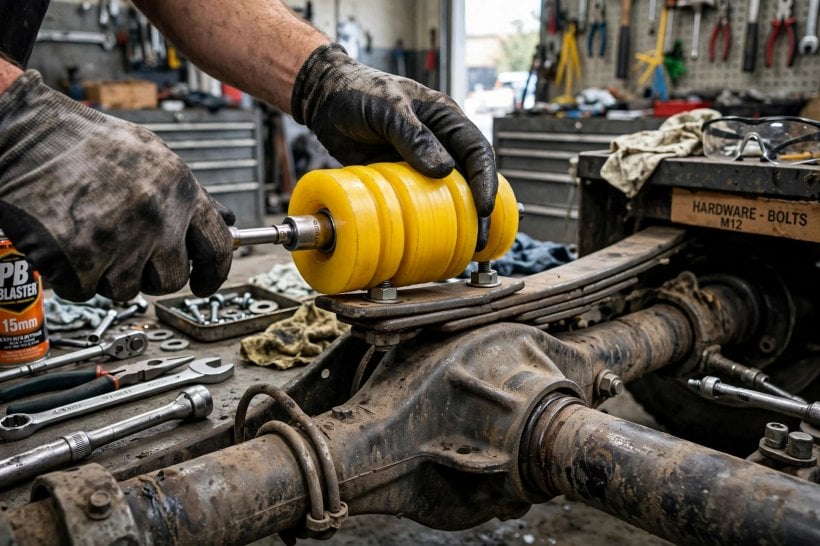
Helper springs are the passive answer to sag, and the tool describes the well-known versions — Timbrens and SumoSprings — with a phrase owners love: “set and forget.” They replace your bump stops, the rubber blocks that normally only meet the axle at the end of suspension travel, with taller, progressive supports that begin helping much earlier. Crucially, in the tool’s words, “they engage only when loaded” — driving around empty, the truck rides on its factory springs, as it always did.
The appeal is durability and simplicity. The tool lists zero maintenance and calls them “impossible to pop,” because there is nothing to inflate, no air to leak, and no compressor or lines to fail on a cold morning three states from home. For an owner who tows the same house, at much the same weight, on a regular route, that passivity is a real virtue: fit them once, and the truck simply stops squatting.
The trade-offs are equally clear in the tool’s comparison. Helper springs are “not adjustable” — the support you fit is the support you get, whether the trailer is fully loaded for a move or half empty for a weekend. And because the helpers are in contact under load, they “can cause a harsher ride on big bumps.” Neither is a flaw so much as the price of having nothing to operate.
7. Airbags: Full Adjustability, With Moving Parts
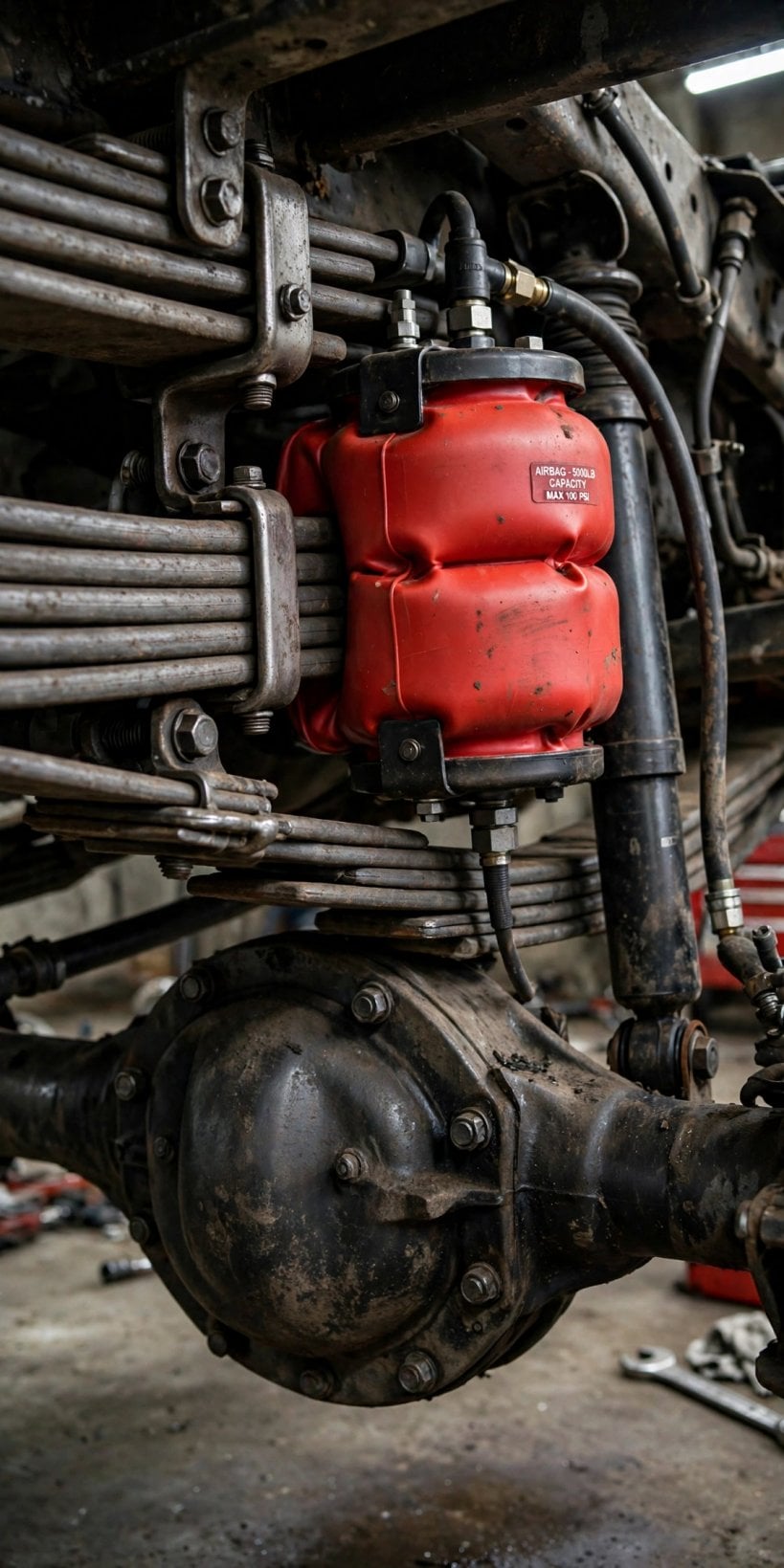
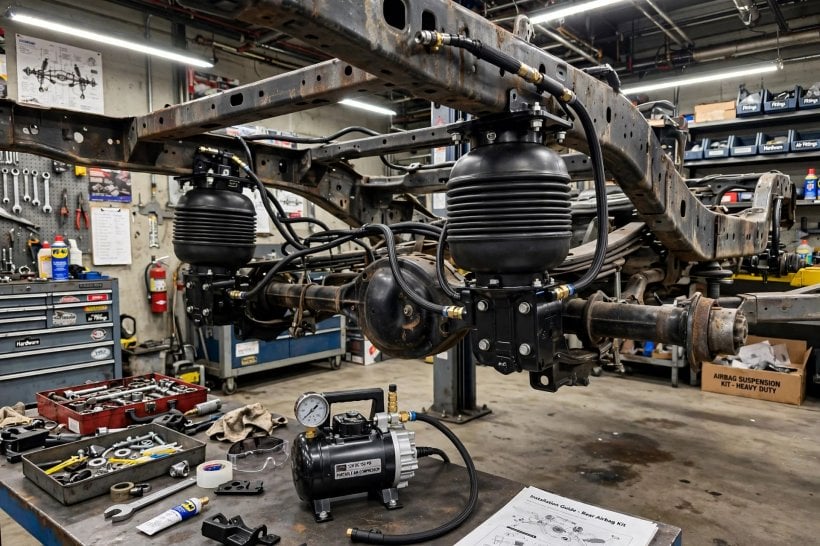
Airbags are the active answer. Where helper springs offer one fixed level of support, an airbag setup lets you dial in the support the day demands. The tool’s summary is direct: airbags are “fully adjustable — you can pump them up to perfectly level a heavy tiny house, then deflate them for a smooth ride when empty.” That second half matters as much as the first: an airbag truck simply lets the air back out and returns to stock manners when unhitched.
That adjustability suits owners whose towing varies. If the same truck moves the tiny house one month, hauls a loaded bed the next, and runs empty in between, airbags follow the load instead of forcing the load to follow them. They also let you fine-tune: a little more pressure for a trip with full water tanks, a little less when travelling light, always chasing the level stance the simulator measures.
The tool is equally direct about the costs. Airbags are “more expensive” than the passive option, they bring “more parts to fail (leaks),” and the setup “requires maintenance.” Rubber bellows, air lines, fittings and a compressor can all age, chafe or leak, and they ask for occasional checks rather than permanent forgetting. You are trading simplicity for control — a fair trade, made with your eyes open.
8. Airbags vs. Helper Springs: Choosing Between Active and Passive
With both fixes understood, the choice usually makes itself once you describe your towing honestly. Ask first whether your load changes. A tiny house that moves a few times a year, at a consistent weight, behind a truck that otherwise lives unloaded, is the passive option’s home ground: the helpers wake up when the house is on, sleep when it is off, and never ask for a gauge or a compressor. Owners who tow varied loads, or who are particular about a level stance in every condition, get more from the active option’s adjustability.
Ask second how you feel about maintenance. The owner who never checks anything will eventually meet an airbag leak at a bad moment, while the owner who enjoys dialling in a setup may find a fixed helper spring frustratingly approximate. Match the product to the person, not just to the truck. And remember both options address the same measured thing — rear squat, and the level stance that fixes headlight aim, steering and braking. Mild sag usually calls for the simpler system; widely swinging loads earn adjustability its complexity.

9. The Limit No Upgrade Can Move: Payload and GVWR
Every honest discussion of suspension support has to end at the warning the tool prints in bold: “Suspension upgrades fix sag (leveling), but they do NOT increase your truck’s legal Payload Capacity or GVWR.” A level truck can look legal while being overloaded, and that illusion is the most dangerous thing in this whole topic. The upgrades restore stance and control; they do not re-rate a single component, and the numbers on your door sticker do not care how flat the truck sits.
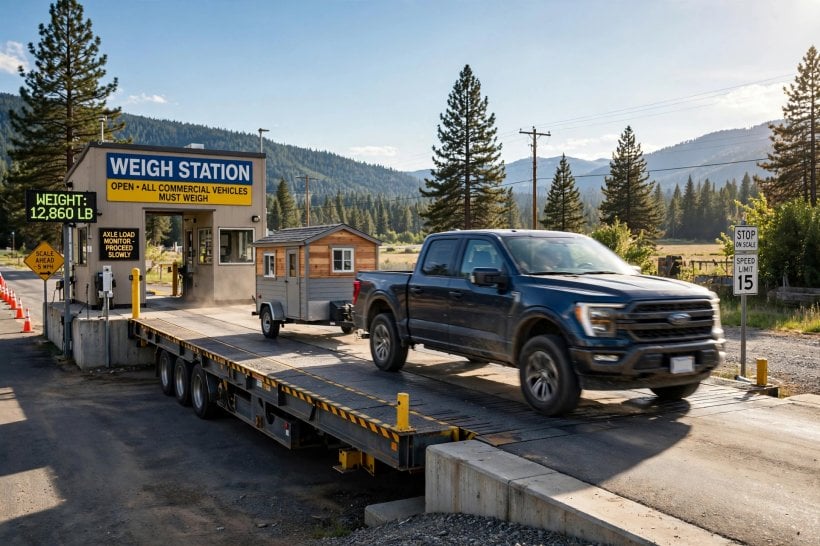
This is why the measuring in Section 4 matters so much. Tongue weight counts against the truck’s payload along with passengers, gear and everything in the bed, and the only way to know the real totals is to weigh the rig as it actually travels — our CAT scale weighing guide and simulator shows how to do that properly. If the numbers are over, the fix is a lighter load, a different balance, or a bigger truck — never a stiffer spring.
Treat the suspension decision and the capacity decision as separate questions with separate evidence. Capacity is answered by scales and stickers — and if you are still choosing a trailer, our axle comparison tool covers the running-gear side of that match. Leveling is answered by the simulator below. Owners who keep the two separate end up with rigs that are both level and legal; owners who merge them often get only the appearance of safety.
10. Using the Simulator Before You Spend Anything
The tool below exists so the decision costs you nothing to rehearse. Run your own towing suspension upgrade comparison before any money changes hands: select your truck class, enter your tongue weight in pounds, and leave the suspension mod on Stock Suspension (Factory) for the first run. Press Check Sag and read the verdict — your rear squat figure, whether the truck sits level, and what your headlights are doing to traffic.
Then run the same numbers twice more, once with Helper Springs (Timbren/Sumo) and once with Airbags (Adjustable), and watch the squat respond. The comparison panel under the tool lays the two systems side by side — active against passive, adjustable against set-and-forget. Pay special attention to the Headlight Aim Visualizer: it converts inches of sag into a picture of what oncoming drivers see, the most persuasive argument in the whole exercise.
When you are ready to act on the result, the wider picture lives in our guide to towing a tiny house, trucks and hitch weights, and our tiny house moving guide and transport cost breakdown covers what a properly set-up move looks like end to end. Measure, simulate, then buy — in that order, the upgrade you choose will be the one your rig actually needed.
Final Considerations
Rear sag is a small measurement with an outsized reach: a few inches of compressed spring decide where your headlights point, how precisely your truck steers, and how confidently it stops. Helper springs answer that problem passively, engaging only when loaded and asking for nothing in return. Airbags answer it actively, trading a little cost and maintenance for complete adjustability. Both are legitimate; the right one is the one that matches your truck class, your real tongue weight and your own habits.
Just keep the tool’s warning taped to the decision: leveling is not capacity. Get the rig level, keep it inside payload and GVWR, and the tiny house behind you becomes what it should be — a level, calm, well-lit tow.
Suspension Upgrade Simulator
Suspension Upgrade Simulator
Fix the “Squat”: Airbags vs. Helper Springs.
1. Truck Configuration
Weight pressing down on the hitch.
Performance Impact
Airbags vs. Helper Springs
Pros: Fully adjustable. You can pump them up to perfectly level a heavy tiny house, then deflate them for a smooth ride when empty.
Cons: More expensive, more parts to fail (leaks), requires maintenance.
Pros: “Set and forget.” Timbrens or SumoSprings replace your bump stops. They engage only when loaded. Zero maintenance, impossible to pop.
Cons: Not adjustable. Can cause a harsher ride on big bumps.




0 Comments