

Guessing your tiny house weight is easy. Knowing it is different — and the difference rides on every mile you tow.
This guide walks you through CAT scale weighing from prep to ticket, so your first certified weigh feels routine, not intimidating, and every number on the slip has a job. You will prep once, position once, and read the result with confidence.
1. At a Glance: Four Steps to a Certified Ticket
Begin with the shape of the visit, not with the numbers. A certified weigh is a short, orderly sequence: you arrive loaded the way you actually travel, place each axle group on its own section of the platform, hold still while the reading is taken, and leave with a printed ticket that records it all. Nothing in it is rushed or requires special skill — only preparation and patience.
| Step | What you do | What it produces |
|---|---|---|
| Prep | Arrive with full fuel and the house loaded as if you were traveling | A realistic travel weight, not a stripped-down best case |
| Approach | Drive onto the platform slowly and stop with each axle group on its own pad | Steer, drive and trailer readings kept separate |
| Weigh | Hold still on the pads while the operator takes the reading | A certified weight for each axle group and for the total |
| Ticket | Collect the printed ticket and keep it with the rig’s records | A dated, certified record you can check your limits against |
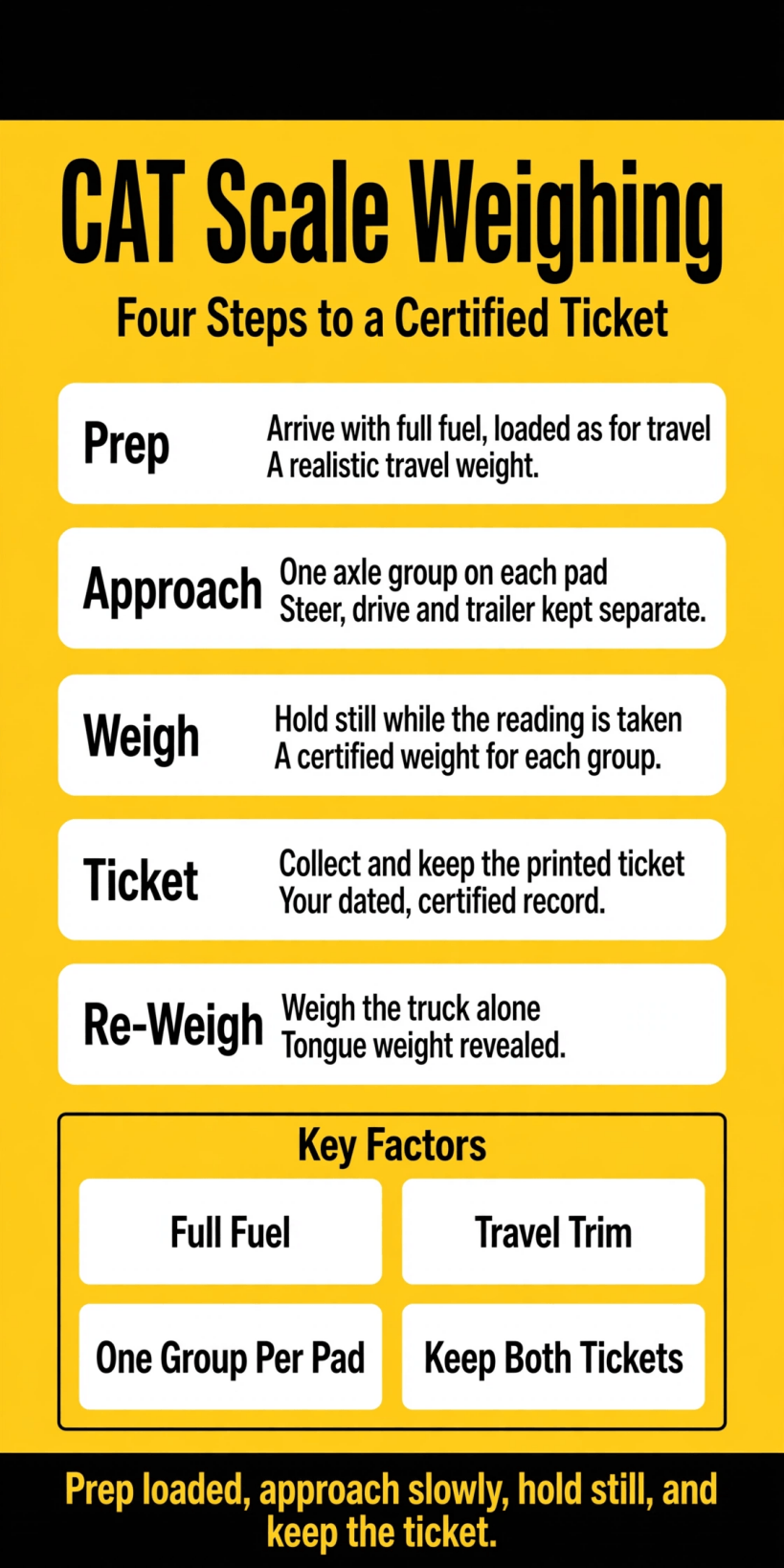
The four steps at a glance: prep loaded, approach slowly, hold still for the reading, and keep the ticket as your record.
Each step protects the next. Good prep makes the approach honest, a careful approach makes the reading clean, and a clean reading makes the ticket worth keeping. The sections that follow take the visit in order, ending with the second, shorter visit that unlocks the one number the first ticket cannot show directly.
2. Why a Certified Ticket Matters
An estimate is a feeling with numbers attached. You can add up materials, appliances and furnishings on a spreadsheet, and the total will still miss the fasteners, the adhesive, the half-finished box of fittings and the water sitting in the lines. Done well, CAT scale weighing replaces that guesswork with a measured fact: this rig, loaded this way, weighs this much on this axle and that much on that one. That fact is the foundation every other towing decision stands on.
The ticket matters because so many limits are written against it. Your truck, your hitch, your trailer axles and your tyres all carry rated limits, and none of them can be checked honestly against an estimate. Our guide to calculating GVWR for tiny homes shows how those ratings fit together — but the ratings are only half the equation. The scale supplies the other half: what your build actually weighs, axle by axle, in travel trim.
There is a quieter benefit, too. A dated, certified ticket is a record: it documents the rig honestly if you sell it or hand it to a mover, and it turns vague unease before a long tow into a short checklist you have already answered. Guessing is free. Knowing is cheap, quick and permanent.
3. Three Pads, Three Answers: Steer, Drive and Trailer
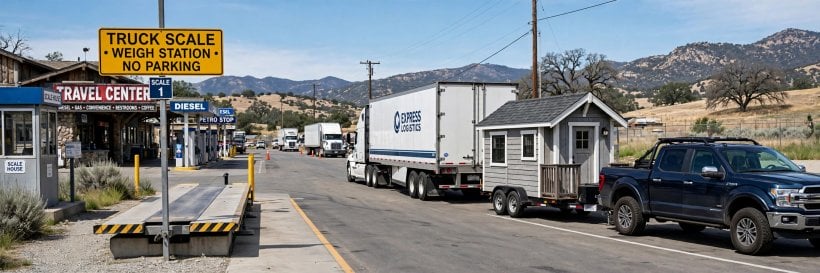
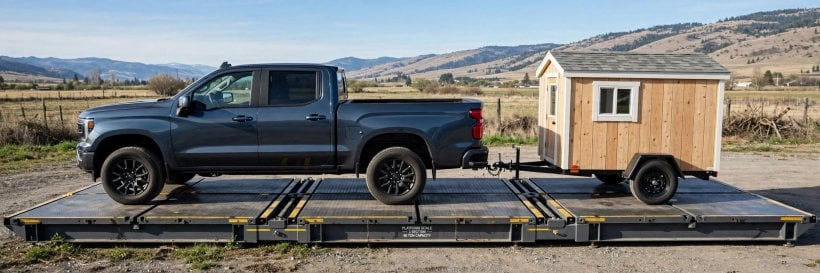
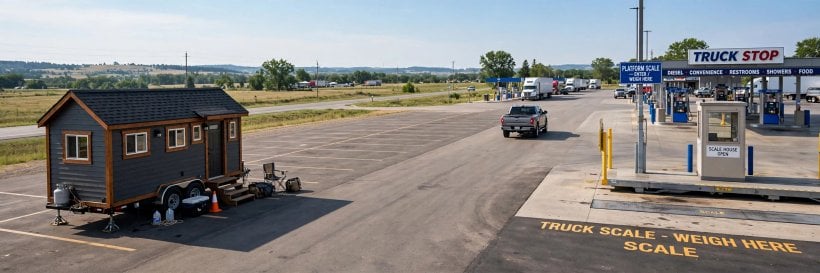
A platform scale for trucks is not one scale but a row of connected pads, and that division is the whole point. When you position correctly, the front axle of your truck rests on the first pad, the steer axle. The truck’s rear axle rests on the second pad, the drive axle. The trailer’s axles rest on the third pad, the trailer pad. Each pad reports its own reading, so a single stop produces three separate answers instead of one blurred total.
That separation makes the ticket diagnostic rather than merely informative. A total alone can hide a serious imbalance: the rig can sit under its combined limit while one axle group carries far more than its share. Three readings expose the distribution — trailer heavy and steer light means the load sits too far back; a startling drive share means the tongue is pressing hard. Our tiny house weight distribution diagram maps how those readings relate to weight placed along the frame.
Hold that three-part picture in mind for everything that follows. Prep decides what the pads measure; positioning decides whether they measure it cleanly; the ticket is simply those three answers written down and certified.
4. Preparing the Rig: Arrive Loaded as You Travel
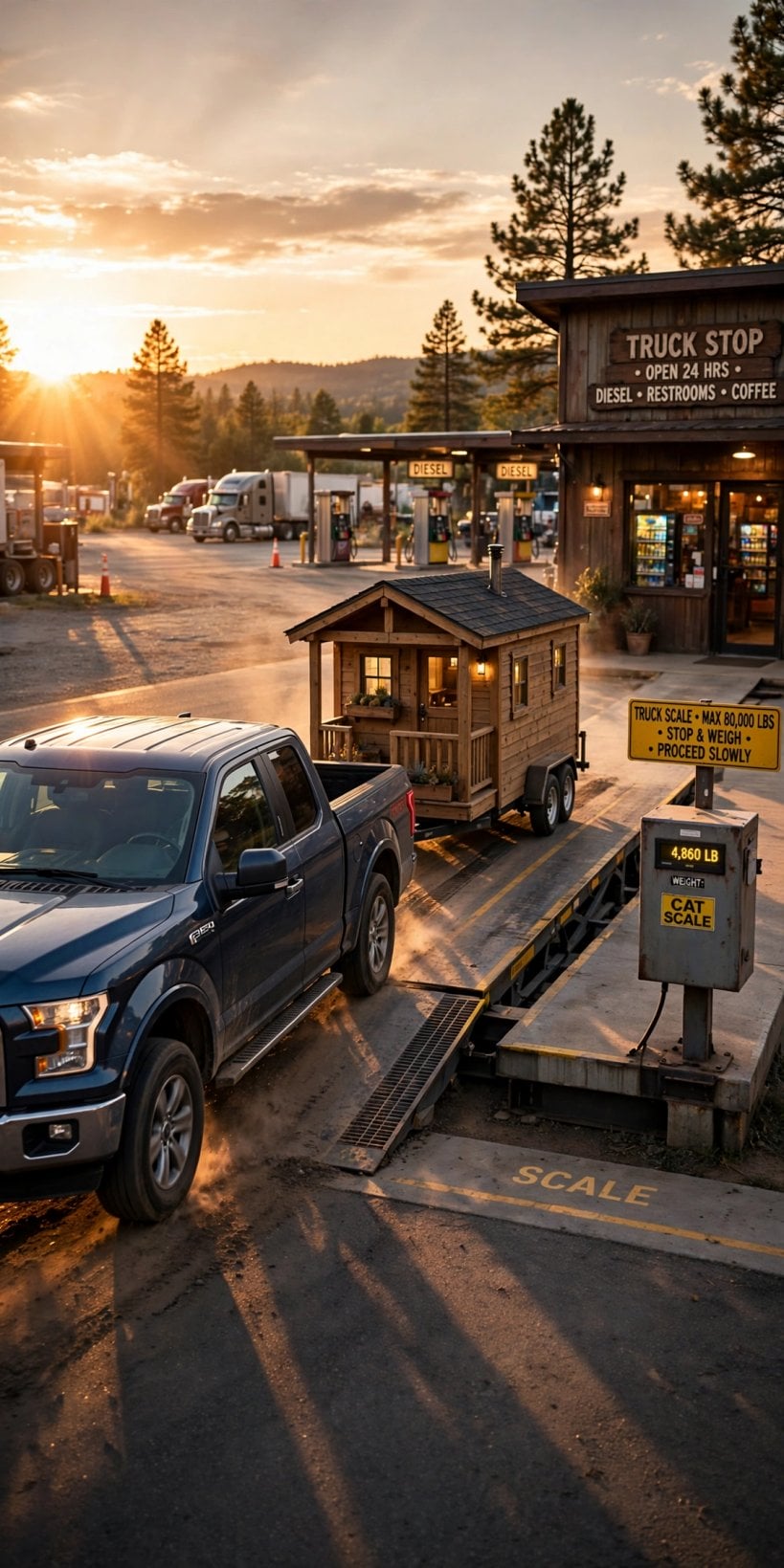
The simulator’s prep instruction is short enough to memorise: arrive with full fuel and the house loaded as if you were traveling. Both halves matter. Fuel is weight, and it sits on the truck’s own axles, so a truck weighed with a nearly empty tank will read lighter than the same truck at the start of a real trip. Fill the tank before the weigh, not after it, and the ticket will describe the rig you actually drive away in.
The house deserves the same honesty. Load it in travel trim: water where you normally carry it, food in the fridge, bedding on the bed, tools, hoses, cords and chocks in their travelling homes. A house weighed empty and tidy produces a beautiful ticket that describes a house nobody tows. If you are still choosing heavy finishes, remember that surfaces ride along on every trip — our flooring weight calculator shows how floor choices add up across a whole plan, and the comparison of steel vs wood framing weight explains why two identical-looking houses can arrive at the scale with very different totals.
Prep the cab, too. Passengers and pets change the truck’s readings, so decide who rides during the weigh and be consistent between visits. Finally, know where you will park afterwards, and where you can safely drop the house for the re-weigh. A calm visit is a prepared visit.

5. Positioning on the Pads: Approach, Align and Hold Still
Positioning is the one moment of technique in the whole process, and it rewards slowness. Approach the platform straight and slow, rolling on rather than turning onto it, so the rig settles in a straight line along the pads. Your goal is simple to state: one axle group per pad, with no wheel straddling the gap between pads and no part of the rig hanging off the platform. A wheel that bridges two pads splits its weight between them and quietly corrupts both readings.
Once placed, stop and check before signalling for the reading: front axle fully on the first pad, rear axle fully on the second, trailer axles fully on the third? Small corrections are easy now and impossible later. This is also where axle placement under the frame becomes visible in practice: where the axles sit decides how naturally the rig divides across the pads.
Then hold still. Stay in the cab as planned, keep the rig settled, and let the operator take the reading without rocking, braking or shifting weight around. Movement is noise, and the scale is listening for a steady answer. When the reading is taken, roll off as slowly as you rolled on, park clear of the platform so the next driver can use it, and walk in for your ticket. The hard part — which was never very hard — is done.
6. Reading the First Ticket, Line by Line
The ticket translates your stop into three lines and a total. The steer line is the weight carried by the truck’s front axle. The drive line is the weight on the truck’s rear axle — and this is the line to linger on, because it carries not only the truck’s own rear share but also the downward press of the trailer tongue through the hitch. The trailer line is the weight resting on the house’s own axles. The total is the three lines added together: the whole rig, as travelled, on that day.
Read the lines against each other before you read them against any limit. Does the trailer line carry a sensible share, or is the drive line doing suspiciously heavy work? Has the tongue levered weight off the steer line? You are looking for a distribution that makes mechanical sense — each group carrying its intended share. If a line surprises you, that surprise is information, not failure: it points at where weight sits in the build.
What the first ticket cannot do is just as important. Nowhere on it will you find tongue weight written as its own line. Because the tongue is attached to the truck, its weight is hidden inside the truck’s axle readings — folded into the steer and drive lines where no arithmetic on this ticket alone can isolate it. That hidden number is exactly why the process has a second act.

7. The Re-Weigh: Finding Tongue Weight the Honest Way
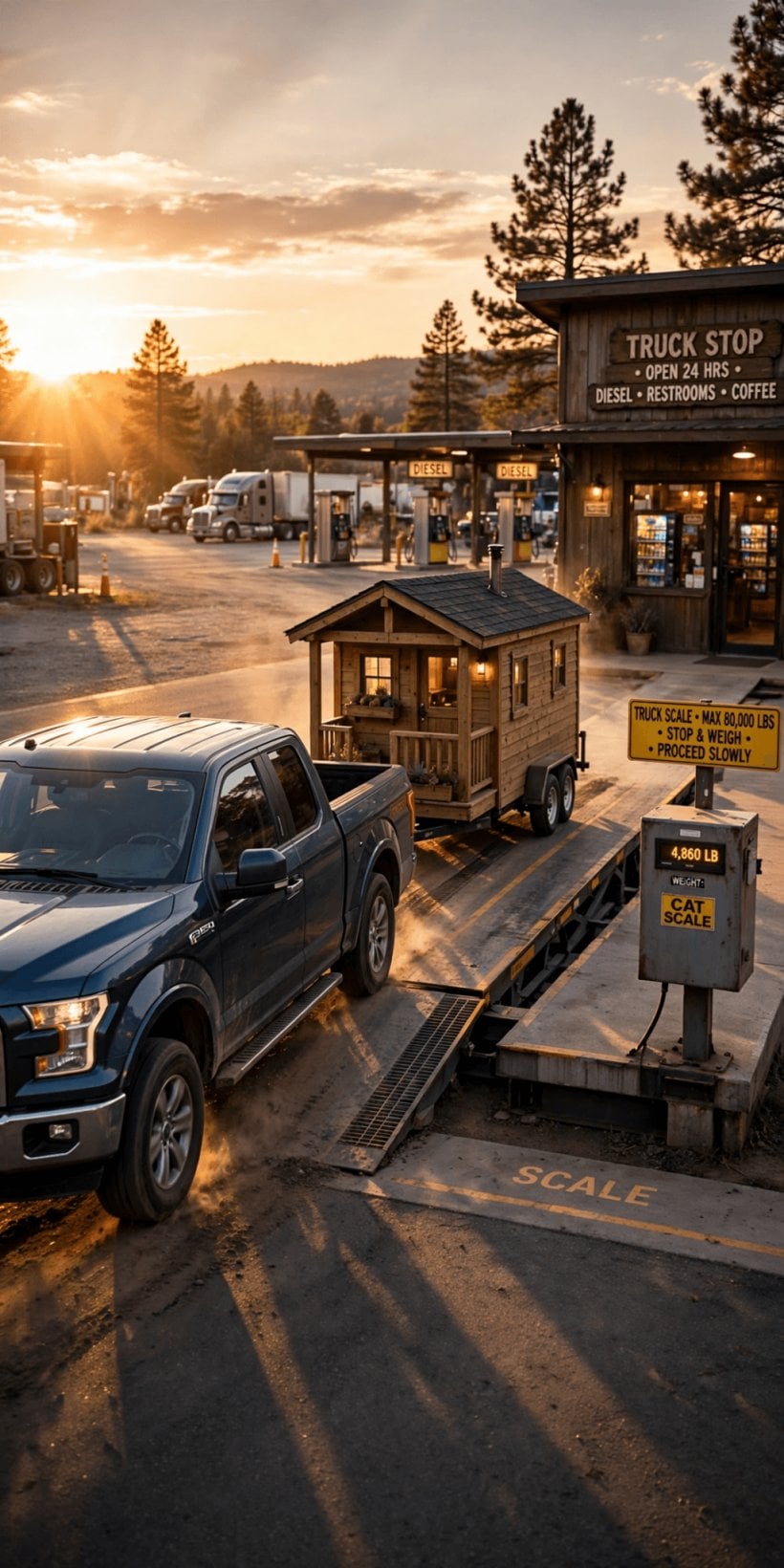
The re-weigh is the secret the simulator puts at the centre of the process, and it is elegantly simple. Step one: weigh the truck and house attached, exactly as you have just done, and keep that ticket. Step two: drop the house in the parking lot, drive back onto the scale, and weigh the truck alone. The difference between the two is the tongue weight. In the tool’s own formula: truck weight attached, minus truck weight alone, equals tongue weight. The hidden press of the tongue stops being hidden, because you have measured the truck both with it and without it.
Two habits keep the subtraction honest. First, change nothing else between the two weighs: same fuel, same passengers, same gear in the cab, same day if you can manage it. Every item you add or remove between tickets becomes a small lie inside the difference. Second, use the scale’s re-weigh option for the second pass — the simulator notes a small re-weigh fee of $2-4 for it, presented there as the money-saving route to the second ticket, rather than paying for two unrelated full weighs.
With a true tongue figure in hand, fine-tuning becomes possible instead of speculative. If the number needs adjusting, our tongue weight tuner models how moving heavy items along the house shifts it, and if the figure raises questions about the trailer setup itself, the axle comparison tool explores how different axle arrangements carry a heavy build. Measure first, then adjust: that order is the whole discipline.
8. What to Do With Each Number
A ticket filed in a drawer is trivia; a ticket checked against limits is a tool. Work through it line by line. Compare the steer and drive readings with the truck’s own axle ratings, and the trailer reading with the axles’ rating under the house. Compare the total with the combined rating of truck and trailer together. Our walkthrough of towing a tiny house: trucks, hitch and weights sets out how those ratings stack — the ticket tells you which side of each line your rig currently sits on.
Then let the numbers make decisions. A trailer line pressing its limit argues for moving heavy stores over the axles or carrying water differently on travel days. A drive line working hard while the steer line runs light is an argument about tongue load and hitch setup, not the house as a whole. Each reading has its own remedy — precisely why the pads separated them.
Keep the ticket with the rig’s papers, dated, with a note of how the house was loaded. That note turns one ticket into a baseline the next weigh can be compared against, like for like. Weight creeps — the ticket is how you catch it early, while the fix is still a rearrangement rather than a rebuild.
9. Common Mistakes at the Scale
Most bad tickets are made before the wheels touch the platform. The classic error is weighing a fantasy rig: empty water, no fuel, half the belongings still in the garage. The ticket is accurate and useless, because it certifies a house that will never be towed. Prep honestly, as described earlier, and the numbers describe your real life on the road.
The second family of errors happens on the pads. Straddling a gap between pads splits an axle’s weight across two readings. Stopping crooked leaves the trailer angled and its load shared unevenly. Rolling off before the reading settles, or shifting around in the cab while it is taken, adds noise to every line. All of these are cured by the same prescription: approach straight, place one group per pad, check, then hold still.
The third family happens afterwards. Losing the first ticket makes the re-weigh subtraction impossible. Changing the load between the two weighs poisons the tongue calculation. And the subtlest mistake of all: treating the first total as the whole story, and never learning the tongue weight that was hiding inside the truck’s lines all along. The simulator exists largely to break that habit — the first ticket is the beginning of the reading, not the end of it.
10. Weighing Again After Changes
A tiny house is never truly finished, and every change is a weight change. A new appliance, a tiled shower, a bookshelf that slowly fills, a battery bank that grows — each one moves the totals, and moves them unevenly along the frame. The habit that keeps the rig honest is simple: after any change you can feel when you lift it, weigh again. The second visit is faster than the first, because the routine is now yours.
Changes inside the house deserve particular respect, because placement matters as much as mass. A heavy item added behind the axles unloads the tongue; the same item added ahead of them loads it. Before a renovation, our appliance placement strategy calculator helps you think through where heavy pieces should live, so the post-renovation ticket confirms a plan instead of delivering a surprise.
Weigh, too, before the journeys that ask the most of the rig: a long relocation, a new tow vehicle, a mountain route. If a professional mover takes the house, the ticket becomes part of the handover — our tiny house moving and transport guide covers how documented weight shapes that process. Treat the scale as an instrument you consult whenever the rig changes.
Final Considerations
The whole discipline fits in one sentence: arrive loaded as you travel, place one axle group on each pad, keep both tickets, and let the subtraction tell you what the first ticket hides. The simulator below exists so that sequence can become familiar before you leave the driveway. Run through it until the four steps feel boring — prep, approach, weigh, ticket — then try the re-weigh and watch tongue weight appear out of two ordinary readings. When the real visit feels like a repeat of the rehearsal, you are ready.
CAT Scale Simulator
CAT Scale Simulator
Learn how to get certified weight tickets without the stress.
Ready?
Click ‘Start Simulation’ to begin.
Before you drive onto the scale, make sure your fuel tank is full and your house is loaded as if you were traveling.
The Secret: “The Re-Weigh”
The first weigh gives you the total weight, but it DOES NOT tell you the Tongue Weight directly. Because the tongue is attached to the truck, its weight is hidden in the truck’s axle readings.
Step 1: Weigh Truck + House attached.
Step 2: Drop the house in the parking lot. Weigh Truck ONLY.
Calculation: (Truck Weight Attached) – (Truck Weight Alone) = Tongue Weight.


0 Comments