

Two axles or three? That single choice decides how much your tiny house can weigh, how it turns into a tight driveway, and how it behaves at highway speed.
Choosing between double vs triple axle setups is not about more wheels looking stronger. It is about matching capacity, scrub and maintenance to the house you actually build. This guide, and the analyzer below, make that match clear.
1. At a Glance: Tandem and Triple Setups in Brief
Start with the whole picture, not with a wheel count. A tiny house trailer has to carry a finished home, move it safely, park it in real places and then sit still for months or years without quietly damaging its own tires and bearings. Tandem and triple configurations both do that job, but they trade the same things in opposite directions: capacity against agility, and highway calm against tight-turn kindness. The table below is the whole comparison on one screen, using the figures the analyzer itself presents.
| Factor | Double Axle (Tandem) | Triple Axle |
|---|---|---|
| Typical capacity | 10k–14k lbs | 18k–21k lbs |
| Tire scrub | Minimal | High |
| Maintenance cost | Low (4 tires) | High (6 tires) |
| Best for | Tiny homes under 28 ft; easy to pivot into tight spots | Heavy builds 30 ft and over; tracks straight on highways |
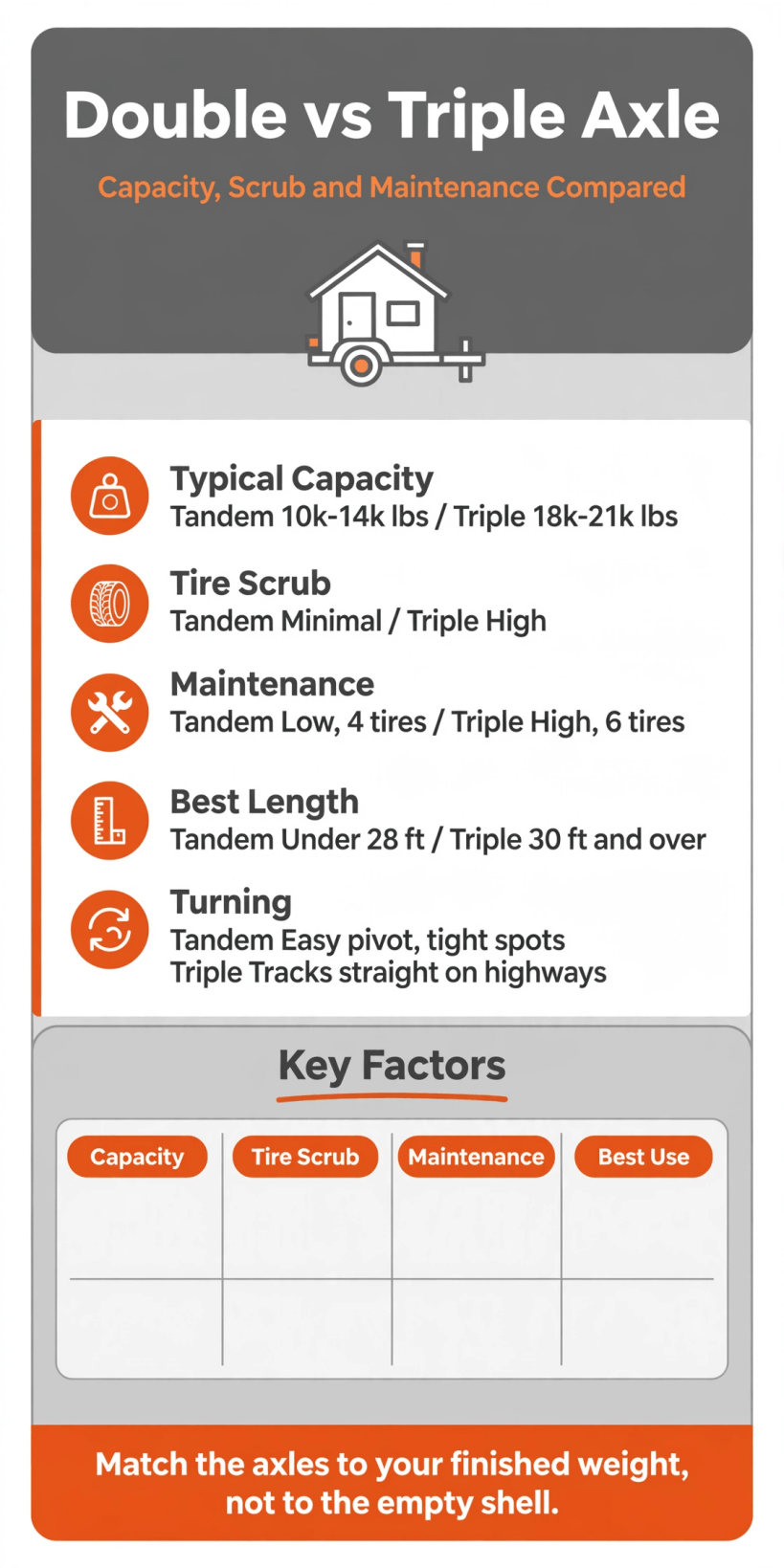
Tandem and triple setups at a glance: capacity, scrub, maintenance and best use, side by side.
Neither column wins outright. The tandem wins wherever weight is modest and space is tight. The triple wins wherever weight is genuinely high and the road is long and straight. Everything that follows explains why, so you can place your own build honestly in one column or the other before you order a trailer.
2. What an Axle Set Must Actually Carry
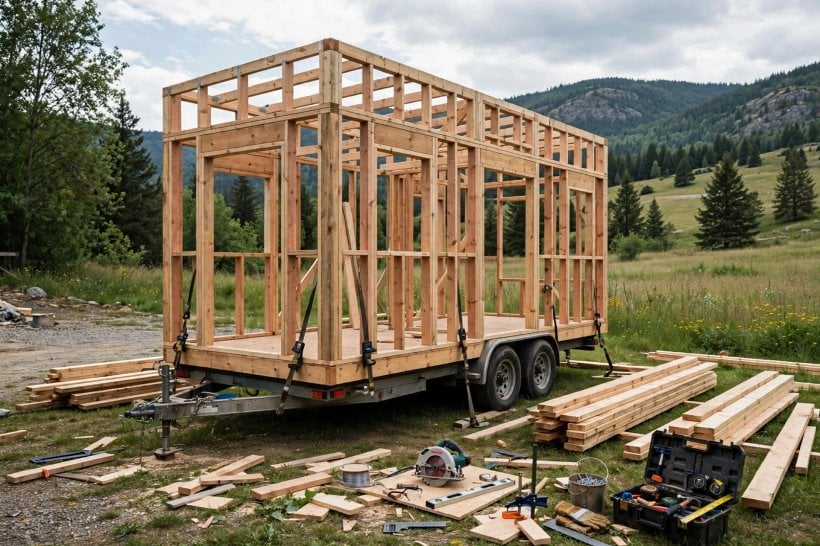
An axle set does not carry a house in the abstract. It carries everything the finished build becomes: the trailer frame itself, the floor system, walls and roof, insulation, cladding, windows and doors, cabinetry, appliances, plumbing, water, belongings and people. Much of that weight arrives late in a build, after the trailer has already been bought, which is why axle choice has to be made from a finished-weight estimate rather than from the weight of an empty shell on delivery day.
That estimate needs to be honest about materials. Framing choices, flooring and finishes all shift the total by meaningful amounts, and a careful steel versus wood framing weight comparison is a useful early check on what your structure will ask the axles to hold. Flooring alone can surprise builders, which is why estimating it separately with the flooring weight calculator before you choose a trailer keeps a pleasant material decision from becoming a capacity problem later.
Carrying is also about where weight sits, not only how much there is. A house within its total limit can still tow badly if its balance is poor. The axle set defines the centre around which the rest of the layout has to be arranged.
3. Capacity and Rating Headroom: When More Is Not Just More
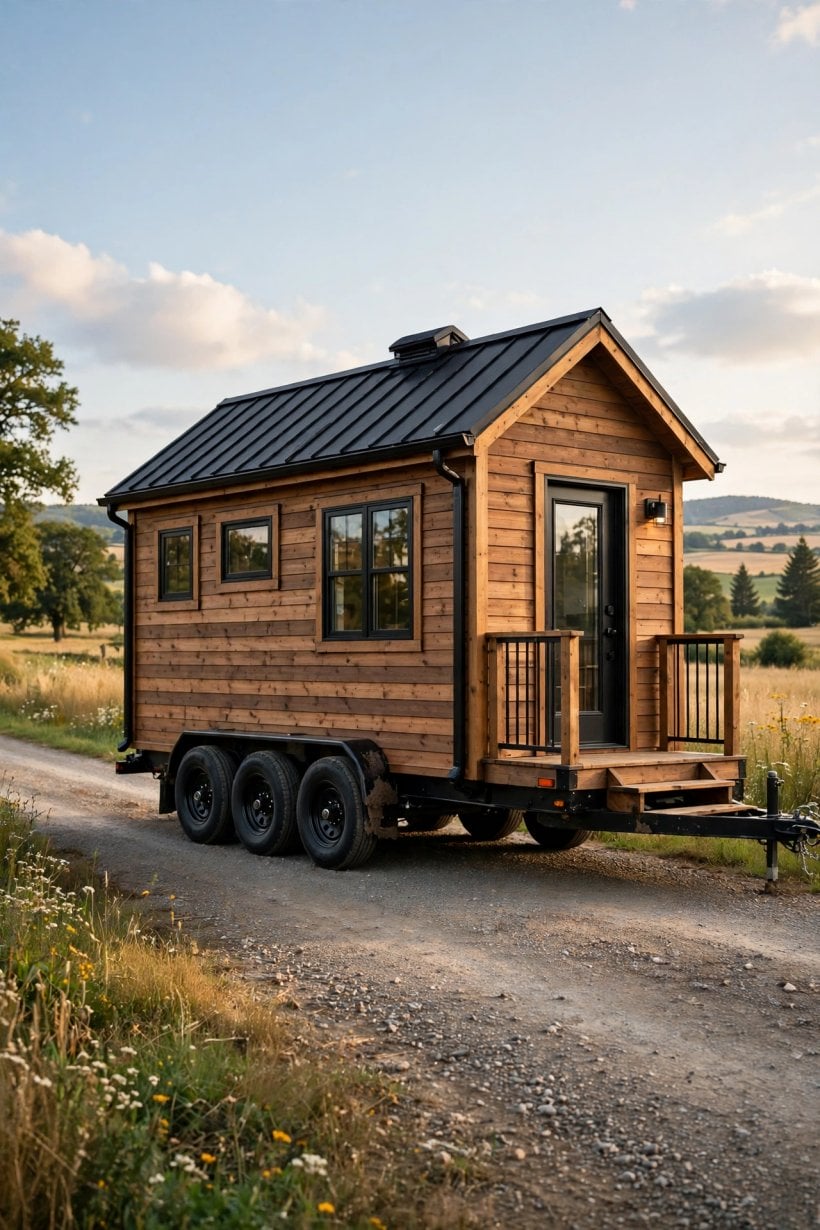
Capacity is the first filter, and the analyzer states it plainly. A tandem setup typically offers 10k–14k lbs, while a triple setup typically offers 18k–21k lbs. Those ranges are not targets to aim at. They are ceilings to stay comfortably below, because a house run right up against its limit leaves no room for the water tank you fill, the books you add, or the heavier finish you choose halfway through the build.
Headroom is the quiet part of good design. Builders who leave a sensible margin can adapt as the build evolves; builders who spend every pound on paper end up removing features, or worse, towing overweight. Working through calculating GVWR for tiny homes before the trailer order turns that margin from a guess into a number you can defend, and it tells you early whether a tandem range is genuinely enough or whether you are already in triple territory.
More capacity is not free, though. The triple range exists because some builds honestly need it: longer houses, heavier materials, larger water capacity and full residential appliances add up quickly. Choosing triple for capacity you will never use brings the scrub and maintenance costs described below without buying you anything in return. The right question is never which setup is stronger. It is which range holds your finished weight with room to spare, and no more than that.
4. Tire Scrub: Why Three Axles Fight a Turn
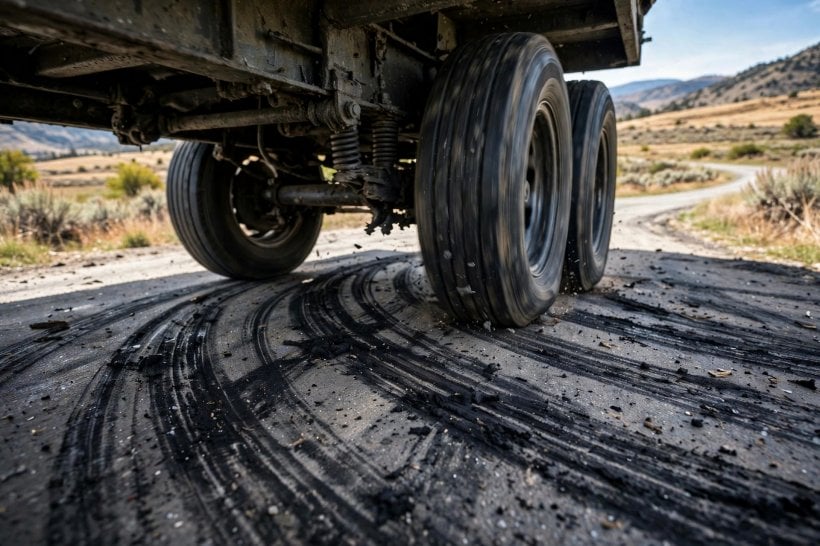
Tire scrub is the cost that surprises people most, because it is invisible when a trailer is parked and obvious only when it moves slowly through a turn. As the analyzer explains, trailers do not have differentials or steering axles. When you turn, the trailer pivots around the centre axle. The axles in front and behind are forced to drag sideways across the pavement instead of rolling cleanly through the curve.
On a tandem, that sideways drag is present but modest, and the tool rates scrub as minimal. On a triple, the longer wheelbase makes the effect severe. The front and rear tires are dragged harder in tight turns, and the analyzer warns that this can pop tires off rims or bend spindles if you turn too sharply on pavement. Scrub is not a defect in a particular trailer. It is geometry, and adding a third axle lengthens the geometry that causes it.
Scrub also wears. Tires dragged sideways lose tread unevenly and sidewalls work harder, every time the house is parked or repositioned. A house moved often will feel it as a recurring cost in rubber. Understanding tiny house weight distribution helps here too, because a well balanced load reduces how hard the tow vehicle has to force the trailer through those slow turns.
5. Tight Spots: Pivoting, Driveways and Real Parking
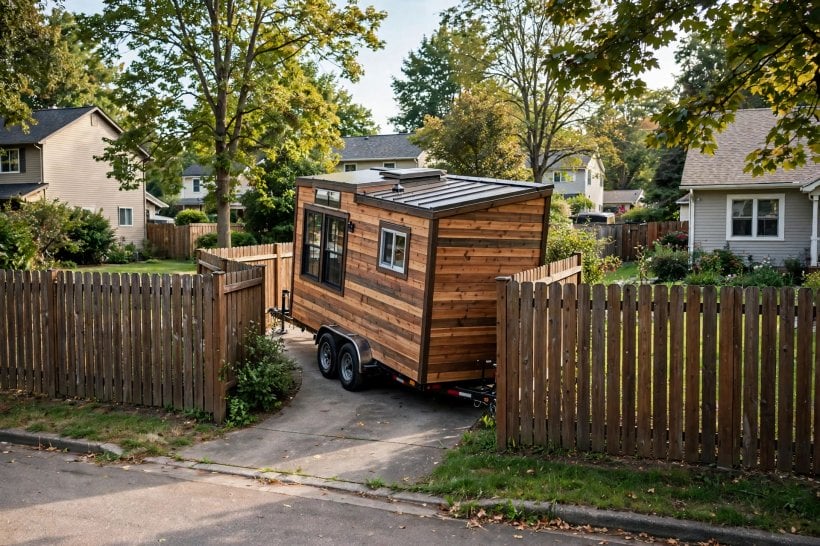
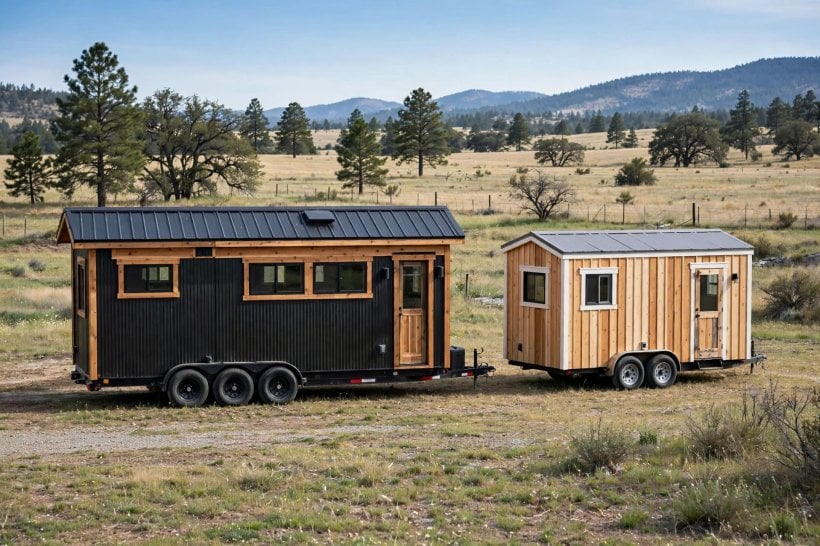
Most tiny houses do not live on highways. They live at the end of a driveway, in a side yard, on a smallholding, or in a park space reached by a narrow access track. Getting into that place is a slow-speed problem, and slow speed is where the tandem earns its reputation. The analyzer notes that a tandem is best for tiny homes under 28 ft and easy to pivot into tight spots, and that description matches how the geometry feels from the driver’s seat: shorter wheelbase, less sideways drag, and a trailer that answers small steering corrections instead of resisting them.
A triple in the same space fights you, in the analyzer’s own phrase, in parking lots. Every correction asks the outer tires to scrub and loads the spindles. Experienced triple owners learn to plan wide arcs, use loose surfaces where they can, and avoid full-lock turns on concrete altogether.
Think honestly about your destination before you choose. A house that will be placed once and left for years can tolerate a difficult arrival day. A house that will move between sites, seasons or rental pitches cannot. If your life involves frequent repositioning, the wider tiny house moving guide and transport costs are worth reading alongside this choice, because manoeuvrability affects every move, not just the first delivery.
6. On the Highway: Tracking, Stability and Long Miles
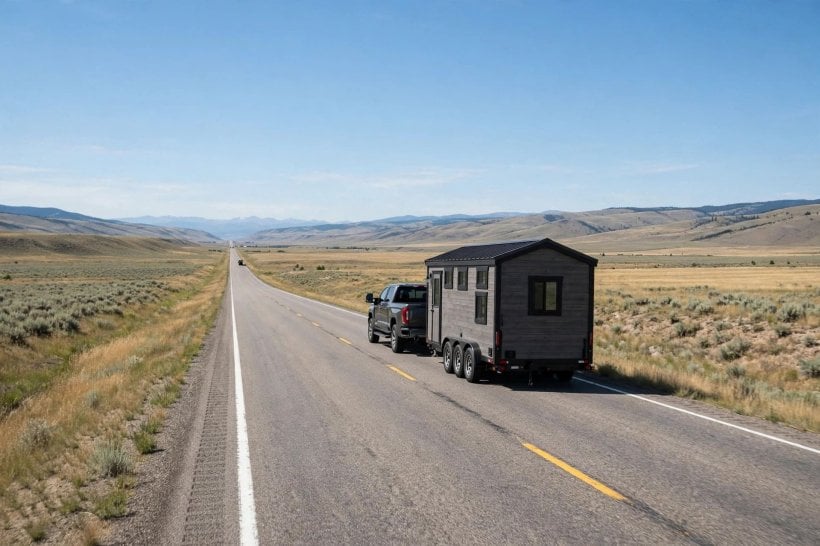
Turn the picture around and the triple’s weakness becomes its strength. The same long wheelbase that scrubs in a car park settles a heavy trailer on the open road. The analyzer notes that triple setups track straight on highways, and for a heavy build covering long distances that straight, planted tracking is a real safety and comfort benefit: fewer corrections, less sway tendency from a long load, and a trailer that feels composed behind the tow vehicle mile after mile.
A tandem tracks well too within its proper weight range, and for the under-28 ft houses it suits, highway behaviour is rarely the deciding factor. The difference appears when weight and length grow together. A long, heavy house on an undersized tandem is a poor highway companion however carefully it is loaded, because the axles are working near their ceiling for the whole journey.
Highway manners also depend on what is inside the house. Heavy appliances placed far from the axle centre create a pendulum effect that no axle count can fully tame, so plan placement with the appliance placement strategy calculator and verify the finished result using the method in the CAT scale weighing guide and simulator before a long tow. Axle choice sets the potential for stable tracking; loading decides whether you actually get it.
7. Tires, Bearings and the Maintenance Bill
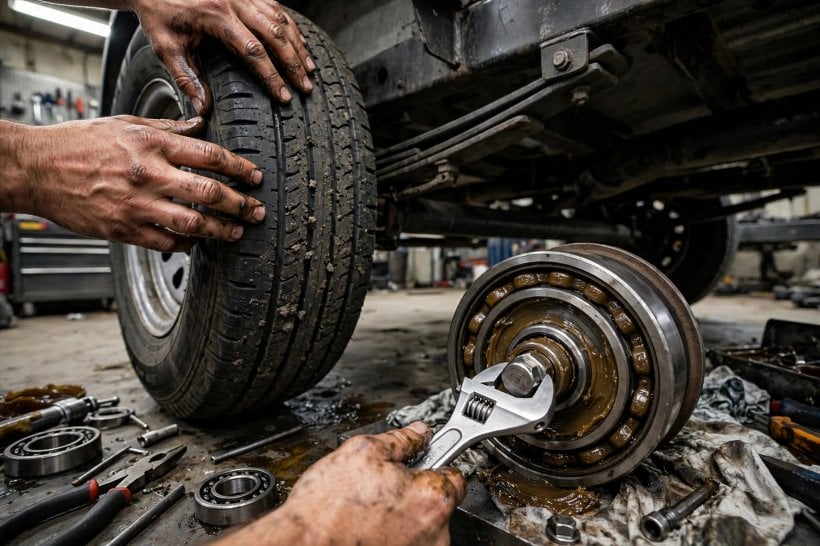
Maintenance is where the wheel count turns into a recurring bill. The analyzer keeps it simple: low maintenance cost with 4 tires for a tandem, high maintenance cost with 6 tires for a triple. Every additional tire is another tire to buy, rotate, inspect and eventually replace, another set of bearings to service, and another brake assembly to check. None of that is complicated, but all of it is multiplied, forever, by the number of wheels you chose at the start.
Scrub accelerates the triple’s side of that bill. Tires worn sideways in tight turns do not last as long as tires that mostly roll straight, so a triple that is manoeuvred often can consume front and rear tires noticeably faster than its centre pair. Bearing and spindle checks matter more for the same reason: the components that absorb scrub stress deserve earlier and closer inspection.
There is a counterpoint. Spreading a genuinely heavy load across six tires means each tire works further from its individual limit on long highway runs. Maintenance cost is not an argument against triple axles in themselves. It is an argument against carrying six wheels, and their upkeep, for a house light enough to be served well by four.
8. The Weight of the Running Gear Itself
An extra axle is not weightless. The third axle arrives with its own wheels, tires, brakes, suspension components and frame reinforcement, and all of that running gear is itself part of the load the trailer must carry down the road. Some of the triple’s higher headline capacity is therefore spent carrying the equipment that provides it, which is another reason headline ranges should be read as ceilings with headroom, not as usable payload to fill completely.
Running-gear weight also affects the tow from the other end. Heavier gear changes how the trailer presents weight to the hitch, and fine adjustments there matter for stable towing. The tongue weight tuner shows how moving familiar loads changes that balance, and it is a useful companion when you are comparing a lighter tandem rig against a heavier triple rig for the same house.
For builders counting every pound, this is the hidden line in the comparison. A tandem keeps the running gear light and leaves more of its capacity for the house itself. A triple spends some capacity on hardware, in exchange for a much higher ceiling when the house genuinely needs one.
9. Matching Axles to House Length and Finished Weight
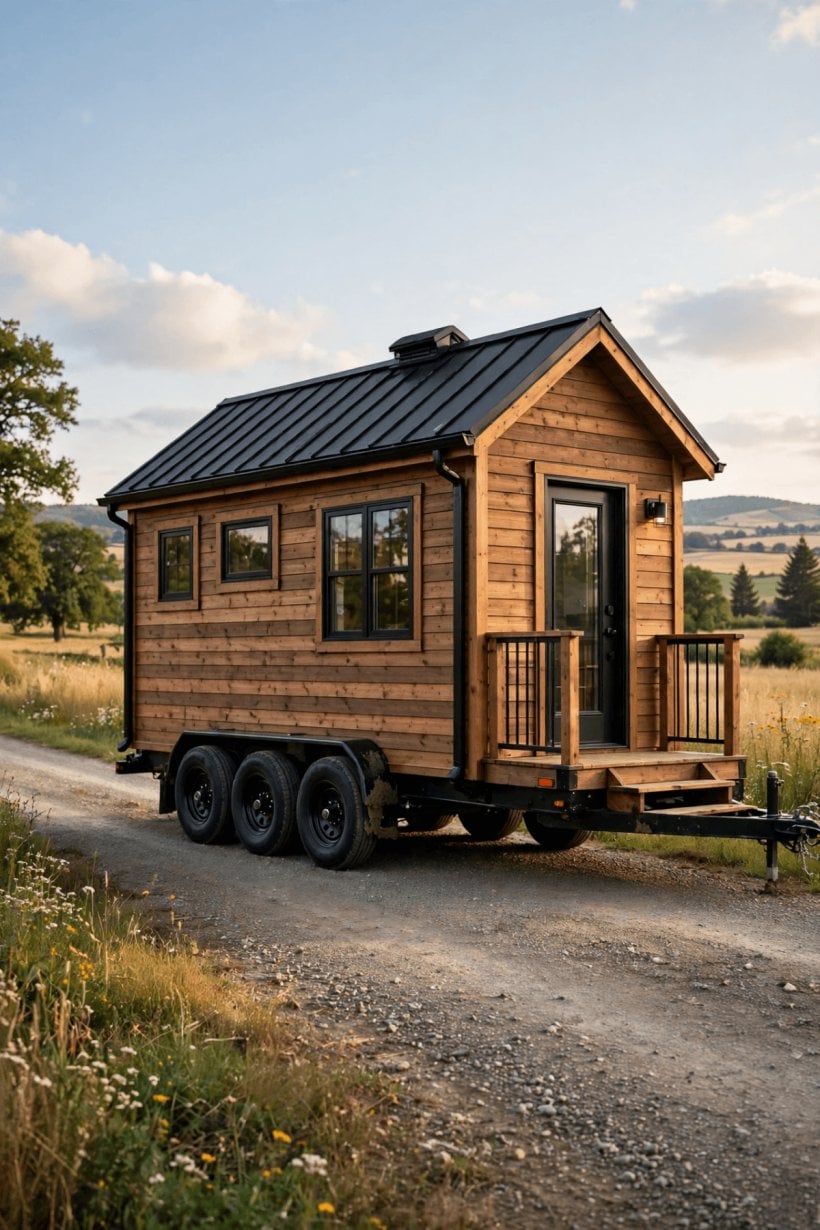
The analyzer draws its dividing line in a place that matches real builds. Tandem setups suit tiny homes under 28 ft. Triple setups become necessary for heavy builds at 30 ft and over. Length matters because it correlates with almost everything else: longer houses carry more material, more fittings, more water and more belongings, and their weight climbs even when the design is disciplined.
Use length as a first signal, then confirm with weight. A short but exceptionally heavy build, in dense materials with large tanks, can outgrow a tandem sooner than its length suggests. A long but deliberately light build can sometimes stay within tandem range, though it should prove that with a real weight estimate rather than optimism. That is the honest way to settle the double vs triple axle question: length points, weight decides, and headroom confirms.
Placement completes the match. Where the axles sit under the frame decides how the finished house balances, how much weight the hitch carries, and how the trailer behaves both in a turn and at speed. Our axle placement guide covers that positioning in detail, and it should be read as part of the same decision, not as an afterthought once the trailer arrives. Axle count, axle capacity and axle position are one choice made in three parts.
10. Retrofit Realities and Using the Analyzer
Builders sometimes ask whether they can start on a tandem and add a third axle later if the house grows heavier. Treat that as a major structural change, not a bolt-on upgrade. Frame design, axle position, suspension geometry, braking and the original capacity rating were all chosen around the first configuration, and changing the count afterwards can disturb the balance the trailer was built for. In most cases the honest retrofit answer is that choosing correctly at the order stage is far cheaper than correcting the choice later.
That is exactly what the analyzer below is for. Select a configuration, then move between a straight line and a sharp turn and watch the scrub stress change. Run the tandem first and note how little the turn punishes it. Run the triple and watch the same turn become the expensive manoeuvre, while remembering that the triple repays you with capacity and straight highway tracking the tandem cannot match for a heavy build. The simulation makes the trade physical instead of abstract.
Use it with your real numbers beside you: your estimated finished weight, your planned length, your likely parking situation and how often the house will move. If the house will be towed regularly, the full picture in towing a tiny house, including trucks and hitch weights, will help you check that the tow vehicle, the hitch and the axle choice all agree with each other before anyone commits money.
Final Considerations
There is no heroic choice here, only a matched one. A tandem gives a lighter tiny house minimal scrub, low maintenance with 4 tires, easy pivoting into tight spots and capacity in the 10k–14k lbs range that most homes under 28 ft will never trouble. A triple gives a heavy build the 18k–21k lbs range it needs, straighter highway tracking and load spread across 6 tires, at the price of high scrub in tight turns and higher maintenance for as long as you own it.
Decide from the finished house backwards: estimate its real weight, respect its length, picture where it will park and how often it will move, then pick the configuration that holds that life with headroom to spare. Do that, and the wheels under your home will be a quiet, correct decision you rarely think about again, which is exactly what good running gear should be.
Triple vs. Double Axle Analyzer
Triple vs. Double Axle Analyzer
Compare capacity vs. the dreaded “Tire Scrub.”
1. Select Configuration
2. Simulate Turn
2 Double Axle (Tandem)
- Typical Capacity: 10k – 14k lbs
- Tire Scrub: Minimal
- Maint. Cost: Low (4 tires)
- *Best for Tiny Homes under 28ft. Easy to pivot into tight spots.
3 Triple Axle
- Typical Capacity: 18k – 21k lbs
- Tire Scrub: High
- Maint. Cost: High (6 tires)
- *Necessary for heavy builds (30ft+). Tracks straight on highways but fights you in parking lots.
Trailers don’t have differentials or steering axles. When you turn, the trailer pivots around the center axle. The axles in front and behind are forced to drag sideways across the pavement.
Triple Axles have a longer wheelbase, creating severe drag (scrub) on the front and rear tires during tight turns, which can pop tires off rims or bend spindles if turning too sharply on pavement.



2 Comments