

Move a battery bank a few feet and tongue weight changes — sometimes enough to turn a nervous, weaving tow into a calm one. Nothing got lighter. It just stopped leaning on the hitch. This guide shows how the lever effect works, which heavy items to move first, and when shuffling loads stops being the right fix.
1. At a Glance: Moving Heavy Gear to Rebalance the Hitch
Start with the items you can actually move. On most tiny house trailers, the total load is not the problem — its address is. Propane, batteries, a generator and a spare tyre collect at the front, in or near the tongue box, where every pound presses straight down on the hitch. The same items, carried over the axles, press on the trailer’s own wheels instead. Carried behind the axles, they actively lift the front. The tuner below works through exactly five movable items, and the table summarises each one.
| Heavy item | Weight | Over the axles | Behind the axles |
|---|---|---|---|
| 2x Propane Tanks | 75 lbs | Removes all 75 lbs from the hitch — neutral | Lifts the front by more than 75 lbs |
| 2x AGM Batteries | 130 lbs | Removes all 130 lbs from the hitch — neutral | Lifts the front by more than 130 lbs |
| 4x AGM Batteries | 260 lbs | Removes all 260 lbs from the hitch — neutral | Lifts the front by more than 260 lbs |
| Portable Generator | 100 lbs | Removes all 100 lbs from the hitch — neutral | Lifts the front by more than 100 lbs |
| Spare Tire | 40 lbs | Removes all 40 lbs from the hitch — neutral | Lifts the front by more than 40 lbs |
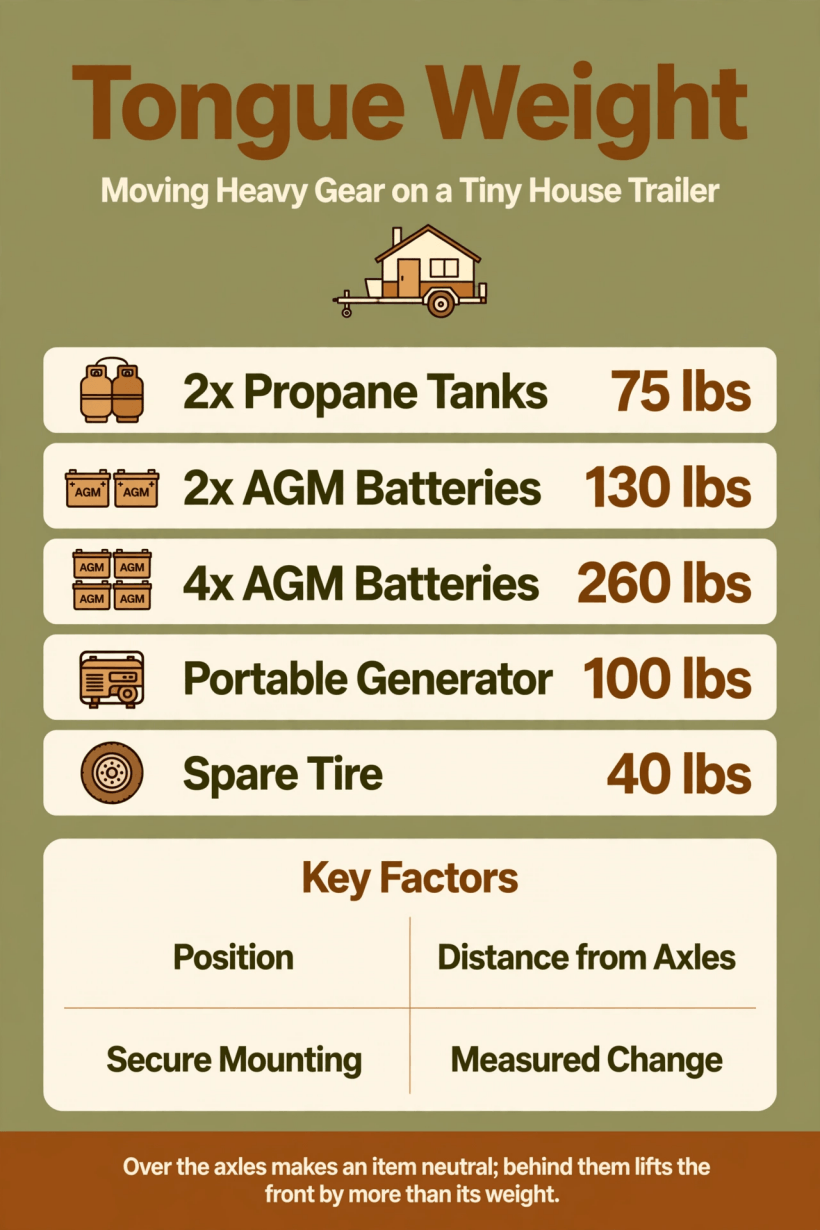
The five movable loads at a glance: what each one weighs, and what moving it over or behind the axles does to the load on the hitch.
Two lessons sit inside those numbers. First, the battery bank is the biggest lever most owners hold: a four-battery AGM bank outweighs the propane pair, the generator and the spare combined. Second, position beats effort — you do not need to remove anything from the trailer to change how it tows. You need to give the heavy things a better address.
2. What the Load on the Hitch Is — and Why Both Extremes Are Dangerous
The load on the hitch is the downward force the trailer’s front end places on the tow vehicle through the coupler. The trailer’s total weight is carried in two places: mostly by its own axles, and partly by that front contact point. Shift weight forward inside the trailer and the front share grows; shift it back and the front share shrinks. The total has not changed at all — only the split has.
Too much front-end load punishes the tow vehicle. The rear of the truck sags, its front axle is unloaded, and steering and braking lose their bite precisely when a heavy trailer is pushing from behind. Headlights point high, and the whole outfit feels nose-heavy and reluctant. It also eats into the truck’s payload margin, which is why the front share belongs in the same conversation as calculating GVWR for tiny homes before any trip.
Too little is worse. A trailer carrying almost nothing on its front end is a trailer waiting to sway: crosswinds, passing trucks and small steering inputs start an oscillation the back end wants to continue. A clear weight distribution diagram for a tiny house makes the point visually — the axles are the pivot, and the loads on either side of them have to stay in a working balance, neither crushing the hitch nor abandoning it.
3. The Lever Principle: Distance Matters More Than Weight Alone
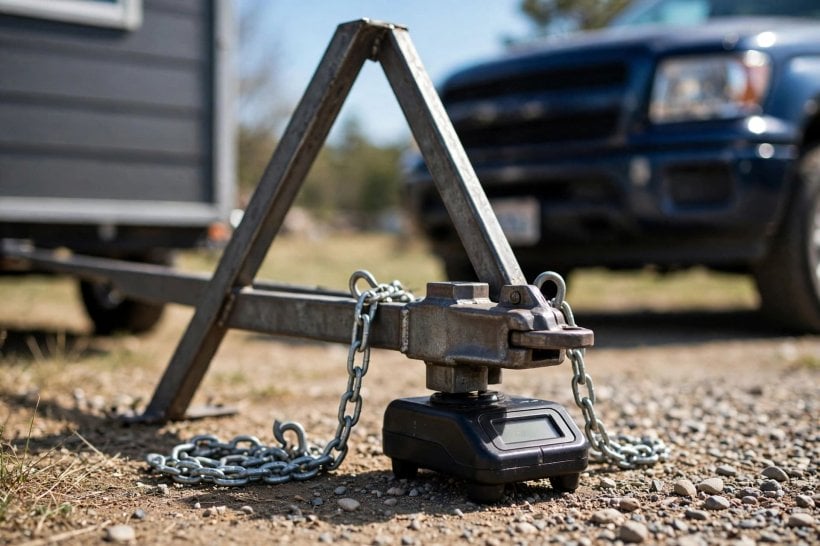
A trailer is a lever balanced on its axles. Anything ahead of that pivot presses the front down; anything behind it lifts the front up; anything directly over it does neither. The tuner states the cleanest version of the rule: moving an item from the tongue box to directly over the axles removes 100% of that item’s weight from the hitch. The item still weighs exactly what it weighed. It has simply stopped voting on the front end.
Distance is the multiplier. A load sitting far ahead of the axles, up in the tongue box, is at the long end of the lever, so its full weight lands on the hitch. The same load moved a short distance — from the box to a bay over the wheels — loses that leverage entirely. This is why small moves produce outsized results, and why owners who think in total pounds miss the point: the question is never just how heavy an item is, but how far from the pivot it rides.
Work the lever in the right order. Move the heaviest movable item first, re-check, then decide whether a second move is needed. One deliberate change, measured, teaches you more about your trailer than three changes made at once.
4. The Tongue Box Problem: Convenient Storage in the Worst Place
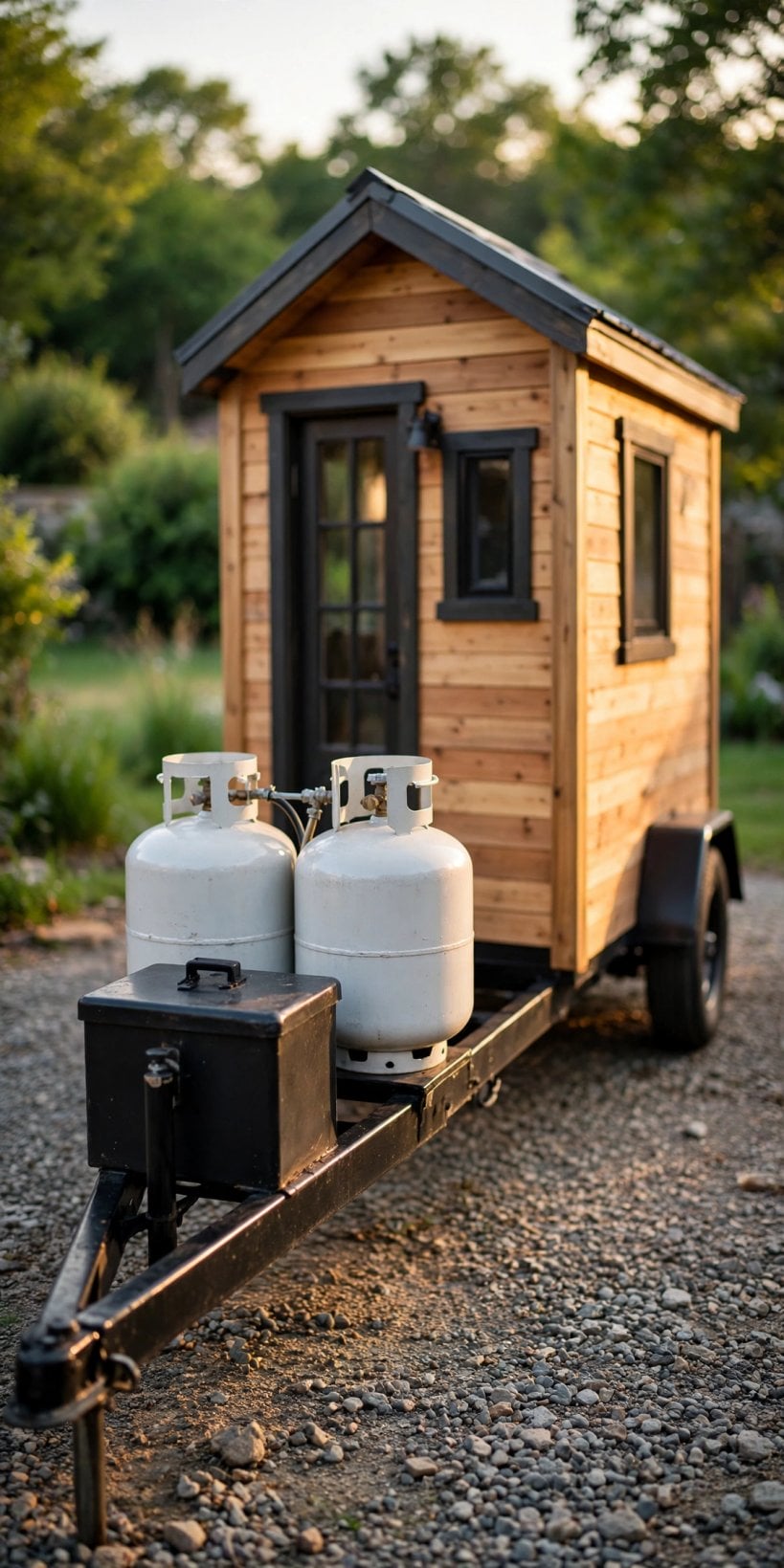
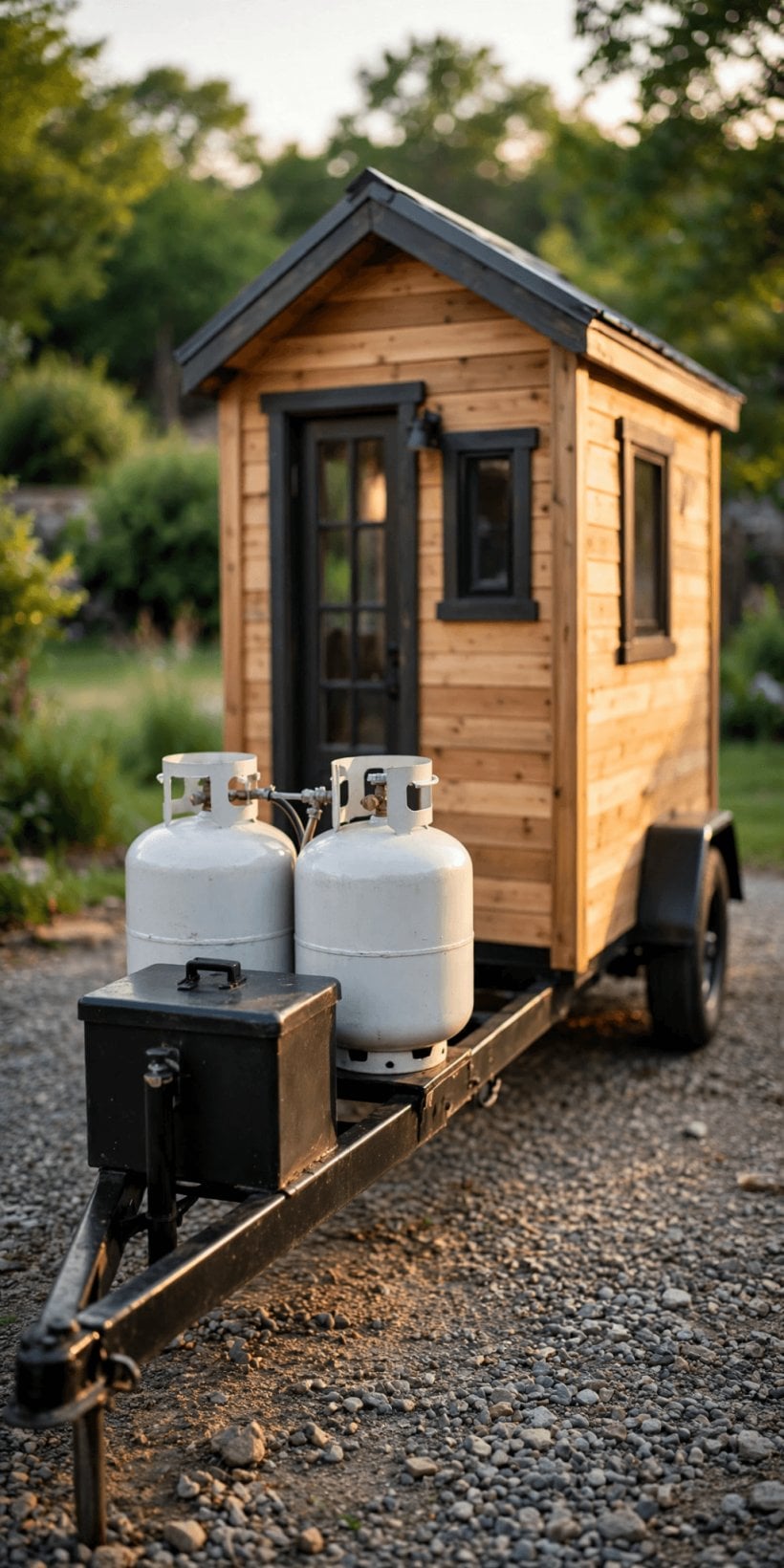
The tongue box is not badly designed — it is badly used. It sits in otherwise wasted space, it locks, it is easy to reach when hitched, and it keeps messy gear outside the living space. So it fills up. Propane goes in by tradition. Batteries go in because the box is vented and close to the wiring. Then the generator squeezes in, and the spare, and the box quietly becomes the densest point on the whole trailer — at the far end of the lever, where every pound counts in full.
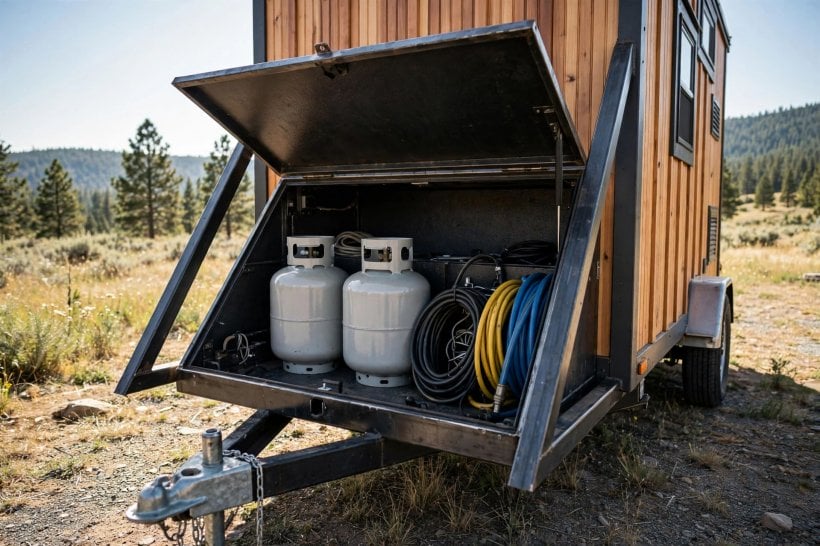
The fix is rarely to empty the box completely. It is to demote it: a home for light, bulky, awkward things rather than dense ones. Cables, chocks, hoses, levelling blocks and tools you want at the hitch can stay. Dense energy storage — the items that exist purely as weight — should be audited first, because they are doing the most harm per cubic inch in that location.
Treat the box as a budget, not a bin. Before anything heavy goes back in, ask what it displaces and whether it could ride over the axles instead. The structural side of that decision — how the frame itself carries concentrated loads — connects to our comparison of steel vs wood framing weights, since a trailer frame and a house frame share the same unforgiving arithmetic.
5. Batteries as Ballast: The Heaviest Lever You Own
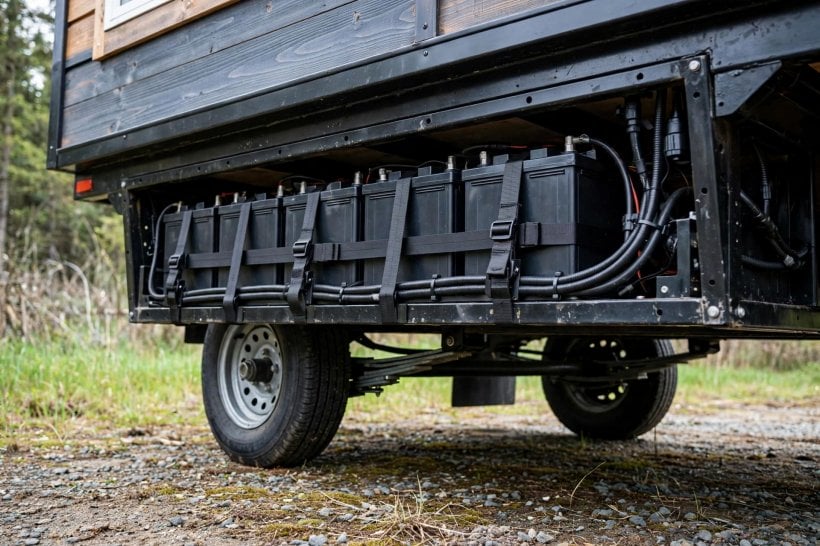
If one move fixes a heavy front end, it is usually this one. The tuner lists two AGM battery setups: a two-battery bank at 130 lbs and a four-battery bank at 260 lbs. Even the smaller bank outweighs the propane pair and the spare together. Batteries are dense, compact and already wired as a unit, which makes them the classic hidden cause of a front-heavy trailer — and, moved well, the classic cure.
Over the axles is the natural home. A bank carried there becomes neutral: its considerable weight rides on the trailer’s wheels, contributes nothing to the hitch, and stays central, low and secure. Low matters — a battery bank is one of the few loads that can lower a trailer’s centre of gravity while it rebalances it, provided it is properly strapped, fused and ventilated for its chemistry, and kept accessible enough that you will actually maintain it.
Plan the wiring before the move, not after. Longer cable runs, a relocated disconnect and a new mounting tray are the real cost of this fix; the rebalancing itself is free. The same placement thinking governs fixed heavy appliances inside the house, which is why the logic pairs naturally with an appliance placement strategy for stoves, fridges and water heaters that cannot be shuffled on the day of the move.
6. Propane Placement: Light Enough to Move, Awkward to Ignore
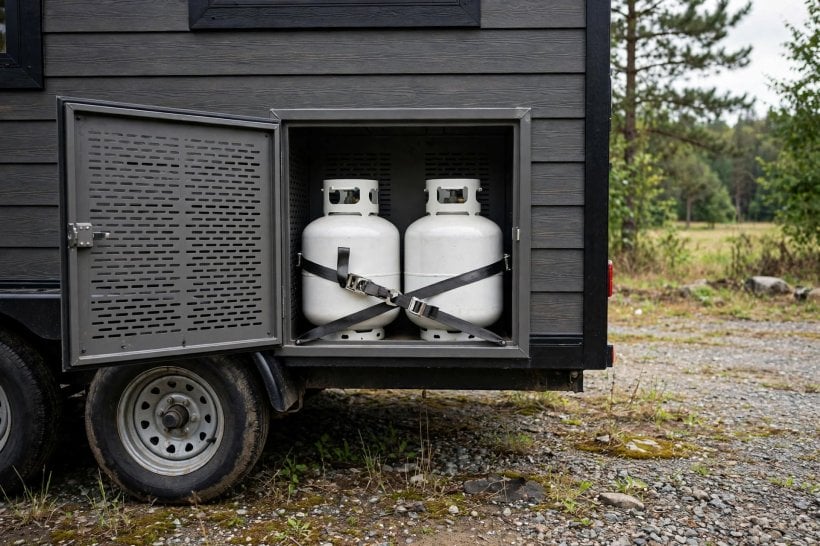
At 75 lbs for the pair, propane tanks sit in the middle of the tuner’s list — too heavy to dismiss, light enough to relocate without drama. Their traditional home is the front, close to the appliances they feed and easy to swap at a refill stop. That convenience is real, and it is why propane should usually be the second or third item you move, not the first: the battery bank buys you more relief per hour of work.
Wherever the tanks ride, the non-negotiables travel with them. Tanks stay upright, secured against movement in every direction, ventilated, and clear of heat sources and exhaust routes. A move that trades a heavy front end for a loose tank in a rear compartment is not a fix; it is a different accident. Keep the regulator, pigtails and shut-off reachable, because a tank you cannot isolate quickly is a tank in the wrong place however well it balances.
Think of propane as your fine adjustment. Once the batteries have done the heavy lifting, shifting the propane pair over the axles trims the front share by a useful, predictable amount — its full 75 lbs — without the leverage surprises that come from placing weight at the very back.
7. Spare Tire and Generator: The Flexible Pair
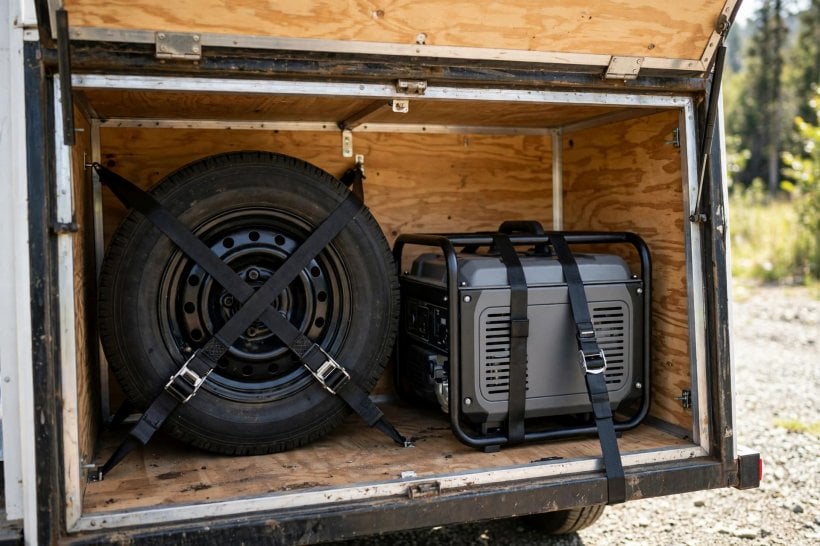
The spare tire, at 40 lbs, is the lightest item on the tuner’s list and the most freely placed. It has no wiring, no fuel and no ventilation needs — only the requirement that you can actually reach it, at night, in the rain, on a soft shoulder. A spare carried over the axles or low at the rear is a small, safe contribution to balance. A spare buried under cargo is ballast you cannot use when it matters.
The portable generator, at 100 lbs, is the opposite temperament: genuinely heavy, used outside the trailer, and happiest travelling somewhere it can be lifted out without unloading half the house. Over the axles suits it well — neutral on the hitch, central and secure. What it should not do is ride loose, and its fuel should travel with the same care as the propane: sealed, upright, ventilated and away from the living space.
Together, the pair are your trim tabs. At 140 lbs combined, they fine-tune after the big items are settled: the generator over the axles to neutralise it, the spare at the rear if the front still needs a gentle lift, or both central if the balance is already right.
8. Counter-Balancing Behind the Axles — and Its Limits
Counter-balancing is the lever working in reverse, and the tuner states its power plainly: moving an item behind the axles not only removes its weight from the front, it lifts the front further, reducing the load on the hitch by more than the item’s own weight. A 40-lb spare on the rear bumper therefore does more than the same spare over the axles — the bumper is the long end of the lever, and leverage multiplies whatever rides there.
That multiplication is why this move needs respect. The goal is a front end carrying its proper share — not the lightest front end you can achieve. Overshoot, and you have built the sway-prone trailer described earlier: light at the coupler, eager to wander. Rear-mounted weight also works the back of the frame, can drag on steep driveways, and swings wide in turns, so anything on the bumper must be rated, mounted and checked like structure, not luggage.
Use counter-balancing as the last adjustment, in the smallest dose that works. Move one item behind the axles, measure again, and stop the moment the balance is right. Chasing a perfect number with ever more rear weight trades one towing problem for another.
9. Measuring Before and After Every Move
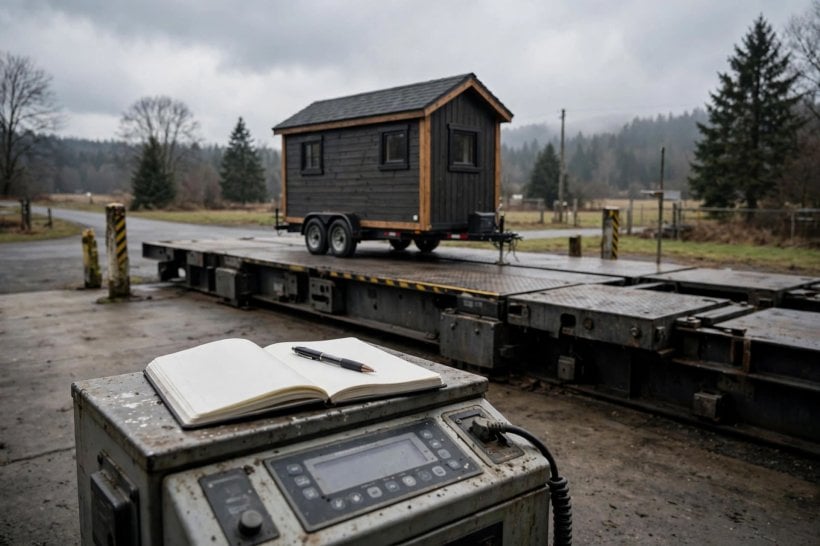
Guessing is how trailers end up rebalanced three times in one afternoon. Measure the load on the hitch before you move anything, write the number down, and measure again after each single move. A dedicated hitch scale makes this quick at home; a platform scale tells the fuller story when you want axle loads as well, and our CAT scale weighing guide and simulator walks through reading the pads and the ticket before you ever roll onto one.
Keep the test conditions honest. Weigh with the trailer loaded as it will travel — water, food, gear and all — parked level. A measurement taken on an empty trailer in the driveway describes a trailer you never actually tow. Note what changed between readings: one item, one position. That discipline turns the tuner’s predictions into numbers you can trust on your own rig.
Re-check after the first real tow, too. Loads settle, tanks empty and fill, and the spare you moved in spring may have crept forward again by autumn. Balance is a habit of verification, not a one-time achievement.
10. When to Fix the Layout Instead of Shuffling Loads
Sometimes the movable items are innocent. If the batteries, propane, generator and spare are already over the axles and the front is still heavy, the problem is built in: fixed weight — a tiled shower, a cast-iron stove, full water tanks, stone counters — sitting too far forward, or axles placed too far back for the house they carry. No amount of shuffling fixes geometry.
That is a layout conversation, and it starts with position rather than purchases. Our axle placement guide covers how the pivot point is chosen for a build, and the axle comparison tool helps weigh whether the running gear itself matches the house’s weight and length. On an existing trailer, moving the axle group is serious structural work for a professional fabricator — but so is living with a trailer that cannot be balanced any other way.
The honest test is simple. If the tuner below cannot get you to a workable balance using only the movable items, in sensible positions, secured properly — stop tuning and fix the layout. And when the day comes to move the house, the full picture in our guides to towing a tiny house, trucks and hitch loads and the tiny house moving guide and transport costs will help you plan the trip the balanced trailer deserves.
Final Considerations
Balancing a tiny house trailer is not about making the front light; it is about making the front right. The method is deliberately modest: know what the heavy movable items weigh, understand the lever they ride on, move the biggest one first to the neutral ground over the axles, trim with the flexible items, and reserve the rear bumper for the smallest final adjustment. Measure before, measure after, and change one thing at a time.
Do that, and the tuner below becomes what it was built to be: a quick way to test a move on screen before you unbolt anything in the driveway. Try the combinations, watch what each position does, and then go and make the one move your trailer actually needs.
Tongue Weight Tuner
Tongue Weight Tuner
Fix a heavy tongue by moving batteries & propane.
1. Select Item to Move
The Lever Effect
Moving an item from the tongue box to directly over the axles removes 100% of that item’s weight from the hitch. It essentially makes the item “neutral.”
Moving an item behind the axles acts as a lever. It not only removes the item’s weight from the tongue but actually lifts the tongue further, reducing total hitch weight by more than the item’s actual weight.


2 Comments