

This tool is a lifesaver for tiny house DIYers. It addresses the dangerous misconception that “if the wall doesn’t feel hot, it’s safe.” It educates users on Pyrolysis—the invisible chemical process that lowers wood’s ignition temperature over years of exposure—and calculates safe distances based on shielding types (NFPA 211 standards).
It features a “Heat Zone Visualizer” that simulates the radiant heat field. As you slide the stove closer to the wall, you can see if the heat envelope overlaps with the combustible wall surface.
A wood stove makes a tiny house feel like a home, but in a space this small the stove always sits close to something that can burn. The distance between the stove and the wall behind it is not a styling choice — it is the margin that decides whether that wall stays safe for decades or quietly chars from the inside. This guide explains how clearance works, and the calculator below checks your exact setup.
1. At a Glance: Clearance by Stove and Shield
Clearance is the empty space a stove needs between its hot surfaces and any combustible material — the wood wall, the drywall, the studs behind it. How much space depends on two things: the stove itself, and what protects the wall. A certified tiny stove that has been tested by its manufacturer can sit far closer than an uncertified stove, and a properly ventilated heat shield can cut the required distance dramatically. The table below mirrors the figures built into the calculator below, which are drawn from manufacturer manuals and NFPA 211.
| Stove model | Unshielded clearance | With a ventilated shield (1-inch gap) |
|---|---|---|
| Uncertified cast iron (generic) | 36 inches | 12 inches minimum |
| Cubic Mini Grizzly | 20 inches | 3 inches with the maker’s shield kit |
| Cubic Mini Cub | 20 inches | 3 inches with the maker’s shield kit |
| Tiny Wood Stove Dwarf 3kW | 16 inches | 10 inches |
| Tiny Wood Stove Dwarf 4kW | 19 inches | 10 inches |
| Tiny Wood Stove Dwarf 5kW | 20 inches | 10 inches |
One warning before the numbers make shielding sound simple: sheet metal or tile fixed directly to the wall earns only a token reduction, because heat conducts straight through metal into the wall behind it. The big reductions in the right-hand column come from the ventilated shield — a panel held off the wall on 1-inch spacers so air can flow behind it. Section 4 explains why that air gap matters more than the metal itself.
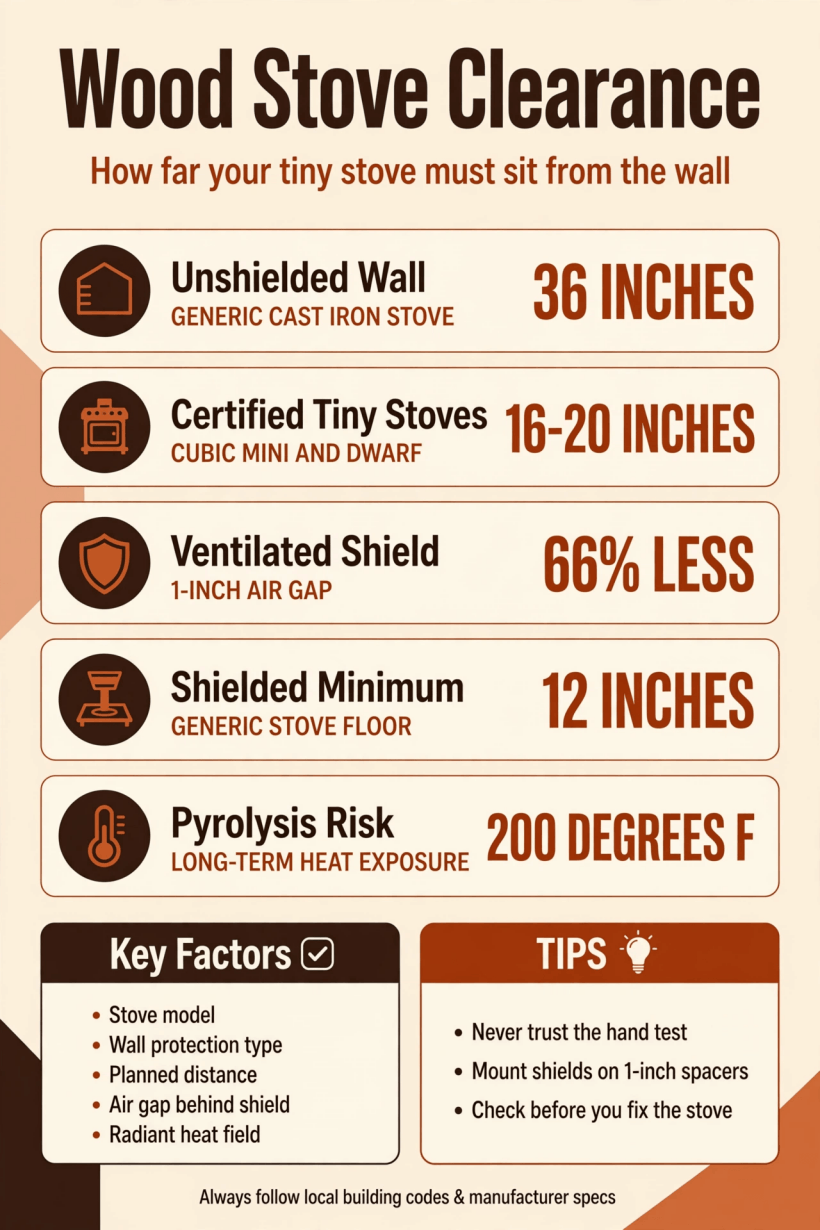
The headline numbers at a glance: 36 inches unshielded for a generic stove, 16–20 inches for certified tiny stoves, and a 66 percent reduction when a ventilated shield does the work.
2. How Clearance Is Measured: From Stove Body to Combustible Surface
Clearance is measured in a straight line from the nearest hot part of the stove to the nearest combustible surface. That second half of the measurement is where people go wrong: the combustible surface is not the decorative panel you can see, it is the burnable material itself — the wood paneling, the drywall over wooden studs, the framing inside the wall. If a sheet of metal is screwed flat against a wooden wall, the wall behind it is still the surface that matters, because the heat passes through.
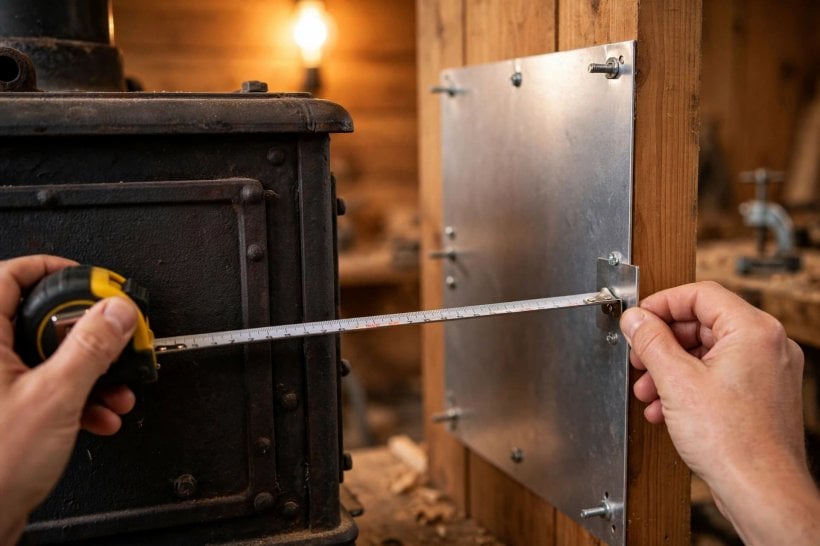
This is exactly the comparison a wood stove clearance calculator is built to run: pick the stove, pick the wall protection honestly, then measure the distance you actually plan to leave and see whether it meets the requirement. Measuring costs nothing and takes a minute — a tape stretched from the back of the stove to the wall face, as in the photo below. What it cannot do is rescue a guess made after the hearth is tiled and the flue hole is cut, which is why clearance belongs in the planning stage, alongside the other decisions in our guide to how to heat a tiny house.
3. Stove Models: Why Certified Tiny Stoves Can Sit Closer
The single biggest variable in the table above is the stove itself. An uncertified cast-iron stove — the generic option in the calculator — carries a default unshielded clearance of 36 inches, because with no tested rating behind it, the safe assumption is the conservative one. The certified tiny stoves built for small spaces tell a different story: the Cubic Mini Grizzly and Cubic Mini Cub are manufacturer-tested at 20 inches, and the Dwarf range runs from 16 inches for the 3kW model to 19 inches for the 4kW and 20 inches for the 5kW, all before any shielding is added.
Those tested numbers are not marketing. They come from the manufacturer manuals the calculator is based on, and they reflect how a small, controlled firebox actually radiates heat compared with a large uncertified box. The practical lesson cuts both ways: do not waste precious floor space parking a certified stove 36 inches from the wall it never needed, and never borrow a certified stove’s smaller number for an uncertified stove that has not earned it. In a tiny house, where every inch of floor is argued over, a tested rating is worth real room — it is one reason stove choice in cold-climate builds, like those in these tiny house plans for cold climates, starts with the manual rather than the tape measure.
4. Heat Shields and the 1-Inch Air Gap
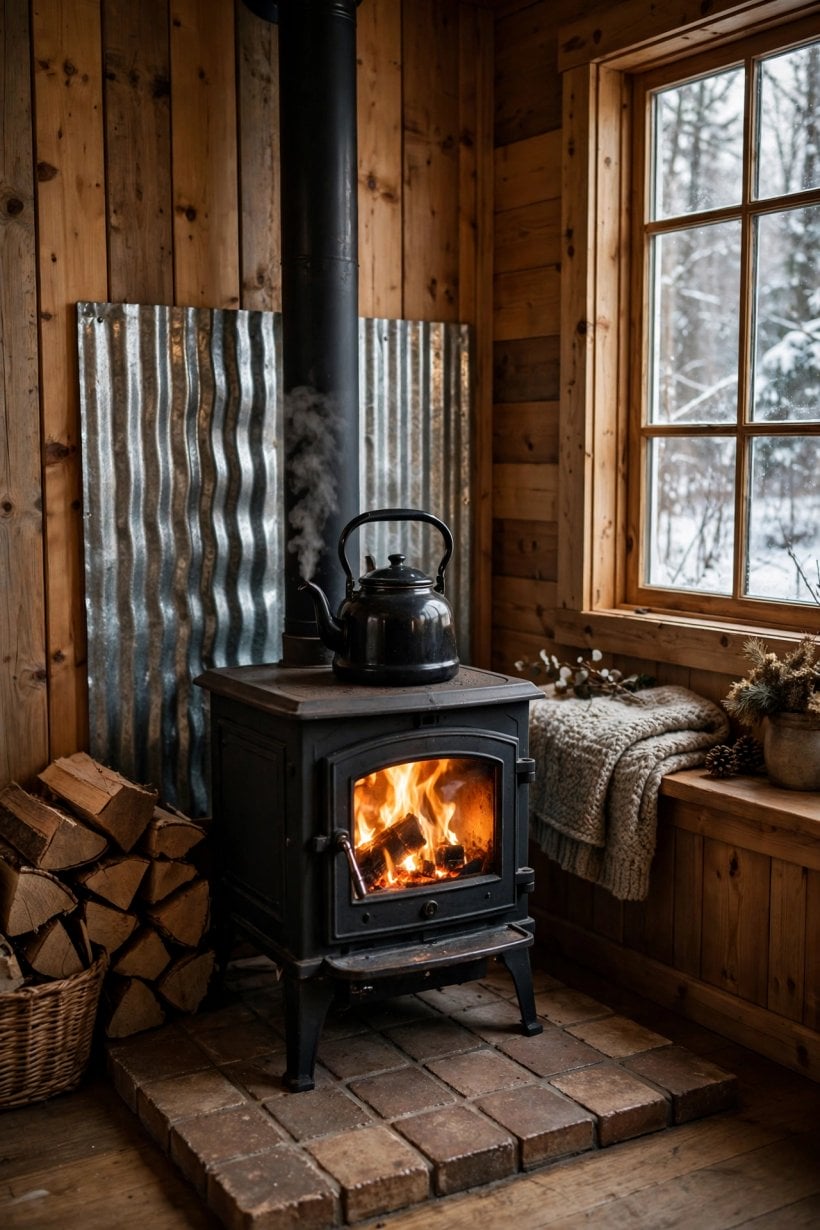
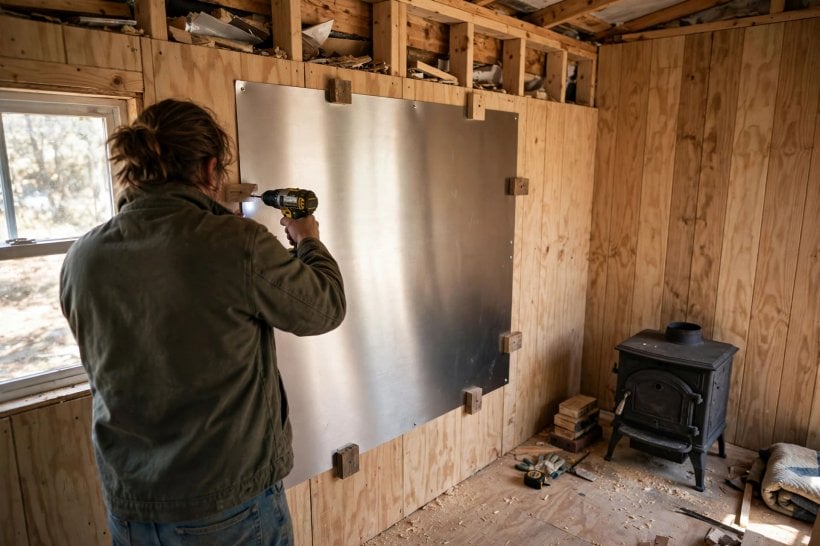
A heat shield protects a wall in one of two very different ways, and only one of them works well. Screwing sheet metal or tile directly to the wall does almost nothing to reduce the required clearance: metal is a conductor, so the heat that strikes the shield simply travels through it and into the wall behind, barely slowed. It may stop a spark or a direct scorch mark, but against the slow radiant load that actually matters, a flat-mounted panel is close to decoration. The calculator reflects this — direct sheet metal or tile earns only a small reduction, and it does not protect against the long-term damage described in the next section but one.
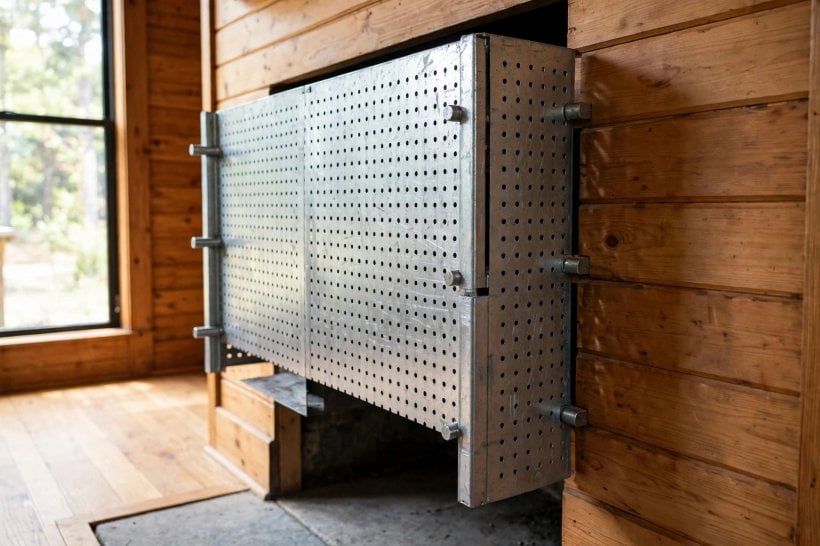
The ventilated shield is a different device entirely. The panel is mounted on 1-inch spacers, with the gap left open at the bottom and the top, so cool air enters underneath, rises behind the metal as it warms, and carries the heat away before it can soak into the wall. Built that way — the NFPA-compliant air-cooled shield in the calculator — the shield reduces the required clearance by 66 percent under NFPA 211. That is how the generic stove’s 36 inches becomes a 12-inch minimum, and how the Cubic stoves, using their makers’ own shield kits, can be rated as close as 3 inches. Notice what did the work: not thicker metal, but moving air. A shield sealed tight at the top, or mounted flush “just for looks,” gives up the very effect that earns the reduction.
5. Floor Protection: The Clearance Beneath the Stove
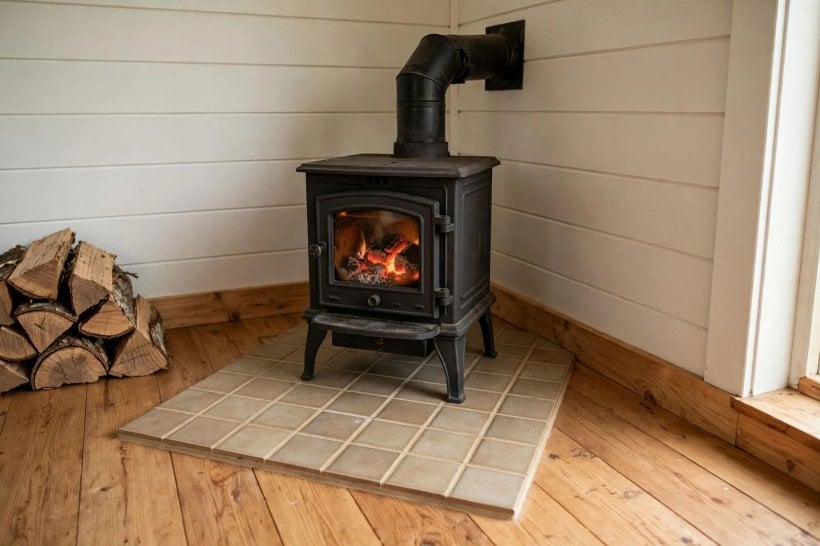
Clearance talk usually stops at the wall, but the stove stands on something too, and in a tiny house that something is usually a wooden floor. Floor protection — the tile, stone or metal hearth pad under the stove — exists for the moments the wall clearance never sees: the ember that rolls out when the door opens, the ash that spills during cleaning, the steady radiant heat soaking downward through the stove’s legs for hours at a time.
Treat the hearth as part of the same system rather than a finishing touch. It should be a genuinely non-combustible surface, sized so the stove and its loading zone sit comfortably within it, and it belongs in the plan before the stove’s position is fixed — because the pad’s footprint, added to the wall clearance behind, is the real amount of floor the installation consumes. What sits under that pad matters as well: builders thinking through the whole floor build-up will find the layers weighed in our floor insulation calculator useful, since the hearth, the insulation and the subfloor all meet in the same few inches.
6. The Flue and the Radiant Heat Field
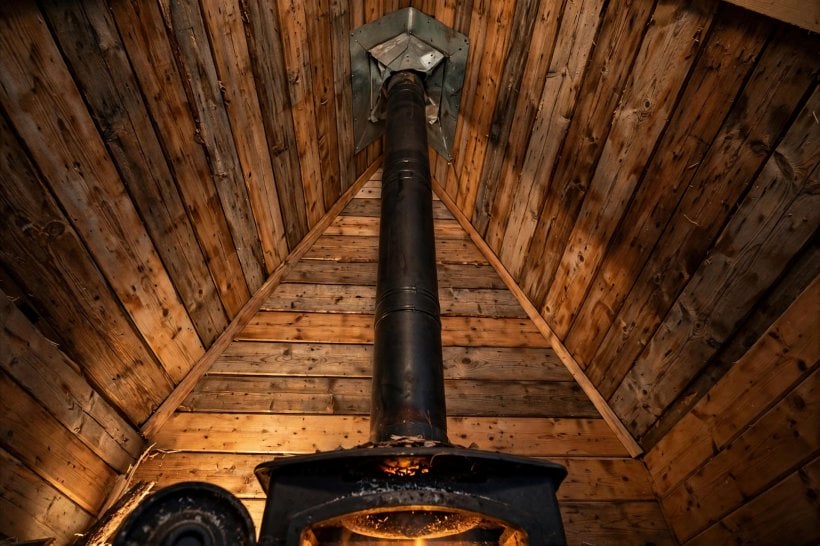
The stove body is only the center of the problem. Around every burning stove sits an invisible radiant heat field — the “heat envelope” the calculator’s visualizer draws — and anything combustible inside that field is being heated whether it is touched by flame or not. The flue pipe rising from the stove carries exhaust gases at their hottest and radiates into that same field, which is why the pipe run deserves the same respect as the stove body: a straight, sensible run, kept to the route the stove’s manual describes, with the wall and ceiling surfaces along its path treated as part of the installation rather than scenery it happens to pass.
The visualizer below makes the field tangible. Slide the stove closer to the wall and the heat envelope begins to overlap the wall surface; pull it back to the required distance and the overlap clears. That overlap is the whole story of clearance in one picture — the fire never has to reach the wall, because the heat field reaches it first, every hour the stove burns, all winter long.
7. Pyrolysis: The Invisible Damage Inside the Wall
Here is the fact that reframes everything above: wood does not need a flame to catch fire. It just needs heat, applied patiently. Constant exposure to temperatures as low as 200°F chemically changes wood over time — a process called pyrolysis — gradually turning the studs inside a wall into something closer to charcoal. Charred wood ignites far more easily than sound wood, so a wall that has absorbed years of “harmless” warmth can one day ignite spontaneously, inside the wall, with no spark and no warning anyone saw coming.
Pyrolysis is why clearance rules are written the way they are, and why they cannot be judged by feel. The damage is cumulative, invisible and irreversible — the wall does not recover over the summer. It is also why the form of heating matters as much as the amount: a heat source that spreads its output gently and evenly, like the systems compared in our radiant floor heating power analyzer, never concentrates a hot field against one patch of framing. A wood stove absolutely can be safe in a tiny house — thousands are — but its safety lives in the distance and the shielding, maintained for the life of the installation, not in how the wall happened to feel on one evening in October.
8. The Hand-Test Myth and Other Expensive Mistakes
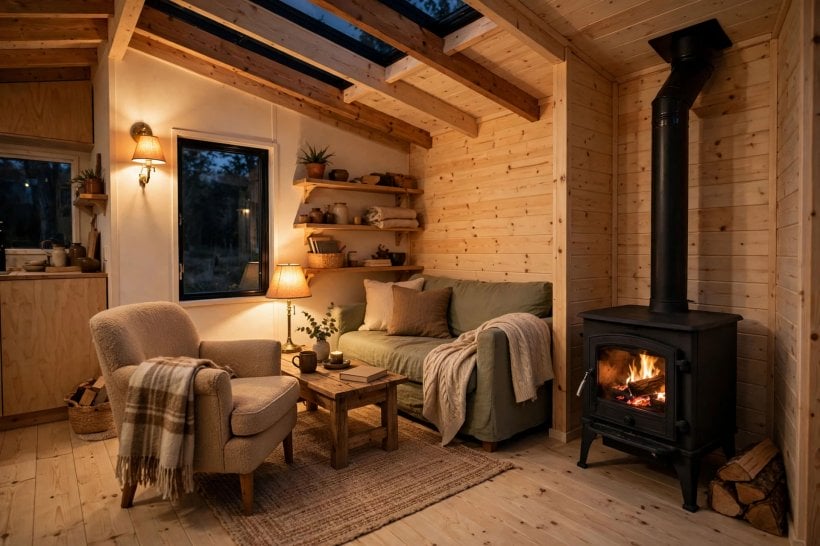
The original guide names the most dangerous misconception in tiny house heating directly: the belief that “if the wall doesn’t feel hot, it’s safe.” Your hand is a terrible instrument for this job. It samples the surface, for a second, on a mild burn — while pyrolysis works on the studs behind that surface, over years, at temperatures your palm would read as merely warm. By the time a wall feels hot to the touch, the chemistry inside it has been running for a long while.
The other mistakes repeat just as reliably. Mounting a shield flat to the wall and claiming the shielded clearance anyway. Sealing the top of a ventilated shield so the cooling airflow never starts. Measuring to the face of a decorative panel instead of to the combustible material behind it. Borrowing the 3-inch shielded figure of a Cubic stove for a different stove that was never tested with that kit. And the quietest mistake of all: setting the distance during a summer build, then edging the stove a few inches closer in January to make room for a chair — and never re-checking. Every one of these is a decision the calculator below can catch in ten seconds, which is more than can be said for the wall. If you are comparing the stove against other ways of staying warm, our overview of heating a tiny home in winter sets out the alternatives honestly.
9. Planning the Layout: Distance as a Design Decision
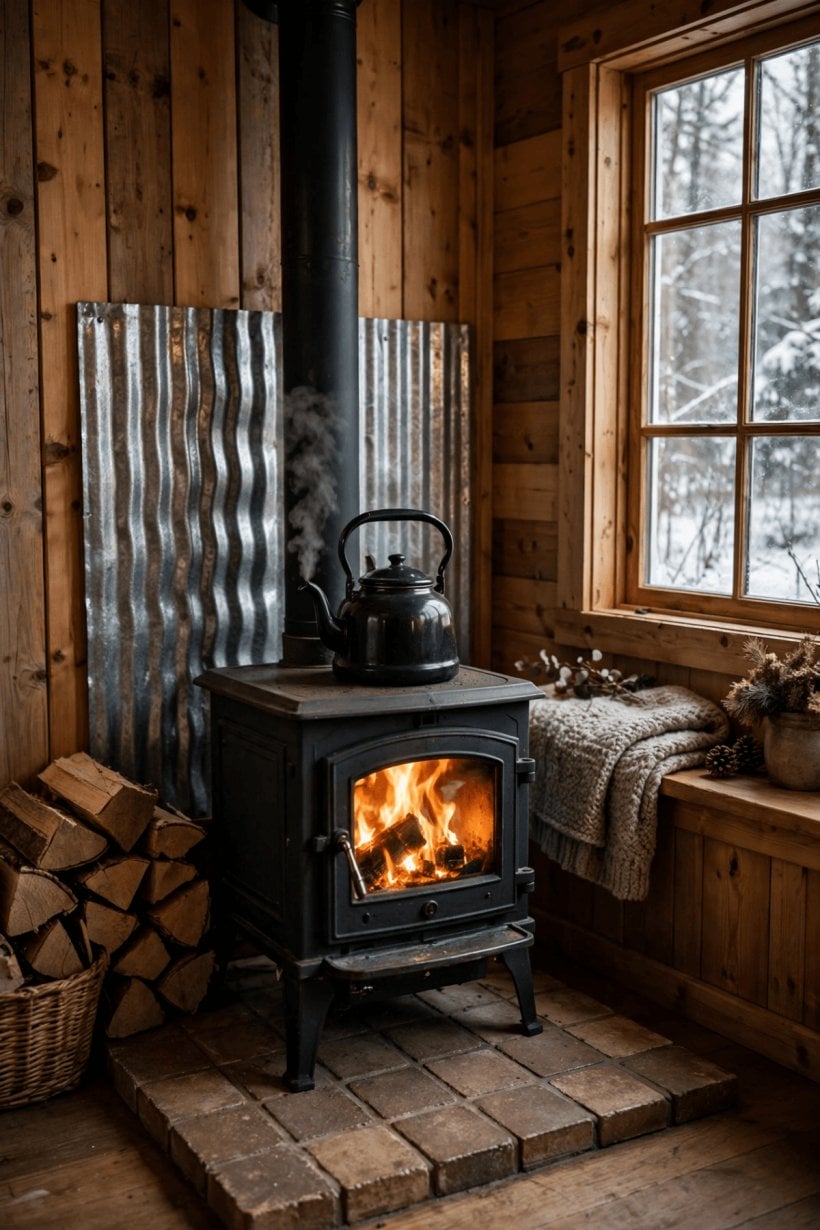
The cheapest time to solve clearance is before anything is built, when the stove’s corner is still lines on a plan. Start from the required distance for the stove and shield you actually intend, add the hearth pad’s footprint, and let that combined zone claim its floor space first; then arrange the seating, the kitchen run and the walkway around it. Worked the other way round — furniture placed, stove squeezed into what is left — the clearance is whatever the leftover happens to be, and the calculator becomes an apology instead of a check.
Planning ahead also means planning the air. A stove draws combustion air from the room and sends a constant stream of warm air up the flue, and in a small, tightly sealed house that airflow is part of the design, not an afterthought — the same fresh-air balance examined in our tiny house HRV efficiency calculator. Builders who treat distance, shielding, hearth and airflow as one corner designed once tend to light their first fire with a clear conscience; builders who improvise the corner tend to re-open it later, at tile-and-flue prices.
10. Using the Calculator Below: Stove, Shield, Distance
The tool below reduces this whole guide to three honest answers. First, the stove model: choose the generic uncertified cast-iron option, a Cubic Mini Grizzly or Cub, or a Dwarf 3kW, 4kW or 5kW — the choice loads that stove’s manual-based clearance. Second, the wall protection: none, meaning a bare combustible surface; sheet metal or tile mounted directly on the wall; or the ventilated shield with its 1-inch air gap. Third, your planned distance: slide it anywhere from 0 to 48 inches and press Check Safety.
The verdict comes back in the two words that matter — SAFE or FIRE HAZARD — alongside the required clearance for your combination, while the heat zone visualizer shows whether the stove’s heat envelope overlaps your wall. Use it experimentally before you use it finally: watch a bare-wall setup fail, add the ventilated shield, and see the requirement fall by two-thirds. Then run your real numbers, exactly as you measured them, and let the result — not optimism, not the hand test — fix the stove’s position. If the verdict goes the other way and a furnace starts looking simpler, the RV furnace efficiency and noise simulator explores that trade-off; most builders find the stove wins, provided its corner is honest.
Final Considerations
A tiny wood stove is one of the great pleasures of small-space living, and its safety is refreshingly mechanical: a tested stove, a measured distance, and a shield with air moving behind it. Respect the numbers the manufacturer and NFPA 211 stand behind, distrust any wall judged by palm, and remember that the damage clearance prevents is the kind that accumulates silently for years before it announces itself once. Run your stove, your shield and your distance through the calculator below before the first fire — and build the corner it approves.
Tiny Stove Clearance Calculator
Tiny Stove Clearance Calculator
Safety distances for Cubic Mini, Dwarf, and more.
Based on manufacturer manuals & NFPA 211.
The Science of Safety
Wood doesn’t need a flame to catch fire; it just needs heat. Over time, constant exposure to temps as low as 200°F chemically changes wood (Pyrolysis), turning your studs into charcoal. One day, they will spontaneously ignite inside the wall.
Screwing sheet metal directly to the wall does almost nothing (heat conducts through metal). To reduce clearance by 66% (NFPA 211), the shield must be mounted on 1″ spacers with an air gap at the bottom and top, creating a cooling airflow behind the metal.



1 Comment