

A heavy item in the wrong place can make a tiny house feel unsafe to tow, even when the total weight is legal. Good appliance placement strategy starts over the axles, not at the ends — and this guide shows you where each heavy load belongs, and why.
1. At a Glance: Heavy Loads, Weights and Where They Belong
Start with the loads the visualiser below works with, because they are the ones that dominate most tiny house layouts. A washer and dryer combination, a solid-fuel stove, a stocked refrigerator and a run of shelving do not weigh the same, and they do not behave the same once the trailer starts to move. The table gathers the tool’s own figures in one place, with the placement lesson that follows from each one.
| Appliance or load | Weight in the tool | Placement guidance |
|---|---|---|
| Washer / dryer combo | 180 lbs | Keep centred over the axles; allow for water weight in use |
| Cast iron stove | 250 lbs | Fix low and close to the axle centre; never at a rear corner |
| Full fridge + food | 350 lbs | Treat as permanent cold mass over or just ahead of the axles |
| Bookshelf / library | 600 lbs | Split the load, keep it low, and centre the heaviest shelves |
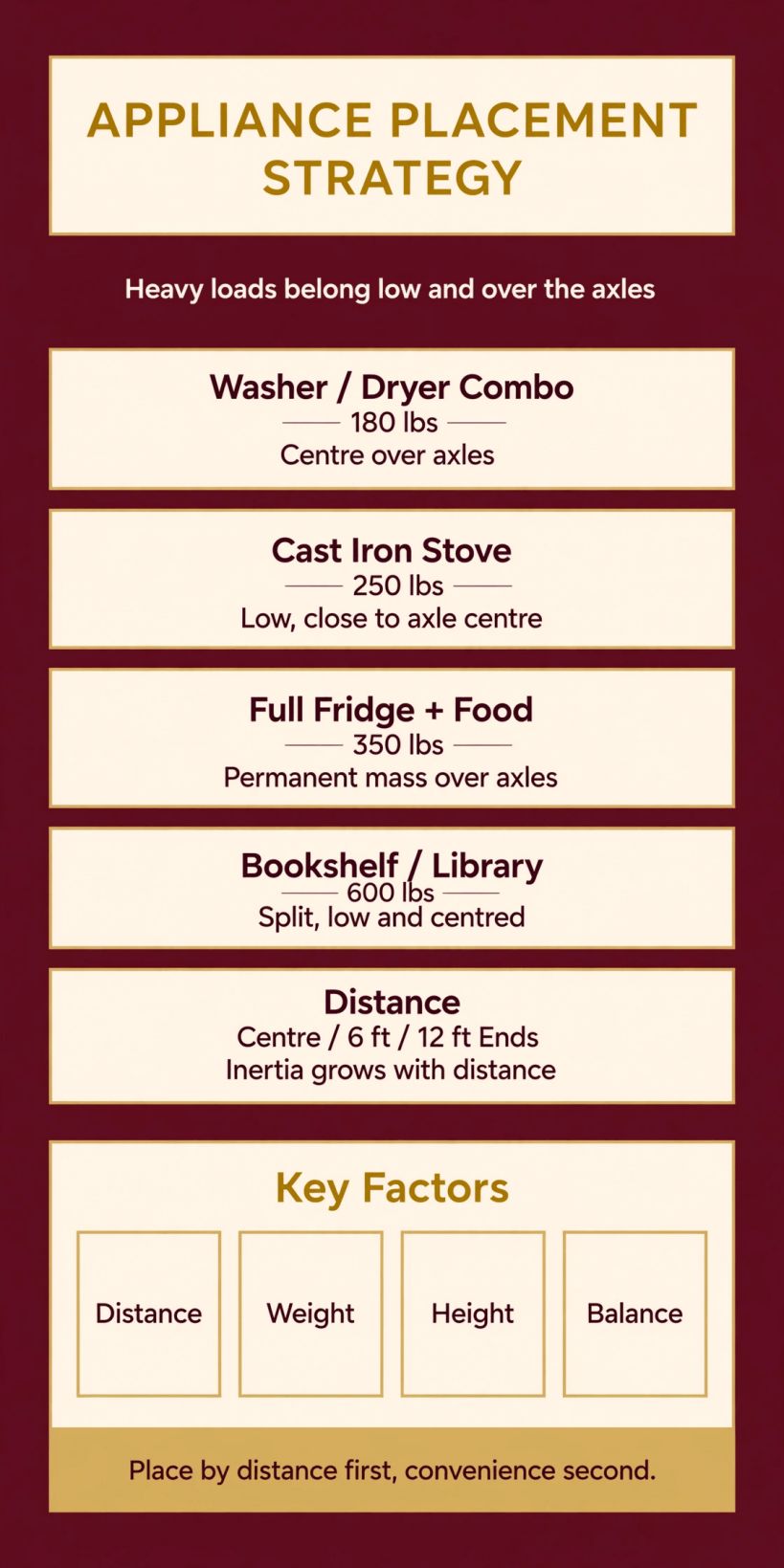
The four loads at a glance: the heaviest items belong low and centred, because distance from the axles matters more than the number on the scale.
Read the table from the bottom up and the pattern is clear. The lightest item on the list still matters if it sits at the tail, and the heaviest item can be carried safely if it sits where the trailer is designed to carry weight. The sections that follow unpack that pattern load by load, so you can test any layout before a single cabinet is fixed in place.
2. Why Position Beats Weight
Most builders weigh everything and then stop thinking. Total weight matters — it decides whether you stay inside the trailer’s rating, which is why a careful check with our guide to calculating GVWR for tiny homes comes first — but two houses with identical totals can tow completely differently. The difference is rarely the scale reading. It is where that weight sits along the length of the frame.
Weight carried close to the axles is supported almost directly. The frame, the suspension and the tyres are all working where they are strongest, and the load has very little leverage over the rest of the trailer. Move the same load towards the tail and it gains leverage. It can lift weight off the hitch, push the rear around in a crosswind and keep moving long after the tow vehicle has tried to settle it.
That is why a lighter house can feel worse than a heavier one. A compact build with a library and a stove stacked at the back may wander and sway, while a heavier build with its mass centred rides calmly behind the truck. Position turns weight into behaviour, and behaviour is what you actually feel through the steering wheel on a long, windy tow.

3. The Pendulum Effect and the Dumbbell, in Plain Language
The tool describes this with a dumbbell, and it is the clearest picture available. Hold a dumbbell close to your chest and twist from side to side. Starting is easy, and stopping is easy, because the weight travels a short arc and carries little momentum. Now hold that same dumbbell out at arm’s length and twist again. Nothing about the weight has changed, yet stopping the swing suddenly takes real effort.
A trailer works the same way. Heavy items far from the axles swing on a long arc whenever the trailer yaws, changes lane or catches a gust. Once that mass is moving sideways, it wants to keep moving, and it pulls the tail with it. The tow vehicle then has to correct not just the trailer, but the trailer plus a swinging load that is still travelling in the old direction.
The tool names the underlying measure the polar moment of inertia, and its distance rule is the part worth remembering: the force needed to stop a swaying trailer grows with distance, so moving a load from the axles to the rear wall does not merely double the sway force — in the tool’s own illustration, it can multiply it. A high inertia score is therefore not a comment on how heavy your house is. It is a warning that its heaviest pieces are too far from the centre to be brought back quickly.

4. The Axle-Centre Safe Zone
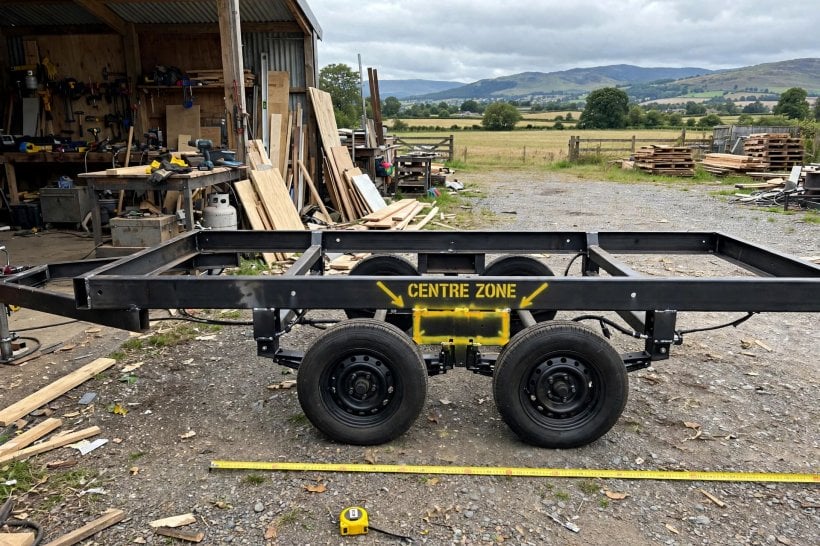
Picture three positions along the trailer, exactly as the visualiser offers them: the centre over the axles, a point six feet away, and the ends at twelve feet. The centre is the safe zone. Loads placed there add weight without adding much swing, because they sit close to the pivot the trailer naturally turns around. It is the first place to assign to anything dense, fixed or hard to move later.
The six-foot positions are the compromise zone. Everyday furniture, lighter cabinetry and loads you can split or shift belong here, balanced front to back and side to side so neither end is asked to carry a concentration on its own. The twelve-foot ends are for the lightest things in the house: bedding, clothing, empty storage and the flexible items you can move on weighing day if the balance needs adjusting.
Design the floor plan around that gradient from the start. Our tiny house weight distribution diagram shows the same centre-first logic visually, and the companion guide to axle placement for tiny houses explains how the axle position itself sets where that safe zone falls. If the axles sit too far back or too far forward for your layout, no amount of careful furnishing will fully rescue the balance.
5. The Fridge: Cold Mass That Never Gets Lighter
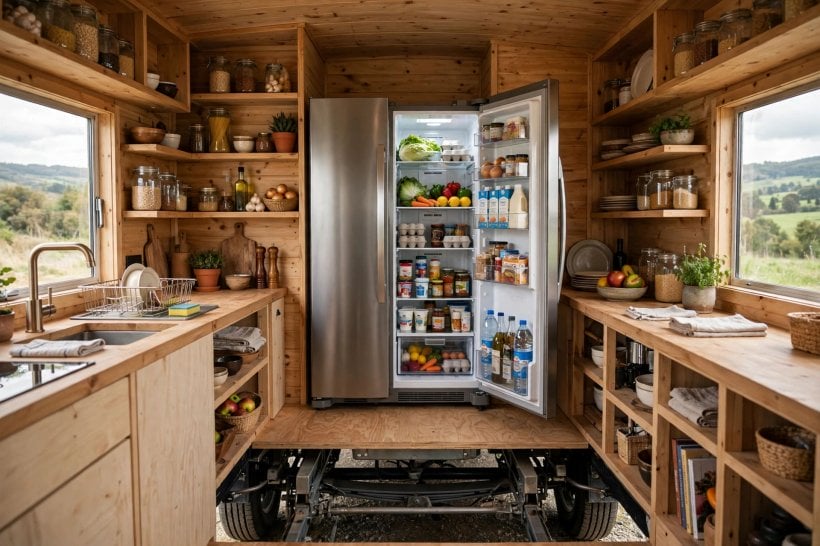
At 350 lbs stocked, the refrigerator is easy to underestimate because it looks like ordinary kitchen cabinetry. It is not. Unlike a water tank, it does not empty as you travel. Unlike a bag of food, it is not consumed and gone in a week. A full fridge is present at the start of every tow and at the end of it, at roughly the same weight, which makes it one of the most honest loads in the whole layout.
That permanence is why the fridge deserves a centre position even when the kitchen design would look tidier with it at the far end. Tucked over the axles, its mass steadies the trailer and frees the ends for lighter storage. Pushed to the rear wall to save a few steps while cooking, it becomes a fixed swinging weight that no loading habit can correct, because you cannot unload cold food at the roadside and carry on.
Plan the kitchen triangle around the centred fridge rather than moving the fridge to suit the triangle. Keep the heavy larder units near it, let the lighter pull-out shelves and bins drift towards the ends, and remember that door swing and ventilation matter too — a fridge that cannot breathe will work harder wherever it stands. The goal is a kitchen that functions daily and tows calmly, in that order on moving day and the reverse on every other day.
6. Washer and Dryer: The Load That Gains Weight in Use
The washer and dryer combination is listed at 180 lbs, the lightest of the four loads in the tool, and in a static weigh-in it looks like the easiest to place. In use it is less innocent. A wash load brings water with it, wet laundry holds more water still, and a spinning drum concentrates that moving mass in a way a static cupboard never does. The appliance you weighed dry is not quite the appliance that lives in the house.
Centre placement solves most of this. Over the axles, the added water weight during a wash cycle is carried where the frame expects load, vibration has the shortest path to the suspension, and the machine’s movement does not translate into leverage at the tail. At the rear, the same cycle can be felt through the floor, and the load’s position gives every spin and slosh an outsized effect on how the trailer sits.
Access matters as well as physics. Plumbing runs stay shorter and simpler near the middle of most layouts, drainage falls are easier to arrange, and a leak — should one ever happen — is discovered in the lived-in centre of the house rather than quietly soaking a rear corner. If your layout also depends on the floor build-up beneath the machine, our flooring weight calculator helps you count that layer honestly before you fix the position for good.

7. Stoves and Fixed Heavy Points
A cast iron stove at 250 lbs sits between the washer and the fridge on the scale, but it behaves differently from both because it is fixed, hot and surrounded by clearances. You cannot slide it six feet for weighing day. Its flue, its hearth and its safe distances from combustible surfaces all lock its position early, which means the stove decision is really a floor-plan decision taken before the walls go up.
The good news is that a stove wants roughly what the trailer wants. It works best low, on a solid hearth, away from sleeping lofts and soft furnishings — and low and central is exactly where heavy point loads belong. Centred near the axles, its weight is carried cleanly and its heat reaches both ends of a small space reasonably evenly. In a rear corner, the same stove concentrates mass, heat and flue length in the worst place for all three.
Treat every fixed heavy point the same way: stoves, water heaters, masonry features and built-in seating with storage inside. List them before you draw the pretty version of the plan, assign the heaviest to the centre first, and let the movable furniture negotiate for what is left. A frame choice changes the sums too, so it is worth reading the steel vs wood framing weight comparison alongside your appliance list — the structure and its contents share one weight budget.

8. Bookshelves and Libraries: The Deceptive Load
The bookshelf is the shock entry in the tool: at 600 lbs, a filled library outweighs the fridge, the stove and the washer combination individually, and nearly matches two of them together. Books are dense, uniform and easy to keep adding. A shelf that looked modest at the design stage quietly becomes the heaviest single feature in the house once every row is filled, and it does so without ever looking like machinery.
Deception is the danger. Nobody designs a rear wall of books thinking of it as ballast, yet that is how the trailer experiences it — a tall, heavy, fixed concentration at the maximum distance from the axles, with its weight carried high as well as far back. High and far is the worst combination the visualiser can show you: a high inertia score, a raised centre of gravity and a load that cannot be redistributed quickly.
The fix is not to give up books. Split the library: the heaviest reference shelves low and centred, smaller runs elsewhere, and the lightest reading near the ends. Build shelving into the centre partition if the plan allows it, keep tall runs braced and genuinely fixed rather than freestanding, and count a full shelf — not an empty one — in every weight estimate from the beginning. What gets counted honestly gets placed honestly.

9. Batteries, Tanks and the Loads You Can Use as Tools
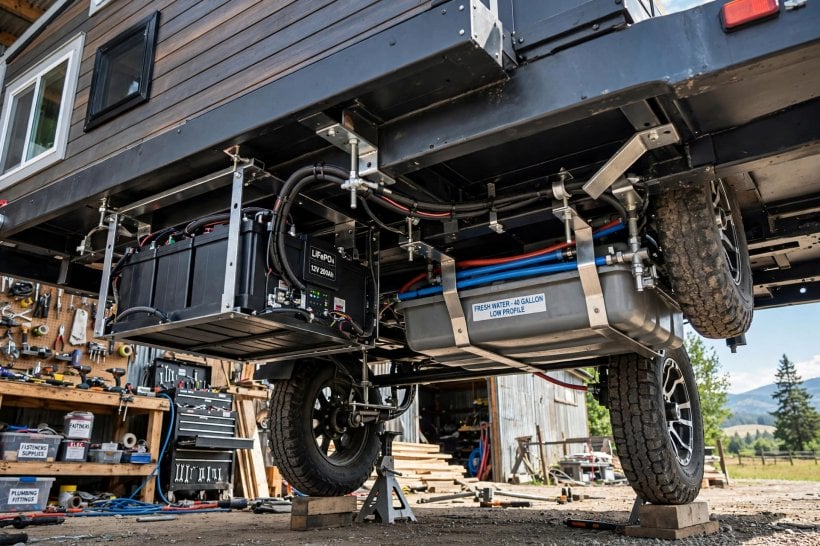
Not every heavy item is a problem to hide. Some loads are adjustable, and adjustable weight is a placement tool in its own right. Battery banks, water tanks and stored fuel can be positioned deliberately — low, centred, or shifted slightly to correct a layout that is otherwise fixed by its kitchen, stove and shelving. Where a fridge is permanent and a library is stubborn, a tank is negotiable.
Batteries make the point clearly. A bank sized for serious off-grid use is heavy enough to matter, and siting it over the axles turns a necessary burden into stabilising mass. Our guide to how much solar power a tiny house needs helps size that bank realistically; once you know its scale, give it a centre position in the plan rather than exiling it to a rear locker because the locker happened to be empty.
Water needs the same respect, with one extra caution: it moves. A partly filled tank can slosh, and sloshing weight is moving weight, so baffled, low, centred tanks behave far better than a single tall tank at an end. Used this way, the service loads stop being afterthoughts and become the fine-tuning that lets the fixed loads stay where daily life wants them.
10. Checking a Finished Layout and Using the Visualiser
When the plan feels finished, check it in three passes. First, the paper pass: list every heavy item, its realistic in-use weight and its distance from the axle centre, and look for concentrations at the ends or on one side. Second, the visualiser pass below: work through the four loads one at a time, slide each from the centre to six feet and then to the ends, and watch how sharply the inertia score responds to distance alone.
Third, the real-world pass: weigh the finished house properly. A session guided by our CAT scale weighing guide and simulator turns estimates into axle readings you can act on, and small corrections can then be tuned with the tongue weight tuner rather than by rebuilding cabinetry. If the readings still fight the layout, compare axle setups in the axle comparison tool before blaming the furniture.
Finally, tow the check, do not just calculate it. Our overview of towing a tiny house, trucks and hitch weights sets out what a calm tow should feel like and which sensations are early warnings. A centred layout should track quietly, recover from gusts without drama and ask little of the tow vehicle’s stability systems. If it does not, the answer is almost always in the plan, not the truck — move the mass, then test again.
Final Considerations
None of this requires a lighter house. It requires an honest list, a centred plan and the discipline to give the ends of the trailer to the lightest things you own. Weigh each heavy load as it will actually travel — stocked, filled and finished — place it by distance first and convenience second, and use the adjustable loads to fine-tune what the fixed loads decide. Do that, and the visualiser below stops being a warning and becomes a confirmation: heavy, legal and calm are perfectly compatible, as long as the weight lives where the axles can carry it.
Appliance Placement Strategy
Appliance Placement Strategy
Visualize the “Pendulum Effect” of heavy appliances.
1. Configure Load
Front (Tongue) | Rear (Tail)
The Physics: Why Position Matters
Imagine holding a dumbbell close to your chest and twisting your body left and right. It’s easy to stop and start.
Now, hold that dumbbell at arm’s length and try to twist. It’s much harder to stop the momentum once it starts moving. This is what happens to your trailer when heavy items are far from the axles.
The force required to stop a swaying trailer grows exponentially with distance. Moving a washer/dryer from the axles to the rear wall doesn’t just double the sway force—it can quadruple it. High inertia makes it impossible for your truck’s stability control to correct a fishtail event.




2 Comments