

When a furniture purchase goes wrong, the piece itself is rarely the whole story. More often the trouble sits in the transaction around it: a warranty nobody read, a return term nobody noticed, a delivery arrangement nobody confirmed, or a review that promised more than the seller ever did. Checking the seller is therefore a separate job from checking the furniture, and it deserves its own routine. This guide covers that routine in general terms. It names no maker and no retailer, offers no verdict on any source, and states no policy, price or availability claim about any seller, because every one of those details belongs to the individual seller’s own written terms, which change over time.
What follows is what to look for, what to ask, and what to keep, before money changes hands. Used in full, it turns an exciting purchase into a calm one: you will know who you bought from, what happens if something arrives damaged, how returns work, and where every promise lives in writing. The piece itself still needs its own examination, and that is a different guide. Here, the subject is the seller and the sale.

1. Start With the Seller, Not the Sofa
Before falling for a piece, learn who is selling it. A real seller can be reached, and that reachability is itself a check: a working contact route, a business address or showroom you can identify, and a named route for after-sales questions all tell you that the business expects to hear from customers after delivery as well as before it. A seller that can only be contacted through a single form, with no other route and no clear name, has given you nowhere to go if a delivery goes wrong. That is not proof of anything about the furniture, but it is a practical problem worth weighing before you order.
Ask how the business describes itself, in its own words, and compare that description with what you can see. Does it sell from stock, make to order, or pass orders to a third party? Each model is legitimate, but each changes what happens next: stock can usually be inspected or dispatched quickly, made-to-order pieces take longer and are harder to return, and a marketplace or agent model means the company handling your money may not be the company handling your furniture. Knowing which arrangement applies tells you who to contact about each kind of problem, and it stops you assuming that one company controls every step.
Consistency is another quiet check. The name, contact details and terms should match wherever you meet them: on the listing, on the order page, and in the confirmation you receive. Mismatches do not always mean trouble, since businesses restructure and rebrand, but an unexplained mismatch is a reason to pause and ask, not a detail to wave through. A seller with nothing to hide will answer a direct question about who you are contracting with, and will do so in writing if you ask. Furniture buying checks cover the piece itself, while this guide stays with the seller and the sale.
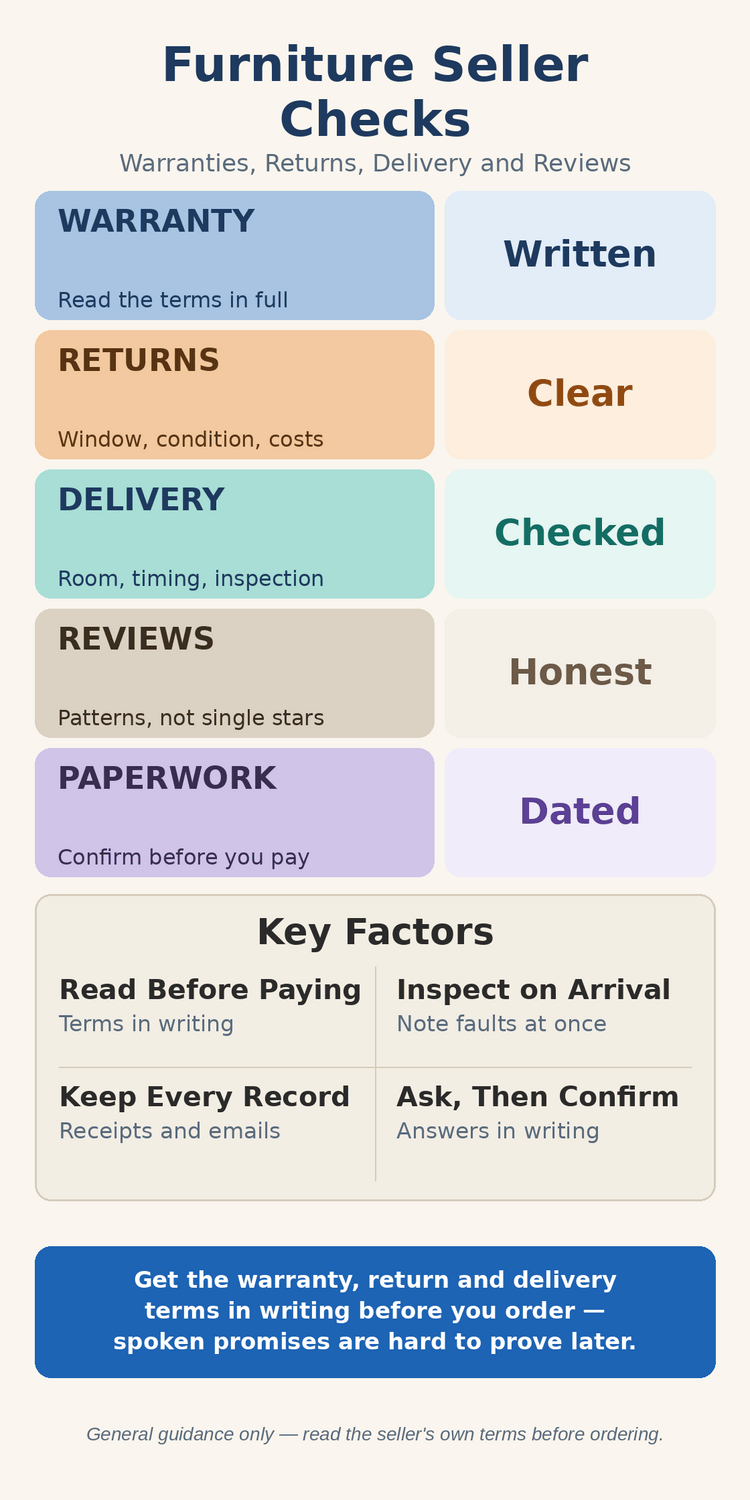
The infographic above summarises the five seller checks that carry a furniture purchase: a warranty read in full, returns understood before ordering, delivery confirmed in advance, reviews read for patterns, and paperwork kept from the first enquiry to the last.
2. The Warranty: Read It Before You Need It
A warranty is a document, not a reassurance, and the only version that matters is the written one. Before ordering, find the warranty terms for the exact piece you are considering and read them end to end, including the parts that describe what is not covered. General wording about lasting quality is not a warranty; the warranty is the specific text that says which parts or problems are covered, for how long, and under what conditions. If you cannot find that text, ask for it, and treat the absence of an answer as information in itself.
Pay attention to who handles a claim. Some sellers deal with claims themselves, some pass you to a maker, and some use a third-party service. Each route works differently, and the difference matters most when you are already annoyed about a fault: a single named contact with a clear process is easier to deal with than a chain of referrals. Ask, before ordering, who you contact first, what evidence they ask for, and whether repairs, parts or replacement are the usual outcomes. You are not looking for a promise you like; you are looking for a process you understand.
Also check what the warranty asks of you. Many warranties expect normal domestic use, care along the lines of the maker’s guidance, and prompt reporting of faults. Those expectations are usually reasonable, but they are only fair if you know them in advance. Keep a copy of the warranty with your order papers, and note the date and route of any claim you ever make. A warranty you have read is a tool; a warranty you assumed is a surprise waiting for the worst moment.

3. Returns: The Terms That Matter Most
Returns are where furniture buying differs most from ordinary shopping, because furniture is large, heavy and hard to move twice. The return terms therefore deserve more attention than any other part of the sale, and they deserve it before ordering, not after a piece arrives and disappoints. Find the return terms in writing and read them the way you read the warranty: what can be returned, in what condition, within what window, and at whose cost and arrangement. Vague wording such as easy returns means nothing on its own; the specifics are the policy.
Several questions separate a clear return policy from a murky one. Who arranges collection, and does the piece need its original packaging? Is there a charge for collection or restocking, and how is it calculated? What happens to any delivery charge you already paid? And what condition must the piece be in — unused, assembled, or simply undamaged? Each answer changes the real cost of changing your mind, and a seller who answers plainly is easier to trust with a large order than one whose answers stay vague through several enquiries.
One more distinction matters: the difference between returning a piece because you changed your mind and returning one because it arrived damaged or faulty. Sellers often treat those two cases differently, and the distinction is usually fair, but only if you know it before ordering. Ask which case applies to which situation, and keep the answer with your order papers. A return policy understood in advance turns a disappointment into an errand; one discovered afterwards turns it into a dispute.

4. Delivery: What Arrives, Where, and When
Delivery is the moment a furniture purchase becomes real, and it is also the moment most easily spoiled by an unasked question. Before ordering, confirm what the delivery service actually includes. Some deliveries end at the door, some bring the piece into a room of your choice, and some include unpacking or removing packaging. None of these is standard, and assuming the most generous version is how a sofa ends up waiting in a hallway. Ask plainly where the delivery ends, what the crew will and will not do, and what happens if access proves difficult on the day.
Timing deserves the same directness. Ask how the delivery date is set, how you are told about it, and what happens if the date changes. A seller that gives a delivery window and a contact route for the day itself is giving you something workable; a seller that gives only an estimate with no way to check progress is asking you to wait blind. If the piece is made to order, ask what the stages are and how you will hear about each one. Waiting is much easier when you know what you are waiting for and who to ask about it.
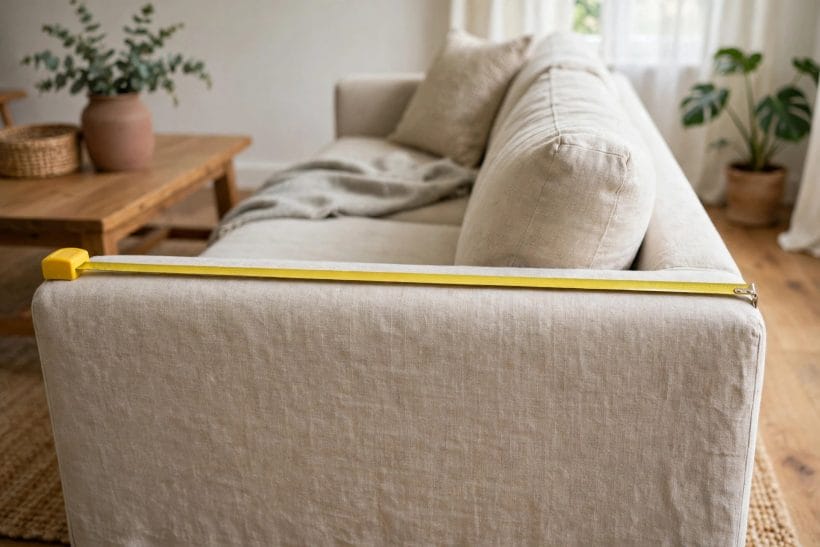
Finally, plan the arrival itself. Clear the route the piece will travel, measure the doorways and turns it must pass — not the room alone, but the whole journey from the street to its place — and be present, if you can, when it arrives. Inspect the piece before the delivery crew leaves, in good light, and note anything wrong on the delivery paperwork at the time, even if it seems minor. Small marks are easy to discuss on delivery day and hard to prove a week later. Patio furniture checks show the same arrival discipline applied outdoors, where weather and access complicate delivery further.

5. How to Read Reviews Without Being Misled
Reviews are useful evidence and terrible verdicts, and the difference lies in how you read them. A single review, however enthusiastic or furious, tells you about one person’s order, not about a seller. Patterns tell you far more: the same praise or complaint appearing across many reviews, over a long period, and in specific detail, is worth more than any number of vague five-star or one-star notes. Read for repetition first, and for extremes last.
Detail is the best filter for genuine reviews. A useful review names the piece, describes the delivery or the fault, and says what happened next — whether the seller responded, what was offered, and how long it took. A review that only praises or only condemns, with no specifics and no timeline, tells you little either way. Photographs from buyers help, because they show the piece in a real room rather than a studio, but even photographs need care: colour and scale shift between cameras and rooms, so treat them as a rough guide, not a guarantee.
Also weigh who wrote the review and when. Recent reviews matter more than old ones, because staff, suppliers and policies change. Reviews tied to a confirmed purchase carry more weight than anonymous ones, and a seller’s replies matter too: a calm, specific reply to a complaint tells you more about after-sales care than a page of praise. Ignore any single score, however it is presented, and read the words underneath it. A seller with a mixed but detailed review record and responsive replies is often a safer bet than one with a spotless record and no detail at all.

6. The Description: What Is Actually Promised
A listing is a promise written in sales language, and your job is to translate it back into facts. Read the description line by line and separate what is stated from what is implied. Stated dimensions, stated materials and stated finishes are facts you can check; words that suggest luxury, comfort or craftsmanship without specifics are atmosphere, not information. If a description leans heavily on atmosphere and lightly on specifics, ask for the specifics before ordering, and keep the answers with your order.
Colour deserves special care. Screen colours shift, room lighting shifts them further, and a fabric or finish that looked one way online can look different at home. If colour matters to you, ask for a sample or swatch where one is offered, and view it in the room where the piece will live, in daylight and in evening light. The same caution applies to scale: a piece photographed alone can look smaller or larger than it is, so trust the listed dimensions and your own measurements over the photograph. Photographs sell furniture; dimensions place it.
Finally, check what is included and what is not. Some pieces arrive assembled, some need assembly, and some need assembly plus fixings or tools you may not own. Cushions, covers, legs and fixings are sometimes included and sometimes separate, and the listing should say which. A short message asking what exactly arrives in the box can prevent a second order for a missing part and a wait for a piece that cannot yet be used. Furniture quality checks cover the hands-on examination of the piece itself once it arrives, which is the natural companion to reading the description well.

7. Questions Worth Asking Before You Order
A short list of questions, asked before ordering, prevents most furniture disputes. The questions themselves are simple, and a good seller answers them without fuss. What is the full warranty wording, and who handles a claim? What are the return terms for a change of mind, and what are they for a damaged or faulty piece? What does delivery include, where does it end, and how is the date confirmed? What happens if the piece arrives damaged, and how quickly should you report it? What is included in the box, and what assembly is needed? Each question has a written answer somewhere; your job is to collect those answers before committing.
Two further questions are worth asking because they reveal how a seller behaves under pressure. The first is what happens if the piece is delayed: who tells you, when, and what choices do you have? The second is who to contact after delivery if something goes wrong, and by what route. Sellers that answer both plainly have thought about problems in advance, which is exactly what you want. Sellers that treat either question as an insult have told you something important about how a future problem will be handled.
Ask these questions in writing where you can, even if you first discuss them in a showroom or on the telephone. A short message summarising what was agreed — the piece, the terms, the delivery arrangement — gives both sides the same record and removes most arguments about what was said. If a seller will not confirm an important point in writing, treat that reluctance as part of your decision, not as a detail to overlook. The same what-to-check discipline applies well beyond furniture: bamboo flooring checks show it applied to another large, hard-to-return purchase.
8. Paperwork: Keep Everything
Good paperwork is boring, and that is its virtue. From the first enquiry to the final delivery, keep every document the sale produces: the listing or quote, the order confirmation, the warranty terms, the return terms, the delivery note, and every message in which the seller confirmed something. Keep them together, in one place, physical or digital, so that any question can be answered from the file rather than from memory. Memory softens with time; paperwork does not.
Delivery day adds two documents worth special care. The first is the delivery note itself: read it before signing, and write any damage or shortage on it at the time, however small it seems. A note signed without comment is hard to argue with later, while a note with a clear comment preserves your position without creating a confrontation. The second is your own record: photographs of the piece as it arrives, including packaging and any marks, taken in good light before anything is unpacked or moved. Photographs taken on the day are worth more than descriptions written a week later.
Keep the file after the piece is in place, too. Warranties run for a long time, and a fault can appear months after delivery. A file that still holds the order, the terms and the delivery photographs turns a warranty claim into a short, factual message rather than a search through old inboxes. Bookcase ideas are a reminder of why this matters: large pieces that live against walls are rarely moved again, so any fault found late is much harder to evidence without arrival-day records.

9. Payment and Protection in General Terms
Payment is part of the seller check, not an afterthought, because the way you pay shapes what happens if the sale goes wrong. Before paying, understand the payment route you are using and what records it gives you: a receipt that names the seller, the piece and the amount, and a payment record you can trace. Pay in a way that leaves a clear trail, and avoid any arrangement that asks you to pay without one. A seller that prefers untraceable payment has removed your evidence as well as your protection, and that alone is reason to pause.
Also confirm what the payment covers and when each part falls due. Some orders take full payment at once, some take a deposit with a balance on delivery or dispatch, and each arrangement carries a different risk if the order is delayed or cancelled. Neither model is wrong in itself, but the model should be stated plainly before you pay, along with what happens to money already paid if the order cannot be completed. If any part of the payment arrangement is unclear, ask until it is clear, and keep the answer in writing with the rest of the file.
Finally, separate the price from the value of the checks in this guide. A low price does not excuse unread terms, and a high price does not guarantee good after-sales care; both have to be checked on their own evidence. The sellers that earn confidence are not the cheapest or the dearest, but the ones whose terms are clear, whose answers are written, and whose delivery and returns processes survive a careful reading. Price is one line of the order. The rest of the order is the seller.

10. Putting It Together: A Pre-Order Routine
With the checks understood, they compress into a routine you can run before any furniture order, however large or small. First, identify the seller and confirm who you are contracting with. Second, read the warranty and return terms in full, and note the answers to the questions that matter: who handles claims, who arranges returns, and what each case costs you. Third, read reviews for patterns rather than scores, weighing recent, detailed, purchase-linked reviews above vague praise or blame. Fourth, confirm delivery in writing: where it ends, how the date is set, and how damage should be reported.
Fifth, measure the whole journey the piece must travel, from the street to its final place, and compare those measurements with the listed dimensions rather than with photographs. Sixth, confirm what arrives in the box and what assembly is needed, so the piece can be used on delivery day rather than after a second order. Seventh, pay by a traceable route, keep the receipt, and file every document with the order. Run in that order, the routine takes less time than choosing the fabric, and it protects a far larger commitment.
Complex pieces reward the routine most. A mechanism bed, a wall-fixed unit or any piece that needs installation as well as delivery adds a further question: who installs it, and what happens if installation reveals a problem? Murphy bed ideas illustrate the point, since a folding mechanism has moving parts and fixings that a simple chair never will. Coffee table pictures show the gentler end of the same scale, where the main risks are size and finish rather than mechanism. Either way, the routine is the same: seller first, terms in writing, delivery confirmed, arrival inspected.
Final Considerations
A furniture seller is not judged by a single purchase, a single review or a single slogan, and this guide has deliberately offered no such judgement about any seller. What can be judged, piece by piece and term by term, is the transaction in front of you: a warranty you have read, return terms you understand, delivery you have confirmed, reviews you have read for patterns, and paperwork you have kept. Those five checks, run before ordering, catch most furniture disappointments while they are still easy to avoid.
Buy the piece you love, but buy it through a seller whose terms you have actually read. Check first, confirm in writing, inspect on arrival, and keep the file. The furniture will then have the best possible chance to do the quiet job it was bought for: sitting in your home, used daily, and never giving you a reason to think about the seller again.




0 Comments