
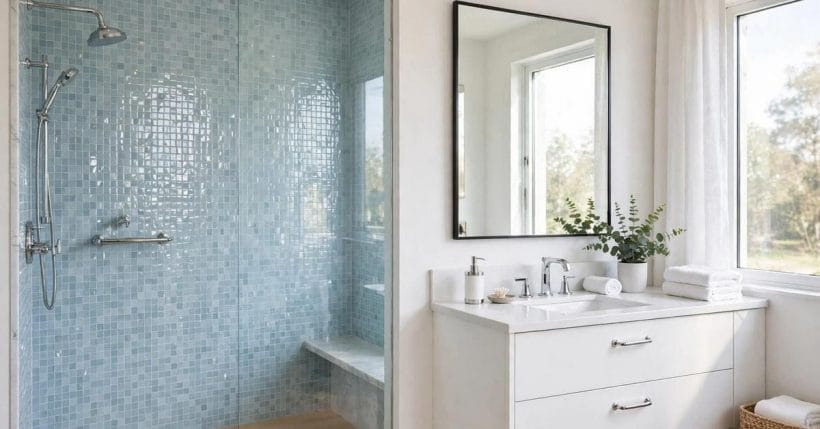
Glass tile changes a bathroom the moment light hits it. Where a plain wall simply holds colour, a glass wall returns it, shifting with the daylight, the mirror lights, and the steam after a shower, so even a modest room can feel bright, layered, and carefully finished. The seventy-five glass tile bathroom ideas below stay firmly on glass tile itself: its finishes, colours, patterns, layouts, vanity pairings, and space-saving tricks, so you can compare looks side by side and choose the direction that suits your room. Among all the glass tile shower ideas in circulation, the strongest ones share a simple discipline: pick one tile story, repeat it with restraint, and let the fittings and the grout support it rather than compete with it.
Start with the room before falling for a finish. A shower that gets generous daylight can carry deeper colour and stronger pattern, while a windowless room leans on pale glass, clear finishes, and good mirror lighting to stay bright. A family bathroom needs surfaces that wipe clean and grout lines that stay presentable with ordinary care, while a quiet retreat can favour soft blends and calm, continuous walls. Plumbing changes, waterproofing, and any work behind the wall belong to qualified professionals, and local requirements should be checked with your local authority before work begins. Costs vary with tile size, finish, pattern complexity, and the amount of cutting and detailing involved, so treat the drivers in this guide as general guidance for comparing options, not as figures for any particular room.
1. Glass Tile Finishes to Know First
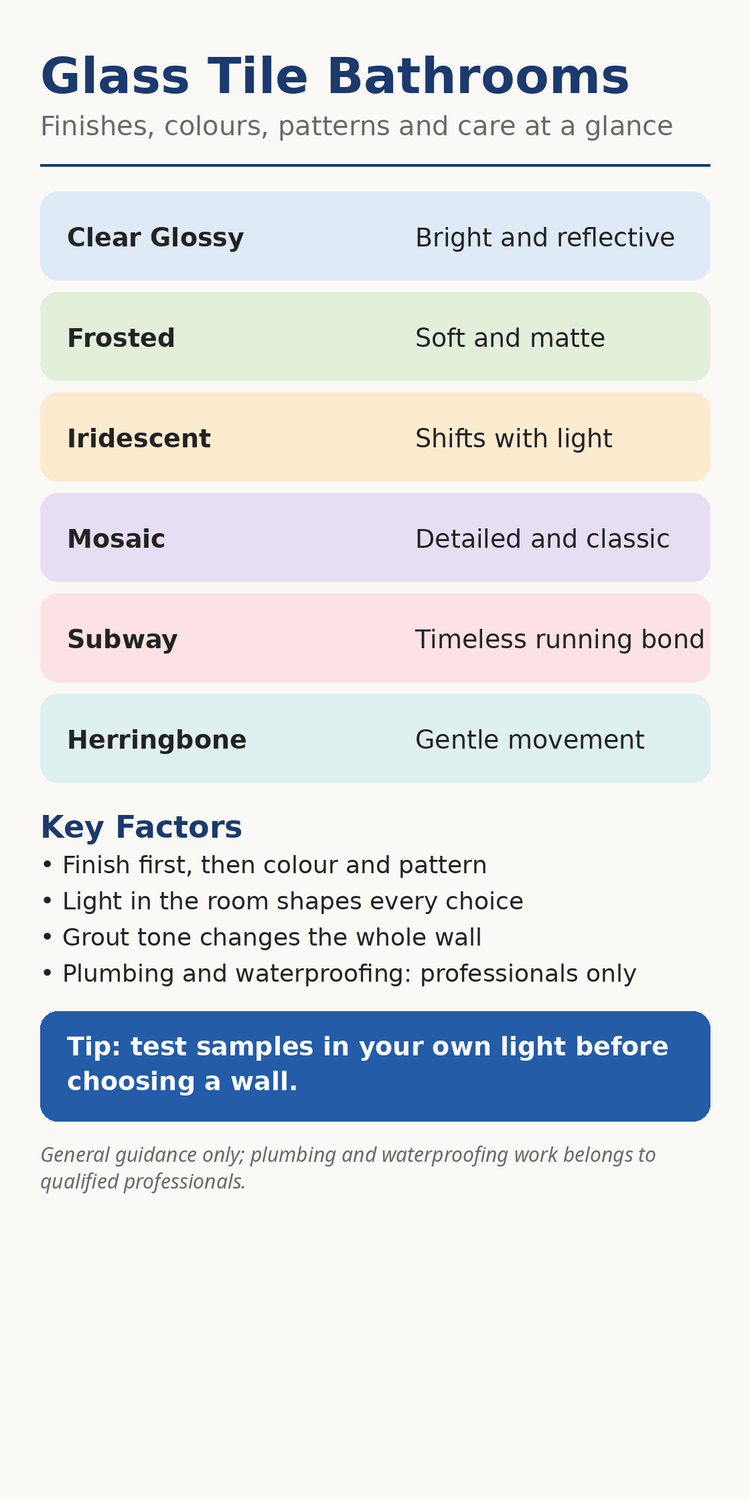
Every glass tile idea in this guide starts with finish, because finish decides how much light a wall returns, how much pattern shows, and how forgiving the surface is day to day. Compare samples in your own room, in daylight and under your mirror lights, before committing to a wall.
| Item | What it is |
|---|---|
| Clear glossy glass mosaic on a shower wall | Clear glossy mosaic is the classic glass tile look, and it earns its place by reflecting light deep into the room. |
| Frosted glass for a soft, matte glow | Frosted glass trades sparkle for softness, diffusing light across the wall instead of throwing it back in bright points. |
| Iridescent glass that shifts with the light | Iridescent glass carries a thin shimmer that changes as you move past it, so a wall can look pearl in the morning and faintly coloured by evening. |
| Textured glass that adds grip for the eye | Textured glass, with ripples, waves, or a softly hammered surface, adds depth that flat tile cannot match, and it breaks up reflections in a way that feels handcrafted. |
| Large-format glass panels for a calm wall | Large-format glass panels reduce grout lines to a minimum, giving a shower wall a smooth, almost seamless look that suits modern rooms. |
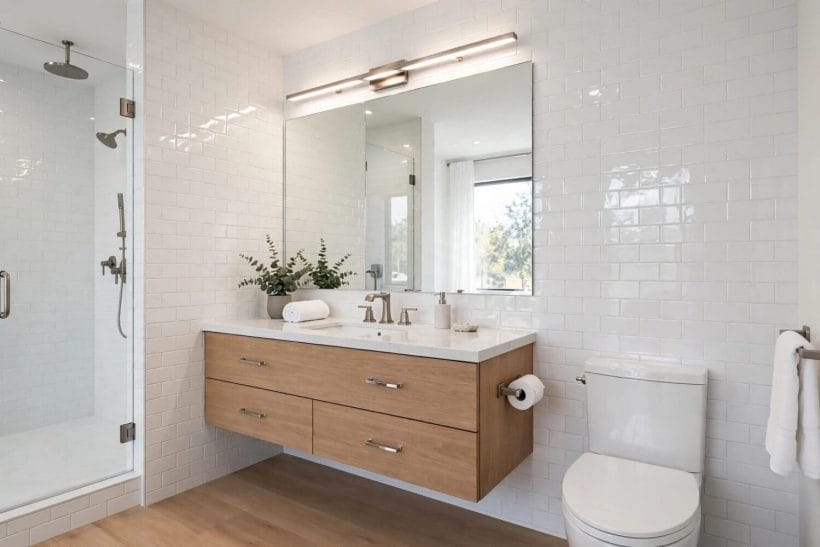
| Glass subway tile in a classic running bond | Glass subway tile brings the familiar brick rhythm of a classic bathroom into a lighter, brighter material, and the running bond layout keeps the wall feeling orderly and timeless. |
| Recycled glass tile with a story in every piece | Recycled glass tile turns reclaimed material into a wall with subtle variation from piece to piece, so no two walls ever look quite alike. |
| Back-painted glass for pure, even colour | Back-painted glass gives a wall a pure, even colour with a glossy depth that printed or glazed surfaces struggle to match. |
| Full-height glass wall from floor to ceiling | A full-height glass wall makes the shower feel taller and more generous, drawing the eye upward and giving the room a finished, architectural feel. |
| A single accent wall behind the showerhead | Placing glass tile on the wall behind the showerhead concentrates colour and shimmer exactly where the eye lands, while the remaining walls stay plain and calm. |
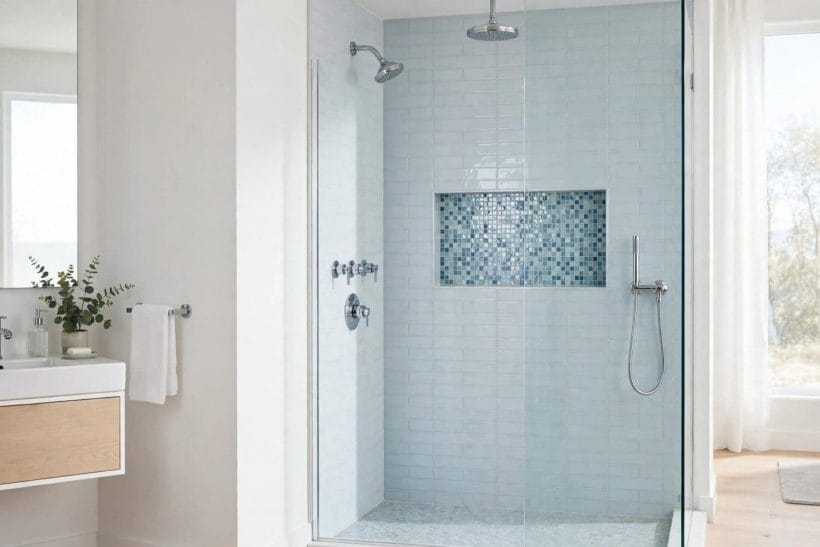
| Glass tile wrapping a shower niche | Wrapping a shower niche in glass tile turns a practical recess into a small jewel box, framing bottles and bars in colour and light. |
| Glass tile climbing onto the shower ceiling | Carrying glass tile from the wall onto a shower ceiling creates a cocooning effect, as light reflects from above as well as from the sides. |
| Wainscot-height glass band around the shower | A wainscot-height band of glass tile, finished with a neat trim, gives a shower a tailored edge without the commitment of a full wall. |
| Vertical stacked glass strips that lift the eye | Stacking glass tile in vertical strips emphasises height, making a low or compact shower feel taller than it is. |
| Horizontal glass bands that widen a narrow shower | Horizontal bands of glass tile stretch a narrow shower sideways, balancing rooms that feel tight from side to side. |
| Glass tile framing the shower opening | Framing the shower opening with glass tile, like a border around a doorway, marks the threshold between the dry room and the wet zone with colour and shine. |
| Sea-glass blues for a coastal calm | Sea-glass blues, from pale aqua to soft mid-blue, bring a coastal calm that suits bathrooms of every size. |
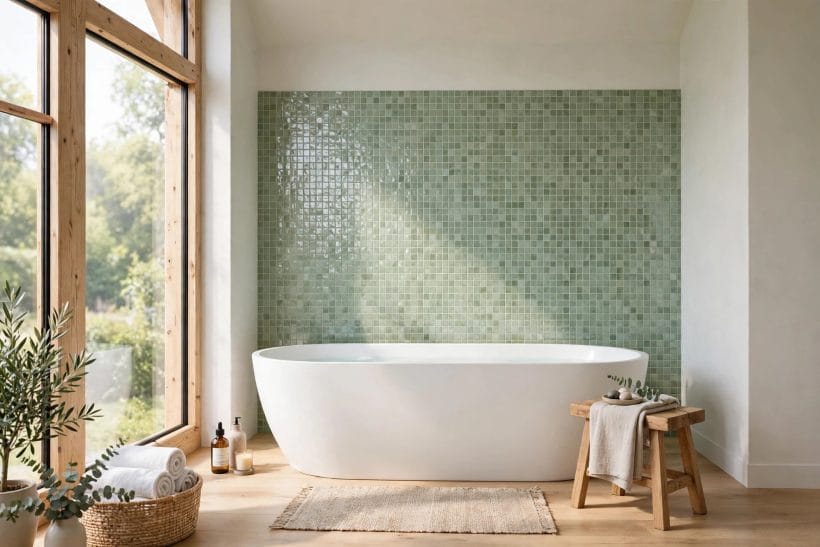
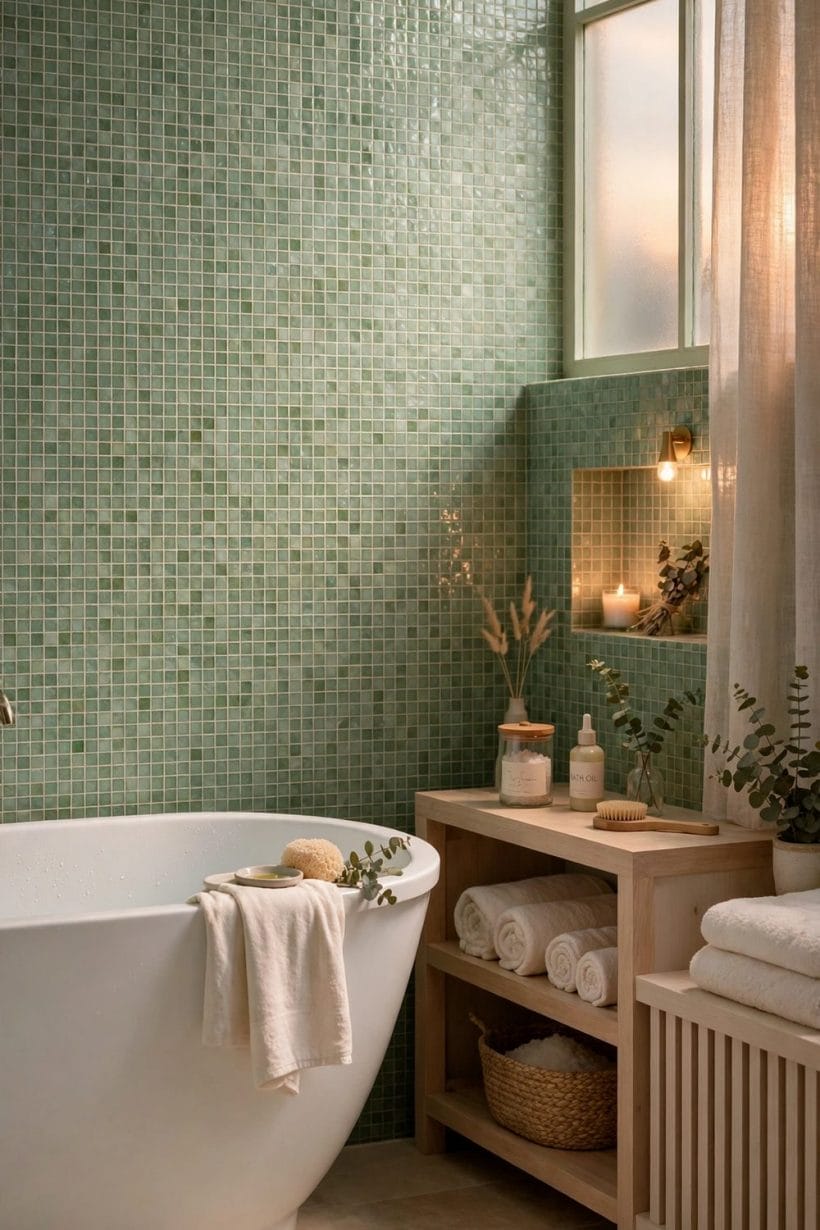
| Soft greens that feel fresh and restful | Soft greens, from sage to seafoam, feel fresh without feeling cold, and glass gives them a dewy depth that suits morning routines. |
| Aqua blends that brighten a windowless room | Aqua blends, mixing pale blue, green, and clear glass, are a reliable way to brighten a room without a window, since the varied tones scatter light in many directions at once. |
| Crisp white glass for a clean, bright room | Crisp white glass gives the cleanest, brightest wall of all, reflecting the maximum light and making small rooms feel larger. |
| Smoky greys for a quiet, modern mood | Smoky grey glass brings a quiet, modern mood that pairs beautifully with concrete-look floors, matte black fittings, and pale timber. |
| Deep navy glass for evening drama | Deep navy glass turns a shower wall into an evening feature, glowing under warm lights like water at dusk. |
| Jewel tones for a single bold statement | Jewel tones, such as emerald, ruby, or amethyst glass, make a single bold statement best reserved for one wall, niche, or band. |
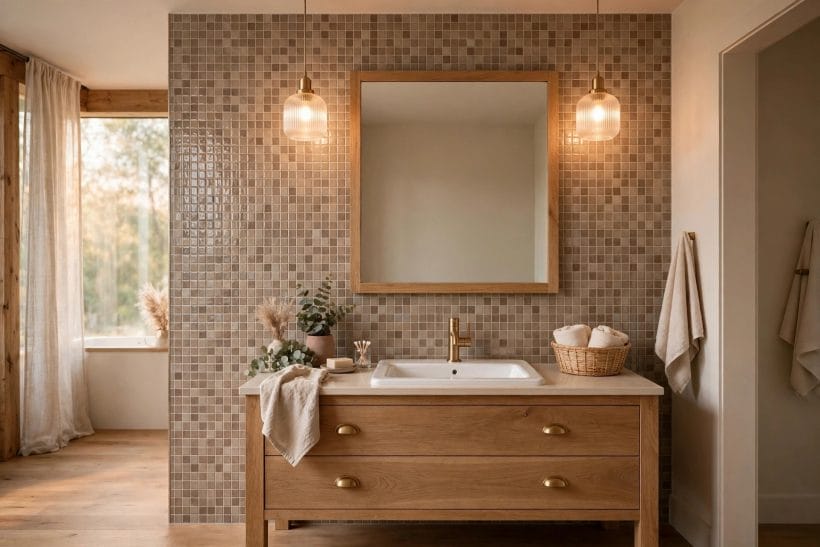
| Warm neutrals that age gracefully | Warm neutrals in glass, from sand to soft taupe to pale gold, age gracefully because they sit comfortably with changing towels, accessories, and fittings. |
| Glass mosaic backsplash behind the basin | A glass mosaic backsplash behind the basin protects the wall from splashes while adding colour exactly where the eye rests during daily routines. |
| Full vanity wall in pale glass | Running pale glass tile across the full vanity wall, from counter to mirror and beyond, creates a luminous backdrop that flatters the whole zone. |
| Glass tile framing the mirror | Framing a mirror with glass tile turns a plain mirror into a designed feature, with colour and shine bordering the reflection. |
| Floating vanity with a glass tile backdrop | A floating vanity against a glass tile backdrop feels light and modern, since the wall shines beneath and around the suspended unit. |
| Double vanity divider in contrasting glass | A vertical strip of contrasting glass tile between two basins gives each side of a double vanity its own identity while keeping the wall unified. |
| Glass tile edging a vanity countertop | Edging a vanity countertop with glass tile adds a jewel-like detail to the counter edge, catching light at hand height and tying the counter to the wall behind it. |
| Open shelving backed by glass mosaic | Open shelving backed by glass mosaic turns stored towels and jars into a display, with colour and shine behind everyday objects. |
| Powder-room vanity wall in bold glass | A powder room is the perfect place for bold glass, since its small vanity wall can carry a confident colour or pattern that might overwhelm a large family bathroom. |
| Shower floor in small glass mosaic | Small glass mosaic on a shower floor gives the enclosure a jewel-like base, with many grout lines that also help the surface feel secure underfoot. |
| Glass border strip along a plain wall | A slim glass border strip along an otherwise plain wall adds a line of light and colour without committing to a fully tiled surface. |
| Glass threshold strip at the shower entry | A glass threshold strip at the shower entry marks the wet boundary with a neat line of colour, finishing the junction between the shower floor and the dry floor. |
| Rug-like glass inlay in the bathroom floor | A rug-like glass inlay, a rectangle or medallion of mosaic set into a plainer floor, gives the bathroom a designed centre without tiling the whole floor in glass. |
| Glass mosaic around the drain | Framing the drain with a contrasting glass mosaic turns a necessary fitting into a small design moment, with colour radiating from the drain point. |
| Skirting-height glass band around the room | A skirting-height glass band around the bathroom, just above the floor line, protects the lower wall while adding a ribbon of colour that ties the room together. |
| Glass tile riser on a bathroom step | Where a bathroom has a step up to a bath or a raised shower tray, a glass tile riser turns that step face into a colourful detail. |
| Matching glass borders on wall and floor | Repeating the same glass border on the wall and the floor ties the two planes together, giving the bathroom a tailored, finished feel. |
| One continuous glass wall to stretch a tiny room | Running one glass wall continuously, without breaks or competing features, stretches a tiny room by giving the eye an unbroken plane to follow. |
| Mirror paired with glass tile for double light | Pairing a large mirror with glass tile doubles the light in a small bathroom, as each surface reflects the other and the room feels twice as bright. |
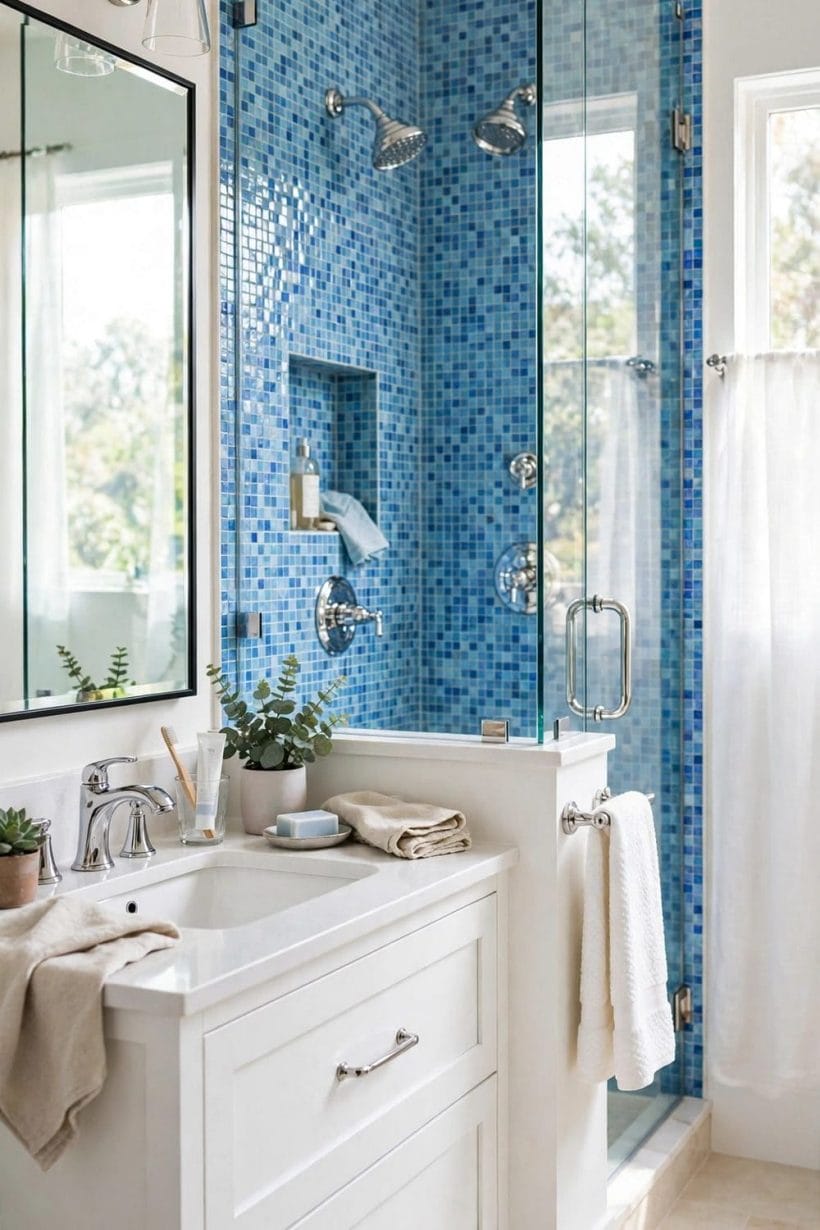
| Corner shower wrapped in pale glass | Wrapping a corner shower in pale glass makes the corner feel like a light box rather than a tight enclosure, since the pale tones and reflections open up the angle. |
| Alcove shower with glass on three sides | An alcove shower with glass on three sides feels like a small grotto of light, with colour and shine surrounding the bather without needing a large footprint. |
| Glass-on-glass: tile plus clear screen | Combining glass tile with a clear shower screen, glass on glass, keeps the whole shower transparent and light, so the room reads as one space rather than two. |
| Vertical glass panels above a compact vanity | Vertical glass panels above a compact vanity draw the eye upward, making a small vanity zone feel taller and more generous. |
| Light glass behind a wall-hung toilet | Placing light glass tile on the wall behind a wall-hung toilet brightens a corner that is often left plain, and it makes the sanitaryware feel designed rather than merely fitted. |
| Narrow glass splashback in a cloakroom | A narrow glass splashback in a cloakroom, just wide enough for the basin, adds colour and protection to the smallest bathroom of all. |
| Shower controls mounted on glass mosaic | Mounting shower controls on glass mosaic puts the hardware against a shimmering backdrop, so even plain controls look considered. |
| Built-in shower shelf lined with glass | Lining a built-in shower shelf with glass tile gives the shelf a finished interior that matches or contrasts with the shower wall. |
| Glass tile bench inside the shower | A shower bench tiled in glass mosaic becomes a comfortable and beautiful seat, with colour and shine at sitting height. |
| Freestanding bath against a glass feature wall | Placing a freestanding bath against a glass feature wall creates a bathing focal point, with the bath silhouette framed by colour and light. |
| Glass tile behind the bath taps | Tiling the wall behind the bath taps in glass mosaic protects the splash zone while giving the taps a jewel-like backdrop. |
| Toilet wall accent in quiet glass | A quiet glass accent on the toilet wall, in a pale or smoky tone, gives the least-decorated wall in the bathroom a gentle lift without demanding attention. |
| Glass tile lining a bath surround | Lining a bath surround, the apron or the wall around a built-in bath, with glass tile turns the bath into a piece of furniture rather than a plain box. |
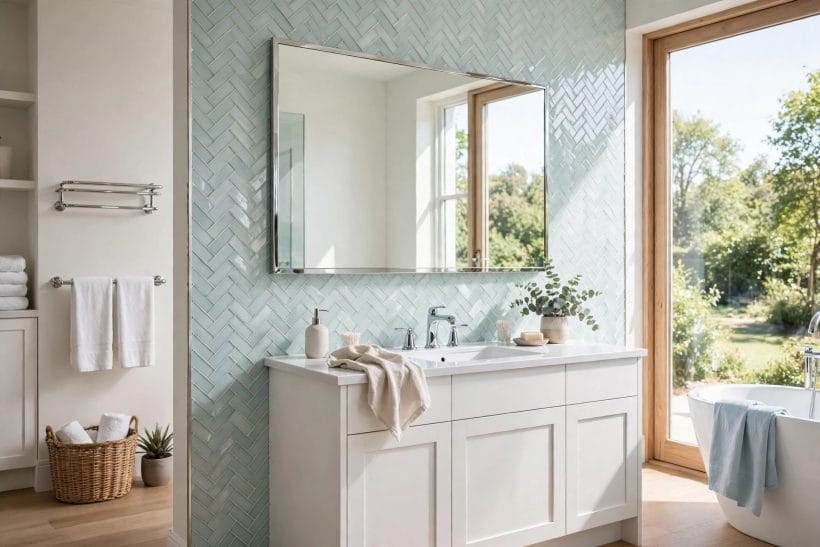
| Herringbone glass for gentle movement | Herringbone glass, with its zigzag rhythm, adds gentle movement to a wall without strong colour contrast, since the pattern itself provides the interest. |
| Basketweave glass for classic charm | Basketweave glass, with its woven over-under rhythm, brings classic charm to bathrooms that want a traditional feel with a luminous material. |
| Penny-round glass for playful dots | Penny-round glass, small circles set in a sheet, adds a playful dotted texture that suits family bathrooms and cheerful cloakrooms. |
| Arabesque glass for an elegant arch | Arabesque glass, with its lantern-like arch shape, brings an elegant, almost Moroccan feel to shower walls and feature panels. |
| Stacked glass in a clean modern grid | Stacked glass, laid in a straight grid rather than a staggered bond, gives a clean modern look that suits minimalist bathrooms. |
| Brick-bond glass for timeless order | Brick-bond glass, the staggered running bond, gives a timeless order that suits almost any bathroom, from classic to contemporary. |
| Grout colour as a design decision | Grout colour deserves the same attention as tile colour, since it can make glass tile read as seamless, textured, or graphic. |
| Layering mirror light over glass tile | Layering mirror light over glass tile, with sconces or a lit mirror beside the tiled wall, makes the glass glow in the evening as well as by day. |
| Glass tile in a steam shower | Glass tile suits steam showers well, since its smooth, non-porous surface handles humidity gracefully and its colour deepens beautifully in steam. |
| Daily wipe-down that keeps glass bright | A quick daily wipe-down with a soft cloth keeps glass tile bright, removing water marks before they dry and dull the shine. |
| Hard-water care for glass walls | Hard water leaves mineral marks on glass that show more clearly than on opaque tile, so a gentle routine matters in hard-water homes. |
| Sealing grout around glass tile | Sealing the grout around glass tile helps the joints resist staining and moisture, keeping the wall looking fresh for longer. |
| Ventilation that protects the whole room | Good ventilation protects glass tile and the whole bathroom, clearing steam before it condenses and settles on walls and ceilings. |
| Touching up a damaged glass tile | A damaged glass tile, chipped or cracked, should be replaced rather than painted over, since glass cannot be disguised the way opaque tile sometimes can. |
| Coastal bathroom in sea-glass tones | A coastal bathroom in sea-glass tones, with aqua and pale blue glass, white fittings, and pale timber, feels like a breath of seaside air. |
| Modern bathroom in pale grey glass | A modern bathroom in pale grey glass, with matte black fittings, a floating vanity, and a frameless screen, reads as calm and architectural. |
| Spa retreat in soft green glass | A spa retreat in soft green glass, with cream towels, timber accents, and warm mirror light, turns daily routines into small rituals. |
| Vintage-inspired bathroom with basketweave glass | A vintage-inspired bathroom with basketweave glass, a classic basin, and brushed fittings nods to the past without feeling like a museum. |
| Bold feature wall as the room star | A bold feature wall in jewel-toned or iridescent glass gives the bathroom a single star, with everything else in supporting roles. |
| Calm neutral retreat for everyday living | A calm neutral retreat in warm sand and taupe glass suits everyday living best of all, since it welcomes changing towels, seasons, and moods without ever clashing. |
1. Clear glossy glass mosaic on a shower wall
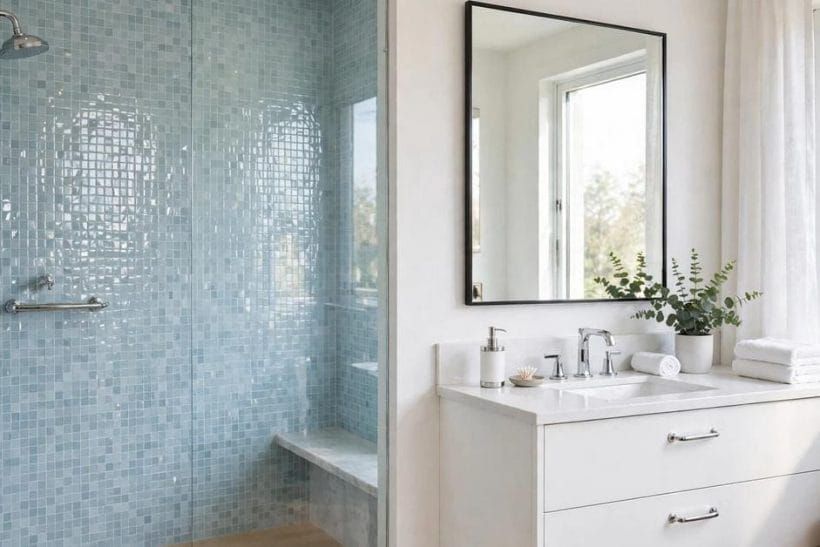
Clear glossy mosaic is the classic glass tile look, and it earns its place by reflecting light deep into the room. Small squares catch the eye without demanding attention, and the grout grid gives the wall a tidy rhythm that suits both calm and colourful schemes. Keep the surrounding fittings simple so the shimmer reads as texture rather than clutter, and choose a grout tone close to the tile so the wall feels continuous rather than busy.
2. Frosted glass for a soft, matte glow
Frosted glass trades sparkle for softness, diffusing light across the wall instead of throwing it back in bright points. It suits bathrooms that want a quiet, spa-like mood, and it pairs beautifully with pale timber, brushed fittings, and warm mirror lighting. Frosted finishes also calm strong colours, so a bold blue or green reads as gentle rather than loud, which helps in rooms that are used early in the morning.
3. Iridescent glass that shifts with the light
Iridescent glass carries a thin shimmer that changes as you move past it, so a wall can look pearl in the morning and faintly coloured by evening. Use it where the light moves, such as a wall opposite a window or beside a mirror, and keep the rest of the room calm so the shift stays a pleasure rather than a distraction. A little iridescence goes a long way, so a single feature wall usually beats a whole room of it.
4. Textured glass that adds grip for the eye
Textured glass, with ripples, waves, or a softly hammered surface, adds depth that flat tile cannot match, and it breaks up reflections in a way that feels handcrafted. It works well as a shower accent or a vanity backdrop, where hands and eyes linger, and it hides water marks better than a perfectly smooth sheet. Pair texture with plain fittings and quiet grout so the surface itself can carry the interest.
5. Large-format glass panels for a calm wall
Large-format glass panels reduce grout lines to a minimum, giving a shower wall a smooth, almost seamless look that suits modern rooms. The calm surface lets colour and light do the talking, and cleaning becomes simpler because there are fewer joints to tend. Large panels need careful handling and precise fitting, so this is a choice to discuss with an experienced installer rather than a weekend experiment.
6. Glass subway tile in a classic running bond
Glass subway tile brings the familiar brick rhythm of a classic bathroom into a lighter, brighter material, and the running bond layout keeps the wall feeling orderly and timeless. It suits vanity walls, shower surrounds, and wainscot-height bands alike, and it accepts almost any grout tone, from matching pale grey to a gentle contrast. Subway glass is also forgiving in small rooms, because its regular shape reads as calm rather than fussy.
7. Recycled glass tile with a story in every piece
Recycled glass tile turns reclaimed material into a wall with subtle variation from piece to piece, so no two walls ever look quite alike. The gentle differences in tone and translucency give the room a handcrafted feel, and the story behind the material suits households that value reuse and thoughtful sourcing. Ask suppliers about the recycled content and the finish, and view a full sheet rather than a single chip, since variation is the point.
8. Back-painted glass for pure, even colour
Back-painted glass gives a wall a pure, even colour with a glossy depth that printed or glazed surfaces struggle to match. It suits bold vanity backdrops and shower accents where a single confident colour is wanted, and it pairs well with chrome, brushed nickel, or matte black fittings depending on the mood. Because the colour is so even, keep the layout simple and let the finish itself be the feature.
2. Shower Walls and Layouts
The shower wall is where glass tile earns its keep, catching water, light, and attention at once. These layouts show how far a single wall can go, from full-height drama to a quiet band that simply finishes the room.
9. Full-height glass wall from floor to ceiling
A full-height glass wall makes the shower feel taller and more generous, drawing the eye upward and giving the room a finished, architectural feel. Pale or mid-tone glass keeps the height feeling airy rather than heavy, and a single grout tone throughout prevents the tall wall from breaking into stripes. This layout suits rooms with good ventilation and steady light, where the tall wall can glow rather than loom.
10. A single accent wall behind the showerhead
Placing glass tile on the wall behind the showerhead concentrates colour and shimmer exactly where the eye lands, while the remaining walls stay plain and calm. The accent approach stretches a favourite tile further, since one wall needs far fewer sheets than a whole enclosure, and it makes future changes simpler. Choose a tile with enough character to carry the wall alone, then repeat its tone in a towel or accessory rather than a second tiled wall.
11. Glass tile wrapping a shower niche
Wrapping a shower niche in glass tile turns a practical recess into a small jewel box, framing bottles and bars in colour and light. A contrasting mosaic inside the niche, against a plainer shower wall, reads as intentional rather than accidental, and it gives the eye a resting point at hand height. Keep the niche tile small in scale so the recess feels detailed rather than cramped, and discuss drainage and waterproofing details with a professional installer.
12. Glass tile climbing onto the shower ceiling
Carrying glass tile from the wall onto a shower ceiling creates a cocooning effect, as light reflects from above as well as from the sides. The idea suits generous showers with good headroom, where the tiled ceiling feels enveloping rather than lowering, and pale or iridescent glass keeps the overhead plane bright. Ceiling tiling needs experienced fitting and proper substrate preparation, so treat it as a professional job from the start.
13. Wainscot-height glass band around the shower
A wainscot-height band of glass tile, finished with a neat trim, gives a shower a tailored edge without the commitment of a full wall. The band protects the most splashed zone while leaving the upper wall free for paint or plain tile, which keeps the room feeling open. This layout also suits rented or lightly refreshed rooms, where a modest band can transform the shower without a full rebuild.
14. Vertical stacked glass strips that lift the eye
Stacking glass tile in vertical strips emphasises height, making a low or compact shower feel taller than it is. Narrow vertical pieces in a soft blend draw the gaze upward toward the showerhead and beyond, and the rhythm feels modern without being stark. Keep the grout tone close to the tile so the strips read as flowing lines rather than a grid, and let the vertical direction do the lifting.
15. Horizontal glass bands that widen a narrow shower
Horizontal bands of glass tile stretch a narrow shower sideways, balancing rooms that feel tight from side to side. A single wide band at eye level, or a pair of bands framing the shower controls, can widen the view without overwhelming the wall. Horizontal layouts also pair well with linear drains and long shower shelves, reinforcing the sideways direction throughout the enclosure.
16. Glass tile framing the shower opening
Framing the shower opening with glass tile, like a border around a doorway, marks the threshold between the dry room and the wet zone with colour and shine. The frame can be slim and subtle or broad and bold, depending on the room, and it works with both open walk-in showers and enclosed screens. Keep the frame tone in conversation with the shower interior, so the opening feels like an invitation rather than a clash.
3. Colour Palettes in Glass
Colour is where glass tile shows its range, from watery blues to deep jewel tones, and the right palette can set the whole bathroom mood. These palettes stay focused on glass, so the colour always carries the light and depth that only glass gives.
17. Sea-glass blues for a coastal calm
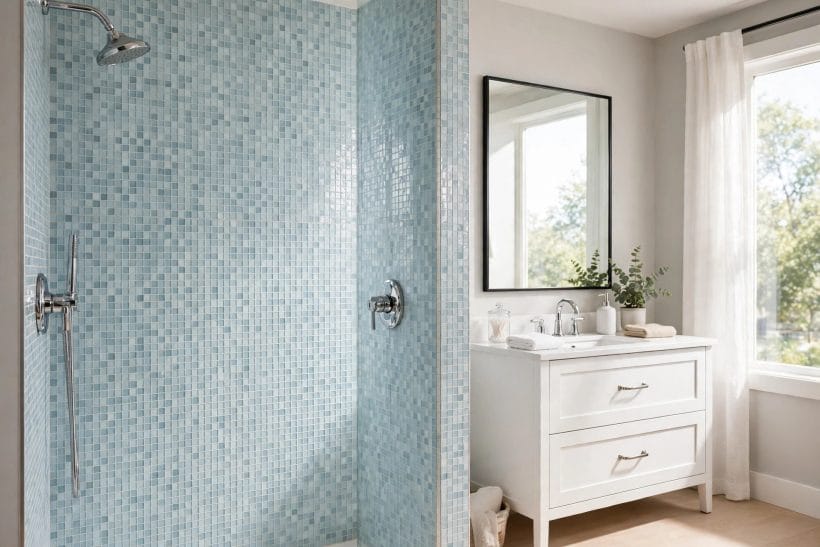
Sea-glass blues, from pale aqua to soft mid-blue, bring a coastal calm that suits bathrooms of every size. The translucent quality of glass keeps blue feeling watery rather than flat, and the palette pairs naturally with white fittings, pale timber, and brushed chrome. Mix two or three neighbouring blues in a mosaic for gentle movement, or keep one even blue for a quieter, more modern wall.
18. Soft greens that feel fresh and restful
Soft greens, from sage to seafoam, feel fresh without feeling cold, and glass gives them a dewy depth that suits morning routines. Green glass pairs well with cream, pale timber, and plants, reinforcing a natural, restful mood, and it flatters skin tones in mirror light better than harsher colours. Keep the green muted rather than vivid for a wall that stays restful year after year.
19. Aqua blends that brighten a windowless room
Aqua blends, mixing pale blue, green, and clear glass, are a reliable way to brighten a room without a window, since the varied tones scatter light in many directions at once. The blend reads as lively rather than chaotic when the tones stay close neighbours, and a pale grout keeps the mixture airy. Aqua suits shower walls, vanity backsplashes, and small accent bands alike, wherever brightness is the priority.
20. Crisp white glass for a clean, bright room
Crisp white glass gives the cleanest, brightest wall of all, reflecting the maximum light and making small rooms feel larger. White glass suits households that love a fresh, hotel-like bathroom, and it provides a calm backdrop for timber, black fittings, or a single bold accessory. Choose a grout tone close to white for a seamless look, or a soft grey for gentle definition that still reads as bright.
21. Smoky greys for a quiet, modern mood
Smoky grey glass brings a quiet, modern mood that pairs beautifully with concrete-look floors, matte black fittings, and pale timber. Grey glass avoids the coldness that plain grey can carry, because the glass depth adds warmth and movement to the tone. Use mid-grey for the main wall and a darker grey for a niche or band, keeping the contrast gentle rather than dramatic.
22. Deep navy glass for evening drama
Deep navy glass turns a shower wall into an evening feature, glowing under warm lights like water at dusk. Navy suits generous rooms and well-lit showers, where the depth can be appreciated rather than feeling enclosing, and it pairs strikingly with brass or brushed gold fittings. Balance navy with pale surroundings, such as a white vanity or light floor, so the drama stays elegant rather than heavy.
23. Jewel tones for a single bold statement
Jewel tones, such as emerald, ruby, or amethyst glass, make a single bold statement best reserved for one wall, niche, or band. The richness of jewel glass rewards restraint elsewhere, so keep fittings simple and neighbouring walls plain, letting the colour carry the room. Jewel glass suits bathrooms that want a touch of luxury without a full redesign, since one confident wall can transform the space.
24. Warm neutrals that age gracefully
Warm neutrals in glass, from sand to soft taupe to pale gold, age gracefully because they sit comfortably with changing towels, accessories, and fittings. Neutral glass still carries light and depth, so the wall never feels flat, and it suits households that redecorate often or prefer a timeless backdrop. Pair warm neutrals with timber and cream for a soft, welcoming bathroom that never dates.
4. Vanities and Counters
Glass tile around the vanity brings shimmer to the most-used wall in the bathroom, framing the mirror and the morning routine. These ideas keep the vanity practical, with splash protection and easy cleaning built into the beauty.
25. Glass mosaic backsplash behind the basin
A glass mosaic backsplash behind the basin protects the wall from splashes while adding colour exactly where the eye rests during daily routines. Small mosaic pieces suit the compact vanity zone, where their scale reads as detailed rather than busy, and a pale grout keeps the area bright. The backsplash also gives a plain vanity a finished feel, tying the basin, mirror, and lighting into one composed wall.
26. Full vanity wall in pale glass
Running pale glass tile across the full vanity wall, from counter to mirror and beyond, creates a luminous backdrop that flatters the whole zone. The continuous wall reflects mirror light back into the room, brightening faces and the wider bathroom alike, and it makes a modest vanity feel considered and complete. Keep the vanity itself simple, with clean lines and quiet hardware, so the wall can shine.
27. Glass tile framing the mirror
Framing a mirror with glass tile turns a plain mirror into a designed feature, with colour and shine bordering the reflection. A narrow mosaic frame suits round or arched mirrors, while a broader frame anchors a large rectangular mirror, and the tile tone can echo the shower wall for a connected scheme. Keep the frame width consistent on all sides so the mirror stays balanced rather than crowded.
28. Floating vanity with a glass tile backdrop
A floating vanity against a glass tile backdrop feels light and modern, since the wall shines beneath and around the suspended unit. The gap below the vanity lets light and floor show through, which helps small rooms feel larger, and the tile backdrop protects the wall while adding colour. This pairing suits wall-hung basins and open shelving below, where the tiled wall remains visible rather than hidden.
29. Double vanity divider in contrasting glass
A vertical strip of contrasting glass tile between two basins gives each side of a double vanity its own identity while keeping the wall unified. The divider can carry a bold colour or a shimmering mosaic, acting as a centrepiece that both basins share, and it helps the wide vanity wall feel composed rather than stretched. Keep the divider slim and the basins symmetrical so the composition stays calm.
30. Glass tile edging a vanity countertop
Edging a vanity countertop with glass tile adds a jewel-like detail to the counter edge, catching light at hand height and tying the counter to the wall behind it. The edge detail suits counters in plain materials, where a slim glass line provides just enough decoration without fuss, and it repeats the wall tile tone for a tailored finish. Discuss edge profiles with the installer, since a neat, sealed edge matters more than the tile choice itself.
31. Open shelving backed by glass mosaic
Open shelving backed by glass mosaic turns stored towels and jars into a display, with colour and shine behind everyday objects. The mosaic backdrop elevates plain shelves into a feature, and it protects the wall from damp towels and splashes at the same time. Keep shelf styling simple and tonal, so the mosaic remains visible rather than buried behind clutter.
32. Powder-room vanity wall in bold glass
A powder room is the perfect place for bold glass, since its small vanity wall can carry a confident colour or pattern that might overwhelm a large family bathroom. A single bold wall behind a compact basin gives guests something memorable, and the small scale keeps the cost and commitment modest. Pair bold glass with a simple mirror and quiet fittings, letting the wall be the welcome.
5. Floors, Borders and Thresholds
Glass tile on floors and borders needs a different eye than glass on walls, favouring small formats, gentle tones, and practical detailing. These ideas keep glass underfoot beautiful without forgetting that floors work hard.
33. Shower floor in small glass mosaic
Small glass mosaic on a shower floor gives the enclosure a jewel-like base, with many grout lines that also help the surface feel secure underfoot. Pale or mid-tone blends suit shower floors, hiding water marks better than very dark or very pale single tones, and the small format follows the gentle falls toward the drain. Floor tiling, falls, and waterproofing belong to experienced professionals, so discuss the whole shower build rather than the tile alone.
34. Glass border strip along a plain wall
A slim glass border strip along an otherwise plain wall adds a line of light and colour without committing to a fully tiled surface. The strip can run at dado height, at mirror height, or as a chair-rail accent, and it ties a plain room to a glass shower or vanity elsewhere. Keep the strip tone drawn from the main tile scheme, so it reads as a thread rather than a stray detail.
35. Glass threshold strip at the shower entry
A glass threshold strip at the shower entry marks the wet boundary with a neat line of colour, finishing the junction between the shower floor and the dry floor. The strip should be level, well sealed, and discussed with the installer as part of the waterproofing detail, since thresholds do practical work as well as decorative work. Choose a tone that matches the shower floor for a seamless step, or the dry floor for a gentle transition.
36. Rug-like glass inlay in the bathroom floor
A rug-like glass inlay, a rectangle or medallion of mosaic set into a plainer floor, gives the bathroom a designed centre without tiling the whole floor in glass. The inlay can sit before the vanity or the freestanding bath, drawing the eye and anchoring the room layout, and it lets a favourite mosaic shine in a modest area. Keep the inlay flush and the surrounding floor quiet, so the pattern reads as intentional.
37. Glass mosaic around the drain
Framing the drain with a contrasting glass mosaic turns a necessary fitting into a small design moment, with colour radiating from the drain point. The detail suits linear and square drains alike, and it draws attention to the craftsmanship of the floor rather than the fitting itself. Keep the surrounding floor tone calm so the drain detail reads as jewellery rather than clutter.
38. Skirting-height glass band around the room
A skirting-height glass band around the bathroom, just above the floor line, protects the lower wall while adding a ribbon of colour that ties the room together. The band suits rooms where a full wall would feel too much, and it repeats the shower or vanity tile tone at floor level for a connected scheme. Finish the band with a neat trim so the lower edge stays crisp against the floor.
39. Glass tile riser on a bathroom step
Where a bathroom has a step up to a bath or a raised shower tray, a glass tile riser turns that step face into a colourful detail. The riser catches light at a low angle, so shimmer and colour show beautifully, and the small area lets a bold mosaic shine without overwhelming the room. Keep the tread itself in a practical, secure material, reserving glass for the vertical riser face.
40. Matching glass borders on wall and floor
Repeating the same glass border on the wall and the floor ties the two planes together, giving the bathroom a tailored, finished feel. The shared border tone can echo the shower mosaic or the vanity backsplash, creating a quiet thread that runs through the room, and it helps separate zones without walls or screens. Keep the border width consistent on both planes so the repetition reads as deliberate.
6. Small Bathrooms and Space-Saving Ideas
Glass tile is a natural ally for small bathrooms, because it returns light instead of absorbing it. These ideas use reflection, continuity, and careful placement to make compact rooms feel larger.
41. One continuous glass wall to stretch a tiny room
Running one glass wall continuously, without breaks or competing features, stretches a tiny room by giving the eye an unbroken plane to follow. Pale glass and a matching grout keep the plane calm, and the reflection doubles the sense of space, especially when the wall faces the door or the mirror. Resist the urge to add a second feature to the same wall, since continuity is the trick.
42. Mirror paired with glass tile for double light
Pairing a large mirror with glass tile doubles the light in a small bathroom, as each surface reflects the other and the room feels twice as bright. Place the mirror on the wall opposite or beside the glass tile, rather than on it, so both surfaces have room to work, and keep the mirror frame slim so the pairing stays airy. This combination is one of the simplest ways to lift a windowless room, and it pairs well with the lighting ideas in a tiny house interior lighting guide.
43. Corner shower wrapped in pale glass
Wrapping a corner shower in pale glass makes the corner feel like a light box rather than a tight enclosure, since the pale tones and reflections open up the angle. The corner position already saves floor space, and glass enhances the saving by keeping the shower visually open, especially with a clear screen rather than a curtain. Keep the corner tile pale and the grout close in tone, so the corner glows rather than closes in.
44. Alcove shower with glass on three sides
An alcove shower with glass on three sides feels like a small grotto of light, with colour and shine surrounding the bather without needing a large footprint. The three-sided treatment suits alcoves carved from a small room, where the tiled enclosure becomes the room feature, and a single tile story across all three walls keeps the alcove calm. Choose a mid-tone blend that flatters skin and hides water marks, rather than a very dark or very pale single tone.
45. Glass-on-glass: tile plus clear screen
Combining glass tile with a clear shower screen, glass on glass, keeps the whole shower transparent and light, so the room reads as one space rather than two. The tile provides the colour and the screen provides the enclosure, and neither blocks the other, which is ideal for small rooms where every sightline matters. Keep the screen hardware minimal and the tile tone pale, so the combination stays airy.
46. Vertical glass panels above a compact vanity
Vertical glass panels above a compact vanity draw the eye upward, making a small vanity zone feel taller and more generous. The panels can flank the mirror or rise behind open shelving, adding colour without consuming counter space, and the vertical direction balances the horizontal vanity below. This idea suits narrow vanities in cloakrooms and small ensuites, where wall space is the resource to use.
47. Light glass behind a wall-hung toilet
Placing light glass tile on the wall behind a wall-hung toilet brightens a corner that is often left plain, and it makes the sanitaryware feel designed rather than merely fitted. The pale glass reflects light into the corner, and the smooth surface wipes clean easily, which matters in a hard-working zone. Keep the tile area generous enough to read as a panel rather than a patch, and let the cistern housing stay plain so the glass leads.
48. Narrow glass splashback in a cloakroom
A narrow glass splashback in a cloakroom, just wide enough for the basin, adds colour and protection to the smallest bathroom of all. The compact scale lets a favourite mosaic or bold colour shine without dominating, and the splashback gives a cloakroom basin a finished, considered feel. Pair the splashback with a small mirror and a single light, keeping everything else quiet so the glass can carry the room.
7. Fixtures, Niches and Fittings
Glass tile meets fittings at every edge, from shower controls to bath surrounds, and thoughtful pairings keep those junctions beautiful. These ideas show how tile and hardware can support each other rather than compete.
49. Shower controls mounted on glass mosaic
Mounting shower controls on glass mosaic puts the hardware against a shimmering backdrop, so even plain controls look considered. The mosaic scale should be small enough that cutouts around the controls stay neat, and the grout tone should match the tile so the fittings sit calmly. Discuss fixing and sealing details with the installer, since penetrations through tile need proper preparation behind the surface.
50. Built-in shower shelf lined with glass
Lining a built-in shower shelf with glass tile gives the shelf a finished interior that matches or contrasts with the shower wall. A contrasting shelf lining, such as a jewel tone against a pale wall, makes the shelf easy to find and pleasant to use, and the smooth glass interior wipes clean. Keep shelf edges neatly trimmed so bottles sit safely and the shelf reads as built-in rather than added on.
51. Glass tile bench inside the shower
A shower bench tiled in glass mosaic becomes a comfortable and beautiful seat, with colour and shine at sitting height. The bench top should be gently sloped for drainage as part of the professional shower build, and the mosaic format suits the bench curves and edges better than large panels. Pair the bench tile with the shower wall tone for a seamless look, or contrast it for a seat that stands out.
52. Freestanding bath against a glass feature wall
Placing a freestanding bath against a glass feature wall creates a bathing focal point, with the bath silhouette framed by colour and light. The wall behind the bath can carry the boldest tile in the room, since the bath itself is simple and sculptural, and the pairing suits both modern and classic baths. Keep the floor calm and the bath fittings minimal, so the wall and the bath share the stage equally.
53. Glass tile behind the bath taps
Tiling the wall behind the bath taps in glass mosaic protects the splash zone while giving the taps a jewel-like backdrop. The small area suits a detailed mosaic or a bold accent, since it is seen up close during every bath, and the glass surface handles splashes gracefully. Coordinate the tap finish with the tile tone, such as chrome with cool blues or brass with warm neutrals, for a composed junction.
54. Toilet wall accent in quiet glass
A quiet glass accent on the toilet wall, in a pale or smoky tone, gives the least-decorated wall in the bathroom a gentle lift without demanding attention. The accent can run full height behind the cistern or as a band at eye level, and it ties the toilet zone to the shower or vanity scheme. Keep the tone muted here, since this wall should support the room rather than star in it.
55. Glass tile lining a bath surround
Lining a bath surround, the apron or the wall around a built-in bath, with glass tile turns the bath into a piece of furniture rather than a plain box. The surround can echo the shower tile for a connected room, or carry a contrasting mosaic for a bath that stands out, and the glass surface handles splashes and steam gracefully. Discuss access panels and sealing with the installer before tiling, so future maintenance stays straightforward.
8. Patterns and Grout Choices
Pattern and grout decide whether glass tile reads as calm or lively, modern or classic. These ideas cover the patterns that suit glass best, and the grout decisions that make or break them.
56. Herringbone glass for gentle movement
Herringbone glass, with its zigzag rhythm, adds gentle movement to a wall without strong colour contrast, since the pattern itself provides the interest. The layout suits shower walls and vanity backsplashes, where the eye lingers, and it pairs well with a single tile tone and a matching grout. Herringbone needs careful setting out, so discuss layout and cutting with an experienced installer before work begins.
57. Basketweave glass for classic charm
Basketweave glass, with its woven over-under rhythm, brings classic charm to bathrooms that want a traditional feel with a luminous material. The pattern reads as detailed and handcrafted, especially in pale or soft tones, and it suits vanity walls, shower niches, and bath surrounds. Keep the grout tone close to the tile so the weave reads as texture rather than a grid.
58. Penny-round glass for playful dots
Penny-round glass, small circles set in a sheet, adds a playful dotted texture that suits family bathrooms and cheerful cloakrooms. The round format softens the wall, breaking up straight lines elsewhere in the room, and it works beautifully in blends of neighbouring tones. Penny rounds also suit curved surfaces and niche interiors, where their small scale follows the shape gracefully.
59. Arabesque glass for an elegant arch
Arabesque glass, with its lantern-like arch shape, brings an elegant, almost Moroccan feel to shower walls and feature panels. The curved shape softens the room and pairs well with arched mirrors and brass fittings, and a single tone in arabesque reads as refined rather than busy. Use arabesque where its curves can breathe, such as a feature wall or a niche, rather than crowding it into a narrow band.
60. Stacked glass in a clean modern grid
Stacked glass, laid in a straight grid rather than a staggered bond, gives a clean modern look that suits minimalist bathrooms. The aligned joints emphasise the tile geometry and the grout lines, so choose both with care, keeping the grout close in tone for calm or contrasting for graphic definition. Stacked layouts reward precise installation, since any uneven joint shows clearly in the grid.
61. Brick-bond glass for timeless order
Brick-bond glass, the staggered running bond, gives a timeless order that suits almost any bathroom, from classic to contemporary. The offset joints break up the wall gently, avoiding the formality of a grid, and the layout works in every glass format from subway to small mosaic. Brick bond is also forgiving of minor variation, which makes it a reliable choice for large walls.
62. Grout colour as a design decision
Grout colour deserves the same attention as tile colour, since it can make glass tile read as seamless, textured, or graphic. Matching grout lets the glass shine uninterrupted, a neighbouring tone adds gentle definition, and a contrasting grout turns the joint pattern into a feature in its own right. Always test grout colours beside the actual tile in your room light, and ask about stain resistance and sealing for the chosen product, since grout care shapes how the wall ages. For more on how the wider room scheme comes together, a tiny bathroom ideas guide shows how small-room choices interact, while a tiny house bathroom designs collection places tile within whole-room layouts.
9. Light, Steam and Everyday Care
Glass tile lives with light, steam, and daily splashes, so the ideas in this section cover how to keep it glowing. None of these need special products or complicated routines, just attention to light, ventilation, and gentle care.
63. Layering mirror light over glass tile
Layering mirror light over glass tile, with sconces or a lit mirror beside the tiled wall, makes the glass glow in the evening as well as by day. Warm light flatters warm glass tones, while cooler light suits blues and greys, so match the light temperature to the tile palette rather than defaulting to the brightest bulb. Dimmer controls help, letting the bathroom shift from bright mornings to calm evenings with the same wall.
64. Glass tile in a steam shower
Glass tile suits steam showers well, since its smooth, non-porous surface handles humidity gracefully and its colour deepens beautifully in steam. The steam enclosure itself, including sealing, ventilation, and any steam unit, belongs to qualified professionals, and the tile choice should be discussed as part of that professional specification. Pale or mid-tone glass keeps a steam shower feeling bright rather than enclosing, which matters in a small sealed space.
65. Daily wipe-down that keeps glass bright
A quick daily wipe-down with a soft cloth keeps glass tile bright, removing water marks before they dry and dull the shine. The habit matters more than any product, since glass rewards frequent gentle care and punishes neglect with visible spotting, especially in hard-water areas. Keep a dedicated soft cloth in the bathroom so the wipe-down becomes part of the routine rather than a chore.
66. Hard-water care for glass walls
Hard water leaves mineral marks on glass that show more clearly than on opaque tile, so a gentle routine matters in hard-water homes. Wiping after showers, ventilating well, and using a mild cleaner recommended for glass tile keeps marks from building up, while harsh abrasives should be avoided since they can dull the finish. If marks persist, ask the tile supplier or installer for a suitable gentle treatment rather than experimenting with strong products.
67. Sealing grout around glass tile
Sealing the grout around glass tile helps the joints resist staining and moisture, keeping the wall looking fresh for longer. The tile itself needs no sealing, but the grout lines benefit from a suitable sealer applied and refreshed as the product directs, especially in the shower zone. Discuss sealing with the installer at handover, so the right product and schedule are recorded for the household.
68. Ventilation that protects the whole room
Good ventilation protects glass tile and the whole bathroom, clearing steam before it condenses and settles on walls and ceilings. An effective fan, used during and after showers, matters more than any tile choice for long-term freshness, and windows help where the room has them. Ventilation planning belongs with the wider bathroom specification, and any fan or ducting work should be handled by qualified professionals.
69. Touching up a damaged glass tile
A damaged glass tile, chipped or cracked, should be replaced rather than painted over, since glass cannot be disguised the way opaque tile sometimes can. Keep spare sheets from the original batch for exactly this purpose, noting the tile name and supplier, and ask an experienced installer to carry out the replacement so surrounding tiles and waterproofing stay intact. Spare stock is the simplest insurance for a tiled room, and it costs little at the time of ordering.
10. Styles and Pairings
Finally, glass tile adapts to almost any bathroom style, from coastal to contemporary, as long as the tile, fittings, and neighbours share a mood. These closing ideas show how one material can serve very different rooms.
70. Coastal bathroom in sea-glass tones
A coastal bathroom in sea-glass tones, with aqua and pale blue glass, white fittings, and pale timber, feels like a breath of seaside air. The glass carries the coastal story without literal decoration, and natural textures such as timber stools and cotton towels complete the mood. Keep the palette watery and light, avoiding deep navy or heavy timber that would drag the coast indoors into gloom.
71. Modern bathroom in pale grey glass
A modern bathroom in pale grey glass, with matte black fittings, a floating vanity, and a frameless screen, reads as calm and architectural. The grey glass provides just enough warmth and movement to keep minimalism from feeling cold, and the restrained palette lets the room proportions and light lead. This style rewards precision, so invest in neat edges, aligned joints, and quiet hardware.
72. Spa retreat in soft green glass
A spa retreat in soft green glass, with cream towels, timber accents, and warm mirror light, turns daily routines into small rituals. The green glass sets a restful tone that suits soaking baths and slow mornings, and the palette pairs naturally with plants and pale timber neighbours. Keep the room uncluttered, with closed storage for everyday items, so the spa calm survives real life. Storage planning pairs naturally with a tiny house interior storage guide, which covers keeping small bathrooms tidy.
73. Vintage-inspired bathroom with basketweave glass
A vintage-inspired bathroom with basketweave glass, a classic basin, and brushed fittings nods to the past without feeling like a museum. The woven glass pattern carries the vintage story, while modern plumbing and lighting keep the room practical, and a soft palette of cream and sage prevents the look from feeling fussy. Let one vintage element lead, such as the pattern or the basin, rather than layering every period detail at once.
74. Bold feature wall as the room star
A bold feature wall in jewel-toned or iridescent glass gives the bathroom a single star, with everything else in supporting roles. The feature wall can sit behind the bath, in the shower, or on the vanity wall, and its success depends on restraint elsewhere: plain floors, simple fittings, and quiet neighbours. Bold glass suits confident households and small rooms alike, since one wall is a modest commitment with a large return.
75. Calm neutral retreat for everyday living
A calm neutral retreat in warm sand and taupe glass suits everyday living best of all, since it welcomes changing towels, seasons, and moods without ever clashing. Neutral glass still glows and shifts with the light, so the room never feels plain, and it provides a timeless backdrop that outlasts trends. For households that want one bathroom to serve everyone gracefully for years, calm neutrals in glass are the safest beautiful choice, and the vanity pairing deserves the same care as the wall, as a bathroom vanity buying guide explains in full.
Final Considerations
Choosing glass tile well comes down to a few steady decisions. Pick one tile story and repeat it with restraint, letting a single wall, niche, or band carry the colour while the rest of the room stays calm. Test samples in your own light, since glass changes more between showroom and bathroom than almost any other material, and choose grout and fittings as carefully as the tile itself. Keep plumbing, waterproofing, and steam or structural work with qualified professionals, and record the tile name, supplier, and spare stock for future repairs. The best glass tile shower ideas are not the loudest ones, but the ones that still look right on an ordinary morning years later, glowing quietly as the light moves across the wall. Whole-room context helps here too: a shower room guide covers the layout that glass tile sits within, and a window in shower guide shows how daylight and privacy shape the same wall.
Start with the finish that suits your light, then the colour that suits your mood, then the pattern that suits your patience for detail, and let the room grow from there. A bathroom tiled in glass rewards that order, returning light, colour, and calm every day, in a room that feels considered rather than merely decorated.


0 Comments