

Nobody budgets for screws. The timber gets weighed, the appliances get weighed, the trailer gets rated — and then a tiny house rolls onto the scales hundreds of pounds heavier than the spreadsheet said. The missing weight was never missing. It was sitting in buckets, boxes and brackets the whole time: the hidden hardware holding the house together.
1. At a Glance: The Hardware Nobody Weighs
Every tiny house on wheels lives inside a hard weight limit, yet the smallest components are the ones most builders never count. Fasteners feel weightless one at a time — a single screw barely registers — but a house is held together by thousands of them, plus the steel connectors, bolts and rods that tie the structure to its trailer. That is why this page pairs the guide with a hardware and fastener weight estimator: the tool below turns the usual shrug into a number before the house ever reaches a scale. This article walks through where the weight sits, how to count each family honestly, and how to give it a proper line in the payload budget.
| Hardware family | How it is counted | Why it adds up |
|---|---|---|
| Bulk screws and nails | By the container: 25 lb buckets for framing, 5 lb boxes for deck and trim work, 1 lb boxes of finish nails, coil-nail boxes of around 30 lb for roofing | Bought in bulk and used in the thousands, so the containers — not the pieces — are the honest unit |
| Hurricane ties and brackets | Per piece: ties at roughly 0.15 lb each, corner brackets at roughly 0.75 lb each | A tie on almost every stud and rafter means a modest unit weight multiplied by a very long count |
| Large bolts and threaded rods | Per piece, including hold-down rods at roughly 3 lb each | Few in number, but each one is a serious piece of steel doing structural work |
| Spares and leftovers | By what you bought, not what you used | Part-used boxes ride along in the tongue box or utility closet as travelling spares |
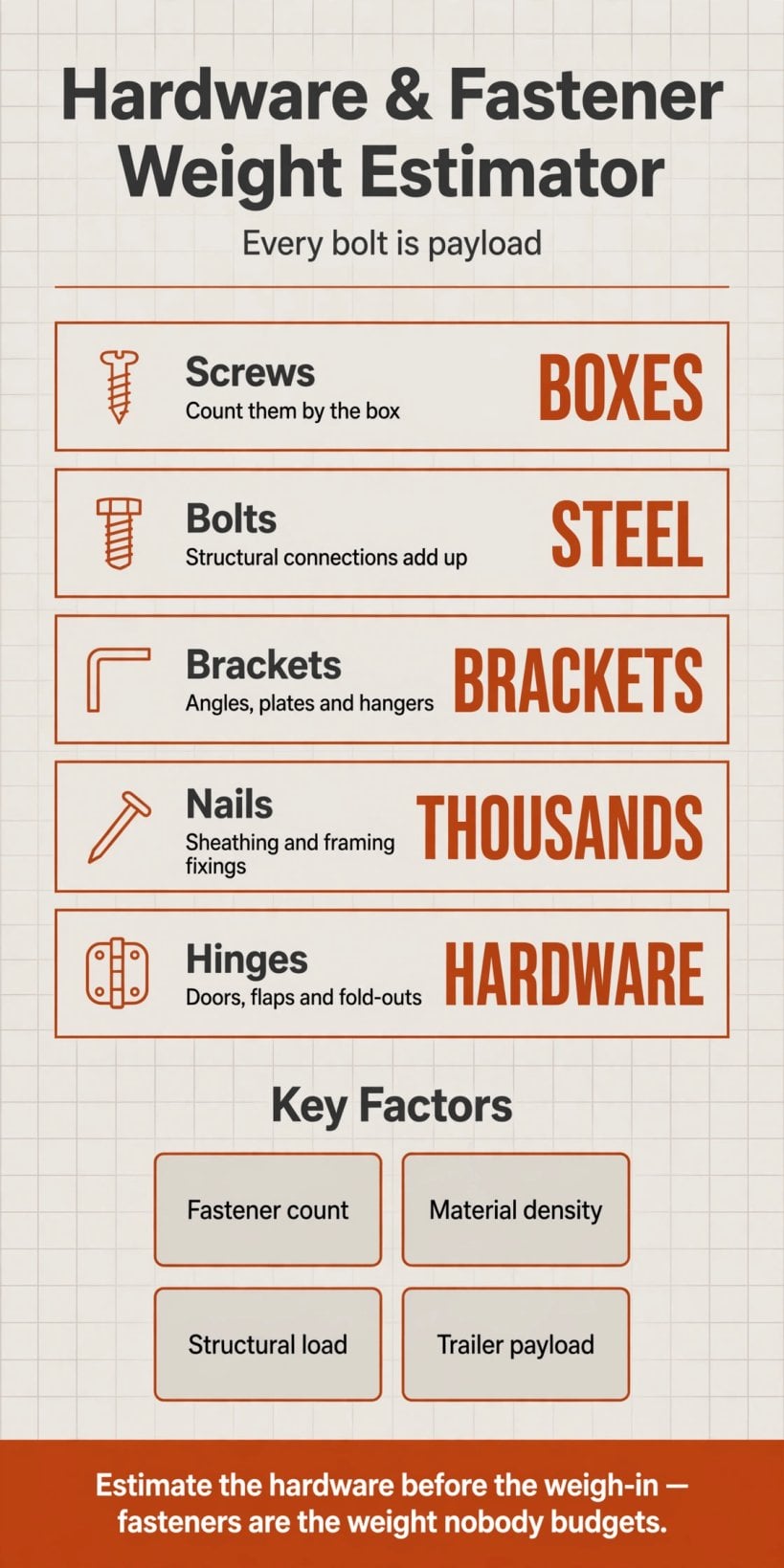
The hardware hiding in plain sight: five fastener families, counted four different ways, all landing on the same payload.
The pattern to notice is that hardware weight is not one problem but four: bulk fasteners are a purchasing question, connectors are a counting question, structural bolts are a short list of heavy pieces, and spares are an honesty question.
2. Why Fastener Weight Matters in a House That Moves
A site-built house can be overweight without anyone ever knowing. A tiny house on wheels cannot. Its trailer has a rated ceiling, and everything the build adds — framing, sheathing, systems, belongings — draws against that same allowance. Our guide to calculating GVWR for tiny homes shows how quickly the allowance is spoken for by the big, obvious items. Hardware is dangerous precisely because it is not obvious: it arrives in dozens of small purchases across months of building, none of which ever feels like a weight decision.
There is a second reason tiny houses carry more hardware than their size suggests. A house that travels at highway speed lives, in structural terms, in a constant storm: the tool below makes the point that securing a tiny house for 60 mph towing is essentially securing it against a permanent hurricane. That means metal ties and connectors at far more junctions than a stationary cabin of the same size would ever need. The fasteners are not decoration; they are what keeps the house attached to itself and to the trailer. Their weight is the price of that security — and it is exactly why balance matters as much as the total, as the axle placement guide for tiny house trailers explains when it works through where a load should sit over the wheels.
3. The Fastener Line-Up: Categories and How They Behave
Fasteners fall into families that behave very differently on the scale. Bulk screws and nails are the volume family. They are bought by weight in the first place — framing screws in 25 lb buckets, deck and trim screws in 5 lb boxes, finish nails in 1 lb boxes, roofing coil nails in boxes of around 30 lb — and a build consumes them by the thousand. Individually trivial, collectively they are one of the largest single lines in the hardware total, simply because there are so many of them in the walls, the floor, the roof and the cladding.
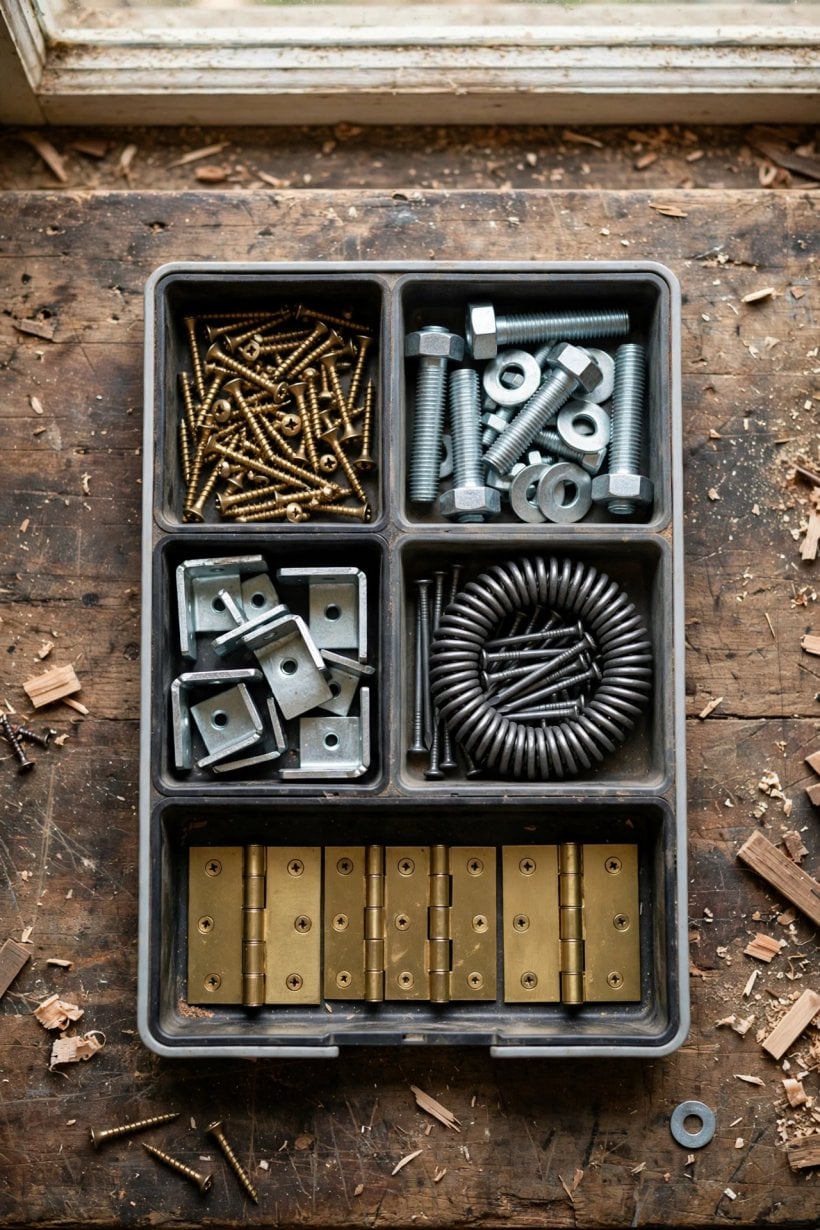
Connectors are the multiplier family. A hurricane tie weighs only about 0.15 lb and a corner bracket about 0.75 lb, which sounds like nothing — until the count starts. Ties go on studs and rafters one after another, brackets land at corners and junctions, and joist hangers, straps and plates join the list. The third family is the heavy few: large bolts — the 1/2-inch by 6-inch bolts that attach the house to its trailer — and threaded hold-down rods at roughly 3 lb apiece. You can count this family on your fingers, but every piece is dense steel doing the most structural work in the building. Finally there is the hinge-and-latch family: door hinges, fold-out hardware, catches and handles — small, scattered, and almost never on anyone’s list.
4. Counting Methods: Boxes, Buckets and Per-Piece Weights
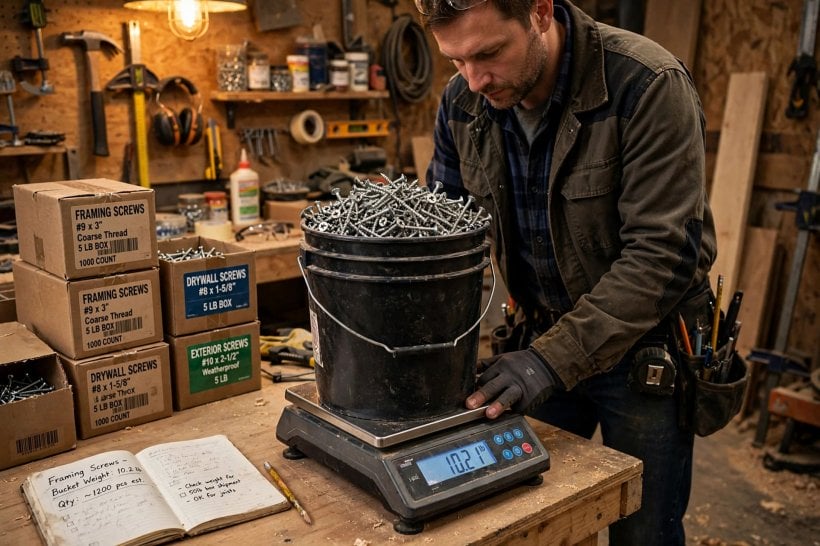
The practical secret is that you never count fasteners one by one. You count the units they are bought and stored in. For bulk fasteners, the container is the unit: so many 25 lb buckets of framing screws, so many 5 lb boxes, so many 1 lb boxes, so many coil-nail boxes. If the purchasing records exist, the estimate is mostly arithmetic. Where the records are patchy, a bathroom or kitchen scale under one representative bucket gives a working figure for the rest — weighing one container honestly beats guessing at ten.
Connectors and heavy hardware are counted the other way: pieces multiplied by a unit weight. The estimator below uses about 0.15 lb for a hurricane tie, about 0.75 lb for a corner bracket and about 3 lb for a threaded hold-down rod, so a plan count — ties read straight off the framing plan — converts directly into pounds. It is the same estimate-by-unit thinking used for the materials around the fasteners: our sheathing weight calculator turns sheet counts into pounds the same way, because on a trailer-rated build every layer deserves the same treatment. The discipline matters more than the precision. A count that is roughly right catches the hundreds of pounds that a count of zero — the default when hardware is ignored — always misses.
5. Structural Connections: Ties, Brackets and Hold-Downs
Structural hardware deserves its own section because it is the weight you cannot design away. To secure a tiny house for 60 mph highway towing — essentially a constant hurricane — you need a metal tie on almost every stud and rafter. A typical 24 ft build uses 100+ ties, and while each tie is light on its own, 100 ties plus the specific nails that fix them can add 30–40 lbs alone. That figure, from the tool’s own notes below, surprises almost every first-time builder: the lightest item in the catalogue becomes a line item purely through repetition.
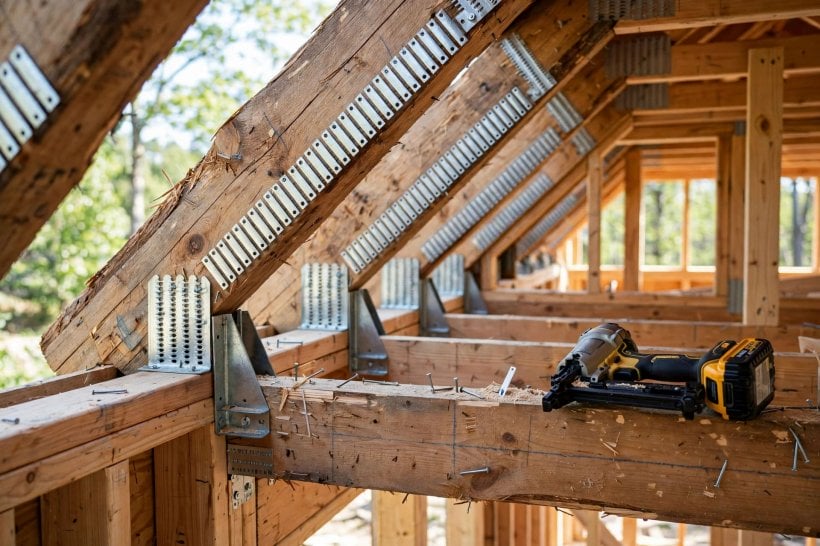
Above the ties sit the heavier connections. Corner brackets reinforce the junctions where walls meet floors and roofs. Large bolts clamp the house frame to the trailer. Threaded rods work as hold-downs, anchoring the structure against the uplift and racking forces of the road. None of this is optional weight that a cleverer design could trim to zero; it is the structural spine of a moving house. The honest choices are about which system carries the load, not whether the load exists — and framing choice plays into it, since the frame material changes both its own weight and the connector strategy, as the steel vs wood framing weight comparison lays out. Budget the connections as structure, because that is what they are.
6. Where the Weight Hides
The most reliably underestimated hardware is the hardware that is not in the walls at all. The tool below calls it the box-versus-usage trap: always calculate based on what you buy, not just what you use. If you buy three 25 lb buckets of screws but have 10 lb left over, that extra weight is often still travelling with you in the utility closet or tongue box as “spares.” A part-used bucket is full weight on the trailer and zero weight in most builders’ estimates, because the spreadsheet counted the house and forgot the luggage.

Spares are not the only hiding place. Hardware hides in the fit-out: hinges on every door and hatch, latches, drawer runners, fold-down table hardware, brackets for shelving, the fixings inside built-in furniture. It hides in the second fix — the trim screws and finish nails that arrive near the end of the build, long after the weight budget was drafted. And it hides in position as much as in quantity: a tongue box full of spare steel sits at the very front of the trailer, where every pound presses directly on the hitch. Where hidden weight sits changes how the house tows, which is why the tiny house weight distribution diagram is worth studying alongside any total: the same pounds, moved a few feet, tow completely differently.
7. Estimating Before the CAT Scale
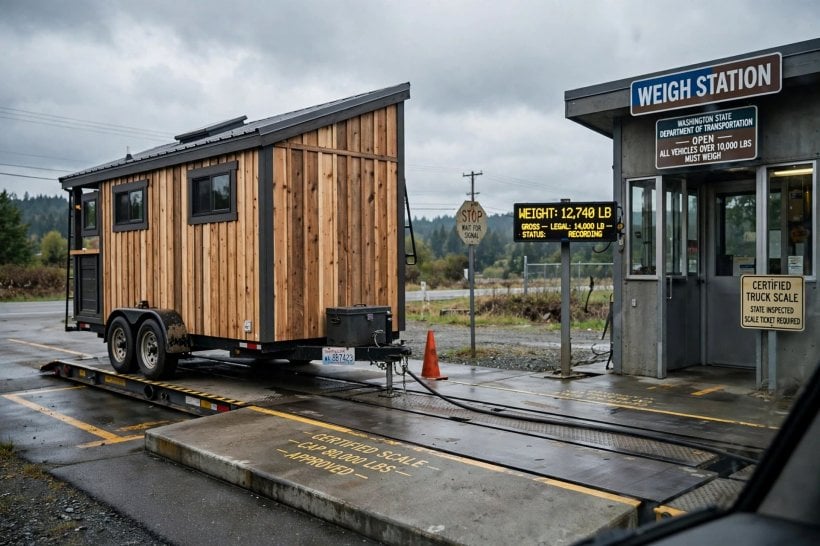
The weighbridge is a terrible place to learn arithmetic. By the time a finished house rolls onto a CAT scale, every pound of hardware is already nailed, screwed or bolted in, and removing weight means removing structure. The estimate has to happen at the planning stage, when the build is still a list: count the studs and rafters on the framing plan and you have the tie count; count the junctions and you have the brackets; read the buckets and boxes off the materials order and you have the bulk total; add the hold-downs and trailer bolts as the short, heavy list they are.
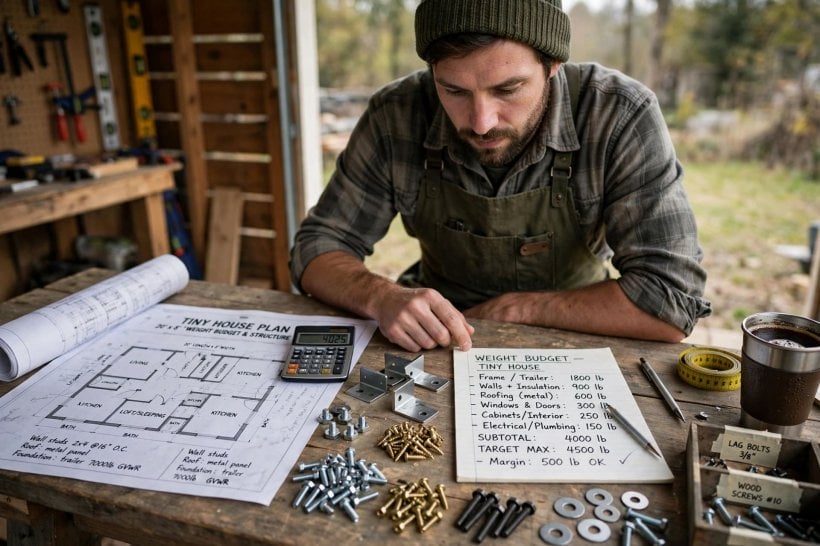
Two habits make a planning-stage estimate trustworthy. First, estimate what will be bought, in the units it is bought in, and then add a deliberate allowance for the part-used containers and spares that will end up travelling — the leftover fraction is a certainty, not a risk. Second, leave margin. An estimate built from unit weights and counts is a good estimate, not an exact one — and builders get caught at the scale when their budget only worked if every estimate was exactly right. Hardware estimated early, with a margin, is a solved problem; hardware discovered at the weigh-in is a rebuild.
8. Hardware in the Payload Budget
A payload budget is simply the trailer’s allowance divided into named claims: structure, cladding and roofing, insulation, systems, appliances, furniture, belongings — and hardware. The failure mode this article exists to prevent is the budget where hardware is not a claim at all, so its hundreds of pounds are silently spent twice: once in the estimate that assumed them away, and once on the scale. Giving hardware its own line, sized by the counting methods above, costs nothing at the planning stage and protects every other line from absorbing the surprise.
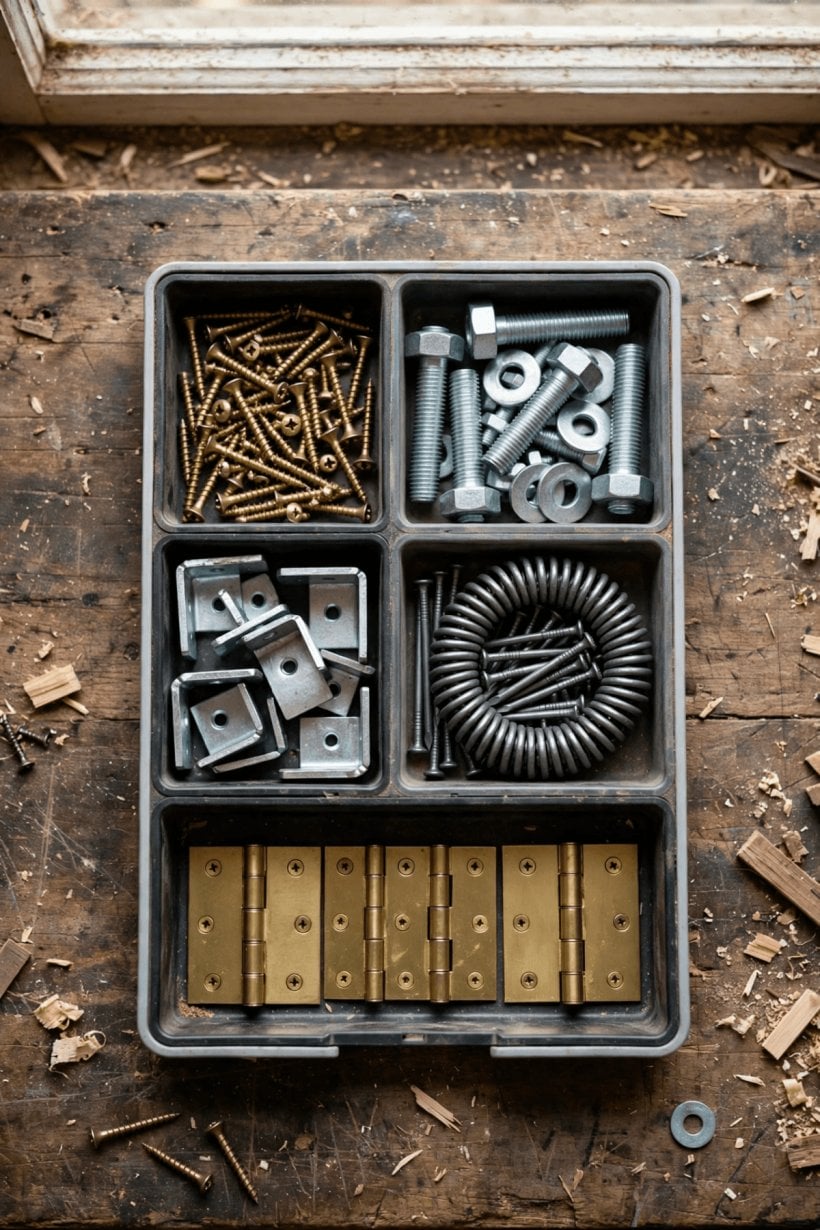
Position belongs in the same conversation. Hardware is unusually mobile weight — buckets and boxes get stored wherever they fit — so decide deliberately where the heavy containers live: low, secured, and placed with the same care as any other dense load. Weight carried at the front of the trailer feeds straight into tongue weight, and the tongue weight tuner shows how sensitive that figure is to what rides in the tongue box and front storage. The budget, in other words, is two numbers — how much hardware, and where it sits — and the estimator below helps with the first so you can think clearly about the second.
9. Using the Estimator: From Counts to a Total
The hardware and fastener weight estimator below this article is built around the same families this guide has walked through, so using it is mostly a matter of feeding it honest counts. The first group covers bulk fasteners: quantities of 25 lb framing buckets, 5 lb deck and trim boxes, 1 lb finish-nail boxes and coil-nail boxes. The second group covers connectors and bolts per piece: hurricane ties, corner brackets, the large bolts that attach the house to the trailer, and threaded hold-down rods.

The output separates the story into the parts worth knowing: a total hardware weight, then sub-totals for bulk fasteners, for connectors and ties, and for heavy bolts and rods — so you can see which family is driving the number and whether the surprise is volume, repetition or the heavy few. The tool also translates the total into a rough equivalence of average adults standing in your house, which sounds like a joke and works like a warning: it converts an abstract poundage into bodies you can picture standing on the trailer. Run it at the planning stage and again when the materials order changes; treat any big jump between runs as a question worth answering before the build answers it for you.
10. Mistakes That Blow the Budget
The classic mistake is counting what was used instead of what was bought — the error the tool below flags directly. Part-used buckets, opened boxes and the spares collection all travel, and an estimate that only counts fasteners physically inside the walls understates the travelling weight by exactly the amount sitting in the tongue box. The second mistake is counting the ties and forgetting their nails: the 30–40 lbs a typical build carries in ties includes the specific nails that fix them, and a count of bare ties alone quietly drops part of the load.
The third mistake is treating connectors as beneath notice because each one is light — confusing a small unit weight with a small total, when repetition is the entire story. The fourth is the mirror image: weighing the obvious bulk buckets carefully while giving the structural bolts and hold-down rods a guess, even though a handful of 3 lb rods outweighs a shelf of finish nails. And the final mistake is timing — doing the estimate once, early, and never again, while months of small purchases, substitutions and spares accumulate off the books. The estimate is a living number, or it is a fiction.
Final Considerations
Hardware weight is the most democratic weight in a tiny house: no single piece matters, and the total matters completely. Counted by the container, multiplied out per piece for the connectors, and given its own honest line in the payload budget — spares included — it stops being the hidden hundreds and becomes just another planned number, like the framing or the roofing. The estimator below this article does that arithmetic in seconds. Run your build through it before the weigh-in, and let the scale confirm a number you already know.
Hardware & Fastener Weight Estimator
Hardware Weight Estimator
Estimate the “Hidden Hundreds” of pounds in screws & brackets.
Fasteners (Screws & Nails)
Connectors & Bolts
~0.15 lbs each
~0.75 lbs each
For attaching house to trailer
~3 lbs each
Total Hardware Weight
The “Hidden 5%” Factor
To secure a tiny house for 60mph highway towing (essentially a constant hurricane), you need a metal tie on almost every stud and rafter. A typical 24ft build uses 100+ ties. While light individually, 100 ties plus their specific nails can add 30-40 lbs alone.
Always calculate based on what you buy, not just what you use. If you buy three 25lb buckets of screws but have 10lbs left over, that extra weight is often still traveling with you in the utility closet or tongue box as “spares.”




0 Comments