

A loft that holds your weight while you stand on it can still be a bad loft. Timber bends long before it breaks, and the real questions are quieter ones: two people rolling over in the night, a heavy box stored at the far end, years of slow sag. This guide works through how loft joists actually carry a tiny house — and how to size them so the floor feels solid, not springy.
1. At a Glance: The Five Things That Decide a Loft
Every sleeping loft in a tiny house is a small bridge, and like any bridge it succeeds or fails on a short list of decisions: how far it spans, how deep its joists are, how closely they are spaced, what species and grade the timber is, and what the loft will honestly be used for. Get those five right and the platform feels like part of the house. Get one wrong and no amount of decking will hide the bounce. That is why running your numbers through a loft joist span calculator before you frame, rather than standing on a board in the yard and guessing, is the cheapest quality check in the whole build.
| Factor | What it decides | What to watch |
|---|---|---|
| Span | The clear distance the joist must bridge between supports | Longer spans bend far more, even under the same load |
| Joist size | Depth is the strongest single lever on stiffness | Shallow joists save headroom but spend it in bounce |
| Spacing | How many joists share the load | Wider spacing asks each joist to carry more |
| Species & grade | How stiff and strong the wood itself is | Knots and slope of grain quietly weaken a board |
| Intended use | How much load the loft must honestly carry | Storage loads a loft very differently from sleepers |
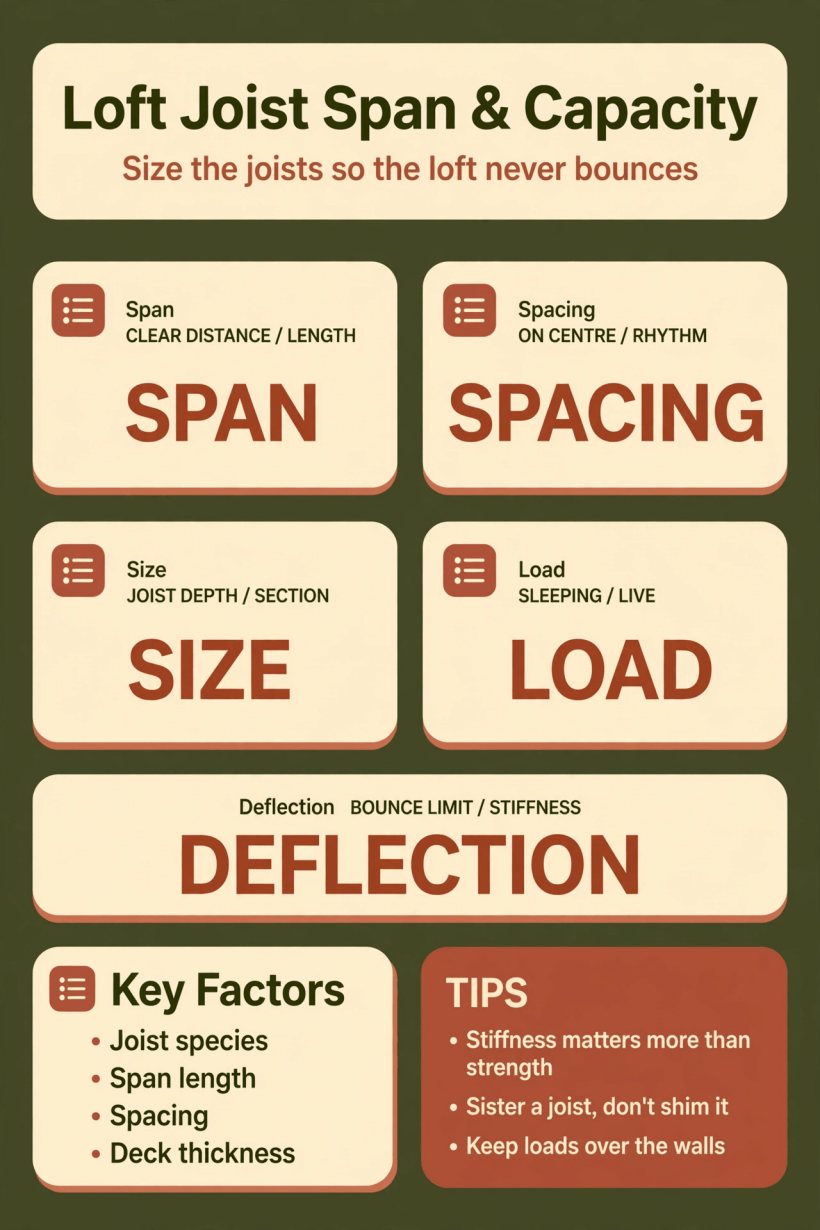
Span, spacing, size, load and deflection — the five decisions behind a loft that never bounces.
2. What a Loft Joist Actually Carries
A loft joist carries two very different kinds of load, and confusing them is where most undersized lofts begin. The first is the load that arrives and moves: people climbing up, sitting down, rolling over in the night. Those are dynamic loads — two people moving on a platform ask far more of the wood than the same two people lying still, because movement multiplies force. The second is the load that arrives and stays: a mattress, the deck itself, stored boxes, a water tank. Static loads seem gentler, but they work on the timber around the clock, and wood under a constant load slowly creeps, bending a little more each season in a way it never quite springs back from.
This is why the classic builder’s test — “it holds me when I stand on it” — proves almost nothing. Standing still, briefly, in the middle of one joist is the kindest load the loft will ever see. It says nothing about dynamic loads on a winter night, nothing about a year of heavy storage, and nothing about how the floor will feel in five years. A loft also has to be honest about the whole house’s weight story: everything the loft holds is weight the trailer and frame carry too, which is why loft planning belongs alongside a tiny house weight distribution diagram rather than in isolation. Design for the loads the loft will actually live with, not the test it can pass once.
3. The Three Levers: Span, Spacing and Depth
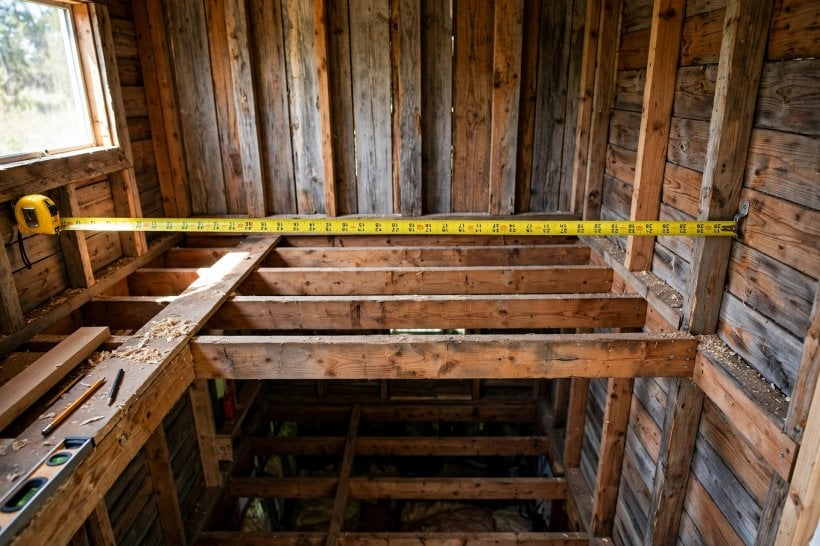
Once the loads are honest, three levers decide whether the joists can carry them: the span, the spacing and the depth of the timber. The span is mostly given to you. Tiny homes are usually 7 to 8.5 feet wide, so a loft joist typically bridges that width from wall to wall — a short span by house standards, which is exactly why modest timber can work here at all. But span is unforgiving arithmetic: stretch the distance and the same joist bends dramatically more. A size that feels fine across a narrow house can turn to sponge across a wider one.
Spacing is the lever you control most cheaply. The calculator offers 12-inch spacing for strength, 16 inches as the standard rhythm, and 24 inches as the wide option — and each step wider asks every remaining joist to carry a bigger share of the same floor. Depth is the most powerful lever of the three. The sizes in the tool run from a 2×4 through a 2×6 and 2×8, up to 4×4 and 4×6 timbers, and the original guide’s verdict is blunt: a 2×4 at an 8-foot span is right at the limit for a sleeping loft, while a 2×6 is the gold standard for stiffness. Builders reach for the 2×4 to save headroom — a real pressure in a loft — but the inches saved overhead are paid for underfoot, every single night.

4. Strength Is Not Stiffness: The Deflection Question
Here is the idea the whole tool is built around: a joist can be strong enough and still be a failure. Strength asks whether the wood will snap. Stiffness asks how much it will bend on the way — and in a loft, bending is what you live with. The measure is deflection, expressed as a ratio such as L/360: for every 360 units of span, the floor is allowed to bend one unit. That sounds tiny, and on paper it is — but exceed it and the floor feels like a trampoline, and the ceiling finish underneath pays the price in cracks.
The original tool makes this vivid with its Bounciness Visualizer, which simulates how much the floor will flex under load, because the gap it exposes is the one that matters: meeting a minimum standard is not the same as feeling solid. A loft can pass a strength check and still bounce enough to slosh a drink, rattle the ladder and make the whole house feel flimsy. When you compare options, compare the deflection verdict first and the capacity verdict second. Sleepers forgive a lot, but they never forgive a floor that moves — and movement, repeated thousands of times, is also what works fixings loose and opens joints.
5. Species and Grade, in Plain Terms
Two boards with identical dimensions can behave quite differently, because wood is a grown material, not a manufactured one. Species matters: some timbers are naturally stiffer and stronger than others, so the same joist size in a stiffer species will span a little more happily than in a softer one. Grade matters just as much. Grading is really a judgment about defects — the size and position of knots, the slope of the grain, checks and wane. A large knot near the middle of a joist’s span, where bending stress is highest, weakens that joist far more than the same knot near a support, where stress is low.
The practical habits follow from that. Sight along every joist before it goes in, put the crown — the slight natural bow — facing up so the load flattens it rather than deepening a sag, and keep the worst defects away from mid-span. Store loft timber flat, dry and off the ground; a joist that has twisted in a wet pile will never sit quietly in a floor. If you are weighing timber framing against alternatives for the structure as a whole, the steel vs wood framing weight comparison and the frame material analyzer cover the wider trade-offs. For the loft itself, the rule is simple: buy the best grade you can for the longest spans, and never ask a poor board to do the hardest job in the floor.
6. Bearing and Hangers: Where the Load Lands
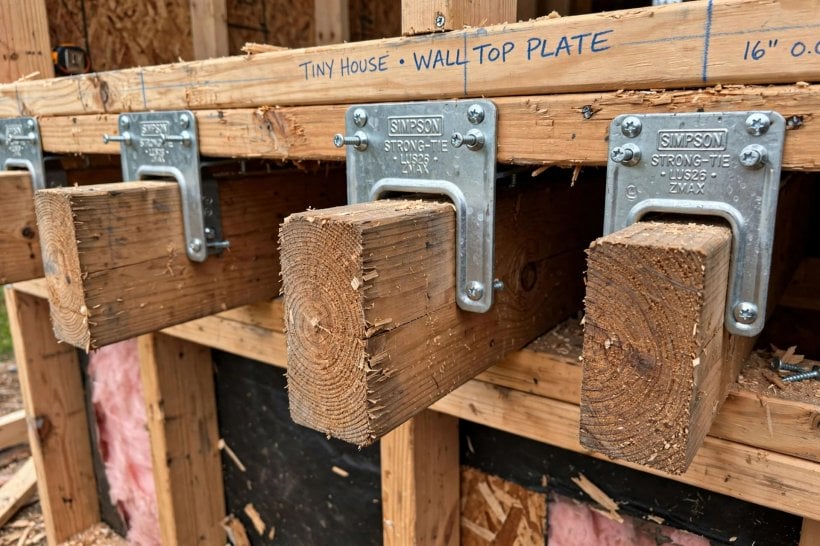
Everything a joist carries is eventually delivered to its two ends, so the ends deserve as much care as the span. A joist end needs honest bearing — sitting fully on the wall’s top plate or in a properly sized metal hanger — not balanced on a corner or toenailed into hope. Hangers only work when they match the joist size and every nail hole is filled with the right fasteners; a hanger with half its holes empty is half a hanger. Where joists bear on a plate, the load then has to continue down through the wall framing, so studs below should line up with joists above rather than leaving the plate to bridge gaps alone.
Two quiet details separate a loft that stays tight from one that works loose. The first is restraint: joists want to roll or twist under load, and blocking or a rim board at the ends keeps them upright and working as a team. The second is the stair opening, which usually interrupts the very ends where bearing matters — plan it so trimmed joists still land on real support, never on the header alone without the header itself being properly carried. Get the landings right and the span between them can do its job undisturbed for decades.
7. The Deck Is Part of the Structure
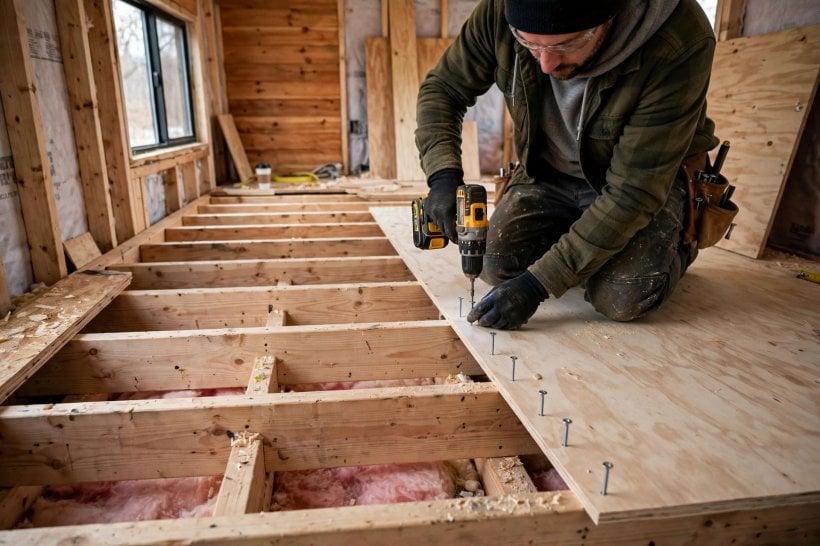
It is tempting to think of the loft deck — the plywood or boards you sleep on — as a floor finish. Structurally, it is much more than that. Screwed down firmly to every joist it crosses, the deck acts as a diaphragm: a stiff skin that ties all the joists together so they behave as one floor instead of a row of independent boards. Stand on one joist of a well-decked loft and the deck spreads your weight sideways onto its neighbours, which is why a finished loft almost always feels stiffer than the bare frame suggested.
That teamwork only happens if the fixings do their job: screws at sensible spacing along every joist, edges supported rather than floating between joists, and sheets staggered so joints do not line up into a hinge. Glue as well as screws and the composite action gets stronger still — the same principle explored in the trailer frame rigidity and subfloor visualizer, where the subfloor’s connection transforms how a whole chassis feels. The deck has a weight cost, of course, and the sheathing weight calculator will tell you what your chosen sheet adds to the build. Treat the deck as structure, not decoration, and it quietly repays you every night.
8. Openings and Stair Cut-Outs
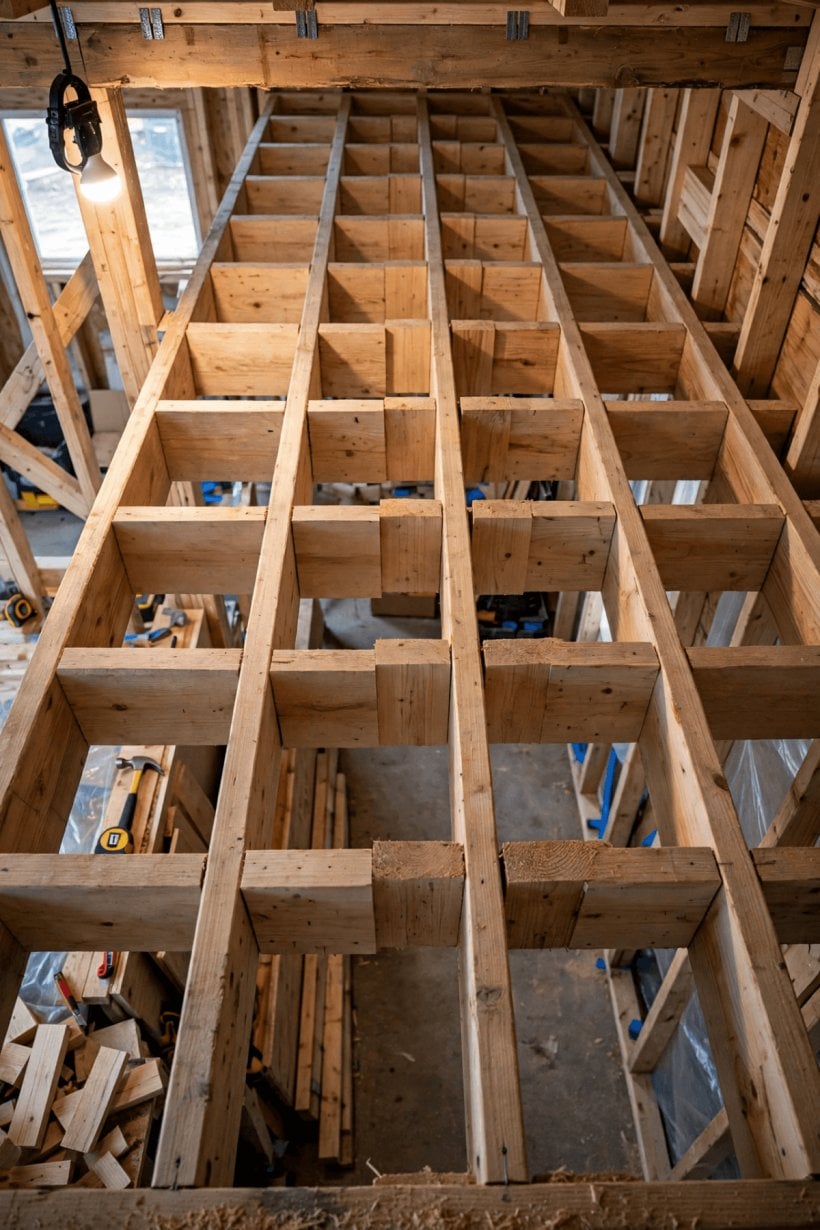
Almost every loft has a hole in it: the opening you climb through. That opening is a structural event, not just a carpentry detail, because it interrupts the rhythm of the joists. The joists that would have crossed it stop short, and their load must be handed sideways — through a header into the doubled trimmer joists along each side of the hole. Those trimmers therefore carry more than their neighbours, and they should be sized and supported with that extra duty in mind rather than copied from the standard joists around them.
The mistakes here are predictable. Cutting a joist after the floor is framed, without installing the header and trimmers that reroute its load, leaves a quiet weakness exactly where people step up and down — the highest-traffic, highest-load point of the whole loft. Notching or drilling a joist carelessly for a cable or pipe does similar damage, worst at mid-span where the wood is working hardest. And making the opening bigger later, for a wider stair or a storage hatch, is never just a matter of moving one joist. Decide the opening’s size and position at the same time as the joist layout, double what needs doubling, and the hole in the floor stops being the weak point in it.
9. Storage Lofts Are Not Sleeping Lofts
The single most dangerous moment in a loft’s life is the day its job changes. A platform designed for sleepers that slowly fills with stored weight is a structure being re-roled without being re-checked — and the original tool’s three use settings show how wide the gap is. A sleeping loft is figured at a 30 psf live load, light storage at just 20 psf for empty suitcases and boxes, but heavy storage and utility use at 50 psf — the world of tanks, batteries and books. Books in particular are a trap: a row of paperbacks looks harmless and weighs like masonry.
So decide the loft’s real job before you size a single joist, and if there is any chance it will store heavy things, design for the heavy setting from the start. Where heavy storage is unavoidable, keep it over the walls and near the supports rather than at mid-span, where every pound does the most bending damage — the same load-placement logic that governs axle placement down at the trailer. A loft honestly designed for sleeping, and honestly used for sleeping, will feel solid for decades. A loft designed for sleeping and used as a warehouse will tell you about it — in bounce first, and in sag later.
10. Using the Calculator — and the Mistakes That Undo It
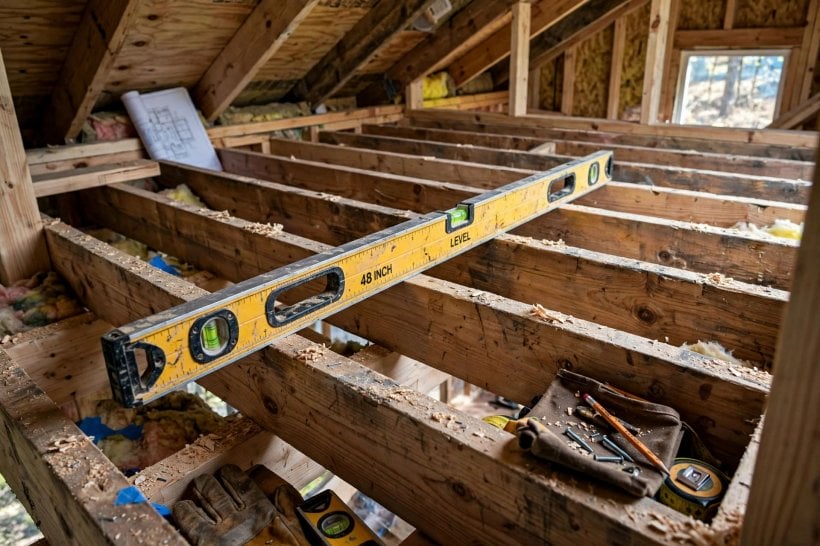
A loft joist span calculator is only as honest as the numbers you feed it, so use it in the right order. Measure the real clear span from inside face to inside face of the walls, not the nominal width of the house. Enter the lumber size you can actually buy and the spacing you will actually frame — not the tighter spacing you might get around to. Then set the intended use truthfully: sleeping, light storage or heavy storage, remembering that the honest answer today prevents the dangerous answer in five years. Read both verdicts the tool gives — the maximum allowed span against yours, and the safety and bounce status — and if either one complains, change a lever rather than arguing with it: deepen the joist, tighten the spacing, or split the span with a beam.
The recurring mistakes are all versions of optimism. Trusting the stand-on-it test. Copying a neighbour’s joist size without copying their span, spacing and use. Choosing the shallow joist for headroom and then storing heavy things on it anyway. Treating the deck as an afterthought. Cutting the stair opening wherever it fits and doubling nothing. Every one of them is avoidable at the planning stage and expensive afterwards: a loft’s structure disappears under its deck the day it is finished. Spend the scepticism early, while the floor is still a drawing and the fix is still a different number in a calculator.
Final Considerations
A good loft is unremarkable in the best way: you climb up, you lie down, and the floor simply feels like the house. Getting there is not about exotic materials or heroic timber — it is about honest loads, the right depth at the right spacing, ends that land properly, and a deck screwed down like it matters. Run your own span, your own lumber and your own intended use through the tool below, and let its verdict — not optimism — make the final call.
Loft Span Calculator
This tool addresses a critical safety area. Many DIY builders assume a 2×4 is strong enough for an 8-foot span because “it holds me when I stand on it,” not realizing that dynamic loads (two people moving) or long-term static loads (heavy storage) cause dangerous deflection or failure over time.
It includes a “Bounciness Visualizer” that simulates how much the floor will flex under load, helping users understand why “Meeting Code” isn’t the same as “Feeling Solid.”
Loft Span Calculator
Is your sleeping loft safe or bouncy? Check your spans.
Tiny homes are usually 7′ to 8.5′ wide.
Understanding Loft Loads
Code doesn’t just care if the wood snaps; it cares if it bends. L/360 means for every 360 units of length, it can bend 1 unit. If you exceed this, your floor will feel like a trampoline, and the drywall ceiling underneath will crack.
Many tiny house builders try to use 2x4s to save headroom. Be careful. A 2×4 at 8ft span is right at the limit for a sleeping loft. For storage lofts holding books or water tanks, a 2×4 is often unsafe. 2×6 is the gold standard for stiffness.




1 Comment